

Can Data Centers reduce environmental impact? Digital infrastructure now shapes daily life, public budgets, and regional power systems. Yet its physical footprint often remains hidden behind a polished cloud interface. The central question is simple: can technology expand without weakening community power?
On November 12, Dr. Ben Green presented local and electric-grid findings to the DEP Citizens Advisory Council and Environmental Justice Advisory Board. His work shows how AI facilities can affect water, energy costs, neighborhood health, and municipal planning.
OpenAI’s proposed 2.2-million-square-foot project near Saline, Michigan, reveals the remarkable scale behind online services. Meanwhile, a California study reviewed Santa Clara, Los Angeles, Sacramento, Gilroy, and Imperial County; it raised concerns about transparency and water access.
This article examines greenwashing, cultural exploitation, geopolitical conflict, and corporate greed. It also explores cooperative ownership, biomimicry, net-zero practices, renewable technology, accountable policy, and expanded urban open space. Progress need not copy the logic of extraction; communities can help design what comes next.
Data Centers Green Builings Smart Cities Environmental Justice Coop Development
Artificial intelligence is turning computing demand into a major building surge across the United States. Generative tools for images, summaries, and language need far more processing power than basic machine-learning tasks. That pressure is speeding up data center development and reshaping utility plans.

Why the AI Boom Is Accelerating Data Center Development
The U.S. Department of Energy estimates that facilities could use 12% of national electricity by 2028. Other forecasts reach 17% by 2030. For Data Centers, A 2023 market review also projected that power use could double from its 2022 level by 2030. These figures make unchecked growth a costly gamble.
How Connected Municipalities Can Align Digital Growth With Equity
Smart cities need one shared plan for power, housing, schools, transport, and public services. Environmental justice requires honest reporting and protection for neighborhoods with less political influence. Cooperative enterprises, public agencies, and local firms can guide data center development toward jobs, clean power, and community ownership of data centers.
“Digital growth must serve the public, not merely the server rack.”
The goal is not to stop innovation; it is to make its benefits broadly shared.
What Makes a Modern Data Center Hyperscale and Resource Intensive

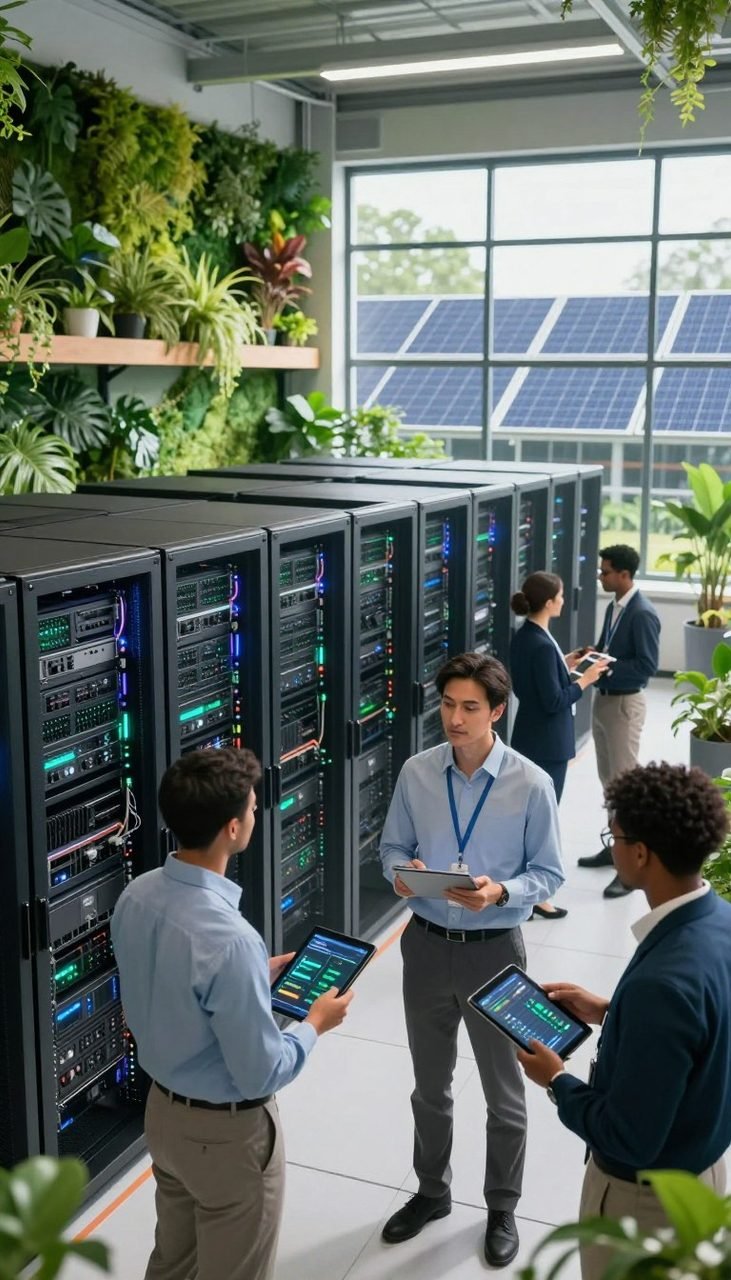
A modern data center is less like an office and more like an industrial machine. Its scale depends on servers, storage, power systems, and cooling equipment working without pause. Size alone does not tell the full story; computing density matters just as much.
Hyperscale usually describes a facility larger than 10,000 square feet. OpenAI’s proposed project near Saline, Michigan, offers a striking comparison at 2.2 million square feet. Inside, processors, hard drives, CPUs, GPUs, switches, fiber networks, backup batteries, and cooling systems form one tightly linked operation.
Servers, GPUs, Networking Equipment, and Facility Infrastructure
Artificial intelligence raises rack density because GPUs handle demanding workloads at high speed. That design requires stronger electrical systems and faster heat removal. A building may look quiet from the road, yet its equipment runs with industrial intensity.
Rising Electricity Demand From Artificial Intelligence
One 100-word email created by ChatGPT uses roughly the electricity of an LED bulb running for 14 hours. That comparison makes a single request relatable, but millions of requests create a far larger burden. Each data center therefore belongs in a regional grid review, not in an isolated planning file.
The Environmental Impact of Data Center Energy, Water, and Land Use
Every new computing campus places pressure on power lines, local water supplies, and open land. Its benefits may reach far beyond the host town, while its costs remain close to nearby homes.
Electricity Consumption and Grid Capacity
High-power facilities can require new transmission lines, backup turbines, and fossil-fuel generation. In North Omaha, a coal plant stayed open beyond its planned 2023 closure because of rising demand. The decision extended pollution exposure in a predominantly Black neighborhood. In Memphis, xAI operated dozens of unpermitted methane turbines that released formaldehyde and smog-forming pollution.
Water Use for Cooling in Stressed Regions
Cooling systems also consume a major resource. Google reports roughly 6 billion gallons of water use worldwide each year. Gilroy, California, depends on a closed groundwater basin with little replenishment and no backup source. Imperial County relies fully on imported Colorado River water while mandatory cutbacks continue.
Construction Waste, Air Pollution, and Embodied Carbon
Land clearing removes habitat and increases runoff. Concrete, steel, wiring, and discarded equipment add embodied carbon and construction waste. Strong permits should track air emissions, material use, and water use from site preparation through operation; otherwise, “progress” becomes an expensive local experiment.
Greenwashing and the Transparency Gap in Data Center Sustainability

Sustainability claims can shine brightly while the facts remain in the shadows. A polished net-zero promise means little when residents cannot review current information about power use, water demand, emissions, or backup equipment. Credible performance requires facility-level proof, not corporate language alone.
Why Public Information About Energy and Water Use Is Often Limited
A May 2026 report from The Next 10 and Santa Clara University found that about 93% of Los Angeles County facilities had no publicly accessible environmental documents. This gap blocks meaningful review of local risks. Dr. Irina Raicu called the mix of limited information and California’s fragile water supplies a serious planning problem.
Distinguishing Net Zero Claims From Measurable Performance
Operators should publish electricity, water, emissions, generator use, and construction impacts in comparable formats. Independent audits should test each claim. Residents also need timely information before permits are approved, not after contracts are signed.
Net zero becomes credible only when communities can inspect results, question assumptions, and track progress. Otherwise, sustainability may become a label that carries more polish than proof.
Environmental Justice and the Unequal Burden of Data Center Siting
A server site may look efficient on paper, yet its costs can land unevenly across nearby neighborhoods. Location matters as much as technology. Water stress, social vulnerability, and weak air quality protections can turn a local project into a public health concern.
Social Vulnerability, Water Scarcity, and Local Air Quality
A California report examined Santa Clara, Los Angeles, Sacramento, Gilroy, and Imperial County. Imperial County and Sacramento showed the clearest overlap between scarce water and vulnerable residents. In such places, new facilities may compete with farms, homes, and essential services.
North Omaha offers another warning. A coal plant serving a predominantly Black neighborhood remained open as computing demand grew, despite some of the nation’s highest asthma rates. In Memphis, xAI’s unpermitted turbines released formaldehyde and smog-forming pollution linked to asthma, heart disease, and cancer risks.
Who Bears the Health Risk?
Black, Latino, Indigenous, and low-income residents should have equal power in siting decisions. Efficiency cannot excuse unequal exposure.
“A fair site protects health before it promises growth.”
| Place | Primary concern | Equity lesson |
|---|---|---|
| Imperial County | Water scarcity | Protect basic supply |
| North Omaha | Coal pollution | Prioritize asthma prevention |
| Memphis | Turbine emissions | Enforce air permits |
Misrepresentation of Marginalized Communities in Development Decisions

Public input loses value when officials invite residents only after key choices have been made. A packed meeting can create the appearance of consent while leaving affected families without technical support or real influence. Ethical participation must continue from early review through final approval.
Token Consultation Versus Meaningful Community Consent
Meaningful consent gives residents access to engineers, legal advisers, and clear project records. It also allows them to question water studies, grid forecasts, air permits, and tax agreements. Iris Stewart-Frey’s Climate Justice Lab at Santa Clara University links climate risk with community voice, offering a useful model for fair review.
Irina Raicu, who directs the university’s Internet Ethics Program, applies rights, justice, care, common-good, and virtue-ethics principles. These lenses help communities weigh competing public interests without treating residents as obstacles.
Building Local Capacity to Review Server Proposals
Local review teams can train residents to examine technical filings and explain them to neighbors. Community mobilizers, nonprofits, NGOs, and “grasstops” leaders can support this work. The people most affected should define their own priorities.
| Weak process | Stronger practice | Community benefit |
|---|---|---|
| One public meeting | Ongoing consent process | Trust and influence |
| Complex filings | Local technical training | Informed review |
| Outside priorities | Resident-led goals | Ethical representation |
Exploitation of Under-Represented Cultures, Heritage, and Community Knowledge
Land carries memory, identity, and practical knowledge. A server project can harm all three when planners treat a cultural landscape as empty space. Indigenous rights and local heritage must shape decisions before land is acquired, graded, or linked to new infrastructure.
Protecting Indigenous Rights and Cultural Landscapes
Tribal nations and local residents may understand groundwater, seasonal change, wildlife routes, and heritage sites better than a short survey can show. Their knowledge can improve site review, but only when contributors keep control over its use. Broad stakeholder participation, early consent, and paid cultural advisers create a stronger process.
Using Cultural Assets Through Reciprocity Rather Than Extraction
The California research supports care ethics and the common good. These approaches value relationships, shared resources, and long-term trust over quick approval. Developers can offer reciprocity through local ownership, consent-based research, heritage protection, and lasting community investment.
Cultural symbols should not become decorative branding for benefits that flow elsewhere.
| Risk | Protective practice | Community result |
|---|---|---|
| Heritage loss | Early cultural review | Sites remain protected |
| Knowledge extraction | Consent and payment | Local agency grows |
| Unequal benefits | Shared ownership | Value stays local |
Geopolitical Conflicts, Supply Chains, and the Race for Digital Infrastructure

Behind every server campus lies a global contest for chips, minerals, equipment, and electricity. International rivalry can turn local land into a strategic asset, while residents face decisions shaped by forces far beyond their county.
Virginia leads the U.S. market, followed by Texas and California. Reliable grids, fiber networks, land, and tax incentives draw major operators to these regions. As generative AI becomes a central business priority, hyperscalers are raising capital spending sharply. Municipalities may compete so hard for investment that their negotiating power weakens.
Critical Minerals, Equipment Manufacturing, and Energy Security
Chips, transformers, batteries, and rare minerals move through complex supply chains. Conflict, export limits, or labor abuses can delay projects and raise costs. Responsible procurement should test labor rights, human rights, mining practices, and supplier emissions—not just delivery times.
How Global Competition Shapes Local Expansion
Energy security adds another challenge. Some regions retain fossil-fuel plants when renewable capacity, transmission, or storage cannot grow quickly enough. Strong permits should link new campuses to cleaner power, firm deadlines, and public reporting.
| Global pressure | Local effect | Responsible response |
|---|---|---|
| Mineral shortages | Higher equipment costs | Traceable sourcing |
| Rising AI investment | Faster land competition | Firm public terms |
| Grid constraints | Fossil plants remain online | Clean capacity targets |
Slow Yet Reluctant Municipal Development and Infrastructure Planning
Local governments often face an awkward bargain: welcome investment quickly or pause to measure its lasting cost. A major server center can bring jobs and tax revenue, yet it may also strain water systems, roads, schools, housing, and public budgets. Careful planning protects residents before construction begins.
Planning Gaps, Confidential Agreements, and Public Accountability
Planning assumptions can change faster than a permit review. In Georgia, projected extra power needs for 2030 rose from about 2 gigawatts to 6 gigawatts as computing demand grew. California researchers mapped operating and proposed facilities across the state, giving officials a clearer view of cumulative pressure.
Private agreements can hide utility promises, public costs, land impacts, and emergency needs. Confidentiality should not become a substitute for accountability. Residents need hearings, accessible records, and enforceable deadlines.
Coordinating Utilities, Schools, Housing, Water, and Transportation
Agencies should review each project together. Gilroy’s closed groundwater basin has limited replenishment and no backup source, making water review urgent. Municipalities should require cumulative-impact studies and coordinate utilities, schools, housing, roads, and transit before approving major center development.
Corporate Greed, Tax Incentives, and the Unequal Economics of Data Centers

Public subsidies can make private expansion look like a public victory. Yet discounted power, generous tax incentives, and weak oversight may leave residents carrying hidden costs. Economic development is fair only when public returns match public support.
Utility Rate Increases and Costs Passed to Residents
Large server facilities often negotiate special utility terms. If a utility builds lines or plants for one customer, households, schools, and small firms may help pay the bill. Bloomberg reported that electricity prices more than doubled in over five years in some areas near these sites. Regulators should require clear cost-sharing rules and rate protection.
Questioning Job Creation and Lost Public Revenue
Construction can create many short-term jobs, but operations usually need far fewer permanent workers. Good Jobs First found that Texas raised its estimated tax breaks from $130 million to $1 billion in two years. Such incentives can drain funds from schools, transit, and public health unless officials measure lasting value.
Designing Community Benefit Agreements With Enforceable Terms
A strong agreement should require local hiring, procurement, tax recapture, air and water monitoring, rate safeguards, and penalties for missed promises. Economic development should build local wealth, not simply reduce corporate costs.
How Cooperative Enterprises Can Create Shared Ownership and Local Value

Ownership can shape whether a large computing project strengthens a region or simply extracts its resources. Member-led models offer a practical way to keep earnings, skills, and decision-making closer to residents. This way, local value becomes part of the plan rather than a late promise.
Energy Cooperatives and Community-Owned Renewable Power
Energy cooperatives can finance solar panels, wind turbines, battery storage, and efficiency upgrades. These assets can serve a facility and nearby households at the same time. Another way to reduce grid pressure is to pair renewable power with demand planning and shared storage.
Worker, Consumer, and Community Investment Models
Workers, consumers, and residents can purchase a financial share in local infrastructure. They can also elect board members and review spending. A second share can support schools, job training, cultural preservation, water resilience, or lower energy bills.
Virtualization offers a related lesson: shared computing resources improve equipment use and limit duplicate hardware. That approach creates a better way to manage capacity. It also shows the way cooperation can support reliable services without endless expansion.
Shared ownership turns public support into public participation.
Cooperation is a governance structure, not decorative branding.
What Policymakers Can Require for Equitable Data Center Growth

Public rules can turn rapid computing expansion into a fairer bargain. The U.S. Department of Energy projects that server facilities could consume 12% of national electricity by 2028. Utilities need clear goals before approving new loads, rather than treating each proposal as an isolated deal.
Standardized Reporting for Energy, Water, and Air Quality
Reporting should cover electricity, water, PUE, CUE, greenhouse gases, backup generators, air emissions, and local effects. The Green Grid metrics help utilities compare energy and carbon performance. Public records also let residents test corporate claims.
Permits, Renewable Rules, and Responsible Incentives
The 2023 German Energy Efficiency Act offers a useful model for binding goals. Utilities can use similar standards when reviewing projects. Permits should assess cumulative effects on water, grid capacity, traffic, housing, and air quality.
Memphis shows why regulators must reject unpermitted methane turbines and monitor formaldehyde and smog-forming emissions. Tax incentives should require renewable additions, local hiring, public revenue, ratepayer protection, and verified results. Utilities must meet renewable goals, while permit terms should include emissions controls and penalties.
“Public support should purchase public accountability, not private silence.”
How NGOs, MSMEs, Nonprofits, and Community Mobilizers Can Collaborate

Local partnerships can turn complex infrastructure debates into practical public action. NGOs, nonprofits, and grassroots support groups may work together, or act independently when urgent needs arise. Their shared goal is clear: help residents understand proposals for data centers before officials approve them.
Grassroots Monitoring, Legal Support, and Public Education
Community groups can translate technical filings, host public meetings, and provide legal services. They can also track water use, air quality, permits, and utility costs through accessible monitoring programs. The California report, co-authored by Santa Clara University students and researchers, urges communities to build local research capacity when information is missing.
Local Procurement, Workforce Training, and Small Business Participation
MSMEs can supply construction services, catering, landscaping, cybersecurity, transport, equipment repair, and renewable-energy services. Construction work also creates openings for electricians, HVAC workers, and other skilled trades.
- Community mobilizers organize residents.
- Tastemakers build public attention.
- Grasstops leaders open institutional doors.
- Workforce programs connect residents with lasting technical careers.
Strong collaboration makes public oversight a shared civic skill, not a specialist privilege.
Responsible Data Center Construction and Operations for Sustainable Communities

Responsible construction begins before the first server enters the building. A compact footprint, low-emission materials, and recycled construction inputs can reduce embodied carbon and limit land disturbance. Designers should also plan for repair, reuse, and safe recycling when equipment reaches the end of its service life.
Operations matter just as much. Virtualization lets several virtual servers run on one physical machine, which cuts idle hardware and energy use. Workload scheduling can shift flexible tasks to periods with cleaner power or lower demand. A DCIM platform can track power, lighting, assets, and cooling in real time.
Efficient Cooling, Waste Heat Recovery, and Water Stewardship
Liquid cooling can support dense AI workloads, but it needs skilled maintenance. Hot-aisle and cold-aisle containment also reduces wasted cooling. Combined heat and power may reuse waste heat for electricity or nearby heating. Water-efficient systems and closed-loop designs further protect local supplies.
PUE divides total facility energy by IT equipment energy. CUE compares carbon emissions with IT energy use. Together, these measures reveal whether efficiency claims match performance.
| Practice | Primary benefit | Key safeguard |
|---|---|---|
| Virtualization | Fewer idle servers | Monitor workload demand |
| Liquid cooling | Better heat control | Maintain specialized systems |
| Heat recovery | Useful local energy | Connect to nearby users |
Biomimicry, Net Zero Practices, and Renewable Technology in Data Centers

Nature offers useful lessons for climate-conscious computing. A facility can study termite mounds, human circulation, and natural ventilation to move heat with less mechanical effort. Adaptive controls can adjust airflow as temperatures and workloads change. This climate-aware approach treats efficiency as a design principle, not a marketing line.
Designing Cooling and Energy Systems Inspired by Nature
Direct-to-chip and liquid cooling support dense processors, though both require specialized infrastructure. Designers can pair these tools with heat recovery and passive airflow. Such measures reduce climate impact while improving equipment reliability.
Combining Solar, Wind, Storage, and Demand Flexibility
Solar, wind, and hydropower can supply clean energy. Batteries help preserve clean energy when weather shifts or grid supply tightens. Operators can also move nonurgent workloads to hours with lower emissions and stronger renewable output.
Net-zero plans should show absolute cuts, new renewable capacity, storage results, and limits on fossil-fuel backup. Rising hyperscaler emissions after the generative AI boom reveal why climate goals must survive changing business priorities. Transparent accounting keeps clean energy claims tied to real climate commitments.
| Strategy | Practical value | Proof required |
|---|---|---|
| Biomimicry | Lower cooling demand | Measured efficiency gains |
| Storage | Firm renewable supply | Output and duration records |
| Flexible workloads | Less grid stress | Carbon-based scheduling logs |
Enhancing Greenspaces, Public Health, and Community Resilience Around Facilities

Thoughtful site design can turn a large computing facility into a better neighbor. Native plants, shade, and public paths can soften its footprint while improving local health. Landscape planning should serve people and wildlife, not merely hide an industrial wall.
Native Landscapes, Stormwater Management, and Biodiversity Corridors
Native trees and grasses need less irrigation and support birds, insects, and pollinators. Wetlands, bioswales, permeable pavement, and tree cover can slow runoff during heavy rain. These features also connect habitat areas and reduce heat near homes.
Public plans should include walking routes, shaded seating, noise buffers, air-quality checks, and safe access. Such features can make facilities less disruptive and help residents manage heat exposure.
Measuring PUE, CUE, Water Performance, and Community Benefits
The Green Grid created PUE and CUE to assess energy and carbon performance. LEED reviews energy, water, materials, and wider site impacts. Energy Star, managed by the EPA and the Department of Energy, adds another verification tool. Yet public records should also track water use, health outcomes, habitat gains, and local investment.
| Measure | What it shows | Public value |
|---|---|---|
| PUE and CUE | Energy and carbon efficiency | Comparable performance |
| Water metrics | Consumption and reuse | Resource protection |
| Community indicators | Health, access, and local benefits | Accountable results |

Conclusion
Digital infrastructure can support modern life without becoming a license for unchecked expansion. Forecasts that facilities may use 12% of U.S. electricity by 2028 show why public rules must guide growth.
Water planning matters just as much. Google’s reported six billion gallons of annual use makes efficient cooling, reuse, and local supply reviews essential. The 93% documentation gap in Los Angeles County also proves that open records are a foundation of fair oversight, not a public-relations extra.
A stronger path joins operators with policymakers, NGOs, MSMEs, community groups, and cooperative enterprises. Enforceable benefits, local purchasing, shared ownership, and public monitoring can keep value near affected communities while respecting cultural knowledge.
Biomimicry, renewable power, efficient computing, repairable equipment, and larger public landscapes can improve resilience and health. Equitable growth does not reject technology; it gives communities information, consent, safeguards, ownership, and measurable benefits. That is how sustainable development earns trust—and lasts.

FAQ
Why is artificial intelligence accelerating server-campus growth?
Artificial intelligence requires large computing clusters, advanced GPUs, and constant processing power. This demand increases electricity use, equipment orders, facility construction, and pressure on utility grids.
What makes a modern server facility resource intensive?
A large facility combines servers, networking systems, backup power, cooling equipment, and security services. These systems consume substantial energy, water, land, and construction materials.
How does electricity demand affect local communities?
A major new load can require grid upgrades, new substations, or power-line expansion. If regulators approve projects too quickly, residents may face higher utility costs or weaker reliability.
Why is cooling a major concern?
Computing equipment produces intense heat. Many cooling systems use water, while others increase electricity demand. Regions facing drought must weigh industrial use against household, farm, and ecosystem needs.
What environmental effects can facility construction create?
Construction can generate waste, traffic, dust, noise, air pollution, and embodied carbon. Site selection should also consider wetlands, farmland, wildlife corridors, and nearby homes.
How can the public distinguish real sustainability from greenwashing?
Strong claims should include verified figures for electricity, water, emissions, air quality, and renewable power. A vague net-zero promise means little without a clear baseline, timeline, method, and public report.
What does environmental justice mean in facility siting?
It means no community should carry a disproportionate share of pollution, water stress, noise, or financial risk. Reviews should examine income, race, health, housing, and existing industrial burdens.
Why do Black, Latino, Indigenous, and low-income communities need a strong voice?
These communities have often experienced weaker political influence and higher exposure to pollution. Fair planning requires early notice, accessible information, legal support, and meaningful consent—not a meeting after the decision.
How can local governments prevent token consultation?
Officials can publish agreements, provide independent technical reviews, fund community experts, and allow time for public response. Binding conditions should cover water, jobs, pollution, traffic, and long-term monitoring.
How should Indigenous rights and cultural landscapes shape planning?
Governments and companies should respect tribal sovereignty, sacred places, traditional knowledge, and cultural heritage. Any use of community knowledge should involve reciprocity, permission, fair payment, and shared control.
How do global supply chains affect local facility projects?
Critical minerals, chips, transformers, batteries, and networking equipment come from complex international markets. Geopolitical conflict can raise costs, delay construction, and increase concerns about energy security.
Why do municipal planning gaps create risk?
Local plans may not keep pace with rapid computing growth. Confidential agreements can limit public oversight, while weak coordination can strain schools, housing, roads, water services, and emergency systems.
Do tax incentives always produce broad economic benefits?
Not always. Incentives may reduce public revenue while residents absorb utility upgrades and infrastructure costs. Policymakers should test job quality, local hiring, tax recovery, and the full public return.
What should a community benefit agreement include?
It should set enforceable goals for local procurement, workforce training, air monitoring, water protection, renewable power, public services, and neighborhood investment. Penalties should apply when the operator misses its commitments.
How can cooperative enterprises create shared value?
Energy cooperatives can help residents own renewable projects, storage assets, or efficiency services. Worker, consumer, and community investment models can keep part of the revenue in the region.
What reporting rules should policymakers require?
Operators should disclose electricity use, peak demand, water withdrawal, emissions, cooling methods, air quality, waste, and renewable energy claims. Reports should use common methods and cover the entire facility life cycle.
How can nonprofits and small businesses participate?
Community groups can support legal review, grassroots monitoring, public education, and health research. Small firms can gain opportunities through local procurement, maintenance, catering, construction, and technical services.
Which design choices reduce resource use?
Compact layouts, low-emission materials, repairable equipment, virtualization, workload optimization, and circular purchasing can lower impacts. Infrastructure management tools also help operators track performance and avoid waste.
How can renewable technology support responsible operations?
Solar, wind, batteries, and demand flexibility can reduce reliance on fossil-fuel generation. Nature-inspired design may improve airflow, shade, heat exchange, and resilience without treating technology as a magic wand.
What role do public landscapes play near industrial facilities?
Native plantings, stormwater systems, shade trees, and biodiversity corridors can reduce heat, flooding, and habitat loss. These features should serve nearby residents rather than function as decorative public relations.
Which performance measures matter most?
Power Usage Effectiveness, Carbon Usage Effectiveness, water performance, emissions, outage rates, and community benefits offer useful insight. Results should be measured over time and compared with local health and climate goals.
Key Takeaways
- AI infrastructure can reshape local resources and electric grids.
- Large facilities create major planning and public-health questions.
- California research highlights transparency and water-access gaps.
- Municipal hesitation often reflects real fiscal and social risks.
- Cooperative ownership can strengthen community power.
- Renewables, biomimicry, and open space offer practical alternatives.
- With forethought, insight, with CSR and ESG coupled with an intentional sustainable agenda, Data Centers can provide social impact.