Global African and African Liberation Day in 2026 amidst Memorial Day

2026 Global African Day 2026 African Liberation Day 2026 Memorial Day

The convergence of significant observances on May 25, 2026, presents a unique moment for reflection and action. This day marks the intersection of Global African, African Liberation, and Memorial Day, creating a profound opportunity for millions worldwide. Each observance carries its own weight, but together, they symbolize a collective journey toward justice and remembrance.

Historically, this date is rich with meaning. It commemorates the first Congress of Independent African States. In which, it was held in 1958 in Accra, Ghana. A half a decade later, the founding of the Organization of African Unity in 1963 took place. These milestones laid the groundwork for a modern understanding of identity and liberation.

As we approach this pivotal day, the solemnity of Memorial Day aligns with the revolutionary spirit of African Liberation. Observers note that this year’s events will resonate deeply. In particularly in light of ongoing discussions about historical justice and systemic reform. By exploring the significance of this Liberation Day, we can appreciate how these movements progressed. Thus having shaped political identities across the diaspora.

Introduction to Global Celebrations on May 25, 2026

On May 25, 2026, a unique convergence of celebrations offers a profound opportunity for communities to engage and reflect. This date will not only mark the observance of Africa Day and African Liberation but also highlight the ongoing journey toward justice and equity.

The significance of this day is amplified by recent events. In 2026, the United Nations General Assembly recognized the transatlantic slave trade as a crime against humanity. This pivotal acknowledgment transforms every Africa Day celebration, urging communities to reflect on historical injustices.

Moreover, the African Union has launched a Decade of Reparations, which will span from 2026 to 2036. This initiative emphasizes that the struggle for sovereignty is an ongoing process. As people around the world prepare for this event, it serves as a reminder that the fight for justice continues today.

Key Points to Consider

  • The UN’s recognition of the slave trade reshapes the narrative of Africa Day.
  • Communities in the United States and the diaspora reflect on reparations.
  • The African Union’s focus on liberation highlights ongoing struggles.
  • Events in Accra, Ghana, will showcase how the diaspora organizes for change.
  • This celebration reinforces that justice is a current and active pursuit.

Historical Origins and Unique Significance

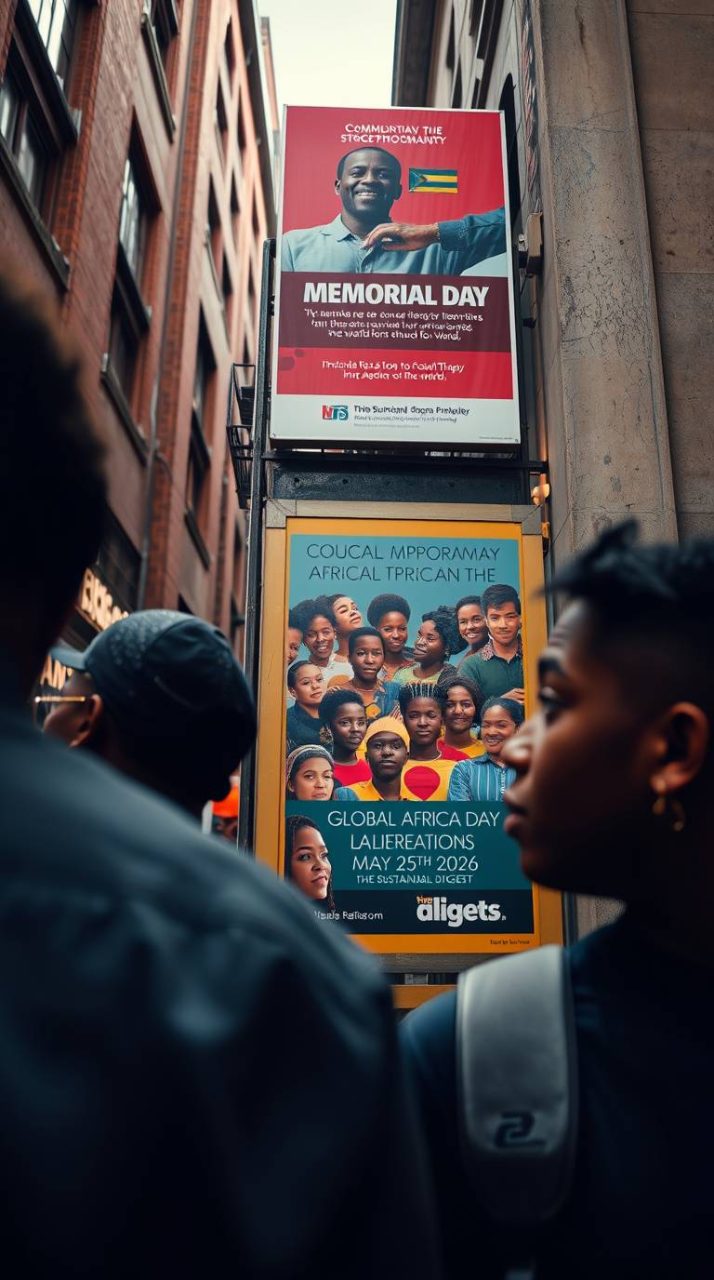
A vibrant depiction of African unity and liberation, showcasing diverse individuals dressed in professional business attire gathered in an open serene landscape that symbolizes strength and progress. In the foreground, a group of men and women of various African ethnicities engage in a discussion, their expressions reflecting hope and determination. The middle ground features traditional African symbols of unityโ€”such as intertwined hands and colorful fabricsโ€”representing cultural heritage. The background transitions into a sunset skyline of an African city, where silhouettes of palm trees and iconic architecture emerge against an orange and purple sky. The lighting is warm and inviting, evoking feelings of camaraderie and resilience, encapsulating the essence of unity and liberation. This image will resonate with the themes explored in "The Sustainable Digest."

A closer look at the historical context of African unity uncovers a rich tapestry of struggle and triumph. The transition from the 1958 African Freedom Day to the 1963 formation of the Organization of African Unity marked a pivotal shift in continental strategy. This evolution demonstrates how African countries moved from fragmented resistance to a unified front against colonial exploitation.

In 1963, 31 independent African heads of state met in Addis Ababa to solidify the foundation for what we now recognize as the African Union. This gathering aimed to support freedom fighters and diminish military access for colonial nations across the continent. By renaming the event to African Liberation Day, the founders ensured that the focus remained on the ongoing struggle for total sovereignty.

Today, the world recognizes that the charter signed by these representatives in 1963 was intended to improve living standards for all member states. This legacy of unity and liberation continues to inspire movements across the globe.

YearEventSignificance
1958African Freedom Day EstablishedSymbolized the determination to end foreign domination
1963Formation of OAUFoundation for African unity and cooperation
2002Establishment of AUContinued commitment to sovereignty and development

2026 Global African Day 2026 African Liberation Day 2026 Memorial Day: A Convergence of Legacy and Modern Impact

On this pivotal date, various observances converge, creating a rich tapestry of remembrance and activism. The proximity of Memorial Day to Juneteenth sparks essential discussions about the United States’ role in both historical and contemporary oppression.

In 1833, the UK government paid ยฃ20 million in compensation to enslavers after abolishing slavery. This act underscores the ongoing economic ramifications of slavery that resonate today.

  • The close timing of these observances compels a dialogue on historical injustices.
  • The UKโ€™s abstention from the 2026 UN reparations vote highlights enduring anti-Blackness in institutional frameworks.
  • For the African diaspora, this year symbolizes a defiance against the narrative that slavery’s end brought immediate equality.
  • The fight for liberation day recognition addresses not only the past but also the current practices of global governments.
  • Linking Memorial Day’s tribute to the broader fight for freedom day calls for a more truthful recounting of history.
  • Awareness is growing that the wealth transferred in 1833 remains central to modern reparations discussions.

Social Impact and Community Mobilization: Ubuntu, Sakofa, and Global Unity

A vibrant community gathering scene showcasing the theme of social impact and mobilization. In the foreground, diverse individuals of various African descent wear professional business attire, engaging in lively discussions while holding hands in a circle, symbolizing unity and collaboration. The middle ground features a colorful array of banners and flags representing different African nations, illustrating the concepts of Ubuntu and Sankofa. In the background, a cityscape is visible under a bright, hopeful sky, with soft sunlight filtering through clouds, casting warm highlights on the scene, creating an atmosphere of celebration and solidarity. The image embodies a sense of global unity and commitment to social justice, perfectly aligning with the essence of "The Sustainable Digest."

The celebration of liberation serves as a reminder of the strength found in collective action and shared histories. This year’s observance emphasizes the power of community mobilization through the metaphors of Ubuntu and Sakofa.

The summit in Accra, Ghana, under the theme of sustainable peace, illustrates how nationalism and socialism can be harmonized for the collective good. Local initiatives, such as those in Philadelphia, showcase the work of leaders like Dr. Molefi K. Asante, bridging theory and grassroots action.

Moreover, the African Union’s support for the Africans Rising movement aligns with the goal of integrating globalism and internationalism to uplift the diaspora. This event is not just a celebration; it is a platform for cultural empowerment, urging collaboration between government and civil society.

Ubuntuย andย Sankofaย asย Culturalย Foundationsย forย Globalย Africanย andย Liberationย  Days

Ubuntu, a Southern African philosophy encapsulated in the phrase “I am because we are,” emphasizes that the liberation of African peoples is a collective endeavor. This principle resonates profoundly during the celebrations, as the freedom of one is intertwined with the freedom of all. The coordinated global mobilization on this day illustrates the collective spirit that Ubuntu embodies.

Sankofa, represented by a bird looking backward while moving forward, serves as a metaphor for the need to learn from the past. This philosophy is particularly relevant in 2026, as it aligns with the UN’s reparations resolution and the African Union’s Decade of Reparations. The insistence on historical accountability is crucial for building a meaningful future.

Intersectingย Globalism,ย Internationalism,ย Nationalism,ย andย Socialismย inย theย  Contextย ofย Africanย Unity

Theย interplayย betweenย globalismย andย Africanย liberationย onย thisย dayย revealsย complexย  dynamics.ย Theย Pan-Africanย movementย navigatesย theย universalย aspirationsย ofย globalย  solidarityย whileย  addressingย theย specificย demandsย ofย Africanย self-determination.ย Thisย tensionย highlightsย theย needย toย resistย globalย powerย structuresย thatย oftenย undermineย theย veryย liberationย effortsย theyย claimย toย support.

Nationalism presents another layer of complexity. The Casablanca Group’s vision of immediate continental federation contrasts sharply with the Monrovia Group’s preference for gradual economic cooperation. This ongoing debate shapes the African Union’s Agenda 2063 and the Decade of Reparations, as leaders strive to balance national sovereignty with the quest for unity.

Symbolicย andย Dynamicย Interpretationsย inย Contemporaryย Diasporaย Movements

Contemporary diaspora movements embody these philosophies through what can be termed “Sankofa internationalism.” This practice involves looking back to the organizational models of the Pan-African Congress while building transnational networks. For instance, Africans Rising’s African Liberation Week 2026 connects organizations across the UK, US, Canada, and the Caribbean with groups on the continent.

The symbolic interpretation of the convergence reveals that the presence of Memorial Day alongside African Liberation Day expands the meaning of both observances. Ubuntu challenges us to extend our remembrance beyond national boundaries, recognizing that the sacrifices honored on both days are part of a single, interconnected human struggle for dignity.

As we approach this pivotal moment, the ideological foundations of Ubuntu, Sankofa, globalism, and socialism guide real-world mobilization. From leadership forums in Nairobi to reparations advocacy in Accra, the events of May 25 demand global attention and action.

Sustainability, Environmentalism, and Cooperative Development for the Future

The observances surrounding liberation highlight the urgent need for sustainable practices in our communities. Events such as the African Liberation Walk in Kenya serve as a call to action, emphasizing the necessity for sustainable infrastructure. This walk from KICC to Uhuru Park symbolizes a commitment to environmental stewardship.

Moreover, the Accra summit’s theme of “Assuring Sustainable Water, Technology, Peace & Security for Agenda 2063” directly addresses critical institutional improvements. By focusing on water and technology, leaders aim to ensure that African countries can thrive independently, without the burden of external debt.

As the diaspora in the United States and beyond contributes to funding local environmental initiatives, we must recognize that the legacy of the Organization of African Unity is incomplete without a modern commitment to sustainability. This time of reflection reminds us that the realization of true freedom depends on our ability to build systems that endure beyond any single event.

Conclusion

The intersection of historic observances invites people worldwide to engage in a renewed commitment to liberation. This unique moment offers a chance to integrate lessons from the past with future aspirations, enabling communities to foster resilience and equity.

Africa Day remains a vital institution for promoting unity; however, it must be paired with the radical action inherent in the African Liberation tradition. As we advance, the diaspora must lead the charge in advocating for reparations and sustainable development for all nations.

This liberation day serves as a final call to action, reminding us that our collective destiny is shaped by the work we do today. Together, we can forge a path toward a more just and equitable world.

Key Takeaways

  • The convergence of these observances creates a unique moment for reflection.
  • May 25 holds historical significance tied to African independence movements.
  • This day unites solemn remembrance with a call for liberation.
  • Ongoing global discourse enhances the relevance of these events.
  • Understanding this day can illuminate the political identity of the diaspora.

Jane Goodall’s Enduring Influence: Global Sustainable Impact

One woman’s effort to learn and understand primates within a biodiverse rich ecology could change science forever. In conjunction with efforts of Rachel Carson’s epiphany of dire environmental impacts of both the 1st and 2nd industrial revolution, post-World War development expansion, Jane Goodall’s concentration on initial observation, can be misinterpreted as overly idiosyncratic microcosmic. Furthermore, the progression of her study and growth of these relationships within the total ecosystem in this case, South Eastern to Southern Africa would span across generations.

Jane Goodall global impact envirommental stewardship habitat perservation

Dr. Jane Goodall ventured into the Gombe forests of Western Tanzania in 1960 with little more than a notebook and binoculars. This research redefined the arbitrary boundary we once drew between home sapien sapiens and our primal primate cousins. Her childhood curiosity in London blossomed into a lifelong callingโ€”one that eventually forced humanity to rethink its rather inflated sense of self.

The conservation movement owes its modern soul to her integrated vision. She recognized that biodiversity loss and human inequity are not separate tragedies but a single, tangled tapestry. By insisting that we all thrive only when nature does, she brought much-needed empathy to a field historically allergic to emotion.

Her life mission creates a direct bridge to the 17 UN Sustainable Development Goals. This framework empowers communities to protect the world and its ecosystems; it effectively translates high-level policy into local action. Today, her impact remains an actionable template for habitat preservation and evidence-based climate priorities.

Jane Goodall’s Revolutionary Approach to Conservation

In 1960, a young woman without a degree stepped into the forests of Tanzania and changed science forever. She arrived at Gombe Stream National Park with little more than a pair of binoculars and a notebook. This unconventional start allowed her to bypass rigid academic biases that often limited other scientists.

From Gombe to Global Movement

Her early work involved sitting quietly for months to gain the trust of the local chimpanzees. She watched their daily lives with a level of patience that few trained professionals possessed at the time. This slow approach eventually revealed the complex social structures of our closest relatives.

Decades later, an aerial view of the region revealed a startling truth about habitat loss. She saw that the vast national park had become a tiny island in a sea of deforestation. The sight shocked her and shifted her focus from pure observation to active conservation.

She realized that protecting animals required supporting the human communities living nearby. This moment crystallized her understanding that wildlife survival and human welfare are permanently linked. It marked the transition from a local study to a worldwide environmental crusade.

Redefining Human-Nature Relationships Through Empathy

Dr. Jane famously gave names like David Greybeard and Flo to her subjects rather than numbers. Many academics criticized this choice as being unscientific or overly emotional. However, she proved that empathy could actually enhance the quality of scientific research.

By acknowledging the emotional lives of these animals, she expanded the moral framework of ethology. Her research demonstrated that humans are not as separate from the natural world as we once dared to believe. It turned a cold discipline into one fueled by respect and connection.

FeatureTraditional EthologyGoodallโ€™s Methodology
Subject NamingAssigned numbers onlyPersonal names (e.g., Goliath)
Data CollectionDetached observationEmpathy-driven immersion
Subject ViewBiological objectsSocial chimpanzees with personalities

The Discovery That Changed Conservation Forever

The most famous discovery involved chimpanzees using grass stems to fish for termites. This proved they could make and use tools, a trait previously thought to be uniquely human. It forced the scientific community to fundamentally rethink humanity’s place in the animal kingdom.

Such insights expanded ethical considerations for how we relate to all habitats. Modern conservation now relies on this interconnected view where humans and chimpanzees share a common biological heritage. This legacy ensures that science remains both rigorous and deeply compassionate.

“Now we must redefine tool, redefine Man, or accept chimpanzees as human.”

โ€” Louis Leakey

Understanding Jane Goodall Day and Its Significance

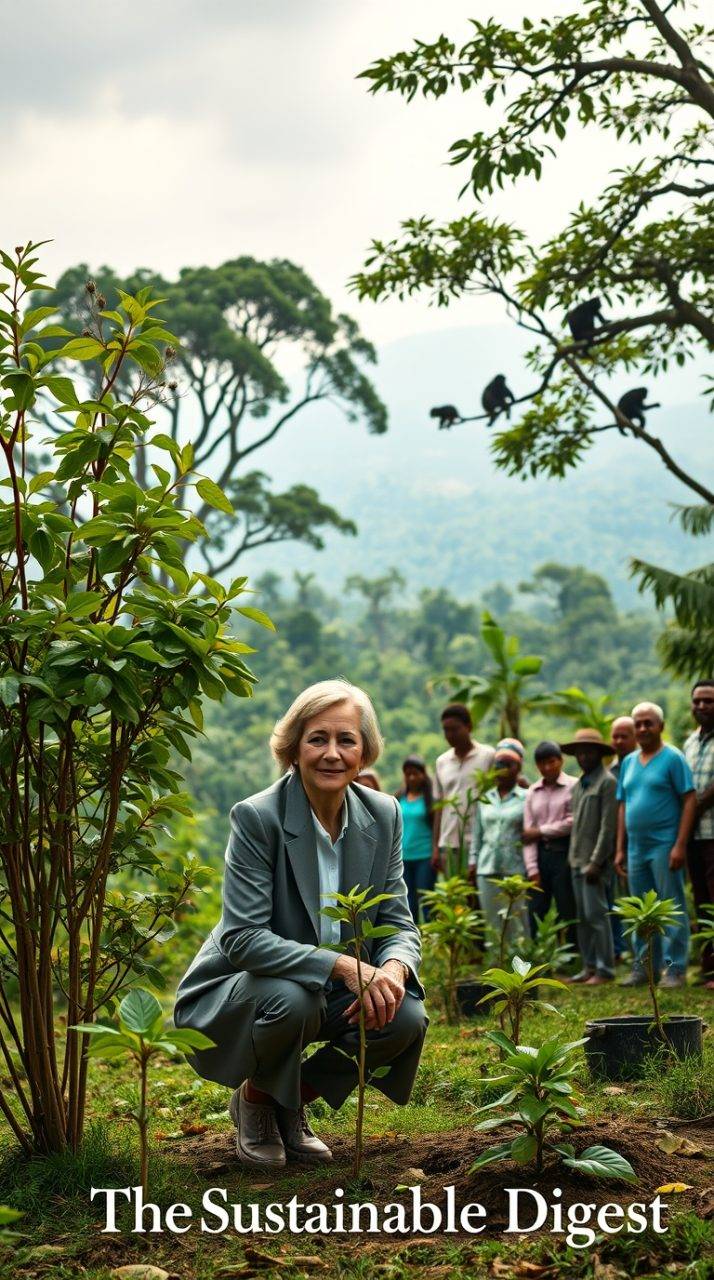
A serene landscape showcasing Jane Goodall's conservation efforts and global legacy. In the foreground, a determined woman in professional attire resembling Jane Goodall kneels beside a thriving grove of trees, gently tending to young saplings, symbolizing her commitment to reforestation. The middle ground features a diverse group of enthusiastic volunteers, planting trees and engaging in wildlife conservation, all showcasing cultural diversity. In the background, a lush rainforest teems with life, with silhouettes of chimpanzees in the trees symbolizing their endangered habitats. Soft, natural lighting filters through the canopy, casting gentle shadows, emphasizing a hopeful atmosphere for sustainability. The scene embodies a spirit of unity and purpose toward a better planet, reflective of Jane Goodall's enduring influence. The brand name "The Sustainable Digest" can subtly relate to the atmosphere of connection and conservation.

The establishment of Jane Goodall Day marks a transition from admiring a scientist to adopting her rigorous methodology. It serves as a structured opportunity for people to align their daily choices with the health of the environment. This annual observance transcends simple commemoration by offering a pragmatic framework for modern action.

The Origin and Purpose of Jane Goodall Day

This event emerged from decades of grassroots activism and steady institutional growth. It evolved from recognizing one scientist’s achievements into a global platform for coordinated action spanning many years. During Climate Week NYC 2025, dr. jane goodall highlighted our shared responsibility to protect the Earth.

Her recent appearance with the Planetary Guardians emphasized that current stewardship shapes the world for future generations. This day functions as a vital checkpoint for evaluating our collective progress toward sustainability goals. It encourages a shift from passive observation to active, value-driven conservation advocacy.

Celebrating a Legacy of Compassionate Activism

The legacy of jane goodall challenges the false choice between scientific rigor and emotional engagement. She famously reframed hope as a “tool, not a feeling,” requiring active maintenance rather than passive optimism. This philosophical stance has a profound impact on how we view environmental civic infrastructure today.

“So if we all care, as we do, about the future of this beautiful planet and life on it, then we need to work to help our children to make the world a better place for them.”

Dr. Jane Goodall

By replicating her persistent methodology, individuals can honor jane goodall through meaningful, community-centered problem-solving. This approach ensures that her vision remains a living, breathing guide for global development. Pragmatic hope remains the primary engine for incremental progress in a changing climate.

Jane Goodall Global Impact Environmental Stewardship Habitat Preservation

Jane Goodall global impact environmental stewardship habitat preservation began when she realized that protecting chimpanzees required more than just observing them from a distance. In 1977, she founded the Jane Goodall Institute to combine rigorous scientific study with deep community engagement. This shift moved conservation away from the old model of “fortress” protection that frequently excluded or displaced local people.

Dr. Goodall understood that the survival of wildlife is inseparable from the well-being of the humans who share the land. By focusing on the human-wildlife bond, her work turned environmental protection into a shared mission rather than an outside imposition. This holistic view ensures that both nature and people can thrive in a balanced, sustainable way.

The Tapestry of Life: Interconnected Ecosystems and Communities

Scientific data reveals that roughly 80% of the planet’s remaining biodiversity exists within indigenous territories. This reality makes it a scientific necessity to engage with local communities as the primary guardians of the Earth. The goodall institute prioritizes these partnerships to ensure that indigenous knowledge leads the way in protecting vital resources.

By treating communities as equals, the Institute empowers them to manage their own ancestral lands effectively. These communities help restore natural areas that have faced degradation from climate change or over-exploitation. This collaborative strategy ensures that the tapestry of life remains intact for future generations.

The TACARE Model: Community-Centered Conservation

The Take Care (TACARE) program serves as the signature methodology for the Jane Goodall Institute. It operates on the simple but powerful logic that when people thrive, the surrounding forest and wildlife also benefit. This community-centered approach improves soil health and provides sustainable ways for families to earn a living.

Through TACARE, residents establish forest reserves that act as protective buffers for their villages. These green zones help prevent devastating landslides and manage soil erosion during heavy rains. When the local community sees the direct benefits of conservation, they become the strongest advocates for protecting the land.

Technology-Enhanced Habitat Protection and Monitoring

Modern efforts led by jane goodall now use advanced digital tools to monitor vast landscapes in real-time. Village forest monitors use smartphones and satellite data to track changes across critical habitat zones. These partners collect standardized information that allows for transparent and accountable land management.

This data is shared with government partners and the goodall institute to manage over 6 million hectares of land in Africa. High-tech monitoring ensures that remote areas receive the attention they need to stay healthy and vibrant. It bridges the gap between local field work and global habitat protection strategies.

Conservation FeatureTraditional ApproachTACARE Model
Primary FocusExclusionary ProtectionCommunity Well-being
Data CollectionExternal ScientistsLocal Village Monitors
Land UseRestricted AccessParticipatory Planning
Environmental GoalSpecies IsolationEcosystem Restoration

Connecting Jane Goodall’s Legacy to the 17 UN Sustainable Development Goals

A serene landscape showcasing a vibrant wildlife habitat influenced by Jane Goodall's legacy. In the foreground, a diverse group of professionals in business attire are planting trees and collaborating on sustainable practices, symbolizing community engagement. The middle layer features a variety of jungle fauna, such as chimpanzees, elephants, and tropical birds, coexisting harmoniously within the lush greenery. In the background, a distant view of a village exemplifies sustainable development, with eco-friendly buildings amidst nature. Soft morning light illuminates the scene, casting gentle shadows and creating an uplifting atmosphere. The overall mood is one of hope, collaboration, and respect for nature, reflecting the mission of "The Sustainable Digest."

While some see the 17 UN Sustainable Development Goals as a checklist, Jane Goodall has spent decades treating them as a living, breathing reality. Her holistic philosophy suggests that we cannot protect nature without also supporting the humans who live alongside it. By linking ecological health with human dignity, her work bridges the gap between environmental activism and global development.

“You cannot get through a single day without having an impact on the world around you. What you do makes a change, and you have to decide what kind of change you want to make.”

โ€” Jane Goodall

The Jane Goodall Institute (JGI) applies this wisdom by treating the planet as a single, woven tapestry. Their work proves that civic resilience is the first step toward environmental resilience. When people gain control over their resources, they naturally become the best guardians of the future.

Environmental Sustainability: Climate Action, Life Below Water, and Life on Land (SDGs 13, 14, 15)

Jane Goodallโ€™s efforts directly tackle the most pressing ecological threats by restoring forests and sequestering carbon. These reforestation projects serve as a powerful tool for climate change mitigation. By expanding green corridors, JGI protects habitats and prevents wildlife loss on a massive scale.

The protection of watersheds ensures high water quality, which supports life below water and terrestrial ecosystems alike. Preserving these habitats is vital for the survival of chimpanzees and other endangered species. These actions demonstrate that climate stability depends on healthy, vibrant biological systems.

Social Equity and Human Development: Poverty, Hunger, Health, Education, Gender Equality, Clean Water, and Reduced Inequalities (SDGs 1, 2, 3, 4, 5, 6, 10)

The TACARE model addresses social equity by empowering communities through microcredit and health education. This method helps reduce poverty and improves soil health for better food security. By providing clean water projects, JGI ensures that basic human needs are met before asking locals to prioritize conservation.

  • Education programs build local capacity and create new environmental leaders.
  • Womenโ€™s empowerment initiatives advance gender equality and improve community wellness.
  • Participatory planning reduces the gap between external authorities and local humans.

Economic Growth and Sustainable Communities: Decent Work, Innovation, Sustainable Cities, and Responsible Consumption (SDGs 8, 9, 11, 12)

Goodallโ€™s programs create work opportunities that align with nature rather than destroying it. Innovation plays a key role, as JGI uses modern mapping tools to monitor wildlife and forest health. These technology partnerships allow humans to coexist with chimpanzees more effectively.

SDG CategoryAction AreaKey Impact
Economic GrowthSustainable LivelihoodsProvides work that preserves natural resources.
InnovationSatellite MappingEnhances habitat protection and monitoring accuracy.
CommunitiesVillage ReservesPromotes responsible consumption and local governance.

Enabling Systems: Affordable Energy, Peace and Justice, and Partnerships for the Goals (SDGs 7, 16, 17)

Sustainable development requires strong systems, such as affordable energy and peaceful governance. Reducing the pressure on forests helps communities transition to cleaner energy sources. Collaborative partnerships between JGI and global networks show how we can fight climate change together.

Goodallโ€™s focus on education and food security builds a foundation for lasting peace. Her legacy reminds us that the 17 SDGs are mutually reinforcing systems. By protecting the world today, we ensure a stable climate for the generations to come.

Taking Action on Jane Goodall Day in the Modern Climate Context

Translating Jane Goodallโ€™s legacy into modern practice requires a sophisticated blend of scientific literacy and grassroots action. Dr. Goodall famously emphasizes that you cannot get through a single day without having an impact on the world around you. What you do makes a difference, and you must decide what kind of difference you want to make.

In the face of climate change, her example calls for repairing ecosystems and the human capacity to believe in repair itself. This persistent engagement bridges the gap between scientific data and civic practice. We must move beyond admiration and scale the “think globally, act locally” method into a shared planetary fabric.

Individual Actions That Create Collective Impact

Moving beyond symbolic gestures involves coordinating daily consumption choices across global networks of engaged people. These individual efforts create a measurable collective impact when viewed through the lens of modern environmental science. Change occurs when we view environmental work as essential maintenance rather than a distant utopian dream.

By participating in habitat restoration, individuals contribute to building resilience for our entire planet. Reassessing how we use resources at home acts as a reset point for our personal environmental footprints. These small acts of care link together to form a robust defense against biodiversity loss.

Integrating Climate Science with Daily Environmental Choices

Modern climate change research reveals how energy use and dietary patterns directly influence habitat preservation. Scientific literacy allows individuals to understand how their home energy decisions affect distant forests and wildlife. Making informed solutions part of your routine turns abstract data into tangible environmental benefits.

Choosing sustainable resource allocation reduces carbon emissions and protects the climate for future generations. This pragmatic framework helps overcome climate fatigue by focusing on achievable, cumulative goals. Every informed change in purchasing behavior supports the broader systems that sustain life on land.

Supporting the Jane Goodall Institute’s Conservation Programs

A high-quality portrait of a chimpanzee in a lush, green African canopy, focusing on expressive eyes and natural textures, 8k resolution.

Learn More

Supporting the Jane Goodall Institute means investing in community-centered solutions that address the root causes of environmental decay. Programs like TACARE demonstrate that effective conservation requires tackling poverty and education access simultaneously. These efforts ensure that local communities maintain natural systems long after external funding ends.

Direct support for the goodall institute aids in the protection of chimpanzees and their vital forest corridors. You can amplify these solutions by advocating for policies that protect wildlife or by joining a Roots & Shoots chapter. Financial contributions provide the resources needed to safeguard chimpanzees and restore the habitat they need to thrive.

Roots & Shoots and Youth Empowerment for Environmental Change

A cinematic wide shot of diverse young leaders from different continents standing together in a lush green valley, holding saplings, symbolizing the global expansion of the Roots & Shoots program.

Learn More

Empowering the next generation is the fundamental engine of the global roots shoots movement. Jane Goodall founded this initiative in 1991 with only twelve students in Tanzania. Today, it operates as a massive, decentralized network across 100 countries. Young people design locally relevant solutions through this program. It represents her most scalable contribution to conservation. This effort fosters a deep, lifelong responsibility for the world.

Youth Leadership in Post-Modern Environmental Stewardship

Modern conservation requires more than traditional education; it demands active participation. Dr. Jane views youth not as passive recipients but as innovative leaders with high digital fluency. These young people utilize their creativity to drive conservation innovation across diverse communities. By providing a platform for their ideas, the program reframes youth as the primary agents of planetary health.

Local Action with Global Reach: 10,000 Groups Across 100 Countries

The roots shoots framework encourages empathy for all living things through practical, place-based tasks. Whether restoring a degraded forest or building wildlife corridors, young people learn that local actions have a global impact. This model provides the hope needed to face complex challenges in nature.

Through over 10,000 groups, youth translate their environmental concern into measurable success for their communities. They bridge the gap between scientific knowledge and civic action. The roots shoots program ensures that the legacy of jane goodall flourishes in every corner of the world.

Conclusion

The legacy of dr. jane goodall proves that hope is not a passive emotion but the work of a lifetime. Her pioneering research on chimpanzees redefined the relationship between humans and animals. By protecting forests and critical habitats, we preserve the health of our shared planet and every form of life.

Jane Goodall emphasizes that community involvement is essential for lasting solutions to habitat loss. Through years of active conservation efforts, she has shown that when nature thrives, people thrive too. Small individual actions create the change needed to secure a sustainable future for everyone.

Investing in our home means addressing climate shifts and protecting diverse areas from destruction. This integrated work ensures that every life on this world has a place to grow. We must recognize that we are not separate from the environment, but strong threads within its vital fabric.

Strategic DimensionActionable PathwayPlanetary Outcome
Individual LevelConscious Daily ConsumptionClimate Resilience
Community LevelLocal Habitat ProtectionBiodiversity Restoration
Global LevelYouth EmpowermentSustainable Development

Key Takeaways

  • Her research at Gombe shifted primatology toward an integrated, empathetic science.
  • The philosophy links biological health directly with social equity and community well-being.
  • Her institute provides a replicable model for addressing climate crises through programs like TACARE.
  • The work supports the 17 UN Sustainable Development Goals, specifically targeting biodiversity.
  • Youth empowerment via Roots & Shoots translates individual admiration into collective action.
  • The commemorative day serves as a framework for local ecological restoration and climate science.

Rachel Carson: How one woman birthed the Climate Debate

Rachel Carson Sustainability, Environmentalism Ecosystem Climate Impact

During Women’s History Month, we often celebrate pioneers who broke barriers. One such figure was a marine biologist whose eloquent writing changed how we see the natural world. Her journey in STEM, at a time when few women held such roles, makes her legacy particularly powerful.

She possessed a rare dual expertise. As a rigorous scientist and a gifted writer, she translated complex biology into stories everyone could understand. This skill turned ecological ideas into a mainstream concern.

Her most famous book, Silent Spring, questioned the unchecked use of chemicals. It framed environmental protection as a moral duty to future generations. The work did more than warn about dangers; it sparked a global movement.

Her experience within government, as an editor for the U.S. Fish and Wildlife Service, shaped her view. She believed firmly in the public’s right to know. This principle would later echo in the creation of agencies like the Environmental Protection Agency.

The central question remains: how do her warnings about chemical overreach prefigure today’s crises? Her story is one of intellectual courage against a powerful industrial complex. It provides an ethical blueprint for planetary stewardship that still guides us.

Fromย Marineย Biologistย toย Environmentalย Prophet

Rachel Carsonย startedย asย aย biodiversityย conservationย pioneerย knownย forย explainingย scienceย toย everyone.ย Herย books,ย likeย “Theย Seaย Aroundย Us,”ย madeย scienceย interestingย andย accurateย forย all.ย Sheย showedย thatย scienceย shouldย beย forย everyone,ย notย justย experts.

Carson grew from focusing on oceans to understanding the whole planet. She saw how the ocean’s health reflects our planet’s. This broad view set her apart ๏ปฟfrom others who focused only on parts of the environment.

Her work in marine biology led to new ideas about sustainability. She showed how pesticides harm ecosystems and build up in living things. Her knowledge helped her challenge the chemical industry’s claims.

The massive impact from Rachel Carsonย wentย beyondย herย books.ย Sheย showedย thatย scientistsย canย serveย theย publicย whileย stayingย trueย toย theirย work.ย Herย exampleย encouragedย othersย toย questionย theย costsย ofย progressย andย theย safetyย ofย chemicals.ย Sheย taughtย usย thatย askingย toughย questionsย isย theย dutyย ofย scientists.

1. The Making of a Witness for Nature: Education and Early Career in a Changing World

In the shadow of Pittsburgh’s steel mills, a childhood spent exploring a family farm laid the groundwork for a revolutionary career in public science. Rachel Carson was born in 1907 in Springdale, Pennsylvania. Her family’s 65-acre plot near the Allegheny River was her first laboratory.

This pastoral landscape stood in stark contrast to the industrial behemoth nearby. That contrast between the organic and the mechanical would deeply inform her later life.

From Pennsylvania Woods to Marine Biology: A Foundation in Observation

Her early immersion fostered a powerful ethos of observation. By age ten, she had a story published in St. Nicholas magazine. This early literary success hinted at her future path.

At Pennsylvania College for Women, she initially studied English. In a pivotal move, she switched her major to biology. This fusion of literary skill and scientific rigor became her unique signature.

A 1929 summer fellowship at the U.S. Marine Laboratory in Woods Hole was transformative. It was her first sustained encounter with the sea. The experience cemented her academic direction.

She earned a scholarship to Johns Hopkins for graduate work. Her focus was marine zoology. This period built the authoritative foundation she would later use to communicate with the public.

Breaking Barriers: A Woman in the U.S. Fish and Wildlife Service

Her professional break came in 1935. The U.S. Bureau of Fisheries hired her part-time to write a radio series, “Romance Under the Waters.” Her talent for making science engaging was immediately apparent.

By 1936, she was appointed a junior aquatic biologist. She was one of only two women at a professional level in the agency. This was a significant barrier broken in federal government.

During World War II, her research skills were directed to a submarine detection program for the Navy. This work deepened her practical understanding of oceanography and federal priorities.

Promoted to aquatic biologist in 1943, she worked for the renamed U.S. Fish and Wildlife Service. She served as an editor and chief of publications. In this role, she authored public bulletins and the “Conservation in Action” series.

The irony was rich. Here was a woman excelling in a male-dominated agency. She was mastering the very system of public information she would later challenge.

Key Early Career Milestones of Rachel Carson

YearMilestoneSignificance
1929Fellowship at Woods Hole Marine LabFirst direct marine biology research; connection to the coast maine region.
1935Hired by U.S. Fish & Wildlife precursorBegan professional science writing for the public.
1936Appointed Junior Aquatic BiologistBroke gender barriers in federal science.
1943Promoted in Wildlife ServiceGained editorial control and bureaucratic insight.

The Post-WWII Context: Science, Growth, and Unquestioned Progress

Carson’s early career unfolded against a specific historical backdrop. The post-war era was defined by unfettered economic growth and technological optimism. A “machine age” mentality viewed the natural world purely as a resource.

The Cold War and reconstruction efforts fueled a narrative of unquestioned progress. Conflicts like the Korean War reinforced a mindset of dominion. This was the dominant ethos during her time at the U.S. Fish Wildlife Service.

Globally, the 1950s and 60s saw decolonization and new nations gaining independence. Conflicts like the Vietnam War stirred international consciousness. A global audience for messages about planetary care was emerging.

Her insider view seeded a profound ecological caution. She saw the costs of industrial expansion. The impending crises of the 1970sโ€”like the oil embargoโ€”were prefigured in her early work.

This period forged her into a “witness for nature.” She gained scientific authority, literary skill, and an insider’s understanding of policy. These tools would soon be turned toward a critique of the very progress narrative she was immersed in.

Breakingย Barriersย inย aย Male-Dominatedย Scientificย World

In the 1940s and 1950s, women in science faced big barriers. The Cold War pushed for more technology and chemicals, ignoring the risks. Yet, Carson’s work earned her respect from her male colleagues.

Being a woman had its advantages and challenges:
Men often doubted her findings on chemical dangers
She worked outside the usual university power structure
Her writing reached more people than usual
Her fresh perspective allowed her to challenge the status quo
She could talk to a wider audience
Carson refused to accept the usual views on progress and safety. While others celebrated synthetic pesticides, she showed their harm. Her courage to disagree made her stronger, not weaker.

2. The Sea Trilogy: Laying the Ecological Foundation for a Public Audience

Rachel Carson's "The Sea Trilogy" books displayed prominently in a natural setting, illustrating her profound influence on ecological awareness. In the foreground, the rugged covers of the trilogy books are neatly arranged on a weathered wooden table, with sunlight gently illuminating their textured surfaces. The middle ground features a serene coastal scene, with gentle waves lapping at a pebbled shore and soft green seaweed peeking through the water. Further back, a tranquil horizon shows an endless blue sea under a clear sky, hinting at the environmental themes Carson championed. The atmosphere is peaceful and reflective, evoking a sense of connection to nature. The entire scene is captured with a warm, soft focus, simulating a late afternoon glow. Designed for "The Sustainable Digest," the image embodies the essence of Carson's writings without any text overlays or distractions.

A trilogy of works about the sea, published between 1941 and 1955, performed a quiet revolution by making ecological science a mainstream literary genre. This series did more than describe marine life; it built a reservoir of public trust and wonder. That trust would prove essential for the more confrontational warnings to come.

Through these books, the biologist translated raw data into compelling narrative. She established ecology as a public science. The global hunger for this wisdom revealed a planet ready to think beyond national borders.

Under the Sea-Wind: Writing the Ocean’s Narrative

Her first major carson book, Under the Sea-Wind (1941), presented intricate science through poetic language. It followed the life cycles of a sea bird, a fish, and an eel. This narrative innovation personified marine creatures, making complex ecology relatable.

The work established her signature style. She blended rigorous research with the pacing of a story. This approach invited readers into the natural world, fostering empathy rather than just delivering facts.

The Sea Around Us: A Bestseller Brings Ocean Science to the World

The monumental success of The Sea Around Us (1951) was unprecedented. It topped the New York Times bestseller list for 81 weeks. Translated into 32 languages, its reach was truly global.

This sea around us phenomenon revealed a public hungry for planetary wisdom. Its focus on the ancient, timeless ocean offered a subtle critique of the era’s frantic, consumption-driven pace. The book’s international reception acted as a form of soft diplomacy, fostering shared wonder across Cold War divides.

The financial independence it provided was critical. Carson published the bestseller and resigned from government service in 1952. This marked her pivotal transition from federal scientist to independent public intellectual.

The Edge of the Sea: Exploring Ecosystems and Interconnectedness

The Edge of the Sea (1955) is a masterclass in interconnected thinking. It explored fragile coastal zones from the coast maine region to Florida. Carson detailed the precise interdependencies within tide pools and shorelines.

This work prefigured core principles of modern conservation biology. It presented an ecosystem as a web of relationships, not a collection of parts. Her observations included early notes on phenomena now central to the climate debate, like rising sea levels.

Her research for this volume utilized emerging post-WWII technologies. She blended findings from submarine studies with literary elegance. This demonstrated her commitment to cutting-edge science served with clarity.

The Sea Trilogy: A Foundational Project

YearTitleCore InnovationPublic Impact
1941Under the Sea-WindNarrative personification of marine lifeEstablished her lyrical, accessible writing style
1951The Sea Around UsBiography of the ocean as a geologic entityGlobal bestseller; built massive public trust and credibility
1955The Edge of the SeaEcosystem analysis of coastal zonesTaught ecosystem thinking to a broad audience

The trilogy’s collective impact was profound. Rachel Carson first invited the world to marvel at the sea‘s wonders. This established her as its most trusted voice. That carefully earned credibility set the stage for her next, revolutionary act: revealing how that same world was being poisoned.

She built the foundation for public ecology in this time. The writing made the ocean‘s story everyone’s story. This global classroom prepared the ground for the urgent lessons that followed.

3. Silent Spring and the Awakening of Modern Environmentalism

The publication of Silent Spring in 1962 did not merely critique agricultural practices. It declared a profound philosophical war on the era’s core belief in technological infallibility. This carson book transformed a specialized scientific concern into a urgent national debate.

It argued that the widespread use of synthetic chemicals was an assault with unforeseen consequences. The work meticulously connected laboratory data to real-world dangers in backyards across America.

Connecting the Dots: From DDT to a “War Against Nature”

Rachel Carson wrote with forensic detail. She traced the journey of pesticides like DDT from crop dusters into the soil, water, and food chain. Her research demonstrated bioaccumulation, where toxins concentrate as they move up the ladder of life.

She linked these poisons to cancer and the thinning of bird eggshells. This was a clear indictment of an entire industry‘s practices. Her central thesis was that this was not progress, but a reckless conflict.

She called it an “uncontrolled lab experiment” on the American public.

Her methodology was formidable. With help from colleagues like Shirley Briggs, she compiled 55 pages of references. She synthesized entomology, oncology, and ecology into a single, damning narrative.

The Firestorm: Industry Backlash and Public Mobilization

The reaction from chemical companies was swift and severe. They mounted a coordinated smear campaign, spending over $250,000 to discredit her. They labeled her “frantic” and anti-science, a tactic meant to undermine her credibility.

What her critics did not know was her private battle. During this time, she was secretly fighting metastasizing breast cancer. She concealed her illness to prevent her science from being dismissed as emotionally motivated.

Her public rebuttal was calm and evidence-based. This stark contrastโ€”between corporate fury and her reasoned authorityโ€”galvanized the public. It sparked a grassroots awakening that became the modern environmental movement.

Policy and Paradigm Shift: From Banning DDT to a New Environmental Ethic

The book‘s impact reached the highest levels of government. President John F. Kennedy launched a presidential science advisory committee investigation. In 1963, she testified before Congress, her scientific clarity cutting through political noise.

This direct communication led to tangible policy change. The United States eventually banned DDT for agricultural use. This was a direct result of her advocacy and the public pressure she ignited.

The world context amplified her message. The Cold War created a mindset of invisible threats. Carson’s framing of chemical peril resonated with this vigilance. Simultaneously, the use of Agent Orange in the Vietnam War exemplified the global “war against nature” she condemned.

The paradigm shift was profound. The ideology of total control, born from post-World War II triumphalism, was challenged. It was challenged by a woman using that era’s own tools of science and communication.

The ultimate institutional legacy was the creation of the U.S. Environmental Protection Agency in 1970. Silent Spring provided the ethical blueprint for its mission. It established a new framework for assessing environmental risk.

Key Events: From Publication to Policy (1962-1970)

YearEventOutcome
1962Silent Spring publishedNational bestseller; public alarm raised about pesticides.
1963Carson’s Congressional testimonyScience directly influences federal policy review.
1963-1972Scientific review & public campaignMounting evidence leads to regulatory action.
1970EPA establishedNew federal agency created to manage environmental risks.
1972DDT banned in the U.S.Landmark regulatory victory stemming directly from the book‘s thesis.

The years following 1962 created a new playbook for citizen action. It combined science, litigation, and advocacy to hold power accountable. Rachel Carson‘s quiet study had sparked an unfinished revolution.

4. Carson’s Enduring Framework: Her Vision and the 2030 UN Sustainable Development Goals

A serene landscape representing the UN Sustainable Development Goals, featuring a lush green environment symbolizing nature's preservation, alongside imagery inspired by Rachel Carson's legacy. In the foreground, a diverse group of professionals in business attire holds a vibrant, oversized depiction of the 17 Sustainable Development Goals icons, conveying collaboration and hope. The middle ground showcases a harmonious balance of nature and clean technology, with wind turbines and solar panels integrated into the landscape. In the background, a clear blue sky illuminates the scene, symbolizing a brighter future. The atmosphere is inspiring and optimistic, reflecting the call for sustainable action aligned with Carson's vision. The image must be suitable for "The Sustainable Digest."

Today’s global sustainability agenda, codified in the UN’s 17 goals, finds a profound precursor in the systemic vision of a mid-century science writer. The Sustainable Development Goals (SDGs) are the modern operational plan for a viable planet. Their ethical and ecological DNA, however, was articulated decades earlier.

Her philosophy was built on several core tenets. These ideas now form the bedrock of integrated global policy.

  • Interconnectedness of all life systems.
  • Moral duty to future generations.
  • The public’s right to know about hazards.
  • The precautionary principle for new technologies.
  • A critique of unchecked economic growth.

This framework refuses to separate planetary health from human justice. It makes her the unacknowledged architect of the SDG structure.

Direct Environmental Stewardship: Goals for Planet

The “Planet” cluster of SDGs (6, 13, 14, 15) has a direct lineage to her research. Her book Silent Spring exposed the poisoning of waterways by agricultural chemicals. This established the scientific urgency for SDG 6: Clean Water and Sanitation.

Her sea trilogy documented atmospheric and oceanic changes. She warned of rising sea levels and collapsing populations. These observations presaged SDG 13: Climate Action and SDG 14: Life Below Water.

Her critique of pesticides like DDT highlighted the collapse of bird populations. It framed terrestrial protection as a survival issue. This moral argument underpins SDG 15: Life on Land.

Foundations for Health, Equity, and Justice: Goals for People

The “People” goals address poverty, health, and inequality. Carson’s work indirectly targeted these root causes. She linked environmental pollution directly to public health, a core of SDG 3: Good Health.

The Silent Spring Institute continues this legacy. It has identified over 900 potential breast cancer-causing chemicals. This ongoing research validates her early warnings and fuels modern advocacy.

Her mission to educate the public embodied SDG 4: Quality Education. She believed informed citizens were essential for change. Furthermore, her success as a woman in a male-dominated field challenged power structures, aligning with SDG 5: Gender Equality.

Enabling Sustainable Systems: Goals for Prosperity and Partnership

Her foresight extended to economic and social models. The “Prosperity” goals seek sustainable industry, energy, and cities. Carson’s critique of irresponsible industry prefigured this need.

She questioned a growth model that sacrificed the natural world. This critique aligns with SDG 8: Decent Work and Economic Growth and SDG 12: Responsible Consumption. It calls for systems that do not externalize their dangers.

The final “Partnership” goals (16 & 17) require transparent governance and collaboration. Her reliance on scientific networks modeled multi-stakeholder action. Her demand for accountable government echoes SDG 16: Peace, Justice, and Strong Institutions.

Mapping Carson’s Core Tenets to the SDG Framework

Carson’s PrincipleSDG ClusterModern Manifestation
InterconnectednessPlanet (14, 15)Integrated ecosystem management policies.
Public’s Right to KnowPeople (3, 4)Community right-to-know laws and health education.
Precautionary PrincipleProsperity (9, 12)Regulations on novel materials and chemicals.
Critique of Unchecked GrowthPartnership (17)Global partnerships for sustainable development.

The relationship is bilateral. Her work informed the goals’ creation. Now, the pursuit of these goals extends her unfinished revolution.

It is deeply ironic. The world is now codifying objectives she identified as necessary over half a century ago. This underscores the protracted pace of institutional change. The vision of Rachel Carson was inherently systemic. It remains the blueprint for a livable future.

5. Conclusion: The Rachel Carson Legacy – Disciples, Movement, and an Unfinished Revolution

Immediate collaborators and later disciples have carried forward the crucial work begun in the mid-20th century. Allies like Shirley Briggs provided vital research for Silent Spring, forming its intellectual core.

This effort spurred tangible government action, including the founding of the U.S. Environmental Protection Agency. The environmental movement she ignited now thrives through organizations and advocates worldwide.

Scientific successors, such as the Silent Spring Institute, continue probing links between chemicals and cancer. Yet, with many pesticides like DDT banned but thousands of novel compounds untested, her revolution remains unfinished.

Rachel Carson‘s legacy endures as a living call for precaution and informed public stewardship. It is a blueprint still guiding the quest for a healthier planet.

Key Takeaways

  • Rachel Carson’s work in the mid-20th century launched the modern environmental movement by making science accessible to the public.
  • Her unique background as both a scientist and a writer allowed her to effectively communicate complex ecological concepts.
  • Silent Spring was instrumental in shifting public policy and raising awareness about the dangers of pesticides.
  • As a woman in STEM during the 1950s and 60s, she overcame significant gender barriers in science and government.
  • Her advocacy established the principle of the public’s right to know about environmental hazards.
  • Carson’s vision of ecological interconnectedness directly informs contemporary frameworks like the UN Sustainable Development Goals.
  • Her legacy demonstrates how a single, powerful voice can challenge industrial norms and inspire global change.

Black History Month 2026: Advancing Environmental Justice and Civil Rights

2025 Black History Month, Environmental Justice, civil/labor/human rights.

The current focus on labor and the earth highlights how people interact with nature with peculiar perspective during Black History Month. It is also a great time to study Environmental Justice and social growth. We see that the fight for fair pay is much like the fight for clean air and water.

In the past, african americans helped build this nation with skill and care. They used smart ways to farm and manage the land from the very start. These ecological efforts were vital to survival and national growth.

Sadly, most school books leave out these vital stories of nature and work. They also gloss over details during Black History Month. Theses stories and the individuals of this narrative however, were the first to use many green methods we see today on modern farms. Their stewardship was born from necessity and a deep connection to the soil.

An interpretation representing Black environmental wisdom throughout history, highlighting the contrast from ancient history resilience to pre-colonial sustainability to the impact of industrial exploitation.

Now, black history month 2026 shows us that nature and equity go hand in hand. Leaders like A. Philip Randolph linked civil/labor/human rights to the struggle against industrial harm. This connection remains a cornerstone of modern advocacy.

Leaders saw that pollution often follows the color line with unfortunate accuracy. Getting true balance means that everyone should have a safe and green home for their families. Civil rights must include the right to a healthy, sustainable world.

The Legacy of Black Environmental Stewardship: Setting the Context

While mainstream narratives often celebrate figures like John Muir, the deep-rooted history of Black environmental stewardship remains an unsung pillar of conservation. For too long, the conventional story of environmentalism has focused on white, middle-class concerns. This perspective ignores the vital contributions of black people who have defended their land for centuries. This erasure suggests that protecting the planet is a recent interest for minority groups, but the reality is far more complex.

Long before “sustainability” became a popular corporate buzzword, African American families practiced resource conservation as a way of life. This stewardship was not just about loving nature; it was a strategy for survival and resilience. Indigenous African wisdom regarding agriculture and water management traveled across the Atlantic with enslaved peoples. These communities transformed scarcity into abundance through sheer ingenuity, even when they lacked legal rights to the soil they enriched.

The Legacy of Black Environmental Stewardship: Setting the Context Continuing…

Mainstream movements often separated nature from people, yet Black stewardship recognized that human health and ecological health are the same. This black history shows that environmental action and social justice are inseparable priorities. Environmental justice emerged from a need to protect both the land and the people who depend on it most directly. This legacy proves that the fight for environmental justice is a fundamental part of black history, black history month, and American progress.

Focus AreaMainstream NarrativeBlack Stewardship Legacy
Primary GoalWilderness preservation for recreationCooperative land use and survival
View of NatureSeparate from human societyInseparable from human dignity
MethodologyExclusionary land managementSustainable resource allocation

Understanding this historical context changes how we view modern climate challenges. It reveals that solutions for our planet already exist in ancestral practices and grassroots movements. Strong leaders have consistently demonstrated that we cannot fix the environment without also addressing racial inequity. The following points highlight how this stewardship took shape over time:

  • Agricultural Ingenuity: Enslaved people used African farming techniques to sustain themselves and build American wealth without receiving credit.
  • Resilient Gardens: During the Great Depression, victory gardens became essential tools for food security and community autonomy.
  • Protest as Protection: Civil Rights leaders targeted polluting industries long before modern regulations existed.
  • Interconnected Health: Grassroots activists proved that clean air and water are basic human rights for everyone, not just the elite.

The environment is not just where we go for a hike; it is where we live, work, play, and pray.

From Pre-Colonial Sustainability to Industrial Exploitation

A vibrant illustration representing Black environmental wisdom throughout history, highlighting the contrast from pre-colonial sustainability to the impact of industrial exploitation. In the foreground, a diverse group of three Black individuals in professional business attire stands confidently, sharing knowledge. In the middle, lush green landscapes with traditional farming practices blend with signs of industrial machinery, symbolizing the shift in environmental practices. In the background, a sunset casts warm, golden light, creating a serene atmosphere, while silhouettes of ancient trees and modern factories hint at the ongoing struggle for environmental justice. The composition should evoke a sense of hope and resilience. Inspired by "The Sustainable Digest".

The transition from sacred land stewardship in Africa to the brutal plantation systems of the Americas marks the genesis of environmental injustice. This shift reflects a move from ecological harmony to a system of extraction and discrimination. Understanding this era is crucial to black history and the origins of modern climate activism.

Indigenous African Environmental Wisdom and Sacred Land Practices

Pre-colonial African societies developed sophisticated environmental management systems. They recognized land as a sacred trust rather than an extractable commodity. These communities practiced crop rotation and managed water through collective governance to ensure long-term survival.

Modern permaculture is only now “rediscovering” these techniques with considerable fanfare and notably less humility. These practices embodied what we now define as sustainability. They integrated human life into the natural cycle rather than standing apart from it.

However, they understood it as a spiritual relationship with the Earth. This spiritual bond acknowledged human dependence on natural systems and ecological balance. Such values ensured high diversity across the landscape for future generations.

Wangari Maathai, founder of the Green Belt Movement, later revived these connections. By empowering women to plant millions of trees, she linked conservation to human dignity. Her work showed that protecting ecosystems is a powerful tool for poverty reduction.

Native American leaders also shared this view of the sacred Earth during the formation of the environmental justice movement. They helped early advocates see the planet as a living entity that requires protection. This cross-cultural wisdom remains a cornerstone of ecological resistance.

Slavery, Agricultural Labor, and the Foundation of Environmental Injustice

The transatlantic slave trade did not just extract human beings; it severed them from their environmental knowledge. It then exploited that very expertise to build agricultural wealth in the Americas. This forced labor transformed landscapes while denying enslaved peoples any agency over the land.

This era marks a painful chapter in black history month and black history in general. The plantation system created Americaโ€™s original “sacrifice zones.” These were landscapes that lacked variety because they served monoculture cash crops for global trade.

Enslaved workers bore the brunt of this environmental degradation without seeing the profits. This established the template for modern environmental racism and industrial pollution. Post-emancipation systems like sharecropping continued this exploitation under new names.

Planners concentrated environmental hazards in Black communities through deliberate structural choices. Yet, despite these barriers, Black communities maintained their ecological wisdom and fought for progress. This resilience highlights the enduring contributions black ancestors made to the land.

Woman, Creative, Black lives matter image. https://pixabay.com/photos/woman-creative-black-lives-matter-6394977/
FeaturePre-Colonial African SocietiesIndustrial Plantation System
Land PerceptionSacred trust and community heritageExtractable commodity and capital
Ecological GoalBiodiversity and long-term balanceMonoculture and immediate profit
Human RelationSpiritual stewardship and interdependenceForced labor and exploitation

The Birth of Environmental Justice: Warren County’s Pivotal Protest

While many view conservation as a quest for pristine wilderness, the residents of Warren County redefined it as a struggle for survival. In 1981, North Carolina officials designated this predominantly Black and economically distressed county as a dump site for 60,000 tons of PCB-contaminated soil.

The state chose this location despite a shallow water table that posed a direct threat to the local groundwater. This decision suggested that officials believed poverty and race would equal a lack of resistance. They were profoundly mistaken.

This attempt to bypass safety standards in a marginalized area became a catalyst for change across the united states. It proved that the fight for a clean environment was inseparable from the fight for human dignity and equality.

1981-1982: When Civil Rights Met Environmental Action

The resistance in Warren County signaled a massive shift where the traditional environmental movement finally adopted the tactics of the streets. Local residents and activists organized six weeks of non-violent protests to block 6,000 trucks filled with carcinogenic soil.

People and individuals of kind literally laid their bodies on the road to stop the delivery of toxic waste. This courageous act of civil rights defiance led to over 500 arrests. It was the first time citizens were jailed for defending their right to a non-toxic neighborhood.

These demonstrations quickly captured national attention, forcing the broader public to look at the ugly reality of hazardous waste disposal. The protest proved that “green” issues were not just for the wealthy, but a matter of life and death for the disenfranchised, marginalized, and lower working class.

While the landfill was eventually built, the social cost was too high for the government to ignore. This specific moment in North Carolina history created the framework for what we now call environmental justice.

Rev. Benjamin Chavis and the Definition of Environmental Racism

While serving time in the Warren County Jail, civil rights leader Rev. Benjamin Chavis formulated a concept that changed the political landscape forever. He realized that the targeting of his community was not an accident of geography, but a symptom of systemic racism.

“Environmental racism is racial discrimination in environmental policy-making and the enforcement of regulations and laws, the deliberate targeting of communities of color for toxic waste facilities.”

Rev. Benjamin Chavis

This definition provided a necessary name for the racism embedded in land-use policy. It allowed other communities, from Cancer Alley in Louisiana to Flint, Michigan, to see that their local crises were part of a national pattern.

The struggle in Warren County lasted decades, as the toxic chemicals were not fully remediated until 2004. However, the movement it birthed remains a powerful force in modern civil rights advocacy. Environmental justice is no longer a niche concern; it is a central demand for a fair society.

Key MilestoneHistorical SignificanceOutcome/Impact
1981 Location ChoiceWarren County selected for PCB dump.Sparked the first major intersection of race and environment.
1982 Mass ProtestsOver 500 arrests of non-violent activists.Garnered global media coverage for the cause.
Chavis’s DefinitionCoined the term environmental racism.Provided a legal and social framework for future advocacy.
2004 Site CleanupFinal detoxification of the Warren County site.Proved the long-term cost of discriminatory waste policies.

Founding Figures: The Architects of Environmental Justice

Dr. Robert Bullard, the father of environmental justice, stands confidently in a spacious office overlooking a vibrant urban landscape. In the foreground, he is wearing a professional business suit, hands crossed in front of him, exuding authority and wisdom. The middle ground features shelves filled with books and awards related to environmental activism, symbolizing his extensive contributions to the field. In the background, large windows reveal a clean, green cityscape that reflects progress and sustainability. Soft, natural light filters through, creating an inviting atmosphere. The image captures a contemplative yet hopeful mood, emphasizing the importance of leadership in advancing social justice. This illustration is for "The Sustainable Digest," visually representing the theme of progress in environmental justice and civil rights during Black History Month.

Identifying systemic failures is one thing, but proving they are the result of deliberate policy requires a special kind of courage and academic precision. These visionary leaders did not merely observe the world; they deconstructed the hidden biases within our physical landscapes. By blending rigorous research with community heart, they forced the world to acknowledge that ecology and equity are inseparable.

Dr. Robert Bullard: Proving Systemic Environmental Racism

Dr. Robert Bullard is widely recognized as the father environmental justice. In the early 1980s, his pioneering research provided the first systematic evidence of environmental racism. Robert Bullard famously mapped toxic facility locations against demographic data in Houston to reveal shocking patterns.

He discovered that race, more than income, predicted where waste was dumped. Dr. Robert published his landmark book Dumping in Dixie in 1990, showing how black communities were unfairly targeted. His work proved that dr. robert bullard was right: environmental policy often protected some neighborhoods while sacrificing others.

By using data, robert bullard transformed community complaints into an undeniable academic discipline. Dr. Robert shifted the focus toward justice and public health. Today, the legacy of dr. robert bullard continues to guide urban planning. Finally, robert bullard remains a voice for the voiceless while dr. robert helped define a new era of civil rights.

Hazel M. Johnson: Grassroots Power in Chicago’s Altgeld Gardens

While scholars mapped data, Hazel M. Johnson organized the streets of Chicago. Known as the “Mother of Environmental Justice,” she founded People for Community Recovery in 1979. Her neighborhood, Altgeld Gardens, sat in a “toxic doughnut” of industrial facilities and waste sites.

Johnson didn’t wait for outside experts to validate her reality. She empowered residents to document their own health crises, from asthma to cancer clusters. Her work proved that lived experience is a powerful form of justice.

She brought national attention to the harms facing black communities, demanding that zip codes shouldn’t dictate lifespans. Johnson showed that grassroots leaders can force institutional accountability. She proved that community monitoring is just as vital as laboratory science.

Wangari Maathai: Connecting Conservation to Human Dignity

Across the ocean, Wangari Maathai expanded the movement’s scope to a global scale. As the first African woman to win the Nobel Peace Prize, she founded the Green Belt Movement in 1977. She recognized that planting trees was a tool for both ecological restoration and human rights.

Maathai empowered women to plant tens of millions of trees to combat soil erosion and climate change. She linked environmental conservation directly to sustainable livelihoods and political freedom. Her work demonstrated that you cannot protect the land without protecting the people who depend on it.

“The tree is a wonderful symbol for the peace and hope which can come from a sustainable management of our environment.”

โ€” Wangari Maathai

Her legacy ensures that modern sustainability efforts remain rooted in community dignity and social empowerment. Maathaiโ€™s courage showed that environmentalism divorced from social equity is fundamentally incomplete.

Black lives matter, Protest, Demonstration image.https://pixabay.com/photos/black-lives-matter-protester-black-5251388/
FigureRecognized AsPrimary MethodKey Contribution
Robert BullardFather of Environmental JusticeData Mapping & ResearchProved race as the primary predictor of waste siting.
Hazel JohnsonMother of Environmental JusticeGrassroots OrganizingLed community monitoring in Chicago’s Altgeld Gardens.
Wangari MaathaiNobel Peace Prize LaureateThe Green Belt MovementLinked tree-planting with women’s rights and democracy.

2026 Black History Month, Environmental Justice, and Civil/Labor/Human Rights: The Contemporary Movement

As we observe 2026 black history month, the dialogue surrounding environmental justice has evolved into a sophisticated blend of activism and commerce. This era demands a profound reckoning with how racial justice and ecological health intersect. Modern movements for civil and labor rights now find their most potent expression in the intersection of climate action and socioeconomic equity.

The contemporary landscape of this history month reflects a dynamic shift toward systemic change and economic empowerment. We see a transition from reactive protests to proactive, sustainable industry building. This evolution honors the legacy of justice while forging new paths for the next generation of pioneers.

Leah Thomas and the Rise of Intersectional Environmentalism

Leah Thomas has fundamentally shifted the green narrative by coining the term “Intersectional Environmentalist.” Her framework acknowledges that environmental harm disproportionately impacts marginalized communities of color. Through her platform and book, she advocates for a brand of sustainability that is inclusive and inherently just.

Thomas argues that protecting the planet requires an unwavering commitment to social equity and the dismantling of systemic barriers. Her work demands that mainstream organizations move beyond superficial diversity initiatives. She insists on a fundamental restructuring that centers those bearing the heaviest environmental burdens.

“We cannot save the planet without uplifting the voices of those most impacted by its destruction, ensuring that our green future is accessible to everyone.”

Her approach articulates that environmentalism ignoring race or class merely perpetuates existing inequities. By focusing on environmental justice, Thomas ensures that conservation efforts do not ignore the plight of urban pollution hotspots. This intellectual shift has become a cornerstone of the movement during this history month.

Black-Owned Sustainable Businesses Transforming Industries

The rise of Black-owned sustainable businesses proves that environmental leaders extend far beyond traditional activism. Every ceo in this space demonstrates that building a better economy requires integrating ethics into the very foundation of a company. They are proving that profitability and planetary health are not mutually exclusive goals.

Aurora James: Ethical Fashion and the 15 Percent Pledge

Aurora James, the ceo of Brother Vellies, has redefined luxury through the lens of traditional African craftsmanship. Her brand uses vegetable-tanned leathers and recycled tire materials to create high-end goods. This model enriches source communities rather than extracting from them in a predatory manner.

Beyond fashion, James launched the 15 Percent Pledge to address economic inequality in retail spaces. This initiative urges major retailers to dedicate shelf space proportional to the Black population. It recognizes that rights to economic participation are essential for long-term community sustainability.

Karen Young and SaVonne Anderson: Sustainable Consumer Products

Karen Young founded OUI the People to tackle the beauty industryโ€™s massive plastic waste problem. Inspired by her upbringing in Guyana, she promotes refillable glass bottles and durable stainless steel razors. Her company challenges the “disposable” culture that often harms low-income neighborhoods and others through landfill overflow.

SaVonne Andersonโ€™s Aya Paper Co. provides an eco-friendly alternative in the greeting card market. Her products use 100% recycled materials and plastic-free production methods right here in the U.S. By prioritizing diversity in supply chains, she shows how small consumer choices support a larger green future.

Linda Mabhena-Olagunju and Sinah Mojanko: African Energy and Recycling Leadership

In South Africa, Linda Mabhena-Olagunju leads DLO Energy Resources Group, a powerhouse in renewable energy. She develops large-scale wind and solar farms that combat climate change while closing energy gaps. Her leadership ensures that Black women are at the forefront of the continentโ€™s green energy transition.

Sinah Mojankoโ€™s Tiyamo Recycling transforms waste management into a vehicle for economic opportunity. Her model empowers unemployed individuals to become entrepreneurs within the recycling sector. This approach solves social and ecological challenges simultaneously, proving that justice can be found in the circular economy.

LeaderOrganizationKey InnovationSocial Impact
Leah ThomasIntersectional EnvironmentalistIntersectional FrameworkCentering marginalized voices
Aurora JamesBrother Vellies / 15% PledgeRecycled Tire MaterialsEconomic retail equity
Linda Mabhena-OlagunjuDLO Energy ResourcesWind and Solar FarmsRenewable energy access
Karen YoungOUI the PeopleRefillable Glass SystemsPlastic waste reduction

The Ongoing Struggle: Environmental Racism in Contemporary America

A powerful scene illustrating environmental racism in contemporary America, focusing on a marginalized community neighborhood surrounded by industrial pollution. In the foreground, a diverse group of community activists in professional business attire, holding banners advocating for environmental justice. In the middle ground, a stark contrast between their efforts and the backdrop of an old factory emitting smoke and waste. The background features crumbling infrastructure and overgrown lots, symbolizing neglect. The lighting is dramatic, with a somber, overcast sky to reflect the serious mood, emphasizing the urgency of their struggle. Capture the image at a slightly low angle to give the activists a sense of empowerment against the oppressive environment. The Sustainable Digest should be subtly referenced through elements like an eco-friendly banner.

Forty years after the first major protests, the systems of environmental racism still work with a quiet efficiency. It remains vital for black communities to stay informed about these geography-based hazards. Today, the maps of risk often trace the same lines drawn by historical exclusion.

The Statistics Behind Environmental Inequality Today

Rev. Benjamin Chavis points to a hard truth about our modern era. Roughly 20% of all african americans are exposed environmental hazards today. In contrast, less than 2% of white families face these same risks.

This tenfold gap persists regardless of wealth or education levels in these communities. Experts often call this “policy violence” because it stems from choices made in high-level offices. Older african americans die three times more often from pollution-related illnesses than their white peers.

These numbers prove that racism exists in the very air some people breathe. In Flint, Michigan, the water crisis showed the lethal side of bad environmental policy. Corroded pipes poisoned a majority-Black city because officials prioritized costs over public health.

Similarly, “Cancer Alley” in Louisiana exposes communities to toxic air from chemical plants. Industrial waste and air toxins often target these specific areas. This leaves residents exposed environmental poisons that whiter areas successfully avoid.

Policy Rollbacks and the Dismantling of Environmental Justice Protections

National progress often depends on who sits in the Oval Office. The Biden administration used the Inflation Reduction Act to fund climate solutions and equity projects. These efforts gave hope to many who seek better environmental protection.

However, recent political changes often lead to a dismantling of these vital safety nets. Federal policy shifts have led to the removal of justice-focused language from many official records. Cutting budgets for these programs acts as a form of active discrimination.

Leaders often treat environmental protection for the vulnerable as a luxury rather than a right. This trend confirms that racial discrimination in the united states is not just a ghost of the past. It is an ongoing choice made by current lawmakers.

Even with these rollbacks, grassroots power remains a beacon of hope. People are organizing to fight for a cleaner climate and safer neighborhoods. They understand that a single policy change can harm their health for generations.

By building local strength, they resist the environmental racism and systemic racism that dictates where toxic waste is dumped. Their persistence proves that collective action is the best shield for black communities.

Community GroupPrimary Environmental HazardKey Statistic or Impact
Puerto Rican ResidentsRespiratory IrritantsDouble the national asthma incidence
Hopi NationHeavy Metal Contamination75% of water supply contains arsenic
Cancer Alley (LA)Petrochemical CarcinogensCancer rates far above national average
Older Black AdultsIndustrial Particulates3x mortality rate from air pollution
Flint, MichiganLead-Tainted WaterState-wide denial of toxic pipe corrosion

Conclusion: From Labor Rights to Environmental Justiceโ€”Building Our Collective Future

The 2026 Black History Month theme, “African Americans and Labor,” reveals that environmental justice is essentially labor justice. Fighting for fair wages and breathable air are inseparable goals for communities seeking equity. Workers breathing fumes on factory floors and families in nearby homes face the same exploitative system.

History (through Black History Month) shows us this connection through the work of A. Philip Randolph and Addie Wyatt. They bridged labor rights with civil rights during the 1963 March on Washington. Even Frederick Douglass championed economic justice alongside abolition, proving that workplace dignity sustains life for everyone.

These early contributions paved the way for the 1991 People of Color Environmental Leadership Summit. This landmark event established 17 principles that the United Nations now recognizes. Analysis by the father of environmental justice, Dr. Robert Bullard, helped activists expose the patterns of racial discrimination.

Today, the modern environmental movement faces complex hurdles, including legislative rollbacks and the global climate crisis. We simply cannot address climate change while tolerating the survival of environmental justice gaps. A resilient future demands that we dismantle the siloed approach to social rights and ecological health.

Building collective progress depends on staying involved, as Reverend Benjamin Chavis often emphasizes to his followers. We must honor civil rights icons by pushing for justice in every zip code. True change occurs when people refuse to let their spirits be broken by the immense challenges ahead.

Celebrating the 2026 theme means transforming commemoration into a deep, lasting commitment to the earth and its people. Every step toward sustainability is a step toward progress for all of humanity. Strong action today ensures that the next generation inherits a planet defined by balance and fairness.

Keyย Takeaways

  • Sustainabilityย requiresย addressingย historicalย racialย andย economicย gaps.
  • Theย currentย themeย connectsย industrialย workย toย landย stewardship.
  • Environmentalย equityย isย aย long-standingย civilย rightsย issue.
  • Africanย Americanย innovationsย inย farmingย startedย centuriesย ago.
  • Protestsย againstย toxicย wasteย helpedย shapeย modernย greenย policy.
  • Clean air and water are fundamental to human dignity.

Sustain, Sustainable, and Sustainability: Examine the etymology of the terms

The ideas drafted from the terms of sustain, sustainable, and sustainability are essential to understanding why and how its relevance across all spectrums of society.

The slight Sustainability Paradox

It is important that we continuously present context when exchanging symathics in ever expanding world of sustainability. These frameworks use terms that help apply solutions in achieving compliance within businesses and institutions. At the Sustainable Digest, our goal is provide informal perspectives within Environmental, Structural, and Social perspectives that can leave a lasting impact.

What we discovered is often with both customers and businesses is that, they express uncertainty of the origin sustainability or sometime if the word even exist. Placeholders or derivatives are put in place such as; eco-friendly, ‘green’, and ‘environmentalism’. This method is often effective, but it caps out when attempt scale to great products and services. Let alone when company or institution is seeking to scale to establish a new and updated mission or purposes that aligns with sustainable principles.

Words matter, and the word sustainability has a vast history and purpose. As with the discovery that the origin of this word is rooted in Europe, however, history will recall otherwise. What is found is that, its practices from pre-history to traditionalism/pre-modernity is from across the world with indigenous communities both Eastern and the Global South.

Sustain, Sustainable, Sustainability

As the world face environmental, social, and financial issues, it is beneficial to advise all to understand its linguistic evolution and historical context of these terms is vital. Before anyone could talk about “going green,” society needed the right words. The word origin of our modern environmental cry comes from ancient Latin. There, “sustenare” meant to “hold up” or “support from below.”

These three syllablesโ€”sus-tain-ableโ€”have changed over centuries. Starting in 14th-century French forestry, it grew into a global plan for responsible growth.

The story of these concepts, from their etymological roots to today, is intriguing. By looking into their beginnings and historical use cases, we can better understand their importance.

The Ancient Roots of Sustainability

Ancient societies started the journey to modern sustainability. They knew how to keep resources and environments in balance. Learning about the history of “sustain” and related words helps us see how old cultures managed their resources. Long before companies talked about “sustainability,” ancient societies faced their own environmental battles. They knew how to balance using resources and keeping them safe.

Etymology of “Sustain”: From Latin “Sustinere” to Modern Usage

The word “sustain” comes from the Latin “sustinere,” which means to hold up or keep going. This history shows how ancient Roman ways and words shaped our modern view of sustainability.

The Concept of “Sustentare” in Roman Civilization

In Roman times, “sustentare” meant to support or keep going. This idea was key in their farming and caring for the environment. It shows they understood the importance of managing resources early on.

From “Sub” and “Tenere” to “Sustain”

The word sustinere is made from two parts. “Sub” means “from below” and “tenere” means “to hold.” Together, they mean “to hold up from below.” This idea is at the heart of sustainabilityโ€”keeping something up for a long time.

Ancient Words for Preservation: “Abad” and “Shamar”

Ancient people used “abad” and “shamar” to talk about keeping things safe. These words mean to keep and protect, showing humans have always cared about sustainability.

TermLanguage/CultureMeaning
SustinereLatinTo hold up or maintain
SustentareRoman CivilizationTo support or maintain
AbadAncient CulturePreservation/Conservation
ShamarAncient CultureTo keep or guard
a high open ceiling chic biomimicry semi-outdoor environment with multiple connected rooms and incubators with water generator and solar panels in the afternoon with a group of individuals

Related Concepts: Sustentatio, Conservatio, and Providentia

Conservatio was about keeping resources safe from being used up. Providentia was about planning for the future. With sustentatio and cooperatio, they had a framework very like our modern sustainability ideas.

Latin TermLiteral MeaningModern ParallelApplication Example
ConservatioPreservationConservation 
biology
Forest management 
in ancient Rome
ProvidentiaForesightFuture planningRoman aqueduct 
systems designed 
for generations
SustentatioSupport/
maintenance
Infrastructure 
maintenance
Ongoing care of 
public buildings and 
roads
CooperatioWorking togetherCollaborative governanceCommunity water 
management 
systems
chic biomimicry semi-outdoor environment with multiple connected rooms and incubators with water generator and solar panels in the afternoon with a group of individuals Promoting Solidarity.

Etymology and Historical Use Cases of the Words Sustainable and Sustainability

The words “sustainable” and “sustainability” have a long history. They come from different languages and cultures. To really get them, we need to look at their past use and how they’ve changed.

“Sustainable” comes from “sustain,” which means to keep something going. Over time, “sustainable” came to mean keeping something going without using up resources.

As Latin turned into local languages in Europe, sustinere changed a lot. Monks were not  just copying manuscripts and making beer. They were also creating new words to talk  about their connection with the land.

These new words were not just for learning. They showed how monks managed farms, forests, and water. They wanted to take care of these things for a long time.

In the 12th and 13th centuries, sustentamento started to show up in religious texts. This  Italian word came from Latin and meant to feed and keep up. It was about both physical and spiritual needs.

Monastic records show early green practices. Benedictine monks followed a rule to pray  and work. They used smart farming methods to keep soil good for many years. This was a form of sustainability long before we had the word.

Linguistic Evolution Across Languages and Cultures

The words “sustainable” and “sustainability” have changed a lot in different languages and cultures. This shows how flexible and strong human language is.

From “Soudure” to “Ngekh”: Global Linguistic Variations

Across the world, different words mean sustainability. Other cultures also had their own ways to talk about sustainable development. For example, “soudure” in French means soldering, which is like holding things together. In some African cultures, “ngekh” means strength or lasting power, which is also about sustainability. West African farmers used ngekh to talk about keeping land good for many years. In Arabic, abad (to keep going) It talked about irrigation systems that could last forever. In Hebrew, shamar translates to keep or preserve.

  • “Soudure” shows the French focus on the technical side of sustainability.
  • “Ngekh” in African cultures points to the value of lasting strength in sustainable practices.
  • Abad” in Arabic means to keep going was used in farming texts.
  • “Shamar” meant taking care of things responsibly.

The Semantic Journey from “Sustenance” to “Sustainability”

The move from “sustenance” to “sustainability” is key. “Sustenance” was about feeding or supporting people. “Sustainability” looks at the bigger picture of the environment and economy. This change shows we now see the need to care for the planet and economy together.

  1. First, “sustenance” focused on basic survival needs.
  2. Then, “sustainability” added the long-term view of the environment and economy.
A detailed illustration depicting the etymology and historical context of the words "sustainable" and "sustainability". In the foreground, a large open book with illuminated text and intricate calligraphic elements. Floating above the book, glowing spheres representing the roots and evolution of the concepts. In the middle ground, a collage of historical documents, scientific diagrams, and philosophical texts, hinting at the diverse origins of sustainability. The background features a warm, earthy color palette, with subtle patterns and textures evoking the natural world. Overall, the image conveys a sense of depth, knowledge, and the enduring relevance of sustainability. The Sustainable Digest

The history of “sustainable” and “sustainability” is rich and varied. Knowing this history helps us understand the complex world of sustainability today.

Early Conceptual Appearances in Ancient Civilizations

Ancient China had texts from 500 BCE that showed how to keep soil healthy. These ideas were not just for farming; they were a way of life that balanced human needs with nature.

In Mesopotamia, they managed irrigation systems for the long term. They had rules to  make sure water was used wisely, so everyone had enough. Some ancient ideas even  thought  of the earth as a living being that needed care.

In the Alps, people from the Copper Age were careful with their forests 5,300 years ago.  They chose trees wisely, thinking about their growth. It seems that the idea of sustainability was around long before we thought of it.

The Linguistic Trinity: Sustain, Sustainable, and Sustainability

“Sustain,” “sustainable,” and “sustainability” are like siblings in our language. They have their own unique roles in how we talk about taking care of the environment. Let’s explore how  these three words can mean different things.

Grammatical Distinctions and Semantic Nuances

“Sustain” is a verb that means someone or something is doing the work. Saying “sustain  the ecosystem” means there’s a person or group keeping it going.

“Sustainable” is an adjective that asks if something can keep going without running out. It’s not about doing the work now, but if it can keep going forever.

“Sustainability” is a noun that turns it into a big idea. It’s not just doing something, but a way of thinking that guides us. This shows how our ideas have grown from simple actions to big ideas.

These small differences in meaning are big in how we tackle environmental issues. Moving from “We must sustain this forest” to “We need sustainability” is a big change.

Contextual Applications Across Disciplines

These words are used in many fields, each giving them a special meaning. In economics,  “sustainable growth” means growing without hurting the future. In farming, “sustainable  harvest” means taking only what can grow back.

Engineers talk about “sustainable design” which means using materials wisely.  Psychologists look at “sustainable behaviors” that people can keep up without getting  tired. Each field uses these words in its own way.

This flexibility is both good and bad. It helps different areas work together, but it also makes the words less clear. When “sustainable” can mean so many things, it’s hard to know what it really means.

The idea of resilience often goes hand in hand with sustainability. It adds a layer of meaning about being able to bounce back from challenges. Together, they help us talk about how  we can live within the limits of our planet.

Medieval and Renaissance Visions of Sustaining Nature

The medieval and Renaissance periods had unique views on nature. These views were shaped by religious and philosophical beliefs. Even though sustainability wasn’t a clear concept back then, the roots of today’s thinking were planted.

People’s connection with nature was a big deal during these times. Religious texts and conservation principles were key in how they saw and treated their environment.

Religious Texts and Conservation Principles

Old religious texts often talked about the need to protect nature. The idea of “Mater Terra” or “Mother Earth” was common. It showed the earth’s caring role.

Latin phrases like “Alit Atque Sustentat” and “Sustentare and Conservare” were used in writings. They stressed the need to care for and protect nature.

The Concepts of “Mater Terra” and “Alit Atque Sustentat”

The idea of “Mater Terra” saw the earth as a caring, life-giving force. The phrase “Alit Atque Sustentat” (nourishes and sustains) showed how humans and nature are connected.

“Sustentare” and “Conservare” in Theological Writings

In old writings, “sustentare” (to sustain) and “conservare” (to conserve) were used. They showed the importance of keeping nature safe. These ideas helped start the sustainability movement.

ConceptDescriptionSignificance
Mater TerraNurturing role of the earthEmphasizes earth’s life-giving role
Alit Atque SustentatNourishes and sustainsHighlights interconnectedness
Sustentare & ConservareTo sustain and conserveLaid groundwork for sustainability

Philosophical Foundations That Shaped Sustainability Thinking

Looking into the roots of sustainability shows a rich mix of ideas from centuries past. This concept has grown, shaped by thoughts on nature and how to keep it safe.

Baruch Spinoza, a 17th-century thinker, greatly influenced today’s views on sustainability. His work helps us understand how humans relate to the natural world. From Amsterdam, he wrote about the importance of preserving oneself. His idea, suum esse conservare, says that all living things want to keep existing. This idea is key to understanding sustainability.

Spinoza’s Revolutionary Ideas on Nature and Preservation

Spinoza believed in a single substance, God/Nature (Deus sive Natura), which is key to his views on saving the planet. His ideas went against the common belief of his time that humans were the center of everything.

“Conatus” and “Suum Esse Conservare”: The Drive to Persist

Spinoza came up with “conatus,” or the urge of all things to keep being themselves (suum esse conservare). This idea shows the importance of keeping one’s existence, for both living things and ecosystems.

“Deus Sive Natura” and “Natura Naturata”: Viewing Nature as Divine

Spinoza’s idea of “Deus sive Natura” sees God and Nature as the same, showing a complete view where humans are a part of Nature. “Natura naturata” means the natural world is shaped by Nature itself, showing how everything in Nature is connected.

“The more we understand particular things, the more we understand God.” – Baruch Spinoza

Spinoza’s ideas have shaped today’s thinking on sustainability. They push for a more complete and less human-centered way to protect the environment.

Philosophical ConceptDescriptionRelevance to Sustainability
ConatusThe drive to persist in one’s beingIntrinsic value of preservation
Deus Sive NaturaEquating God with NatureHolistic view of humans and Nature
Natura NaturataNature as a product of its own activityInterconnectedness of natural phenomena

The Eternal Perspective: “Sub aeternitatis specie”

Spinoza also looked at things from an eternal point of view. He encouraged thinking about  the long term, not just what’s immediate. This is very relevant today.

Imagine if leaders thought about the future more than profits. Spinoza’s ideas could help us avoid short-term thinking in sustainability.

He also believed in the power of many working together. This idea, potentia multitudinis, is about collective action. It’s a forward-thinking idea.

Leibniz and Descartes: Competing Visions of Sustenance

While Spinoza was thinking about our place in nature, others had different ideas. These  ideas would shape our views on sustainability for a long time.

Renรฉ Descartes believed in a world where mind and matter are separate. This view made  humans seem above nature. It’s not great for sustainability.

Gottfried Wilhelm Leibniz had a different view. He thought humans and nature are connected through a divine plan. He believed in understanding the universe, not changing it.

PhilosopherKey ConceptView of NatureRelevance to Sustainability
SpinozaConatus & Deus sive naturaSelf-sustaining system humans are part ofSystems thinking, long-term perspective
DescartesMechanistic dualismMachine to be understood and controlledResource exploitation, technological solutions
LeibnizPre-established harmonyDivinely ordered system with inherent logicBalance and integration with natural systems

These different views created a debate that still affects us today. They show how old ideas can still influence us. It’s amazing how 17th-century thoughts can help us now.

The Birth of Modern Sustainability in European Forestry

The history of modern sustainability is closely tied to European forestry. The continent faced many environmental challenges, making sustainable practices crucial. In 17th-century France, forestry was transformed through laws and reforms.

French “Ordinances of the Waters and Forests”

The French “Ordinances of the Waters and Forests” were key in shaping modern sustainability. Introduced in 1669 by Jean-Baptiste Colbert, they created a detailed plan for forest management. They stressed the need to keep forests for future generations, starting a shift towards sustainable forestry.

National Security and Jean-Baptiste Colbert’s Warning: “La France Perira Faute de Bois”

Jean-Baptiste Colbert warned, “La France perira faute de bois” (“France will perish for lack of wood”). This showed the vital role of forest conservation. Colbert’s vision has influenced forestry policies in France and Europe for centuries.

This view changed how forests were managed. It made it a strategic issue, not just a local problem. It showed that limits can lead to new ideas in policy.

The “Grands Maรฎtres des Eaux et Forรชts” and Forest Management: Institutionalizing Sustainability

The “Grands Maรฎtres des Eaux et Forรชts” played a big role in enforcing the ordinances. They were also Europe’s first sustainability team. They managed forests and made sure practices were sustainable. Their efforts set the stage for modern forestry, balancing human needs with environmental protection.

The impact of these early efforts is still seen in today’s forestry. As we face environmental challenges, learning from European forestry’s history is crucial. It teaches us about the value of long-term thinking and conservation.

Industrial Revolution to 20th Century: Sustainability in a Changing World

The Industrial Revolution was a big change in human history. It changed how we interact with the environment. As industries grew, so did the need for natural resources, raising concerns about sustainability.

This time saw new technologies and environmental damage.

Response to Resource Depletion and Environmental Degradation

Fast industrial growth caused big resource depletion and environmental degradation. To fix this, people started new ways and rules to save resources and lessen harm from industry.

The Great Fire of 1666 and Its Impact on Resource Thinking

The Great Fire of 1666 in London was a key event. It changed how we manage resources. It showed early steps towards sustainability.

Free Trade, Colonialism, and Resource Exploitation

The time of free trade and colonialism led to global resource use. Colonized areas faced unsustainable practices, causing lasting environmental harm.

Today, we see the effects of these actions. It shows we need sustainable ways that balance growth with protecting the environment. Looking back, we see the importance of understanding how industry and nature work together.

The Brundtland Report: The Definition That Changed the World

In 1987, the Brundtland Report introduced a groundbreaking definition. This definition would change the world’s approach to sustainability. The Brundtland Report brought “sustainable” and “development” together.

The report, officially titled “Our Common Future,” was published by the World Commission on Environment and Development (WCED). It addressed the growing concern about the environment and development. It provided a crucial link between the two.

A high-resolution, realistic illustration of the "Brundtland Report" cover in a warm, earthy color palette. The report's distinctive green cover with the title "Our Common Future" is rendered in a soft, muted tone, creating a sense of timelessness. The report is placed centrally, with a clean, minimalist background that subtly highlights the text. Warm, gentle lighting casts a natural glow, conveying the importance and gravitas of this landmark publication. The overall atmosphere is one of thoughtfulness and reverence, befitting the report's profound impact on the concept of sustainable development. In the bottom right corner, the text "The Sustainable Digest" is discreetly displayed.

The 1987 Definition and Its Revolutionary Impact

The Brundtland Report’s definition of sustainable development was a game-changer. It said that “meeting the needs of the present without compromising the ability of future generations to meet their own needs” became a landmark in the history of sustainability.

Meeting Present Needs Without Compromising Future Generations

This definition emphasized the intergenerational equity aspect. It highlighted the need for a balanced approach to economic, social, and environmental development.

From Technical Term to Global Movement

As

“sustainable development is not a fixed state of harmony, but rather a process of change in which the exploitation of resources, the direction of investments, the orientation of technological development, and institutional change are made consistent with future as well as present needs.”

The Brundtland Report’s definition transformed sustainability. It went from a technical term used by environmentalists and policymakers to a global movement.

The Triangle of Sustainability: Balancing People, Planet, and Prosperity or Economic, Environmental, and Social

The Brundtland Report introduced the triangle of sustainability. It’s like a three-legged stool for the planet. If one leg is off, the whole thing wobbles.

This idea made sustainability more than just about the environment. It’s now about economic, environmental, and social aspects. This approach shows how complex human development is.

But, this approach also brings challenges. Can we keep growing economically without harming the planet? The Brundtland Report says we must think about all three sides.

Sustainability PillarCore PrincipleKey ChallengesSuccess Indicators
ProsperityMaintaining profitable operations without depleting resourcesBalancing growth with resource constraintsLong-term profitability, reduced waste, resource efficiency
PlanetPreserving ecological systems and biodiversityClimate change, pollution, habitat destructionReduced emissions, biodiversity preservation, ecosystem health
PeopleEnsuring equitable access to resources and opportunitiesInequality, poverty, social exclusionCommunity wellbeing, social justice, cultural preservation

Defining the Modern Framework

The report defined sustainable development as meeting today’s needs without harming tomorrow’s. This balance was both clear and open to interpretation. It helped the idea spread widely.

A photorealistic illustration of the Brundtland Report's sustainable development framework, showcasing a balance between environmental protection and economic progress. In the foreground, a detailed diagram depicts the three interconnected pillars: environmental, social, and economic sustainability. The middle ground features an urban landscape with clean energy infrastructure, green spaces, and people engaged in sustainable practices. In the background, a panoramic view of the Earth, highlighting the global scale of sustainable development. The image conveys a sense of harmony, progress, and a hopeful vision for a sustainable future. The Sustainable Digest logo appears subtly in the bottom right corner.

This idea wasn’t new. The International Union for Conservation of Nature (IUCN) had been working on it since the 1980s. But the Brundtland Report made it political, appealing to everyone.

The report’s magic is in what it doesn’t say. It avoids giving exact answers. This lets people from different sides agree on sustainability.

The world faces major challenges like climate change via global warm and green house gases. A new idea called the sustainability triangle helps find a balance. It connects human well-being, protecting the environment, and growing the economy.

This triangle shows that these three parts are linked. A balance between them is key for lasting sustainability.

The triangle’s core idea is that economic, social, and environmental parts are connected. Economic growth is vital for the other two. Economic sustainability means making value that lasts, not just for now. This can happen through new business models that focus on long-term success.

From Earth Summit to Corporate Boardrooms

The 1992 Earth Summit in Rio was like a rock band’s big break. It was a moment when  sustainability went from being a niche topic to a global concern. The summit made  environmental issues mainstream, involving everyone, not just scientists and activists.

The 1992 Rio Declaration: Sustainability Goes Global

The Rio Earth Summit was a turning point for sustainability. It brought together 172 governments and got a lot of media attention. World leaders, celebrities, and journalists came  together for the biggest environmental conference ever.

A sweeping aerial view of the 1992 Earth Summit in Rio de Janeiro, Brazil. In the foreground, delegates from around the world gather in the sun-dappled Riocentro convention center, engaged in intense discussions. The middle ground features the iconic Sugarloaf Mountain and Christ the Redeemer statue, symbolizing the global nature of the event. In the background, the sprawling city of Rio stretches out, a vibrant backdrop to this historic gathering. The lighting is warm and inviting, capturing the optimism and energy of the moment. Rendered in the style of The Sustainable Digest.

The summit’s key achievement was the Rio Declaration. It outlined 27 principles that broadened sustainability’s scope. These principles covered everything from poverty to  indigenous rights, creating a comprehensive framework for global governance.

The Rio Declaration was groundbreaking because of its signatories. Nations from all over agreed on these principles. This made sustainability a key policy area. The summit also led to Agenda 21, a plan for sustainability at the local level.

Economic Sustainability: Creating Lasting Value Beyond Profits

Economic sustainability is a big part of the triangle. It helps businesses and groups make lasting value for everyone while being kind to the planet. One way to do this is by using a circular economy approach. This means designing things that can be fixed and reused.

The Rise of “Triple Bottom Line” and Corporate Sustainability

In 1994, John Elkington introduced the “triple bottom line.” This made sustainability  appealing to businesses. Companies now measured their impact on people, planet, and profit.

Corporate adoption of sustainability grew fast. Companies saw benefits in reducing waste and going green. By the early 2000s, sustainability reports were common.

Corporate sustainability brought both benefits and challenges. It led to innovation in renewable energy but also faced criticism. Some said it was just greenwashing, hiding business-as-usual practices.

AspectPre-Corporate SustainabilityPost-Corporate SustainabilityImpact
Primary FocusEnvironmental protectionTriple bottom lineBroader but potentially diluted
Key ActorsGovernments, NGOs, scientistsCorporations, investors, consumersMore resources, different priorities
MeasurementScientific indicatorsCorporate metrics and ESG ratingsIncreased quantification
LanguageEcological and ethicalEconomic and strategicMore accessible, less radical
ImplementationRegulation and treatiesVoluntary initiatives and market forcesFaster adoption, inconsistent results

From “Fruges Consumeri Nati” to Circular Economy

The circular economy idea comes from knowing our natural resources are limited. The phrase “fruges consumeri nati” means we should live in harmony with nature. By using circular economy methods, businesses can lessen their harm to the environment and find new ways to grow.

Technical Innovation as a Sustainability Driver

A well-balanced triangle formed by three interconnected pillars - people, planet, and prosperity - representing the core elements of sustainability. In the center, the text "The Sustainable Digest" is displayed in a clean, modern typeface. The triangle is rendered with a minimalist, geometric style, using muted, earthy tones that convey a sense of harmony and balance. The lighting is soft and diffused, creating a contemplative atmosphere. The composition is centered and symmetrical, emphasizing the stability and equilibrium of the sustainable framework. The overall impression is one of thoughtful, responsible design that captures the essence of sustainability.

Technical innovation is a big help for sustainability. It lets businesses make new, better products and services. By investing in research, companies can find new ways to be sustainable and cut down on harm to the environment.

In short, the sustainability triangle is a strong tool for finding balance. By focusing on economic growth, using circular economy ideas, and pushing for new tech, businesses can make a positive impact. They can create value that lasts and protect our planet.

Sustainability in the 21st Century: From Concept to Global Movement

In the 21st century, sustainability has grown from a simple idea to a global movement. People now understand the importance of balancing economic, social, and environmental needs for a better future.

Concerns about climate change, resource use, and social fairness has fueled the shift towards sustainability. Corporate sustainability is now key in business plans. Companies are adopting green practices to reduce risks and find new opportunities.

Corporate Sustainability and ESG Frameworks

Corporate sustainability is tied to ESG (Environmental, Social, and Governance) frameworks. These frameworks help companies measure and report their green efforts. They are crucial for investors, stakeholders, and companies to check their sustainability and ethics.

“Omnia Explorate, Meliora Retinete”: Examining All, Keeping the Best

The Latin phrase “Omnia Explorate, Meliora Retinete” or “Examine all, keep the best” fits today’s sustainability approach. It highlights the need to review different practices and keep the ones that help our future.

The European Dream of Sustainable Business

The European dream for sustainable business focuses on the circular economy, innovation, and social duty. It dreams of a world where businesses grow and help society and the planet. This dream is coming true through green initiatives and policies across Europe.

A vibrant panorama of sustainability in the 21st century, showcasing a thriving city of the future. In the foreground, solar panels adorn sleek skyscrapers, their facades gleaming under warm, golden lighting. Lush, verdant parks dot the cityscape, with people strolling amidst towering trees and blooming flowers. In the middle ground, electric vehicles glide silently along bustling streets, while wind turbines spin gracefully on the horizon. The background is a breathtaking skyline, where futuristic architecture and renewable energy infrastructure coexist in perfect harmony. This image, commissioned for "The Sustainable Digest", captures the essence of sustainability as a global movement, bridging modern innovation with environmental stewardship.

Conclusion: The Enduring Legacy and Future of Sustainability

Sustainability has a long history, from ancient times to today. It shapes how we live with the environment and each other. Its legacy is not just about saving resources but also about living in harmony with the planet.

Our journey from ancient times to today shows how humans have adapted. The Latin words sustentare and conservare started a long journey. This journey shows how our relationship with Earth has changed over time.

In Venice, the provveditori sopra boschi managed forests well. They didn’t use the word  “sustainability,” but their work was all about it. They balanced today’s needs with tomorrow’s.

Cicero said nature “alit atque sustentat” (nourishes and sustains) a long time ago. Today, we understand our role in this relationship better. Sustainable thinking has grown from  managing forests to caring for the whole planet.

The idea of concursus – combining different things – is key in sustainability today. It brings together environmental, social, and economic aspects. This mix didn’t happen overnight but through centuries of thought and action.

The future of sustainability looks bright. It can change how we see the environment and make a better world for all. By innovating and working together, we can keep sustainability’s legacy alive. This will guide us toward a greener future.

Key Takeaways

  • Knowing where sustainsustainable, and sustainability come from is essential.
  • The etymology of these terms gives us a peek into their past.
  • Looking at historical use cases helps us see how they apply today.
  • The terms trace back to Latin “sustenare,” meaning “to hold up” or “support”
  • Early applications appeared in 14th-century forestry management
  • Modern definitions gained prominence through the 1987 Brundtland Commission
  • The linguistic evolution reflects changing human-nature relationships and society’s values
  • Vocabulary development preceded environmental awareness movements
  • The concept expanded from resource management to social and economic dimensions

This website is saving the energy of your screen as it is not being used. It's part of a global effort to lower the planet's electrical consumption and CO2 emission level. Resume browsing
Click anywhere to resume browsing
Verified by MonsterInsights