Data Centers for Environmental Justice?

Data Centers Green Builings Smart Cities Environmental Justice Coop Development

Can Data Centers reduce environmental impact? Digital infrastructure now shapes daily life, public budgets, and regional power systems. Yet its physical footprint often remains hidden behind a polished cloud interface. The central question is simple: can technology expand without weakening community power?

On November 12, Dr. Ben Green presented local and electric-grid findings to the DEP Citizens Advisory Council and Environmental Justice Advisory Board. His work shows how AI facilities can affect water, energy costs, neighborhood health, and municipal planning.

OpenAIโ€™s proposed 2.2-million-square-foot project near Saline, Michigan, reveals the remarkable scale behind online services. Meanwhile, a California study reviewed Santa Clara, Los Angeles, Sacramento, Gilroy, and Imperial County; it raised concerns about transparency and water access.

This article examines greenwashing, cultural exploitation, geopolitical conflict, and corporate greed. It also explores cooperative ownership, biomimicry, net-zero practices, renewable technology, accountable policy, and expanded urban open space. Progress need not copy the logic of extraction; communities can help design what comes next.

Data Centers Green Builings Smart Cities Environmental Justice Coop Development

Artificial intelligence is turning computing demand into a major building surge across the United States. Generative tools for images, summaries, and language need far more processing power than basic machine-learning tasks. That pressure is speeding up data center development and reshaping utility plans.

Why the AI Boom Is Accelerating Data Center Development

The U.S. Department of Energy estimates that facilities could use 12% of national electricity by 2028. Other forecasts reach 17% by 2030. For Data Centers, A 2023 market review also projected that power use could double from its 2022 level by 2030. These figures make unchecked growth a costly gamble.

How Connected Municipalities Can Align Digital Growth With Equity

Smart cities need one shared plan for power, housing, schools, transport, and public services. Environmental justice requires honest reporting and protection for neighborhoods with less political influence. Cooperative enterprises, public agencies, and local firms can guide data center development toward jobs, clean power, and community ownership of data centers.

โ€œDigital growth must serve the public, not merely the server rack.โ€

The goal is not to stop innovation; it is to make its benefits broadly shared.

What Makes a Modern Data Center Hyperscale and Resource Intensive

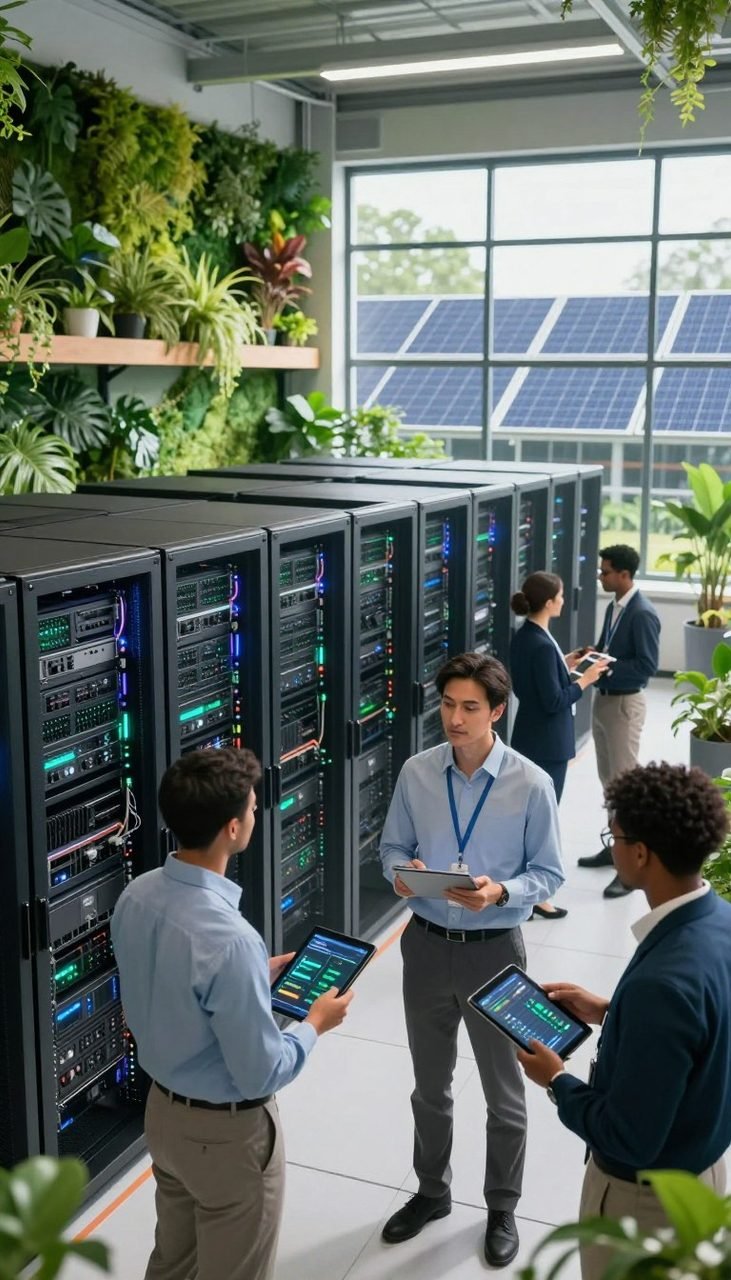
A sprawling hyperscale data center, showcasing extensive computing infrastructure with rows of sleek server racks, illuminated by soft blue LED lights. In the foreground, emphasize advanced cooling systems with visible air ducts and eco-friendly energy sources like solar panels. The middle ground reveals technicians in professional attire, monitoring screens and managing networks, surrounded by a clean, organized environment. The background features large windows allowing natural light to filter in, contrasting with the high-tech equipment. Capture this scene with a low-angle perspective, providing depth and a sense of scale. The atmosphere should evoke innovation and sustainability, tailored for an article by The Sustainable Digest.

A modern data center is less like an office and more like an industrial machine. Its scale depends on servers, storage, power systems, and cooling equipment working without pause. Size alone does not tell the full story; computing density matters just as much.

Hyperscale usually describes a facility larger than 10,000 square feet. OpenAIโ€™s proposed project near Saline, Michigan, offers a striking comparison at 2.2 million square feet. Inside, processors, hard drives, CPUs, GPUs, switches, fiber networks, backup batteries, and cooling systems form one tightly linked operation.

Servers, GPUs, Networking Equipment, and Facility Infrastructure

Artificial intelligence raises rack density because GPUs handle demanding workloads at high speed. That design requires stronger electrical systems and faster heat removal. A building may look quiet from the road, yet its equipment runs with industrial intensity.

Rising Electricity Demand From Artificial Intelligence

One 100-word email created by ChatGPT uses roughly the electricity of an LED bulb running for 14 hours. That comparison makes a single request relatable, but millions of requests create a far larger burden. Each data center therefore belongs in a regional grid review, not in an isolated planning file.

The Environmental Impact of Data Center Energy, Water, and Land Use

Every new computing campus places pressure on power lines, local water supplies, and open land. Its benefits may reach far beyond the host town, while its costs remain close to nearby homes.

Electricity Consumption and Grid Capacity

High-power facilities can require new transmission lines, backup turbines, and fossil-fuel generation. In North Omaha, a coal plant stayed open beyond its planned 2023 closure because of rising demand. The decision extended pollution exposure in a predominantly Black neighborhood. In Memphis, xAI operated dozens of unpermitted methane turbines that released formaldehyde and smog-forming pollution.

Water Use for Cooling in Stressed Regions

Cooling systems also consume a major resource. Google reports roughly 6 billion gallons of water use worldwide each year. Gilroy, California, depends on a closed groundwater basin with little replenishment and no backup source. Imperial County relies fully on imported Colorado River water while mandatory cutbacks continue.

Construction Waste, Air Pollution, and Embodied Carbon

Land clearing removes habitat and increases runoff. Concrete, steel, wiring, and discarded equipment add embodied carbon and construction waste. Strong permits should track air emissions, material use, and water use from site preparation through operation; otherwise, โ€œprogressโ€ becomes an expensive local experiment.

Greenwashing and the Transparency Gap in Data Center Sustainability

A futuristic data center showcasing sustainability efforts, prominently featuring solar panels and green roof gardens in the foreground. In the middle ground, transparent glass structures symbolize openness and transparency, with visible energy-efficient technologies like wind turbines and energy-efficient cooling systems. The background displays a smart city skyline powered by renewable energy, with lush greenery integrated into urban architecture. Soft, natural lighting emphasizes a hopeful atmosphere, suggesting harmony between technology and the environment. A wide-angle view captures the entire scene, highlighting the connection between advanced technology and ecological responsibility. The composition is professional and polished, with a touch of realism to convey the serious subject matter of data center sustainability. Artistry reflects the brand, "The Sustainable Digest."

Sustainability claims can shine brightly while the facts remain in the shadows. A polished net-zero promise means little when residents cannot review current information about power use, water demand, emissions, or backup equipment. Credible performance requires facility-level proof, not corporate language alone.

Why Public Information About Energy and Water Use Is Often Limited

A May 2026 report from The Next 10 and Santa Clara University found that about 93% of Los Angeles County facilities had no publicly accessible environmental documents. This gap blocks meaningful review of local risks. Dr. Irina Raicu called the mix of limited information and Californiaโ€™s fragile water supplies a serious planning problem.

Distinguishing Net Zero Claims From Measurable Performance

Operators should publish electricity, water, emissions, generator use, and construction impacts in comparable formats. Independent audits should test each claim. Residents also need timely information before permits are approved, not after contracts are signed.

Net zero becomes credible only when communities can inspect results, question assumptions, and track progress. Otherwise, sustainability may become a label that carries more polish than proof.

Environmental Justice and the Unequal Burden of Data Center Siting

A server site may look efficient on paper, yet its costs can land unevenly across nearby neighborhoods. Location matters as much as technology. Water stress, social vulnerability, and weak air quality protections can turn a local project into a public health concern.

Social Vulnerability, Water Scarcity, and Local Air Quality

A California report examined Santa Clara, Los Angeles, Sacramento, Gilroy, and Imperial County. Imperial County and Sacramento showed the clearest overlap between scarce water and vulnerable residents. In such places, new facilities may compete with farms, homes, and essential services.

North Omaha offers another warning. A coal plant serving a predominantly Black neighborhood remained open as computing demand grew, despite some of the nationโ€™s highest asthma rates. In Memphis, xAIโ€™s unpermitted turbines released formaldehyde and smog-forming pollution linked to asthma, heart disease, and cancer risks.

Who Bears the Health Risk?

Black, Latino, Indigenous, and low-income residents should have equal power in siting decisions. Efficiency cannot excuse unequal exposure.

โ€œA fair site protects health before it promises growth.โ€

PlacePrimary concernEquity lesson
Imperial CountyWater scarcityProtect basic supply
North OmahaCoal pollutionPrioritize asthma prevention
MemphisTurbine emissionsEnforce air permits

Misrepresentation of Marginalized Communities in Development Decisions

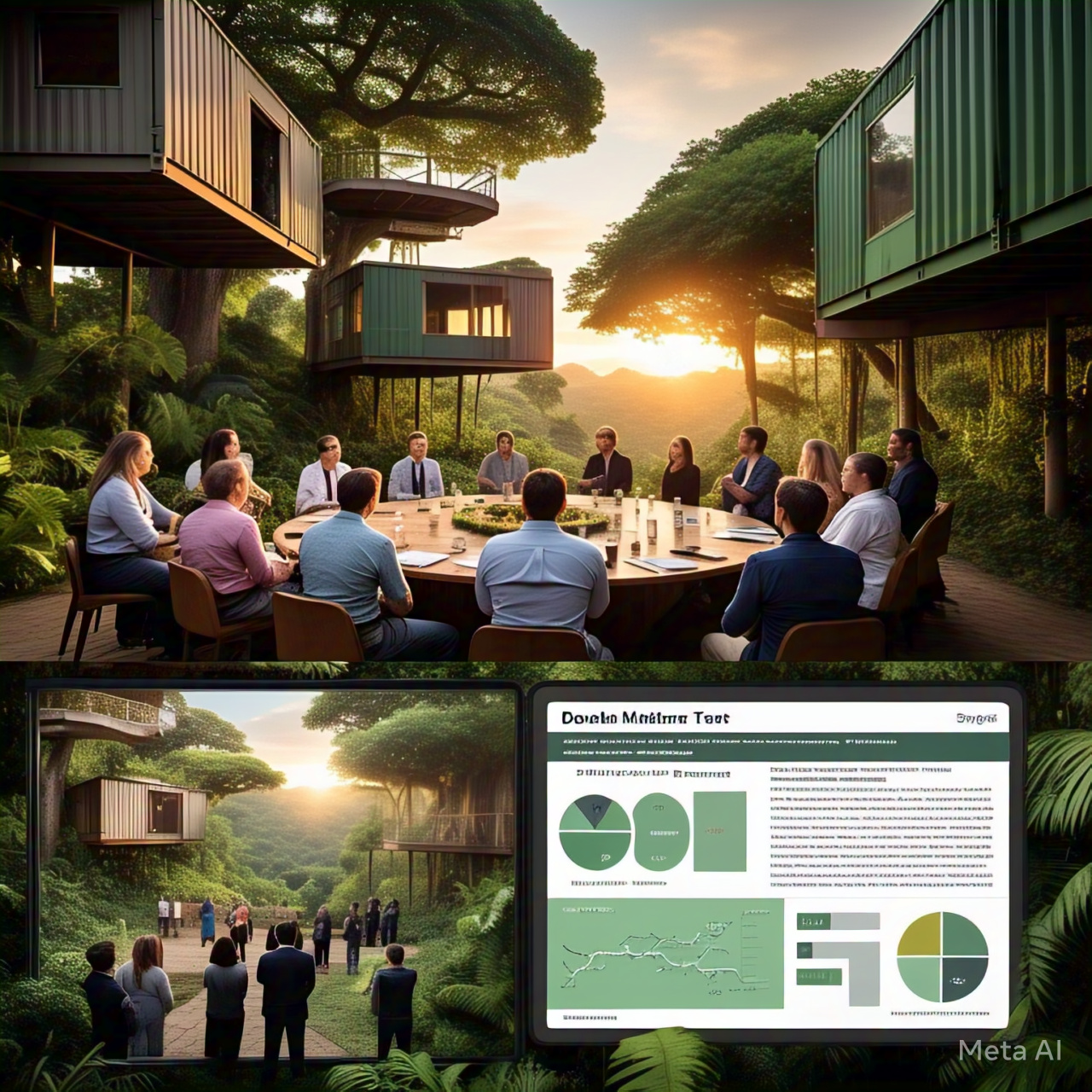
A diverse group of community members, including individuals from marginalized backgrounds, gather in a sunlit conference room, engaged in a respectful discussion around a large, round table covered with blueprints and digital tablets. In the foreground, a young woman of African descent in professional attire actively points to a design proposal, embodying engagement and collaboration. The middle ground features various professionals, including an elderly Hispanic man and a young Asian woman, all dressed in business casual clothing, listening intently and taking notes. The background reveals a wall filled with infographics about community development, with plants creating a green, eco-friendly atmosphere. Warm, natural lighting floods the room, creating an inviting and hopeful mood, reinforcing the concept of meaningful consent in server proposals. The Sustainable Digest logo subtly displayed on a tablet screen conveys a modern, environmentally conscious ethos.

Public input loses value when officials invite residents only after key choices have been made. A packed meeting can create the appearance of consent while leaving affected families without technical support or real influence. Ethical participation must continue from early review through final approval.

Token Consultation Versus Meaningful Community Consent

Meaningful consent gives residents access to engineers, legal advisers, and clear project records. It also allows them to question water studies, grid forecasts, air permits, and tax agreements. Iris Stewart-Freyโ€™s Climate Justice Lab at Santa Clara University links climate risk with community voice, offering a useful model for fair review.

Irina Raicu, who directs the universityโ€™s Internet Ethics Program, applies rights, justice, care, common-good, and virtue-ethics principles. These lenses help communities weigh competing public interests without treating residents as obstacles.

Building Local Capacity to Review Server Proposals

Local review teams can train residents to examine technical filings and explain them to neighbors. Community mobilizers, nonprofits, NGOs, and โ€œgrasstopsโ€ leaders can support this work. The people most affected should define their own priorities.

Weak processStronger practiceCommunity benefit
One public meetingOngoing consent processTrust and influence
Complex filingsLocal technical trainingInformed review
Outside prioritiesResident-led goalsEthical representation

Exploitation of Under-Represented Cultures, Heritage, and Community Knowledge

Land carries memory, identity, and practical knowledge. A server project can harm all three when planners treat a cultural landscape as empty space. Indigenous rights and local heritage must shape decisions before land is acquired, graded, or linked to new infrastructure.

Protecting Indigenous Rights and Cultural Landscapes

Tribal nations and local residents may understand groundwater, seasonal change, wildlife routes, and heritage sites better than a short survey can show. Their knowledge can improve site review, but only when contributors keep control over its use. Broad stakeholder participation, early consent, and paid cultural advisers create a stronger process.

Using Cultural Assets Through Reciprocity Rather Than Extraction

The California research supports care ethics and the common good. These approaches value relationships, shared resources, and long-term trust over quick approval. Developers can offer reciprocity through local ownership, consent-based research, heritage protection, and lasting community investment.

Cultural symbols should not become decorative branding for benefits that flow elsewhere.

RiskProtective practiceCommunity result
Heritage lossEarly cultural reviewSites remain protected
Knowledge extractionConsent and paymentLocal agency grows
Unequal benefitsShared ownershipValue stays local

Geopolitical Conflicts, Supply Chains, and the Race for Digital Infrastructure

A panoramic view of a futuristic cityscape illustrating geopolitics and digital infrastructure. In the foreground, a sleek data center building with solar panels and greenery symbolizes green architecture, surrounded by high-tech surveillance drones monitoring nearby supply chain routes. In the middle ground, roads filled with cargo trucks and autonomous delivery vehicles emphasize the logistics of global trade, while diverse professionals in business attire collaborate at digital workstations, discussing strategies. The background features a skyline of modern skyscrapers integrated with renewable energy sources, under a bright blue sky transitioning to a warm sunset, creating an atmosphere of innovation and global connectivity. The entire scene captures the tension and urgency of geopolitical conflicts intertwined with technological advancement. The Sustainable Digest.

Behind every server campus lies a global contest for chips, minerals, equipment, and electricity. International rivalry can turn local land into a strategic asset, while residents face decisions shaped by forces far beyond their county.

Virginia leads the U.S. market, followed by Texas and California. Reliable grids, fiber networks, land, and tax incentives draw major operators to these regions. As generative AI becomes a central business priority, hyperscalers are raising capital spending sharply. Municipalities may compete so hard for investment that their negotiating power weakens.

Critical Minerals, Equipment Manufacturing, and Energy Security

Chips, transformers, batteries, and rare minerals move through complex supply chains. Conflict, export limits, or labor abuses can delay projects and raise costs. Responsible procurement should test labor rights, human rights, mining practices, and supplier emissionsโ€”not just delivery times.

How Global Competition Shapes Local Expansion

Energy security adds another challenge. Some regions retain fossil-fuel plants when renewable capacity, transmission, or storage cannot grow quickly enough. Strong permits should link new campuses to cleaner power, firm deadlines, and public reporting.

Global pressureLocal effectResponsible response
Mineral shortagesHigher equipment costsTraceable sourcing
Rising AI investmentFaster land competitionFirm public terms
Grid constraintsFossil plants remain onlineClean capacity targets

Slow Yet Reluctant Municipal Development and Infrastructure Planning

Local governments often face an awkward bargain: welcome investment quickly or pause to measure its lasting cost. A major server center can bring jobs and tax revenue, yet it may also strain water systems, roads, schools, housing, and public budgets. Careful planning protects residents before construction begins.

Planning Gaps, Confidential Agreements, and Public Accountability

Planning assumptions can change faster than a permit review. In Georgia, projected extra power needs for 2030 rose from about 2 gigawatts to 6 gigawatts as computing demand grew. California researchers mapped operating and proposed facilities across the state, giving officials a clearer view of cumulative pressure.

Private agreements can hide utility promises, public costs, land impacts, and emergency needs. Confidentiality should not become a substitute for accountability. Residents need hearings, accessible records, and enforceable deadlines.

Coordinating Utilities, Schools, Housing, Water, and Transportation

Agencies should review each project together. Gilroyโ€™s closed groundwater basin has limited replenishment and no backup source, making water review urgent. Municipalities should require cumulative-impact studies and coordinate utilities, schools, housing, roads, and transit before approving major center development.

Corporate Greed, Tax Incentives, and the Unequal Economics of Data Centers

A corporate office looking down on a sprawling urban landscape with data centers in the foreground, detailed with solar panels and greenery, symbolizing sustainability. The middle ground features tax incentives represented as visual metaphors, such as money trees and upward arrows, alongside utility costs depicted as diminishing power bills. The background includes a sunset sky, casting a warm, hopeful glow over the scene, reflecting the tension between corporate greed and environmental justice. The composition should capture a sense of contrast and conflict, highlighting the duality of profit and sustainability in a smart city. The atmosphere is thought-provoking yet optimistic, designed for an audience engaged with economic and environmental issues. The Sustainable Digest.

Public subsidies can make private expansion look like a public victory. Yet discounted power, generous tax incentives, and weak oversight may leave residents carrying hidden costs. Economic development is fair only when public returns match public support.

Utility Rate Increases and Costs Passed to Residents

Large server facilities often negotiate special utility terms. If a utility builds lines or plants for one customer, households, schools, and small firms may help pay the bill. Bloomberg reported that electricity prices more than doubled in over five years in some areas near these sites. Regulators should require clear cost-sharing rules and rate protection.

Questioning Job Creation and Lost Public Revenue

Construction can create many short-term jobs, but operations usually need far fewer permanent workers. Good Jobs First found that Texas raised its estimated tax breaks from $130 million to $1 billion in two years. Such incentives can drain funds from schools, transit, and public health unless officials measure lasting value.

Designing Community Benefit Agreements With Enforceable Terms

A strong agreement should require local hiring, procurement, tax recapture, air and water monitoring, rate safeguards, and penalties for missed promises. Economic development should build local wealth, not simply reduce corporate costs.

How Cooperative Enterprises Can Create Shared Ownership and Local Value

A vibrant and inspiring scene depicting cooperative renewable power ownership. In the foreground, a diverse group of men and women in professional business attire engage in a lively discussion, pointing to a large solar panel layout at their feet, symbolizing collaboration. The middle ground features a modern green building integrated with wind turbines and lush greenery, demonstrating environmental responsibility. In the background, a clear blue sky filled with soft clouds contrasts with the eco-friendly infrastructure, embodying hope and innovation. The lighting is bright and inviting, creating a warm atmosphere. Shot from a slight low angle to emphasize the height of the structures and the aspirations of the people. This image should convey a sense of community, progress, and shared values in sustainability. Inspired by "The Sustainable Digest".

Ownership can shape whether a large computing project strengthens a region or simply extracts its resources. Member-led models offer a practical way to keep earnings, skills, and decision-making closer to residents. This way, local value becomes part of the plan rather than a late promise.

Energy Cooperatives and Community-Owned Renewable Power

Energy cooperatives can finance solar panels, wind turbines, battery storage, and efficiency upgrades. These assets can serve a facility and nearby households at the same time. Another way to reduce grid pressure is to pair renewable power with demand planning and shared storage.

Worker, Consumer, and Community Investment Models

Workers, consumers, and residents can purchase a financial share in local infrastructure. They can also elect board members and review spending. A second share can support schools, job training, cultural preservation, water resilience, or lower energy bills.

Virtualization offers a related lesson: shared computing resources improve equipment use and limit duplicate hardware. That approach creates a better way to manage capacity. It also shows the way cooperation can support reliable services without endless expansion.

Shared ownership turns public support into public participation.

Cooperation is a governance structure, not decorative branding.

What Policymakers Can Require for Equitable Data Center Growth

A modern, equitable server infrastructure scene showcasing a diverse group of professionals in business attire analyzing a high-tech data center. In the foreground, a collaborative meeting table is filled with blueprints and digital tablets displaying sustainable designs. The middle ground features rows of eco-friendly servers with visible greenery integrated into their design, emphasizing environmental justice. The background reveals large windows allowing natural light to flood in, creating a bright and optimistic atmosphere. The setting conveys a sense of progress and innovation, with a focus on renewable energy sources powering the infrastructure. The overall mood is professional yet inspiring, reflecting themes of sustainability and community involvement in technology. The Sustainable Digest logo subtly integrated into one of the tablets.

Public rules can turn rapid computing expansion into a fairer bargain. The U.S. Department of Energy projects that server facilities could consume 12% of national electricity by 2028. Utilities need clear goals before approving new loads, rather than treating each proposal as an isolated deal.

Standardized Reporting for Energy, Water, and Air Quality

Reporting should cover electricity, water, PUE, CUE, greenhouse gases, backup generators, air emissions, and local effects. The Green Grid metrics help utilities compare energy and carbon performance. Public records also let residents test corporate claims.

Permits, Renewable Rules, and Responsible Incentives

The 2023 German Energy Efficiency Act offers a useful model for binding goals. Utilities can use similar standards when reviewing projects. Permits should assess cumulative effects on water, grid capacity, traffic, housing, and air quality.

Memphis shows why regulators must reject unpermitted methane turbines and monitor formaldehyde and smog-forming emissions. Tax incentives should require renewable additions, local hiring, public revenue, ratepayer protection, and verified results. Utilities must meet renewable goals, while permit terms should include emissions controls and penalties.

โ€œPublic support should purchase public accountability, not private silence.โ€

How NGOs, MSMEs, Nonprofits, and Community Mobilizers Can Collaborate

A vibrant community scene showcasing collaboration for sustainable data centers, set in an urban park. In the foreground, diverse community members including NGOs, MSMEs, and nonprofits โ€“ all dressed in professional business attire โ€“ gather around a large interactive digital display showing renewable energy data and community projects. In the middle ground, green buildings with solar panels and vertical gardens reflect modern eco-friendly architecture, emphasizing a commitment to environmental justice. The background features a city skyline with hints of technology and greenery, bathed in warm sunlight, creating an optimistic and collaborative atmosphere. Use a wide-angle lens to capture this bustling scene, highlighting the connection between technology and community spirit, with soft, natural lighting to enhance the welcoming mood. This image embodies the essence of "The Sustainable Digest."

Local partnerships can turn complex infrastructure debates into practical public action. NGOs, nonprofits, and grassroots support groups may work together, or act independently when urgent needs arise. Their shared goal is clear: help residents understand proposals for data centers before officials approve them.

Grassroots Monitoring, Legal Support, and Public Education

Community groups can translate technical filings, host public meetings, and provide legal services. They can also track water use, air quality, permits, and utility costs through accessible monitoring programs. The California report, co-authored by Santa Clara University students and researchers, urges communities to build local research capacity when information is missing.

Local Procurement, Workforce Training, and Small Business Participation

MSMEs can supply construction services, catering, landscaping, cybersecurity, transport, equipment repair, and renewable-energy services. Construction work also creates openings for electricians, HVAC workers, and other skilled trades.

  • Community mobilizers organize residents.
  • Tastemakers build public attention.
  • Grasstops leaders open institutional doors.
  • Workforce programs connect residents with lasting technical careers.

Strong collaboration makes public oversight a shared civic skill, not a specialist privilege.

Responsible Data Center Construction and Operations for Sustainable Communities

A modern data center nestled in a green landscape, showcasing responsible construction and energy-efficient operations. In the foreground, a well-organized team of professionals in smart casual attire examines blueprints and solar panel installations, symbolizing collaboration and innovation. The middle ground features the data center building itself, designed with sustainable materials, large windows reflecting natural light, and integrated greenery on the facade. The background presents a clear sky with wind turbines gently spinning, and a vibrant community with electric vehicles and public green spaces, representing environmentally conscious urban development. The scene is illuminated by warm, natural lighting, conveying an optimistic and responsible atmosphere, suitable for "The Sustainable Digest."

Responsible construction begins before the first server enters the building. A compact footprint, low-emission materials, and recycled construction inputs can reduce embodied carbon and limit land disturbance. Designers should also plan for repair, reuse, and safe recycling when equipment reaches the end of its service life.

Operations matter just as much. Virtualization lets several virtual servers run on one physical machine, which cuts idle hardware and energy use. Workload scheduling can shift flexible tasks to periods with cleaner power or lower demand. A DCIM platform can track power, lighting, assets, and cooling in real time.

Efficient Cooling, Waste Heat Recovery, and Water Stewardship

Liquid cooling can support dense AI workloads, but it needs skilled maintenance. Hot-aisle and cold-aisle containment also reduces wasted cooling. Combined heat and power may reuse waste heat for electricity or nearby heating. Water-efficient systems and closed-loop designs further protect local supplies.

PUE divides total facility energy by IT equipment energy. CUE compares carbon emissions with IT energy use. Together, these measures reveal whether efficiency claims match performance.

PracticePrimary benefitKey safeguard
VirtualizationFewer idle serversMonitor workload demand
Liquid coolingBetter heat controlMaintain specialized systems
Heat recoveryUseful local energyConnect to nearby users

Biomimicry, Net Zero Practices, and Renewable Technology in Data Centers

A futuristic data center seamlessly integrated into a lush urban landscape, showcasing biomimicry in architecture. In the foreground, vibrant green walls mimic plant structures, while solar panels resembling leaves harness sunlight efficiently. The middle ground features wind turbines inspired by natural forms, blending harmoniously with the design. In the background, a clear blue sky illuminates the scene with soft daylight, casting gentle shadows on the eco-friendly structure. The atmosphere is serene and hopeful, hinting at a sustainable future. Include elements like lightweight, translucent materials, water conservation systems, and greenery that surrounds the building, emphasizing innovation and environmental harmony. The image aligns with the theme of clean energy technology as it relates to the mission of The Sustainable Digest, effectively highlighting the intersection of nature and technology in modern architecture.

Nature offers useful lessons for climate-conscious computing. A facility can study termite mounds, human circulation, and natural ventilation to move heat with less mechanical effort. Adaptive controls can adjust airflow as temperatures and workloads change. This climate-aware approach treats efficiency as a design principle, not a marketing line.

Designing Cooling and Energy Systems Inspired by Nature

Direct-to-chip and liquid cooling support dense processors, though both require specialized infrastructure. Designers can pair these tools with heat recovery and passive airflow. Such measures reduce climate impact while improving equipment reliability.

Combining Solar, Wind, Storage, and Demand Flexibility

Solar, wind, and hydropower can supply clean energy. Batteries help preserve clean energy when weather shifts or grid supply tightens. Operators can also move nonurgent workloads to hours with lower emissions and stronger renewable output.

Net-zero plans should show absolute cuts, new renewable capacity, storage results, and limits on fossil-fuel backup. Rising hyperscaler emissions after the generative AI boom reveal why climate goals must survive changing business priorities. Transparent accounting keeps clean energy claims tied to real climate commitments.

StrategyPractical valueProof required
BiomimicryLower cooling demandMeasured efficiency gains
StorageFirm renewable supplyOutput and duration records
Flexible workloadsLess grid stressCarbon-based scheduling logs

Enhancing Greenspaces, Public Health, and Community Resilience Around Facilities

A vibrant urban greenspace adjacent to a modern data center, showcasing lush trees and colorful flowers, with a diverse group of professionals in business attire engaging in outdoor activities, like discussions or yoga, highlighting the connection between technology and public health. In the foreground, a serene walking path lined with benches encourages community interaction. The middle ground features the sleek, eco-friendly architecture of the data center, adorned with solar panels and green roofs, while the background reveals a clear blue sky, symbolizing hope and sustainability. Soft, natural lighting bathes the scene, creating a peaceful, inviting atmosphere that emphasizes community resilience. A logo for "The Sustainable Digest" subtly appears in the corner, reinforcing the theme of environmental justice.

Thoughtful site design can turn a large computing facility into a better neighbor. Native plants, shade, and public paths can soften its footprint while improving local health. Landscape planning should serve people and wildlife, not merely hide an industrial wall.

Native Landscapes, Stormwater Management, and Biodiversity Corridors

Native trees and grasses need less irrigation and support birds, insects, and pollinators. Wetlands, bioswales, permeable pavement, and tree cover can slow runoff during heavy rain. These features also connect habitat areas and reduce heat near homes.

Public plans should include walking routes, shaded seating, noise buffers, air-quality checks, and safe access. Such features can make facilities less disruptive and help residents manage heat exposure.

Measuring PUE, CUE, Water Performance, and Community Benefits

The Green Grid created PUE and CUE to assess energy and carbon performance. LEED reviews energy, water, materials, and wider site impacts. Energy Star, managed by the EPA and the Department of Energy, adds another verification tool. Yet public records should also track water use, health outcomes, habitat gains, and local investment.

MeasureWhat it showsPublic value
PUE and CUEEnergy and carbon efficiencyComparable performance
Water metricsConsumption and reuseResource protection
Community indicatorsHealth, access, and local benefitsAccountable results

Conclusion

Digital infrastructure can support modern life without becoming a license for unchecked expansion. Forecasts that facilities may use 12% of U.S. electricity by 2028 show why public rules must guide growth.

Water planning matters just as much. Googleโ€™s reported six billion gallons of annual use makes efficient cooling, reuse, and local supply reviews essential. The 93% documentation gap in Los Angeles County also proves that open records are a foundation of fair oversight, not a public-relations extra.

A stronger path joins operators with policymakers, NGOs, MSMEs, community groups, and cooperative enterprises. Enforceable benefits, local purchasing, shared ownership, and public monitoring can keep value near affected communities while respecting cultural knowledge.

Biomimicry, renewable power, efficient computing, repairable equipment, and larger public landscapes can improve resilience and health. Equitable growth does not reject technology; it gives communities information, consent, safeguards, ownership, and measurable benefits. That is how sustainable development earns trustโ€”and lasts.

FAQ

Why is artificial intelligence accelerating server-campus growth?

Artificial intelligence requires large computing clusters, advanced GPUs, and constant processing power. This demand increases electricity use, equipment orders, facility construction, and pressure on utility grids.

What makes a modern server facility resource intensive?

A large facility combines servers, networking systems, backup power, cooling equipment, and security services. These systems consume substantial energy, water, land, and construction materials.

How does electricity demand affect local communities?

A major new load can require grid upgrades, new substations, or power-line expansion. If regulators approve projects too quickly, residents may face higher utility costs or weaker reliability.

Why is cooling a major concern?

Computing equipment produces intense heat. Many cooling systems use water, while others increase electricity demand. Regions facing drought must weigh industrial use against household, farm, and ecosystem needs.

What environmental effects can facility construction create?

Construction can generate waste, traffic, dust, noise, air pollution, and embodied carbon. Site selection should also consider wetlands, farmland, wildlife corridors, and nearby homes.

How can the public distinguish real sustainability from greenwashing?

Strong claims should include verified figures for electricity, water, emissions, air quality, and renewable power. A vague net-zero promise means little without a clear baseline, timeline, method, and public report.

What does environmental justice mean in facility siting?

It means no community should carry a disproportionate share of pollution, water stress, noise, or financial risk. Reviews should examine income, race, health, housing, and existing industrial burdens.

Why do Black, Latino, Indigenous, and low-income communities need a strong voice?

These communities have often experienced weaker political influence and higher exposure to pollution. Fair planning requires early notice, accessible information, legal support, and meaningful consentโ€”not a meeting after the decision.

How can local governments prevent token consultation?

Officials can publish agreements, provide independent technical reviews, fund community experts, and allow time for public response. Binding conditions should cover water, jobs, pollution, traffic, and long-term monitoring.

How should Indigenous rights and cultural landscapes shape planning?

Governments and companies should respect tribal sovereignty, sacred places, traditional knowledge, and cultural heritage. Any use of community knowledge should involve reciprocity, permission, fair payment, and shared control.

How do global supply chains affect local facility projects?

Critical minerals, chips, transformers, batteries, and networking equipment come from complex international markets. Geopolitical conflict can raise costs, delay construction, and increase concerns about energy security.

Why do municipal planning gaps create risk?

Local plans may not keep pace with rapid computing growth. Confidential agreements can limit public oversight, while weak coordination can strain schools, housing, roads, water services, and emergency systems.

Do tax incentives always produce broad economic benefits?

Not always. Incentives may reduce public revenue while residents absorb utility upgrades and infrastructure costs. Policymakers should test job quality, local hiring, tax recovery, and the full public return.

What should a community benefit agreement include?

It should set enforceable goals for local procurement, workforce training, air monitoring, water protection, renewable power, public services, and neighborhood investment. Penalties should apply when the operator misses its commitments.

How can cooperative enterprises create shared value?

Energy cooperatives can help residents own renewable projects, storage assets, or efficiency services. Worker, consumer, and community investment models can keep part of the revenue in the region.

What reporting rules should policymakers require?

Operators should disclose electricity use, peak demand, water withdrawal, emissions, cooling methods, air quality, waste, and renewable energy claims. Reports should use common methods and cover the entire facility life cycle.

How can nonprofits and small businesses participate?

Community groups can support legal review, grassroots monitoring, public education, and health research. Small firms can gain opportunities through local procurement, maintenance, catering, construction, and technical services.

Which design choices reduce resource use?

Compact layouts, low-emission materials, repairable equipment, virtualization, workload optimization, and circular purchasing can lower impacts. Infrastructure management tools also help operators track performance and avoid waste.

How can renewable technology support responsible operations?

Solar, wind, batteries, and demand flexibility can reduce reliance on fossil-fuel generation. Nature-inspired design may improve airflow, shade, heat exchange, and resilience without treating technology as a magic wand.

What role do public landscapes play near industrial facilities?

Native plantings, stormwater systems, shade trees, and biodiversity corridors can reduce heat, flooding, and habitat loss. These features should serve nearby residents rather than function as decorative public relations.

Which performance measures matter most?

Power Usage Effectiveness, Carbon Usage Effectiveness, water performance, emissions, outage rates, and community benefits offer useful insight. Results should be measured over time and compared with local health and climate goals.
Key Takeaways

  • AI infrastructure can reshape local resources and electric grids.
  • Large facilities create major planning and public-health questions.
  • California research highlights transparency and water-access gaps.
  • Municipal hesitation often reflects real fiscal and social risks.
  • Cooperative ownership can strengthen community power.
  • Renewables, biomimicry, and open space offer practical alternatives.
  • With forethought, insight, with CSR and ESG coupled with an intentional sustainable agenda, Data Centers can provide social impact.


UN SDG #6: Unlocking Clean Water & Sanitation exploration

United Nations Sustainable Development Goals #6 Clean Water & Sanitation

Access to safe liquid resources is the most basic human need for health. While humanity celebrates reaching the stars, it is deeply ironic that billions still lack basic water sanitation. This reality remains a primary barrier to global stability and economic growth in the modern era.

The United Nations Sustainable Development Goals #6 Clean Water & Sanitation (UN SDG #6) framework provides a vital roadmap for change. This development priority uses eight specific targets to track progress across the globe. It represents an ambitious commitment to human rights and dignity for every person.

Recent data shows that we are making some positive steps forward. Between 2015 and 2024, access for the global population increased from 68 percent to 74 percent. While this growth is helpful, the current pace is not yet fast enough to hit our 2030 targets.

Meeting the demand for clean water sanitation requires a unified global effort. We must protect every source of water to ensure a healthy future (especially in remote regions). Infrastructure must evolve to keep up with the growing needs of our planet.

Efficient management of water is linked to poverty reduction and food security. Improving sanitation systems helps protect fragile ecosystems and promotes social peace. This guide will explore the innovations and policies driving these essential global changes.

As we analyze the distribution of water, we see a complex web of challenges. Universal sanitation remains a distant but achievable goal through smart technology and cooperation. We invite you to explore the data and stories behind this water crisis.

The Global Water Crisis: Understanding the Urgency

In an era of unprecedented technological growth, the irony remains that billions still live without safely managed drinking water. We often treat hydration as a given, yet the global infrastructure is failing to keep pace with our expanding population. This crisis is not merely a logistical hiccup but a fundamental threat to human dignity and economic stability.

Why Water and Sanitation Matter for Human Survival

Access to clean water is the literal baseline for human life. Without reliable drinking water services, communities face a constant barrage of waterborne diseases like cholera and typhoid. These preventable illnesses continue to claim millions of lives, especially among children under five.

Furthermore, the lack of sanitation creates a ripple effect throughout the economy. The World Bank estimates that poor water management results in $260 billion in annual economic losses. When people spend hours daily searching for a source, productivity plummets and education suffers.

Current State of Global Water Access in 2025

As we navigate 2025, the statistics remain sobering despite our collective scientific knowledge. Currently, 2.2 billion people still lack safely managed drinking water. Additionally, 3.4 billion live without safely managed facilities for sanitation.

Waterfall, Victoria falls, Spray image. https://pixabay.com/photos/waterfall-victoria-falls-spray-2227010/
Global MetricEstimated CountSocial Impact
Lacking Drinking Water2.2 BillionHigh child mortality
Lacking Sanitation3.4 Billion$260B economic loss
Water Stress Level18 PercentReduced agricultural output
Faucet, Sink, https://pixabay.com/photos/faucet-sink-tap-tap-water-flow-3240211/

The demand for this resource has consistently outpaced growth in the global population. By 2050, the number of urban dwellers suffering water scarcity is projected to double. This trajectory suggests that nearly 2.4 billion urban residents will struggle to meet their basic needs.

The Connection Between Water Scarcity and Climate Change

Climate change is the great multiplier of the global water crisis. Rising temperatures disrupt traditional precipitation patterns, making water availability increasingly erratic and unpredictable. This volatility turns once-fertile regions into dust bowls, forcing millions into precarious living conditions.

One in ten now lives in areas under high or critical water stress. As droughts intensify, the number of individuals suffering water scarcity will likely reach half the global population for part of the year. This shift demands a radical rethink of how we protect our most precious liquid asset and ensure access for all.

The Freshwater Reality: Availability and Distribution

A detailed map illustrating the global distribution of freshwater resources, showcasing various types of water bodies, including rivers, lakes, and aquifers. In the foreground, highlight vibrant blue rivers snaking through green landscapes, with labels indicating major freshwater sources. The middle ground features diverse ecosystems, such as wetlands and forests, illustrating biodiversity and water conservation. The background depicts a globe with water scarcity areas highlighted, emphasizing the unequal distribution of freshwater. Soft, natural lighting casts a hopeful atmosphere over the scene, suggesting future improvements and sustainability. The image should be vivid and educational, designed to attract attention and inform the viewer about the critical state of global freshwater resources. The Sustainable Digest.

Despite the vast oceans dominating our maps, the reservoir of accessible freshwater is a mere rounding error in the planetary total. While Earth looks like a “blue planet,” only 0.5 percent of its liquid is actually useable water for human survival.

Understanding Earth’s Water Distribution

Most of the planet’s supply, about 97.5 percent, is saline and rests in our oceans. The remaining 2.5 percent is freshwater, but even that information requires closer inspection for proper context. Glaciers and ice caps lock away more than two-thirds of that tiny portion, making it inaccessible for daily use.

Consequently, groundwater constitutes the largest component of the remaining supply and serves as the primary source of supply for many countries. Surface water remains a minuscule fraction, yet it is the most visible part of our global supply chain.

Water TypePercentage of TotalAccessibility Status
Saline (Oceans)97.5%High salt content
Glaciers/Ice~1.7%Frozen and inaccessible
Groundwater~0.75%Main usable reservoir

The Color Spectrum of Water Types and What They Indicate

Experts use a color-coded system to track various water resources and their specific ecological roles. Blue water refers to surface and groundwater that we can readily pump for drinking or industrial cooling. Green water describes the moisture held in soil that plants consume to grow and release back into the atmosphere.

Finally, gray water identifies polluted supplies that require significant treatment before they can safely enter the environment again. These classifications help managers assess usability beyond simple volume metrics. Understanding these colors allows for a more nuanced view of how we manage our precious liquid assets.

Water Stress Levels Across Continents

Global water stress reached 18 percent in 2020, but these levels vary dramatically between different geographic basins. The Middle East and North Africa (MENA) region faces critical stress, withdrawing far more than their renewable resources can naturally provide. Pakistan recorded a stress level of 116 percent, highlighting a heavy reliance on non-renewable groundwater mining.

Even developed nations like Singapore experience high availability issues, with stress levels sitting at 83 percent. However, Singapore proves that limited water does not mean a lack of security. Through desalination and wastewater recycling, they manage their water with impressive technological efficiency.

Renewable Freshwater Resources and the Water Cycle

The water cycle acts as a planetary recycling machine, constantly moving moisture between the sea, air, and land. This natural process generates renewable water resources based on the unique geographical position of different countries. Rainfall and upstream river flow determine the basic availability of water for every community on Earth.

Effective management of these resources is the only way to bridge the gap between nature’s supply and human demand. While the cycle is constant, the human pressure on it has never been higher. We must respect the finite nature of this water to ensure a sustainable future for all.

United Nations Sustainable Development Goals #6 Clean Water & Sanitation: Targets and Progress

Navigating the complex landscape of global hydration requires a deep dive into the six primary pillars of UN SDG #6. These targets provide a technical roadmap to ensure that every human gains equitable access safe and sustainable resources. While the world moves toward these goals, the pace remains a point of analytical debate among experts.

Target 6.1: Universal Access to Safe and Affordable Drinking Water

Progress is visible but slow. Since 2015, the world saw an increase from 68 to 74 percent in managed drinking water services. Despite this, roughly 2.2 billion people still lack access safe affordable solutions, highlighting a significant gap in our global infrastructure.

Achieving equitable access requires more than just pipes; it requires affordable drinking water for the most vulnerable populations. Experts suggest that current rates of improvement must double to meet the 2030 deadline for safe affordable drinking resources. Without this acceleration, many will continue to rely on unprotected drinking water sources.

“The human right to water entitles everyone to sufficient, safe, acceptable, physically accessible and affordable water for personal and domestic uses.”

UN Committee on Economic, Social and Cultural Rights

Target 6.2: Adequate Sanitation, Hygiene, and Ending Open Defecation

Human dignity relies on sanitation hygiene standards that protect the most vulnerable, especially women and girls. Currently, 3.4 billion people live without managed sanitation services, which often leads to severe health crises. This target specifically aims to end open defecation by providing safely managed sanitation infrastructure in rural and urban areas.

Furthermore, 1.7 billion people still lack basic hygiene services at home. This gap compromises the overall success of clean water initiatives. Governments must prioritize safely managed solutions to ensure that equitable access safe facilities becomes a global reality.

Target 6.3: Improving Water Quality and Wastewater Treatment

Improving water quality remains a priority to reduce hazardous chemicals in our supply. We must address wastewater treatment globally to preserve clean water for future generations. Reducing pollution and eliminating the dumping of waste into rivers are critical steps toward this goal.

Target 6.4: Water-Use Efficiency and Addressing Water Scarcity

Climate change makes it vital to ensure sustainable withdrawals across all industrial and agricultural sectors. This target pushes for high water-use efficiency to mitigate the growing threat of scarcity. By optimizing how we use every drop, we can protect drinking water supplies for future urban centers.

Target 6.5: Integrated Water Resources Management

Successful water resources management often requires nations to work together across political borders. This integrated approach ensures that sustainable management water practices benefit entire regions rather than just single countries. Cooperation on transboundary water services is essential for regional peace and security.

Target 6.6: Protecting Water-Related Ecosystems

While the 2020 deadline for protecting ecosystems has passed, the urgency remains. Protecting wetlands and rivers is essential to ensure availability sustainable water cycles for the planet. Restoring these natural systems supports the management of all other drinking and sanitation goals.

Target Metric2015 Status2024 Progress2030 Global Goal
Managed Drinking Water68% Population74% Population100% Universal Access
Safely Managed SanitationBaseline Established3.4 Billion Lack Access100% Coverage
Water Resources ManagementFragmented ImplementationIncreasing CooperationFully Integrated
Wastewater TreatmentHigh Untreated RatiosImproved Recycling50% Reduction in Waste

Infrastructure Advancement and Technological Innovations

Humanity’s quest for sustainable liquid assets has moved from simple collection to sophisticated technological alchemy. To meet our 2030 targets, we must integrate smart infrastructure with bold engineering and cooperative business models.

Modern Sewage Process and Treatment Systems

Treatment systems have evolved from basic septic tanks to sophisticated multi-stage facilities. These facilities utilize secondary biological processes and chemical polishing to ensure safe sanitation for all communities. Advanced quaternary treatments even allow for potable reuse, effectively rendering wastewater safe for direct human consumption.

Wastewater Management Innovations for Urban Centers

Modern cities now face a 300 percent rise in domestic water use compared to the 1960s. New wastewater management strategies include energy-positive plants that capture biogas to power their own operations. Smart sensors provide real-time information to operators, which helps prevent system failures and catastrophic leaks before they occur.

Hydroponics and Aquaponics: Water-Efficient Food Production

Indoor hydroponic and aquaponic farm with lush green lettuce and clean fish tanks, futuristic sustainable agriculture, high-resolution.

Learn More

Agriculture currently claims 70 percent of global freshwater withdrawals, requiring a radical shift in farming. Hydroponic systems recirculate nutrients to use 90 percent less water than traditional soil-based farming methods. This form of sustainable development is essential for feeding a growing population while protecting our most precious liquid resource.

Desalination Technologies and Water Recycling Solutions

Large-scale desalination plant on a coastline with reverse osmosis membranes and solar panels, industrial 8k.

Learn More

Reverse osmosis has made desalination more affordable for coastal regions in the Middle East and North Africa. Leading services in Singapore prioritize water recycling to maintain security despite high environmental stress levels. Reliable sanitation and wastewater management are the pillars of these essential services in our increasingly arid global climate.

Environmental Impacts and Ecosystem Preservation

A serene landscape illustrating water resources management and ecosystem preservation for "The Sustainable Digest." In the foreground, a diverse group of professionals in business attire collaborate around a sustainable water purification system, ensuring clean water access. The middle ground features a lush wetland with thriving plants and wildlife, symbolizing ecosystem health. In the background, a clear blue sky and gentle sunlight create a hopeful atmosphere, with mountains reflecting the importance of conservation. Soft, natural light enhances the vibrant colors of the vegetation, while a wide-angle perspective captures the harmonious relationship between human efforts and nature. The image embodies unity in sustainability and the importance of preserving our water resources.

Environmental preservation remains an exercise in futility if we ignore the chemical and physical integrity of our global water resources. Water is essential for health, food security, and sustaining planetary biodiversity. However, many nations currently face mounting challenges from pollution and degraded water systems.

Target 6.6 of the Sustainable Development Goals specifically called for the restoration of mountains, forests, and wetlands by 2020. This deadline passed with mixed results, leaving many vital ecosystems vulnerable to human activity. We must recognize that healthy ecosystems are not obstacles to progress but the very foundation of it.

Coral Reef Degradation and Water Quality Connections

Terrestrial failures in sanitation often translate to ecological disasters in our oceans. Agricultural runoff and untreated waste flow downstream into coastal waters. This nutrient loading triggers massive algal blooms that effectively suffocate coral reefs.

These marine ecosystems protect shorelines and support global fisheries. When water quality declines, the extraordinary biodiversity of the reef vanishes. This connection demonstrates that freshwater and marine environments are part of a single, inextricably linked system.

Hydropower: Clean Energy Through Water Resources

Roughly 90 percent of global power generation is currently water-intensive. Hydropower serves as a critical source of clean energy for many developing nations. It provides renewable electricity without the direct carbon emissions associated with fossil fuels.

However, harnessing these resources creates a complex tension between climate goals and ecological health. Large dams often alter natural flow patterns and disrupt fish migration in major river basins. Finding a balance requires thoughtful infrastructure design and strict environmental flow requirements.

Protecting Water-Related Ecosystems: Wetlands, Rivers, and Aquifers

Protecting natural resources like wetlands and aquifers is vital for long-term economic development. These systems act as natural infrastructure by filtering pollutants and buffering against floods. They provide invaluable services that human-made systems struggle to replicate.

Ecosystem TypePrimary ServiceConsequence of Loss
WetlandsNatural FiltrationHigher Treatment Costs
RiversNutrient TransportHabitat Fragmentation
AquifersGroundwater StorageReduced Drought Resilience

Biodiversity Loss and Water Pollution

Biodiversity loss and water pollution form a destructive feedback loop. Contaminated water kills microorganisms and invertebrates that form the foundation of aquatic food webs. When these species decline, the ecosystem loses its natural capacity to purify itself.

Without better infrastructure management, we risk undermining the resilience of our entire planet. Inadequate sanitation continues to degrade habitats, leading to a silent crisis for freshwater species. Preserving the biological integrity of our planet requires us to value every drop of our liquid assets.

“Water is critical for electricity production and sustaining biodiversity and ecosystems.”

Achieving sustainable management water targets is the only way to ensure these ecosystems continue to provide for humanity. We must shift our perspective to view nature as essential infrastructure rather than an expendable resource.

Regional Challenges: Global South and Remote Islands

The quest for hydration takes on a different character in the Global South and isolated island chains, where “abundant water” doesn’t always mean “drinkable water.” While high-income regions often take a faucet for granted, developing nations grapple with a landscape where geography and infrastructure are often at odds. This creates a paradox where a country might be physically wet but functionally dry.

Sustainable development requires more than just finding a source; it requires the safely managed drinking water systems that protect public health. We must bridge the gap between resource availability and actual human consumption to ensure long-term stability. The following sections explore how various regions navigate these liquid logistics.

Water Access Challenges in the Global South

In the Global South, the struggle for access safe resources is often a matter of infrastructure rather than a lack of rain. For example, Uganda maintains a low water stress level of 5.8 percent, yet only 17 percent of its population can access managed drinking water. This highlights a clear disconnect between having water and being able to use it safely.

Agriculture further complicates this dynamic by consuming 90 percent of withdrawals in low-income countries. This heavy reliance on primary production leaves little for drinking water services and urban expansion. Without significant investment in management, these resources remain untapped or dangerously contaminated.

Remote Island Nations and Water Security

Remote islands face a unique set of vulnerabilities, including a high dependence on erratic rainfall and the constant threat of saltwater intrusion. These nations cannot rely on inter-basin transfers, making safely managed solutions incredibly difficult to implement. Rising sea levels further jeopardize the delicate aquifers that people rely on for survival.

Geography isolates these communities from technical expertise and the financing needed for clean water sanitation projects. Consequently, islanders often pay more for water services than those on the mainland. This isolation demands localized, resilient innovations to protect the existing population from climate volatility.

Water Cooperatives and Community-Based Solutions

An engaging photograph of a diverse community board meeting in Latin America, where local leaders are pointing at a map of a new community-managed well system.

Learn More

When centralized utilities fail, water cooperative organizations and community water management programs step in to fill the void. These models democratize clean water by giving local residents direct ownership and decision-making power over their systems. This ensures that sanitation hygiene practices align with local cultural norms and specific community needs.

In Latin America and India, these cooperatives operate small-scale treatment plants and enforce usage rules that prioritize sanitation for all. By involving the community in management water sanitation, these projects build lasting local capacity. Such bottom-up development transforms passive users into active stewards of their own health and hygiene.

Transboundary Water Cooperation: The Nile Basin Case Study

The Nile Basin presents one of the most complex water resources management challenges on the planet. Shared by eleven countries, this vital artery supports a population that grew from 143 million in 1971 to 564 million in 2021. With flows already fully allocated, the situation has become a zero-sum game for those seeking managed drinking options.

To prevent conflict, the Nile Basin Initiative facilitates access to shared data and cooperative planning. Ensuring safely managed sanitation and managed sanitation services across borders is essential for regional peace. This case study proves that sanitation and drinking security are not just technical issues, but diplomatic ones that require constant services and negotiation.

Conclusion

As the 2030 deadline approaches, the distance between our global aspirations for water sanitation and the physical reality on the ground remains starkly apparent. While safely managed drinking services reached 74 percent of the global population by 2024, billions still lack basic access. At our current speed, the world will not reach sustainable management of resources until 2049.

To ensure availability sustainable results, we must double our progress in schools and rural countries. This shift requires more than just pipes; it demands better availability of information, increased investment, and a holistic approach to achieve these levels of development. We must also prioritize safely managed sanitation and managed sanitation services.

By integrating sanitation hygiene into every policy, we can improve drinking quality for the population. Let’s move beyond rhetoric to provide reliable drinking water services and hygiene, finally securing clean water for all. Action is no longer optional; it is the only path to survival. Safely managed systems are the bedrock of a resilient future.

Woman, Bathing, Water image.https://pixabay.com/photos/woman-bathing-water-asia-flow-1807499/IImage by <a href="https://pixabay.com/users/sasint-3639875/?utm_source=link-attribution&utm_medium=referral&utm_campaign=image&utm_content=1807499">Sasin Tipchai</a> from <a href="https://pixabay.com//?utm_source=link-attribution&utm_medium=referral&utm_campaign=image&utm_content=1807499">Pixabay</a>

Key Takeaways

  • Access to safe drinking resources is a fundamental human right for all.
  • SDG 6 utilizes eight specific targets to measure global progress.
  • Global drinking coverage rose to 74 percent by the year 2024.
  • Sanitation is deeply interconnected with poverty reduction and ecosystem health.
  • Current progress must accelerate significantly to meet 2030 sustainability goals.
  • Technological innovation is essential for solving regional infrastructure challenges.

ISO Standardization & Benchmarking for Sustainability Achievement

The International Organization of Standardization (ISO) is a global benchmark and is vital in pushing for sustainable growth. It does this through its standards and guidelines, especially in ISO & sustainability. The ISO 9001 standard, for example, is all about quality management, a big part of sustainable growth. ISO 6222:1999 addresses the precise methods for counting microorganisms in water, ensuring the safety and quality of drinking water. Similarly, ISO 13053 utilizes Lean and Six Sigma methodologies to enhance process efficiency, tailoring solutions for different industry needs. As we move towards using more solar energy, ISO’s role in helping us grow sustainably is clearer than ever.

By using ISO standards, companies of all sizes can make sure they’re good for both the planet and people. This means they’re working towards a greener future. When ISO standards meet green practices, like solar energy and other renewables, it makes a big difference while helping cut down on carbon emissions and encourages being eco-friendly.

Introduction to ISO and Sustainability

ISO and sustainability go hand in hand. ISO gives guidelines and standards to help organizations become more sustainable. The ISO 9001 standard, for example, helps with quality management. This is key for companies wanting to lessen their environmental impact and boost their green efforts.

What is ISO for Sustainability?

There specific ISO standards that are a set of formal compliance instruments in promoting sustainability and sustainable development. They offer a framework for organizations to be guided by. This helps them reduce their environmental impact and improve their social impact and economic standing.

The ISO 10002 standard focuses on customer satisfaction. Meanwhile, the ISO 10018 standard is about quality management. These standards guide organizations on their sustainability journey.

Implementing ISO standards, like ISO 13053, can greatly benefit organizations. It uses Lean and Six Sigma to improve processes. This leads to reduced waste and increased efficiency.

Definition of ISO Standards

As mentioned previously ISO standards are guidelines for organizations to achieve specific goals in general. These goals include improving quality, reducing environmental impact, or enhancing customer satisfaction. The International Organization for Standardization (ISO) develops these standards.

Importance of Sustainability Standards

Sustainability standards, like those from ISO, are vital for organizations. They help reduce environmental impact and improve social and economic standing. By following these standards, organizations show their commitment to sustainability.

Overview of ISO Standards

More institutions and MSMEs are adapting ISO standards to promoting sustainability and environmental management. ISO 14000 series establishes comprehensive guidelines on implementing effective environmental management systems, encouraging businesses to minimize their ecological footprint. The ISO 14001 standard focuses on environmental management systems. It gives a framework for organizations to manage their environmental impacts. The ISO 14000 standard offers a broader framework for environmental management systems. It helps organizations develop and implement effective environmental management practices.

Industry-specific standards demonstrate ISOโ€™s versatility. From the energy efficiency assessments of ISO 11011 to the management systems of ISO 14001:2015, these guidelines support a eclectic array of sectors. They offer tailored solutions for achieving operational excellence and environmental responsibility.

This portion of the overview will discuss standards related to water quality, solar energy, compressed air energy efficiency, process improvement, and environmental management.

ISO 6222:1999 – Water Quality Micro-organisms Enumeration

ISO 6222:1999 provides guidelines for assessing water quality by enumerating culturable micro-organisms. This process involves colony counting using inoculation in a nutrient agar culture medium. It is a vital standard for laboratories and organizations involved in water analysis, ensuring accurate results in the measurement of microbial content in water samples. This standard supports the safety and quality of water by providing a reliable method for monitoring micro-organisms.

ISO 9488:1999 – Solar Energy Vocabulary

ISO 9488:1999 is a vocabulary standard for solar energy technology. It outlines the terminology used within the solar energy industry to enhance communication and avoid misunderstandings. By establishing clear definitions, this standard ensures consistency in technical documentation and communication. It is particularly useful for manufacturers, engineers, and researchers working with solar energy systems, allowing them to collaborate effectively internationally.

ISO 11011:2013 – Compressed Air Energy Efficiency

ISO 11011:2013 focuses on assessing energy efficiency in compressed air systems. It provides a methodical approach to evaluate the performance of these systems, from examining energy input to observing potential output improvements. This standard is especially valuable for industries reliant on compressed air, helping them improve energy use and reduce costs. By following these guidelines, companies can achieve optimal performance and sustainability.

ISO 13053 Series – Quantitative Methods in Process Improvement

The ISO 13053 series addresses quantitative methods in process improvement, specifically Lean and Six Sigma methodologies. ISO 13053-1 explains the DMAIC process, while ISO 13053-2 focuses on the tools and techniques. This series is essential for organizations aiming to enhance their processes through data-driven strategies. It provides a structured framework for analyzing and improving processes, ensuring efficiency and effectiveness in achieving business goals.

ISO 13053-1:2011 – DMAIC Methodology

The ISO 13053-1:2011 outlines the DMAIC methodology, which stands for Define, Measure, Analyze, Improve, and Control. This approach is exploited for improving quality and efficiency in processes by identifying problems and implementing effective solutions.

  • Define: Identify the problem and set goals.
  • Measure: Collect data to understand the current process performance.
  • Analyze: Determine root causes of defects or issues.
  • Improve: Implement solutions to improve the process.
  • Control: Maintain improvements in control systems and monitoring.

Businesses rely on DMAIC to reduce variability and improve quality, leading to better customer satisfaction and operational efficiency.

ISO 13053-2:2011 – Tools and Techniques

ISO 13053-2:2011 provides a set of tools and techniques to support the DMAIC methodology. These tools assist in analyzing data, identifying root causes, and developing effective solutions.

Key tools include:

  • Cause and Effect Diagrams: Help identify potential reasons for process issues.
  • Flowcharts: Visualize process steps and identify inefficiencies.
  • Statistical Process Control (SPC): Monitor process behavior and stability.
  • Failure Mode and Effects Analysis (FMEA): Anticipate potential failure points.

These tools ensure a data-driven approach to process improvement, facilitating effective analysis and solution implementation.

ISO/TR 16705:2016 – Six Sigma Statistical Methods

The ISO/TR 16705:2016 offers statistical methods specific to Six Sigma implementation, focusing on contingency table analysis. This enhances process improvement efforts by providing a framework for examining relationships between variables, supporting informed decision-making.

Key statistical techniques include:

  • Contingency Tables: Used to analyze and compare categorical data.
  • Regression Analysis: Identifies relationships between dependent and independent variables.
  • Hypothesis Testing: Assesses the effects of changes and supports valid conclusions.

These statistical methods provide organizations with the analytical skills necessary to drive continuous improvement and achieve substantial quality gains in their processes.

ISO/TR 17098:2013 – Contingency Table Analysis

ISO/TR 17098:2013 offers insights into using contingency tables in Six Sigma projects, which are crucial for analyzing categorical data. This statistical method helps identify the relationship between variables and guides decision-making in quality improvement projects.

By employing contingency table analysis, project managers can understand patterns and identify potential issues in processes. This technique is particularly beneficial for improving accuracy in process optimization and ensuring data-driven decisions. Organizations can gain a clearer understanding of process variations and implement effective corrective actions for enhanced performance.

ISO 14000:2015 Series -Management of Waste Reduction

The ISO 14001:2015 standard outlines requirements for environmental management, providing guidance for better resource use and waste reduction.

ISO 14004, ISO 14004, & ISO 14006

Standards like ISO 14004 and ISO 14006 offer additional guidelines on implementation and eco-design. This series supports businesses in managing their environmental responsibilities systematically, promoting sustainability and regulatory compliance.

ISO 14004:2016 – General Implementation Guidelines

ISO 14004:2016 offers additional guidance for organizations seeking to design and implement an EMS. It complements ISO 14001 by providing more detailed techniques and examples to help businesses achieve their environmental goals. The standard emphasizes leadership involvement, employee participation, and effective communication of environmental policies. It aims to integrate environmental management practices into everyday operations. This guidance is useful for organizations of all sizes and sectors, ensuring that environmental management becomes a natural part of business processes. By following ISO 14004:2016, companies can create a more robust and comprehensive EMS.

ISO 14005:2010 – Phased Implementation

The ISO 14005:2010 standard presents a flexible approach to adopting an EMS, allowing for phased implementation. This method is particularly beneficial for small and medium-sized enterprises or organizations with limited resources. It provides guidelines to gradually establish an EMS while adapting to resource and capability constraints. The phased approach lets companies focus on critical areas first, progressively expanding the scope. This step-by-step progression helps minimize disruption and manage costs efficiently. As a result, organizations can build confidence in their environmental practices before undergoing full assessment.

ISO 14006:2011 – Incorporating Ecodesign

ISO 14006:2011 guides organizations in integrating eco-design principles into their EMS. Eco-design involves considering environmental impacts throughout the product lifecycle, from raw material extraction to end-of-life disposal. This standard aims to help businesses develop environmentally friendly products and services. It provides tools and techniques to incorporate sustainability into design processes. By using ISO 14006, companies can improve product sustainability, reduce environmental impacts, and potentially gain an industry advantage. This approach supports sustainable development by encouraging resource efficiency and innovation in design practices.

Types of ISO Standards Relevant to Sustainability

There are several ISO standards related to sustainability. These include:

  • ISO 14001: Environmental management systems
  • ISO 14000: Environmental management systems – Principles, systems, and techniques
  • ISO 26000: Social responsibility

These standards give a framework for organizations to adopt sustainable practices. They help reduce environmental impacts and promote social responsibility.

Role of ISO in Global Sustainability Efforts

ISO is also crucial in global sustainability efforts. It partners with other organizations to support sustainable development. ISO standards help organizations develop and implement sustainable practices. This contributes to a more sustainable future.

The Process of ISO Certification

Getting ISO certification is a step-by-step journey. It prepares an organization’s management system for the ISO standard it chooses. For environmental management, ISO 14020, ISO 14030, 14031, and 14040 offer guidelines. These standards cover environmental labels, performance evaluation, and life cycle assessment.

Steps to Achieve ISO Certification

To get ISO certification, follow these steps:

  • Find the right ISO standard, like ISO 14020 for environmental labels and declarations.
  • Do a gap analysis to see how much you already meet the standard.
  • Create and use a management system that fits the standard’s needs.
  • Do internal audits and management reviews to check if the system works well.

Cost Factors in ISO Certification

The cost of ISO certification varies. It depends on the organization’s size, complexity, and the standard chosen. Standards like 14031 and 14040 might need more resources for life cycle assessment and environmental performance evaluation.

Benefits of ISO Standardization

ISO standards can greatly impact an organization’s operations and reputation. Adopting standards like ISO 14051 can enhance environmental management systems. This leads to a smaller environmental footprint. ISO 14064 GHG helps manage greenhouse gas emissions, and ISO 14046 offers a framework for water footprint assessment.

Some key benefits of ISO standardization include:

  • Enhanced operational efficiency, resulting in cost savings and improved productivity
  • Improved reputation and trust among customers, stakeholders, and the wider community

Enhanced Operational Efficiency

ISO standardization can streamline processes and boost efficiency. Standards like ISO 14051 help reduce waste and improve resource use. This leads to cost savings and better productivity.

Improved Reputation and Trust

Adopting ISO standards can also boost a company’s reputation and trust. Showing a commitment to environmental management and sustainability can enhance brand image. For example, ISO 14064 GHG helps show efforts to reduce greenhouse gas emissions and fight climate change.

Benchmarking for Sustainability

Organizations are now focusing on reducing their environmental impact. Benchmarking is key in this effort. It helps them compare their performance to industry leaders. This way, they can find areas to improve and lessen their ecological footprint.

The life cycle of products or services is important. It includes everything from raw material extraction to end-of-life disposal or recycling.

Benchmarking is continuously applied in projects and often with sustainable development standards in many areas, like energy consumption, water usage, and waste management. The ISO 14067 GHG standard helps measure and report greenhouse gas emissions. The ISO 14084 standard focuses on environmental management systems.

For tourist destinations, benchmarking is crucial. It helps reduce the environmental impact of tourism. By using sustainable practices and technologies, tourist spots can lessen their ecological footprint. This helps preserve their natural beauty.

The benefits of benchmarking for sustainability include:

  • Improved environmental performance
  • Enhanced reputation and brand image
  • Increased operational efficiency and cost savings
  • Better compliance with regulatory requirements

By using benchmarking, organizations can positively impact the environment. They can contribute to a more sustainable future. Whether through ISO standards or sustainable practices, benchmarking helps achieve sustainability goals and reduce environmental impact.

StandardDescription
ISO 14067 GHGGreenhouse gas management
ISO 14084Environmental management systems

ISO 14785:2014 – Tourist Information Office Requirements

ISO 14785:2014 specifies the service needs of tourist information offices. It highlights how these offices should manage visitor interactions, ensuring accurate information provision and customer satisfaction. The standard emphasizes the importance of staff training and the maintenance of a welcoming environment.

It covers the physical setup, including accessibility and signage, as well as the quality of promotional materials. This ensures visitors receive reliable guidance and support, enhancing their overall experience. Compliance with ISO 14785:2014 helps tourism offices enhance their operational standards and build trust with travellers, promoting sustainable tourism practices.

Frameworks for Sustainable Practices

Businesses aim to be sustainable and often use known frameworks outside of, or in conjunction with, sustainability to help. The six sigma methodology is a popular choice for improving processes. In the tourism and wellness spa world, these frameworks can lessen environmental harm while boosting customer satisfaction.

Key Elements of a Sustainability Framework

A good sustainability framework has parts like environmental care, social duty, and making money. These are vital for tourism businesses, where being green can set them apart. By using a framework, these businesses can cut down on environmental damage, enhance their image, and draw in eco-conscious customers.

Examples of Effective Frameworks

Effective frameworks include the Global Sustainable Tourism Council (GSTC) criteria and the ISO 26000 standard for social responsibility. These offer a straightforward way to tackle sustainability, helping businesses spot and fix issues. By embracing these frameworks, tourism and wellness spas can help the industry become greener.

Benefits of using these frameworks include:

  • Improved environmental management
  • Enhanced social responsibility
  • Economic viability
  • Increased customer loyalty

Environmental Performance and Sustainability

Various ISO standards enhance the relationship between environmental performance and sustainability. These standards guide businesses and organizations in assessing their environmental impact effects and improving their operations. Key areas include due diligence, labeling, performance evaluations, and footprints.

ISO 14015:2022 – Environmental Due Diligence

ISO 14015:2022 provides guidelines for conducting comprehensive environmental due diligence assessments. These evaluations help organizations identify potential environmental risks and liabilities. By following this standard, companies can systematically analyze their operations and supply chains to ensure compliance with environmental laws and regulations. Key factors include: assessing environmental impacts, identifying hazards, and evaluating sustainable practices. This process supports decision-making and enhances corporate accountability.

ISO 14020:2000 – Environmental Labels and Declarations

ISO 14020:2000 outlines the principles for environmental labels and declarations. These labels inform consumers about the environmental attributes of products. The standard promotes transparency by ensuring that claims are accurate, verifiable, and not misleading. Categories within this standard include eco-labels, environmental claims, and product declarations. Organizations benefit from fostering consumer trust and driving sustainable purchasing decisions.

ISO 14031 – Environmental Performance Evaluation

ISO 14031 provides guidelines for evaluating environmental performance. Companies use this standard to track and measure their environmental impacts. It involves key elements, such as setting performance metrics, monitoring changes, and reporting results. By implementing ISO 14031, organizations can improve resource efficiency, reduce waste, and support continuous environmental improvement. This aligns business activities with the United Nations SDG and other sustainability goals.

ISO 14045:2012 – Eco-efficiency Assessment for Product Systems

ISO 14045:2012 outlines the principles for eco-efficiency assessments, aiming to enhance product systems. It measures the balance between product value and its environmental impacts. Organizations can apply these guidelines to increase value while minimizing ecological footprints. Key components involve life cycle assessment, indicator selection, and performance measurement. This approach supports innovation and sustainable product development.

ISO 14046:2014 – Water Footprint

ISO 14046:2014 provides a framework for assessing water footprints. It focuses on understanding water usage, evaluating impacts, and identifying improvement opportunities. Organizations analyze their water consumption and its effect on ecosystems using this standard. By implementing water footprint assessments, businesses can improve water management practices, reduce consumption, and enhance sustainability efforts.

ISO/TR 14073:2017 – Water Footprint Examples

ISO/TR 14073:2017 offers practical examples to apply ISO 14046 concepts effectively. These examples guide organizations in real-world water footprint assessments. The focus includes illustrative calculations, methodology applications, and best practices. By providing detailed examples, this technical report aids companies in accurately assessing water usage and impacts, supporting improved decision-making and environmental stewardship.

ISO 14067 – Carbon Footprint of Products

ISO 14067 details requirements for quantifying the carbon footprint of products. Core elements involve assessing greenhouse gas emissions over a product’s life cycle. By following this standard, organizations can identify opportunities to reduce emissions and enhance energy efficiency. It promotes transparency and credibility in environmental impact reporting, supporting climate change mitigation goals and sustainable development.

Environmental Management – Additional Frameworks and Definitions

ISO standards provide detailed frameworks and definitions that support effective environmental management. These standards cover vocabulary, cost accounting for materials, and greenhouse gases management. They aim to help organizations improve sustainability and efficiency.

ISO 14050:2009 – Environmental Management Vocabulary

ISO 14050:2009 is crucial for understanding terms and definitions related to environmental management. This standard helps ensure clear communication by providing a common language for those involved in environmental practices.

It includes definitions for terms like “sustainability,” “biodiversity,” and “ecosystem services.” Consistent terminology helps improve collaboration and understanding among professionals. This standard plays a vital role in facilitating the consistent application of other ISO environmental management standards across industries.

ISO 14051 – Material Flow Cost Accounting

ISO 14051 focuses on material flow cost accounting (MFCA), a method that provides insights into the financial benefits of reducing waste and improving resource efficiency. MFCA tracks energy and material flows across processes to highlight areas with excessive resource use or waste.

The approach results in more informed decision-making. Companies can use MFCA to identify cost-saving opportunities by analyzing their processes. This can lead to enhanced performance while also supporting sustainability goals. Both financial and environmental benefits are achieved through this standard.

ISO 14064 – Greenhouse Gases

ISO 14064 offers guidelines for quantifying and reporting greenhouse gas emissions and removals. This standard assists organizations in measuring their carbon footprint and can be used to verify claims about emissions reduction.

This framework aids businesses in setting emission reduction targets by providing a structured method for tracking greenhouse gases. This helps organizations contribute to climate change mitigation. The standard also fosters consistency in reporting, promoting transparency and credibility in environmental efforts.

Integration of ISO Standards in Business

Businesses can make their operations more sustainable by using ISO standards. They can match their business plans with ISO standards like ISO 17772 Energy performance of buildings and ISO 20121 Event sustainability management systems. This helps them cut down on environmental harm and boost their image.

Aligning Business Strategy with ISO Standards

First, businesses need to check their current ways of working and find areas to get better. Then, they can plan to make changes, guided by ISO standards. For example, a company can use ISO 17772 to make its buildings use less energy, saving money and resources.

Case Studies of Successful Integration

Many companies have made ISO standards a part of their work. For example, a big event host can use ISO 20121 to make their events greener, cutting down on waste. By learning from these successes, other businesses can also become more eco-friendly.

  • Improved reputation and trust
  • Increased operational efficiency
  • Reduced environmental impact

Using ISO standards can make businesses more sustainable, save money, and improve their standing. Strategies applied by aligning business plans with ISO standards and studying successful examples.

ISO/IEC/IEEE 16326:2009 – Life Cycle Processes

ISO/IEC/IEEE 16326:2009 provides guidance on managing projects from start to finish, focusing on life cycle processes. It outlines the necessary steps for effective project management in systems and software engineering, integrating various disciplines to ensure a seamless process flow.

The standard emphasizes establishing clear project objectives, allocating resources efficiently, and managing risks. It also highlights the importance of stakeholder involvement throughout the project timeline. By following these structured guidelines, organizations can improve their project outcomes and meet expected quality standards.

Challenges in Implementing ISO Standards

Starting ISO standards can be tough. Companies might struggle to make ISO 20400 Sustainable Procurement fit their big plans. They need to really get the standard and how to mix it with what they already do.

Another big hurdle is making sure the company is safe and strong, like ISO 22395 says. This means checking risks and setting up good plans to handle them. Companies also need the right people and tools to keep up with the standard.

  • Not training employees well enough
  • Not having enough money or resources
  • Not talking well with everyone involved

To beat these problems, companies can try a few things:

  • Give regular training to employees
  • Make sure they have enough money and resources
  • Work on clear communication and getting everyone on board

Knowing the tough spots in ISO standards helps companies plan better. They can then successfully use ISO 20400 Sustainable procurement and ISO 22395 Security and Resilience standards.

The Future of ISO for Sustainability

The world is changing fast, making sustainability and social responsibility key for companies. ISO 26000 guides on social responsibility, while ISO 27001 deals with information security. These standards help companies act responsibly and sustainably.

Emerging Trends in Sustainability Standards

There’s a growing trend towards environmental sustainability and social responsibility. Companies must now reduce their environmental footprint and help society. ISO 26000 offers a way for companies to act responsibly.

The Role of Technology in ISO Compliance

Technology is key in following ISO standards, especially for information security. ISO 27001 outlines how to manage security risks. Technology helps in several ways:

  • Automating tasks to cut down on mistakes and boost efficiency
  • Setting up security to protect important data
  • Offering training to keep employees informed

By using technology and following ISO 26000 and ISO 27001, companies can be sustainable and responsible.

ISO and Global Regulation Compliance

Businesses today face a world where following many rules is key to success. The International Organization for Standardization (ISO) helps a lot with this. ISO 2230 Business continuity management systems and ISO 27701 Privacy information management are two important standards. They show that companies care about following the rules.

Using these standards can help a lot. It makes businesses run better and look good. By following global standards, companies avoid big problems and fines.

Benefits of Harmonization

  • Reduced risk of non-compliance
  • Improved operational efficiency
  • Enhanced reputation and trust

By using ISO 2230 Business continuity management systems and ISO 27701 Privacy information management, companies show they care about rules. This brings many good things, like working better and being more trusted.

Engaging Stakeholders in Sustainability

Getting stakeholders involved is key to reaching sustainability goals. Working with stakeholders helps organizations get insights and support for their green plans. The ISO 17800 standard, which deals with building design, is a great guide for this.

Importance of Stakeholder Collaboration

Stakeholder teamwork is vital for green goals. It lets companies know what their stakeholders need and worry about. This includes customers, workers, and the community. Together, they can find ways to be green and profitable.

For instance, using textile machines and recycling materials can cut down on waste. This supports organic recycling.

Tools for Stakeholder Engagement

There are many ways to get stakeholders involved in green efforts. Here are a few:

  • Stakeholder surveys and feedback sessions
  • Sustainability committees and groups
  • Sustainability reports and updates

With these tools, companies can really get stakeholders on board with green efforts. This helps build a green culture in the company.

Resources for ISO Standards and Benchmarking

Finding your way through ISO standards and sustainability benchmarking can be tough. But, there are many resources to help. You can find guides, books, and websites for learning more. This section will show you where to find these tools and information.

Recommended Reading and Guides

The ISO’s official book, “ISO 14001:2015 Environmental management systems – Requirements with guidance for use,” is a great start. It’s full of useful info for those new to ISO standards. Also, the ISO’s guide on sustainability in buildings and civil engineering works is packed with insights. It covers hydrogen tech, event sustainability, tourism sustainability, and more.

Organizations and Websites for Further Learning

Groups like the International Organization for Standardization (ISO), the United Nations Sustainable Development Goals (UNSDGs), and the U.S. Green Building Council are full of knowledge. Their websites, ISO.org, UN Sustainable Development, and USGBC.org, have lots of excellent resources primarily because they offer case studies and best practices for any organization looking to be more sustainable.

Key Takeaways

  • ISO standards play a crucial role in promoting sustainable development
  • ISO 9001 standard focuses on quality management, a key aspect of sustainable development
  • Solar energy is a key aspect of sustainable development
  • Industry-specific guidelines address diverse operational needs.
  • Adopting ISO standards can ensure environmentally responsible operations
  • Integration of ISO standards with sustainable practices can reduce carbon footprint
  • ISO standards provide a framework for quality management and sustainability
  • ISO standards set vital frameworks for quality and efficiency

This website is saving the energy of your screen as it is not being used. It's part of a global effort to lower the planet's electrical consumption and CO2 emission level. Resume browsing
Click anywhere to resume browsing
Verified by MonsterInsights