Today, companies face a big challenge in showing they care about the planet. It’s like trying to solve a puzzle with many pieces that keep changing. They need to show they’re good for the environment, but it’s hard because of all the confusing terms and rules.
Knowing how to cut down on carbon emissions is now a must for big players worldwide. They have to understand the different ways emissions are measured. This is important for being open and sustainable in the long run.
Many companies get confused between being Carbon Neutral and Net Zero. Both goals are about reducing harm to the environment. But they mean different things for a company’s future. It’s key for leaders to know the difference to succeed in a green economy.
Understanding the Hierarchy of Emissions: Scope 1, 2, and 3
To understand environmental accountability, we need to know about carbon emissions. The Greenhouse Gas Protocol sets a global standard for measuring climate impact. It breaks down emissions into three main areas, helping companies make real progress.
Defining Direct and Indirect Emissions
Scope 1 emissions come from sources the company owns or controls. This includes fuel used in boilers and company vehicles. If the smoke comes from your own chimney, it’s a direct emission.
Scope 2 emissions are indirect. They come from the electricity, steam, and cooling the company buys. Even though the company doesn’t burn the fuel, it’s responsible for the energy demand.
“Sustainability is no longer just a moral imperative; it is a fundamental metric of operational efficiency and long-term business viability.”
The Progression from Operational to Value Chain Impact
Scope 3 emissions are the most complex and largest part of a company’s footprint. They include indirect emissions in the value chain, from raw material extraction to product disposal. This category is vast, covering all activities in the supply chain.
Switching to value chain management requires a new way of thinking. Companies must influence suppliers and logistics partners. This shift is crucial for anyone wanting to fully understand their environmental impact.
Category
Primary Source
Control Level
Scope 1
Direct fuel combustion
High
Scope 2
Purchased energy
Medium
Scope 3
Value chain activities
Low to Moderate
Managing these areas well helps companies find hidden risks and new opportunities. By tackling all emissions, companies show they’re serious about global climate goals.
Defining the Sustainability Milestones: Carbon Neutral, Net Zero, and Net Positive
The path to caring for our planet is marked by three key milestones. These terms, though often mixed up, show different levels of commitment. Knowing these steps is key for any company wanting to be eco-friendly.
The Evolution of Corporate Climate Ambition
Companies’ efforts to fight climate change have grown from a simple marketing tactic to a serious plan. At first, many focused on being Carbon Neutral. This meant buying credits to offset their emissions. But it didn’t fix the real problems in their business.
As people started to notice more, companies aimed for Net Zero. This goal means cutting emissions as much as possible, with just a bit left to offset. Now, the best companies aim for Net Positive. They want to make the planet better, not just not harm it.
Distinguishing Between Offsetting and Absolute Reduction
There’s a big difference between using carbon credits and really cutting emissions. Relying on offsets lets companies feel good without changing. True sustainability means changing how a company works, like using green energy or making products that can be recycled.
Changing how a company works is called absolute reduction. It’s about making real changes, not just paying for them. The table below shows how these three goals differ.
Milestone
Primary Focus
Reduction Strategy
Outcome
Carbon Neutral
Balancing emissions
High reliance on offsets
Neutral impact
Net Zero
Deep decarbonization
Science-based targets
Minimal residual impact
Net Positive
Regenerative impact
Restorative business models
Positive ecological gain
Analyzing the Relationship Between Scope 1 and Carbon Neutrality
Direct emissions are the biggest challenge for companies wanting to be Carbon Neutral. Many focus on the whole value chain, but Scope 1 emissions are key. Ignoring these while using offsets is like cleaning up while the mess keeps happening.
Direct Emissions and the Carbon Neutral Framework
To achieve neutrality, companies must track all fuel use, company cars, and leaks. These direct sources are under their control. Without accurate data, any claim of neutrality is shaky.
Companies use offsets to balance their carbon output. But, relying only on offsets without cutting Scope 1 emissions is not seen as genuine. True Carbon Neutral status means cutting emissions first, then using offsets.
Similarities and Contrasts in Operational Accountability
Being accountable means showing real change, not just numbers. Scope 1 deals with the physical act of burning fuels. The Carbon Neutral goal is the bigger picture that makes these efforts valid. Here’s how they differ in corporate strategy.
Feature
Scope 1 Management
Carbon Neutral Goal
Primary Focus
Direct fuel combustion
Net balance of emissions
Control Level
High (Internal assets)
Variable (Includes offsets)
Strategic Role
Operational baseline
Public-facing milestone
Success Metric
Absolute reduction
Net zero balance
Using Scope 1 and Carbon Neutral best practices means moving from just reporting to real management. Companies should see direct emissions as something to constantly improve. By linking these two, businesses can go beyond just following rules and become more resilient.
Connecting Scope 2 Emissions to Net Zero Targets
Direct emissions are easy to see, but Scope 2 energy use is harder to track. Many think just being energy-efficient is enough for Net Zero. But, it’s more complicated, needing a detailed look at every energy source.
Energy Procurement and the Net Zero Mandate
Going from saving energy to cutting all carbon is key for a strong sustainability plan. Companies must check their energy procurement as carefully as their finances. To follow Scope 2 and Net Zero best practices, they should switch to renewable energy and long-term power deals.
Just buying green energy certificates isn’t enough anymore. Companies must show they’re adding to the clean energy mix. This makes energy a powerful tool for fighting climate change.
Bridging the Gap Between Indirect Energy Use and Global Goals
To meet global goals, businesses need to change how they buy energy. By matching their energy buys with the grid’s clean-up plans, they can cut their emissions. This is key for reaching Net Zero without just using carbon offsets.
The table below shows how to move from old energy use to clean energy:
Strategy Level
Energy Source
Impact on Net Zero
Complexity
Basic Efficiency
Standard Grid Mix
Minimal
Low
RECs Purchase
Renewable Credits
Moderate
Medium
Direct PPA
Dedicated Renewables
High
High
Grid Transformation
Systemic Renewables
Very High
Very High
The future is about making smart choices with electricity. Companies that understand their indirect energy use will lead in a changing world.
Addressing Scope 3 Challenges and the Path to Net Positive
Most companies struggle with Scope 3 emissions. Yet, this is where they can make the biggest change. While they can control their own emissions, the value chain is complex and hard to manage.
The Complexity of Value Chain Emissions
Tracking value chain emissions is tough because they happen outside the company. They include raw materials and energy used by customers. Transparency often suffers in this system.
Companies need to work closely with partners to get accurate data. Without it, they can’t report on their sustainability efforts. Using averages is no longer enough for stakeholders who want detailed information.
Moving Beyond Neutrality Toward Net Positive Impact
Going from carbon neutrality to Net Positive is a big change. Neutrality aims to minimize harm, while Net Positive seeks to help the environment more than it takes. This shift requires a new way of thinking about business.
Companies must do more than just offset carbon. They need to restore ecosystems and support regenerative practices. The table below shows the key differences between these approaches.
Strategy Focus
Scope 3 Management
Net Positive Ambition
Primary Goal
Reduction of indirect impact
Active environmental restoration
Operational Scope
Value chain transparency
Regenerative business models
Best Practices
Scope 3 and Net Positive best practices
Holistic ecosystem investment
Success Metric
Lowered carbon intensity
Measurable net gain
By following Scope 3 and Net Positive best practices, companies can overcome old accounting limits. Seeing the value chain as a chance to restore the environment is key. This is not just a trend; it’s the new standard for leadership.
The Theoretical Evolution: Exploring the Concept of Scope 4
Scope 4 goes beyond the usual Scope 1, 2, and 3. It changes how we see corporate climate responsibility. Instead of just looking at past damage, Scope 4 looks at the chance for positive climate intervention. It’s a shift from just accounting for damage to actively caring for the environment.
Defining Avoided Emissions
Avoided emissions, or Scope 4, are about reducing greenhouse gases outside a company’s direct chain. It’s about the theoretical gains when a customer picks a greener option. For example, a software company helps reduce emissions by making remote work possible.
To be accurate, companies need a solid baseline to compare against. They must show what emissions would have been without their innovation. Without this clear analytical baseline, Scope 4 could be used to deceive rather than truly measure progress.
The Role of Innovation in Future Sustainability Frameworks
Innovation drives this change. By focusing on circular design and energy-saving tech, companies can change their clients’ carbon footprint. This makes businesses think about their impact on the global economy.
As reporting standards grow, Scope 4 will give a fuller picture of a company’s environmental value. It rewards those who make high-carbon habits outdated. The table below shows how these scopes differ in focus and responsibility.
Scope Category
Primary Focus
Accountability Level
Scope 1
Direct operational emissions
High (Direct control)
Scope 2
Purchased energy use
Moderate (Procurement)
Scope 3
Value chain impact
Complex (Influence)
Scope 4
Avoided emissions
Theoretical (Innovation)
Global Timelines: Parallels Between 2030 UNSDGs and 2050 Net Zero
Global progress is a balance between short-term goals and the big goal of cutting carbon by 2050. Companies see these dates as key steps, not just goals. By matching their plans with these global targets, they turn big climate promises into real success.
The 2030 Milestone: UN Sustainable Development Goals
The UN Sustainable Development Goals guide global efforts. These seventeen goals tackle poverty, inequality, and environmental harm. Reaching these by 2030 is key for a stable climate.
Companies that focus on Sustainable Development lay a strong base for growth. These early wins are crucial. They help build a solid base for deeper cuts in carbon emissions.
The 2050 Horizon: Long-term Decarbonization Strategies
By 2050, the goal is to reach Net Zero emissions. This long-term aim requires a big change in how industries use energy and resources. It’s a big test of corporate strength and strategic foresight.
The 2030 goals focus on quick Sustainable Development wins. But, the 2050 goal needs a complete change in the value chain. Companies that track their progress against the UN Sustainable Development Goals will be ready for a carbon-free world. These timelines help guide through a complex world.
Strategic Implementation of Carbon footprint reduction Scope 1, 2, 3 Carbon Neutral, Net Positive
Turning environmental goals into business wins starts with managing Scope 1, 2, and 3 emissions well. It’s not about big actions but the small, daily steps. By going beyond just following rules, companies can find new ways to save money and help the planet.
Best Practices for Measuring and Reporting
Accurate measurement is key to a strong climate plan. Companies should use frameworks like the Greenhouse Gas Protocol. This makes sure their carbon footprint reduction efforts are real and can be checked.
Being open about emissions is not just for rules. It builds trust with investors and customers. Good reporting needs a strong system to track emissions from start to finish. This helps spot and fix hidden problems.
Integrating Sustainability into Core Business Strategy
Real Net Positive impact comes when sustainability is part of the company’s mission. Instead of having a separate green team, successful companies make sustainable practices part of everything they do. This way, every part of the business helps reduce carbon.
Making sustainability a core part of strategy makes a business strong and ready for change. Companies that focus on this are better at handling climate risks and finding new green opportunities. Here’s a table showing the key steps in this journey.
Stage
Primary Focus
Strategic Outcome
Measurement
Data Collection
Baseline Accuracy
Reporting
Transparency
Stakeholder Trust
Integration
Operational Change
Competitive Advantage
Optimization
Net Positive Impact
Long-term Resilience
Conclusion
Dealing with carbon accounting is more than just tracking numbers. It’s about turning data into plans that meet global climate goals. Real progress means moving from just following rules to being truly accountable.
For businesses to succeed in a world focused on reducing carbon, they must lead by example. Companies like Patagonia and Microsoft show how making sustainability a core part of their work pays off. This approach helps them meet their ambitious goals for 2050.
The goal for companies should be to leave a positive mark on the environment. This means measuring and reducing all types of emissions. Doing so not only helps the planet but also gives businesses a competitive edge in a market that values sustainability.
Today, people want clear, measurable actions from companies, not just empty promises. By working with these standards, businesses can help achieve the United Nations’ Sustainable Development Goals by 2030. The future belongs to those who are ready to use data and innovation to make a difference.
Key Takeaways
Corporate climate accountability requires a deep understanding of emission categorization.
Distinguishing between various environmental targets is vital for strategic planning.
Scope frameworks provide the necessary structure for tracking organizational impact.
Global professionals must prioritize clarity over buzzwords to drive real change.
Effective sustainability strategies balance immediate actions with long-term systemic goals.
Navigating the complex landscape of international milestones requires more than just a calendar; it demands a strategic analytical framework. As we move through the current year, the pace of systemic change continues to accelerate compared to previous benchmarks.
Professionals must now synthesize data on environmental policy, geopolitical shifts, and humanitarian aid to remain relevant. This guide offers a precise roadmap for aligning corporate strategies with critical international priorities.
By examining these touchpoints, stakeholders can better anticipate the evolving needs of modern technology and ecological stewardship. We provide the necessary insight to transform these dates into actionable intelligence for your organization.
Global Sustainability Frameworks and Environmental Awareness
Navigating the complex landscape of global sustainability events requires a keen understanding of how local actions influence international outcomes. These frameworks provide the necessary structure to translate abstract environmental goals into tangible community progress. By bridging the gap between policy and practice, we create a more resilient future for all stakeholders.
The Intersection of Climate Action and Policy
Effective climate policy relies on the integration of diverse sectors, ranging from urban infrastructure to public health. For instance, the UN Global Road Safety initiative demonstrates how transportation planning directly impacts carbon emissions and urban livability. Strategic alignment between these international mandates and local municipal codes is essential for meaningful change.
Policy makers often overlook the fact that sustainable development is a multi-layered endeavor. When we synchronize national goals with global standards, we foster an environment where innovation thrives. This synergy ensures that climate action is not just a top-down directive but a shared responsibility.
World Migratory Bird Day and Ecological Connectivity
Ecological connectivity remains a vital component of biodiversity, particularly when observing events like World Migratory Bird Day. Protecting American Wetlands serves as a critical strategy for maintaining these migratory corridors. These habitats act as natural filters and buffers, proving that environmental health is intrinsically linked to our own survival.
Furthermore, the celebration of Asian American and Pacific Islander Heritage highlights the deep cultural connections to land stewardship and conservation. We must also remember the importance of the Be Kind to Animals movement, which encourages a compassionate approach to wildlife management. These diverse perspectives enrich our understanding of what it means to be a global citizen.
Clean Air and Water Saving Initiatives
Clean air and water are the fundamental pillars of a healthy society, requiring constant vigilance and community-led action. Initiatives such as National Public Gardens provide essential green spaces that improve air quality in densely populated urban centers. These areas serve as living laboratories for sustainable practices and public education.
Transportation and resource management also play a significant role in our environmental footprint. Promoting National Bike programs reduces reliance on fossil fuels, while the preservation of National Mills reminds us of historical water-powered efficiency. Additionally, the National Salvation Army often leads efforts in resource distribution, proving that social welfare and environmental sustainability are deeply intertwined.
Initiative Type
Primary Focus
Community Impact
Urban Green Spaces
Air Quality
High
Transportation Policy
Carbon Reduction
Moderate
Wetland Conservation
Biodiversity
High
Resource Efficiency
Water Saving
Moderate
May 2026 observances and holidays of world global affairs within Sustainability
The calendar of May 2026 offers a unique lens through which we can view the integration of community-led initiatives and international sustainability mandates. These sustainable development observances act as vital catalysts, transforming abstract global goals into tangible actions at the local level.
Aligning National Celebrations with Global Goals
Countries often utilize national holidays to reinforce broader international commitments. By integrating Building Safety standards into public infrastructure celebrations, governments demonstrate a commitment to long-term resilience. This alignment ensures that National Law remains responsive to the evolving needs of modern society.
Furthermore, the focus on Public Works during these periods highlights the necessity of robust infrastructure. When national celebrations prioritize these sectors, they create a cohesive framework for international cooperation. This strategy effectively turns routine holidays into opportunities for systemic improvement.
The Role of International Days in Shaping Sustainable Development
International days serve as essential markers for public awareness and policy advocacy. Initiatives focused on Clean Air remind citizens that environmental health is a shared responsibility that transcends borders. Similarly, promoting International Heritage Breeds encourages biodiversity, which is a cornerstone of ecological stability.
Public health also takes center stage through campaigns like National Safe Sun. These observances provide a platform for experts to disseminate critical information regarding climate-related health risks. By standardizing these messages, the global community fosters a more informed and proactive public.
Bridging the Gap Between Local Observances and Global Policy
The true power of these observances lies in their ability to inspire Community Action. Local events, such as the whimsical yet ecologically significant Be Nice to Nettles campaign, demonstrate how small-scale efforts contribute to broader conservation goals. These initiatives prove that local engagement is just as vital as high-level policy mandates.
Safety and sustainability often intersect in unexpected ways, such as the emphasis on Deck Safety during community gatherings. By maintaining safe, sustainable spaces, communities contribute to the overall health of the built environment. The following table illustrates how these diverse observances support global sustainability objectives.
Observance Category
Primary Focus
Global Impact
Infrastructure
Building Safety
Resilient Urban Development
Environmental
Clean Air
Climate Change Mitigation
Biodiversity
Heritage Breeds
Genetic Conservation
Public Health
National Safe Sun
Preventative Wellness
Geopolitical Tensions and International Relations
As we look toward May 2026, the intersection of state-level power struggles and humanitarian ethics demands a closer examination. Global stability is not merely a matter of treaties; it is deeply connected to world sustainability holidays and the social health of nations. When regional tensions rise, the ripple effects often disrupt the very systems designed to foster international cooperation.
Analyzing the Iran Conflict and Regional Stability
The situation in Iran remains a focal point for analysts monitoring regional stability in May 2026. Strategic shifts in this area influence everything from energy markets to the security of the Youth demographic, who are increasingly vocal about their future. Effective Water Saving policies are often the first to suffer when resources are diverted toward defense and security measures.
Regional stability requires more than just military posturing; it demands a commitment to long-term diplomatic engagement. Without such efforts, the potential for escalation threatens to undermine the progress made in sustainable development across the Middle East.
UN Peacekeepers and the Pursuit of Global Security
UN Peacekeepers continue to serve as the thin blue line between fragile ceasefires and renewed conflict. Their presence is essential for maintaining global security, yet their success depends heavily on the support of member states. Promoting National Volunteering initiatives can help build the public consensus needed to sustain these vital international missions.
Furthermore, organizations are increasingly prioritizing Global Employee Health and Fitness to ensure that personnel deployed in high-stress environments remain resilient. A healthy workforce is better equipped to handle the complexities of peacekeeping operations in volatile regions. This focus on wellness reflects a broader understanding that human capital is the most valuable asset in any international endeavor.
Conscientious Objectors and the Ethics of Modern Warfare
The ethics of modern warfare are being challenged by the evolving status of conscientious objectors. As technology changes the nature of combat, the moral burden on individuals to participate in state-sanctioned violence becomes more pronounced. Protecting the rights of those who refuse to bear arms is a cornerstone of a Family Wellness-oriented society that values individual conscience over blind obedience.
The following table outlines key areas where international policy intersects with domestic social initiatives, highlighting the need for a balanced approach to global governance.
Initiative
Primary Focus
Impact on Stability
National Vegetarian
Food Security
High
Gardening for Wildlife
Biodiversity
Moderate
Noise Action
Public Health
Low
Economic Shifts and Global Trade Dynamics
The global affairs calendar May 2026 reveals a fascinating intersection between labor rights, cultural heritage, and international trade. As markets evolve, understanding these connections becomes essential for professionals navigating the complexities of the modern economy.
Labor Day and the Evolution of Global Workforce Rights
Labor Day celebrations, such as those observed in the Philippines, serve as a poignant reminder of the ongoing struggle for equitable working conditions. These events highlight the evolution of workforce rights, which are increasingly influenced by international trade agreements and global labor standards.
Modern trade dynamics often force a re-evaluation of how nations protect their workers. By observing these historical milestones, policymakers can better align national labor laws with the demands of a competitive, interconnected global market.
Small Business Resilience in a Changing Economic Climate
Small businesses act as the backbone of the economy, yet they remain vulnerable to volatile shifts in trade policy. To maintain resilience, these enterprises must adopt adaptive strategies that prioritize flexibility and community engagement.
Several observances during this period offer opportunities for businesses to connect with their local communities:
National Patient Participation: Encouraging health-conscious business models.
National Physical Education and Sport Week: Promoting wellness in the workplace.
National Children’s Gardening and Garden Wildlife: Fostering sustainable, eco-friendly practices.
Samoan Language and Global Youth Traffic Safety: Enhancing cultural and social responsibility.
“True economic resilience is not merely about surviving a crisis; it is about the ability to innovate while staying rooted in the values that define our community.”
International Trade and the Impact of May Revolution Day
Historical events like Argentina’s May Revolution Day continue to influence regional trade dynamics by shaping national identity and economic policy. These milestones provide a framework for understanding how countries negotiate their positions within the global marketplace.
Cultural heritage months also play a vital role in shaping the social fabric of international trade. By celebrating Haitian Heritage, Indian Heritage, and Jewish American Heritage, as well as events like Indian Arrival Day in Guyana, businesses can foster inclusive environments that reflect the diversity of their global partners.
Integrating these cultural narratives into trade strategies allows for more meaningful collaboration. Authentic engagement with diverse histories helps companies build trust and long-term stability in an increasingly fragmented economic landscape.
Technological Frontiers: AI and Digital Infrastructure
As we navigate the complexities of the modern era, technological frontiers like AI are redefining the boundaries of innovation. This shift requires us to look back at Labor History to understand how automation has historically influenced the workforce. By balancing past lessons with future potential, we can better prepare for the digital changes ahead.
World Telecommunication and Information Society Day
This annual observance highlights the critical need for robust digital infrastructure in an interconnected world. While many enjoy high-speed access, we must acknowledge the International Week of Solidarity with the Peoples of Non-Self-Governing Territories to address the persistent digital divide. Equitable access remains a cornerstone of global development, ensuring that no region is left behind in the information age.
Artificial Intelligence and the Future of Sustainable Innovation
Artificial Intelligence serves as a powerful catalyst for sustainable growth, offering solutions that were once considered impossible. Organizations are now looking to the Leaders of Tomorrow to guide the ethical implementation of these complex systems. Much like the cultural depth found in Latino Books, the narrative of AI development must be inclusive and representative of diverse global perspectives.
Drone Technology and Modern Surveillance Ethics
The rise of drone technology presents a unique set of ethical challenges regarding privacy and modern surveillance. While drones can monitor crop health—even for delicate produce like lettuce—their use in public spaces demands strict regulatory oversight. We must also consider how these tools intersect with traditional practices, such as those celebrated during International Heritage Breeds Week, to ensure that technology supports rather than disrupts local ecological stewardship.
National Sovereignty and Independence Commemorations
While flags wave high during independence celebrations, the true fabric of a nation is woven through both legal frameworks and grassroots environmental stewardship. Understanding local and community history allows us to see how sovereignty is not just a top-down mandate, but a living experience shared by citizens. This dual perspective highlights the importance of balancing state-sanctioned events with the organic growth of community-led initiatives.
Founding of the Democratic Republic of Azerbaijan and Regional Identity
The founding of the Democratic Republic of Azerbaijan serves as a pivotal moment for regional identity and political autonomy. This historical milestone emphasizes the ongoing commitment to national preservation in a complex geopolitical landscape. By honoring these roots, the nation reinforces its unique cultural narrative while navigating modern global challenges.
Constitution Memorial Day and the Rule of Law
Constitutional milestones, such as those observed in the Marshall Islands and Micronesia, provide the essential framework for the rule of law. These days are often marked by family gatherings and community reflections that prioritize stability and justice. Many citizens use this time for quiet meditation on the rights and responsibilities that define their society. Furthermore, the dedication of professionals like midwives and public servants remains a cornerstone of these stable, law-abiding communities.
Independence Days: Jordan, Georgia, Guyana, Paraguay, East Timor, and Eritrea
Independence days across the globe, including those for Jordan, Georgia, Guyana, Paraguay, East Timor, and Eritrea, celebrate the hard-won freedom of diverse populations. These events often highlight the contributions of national inventors who have shaped the technological and social progress of their respective countries. In contrast to these formal state events, modern citizens are increasingly turning to grassroots movements to express their connection to the land.
Innovative practices like International Sunflower Guerrilla Gardening and permaculture demonstrate how individuals take ownership of their local environment. These activities often involve the use of a drone for mapping sustainable plots or protecting local wildlife, such as the wild koala. Whether through a symbolic walk in red sneakers or a community planting day, these actions prove that sovereignty is expressed in both grand gestures and small, meaningful deeds.
Jordan: May 25th
Georgia: May 26th
Guyana: May 26th
Paraguay: May 14th
East Timor: May 20th
Eritrea: May 24th
Cameroon: May 20th
Community, Heritage, and Cultural Diversity
Cultural diversity acts as the essential bedrock for sustainable development in an increasingly interconnected world. By fostering an environment where different traditions coexist, societies can leverage unique perspectives to solve complex global challenges. This synergy between heritage and progress ensures that no community is left behind in the pursuit of a more equitable future.
World Day for Cultural Diversity for Dialogue and Development
The World Day for Cultural Diversity for Dialogue and Development serves as a vital reminder that our differences are our greatest strength. Engaging in open dialogue allows us to bridge gaps that often lead to misunderstanding. Whether participating in a National Walking event to connect with neighbors or sharing a National Salad at a community potluck, these small acts build social cohesion.
“Diversity is not about how we differ. Diversity is about embracing one another’s uniqueness.”
— Ola Joseph
Celebrating Heritage: Haitian, Indian, and Jewish American Contributions
The American cultural landscape is profoundly enriched by the enduring legacies of diverse immigrant groups. Haitian, Indian, and Jewish American communities have contributed significantly to the arts, sciences, and economic vitality of the nation. These groups demonstrate how maintaining one’s heritage while integrating into a new society creates a more resilient and innovative culture.
Community Group
Primary Contribution
Impact Area
Haitian American
Cultural Arts & Resilience
Social Advocacy
Indian American
Technology & Education
Economic Growth
Jewish American
Philanthropy & Literature
Civic Engagement
Preserving Local History and Community Action
Preserving local history is not merely an academic exercise; it is a strategic necessity for community identity. Local Museum institutions play a critical role in documenting the stories of Older Americans and ensuring that their wisdom is passed down. Furthermore, initiatives like the Child Helpline provide essential support systems that protect the most vulnerable members of our society.
Community action often requires a REACT approach to address immediate needs, such as supporting a local Small Business or promoting Kangaroo Care Awareness in neonatal health. Whether it is a farmer raising a Heritage Breed of livestock or a family sharing a quiet moment over Tea, these traditions define our local character. Even the nurturing role of a Coco Mom contributes to the social fabric that sustains us all, proving that even Conscientious Objectors to rapid change can find common ground in shared community values.
Health, Wellness, and Humanitarian Efforts
True wellness in the modern era demands a holistic approach that integrates individual health with global humanitarian ethics. As we observe Global Employee Health and Fitness Month, professionals are encouraged to look beyond mere physical metrics. Achieving International Business Image Improvement often starts with the internal health of the workforce, proving that a thriving company culture is the ultimate professional asset.
Red Cross and Red Crescent: Humanitarian Responses
The Red Cross and Red Crescent remain the bedrock of global crisis management. Their work during May 2026 highlights the necessity of rapid, neutral intervention in conflict zones and disaster areas. Beyond emergency aid, these organizations foster a culture where we must Be Kind To Animals during evacuations, recognizing that our companions are part of the humanitarian equation.
“The strength of a society is measured not just by its wealth, but by the compassion it extends to the most vulnerable in times of crisis.”
International Humanitarian Council
This commitment to life extends to all living beings, including a growing movement for Respect for Chickens within agricultural humanitarian programs. By ensuring ethical treatment, we reinforce the dignity of all life forms. This perspective creates a more resilient and empathetic global community.
No-Tobacco Day and Global Public Health
Public health initiatives in May focus heavily on the global impact of tobacco consumption. No-Tobacco Day serves as a critical reminder that personal choices have profound systemic consequences. Access to clean Drinking Water remains a parallel priority, as hydration is the foundation of preventing chronic disease and maintaining metabolic health.
Furthermore, awareness campaigns now include Skin Pigmentation Day to educate the public on dermatological health and the risks of environmental exposure. The following table outlines key health indicators for the month:
Health Initiative
Primary Goal
Impact Level
No-Tobacco Day
Disease Prevention
High
Clean Water Access
Public Sanitation
Critical
Skin Health
Early Detection
Moderate
Mental Health: Meditation and Family Wellness
Mental health is no longer a private struggle but a public priority. Practices like meditation offer a proven path to reducing stress and increasing focus in a chaotic world. Incorporating a rhythmic drum circle or similar communal activities can foster social bonds and improve collective mood.
We must also embrace Civility Awareness to improve our daily interactions and reduce societal friction. Open conversations about Dying Matters help families navigate grief with grace and preparation. Ultimately, prioritizing family wellness ensures that the next generation is equipped with the emotional tools to thrive in an unpredictable future.
Wildlife, Agriculture, and Ecological Stewardship
From the depths of our oceans to the soil in our gardens, May 2026 highlights the urgent need for comprehensive ecological stewardship. This commitment to the environment aligns closely with broader societal goals, such as North American Occupational Safety and Health standards and the ongoing Action on Women’s Health. By recognizing Victorious Women Month, we acknowledge the essential role women play in leading conservation efforts and shaping sustainable policies across the globe.
World Tuna Day and Sustainable Fishing Practices
World Tuna Day serves as a critical reminder of the fragility of our marine ecosystems. Overfishing threatens not only the species itself but the entire food web that relies on these apex predators. Sustainable fishing practices are no longer optional; they are a requirement for maintaining the balance of our oceans.
Industry leaders must adopt transparent tracking methods to ensure that every catch meets international standards. By prioritizing long-term health over short-term gains, we protect the livelihoods of coastal communities that depend on these waters. Responsible consumption remains the most effective tool for driving change in the global seafood market.
Bee, Parrot, Turtle, and Otter Day: Biodiversity Protection
Biodiversity is the bedrock of a resilient planet, yet species like bees, parrots, turtles, and otters face unprecedented threats. These creatures act as indicators of environmental health, signaling when ecosystems are under stress. Protecting these habitats is essential for maintaining the natural services—such as pollination and water filtration—that we often take for granted.
Conservation initiatives must move beyond simple awareness to active intervention. Whether it is restoring nesting grounds for sea turtles or creating protected corridors for otters, local action creates a ripple effect. Collective stewardship ensures that these species continue to thrive in an increasingly fragmented world.
Permaculture and Gardening for Wildlife
Permaculture offers a transformative approach to agriculture by mimicking natural patterns to create self-sustaining systems. By integrating gardening for wildlife into our urban and rural landscapes, we provide vital sanctuaries for local fauna. This practice also highlights the importance of Plant Health, as healthy soil and native flora form the foundation of a robust food chain.
The International Day of Argania further illustrates how specific agricultural products can drive sustainable economic development while preserving unique ecosystems. As we look toward the future, we must also consider the intersection of these efforts with other global priorities. From Hurricane Preparedness and National Small Business support to the growth of National Tourism, our environmental choices influence every facet of society. Even the way we manage Light pollution in our cities impacts nocturnal wildlife, while the dedication of UN Peacekeepers reminds us that stability is required for any long-term ecological progress.
Conclusion
May 2026 serves as a vital reminder that our collective future relies on balancing complex systems. From the International Day for Biological Diversity to the International Women’s Day for Peace and Disarmament, these observances highlight the delicate interplay between human progress and ecological health. Whether you are a frequent flyer or a local advocate, your actions shape the global narrative.
National Small Business Day and the focus on Agriculture and Labor Day remind us that economic resilience starts at home. In Washington, policy makers must weigh the impact of technology against the need for human-centric growth. We see this tension in the push for Accessibility Awareness and the implementation of UN Global Road Safety Week. Even the pace of a snail offers a lesson in patience when considering the long-term goals of IEEE Global Engineering.
True progress requires loyalty to our shared values and a commitment to transparency, such as the need to Report Government Contractor Fraud. We must embrace the spirit of Amnesty International Day while fostering Global Love through community initiatives. From the quiet beauty of Public Gardens to the rigor of Wildfire Preparedness, every effort counts. Let the mantra of sustainability guide your path through the complexities of Underground America and beyond.
Whether observing Oak Apple Day in a historic village or testing a new National E-Bike in Utah, your engagement matters. We honor the White Lotus of peace and the dedication of Weather Observers who track our changing climate. As we celebrate Birth Mother’s Day and promote Youth Traffic Safety Month, we build a foundation for lasting change. Do not say sorry for demanding a better world; instead, embrace the spirit of Tourist Appreciation Day to welcome new perspectives into our shared journey.
Key Takeaways
Utilize a structured analytical framework to interpret shifting international priorities.
Compare current year data against previous benchmarks to measure the velocity of change.
Align organizational strategy with critical environmental and humanitarian milestones.
Leverage these dates as essential touchpoints for stakeholders in technology and policy.
Transform complex information into actionable intelligence for long-term development goals.
The convergence of significant observances on May 25, 2026, presents a unique moment for reflection and action. This day marks the intersection of Global African, African Liberation, and Memorial Day, creating a profound opportunity for millions worldwide. Each observance carries its own weight, but together, they symbolize a collective journey toward justice and remembrance.
Historically, this date is rich with meaning. It commemorates the first Congress of Independent African States. In which, it was held in 1958 in Accra, Ghana. A half a decade later, the founding of the Organization of African Unity in 1963 took place. These milestones laid the groundwork for a modern understanding of identity and liberation.
As we approach this pivotal day, the solemnity of Memorial Day aligns with the revolutionary spirit of African Liberation. Observers note that this year’s events will resonate deeply. In particularly in light of ongoing discussions about historical justice and systemic reform. By exploring the significance of this Liberation Day, we can appreciate how these movements progressed. Thus having shaped political identities across the diaspora.
Introduction to Global Celebrations on May 25, 2026
On May 25, 2026, a unique convergence of celebrations offers a profound opportunity for communities to engage and reflect. This date will not only mark the observance of Africa Day and African Liberation but also highlight the ongoing journey toward justice and equity.
The significance of this day is amplified by recent events. In 2026, the United Nations General Assembly recognized the transatlantic slave trade as a crime against humanity. This pivotal acknowledgment transforms every Africa Day celebration, urging communities to reflect on historical injustices.
Moreover, the African Union has launched a Decade of Reparations, which will span from 2026 to 2036. This initiative emphasizes that the struggle for sovereignty is an ongoing process. As people around the world prepare for this event, it serves as a reminder that the fight for justice continues today.
Key Points to Consider
The UN’s recognition of the slave trade reshapes the narrative of Africa Day.
Communities in the United States and the diaspora reflect on reparations.
The African Union’s focus on liberation highlights ongoing struggles.
Events in Accra, Ghana, will showcase how the diaspora organizes for change.
This celebration reinforces that justice is a current and active pursuit.
Historical Origins and Unique Significance
A closer look at the historical context of African unity uncovers a rich tapestry of struggle and triumph. The transition from the 1958 African Freedom Day to the 1963 formation of the Organization of African Unity marked a pivotal shift in continental strategy. This evolution demonstrates how African countries moved from fragmented resistance to a unified front against colonial exploitation.
In 1963, 31 independent African heads of state met in Addis Ababa to solidify the foundation for what we now recognize as the African Union. This gathering aimed to support freedom fighters and diminish military access for colonial nations across the continent. By renaming the event to African Liberation Day, the founders ensured that the focus remained on the ongoing struggle for total sovereignty.
Today, the world recognizes that the charter signed by these representatives in 1963 was intended to improve living standards for all member states. This legacy of unity and liberation continues to inspire movements across the globe.
Year
Event
Significance
1958
African Freedom Day Established
Symbolized the determination to end foreign domination
1963
Formation of OAU
Foundation for African unity and cooperation
2002
Establishment of AU
Continued commitment to sovereignty and development
2026 Global African Day 2026 African Liberation Day 2026 Memorial Day: A Convergence of Legacy and Modern Impact
On this pivotal date, various observances converge, creating a rich tapestry of remembrance and activism. The proximity of Memorial Day to Juneteenth sparks essential discussions about the United States’ role in both historical and contemporary oppression.
In 1833, the UK government paid £20 million in compensation to enslavers after abolishing slavery. This act underscores the ongoing economic ramifications of slavery that resonate today.
The close timing of these observances compels a dialogue on historical injustices.
The UK’s abstention from the 2026 UN reparations vote highlights enduring anti-Blackness in institutional frameworks.
For the African diaspora, this year symbolizes a defiance against the narrative that slavery’s end brought immediate equality.
The fight for liberation day recognition addresses not only the past but also the current practices of global governments.
Linking Memorial Day’s tribute to the broader fight for freedom day calls for a more truthful recounting of history.
Awareness is growing that the wealth transferred in 1833 remains central to modern reparations discussions.
Social Impact and Community Mobilization: Ubuntu, Sakofa, and Global Unity
The celebration of liberation serves as a reminder of the strength found in collective action and shared histories. This year’s observance emphasizes the power of community mobilization through the metaphors of Ubuntu and Sakofa.
The summit in Accra, Ghana, under the theme of sustainable peace, illustrates how nationalism and socialism can be harmonized for the collective good. Local initiatives, such as those in Philadelphia, showcase the work of leaders like Dr. Molefi K. Asante, bridging theory and grassroots action.
Moreover, the African Union’s support for the Africans Rising movement aligns with the goal of integrating globalism and internationalism to uplift the diaspora. This event is not just a celebration; it is a platform for cultural empowerment, urging collaboration between government and civil society.
Ubuntu and Sankofa as Cultural Foundations for Global African and Liberation Days
Ubuntu, a Southern African philosophy encapsulated in the phrase “I am because we are,” emphasizes that the liberation of African peoples is a collective endeavor. This principle resonates profoundly during the celebrations, as the freedom of one is intertwined with the freedom of all. The coordinated global mobilization on this day illustrates the collective spirit that Ubuntu embodies.
Sankofa, represented by a bird looking backward while moving forward, serves as a metaphor for the need to learn from the past. This philosophy is particularly relevant in 2026, as it aligns with the UN’s reparations resolution and the African Union’s Decade of Reparations. The insistence on historical accountability is crucial for building a meaningful future.
Intersecting Globalism, Internationalism, Nationalism, and Socialism in the Context of African Unity
The interplay between globalism and African liberation on this day reveals complex dynamics. The Pan-African movement navigates the universal aspirations of global solidarity while addressing the specific demands of African self-determination. This tension highlights the need to resist global power structures that often undermine the very liberation efforts they claim to support.
Nationalism presents another layer of complexity. The Casablanca Group’s vision of immediate continental federation contrasts sharply with the Monrovia Group’s preference for gradual economic cooperation. This ongoing debate shapes the African Union’s Agenda 2063 and the Decade of Reparations, as leaders strive to balance national sovereignty with the quest for unity.
Symbolic and Dynamic Interpretations in Contemporary Diaspora Movements
Contemporary diaspora movements embody these philosophies through what can be termed “Sankofa internationalism.” This practice involves looking back to the organizational models of the Pan-African Congress while building transnational networks. For instance, Africans Rising’s African Liberation Week 2026 connects organizations across the UK, US, Canada, and the Caribbean with groups on the continent.
The symbolic interpretation of the convergence reveals that the presence of Memorial Day alongside African Liberation Day expands the meaning of both observances. Ubuntu challenges us to extend our remembrance beyond national boundaries, recognizing that the sacrifices honored on both days are part of a single, interconnected human struggle for dignity.
As we approach this pivotal moment, the ideological foundations of Ubuntu, Sankofa, globalism, and socialism guide real-world mobilization. From leadership forums in Nairobi to reparations advocacy in Accra, the events of May 25 demand global attention and action.
Sustainability, Environmentalism, and Cooperative Development for the Future
The observances surrounding liberation highlight the urgent need for sustainable practices in our communities. Events such as the African Liberation Walk in Kenya serve as a call to action, emphasizing the necessity for sustainable infrastructure. This walk from KICC to Uhuru Park symbolizes a commitment to environmental stewardship.
Moreover, the Accra summit’s theme of “Assuring Sustainable Water, Technology, Peace & Security for Agenda 2063” directly addresses critical institutional improvements. By focusing on water and technology, leaders aim to ensure that African countries can thrive independently, without the burden of external debt.
As the diaspora in the United States and beyond contributes to funding local environmental initiatives, we must recognize that the legacy of the Organization of African Unity is incomplete without a modern commitment to sustainability. This time of reflection reminds us that the realization of true freedom depends on our ability to build systems that endure beyond any single event.
Conclusion
The intersection of historic observances invites people worldwide to engage in a renewed commitment to liberation. This unique moment offers a chance to integrate lessons from the past with future aspirations, enabling communities to foster resilience and equity.
Africa Day remains a vital institution for promoting unity; however, it must be paired with the radical action inherent in the African Liberation tradition. As we advance, the diaspora must lead the charge in advocating for reparations and sustainable development for all nations.
This liberation day serves as a final call to action, reminding us that our collective destiny is shaped by the work we do today. Together, we can forge a path toward a more just and equitable world.
Key Takeaways
The convergence of these observances creates a unique moment for reflection.
May 25 holds historical significance tied to African independence movements.
This day unites solemn remembrance with a call for liberation.
Ongoing global discourse enhances the relevance of these events.
Understanding this day can illuminate the political identity of the diaspora.
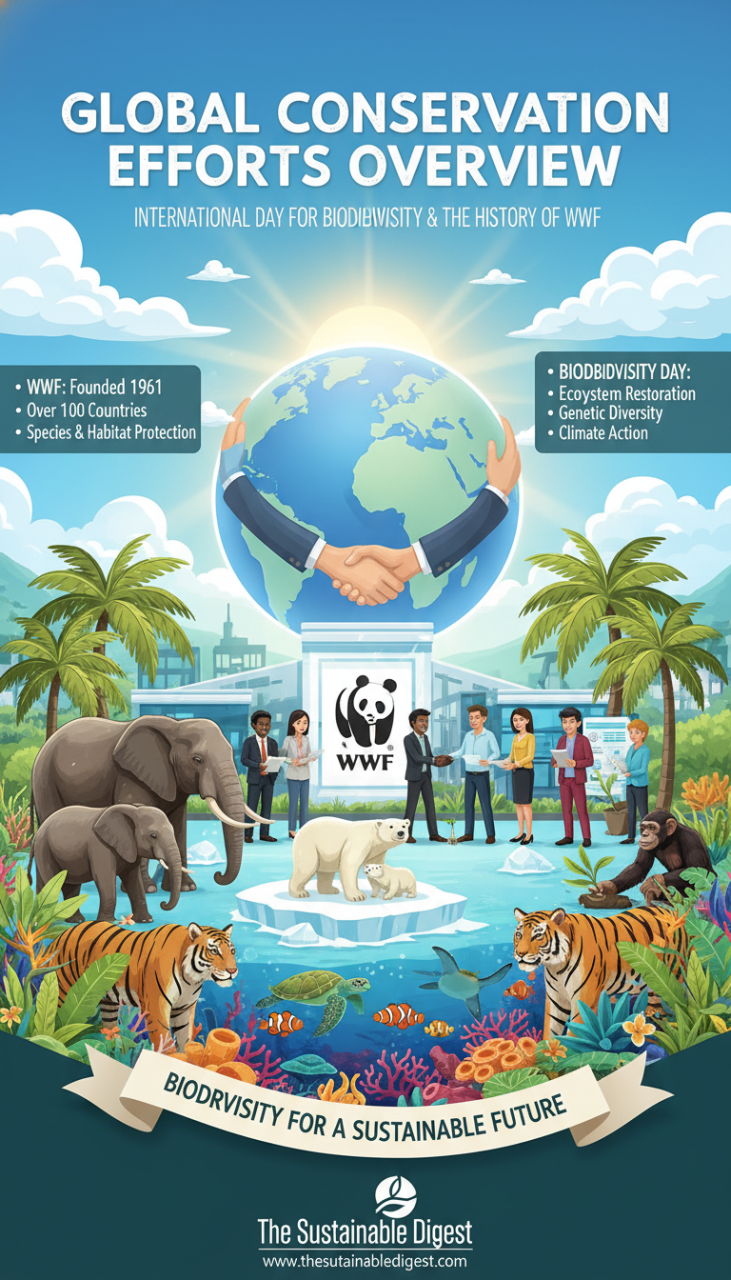
The evolution of conservation efforts has shaped our planet’s future through the International Day for Biodiversity and World Wildlife Fund. This guide delves into the significant role of each global organizations in protecting ecosystems. Established in Zurich, Switzerland, in 1961, the World Wildlife Fund has been at the forefront of these efforts. It has influenced modern environmental policies and fostered awareness about the need for sustainable practices.
In 2000, the UN General Assembly proclaimed a special day to highlight the importance of preserving biodiversity. This annual event serves as a vital reminder of our responsibility towards nature. It encourages reflection on the health of our planet’s biological diversity and promotes actions to protect it.
By examining the historical context of the International Day of Biodiversity and World Wildlife Fund initiatives, we bridge the gap between past milestones and current climate conversations. Understanding these connections is essential for addressing contemporary environmental challenges.
Introduction: The Evolution of Biodiversity and Global Conservation
The progression of environmental protection efforts has been pivotal in determining our planet’s ecological future. Understanding biodiversity is essential as it encompasses the variety of life on Earth, forming the foundation of our ecosystems.
In 1985, Walter G. Rosen coined the term biological diversity to describe this intricate web of life. The term highlights the importance of every species and its role within the ecosystem.
The Convention on Biological Diversity, effective since December 29, 1993, serves as a cornerstone for global initiatives aimed at safeguarding our environment. This agreement emphasizes that biodiversity is not merely a luxury; it is a necessity for the resilience of ecosystems worldwide.
Modern debates on climate change increasingly recognize the significance of biodiversity. A rich variety of species enhances ecosystem stability, making it crucial to address the rapid loss of biological diversity we currently face.
Historical Foundations: The Emergence of the World Wildlife Fund
The establishment of conservation organizations marked a significant turning point in ecological protection. One of the most notable is the World Wildlife Fund, founded in 1961. This organization arose after Sir Julian Huxley published impactful articles in The Observer about the alarming destruction of wildlife in Africa.
Sir Peter Scott, a prominent British conservationist, contributed significantly by designing the iconic giant panda logo for the organization. This symbol became synonymous with wildlife preservation efforts worldwide.
In 1962, the WWF hosted a major fundraising dinner at the Waldorf Astoria Hotel in New York. This event aimed to generate support within the United States, showcasing the organization’s commitment to conservation.
These early efforts were crucial for providing necessary funding to organizations dedicated to protecting endangered species and their habitats. The historical relevance of the World Wildlife Fund continues to influence climate science and ecological preservation, setting high standards for global environmental stewardship.
The Genesis and Impact of the International Day for Biodiversity
The introduction of a special day to honor biodiversity has reshaped the landscape of ecological advocacy. Officially proclaimed by the United Nations on May 22 in the year 2000, this observance celebrates the adoption of the Convention on Biological Diversity (CBD).
This annual event serves to raise global awareness about the ongoing loss of species and the urgent need for collective action to protect nature. With 196 Parties currently involved, the CBD provides a robust framework for nations to address environmental threats.
The establishment of this day highlights the importance of international cooperation in monitoring ecosystem health and promoting sustainable development. By focusing on this specific date, the global community reaffirms its commitment to reversing trends of habitat destruction and resource overharvesting.
Key Aspects
Description
Proclamation Year
2000
Global Awareness
Addressing species loss
Participating Parties
196
Framework
Convention on Biological Diversity
Focus
International cooperation and sustainable development
International Day for Biodiversity prominence World Wildlife Fund history
The intersection of International Day of Biodiversity and World Wildlife Fund is both prominence and historical. The global awareness it creates and dedicated conservation efforts illustrates a dynamic relationship in environmental advocacy. This relationship is evident when comparing the role of the UN-led observance with the action-oriented initiatives of a prominent wildlife organization.
While the wildlife fund emphasizes direct conservation and habitat protection, the awareness day provides a platform for policy alignment among nations. This distinction is crucial in understanding how both entities contribute to the broader conversation on climate change.
Contemporary prominence of the awareness day significantly impacts discussions around species extinction and environmental justice. These efforts are vital for shaping sustainable development agendas that consider the needs of local communities and indigenous peoples.
The juxtaposition highlights a shift towards integrated land and resource management.
Both entities play essential roles in raising awareness and driving conservation efforts.
Global collaboration is necessary to address the ongoing threats to biodiversity.
World Economic Forum and Global Policy Structuring
The World Economic Forum plays a pivotal role in aligning global policies with environmental sustainability. This organization acts as a bridge, integrating the goals of the wildlife fund into broader economic frameworks.
By leveraging the annual observance, the Forum encourages countries to prioritize the sustainable use of natural resources in their long-term development plans. This collaboration highlights the necessity of addressing the threats of habitat loss and species extinction.
Past performance shows that when organizations like the wildlife fund partner with global forums, significant strides can be made in conservation efforts. Future possibilities involve creating stronger ties between private sector activities and the protection of endangered species.
This strategic alignment ensures that the environment is treated as a fundamental part of global economic stability, not merely an afterthought.
Key Contributions
Description
Policy Integration
Aligning conservation goals with economic frameworks
Resource Management
Promoting sustainable use of natural resources
Collaboration
Partnerships with organizations like the wildlife fund
Future Strategies
Strengthening ties with the private sector
Environmental Stability
Ensuring the environment is part of economic planning
Contemporary Impact on Climate Conversations and Environmental Justice
Today’s climate conversations are increasingly acknowledging the critical link between biodiversity and environmental justice. The current prominence of this awareness has prompted a significant shift in how these issues are discussed globally. The International Day of Biodiversity and World Wildlife Fund together provide an outlet for conversion and action for habitat preservation.
Collective sustainable development agendas now integrate the work of the wildlife fund, ensuring that local communities actively participate in conservation efforts. This collaboration is essential, as it empowers communities to protect their natural resources.
By addressing the threats posed by climate change, these organizations play a vital role in safeguarding the land and resources necessary for the survival of diverse plants and animals. This proactive approach helps mitigate the loss of biological diversity.
Furthermore, the influence of these agendas is evident in how governments and organizations collaborate over time to tackle extinction challenges. This holistic strategy ensures that environmental needs are balanced with the development goals of nations worldwide.
Legacy of the WWF: Milestones in Climate Science and Conservation
The legacy of conservation organizations has profoundly influenced climate science and ecological efforts. The World Wildlife Fund has played a pivotal role in several historical achievements that continue to shape our understanding of biodiversity.
In 1973, the wildlife fund led the negotiations for the Convention on International Trade in Endangered Species (CITES). This landmark agreement was essential in protecting vulnerable species from the perils of international trade.
Fast forward to 2016, when a critical report revealed a staggering 58% decline in animal populations since 1970. This alarming statistic underscores the urgent need for conservation efforts and has become a cornerstone in climate science discussions.
Moreover, the launch of Earth Hour in 2007 in Sydney showcased the wildlife fund’s ability to mobilize global awareness. This initiative encourages millions to turn off their lights, symbolizing a commitment to protecting our planet.
These milestones not only highlight the wildlife fund’s dedication but also directly support the United Nations Sustainable Development Goals. By safeguarding critical habitats, the organization ensures that future generations can enjoy the rich diversity of life on Earth.
Biodiversity’s Role in Advancing the United Nations Sustainable Development Goals
Biodiversity serves as a cornerstone for effective global development strategies. The interdependence of nature and human progress is increasingly acknowledged in policy discussions. As countries strive to meet their development goals, integrating conservation into these frameworks is essential.
The 2022 Kunming-Montreal Global Biodiversity Framework outlines urgent objectives that align with the United Nations Sustainable Development Goals. This framework emphasizes the need to use natural resources sustainably, preventing further species extinction.
The World Wildlife Fund plays a crucial role by providing technical expertise to governments. This support is vital for protecting vulnerable habitats and ensuring that conservation efforts are part of national development plans.
Fostering a better relationship between human activities and nature is essential.
These efforts contribute to a sustainable plan that balances economic growth with environmental health.
Maintaining biodiversity is a core component of future development initiatives.
Past Performance and Future Possibilities in Policy Structuring
Examining the past achievements of conservation initiatives reveals a roadmap for future strategies. The success of the wildlife fund demonstrates that effective policy structuring relies on sustained commitment from both governments and private organizations. This collaboration is crucial for creating lasting change.
Looking ahead, the potential for global conservation strategies is promising. The annual observance dedicated to biodiversity can serve as a powerful tool to hold stakeholders accountable for their environmental impact. By emphasizing the need for responsible practices, it encourages nations to align their development plans with ecological preservation.
Moreover, the World Economic Forum can enhance these strategies by integrating species protection into national agendas. Learning from the past fifty years equips us to tackle climate change and habitat loss more effectively in the future.
Ultimately, a continued focus on the relationship between economic activities and biodiversity preservation is essential. This holistic approach will ensure that both nature and communities thrive together.
Key Insights
Description
Past Performance
Successful policies require long-term commitment
Future Strategies
Using observances to hold stakeholders accountable
Policy Integration
Incorporating species protection into development plans
Learning from History
Addressing climate change and habitat loss
Holistic Approach
Balancing economic activities with biodiversity
Global Partnerships Shaping Biodiversity and Conservation Efforts
Uniting various stakeholders is crucial for amplifying the impact of conservation efforts worldwide. Global partnerships between organizations, governments, and NGOs are essential for scaling up initiatives across different countries and regions.
These collaborations enable the sharing of best practices in the sustainable use of resources, which is vital for protecting endangered species and their habitats. By working together, these entities can better address the threats posed by climate change and ensure that biodiversity remains a priority in global discussions.
Such partnerships facilitate the exchange of knowledge and resources, enhancing conservation strategies.
They promote awareness of the importance of biodiversity in maintaining healthy ecosystems.
Over the years, the success of these alliances demonstrates that a unified approach is the most effective way to achieve shared environmental goals.
Looking to the future, these collaborations will continue to be a key part of the global strategy to protect the diversity of life on Earth.
Conclusion
The relationship between conservation awareness and actionable efforts is key to preserving our ecosystems. By leveraging the legacy of the wildlife fund and the policy framework of the United Nations, we can effectively combat the threats of species extinction.
Continued collaboration between the United States, other countries, and global organizations is essential to meet our ambitious sustainable development goals. Protecting our natural resources and habitat areas remains the most effective way to ensure the long-term survival of all life on Earth.
We must remain committed to these efforts, recognizing that the health of our environment is the foundation for a prosperous and equitable future for all.
FAQ
What is the significance of biodiversity?
Biodiversity is crucial for ecosystem stability, providing essential services such as pollination, climate regulation, and natural resource availability. It supports life on Earth and enhances resilience against environmental changes.
How does the World Wildlife Fund contribute to conservation?
The organization focuses on protecting endangered species and their habitats through advocacy, research, and partnerships with governments and local communities. Their efforts aim to mitigate threats to wildlife and promote sustainable practices.
What are some major threats to biodiversity today?
Key threats include habitat loss, climate change, pollution, overexploitation of resources, and invasive species. These factors contribute to the decline of various species and the overall degradation of ecosystems.
How can individuals support biodiversity conservation?
Individuals can support conservation by reducing waste, using sustainable products, participating in local conservation efforts, and advocating for policies that protect natural habitats and endangered species.
What role do governments play in biodiversity protection?
Governments establish policies and regulations that protect natural resources, enforce conservation laws, and collaborate with international organizations to address global biodiversity challenges.
Why is raising awareness about biodiversity important?
Awareness fosters understanding of the importance of biodiversity and encourages collective action to protect it. Increased public engagement can lead to more robust conservation initiatives and policy changes.
What is the relationship between biodiversity and climate change?
Biodiversity and climate change are interconnected; loss of biodiversity can exacerbate climate change effects, while climate change threatens species and ecosystems. Protecting biodiversity is essential for climate resilience.
How does biodiversity impact human health?
Biodiversity supports the provision of clean air, water, and food, all of which are vital for human health. Additionally, diverse ecosystems can help prevent the spread of diseases and provide medicinal resources.
For many regions across the globe, particularly in regions that have Small Island Developing States, the pressing effects of climate change present a unique paradox. These areas contribute less than 1% of global greenhouse gas emissions yet bear the brunt of environmental degradation. This makes their commitment to sustainability not just aspirational but crucial for survival.
Coral reef ecosystems play a vital role in supporting marine biodiversity, providing habitat for around 25% of all known marine species. The preservation of these ecosystems has emerged as a significant focus within sustainability frameworks. As tourism thrives in these areas, understanding how to balance economic needs with environmental protection becomes essential.
However, the implementation of sustainability strategies varies widely. Factors such as governance capacities and cultural contexts influence how effectively these frameworks can be mobilized. Recent findings indicate that coral loss is accelerating, particularly in regions already facing economic challenges.
In this article, we will delve into the complexities of environmental governance, exploring how various regions can learn from one another. By bridging global sustainability knowledge with practical insights, we aim to provide a comprehensive overview for professionals and conscious consumers alike.
The Role of Small Island Developing States ESG Partnership in Coral Reef Algae Preservation
Across the globe, climate change presents a paradox for regions that contribute minimally to global emissions. The delicate balance of marine ecosystems hinges on the health of coral reefs, which rely heavily on microscopic algae known as zooxanthellae. These algae are not just colorful companions; they are the primary energy source for coral, making their preservation vital for reef health.
Understanding the Importance of Coral Reef Algae in Marine Ecosystems
Coral reefs, teeming with life, serve as essential habitats for a myriad of marine species. The vibrant colors we admire are due to the symbiotic relationship between coral polyps and zooxanthellae. When temperatures rise, corals expel these algae, leading to a phenomenon known as coral bleaching. This expulsion is a critical survival mechanism, but prolonged high temperatures can result in coral death.
Since the catastrophic bleaching events of 1998 and 2010, which devastated reefs worldwide, the need for effective conservation has never been more urgent. For instance, the Joint SDG Fund’s commitment of $10 million in Fiji aims to protect over $1 billion in annual tourism revenue by 2030. Such initiatives illustrate how structured conservation efforts can attract international funding and support.
Environmental, Social, and Governance (ESG) principles provide a robust framework for guiding conservation partnerships in vulnerable regions. The Environmental pillar focuses on metrics related to reef health; the Social pillar addresses the livelihoods of communities dependent on reef fisheries and tourism; and the Governance pillar ensures transparent management of marine protected areas.
For example, Cabo Verde’s innovative Blu-X sustainable finance platform has raised millions through green bonds, directing funds into women and youth-led businesses that bolster ocean conservation. This initiative exemplifies how the Social aspect of ESG can foster economic resilience while promoting environmental protection.
Current Initiatives and Progress in Coral Reef Algae Preservation
Despite these advancements, challenges remain. Many small island nations struggle with limited institutional capacity, hindering their ability to meet complex international reporting standards. This paradox often leaves those most in need of ESG-linked finance facing the highest barriers to access.
Moreover, the International Coral Reef Initiative (ICRI) plays a pivotal role in bridging these gaps by offering technical assistance for monitoring and conservation planning. The Coral Reef Alliance’s community-based model demonstrates that integrating local knowledge systems into ESG frameworks enhances their effectiveness.
In conclusion, while significant resources have been mobilized for coral reef algae preservation, the geographical realities of these regions—dispersed archipelagos and vulnerability to external economic shocks—mean that the practicality of ESG initiatives varies greatly. Sustained international cooperation is essential for equitable and effective conservation efforts.
Blue Carbon vs. Green Carbon: Environmental Impacts and Practical Implications for SIDS
The intricate dynamics of carbon capture reveal significant differences between marine and terrestrial ecosystems. Understanding these differences is crucial for developing effective sustainability strategies. In particular, the roles of blue carbon and green carbon offer unique insights into how small island nations can optimize their environmental governance.
Defining Blue Carbon and Its Advantages over Green Carbon
Blue carbon refers to the carbon captured and stored by coastal and marine ecosystems, such as coral reef algae, mangrove forests, and seagrass meadows. In contrast, green carbon is stored in terrestrial forests and agricultural lands. For small island nations, the vast Exclusive Economic Zones make blue carbon strategies especially relevant to their environmental governance frameworks.
One of the key advantages of blue carbon is its ability to sequester carbon at rates up to ten times higher per unit area than terrestrial forests. Additionally, marine ecosystems provide essential services, including habitat for fisheries and coastal protection. These benefits align naturally with the maritime geography of island nations, which often have limited land for large-scale reforestation efforts.
Comparative Environmental and Economic Impacts
While blue carbon has its advantages, green carbon projects also present significant benefits. Terrestrial carbon initiatives typically enjoy more mature carbon credit markets and established verification methodologies. Furthermore, they are generally less complex to monitor and measure, making them easier to implement.
For instance, ancient Brazilian Amazonian biochar technologies enhance soil fertility while sequestering carbon. This dual benefit demonstrates how green carbon strategies can integrate with agricultural productivity improvements, creating a more resilient approach to sustainability.
Application of Blue Carbon Strategies in Small Island Contexts
Geological evidence from Discovery Bay, Jamaica, shows an ancient sea level notch dating back 125,000 years, sitting 7 meters above modern sea levels. This stark reminder underscores why experts argue that the safe CO2 target for small island nations is approximately 270 ppm, significantly lower than current atmospheric concentrations.
In Mauritius, innovative biofertilizers derived from seaweed exemplify a hybrid blue-green carbon approach. By processing marine algae into agricultural inputs, these solutions reduce the carbon footprint of farming while promoting healthy coastal ecosystems.
However, implementing blue carbon strategies in small island contexts is not without challenges. Establishing clear property rights over marine carbon sinks can be difficult, and measuring carbon sequestration in dynamic ocean environments presents technical complexities. Additionally, these ecosystems are vulnerable to climate impacts that can reverse sequestration gains.
Nonetheless, initiatives like Cabo Verde’s Blue Bond issuance showcase the financial innovation possible when blue carbon strategies are embedded within governance frameworks. This approach channels capital toward marine conservation while generating returns through sustainable tourism and fisheries enterprises.
Ultimately, the debate between blue carbon and green carbon is not binary for small island nations. The most effective environmental governance integrates both strategies, leveraging the natural advantages of blue carbon while incorporating green carbon methodologies where applicable. This holistic approach ensures that carbon benefits are accurately measured and equitably distributed.
Global Governance and Policy Dynamics Influencing SIDS’ ESG Efforts
The interplay of global policies shapes the trajectory of sustainability efforts in regions most affected by climate change. Understanding these dynamics is crucial for developing effective strategies that address both local and international challenges.
Insights from the World Economic Forum (WEF) highlight a top-down, private-sector-driven approach to environmental governance. This model emphasizes market mechanisms and standardized metrics. However, it often overlooks the unique needs of vulnerable regions. In contrast, the World Social Forum (WSF) advocates for a grassroots, civil-society-centered approach. This perspective prioritizes community sovereignty and participatory governance.
The WEF’s standardized ESG reporting frameworks can unlock access to global capital markets.
However, they impose compliance costs that overwhelm the limited administrative capacities of small governments.
The WSF argues that genuine sustainable development requires decolonizing conservation finance.
It emphasizes respecting local governance structures and recognizing cultural dimensions in resource use.
United Nations subsidies, particularly through the Joint SDG Fund, provide essential funding for sustainability projects. Led by UN Resident Coordinators, this fund receives contributions from various donor governments. While these subsidies are vital, they often come with complex reporting requirements and short funding cycles. This can undermine long-term conservation planning.
“SIDS have been pressured into accepting CO2 targets that are a ‘suicide pact’ because they guarantee extinction of natural resources.” – Dr. Tom Goreau
Dr. Goreau’s critique underscores the tension between political feasibility and ecological reality. The agreed-upon warming limits still threaten coral ecosystems, which require atmospheric CO2 concentrations around 270 ppm to survive.
Interestingly, innovative technologies developed in regions like Jamaica, the Maldives, and the Marshall Islands for coral restoration remain underutilized due to policy failures and funding gaps. In contrast, similar approaches in Indonesia have received international recognition, such as the 2012 UNDP Equator Award.
International partnerships, like the Global Fund for Coral Reefs, blend public and private capital to finance reef conservation. These funds represent a significant evolution in ESG finance. However, they raise questions about whether the priorities of distant investors align with the immediate needs of local communities facing challenges like sea level rise and fisheries decline.
In conclusion, the global governance landscape for SIDS’ sustainability efforts reveals a fundamental asymmetry. The nations most vulnerable to climate impacts often have the least influence over the policies and funding mechanisms designed to assist them. Thus, fostering genuine partnerships—rather than traditional donor-recipient dynamics—becomes an urgent priority for effective governance.
Diversity in Regional ESG Approaches: From Small Island Developing States to Latin America and Asia Pacific
The diversity of approaches to environmental governance reveals how unique regional contexts shape sustainability efforts. This section will explore the different perspectives on sustainable development among various regions, focusing on the challenges and opportunities faced by Small Island Developing States (SIDS), Caribbean and Latin American nations, as well as those in the Asia Pacific and Oceania.
SIDS vs. Caribbean and Latin Nations: Sustainable Development Perspectives
Small Island Developing States often confront existential threats from rising sea levels. This reality fundamentally alters their sustainability calculus. For these nations, the preservation of coral ecosystems is not merely an environmental preference; it is a matter of territorial survival.
In contrast, larger Caribbean and Latin American nations can frame their environmental, social, and governance (ESG) priorities more flexibly. They can focus on economic diversification and green industrialization, allowing for a broader range of sustainable development strategies.
For example, in Suriname, investments in eco-friendly agriculture are linking organic food production to the tourism industry. This connection ensures that visitors experience authentic, locally sourced cuisine while supporting small farmers.
Asia Pacific and Oceania: Complexity in International Relations and Global Affairs
The Asia Pacific and Oceania region showcases extraordinary diversity in international relations and sustainable development. Indonesia, the world’s largest archipelagic state, possesses significant diplomatic weight and technological capacity. In contrast, Palau, a small island nation, suffered devastating coral bleaching in 1998, leading to reduced fisheries catches and highlighting the acute vulnerability of microstates to ecological shocks.
The Maldives exemplifies how SIDS can integrate social equity into ESG frameworks. Their gender-responsive climate finance strategy empowers women to shape the future of sustainable tourism, ensuring they are not just passive recipients of externally designed interventions.
Integrating Regional Approaches for Global ESG Impact
Integrating diverse regional approaches can amplify global ESG impact. The case of technology transfer is particularly intriguing. Coral reef restoration technologies developed in Jamaica, the Maldives, and the Marshall Islands were successfully implemented in Indonesia, earning the 2012 UNDP Equator Award. However, these technologies remain underutilized in their countries of origin due to policy and funding failures.
Moreover, the geopolitical complexity of the Asia Pacific region creates both opportunities and risks. Major powers compete for influence over small island states through infrastructure investment and development assistance. This dynamic complicates genuine sustainable development partnerships.
Ultimately, recognizing that no single framework fits all contexts is crucial. The Caribbean’s proximity to North American markets shapes its tourism-dependent ESG strategies differently from the Pacific’s reliance on distant partners. Effective global ESG impact depends on respecting these geographical and geopolitical specificities.
In conclusion, the diversity of regional ESG approaches should be viewed as a strength rather than fragmentation. This variety generates a portfolio of experiments in sustainable development from which all regions can learn, provided that knowledge-sharing mechanisms are strengthened and power asymmetries between large and small states are explicitly addressed.
Collaborative Solutions for Citizens, MSMEs, NGOs, and Public Municipalities
Building resilient communities involves integrating the efforts of individuals, MSMEs, NGOs, and public municipalities in sustainability initiatives. The fight against climate change is not solely the responsibility of governments; it requires active participation from all sectors of society. Here are some actionable solutions for diverse stakeholders.
Empowering Communities and Private Sector in Implementation
Citizens can take meaningful steps to combat coral bleaching and protect marine ecosystems. Simple actions like driving less, conserving energy at home, and reducing meat consumption can significantly lower carbon footprints. Additionally, individuals should avoid sunscreens containing harmful chemicals like oxybenzone and octinoxate, which directly harm coral reef algae. Supporting sustainable tourism by choosing certified tour operators can also make a difference.
Micro, Small, and Medium Enterprises (MSMEs) in the private sector can integrate environmental and social governance (ESG) principles without the administrative burden faced by larger corporations. For instance, tourism operators can adopt reef-safe protocols, while fisheries can participate in co-management of marine protected areas. Agricultural enterprises can follow Mauritius’s example by producing biofertilizers from seaweed, which reduces environmental footprints and creates new revenue streams.
Role of Non-profits and NGOs in Sustainable Development
Established non-profits like the Coral Reef Alliance employ community-based conservation approaches that effectively reduce local threats such as overfishing and pollution. By bridging local knowledge with international scientific expertise, these organizations enhance resilience to global climate stressors.
The NOAA Coral Reef Conservation Program serves as a model for government-supported research and monitoring. It provides essential data infrastructure necessary for evidence-based ESG decision-making, which municipalities can access through international partnerships.
Organizations like The Nature Conservancy adopt a multi-stakeholder approach, collaborating with local communities, governments, and private entities to develop and implement conservation strategies. This demonstrates how NGOs can facilitate trust and cooperation among sectors, which is vital for effective governance.
Municipal Strategies for Enhancing Environmental and Social Governance
Municipalities can adopt various strategies to enhance their environmental and social governance. Establishing locally managed marine areas empowers communities to set and enforce fishing rules, promoting sustainable practices. Integrating climate resilience criteria into public procurement and infrastructure planning ensures that local projects consider long-term environmental impacts.
Participatory budgeting processes can also allocate resources to ESG priorities identified by residents, fostering community engagement in governance. For example, the Maldives’ gender-responsive climate finance strategy empowers women to shape sustainable tourism, serving as a replicable model for integrating social equity into environmental governance.
In conclusion, collaborative solutions require moving beyond siloed interventions. Citizens, MSMEs, NGOs, and municipalities must operate within aligned incentive structures. When individual actions, business practices, civil society advocacy, and public policy reinforce one another, we can achieve coherence in sustainability efforts. This alignment is where effective governance frameworks can truly thrive.
Conclusion
The urgency of addressing climate impacts is becoming increasingly evident for vulnerable regions worldwide. The practical application of environmental frameworks presents both opportunities and challenges. While these frameworks unlock vital international finance, geographical isolation and limited capacities often hinder effective implementation.
In the ongoing debate between Blue and Green Carbon, the former offers unique advantages for regions with vast ocean territories. Yet, terrestrial opportunities also play a significant role in comprehensive strategies. This dual approach allows for a more nuanced integration of resources and methodologies.
As Dr. Tom Goreau poignantly noted, the loss of coral ecosystems has become a stark reality. However, existing technologies and innovative partnerships offer pathways for restoration and conservation. Successful examples from Fiji, Cabo Verde, and Mauritius highlight the potential for effective governance models.
Ultimately, the diversity of regional approaches should be seen as a global portfolio of sustainable development experiments. Stakeholders must work collaboratively, respecting the agency of local communities. The preservation of coral ecosystems is not just an environmental goal; it is a litmus test for global governance in addressing the existential threats faced by the world’s most vulnerable populations.
Key Takeaways
Climate change impacts small regions disproportionately despite their minimal emissions.
Coral ecosystems are essential for marine biodiversity and local economies.
Effective sustainability strategies depend on regional governance and cultural factors.
Recent studies show alarming rates of coral loss, necessitating urgent action.
Understanding these dynamics is vital for sustainable development in vulnerable regions.
The fourth month of the year is key for environmental efforts and global progress. As cultures around the world start new cycles, we have a chance to link old traditions with the April 2026 International Observances Holidays Sustainability 2030 UNSDG goals. This time is not just a list of dates; it’s a chance for professionals to make caring for the environment a main part of their work.
Looking at April international holidays 2026, we can connect old customs with today’s advancements. Our study offers a guide for leaders to match their goals with global events. Understanding how these moments shape public opinion and the economy is crucial. We encourage you to see how these events help build a stronger future for everyone.
The Pillars of Earth Month and Global Sustainability
As April arrives, the world focuses on important issues. These include fighting unfair systems and working for a sustainable future. This month is a critical juncture for companies to match their actions with global standards of environmental health and social justice.
Earth Month and Fair Housing Month Initiatives
Spring brings us to Earth Month, a time for environmental restoration and action against climate change. This month also connects environmental health with housing rights through Fair Housing Month.
The month starts with Fossil Fools Day, a day to remind us of the need to stop using carbon-heavy industries. By tackling these issues together, supporters show that living sustainably means having equal access to safe, healthy homes.
Financial Capability and Literacy Month
Economic stability is key for a sustainable future. Financial Capability and Literacy Month helps people and organizations get better at managing money through education and smart choices.
Empowering communities to manage resources well is crucial for lasting strength. When people grasp modern finance, they can help build a stable, growing global economy.
Genocide Awareness and Multicultural Communication
April also calls for a serious look at human history through Genocide Awareness Month. It includes days to remember the Rwandan and Armenian genocides, reminding us of the dangers of hate.
Companies are urged to use this time to support Multicultural Communication Month within their teams. By encouraging open talks and integrity, leaders can fight the prejudices that cause violence and exclusion.
April 2026 International Observances Holidays Sustainability 2030 UNSDG
The world is changing how it celebrates holidays to match long-term goals. These April 2026 sustainability events are more than dates on a calendar. They are key to making big changes happen. By focusing on specific themes, everyone can work together to solve big environmental and social problems.
Aligning Global Holidays with the 2030 Agenda
The 2030 United Nations SDGs are a plan for a better, more sustainable world. By linking these goals to holidays, we make sure our talks are based on real targets. This turns big ideas into plans that governments and businesses can follow.
When groups work together with these global events, they make a bigger difference. This means moving from just showing up to actively working towards goals. This way, we make sure our progress is real and based on the 2030 plan.
The Role of UN Global Days in Policy Advocacy
UN Global Days are great for getting people to care and for changing laws. For example, Consumer Awareness Week shows how our buying choices affect the world. These events make companies think about being more open and fair.
Using these days to talk about big issues helps get the attention of lawmakers. This is key for keeping the focus on important sustainability topics, even when things get tough.
International Day of Conscience and Multilateralism
The International Day of Conscience/Multilateralism and Diplomacy for Peace shows we need to work together. True sustainability can’t happen alone; it needs strong teamwork. This day reminds us that talking things out is the best way to solve big problems.
Also, events like the Union Day of Belarus and Russia show different ways countries can work together. Even though they face different challenges, the goal of building stronger relationships is the same. The table below shows how these events help with sustainability.
Observance
Primary Focus
Sustainability Impact
International Day of Conscience
Ethical Governance
High
Consumer Awareness Week
Market Ethics
Medium
Union Day
Regional Cooperation
Moderate
UN Global Days
Policy Advocacy
High
Cultural Heritage and Global Identity
Preserving heritage is more than looking back. It’s key to building a strong global identity today. As we work on international development, it’s crucial to understand the cultural roots of societies. This month, we also celebrate World Landscape Architecture Month, showing how our environment is part of our heritage.
Assyrian New Year and Scottish-American Heritage
The Assyrian New Year celebrates ancient traditions that have lasted for thousands of years. At the same time, Scottish-American Heritage Month honors the Scottish diaspora’s impact on America. Many also celebrate International Mariachi Week, showing how culture connects us all.
“Culture is the widening of the mind and of the spirit.”
— Jawaharlal Nehru
Arab American Heritage and International Romani Day
Arab American Heritage Month promotes inclusivity and celebrates diverse stories in the U.S. International Romani Day, or the Day of Romas, fights for human rights and recognition. These events are a Universal Day of Culture, pushing for a fairer future.
Cambodian, Tamil, and Theravada New Year Celebrations
In mid-April, we see colorful New Year celebrations like the Cambodian, Tamil, and Theravada New Years. These festivals often overlap with the Songkran Water Festival, a time for purification and unity. Below, we explore the importance of these cultural events.
Celebration
Primary Focus
Global Impact
Assyrian New Year
Historical Continuity
Cultural Preservation
Arab American Heritage
Inclusivity
Social Integration
Theravada New Year
Spiritual Renewal
Community Solidarity
International Romani Day
Human Rights
Historical Recognition
Religious Observances and Spiritual Reflection
In April, spiritual life is filled with rituals that honor ancestors and celebrate enlightenment. These events help us connect with our heritage and the natural world. They strengthen the bonds that unite diverse communities.
Qingming Festival and Cheng Ming Festival
The Qingming Festival, also known as Tomb-Sweeping Day, is a time for families to honor their ancestors. It’s also a time for environmental stewardship, as people clean graves and plant trees. The Cheng Ming Festival also focuses on honoring our ancestors, showing how our actions today are connected to the past.
“The beauty of tradition lies not in the repetition of the past, but in the wisdom we carry forward to build a more sustainable future.”
Laylatul Qadr and Martyrdom of Imam Sadeq
Laylatul Qadr is a night of deep spiritual significance and prayer. It’s a time for reflection and seeking guidance for the future. The Martyrdom of Imam Sadeq reminds us of the importance of truth and justice.
Vaisakhi, Baisakhi, Vishu, and Ram Navami Day
April celebrates vibrant festivals like Vaisakhi and Baisakhi, marking the solar new year and the birth of the Khalsa. These events, along with Vishu and Ram Navami Day, bring joy and renewal of faith. They show the enduring power of community in a world that’s often fragmented.
While big holidays get most of the attention, smaller events like Fresh Tomato Day remind us to appreciate nature’s simple joys. National Bodhi Day and Mahavir Jayanti offer quiet moments for reflection on enlightenment and non-violence. These diverse events make April a month of celebration and inner growth.
Observance
Primary Focus
Cultural Significance
Qingming Festival
Ancestral Respect
Environmental Care
Vaisakhi
Harvest/New Year
Community Unity
Mahavir Jayanti
Non-violence
Spiritual Reflection
Ram Navami
Devotion
Virtuous Living
National Independence and Historical Commemorations
Historical commemorations help us understand how states have evolved. During National Rebuilding Month and Records and Information Management Month, we see the importance of keeping history alive. These times help us see how countries tell their own stories.
Odisha Day, Cyprus National Holiday, and Näfelser Fahrt
The world celebrates many special days that show cultural pride. Events like Odisha Day, Cyprus National Holiday, and Näfelser Fahrt connect people to their heritage.
National All is Our Day: A time for thinking about shared resources.
Dutch-American Friendship Day: Honoring the strong bond between nations.
Regional festivals: Showcasing the unique histories of local communities.
Independence Days: Syria, Senegal, Togo, and Sierra Leone
Independence days show a nation’s fight for freedom. Countries like Syria, Senegal, Togo, and Sierra Leone have shown great strength. We also celebrate National North Dakota Day and the solemn National Oklahome City Bombing Commemoration Day. These days remind us that our identity comes from both victories and losses.
Nation
Significance
Theme
Syria
Independence Day
Sovereignty
Senegal
Independence Day
Unity
Togo
Independence Day
Freedom
Anniversary of the Battle of Rivas and Appomattox Day
Military history shapes the myths of modern states. The Anniversary of the Battle of Rivas and Appomattox Day show the price of change. These days are marked with other important events like the Battle of San Jacinto, Tiradentes Day, and St. George’s Day.
Looking at these events helps us understand the global fight for freedom. Each commemoration connects the past to the future, teaching us for the next generation.
Environmental Advocacy and Nature Awareness
In April, we focus on taking care of our planet. This month is filled with global events that push for protecting our Earth. These efforts help us understand how our actions affect nature.
International Mother Earth Day and Delegate’s Day
International Mother Earth Day reminds us of the planet’s importance. It shows how our planet gives us life and food. Delegate’s Day highlights the need for global agreements to protect our environment.
Many groups celebrate Earth Week to keep these important days alive. It’s a time for people to come together and:
Community Garden Week projects to improve local food.
National Arbor Day tree-planting to fight deforestation.
Nature Day workshops to teach the next generation about conservation.
International Beaver Day and World Curlew Day
Healthy ecosystems depend on diverse species. International Beaver Day celebrates beavers for their role in wetland restoration. World Curlew Day focuses on protecting bird habitats.
These species show us if our environment is healthy. When they do well, so does our ecosystem. Saving them is crucial for our planet’s balance.
International Dark Sky Week and Teak Awareness
Today, we also fight against invisible threats like light pollution. International Dark Sky Week encourages us to enjoy the stars while reducing light pollution. This is part of Sky Awareness Week, which teaches us about our atmosphere.
Teak Awareness Day reminds us to use wood sustainably. As we face today’s challenges, we must remember these important days:
Bee Active Bee Healthy Bee Happy Week: Helping pollinators.
Save the Elephant Day: Fighting poaching and habitat loss.
World Tapir Day and Pygmy Hippo Day: Saving endangered mammals.
Big Wind Day: Honoring renewable energy.
“The environment is where we all meet; where we all have a mutual interest; it is the one thing all of us share.”
— Lady Bird Johnson
Health, Education, and Social Equity
In April, the world focuses on health, education, and equity. These are key for a stable society. They ensure everyone has a chance to succeed, no matter their background. By focusing on these areas, countries can create places where everyone can grow and be well.
World Health Day and National Public Health Week
Health and education are key to fairness, shown by World Health Day and National Public Health Week. These days teach us that being healthy means more than just not being sick. It’s about being fully well in body and mind. Investing in public health helps fight unfairness.
“Equity in health is the bedrock of a just society, where every person has the fair opportunity to attain their full health potential.”
World Health Organization
Global Campaign for Education and National Minority Health
Fighting for equal access to health and education is a big challenge today. The Global Campaign for Education Action/National Environmental Education & Freelance Business Week shows how learning forever can empower us. At the same time, National Minority Health Month aims to improve health for those who are often left behind.
These efforts help break down barriers for those who are often overlooked. By using Informed Women Month ideas, we can make sure everyone knows how to stay healthy. This way, we can make the world more fair for everyone.
National AfricanAmerican Women’s Fitness Month
Being active is key for strong, informed communities. National AfricanAmerican Women’s Fitness Month shows how exercise can help us stay healthy and strong. Events like Healthy Kids/Herbalist Day teach kids to live healthy from a young age.
We also need to remember the Global Day to End Child Sexual Abuse. It’s a reminder of the need for safe places for kids. Health and education are not just personal goals. They are things we all work on together to move forward as a world.
Observance
Primary Focus
Target Impact
World Health Day
Global Wellness
Universal Health Coverage
National Minority Health Month
Equity
Reducing Disparities
National African American Women’s Fitness Month
Physical Activity
Community Resilience
Global Campaign for Education
Learning Access
Empowerment
Innovation, Creativity, and Global Diplomacy
In today’s world, we need creative thinking and diplomacy more than ever. Innovative solutions are key to solving global problems. By embracing diverse ideas, we can tackle big challenges and ensure stability.
World Creativity and Innovation Day
The World Creativity and Innovation Day reminds us that our creativity is endless. It’s a time to find new ways to solve old problems. It’s not just about art; it’s about using our minds to make lasting changes.
International Day for Monuments and Sites
Keeping our cultural heritage alive is crucial in today’s world. The International Day for Monuments and Sites celebrates our history. These sites remind us of the diplomatic bridges built by our ancestors.
International Day of Sport for Development and Peace
Sports speak a language everyone can understand, crossing borders and politics. The International Day of Sport for Development and Peace uses sports to unite us. It teaches us about teamwork and fair play, essential for lasting peace and cooperation.
These observances share common goals, like the joy of World Party Day or the unity of International Jazz Appreciation Month. They all aim to bring people together and celebrate our shared humanity.
Observance
Primary Focus
Global Impact
World Creativity and Innovation Day
Problem Solving
Economic Growth
International Day for Monuments and Sites
Cultural Heritage
Identity Preservation
International Day of Sport for Development and Peace
Social Unity
Conflict Resolution
Conclusion
April 2026 is a key moment for our global community. It shows how important it is to balance culture, nature, and fairness.
Using these important dates in our work helps us make a lasting difference. Companies that work with these global events build stronger connections worldwide. They turn big ideas into real actions every day.
Now, we have the knowledge to make real changes all year. By following this global awareness, we can build a strong future. We encourage everyone to use these lessons in their work and lead the way to success.
Key Takeaways
The month is a key time for cultural heritage and environmental progress.
Aligning plans with global events boosts long-term success.
Old celebrations can help spread new environmental values.
Professional studies help link policy goals with daily work.
Planning during this time supports wider economic and social growth.
Each year, a specific week on the calendar becomes a focal point for the planet’s most pressing challenges. From late April’s Earth Day through World Malaria Day and beyond, a series of formally recognized events unfolds.
This cluster is not random. These observances are established tools of global diplomacy and public engagement. Member states propose them, and the General Assembly adopts each through an official resolution.
This process lends institutional weight, transforming abstract issues into annual moments for collective focus. The late April lineup offers a telling snapshot. It connects environmental stewardship, human health, safe labor practices, intellectual innovation, and cultural harmony.
The narrative woven through these days reflects a holistic view of progress. It balances the ecological, social, and economic pillars of modern development. The stated goal is twofold: to raise worldwide public awareness and to spur concrete action.
There’s a subtle irony, of course. The gap between aspirational declarations and on-the-ground reality is often vast. Yet, these designated moments persist as critical waypoints. They shape policy debates and focus the global consciousness on interconnected goals.
Introduction: A Week of Global Reflection and Action
Beyond mere symbols, these annual observances serve as strategic tools in the international community’s arsenal. They are instruments of soft power, designed to shape narratives and mobilize consensus on complex issues. This framework turns abstract principles into focal points for advocacy and education.
The practice of marking a specific day for a cause predates the modern diplomatic system. Historical precedents include early labor movements and health campaigns. The current formal system evolved to structure this impulse within multilateral governance.
Mechanically, the process is a product of diplomacy. One or more member states draft a proposal for a new observance. The General Assembly then debates and adopts it through a formal resolution.
This official stamp transforms an idea into a sanctioned international day. The resolution typically outlines the theme, objectives, and suggested activities. It focuses the world’s attention on a particular issue for a defined period.
The intended outcome is twofold: to raise public awareness and to spur tangible action. These are not meant to be empty gestures. They are calendar-based catalysts for dialogue, policy review, and concerted effort across borders.
A Week of Global Reflection and Action Continuing..
The final week of April presents a fascinating case study. It contains a dense cluster of these designated moments. This concentration reflects multiple priorities of the global body within a short span.
For this analysis, selection criteria emphasize observances intersecting key pillars. These include planetary health, human well-being, fair labor, intellectual innovation, and cultural cohesion. Each theme represents a thread in the broader tapestry of modern development.
An ironic tension exists here. The proliferation of such days can lead to “calendar clutter,” potentially diluting focus. The real challenge lies in moving from annual symbolism to sustained, substantive policy change.
Nevertheless, this week offers an annual opportunity. It is a moment for global reflection and assessment of progress. Stakeholders from governments to civil society use it to recommit to shared goals.
These individual observances connect to longer-term campaigns. They often nest within dedicated decades or years proclaimed by the same institution. This creates a layered timeline of advocacy, from a single week to a ten-year plan.
The following exploration balances respect for institutional intent with analytical scrutiny. It examines how these late April events aim to translate aspiration into impact. The journey from resolution to reality is the true test of their legacy.
International Mother Earth Day: The Foundation of Global Sustainability
The concept of honoring ‘Mother Earth’ found formal diplomatic expression in 2009, but its philosophical roots run decades deeper. This international day provides a moment to raise public awareness of the planet’s well-being challenges. It underscores a collective duty to promote harmony with nature.
This duty was first codified in a landmark 1992 document. The day acts as an annual checkpoint for a simple, profound idea. The health of our world is the bedrock for all other progress.
The 1992 Rio Declaration and the Birth of a Modern Observance
While formally established by a General Assembly resolution in 2009, the day’s soul was born at the Rio Earth Summit. That 1992 conference produced a defining statement. The Rio Declaration on Environment and Development outlined 27 principles.
Principle 1 states that human beings are at the center of concerns for sustainable development. They are entitled to a healthy and productive life. This life must be in harmony with nature.
The phrase “harmony with nature” is more than poetic. It represents a philosophical shift from domination to coexistence. It implies that economic and social gains cannot come at the environment’s ultimate expense.
The declaration called for a “just balance” among needs. This balance is between the economic, social, and environmental demands of current and future generations. It is a recognition of intergenerational equity.
This holistic vision made the 2009 designation almost inevitable. The day became a tool to institutionalize that Rio ideal. It turns an abstract principle into a recurring calendar event for global reflection.
From Harmony with Nature to the Sustainable Development Goals (SDGs)
The journey from Rio’s holistic ideal to today’s policy landscape is telling. The 2015 Sustainable Development Goals represent a more structured, target-driven approach. They attempt to quantify the balance Rio envisioned.
For instance, SDG 13 (Climate Action) and SDG 15 (Life on Land) directly operationalize environmental care. Yet, the day reminds us these goals are interconnected. True progress requires systems thinking.
There’s an undeniable irony here. Each year, speeches highlight harmony and balance. Meanwhile, metrics on climate change, biodiversity loss, and pollution show a stark disconnect. The rhetoric often outpaces reality.
Harmony with Nature to the Sustainable Development Goals (SDGs)continuing…
This observance connects to a broader calendar of advocacy. World Environment Day on June 5th offers another platform. Together, they create sustained pressure for ecological action.
The theme of balance remains central to global governance. It is also persistently elusive. Economic pressures frequently short-circuit long-term environmental planning.
Environmental justice is a critical subtext. Ecological health is tied to social factors like food security and public health. Pollution and resource depletion disproportionately affect marginalized people.
Interestingly, this day falls near other April events like Chinese Language Day and English Language Day. This proximity is a subtle nod. How we communicate about nature shapes the fight to protect it.
From RIO to SDG targets
The table below illustrates how core Rio principles evolved into specific SDG targets.
Rio Declaration Principle (1992)
Core Concept
Related Sustainable Development Goal (SDG)
Specific Target Example
Principle 1: Harmony with Nature
Humans must coexist with the natural world.
SDG 15: Life on Land
By 2020, promote the implementation of sustainable management of all types of forests.
Principle 3: Right to Development
Development needs of present and future generations must be met.
SDG 8: Decent Work and Economic Growth
Sustain per capita economic growth in accordance with national circumstances.
Principle 10: Public Participation
Environmental issues are best handled with citizen involvement.
SDG 16: Peace, Justice and Strong Institutions
Ensure responsive, inclusive, participatory and representative decision-making.
Principle 15: Precautionary Approach
Lack of full scientific certainty shall not postpone cost-effective measures to prevent environmental degradation.
SDG 13: Climate Action
Improve education, awareness-raising and human and institutional capacity on climate change mitigation.
Principle 17: Environmental Impact Assessment
Assessment of proposed activities likely to have adverse environmental impacts.
SDG 9: Industry, Innovation and Infrastructure
Upgrade infrastructure and retrofit industries to make them sustainable.
As a foundational pillar, International Mother Earth Day’s effectiveness is multifaceted. It successfully frames planetary health as a universal concern. It provides a crucial ethical anchor for the week’s more specific themes.
However, its true test lies in translating annual symbolism into daily policy. The day sets the stage. The ongoing work for a clean environment, diversity of life, and equity for all people continues every other day of the year.
World Malaria Day and World Day for Safety and Health: Protecting Human Capital
Two late April observances pivot from planetary health to human well-being, framing a critical question: how effectively does the world protect its people? This segment of the calendar examines two pillars of societal stability. It focuses on population health and workplace security.
These days are not random. They represent deliberate campaigns against specific, preventable threats. One targets a parasitic disease, the other systemic workplace hazards.
The thematic synergy is profound. Both are fundamentally about safeguarding human capital. This is the health and productive capacity of populations and workers.
World Malaria Day: A Decades-Long Fight for Global Health Equity
Established by the World Health Organization, this international day on April 25th encapsulates a persistent struggle. It highlights the fight for health equity against a preventable disease. The campaign has stretched across decades.
Progress reveals a stark map of inequality. Significant reductions in cases and deaths mark a public health success story. Yet, the burden remains heavily concentrated in sub-Saharan Africa and among young children.
This disparity makes malaria eradication a telling test case. It measures international cooperation and resource allocation. The gap between technical capability and political will is often wide.
Mobilizing action happens at multiple levels. Community-level distribution of insecticide-treated bed nets is a proven tactic. Research into vaccines and new treatments continues.
This day fits within a broader advocacy calendar. It follows World Health Day in early April. This positions late April as a peak period for health-related awareness.
World Day for Safety and Health at Work: Linking Labor Rights to Sustainable Economies
Marked on April 28th, this safety day originates in the advocacy of the International Labour Organization. Its core mission is to promote decent work. This includes freedom, equity, security, and dignity.
The connection to sustainable economies is direct and economic. Safe workplaces reduce costly accidents, injuries, and occupational diseases. They form the foundation of a productive, resilient workforce.
An analytical irony persists. Evidence clearly shows that investing in prevention saves money and lives. Yet, occupational health often remains a secondary concern in development agendas.
Why does this gap exist? Short-term cost pressures frequently override long-term safety planning. In some contexts, labor protections are weak or poorly enforced.
The language of this day connects to other causes. The concept of “elimination” is key. It aims for the day elimination of workplace hazards.
This parallels the fight against social ills. It shares rhetorical ground with the International Day for the Elimination of Racial Discrimination. Both seek to remove systemic barriers to dignity.
Member states and employers use this occasion to review protocols. Corporate safety reforms and policy dialogues are common activities. The goal is to translate annual focus into year-round practice.
The two international days analyzed here form a coherent unit. They underscore that protecting human capital is a dual imperative. It is both a moral duty and an economic prerequisite.
Healthy people and safe workers are the engine of progress. Without them, achieving the broader Sustainable Development Goals is impossible. These late April weeks remind the world of this foundational truth.
The observance cycle continues. It moves from the health of the planet to the health of its inhabitants. This logical progression defines the global agenda’s attempt at holistic sustainability.
Commemoration and Innovation: Chernobyl, Intellectual Property, and Lessons Learned
Two observances sharing a date, April 26th, present a stark dialectic. One looks back at a catastrophic failure, the other forward to engineered solutions. This pairing captures a core tension in modern development.
How does society balance the memory of past mistakes with the promise of future fixes? The late April week provides a structured moment to confront this question. It links sober reflection with strategic optimism.
International Chernobyl Disaster Remembrance Day: Environmental Policy in the Shadow of Disaster
This international day honors the victims of the 1986 nuclear catastrophe. More importantly, it reinforces hard-won lessons. The disaster was a brutal catalyst for change.
It exposed systemic failures in safety culture and transparency. In response, it spurred unprecedented transnational cooperation. New frameworks for radiation safety and disaster preparedness emerged.
The ironic legacy is profound. A tragedy that revealed profound vulnerability also triggered global policy evolution. Scientific collaboration across borders intensified in the decades that followed.
This day serves as an annual checkpoint. It asks if the world has truly internalized those lessons. Are communities better protected from technological and environmental risks?
The remembrance connects to broader issues of planetary health. It echoes concerns raised by other late April observances. The fight for a safe environment is multi-fronted.
World Intellectual Property Day: Fostering Green Innovation for a Sustainable Future
Managed by the World Intellectual Property Organization (WIPO), this day often champions green themes. Its premise is straightforward. Patents, copyrights, and trademarks can incentivize the breakthroughs needed for a cleaner future.
The forward-looking optimism here contrasts sharply with Chernobyl’s somber tone. Yet, common ground exists. Both days believe human ingenuity must be harnessed responsibly.
Can intellectual property (IP) laws truly drive the necessary action? Proponents argue they protect investment in risky research. Critics note IP can create monopolies that hinder open collaboration.
This tension is critical for climate solutions. The urgency demands rapid, widespread sharing of knowledge and technology. The current IP system is not always aligned with this need.
World Intellectual Property Day: Fostering Green Innovation for a Sustainable FutureContinuing…
Other April events reinforce this focus on applied knowledge. World Immunization Week (April 24-30) highlights using science to protect public health. It’s about turning research into real-world awareness and action.
The interconnected web of issues is vast. Concepts like “day zero” for water scarcity remind us of resource limits. Events for migratory bird conservation (bird day) and food security highlight ecological and social dependencies.
Observance
Primary Focus
Core Mechanism
Key Irony / Tension
Desired Outcome
International Chernobyl Disaster Remembrance Day
Learning from a past technological & environmental failure.
Memorialization, policy reinforcement, and international regulatory cooperation.
A catastrophic failure became the catalyst for stronger global safety frameworks.
Improved disaster preparedness and a culture of safety to prevent future crises.
World Intellectual Property Day
Incentivizing future technological solutions for sustainability.
Legal protection (patents, copyrights) to reward and spur innovation.
The system designed to spur innovation may also restrict the open collaboration needed to solve global challenges.
A surge in green technologies driven by protected, marketable inventions.
This dual observance encapsulates a key narrative. It is about learning from past failures while strategically fostering the innovation needed to avoid future ones. The path forward requires both memory and imagination.
The challenge lies in the execution. Memorials must inform policy, not just emotion. Innovation incentives must serve the common good, not just private gain. The late April calendar provides the prompt. The real work continues all year.
International Jazz Day: The Soft Power of Cultural Diplomacy
The week’s narrative arc reaches its logical climax not with another warning, but with a global celebration of intercultural dialogue set to music. International Jazz Day, spearheaded by UNESCO every April 30th, represents a different kind of diplomatic instrument. It leverages culture as a tool for building bridges where formal politics may stall.
This international day operates on a premise of soft power. It aims to attract and persuade through shared artistic experience rather than coercive policy. The goal is to foster the mutual understanding necessary for tackling harder issues.
It provides a moment of unity after a sequence of sobering themes. The placement is intentional. Following reflections on disaster, disease, and labor rights, the day offers a crescendo of human creativity and connection.
Jazz as a Tool for Peace, Dialogue, and Mutual Understanding
Jazz was not chosen at random. Its historical DNA is one of fusion, freedom, and dialogue. Born from a confluence of African rhythms, European harmonies, and American blues, it is a music built on improvisation within a structure.
This makes it an ideal metaphor for effective diplomacy. Musicians listen and respond in real time, building something new together. The art form has long been associated with social movements and the fight for equality.
There is a subtle irony in its adoption by the united nations. The spontaneous, rebellious spirit of jazz seems at odds with the body’s highly structured, consensus-driven processes. Yet, this very tension highlights the institution’s need for humanizing elements.
UNESCO’s leadership underscores the point. The agency’s mandate includes preserving cultural heritage and promoting diversity. Celebrating jazz directly serves that mission by honoring a living, evolving art form that belongs to the world.
The day fosters people-to-people connections that underpin political cooperation. Concerts, workshops, and educational programs occur globally. They create shared experiences that can transcend divisions.
How Cultural Observances Strengthen Global Social Fabric
Cultural days like this one function differently from issue-based observances. They are less about driving specific policy action and more about nurturing the shared identity and social cohesion required for long-term cooperation.
They build the “software” of trust and empathy. This is essential for running the “hardware” of treaties and development goals. A strong social fabric makes collective action on other fronts more feasible.
This focus on diversity connects to other late April events. Language day celebrations for English, Spanish, and Chinese also occur this month. They highlight linguistic heritage as a pillar of cultural identity.
Themes of movement and harmony echo here as well. Concepts behind migratory bird day or a bird day—noting nature’s rhythms and migrations—find a parallel in jazz’s flowing, migratory history across continents.
Similarly, the urgency of a day zero water crisis contrasts with the abundant creativity celebrated here. Both remind us of essential human needs: physical survival and cultural expression.
Issue to Cultural to Commemorative
The table below contrasts the operational logic of cultural observances with their issue-based counterparts featured earlier in the week.
Observance Type
Primary Objective
Key Mechanism
Measurable Output
Example from Late April
Issue-Based Observance
Drive concrete policy change, resource mobilization, or behavioral shift on a specific problem.
Advocacy campaigns, policy reviews, fundraising drives, public service announcements.
World Malaria Day (health action), World Day for Safety and Health at Work (day elimination of hazards).
Cultural Observance
Strengthen social cohesion, mutual understanding, and shared identity across diverse groups.
Shared artistic experiences, educational programs, cultural exchanges, celebratory events.
Audience reach, participation levels, media coverage, qualitative reports on cross-cultural dialogue.
International Jazz Day, UN language day events (Spanish Language Day, etc.).
Commemorative Observance
Preserve historical memory, honor victims, and reinforce lessons from past failures.
Memorial ceremonies, academic conferences, documentary screenings, educational curricula.
Number of commemorative events, educational materials distributed, policy references to lessons learned.
International Chernobyl Disaster Remembrance Day, International Day for the Elimination of Racial Discrimination.
The impact of cultural diplomacy is inherently difficult to quantify. Can a jazz concert in Istanbul or Nairobi directly lower political tensions? The causal chain is long and complex.
Yet, its value is widely acknowledged. These days humanize large institutions. They translate abstract ideals of “unity in diversity” into a tangible, enjoyable experience.
Member states and civil society participate not out of obligation, but often out of genuine passion. This organic engagement is a key strength. It builds bridges that formal dialogues alone cannot.
As the culminating event of a packed week, International Jazz Day delivers a crucial message. Progress in globalaffairs is not solely about treaties and targets. It is also about the shared human experience, the spontaneous collaboration, and the joy found in common rhythm.
Conclusion: The Enduring Legacy of Late April’s UN Observances
The true test of these formal moments lies not in their proclamation, but in their power to catalyze year-round change. This late April sequence sketches a holistic blueprint, binding planetary care to human dignity.
It reveals the interdependent pillars of modern development. Past milestones, from the Rio Earth Summit to Chernobyl, continue to shape our world. Each international day adds a thread to this ongoing policy narrative.
For professionals, the move from annual awareness to daily action is the critical leap. The formal resolutions provide a framework, but impact requires integrating these principles into corporate strategy and community advocacy.
There is a subtle irony in our collective endeavor to name and commemorate our struggles. Yet, this very act is a testament to persistent hope. It is a shared commitment to building a safer, more just environment for all.
Key Takeaways
The late April period hosts a unique concentration of formally adopted global observances.
Each event is established via a resolution by the General Assembly, following proposals from member countries.
The week’s themes collectively address environmental, health, labor, innovation, and cultural issues.
These days serve a dual purpose: raising international awareness and motivating tangible action.
The sequence acts as a microcosm of broader efforts to balance sustainability’s different pillars.
While aspirational, these observances provide structured moments for policy review and public engagement.
Their continued relevance lies in focusing disparate stakeholders on shared, interconnected challenges.
Nature care grew from small ideas into massive global movements. Every year, earth day serves as a key moment for over one billion citizens to help our planet. This movement shows that our world needs real action plus strong goals to thrive.
Since first 1970 protests, this event expanded into 192 countries plus all US territories. Growing participation ensures earth day remains a main tool for green progress. By engaging diverse people, movement transforms a single calendar day into a week of intense focus.
Leadership shifts toward Global South plus BRICS nations as they find new ways to grow. These regions are now central to solving climate crises through smart green plans. BRICS nations help earth day reach new levels of international work.
Their awareness of nature risks drives local actions yielding great results. Strong action ensures climate goals remain at heart of fiscal planning. As earth day approaches, synergy between local states plus international cities becomes very clear.
We see how people united by common goals can still protect our planet from harm. This earth day inspires a shared promise for lasting peace.
Understanding Earth Day and Earth Week 2026
Transitioning from a niche protest to a global standard, the 2026 environmental calendar highlights a week-long mobilization that dwarfs the original 1970 movement. This period serves as a critical juncture for assessing our ecological debts while celebrating our shared progress. It is a moment where high-level policy meets grassroots grit across nearly every time zone on the planet.
The observance functions as both a commemoration of past successes and a mobilization for future needs. It addresses contemporary challenges including climate change, plastic pollution, and biodiversity loss. By connecting neighborhood initiatives to international agreements, the movement seeks to create a more resilient global ecosystem.
What Is Earth Day 2026
Earth Day 2026 occurs on Wednesday, April 22, maintaining the fixed calendar date established over five decades ago. This day 2026 observance represents far more than just a symbolic gesture or a corporate branding opportunity. Instead, it acts as a mobilization point where local communities organize tangible environmental improvements and educational initiatives.
The focus for earth day 2026 remains on generating measurable outcomes in pollution reduction and ecosystem restoration. Participation involves everything from small-scale river cleanups to advocating for national policy changes. It is a day designed to hold institutions accountable while empowering individuals to protect their local environments.
Earth Week 2026 Timeline and Global Observance
Understanding the timeline reveals the strategic thinking behind the modern expansion into Earth Week. Coordinated activities will begin as early as April 18, creating sustained momentum for environmental action. This extended time allows for a wider variety of events that accommodate diverse schedules and cultural contexts.
Concentrated activities on specific days allow for heightened media attention and major policy announcements. By spreading engagement across the week, organizers ensure that the environmental message resonates longer. This structure prevents the movement from becoming a fleeting moment of concern on the annual calendar.
Scale of Worldwide Participation
The scale of participation has transformed earth day from a regional teach-in into a truly global phenomenon. Today, over 1 billion people in 192 countries simultaneously address environmental challenges through culturally appropriate methods. These global events demonstrate that environmental concern transcends political systems and economic development levels.
The following table compares the growth of the movement from its inception to the projected 2026 landscape:
Feature
1970 Observance
2026 Projections
Global Participants
20 Million
Over 1 Billion
Participating Nations
United States
192 Countries
Primary Focus
Pollution Awareness
Climate & Economic Resilience
From densely populated urban centers to remote island territories, the 2026 activities are tailored to local priorities. Whether it is coastal cleanups or urban air quality monitoring, the collective impact exceeds what any single nation could accomplish. This massive cooperation highlights our shared responsibility for the planet’s long-term health.
The 2026 Earth Day Theme: “Our Power, Our Planet”
The 2026 guiding theme, “Our Power, Our Planet,” moves environmentalism from abstract theory into the realm of practical community action. This concept suggests that environmental protection is not just a moral choice but a pragmatic necessity for daily survival. It emphasizes how human effort directly influences the reliability of the infrastructure we use every day.
Theme Meaning and Significance
The theme highlights the inherent agency that people hold within their local ecosystems. It frames the relationship between collective efforts and the health of the planet as a shared investment for future prosperity.
Local initiatives often outlast shifting political priorities because they address immediate human needs. Nature rarely waits for a committee vote, so community-based programs provide the continuity required for long-term ecological health.
Connection to Environmental Protection and Economic Resilience
Shifts in climate change patterns directly impact household budgets and food security across the globe. By addressing the risk of resource scarcity through local stewardship, communities build lasting economic strength that can survive global market fluctuations.
Primary Focus
Local Action Strategy
Economic Outcome
Water Systems
Watershed Stewardship
Predictable Utility Costs
Local Power
Renewable energy Grids
Infrastructure Reliability
Waste Management
Circular Economy Programs
New Employment Sectors
Community Action and Global Stability
When people take charge of their local surroundings, they reduce the pressure on strained global systems. Maintaining high public health standards requires consistent civic participation to ensure that environmental safeguards remain a top priority for leadership.
Collective action has historically influenced environmental standards, enforcement, and implementation even where formal governance structures prove unstable.
EARTHDAY.ORG
This grassroots stability acts as a vital shield against the unpredictable disruptions caused by climate change. By working together, local groups contribute to a foundation of stability that benefits the entire planet.
The First Earth Day: Legacy from 1970 to 2026
History often pivots on a single day, and for the planet, that pivotal moment arrived on April 22, 1970. The first earth day served as a wake-up call for a society largely indifferent to industrial pollution. This event successfully shifted environmentalism from a niche concern to a primary national objective.
Senator Gaylord Nelson and the First Earth Day Movement
The vision for this movement began with senator gaylord nelson, who proposed a national teach-in on the environment. He sought to harness the energy of student protests to force ecological issues onto the political agenda. Senator gaylord understood that only massive grassroots pressure could spark a meaningful change in federal policy.
His strategy was incredibly effective, mobilizing an estimated 20 million americans across major cities. At that time, this represented ten percent of the total United States population. By empowering citizens, gaylord nelson ensured that the first earth-centered mobilization was a bipartisan success. Senator gaylord nelson proved that the public cared deeply about toxic water and smog.
Historic Environmental Legislation
The political pressure from the first earth day led to a rapid series of legal victories. Legislators could no longer ignore the million americans demanding healthier ecosystems. Consequently, the first earth movement directly influenced the creation of the environmental protection agency. Landmark laws like the clean air act and the clean water act soon followed.
Year
Legislation / Event
Primary Focus
1970
First Earth Day
Grassroots Mobilization
1970
Protection Agency (EPA)
Federal Regulation
1973
Endangered Species Act
Wildlife Conservation
Clean Air Act and Clean Water Act
The clean air act transformed how the nation managed industrial emissions and urban smog. This air act established the first rigorous national standards to protect public health. It ensured that the air we breathe was no longer a secondary concern for corporations. These air act regulations forced industries to adopt cleaner technologies.
Similarly, the clean water act focused on revitalizing the nation’s contaminated waterways. This water act made it illegal to discharge pollutants into navigable waters without a specific permit. We owe the safety of our drinking sources to the standards set by this water act. These laws turned aspirational goals into enforceable legal requirements.
Endangered Species Act and Environmental Protection Agency
The establishment of the environmental protection agency in late 1970 provided a central authority for conservation. This federal protection agency was tasked with monitoring land, water, and air quality across the country. It remains the lead body in enforcing the endangered species act. This specific endangered species act provides critical legal shields for plants and animals at risk of extinction.
Evolution from 20 Million to 1 Billion Participants
The legacy of gaylord nelson has scaled remarkably since its domestic inception. While the first earth effort was limited to the U.S., the 1990 earth day campaign went global. Today, the first earth day has evolved into the largest secular observance in the world. It now engages over 1 billion people in 192 different countries.
“The earth day movement is a testament to what happens when individuals demand a better future for their children.”
This massive growth highlights a fundamental shift in global priorities over the last five decades. The first earth day laid the groundwork for the 2026 “Our Power, Our Planet” theme. Every local action today carries the spirit of that original 1970 movement.
BRICS Nations and Global South Leading Earth Week 2026
As Earth Week 2026 unfolds, the spotlight shifts toward the Global South, where the struggle for a greener world meets the reality of rapid development. These countries represent over 40% of the global population and have moved beyond simple participation in environmental debates.
They are now the primary architects of climate resilience frameworks. By balancing economic growth with sustainability, these regions offer a new blueprint for planetary health that values both people and nature.
Brazil’s Amazon Protection and Climate Initiatives
Brazil acts as a vital guardian of the Amazon rainforest during this year’s global observance. The nation is prioritizing strict land preservation and the rights of indigenous communities to ensure long-term stability.
Their active protection efforts are essential for carbon sequestration. These policies prove that agricultural success and forest restoration do not have to be opposing forces in a modern economy.
Russia’s Environmental Programs and Energy Transitions
In the north, Russia navigates the unique challenges of a vast territory facing rapid climatechange, particularly in the Arctic regions. The government is implementing a series of energy transitions to modernize its resource-heavy economy.
These programs focus on adopting cleaner industrial technologies while maintaining national economic stability. It is a complex dance between traditional power and future-proof sustainability.
India’s Renewable Energy and Urban Sustainability
India is currently leading one of the largest clean energy expansions ever seen. By investing heavily in solar and wind power, they are bringing electricity to millions of citizens in expanding cities.
These initiatives are crucial for reducing urban pollution in some of the most densely populated areas on Earth. India’s model shows how rapid urbanization can integrate with green infrastructure.
China’s Green Technology and Pollution Control
China has transformed from an industrial laggard into a global titan of green technology. Their massive manufacturing of electric vehicles and reforestation efforts have redefined the environment of modern industry.
Despite these gains, the nation still faces hurdles with air and water pollution in manufacturing hubs. Ongoing policy innovation remains a priority to balance high production with ecological safety.
South Africa and Continental African Leadership
South Africa provides a strong voice for a continent where many countries face the most severe impacts of climatechange. They champion a framework that demands technology transfers and financial support for developing nations.
African leadership emphasizes that historical emissions from elsewhere should not limit their own right to development. They are asserting a new era of environmental justice on the global stage.
Global South Environmental Justice and Climate Adaptation
Global South nations argue that environmental concern is inseparable from social equity. Their approach integrates public health and infrastructure with environment-focused policies to fight poverty and change at the same time.
These perspectives are increasingly influential in shaping international agreements. By focusing on adaptation and resilience, they are ensuring a more equitable and sustainable world for all.
Nation
Primary Strategic Focus
Key 2026 Initiative
Brazil
Rainforest Preservation
Amazon Zero-Deforestation Pact
China
Green Manufacturing
EV Infrastructure Expansion
India
Renewable Power
National Solar Mission Scale-up
South Africa
Climate Justice
Just Energy Transition Partnership
UN Sustainable Development Goals Alignment Across Global Cities and Regions
The alignment of UN Sustainable Development Goals with municipal planning proves that global survival is, ironically, a very local business in 2026. These international frameworks provide a vital bridge between environmental protection and human health. During Earth Week, municipal policies transform broad agreements into practical infrastructure and social equity programs.
Across the globe, cities act as the primary engines for sustainable development. They utilize the 17 SDGs to address specific local challenges while contributing to the broader stability of the planet. These urban centers demonstrate that global targets only succeed when they reflect the needs of the people living within them.
Major Global Cities Implementing SDGs for Earth Week
European Cities: Paris, London, Berlin, Stockholm
European capitals lead the charge by integrating sustainability into the very fabric of urban life. Paris advances climate action through aggressive urban forestry and cycling networks. London addresses airpollution by expanding low-emission zones to improve respiratory outcomes for its residents.
Berlin prioritizes a rapid transition to renewable energy to power its industrial base. Stockholm integrates sustainability into all urban planning; this affects water quality, energy use, and the long-term health of its citizens. These cities show that old infrastructure can indeed learn new, greener tricks.
Asian Cities: Tokyo, Singapore, Seoul, Mumbai
Asian metropolises manage massive population densities while pursuing ambitious environmental targets. Tokyo implements sophisticated waste management systems that support responsible consumption. Singapore remains a global leader in water recycling technologies to ensure long-term resource security.
Seoul continues to transform its urban waterways, creating lush ecosystems in the heart of the city. Meanwhile, Mumbai addresses climate change by building resilient infrastructure in a context of rapid development and economic inequality. These efforts prove that density and sustainability are not mutually exclusive.
Latin American Cities: São Paulo, Mexico City, Buenos Aires
Latin American urban centers focus on the intersection of environmental risk and social equity. São Paulo manages water resources as a critical component of its metropolitan resilience strategy. Mexico City expands its green spaces and restricts vehicle travel to combat air quality issues.
Buenos Aires implements adaptation plans that recognize the growing risk of urban flooding. These cities prioritize infrastructure that protects their most vulnerable populations. Their actions highlight the necessity of connecting environmental goals with social justice.
African Cities: Nairobi, Cape Town, Lagos
African cities demonstrate remarkable innovation in the face of resource constraints and rapid growth. Nairobi advances its green economy by focusing on ecosystem preservation and sustainable energy. Cape Town leads in conservation, drawing on its intense experiences with historic droughts.
Lagos tackles waste management challenges while building infrastructure for its expanding communities. These cities align their development with SDG frameworks to ensure urban growth does not come at the cost of the environment. They prove that modern urbanization requires a green foundation from the start.
SDG Alignment in US State Programs
Many US states increasingly reference the UN SDG frameworks to guide their climate action plans and renewable energy targets. This alignment provides a common language for interstate cooperation and measurable progress. It allows local leaders to connect their specific policies with the broader international movement for a stable planet.
US Territories and Sustainable Development Integration
US Territories face unique challenges as island communities dealing with the direct impacts of climate change. From sea-level rise to increasing hurricane intensity, these regions use SDG frameworks to build resilience. Their conservation programs protect fragile ecosystems while supporting sustainable economic development for the future.
2026 World Earth Day and Earth Week Across the Global: All 50 US States Participation
The year 2026 marks a pivotal moment as all 50 US states align their local traditions with global sustainability targets during this week-long observance. Each region interprets the “Our Power, Our Planet” theme through the lens of its specific ecological and economic landscape. This nationwide day 2026 mobilization ensures that grassroots efforts contribute directly to the United Nations Sustainable Development Goals.
From coastal restoration to inland soil health, the diversity of participation reflects a shared commitment to a resilient future. Local governments and private sectors are collaborating to turn environmental goals into measurable actions. This collective effort defines the American contribution to the global earth day movement this day.
Northeast Regional Environmental Activities
New England: Maine, Vermont, New Hampshire, Massachusetts, Rhode Island, Connecticut
New England states are currently prioritizing offshore wind development and forest conservation to reach carbon neutrality. These earth dayactivities involve community-led trail maintenance and educational workshops on biodiversity. The preservation of the northern woods remains a top priority for local ecological stability.
Mid-Atlantic: New York, Pennsylvania, New Jersey, Delaware, Maryland
The Mid-Atlantic corridor focuses heavily on urban green infrastructure and air quality improvements. Major cities are investing in permeable surfaces and rooftop gardens to mitigate the heat island effect. These initiatives bridge the gap between industrial history and a sustainable, green future.
Southeast Environmental Programs
Upper South: Virginia, West Virginia, North Carolina, South Carolina, Georgia, Florida
In the Upper South, the primary focus is coastal resilience and the restoration of fragile wetlands. Earth day programs here emphasize the protection of marine ecosystems against rising sea levels. Florida and Georgia are leading efforts in coral reef preservation and sustainable tourism practices.
Deep South: Kentucky, Tennessee, Alabama, Mississippi, Louisiana, Arkansas
States in the Deep South are addressing flood management and the intersection of public health and environment. New programs are helping farmers transition to practices that reduce runoff into the Mississippi River. These efforts recognize that environmental health is inseparable from economic prosperity.
Midwest Climate and Conservation Efforts
Great Lakes: Ohio, Michigan, Indiana, Illinois, Wisconsin, Minnesota
The Great Lakes region is championing the protection of the world’s largest freshwater system. Participation includes climate-focused manufacturing shifts, specifically advancing electric vehicle production and battery technology. These communities are proving that the “Rust Belt” can lead the global green revolution.
Great Plains: Iowa, Missouri, North Dakota, South Dakota, Nebraska, Kansas
Agricultural sustainability defines the movement across the Great Plains. Farmers are implementing soil conservation techniques and expanding wind turbine arrays. These earth day initiatives ensure that the nation’s breadbasket remains productive despite shifting weather patterns.
Southwest Sustainability Initiatives
Texas, Oklahoma, New Mexico, Arizona
The Southwest faces unique challenges regarding water scarcity and extreme heat. Texas and Arizona are expanding their solar energy capacity at record speeds to meet growing demands. This day, local leaders are highlighting innovative water recycling projects that secure the region’s future growth.
Mountain West states balance the conservation of vast public lands with responsible resource management. Their earth day celebrations often focus on wildfire prevention and the protection of critical wildlife corridors. Maintaining the rugged beauty of the Rockies requires constant vigilance and scientific cooperation.
Pacific Coast and Beyond: Washington, Oregon, California, Alaska, Hawaii
The Pacific Coast continues to set aggressive climate targets that serve as models for international policy. California and Washington are leading the transition to 100% clean electricity. Meanwhile, Alaska and Hawaii focus on protecting unique arctic and tropical biomes from the impacts of global warming.
Region
Primary Focus
Key Initiative
Northeast
Renewable Energy
Offshore Wind
Midwest
Water Security
Great Lakes Protection
West Coast
Policy Innovation
Carbon Neutrality Goals
State-level events during this day include everything from massive tree-planting drives to renewable energy showcases. These activities connect local residents with the broader earth day mission of global restoration. By engaging schools and businesses, every state ensures that environmental stewardship becomes a permanent part of the American identity.
US Territories Earth Day and Earth Week 2026
While the continental United States often dominates the headlines, the US Territories are spearheading critical environmental initiatives for Earth Week 2026. These island communities face an immediate threat from climate change, including rising sea levels and intense storms. Their participation reflects a sophisticated blend of modern science and traditional ecological wisdom.
Territorial governments are currently implementing resilience planning that balances economic growth with ecological survival. From the Caribbean to the Pacific, these regions demonstrate how small islands can lead global sustainability efforts.
Puerto Rico: Island Sustainability and Hurricane Resilience
Puerto Rico’s Earth Week activities focus on rebuilding a more resilient infrastructure following years of devastating storm impacts. Community-based renewable energy projects are now reducing the island’s dependence on unstable fossil fuel systems. These efforts include significant protection for coastal ecosystems that act as natural barriers.
Local programs also prioritize water resource management to ensure long-term security for residents. By integrating environmental restoration with economic recovery, the island serves as a model for “green” rebuilding. Education remains at the heart of their 2026 campaign.
US Virgin Islands: Marine Conservation Programs
The US Virgin Islands prioritize the preservation of coral reefs and sea turtle habitats during Earth Week 2026. These ecosystems are vital for both the local economy and the community’s general health. Coastal cleanups and sustainable fishing workshops help residents connect their livelihoods to the sea’s vitality.
Guam: Pacific Ocean Protection Initiatives
Guam addresses the complex balance between military presence, tourism, and indigenous Chamorro cultural practices. Protecting the environment is inseparable from cultural preservation, as warming waters threaten traditional food security. Their initiatives focus on removing marine debris and restoring damaged reef structures.
American Samoa: Coral Reef and Ecosystem Preservation
American Samoa utilizes traditional ecological knowledge to manage its vast marine resources. Local leaders recognize that healthy reefs provide essential storm protection and maintain the island’s unique cultural identity. Scientific research now complements these ancient practices to solve modern ecological puzzles.
The Northern Mariana Islands implement nature-based solutions to reduce the risk of typhoon damage and freshwater loss. Earth Week activities promote mangrove restoration and sustainable land use to safeguard the community. These strategies aim to reduce the vulnerability of infrastructure to supply chain disruptions.
US Territory
Primary Focus 2026
Key Strategy
Puerto Rico
Energy & Water
Community-based Solar
US Virgin Islands
Marine Life
Reef Restoration
Guam
Ocean Protection
Habitat Preservation
American Samoa
Cultural Ecology
Indigenous Knowledge
Northern Mariana
Disaster Mitigation
Mangrove Planting
How to Participate in Earth Day and Earth Week 2026: Step-by-Step Guide
While many view environmentalism as a mere hobby, the 2026 Earth Week offers a structured framework for those ready to transition from spectators to active participants. EARTHDAY.ORG calls on communities, schools, and organizations to lead various earth day activities that drive real change. Scientific data suggests that spending just 120 minutes weekly in nature improves human well-being significantly.
By organizing local efforts, participants can celebrate earth day through meaningful engagement rather than symbolic gestures. These collective actions help celebrate earth by addressing urgent climate needs across 192 countries. Follow this analytical guide to maximize your impact during this global observance.
Step 1: Find and Register for Local Earth Day Events
Start by visiting the official earth day event map to locate nearby gatherings. Registration ensures organizers can plan for attendance and helps you connect with local environmental networks. These day activities often range from technical workshops to interactive community forums.
The Great Global Cleanup tackles the grim reality that only 9% of plastic ever gets recycled. Joining a local event helps remove physical pollution from vital ecosystems like rivers and parks. Participants contribute to a measurable reduction in waste while highlighting the need for systemic consumption changes.
Step 3: Participate in Tree Planting and Reforestation Programs
Strategic reforestation is a cornerstone of any earth day strategy. Remarkably, one single oak tree attracts more insect and bird species than an entire yard of non-native plants. Engaging in these day activities helps capture carbon and cools urban heat islands effectively.
Transform your local land by planting species that support bees and butterflies. Native gardens require less maintenance and provide essential nutrition for pollinators that sustain our food supply. This simple step preserves biodiversity right in your own backyard.
Step 5: Advocate for Clean Air and Clean Water Protections
Civic advocacy remains a powerful tool for preserving the air we breathe and the water we drink. Contacting elected officials ensures that environmental standards remain high and protected from rollbacks. Professional engagement in policy helps maintain the health and property values of your entire community.
Step 6: Implement Waste Reduction and Plastic-Free Practices
Address the fact that 25% of food goes uneaten by starting a home composting system. Reducing your personal waste requires a conscious effort to use fewer single-use plastics. Simple changes, like carrying reusable bottles, send a strong market signal to manufacturers.
Step 7: Engage in Climate and Environmental Education
True earth day impact relies on literacy and informed decision-making. Accessing earth day activities focused on education helps translate complex climate science into practical daily actions. Understanding the link between environmental health and personal risk strengthens long-term motivation.
Step 8: Exercise Civic Participation and Vote for Environmental Policies
Democracy is a vital mechanism to celebrate earth through legislative progress. Registering to vote and supporting candidates with clear sustainability platforms influences infrastructure and international commitments. Your ballot is a direct investment in the future of the planet’s regulatory framework.
Step 9: Support Renewable Energy and Green Jobs Transitions
Transitioning to a green economy requires active activities in community solar and energy efficiency programs. Investing in green job training helps create a just transition for workers while reducing carbon emissions. Economic transformation is the most sustainable path toward a stable climate.
Step 10: Connect with EARTHDAY.ORG Global Partners
Join a network of over 150,000 partners to celebrate earth day on a massive scale. Collaboration with global organizations amplifies your local activities through shared resources and collective advocacy. This partnership connects your small-scale efforts with a massive movement spanning the entire globe.
Conclusion
The 2026 World Earth Day and Earth Week Across the Global demonstrates that environmental protection remains fundamentally about people organizing collectively. From BRICS nations to US territories, this movement preserves systems that support health and economic stability across diverse contexts. By rising together, communities ensure that protection is more than a slogan; it is a pragmatic investment in our shared prosperity.
Participation in these activities creates measurable outcomes in pollution reduction and ecosystem restoration across the world. Local actions aligned with global frameworks build resilience against shared vulnerabilities in food and water systems. This coordinated response to climate challenges transcends borders and political systems to stabilize the planet we call home.
The transition from awareness to sustained action remains the true challenge following earth day events. We must translate the energy of April into year-round stewardship that embeds sustainability into economic planning. This ongoing commitment ensures that the change sparked by earth day leads to a flourishing future for all generations.
Key Takeaways
Engagement of over one billion people across 192 distinct nations.
Expansion from 1970 American protests to a global secular event.
Increasing leadership from BRICS plus Global South in sustainability.
Strategic alignment with UN Sustainable Development Goals worldwide.
Focus on local actions in US states for broader climate stability.
Strengthened public awareness regarding interconnected ecological systems.
This website is saving the energy of your screen as it is not being used. It's part of a global effort to lower the planet's electrical consumption and CO2 emission level. Resume browsing