A global financing pact drew delegates from 174 United Nations member states, while 28 senior national leaders attended. That scale shows how much cooperation sustainable development can demand. The scope on the other hand, displays what international relations and global affairs can supply.
In 2015, the Third International Conference on Financing for Development took place in Addis Ababa, Ethiopia. On July 15, heads of state and government adopted the Addis Ababa Action Agenda. Its international conference financing framework set out how public resources, private investment, and global cooperation could support development.
The agreement followed the 2002 Monterrey Consensus and the 2008 Doha Declaration on Financing for Development. Those earlier commitments shaped a wider effort to turn financing development into practical results.
This article explores how funding choices affect communities, environmental justice, and inclusive, eco-friendly growth. For Singapore and other island economies, such choices can influence climate resilience as well as local needs. The agenda’s value rests not only in its goals, but in whether institutions put them to work. Money matters most when it reaches people and places facing real challenges.
How the Addis Ababa Action Agenda Connects Financing to Sustainable Development
The path began with the 2002 Monterrey Consensus, followed by the 2008 Doha Declaration. At the third international conference on financing development in 2015, countries built on those commitments. The Addis Ababa Action Agenda set out a connected system for funding progress, not a single source of cash.
Adopted three months before the 2030 Agenda, it linked development financing to the sustainable development goals. It also extended work beyond the millennium development goals. Its central insight was practical: public revenue, private investment, trade, debt, technology, and cooperation shape one another.
“We commit to a new global framework for financing sustainable development.”
From Earlier Pacts to a Shared Framework
The United Nations Department of Economic and Social Affairs supported follow-up through an inter-agency task force, with partners such as the World Bank. This structure helped track implementation and means of implementation.
Seven Connected Areas
The framework grouped choices into seven areas. Together, they offered countries a way to connect funding decisions with sustainable development targets.
Area
Focus
Contribution
Public resources; private business and finance
Domestic revenue; investment
Funding for public services and enterprise
Development cooperation; international trade
Partnerships; market access
Shared capacity and wider opportunity
Debt; systemic issues
Debt sustainability; financial rules
More stable financing conditions
Science, technology, innovation, capacity building
Knowledge; skills; tools
Practical means to deliver progress
Addis Ababa Action Agenda and 20 reasons why its important
Global financing promises matter when they fund clinics, schools, clean water, plus local climate plans. Reliable commitments help many countries plan around public needs instead of short-term gaps. For Singapore, this offers a useful lens: sound finance links national planning with shared resilience.
Financing Commitments for Communities
The Addis Ababa Action Agenda supports, complements, plus contextualizes the 2030 Agenda’s means of implementation. Through financing development, it links public revenue with community priorities. Funding choices can also advance environmental justice when they reach people facing greater risks.
Connecting Targets to Real Progress
The sustainable development goals set measurable targets, yet delivery lagged. In the 2024 Financing for Sustainable Development Report, only 15% of assessable targets were on track. Nearly 600 million people could still face extreme poverty in 2030; more than half may be women. This gap shows how development goals shape daily life.
Cooperation, Accountability, Shared Results
The 2030 Agenda links follow-up recommendations from the ECOSOC Forum on Financing for Development to the High-Level Political Forum. That reporting path can help developed countries, developing countries, the private sector, plus least developed countries align investment with inclusive growth. Past lessons from the millennium development goals also show that clear review can guide better choices.
Implementation Progress, Financing Gaps, and the Case for Reform
Implementation began in 2016, after the inter-agency task force formed in late 2015. The United Nations Department of Economic and Social Affairs coordinated its work with the World Bank Group, International Monetary Fund, World Trade Organization, UNCTAD, plus UNDP.
Reviewing Commitments Each Year
The ECOSOC Forum on Financing for Development reviewed the Addis Ababa Action Agenda each year. It tracked sustainable development goals, targets, plus means of implementation under the 2030 Agenda. Regular review helped turn conference financing into a public record of progress.
Debt, Climate Risk, and Investment Needs
The 2024 report estimated annual financing gaps had grown from about $2.5 trillion before COVID-19 to around $4 trillion. Poor countries paid twice as much interest on total debt as developed countries. From 2021 to 2025, developing countries averaged just over 4% annual GDP growth, below the roughly 6% rate before the 2009 crisis.
For least developed countries, median debt service rose from 3.1% of revenue in 2010 to 12% in 2023. Such pressure can crowd out climate plans. Green fiscal policy works best when it supports resilience, basic services, plus environmental justice.
Indicator
Earlier level
Later level
Annual financing gap
$2.5 trillion before COVID-19
About $4 trillion in 2024
Least developed countries’ debt service
3.1% of revenue in 2010
12% in 2023
Developing-country GDP growth
About 6% before the 2009 crisis
Just over 4% in 2021–2025
Cooperatives and Community Mobilization for Inclusive, Eco-Friendly Development
Cooperative enterprise gives residents a practical way to shape local priorities. Member-owned farms, shops, credit groups, or energy projects can pool skills, share risk, keep value nearby. Such work can support sustainable development when communities help set the course.
Cooperative Enterprise, Civil Society, and Local Self-Development
The 2015 conference brought governments, business leaders, civil society leaders, plus other stakeholders together. That broad mix showed how community mobilization can guide financing talks. Local groups can weigh domestic public resources against private investment, while international cooperation supports locally chosen goals.
Indigenous Peoples’ climate activism brings lived knowledge into environmental justice debates. Pan-Africanism links shared identity with cooperation among countries; humanitarian solidarity extends that spirit during hardship. For Singapore, the lesson is clear: local voices can guide green enterprise while strengthening regional ties. Cooperative work can build self-reliance without replacing public oversight.
Approach
Community role
Link to local priorities
Cooperative enterprise
Share skills, costs, and risk
Keep value close to residents
Community mobilization
Set goals and review choices
Guide public or private financing
Climate activism
Bring local knowledge to debate
Advance environmental justice
Green Fiscal Policy, Climate Action, and Decent Work and Leisure for a Just Transition
The 2015 framework called for financing flows to reflect economic, social, plus environmental needs. Green taxes, public spending, or incentives can support climate goals when they also protect people facing the greatest risks. This approach links environmental justice with practical development choices.
The 2024 Financing for Sustainable Development Report noted slow progress on climate action. It also described substantial financing needs for the Sustainable Development Goals plus climate work in developing countries. Public revenue, science, technology, innovation, plus skills can help meet those needs; sound plans must still weigh who benefits.
Aligning Public Finance with Environmental Justice
A just transition connects climate investment with decent work, fair access, plus community well-being. The International Labour Organization’s decent-work priorities can inform this discussion. The World Leisure Organization’s agenda and operations also offer a relevant lens on leisure as part of quality of life. This connection does not claim any specific program or policy.
Assess who gains from climate spending.
Include workers in transition planning.
Consider leisure alongside jobs, health, and resilience.
For Singapore, this lens supports a broader view of financing: climate progress should strengthen livelihoods, not treat them as a side issue.
Conclusion
In 2015, the Addis Ababa Action Agenda linked financing choices with economic, social, plus environmental needs. Its seven areas, aligned with the 2030 agenda, gave the United Nations a route to turn commitments into practical development. For Singapore, that model shows how global rules can support local resilience.
Annual ECOSOC reviews plus the Inter-agency Task Force tracked progress; still, wide funding gaps plus debt costs limited room for public investment. Reporting helped, but numbers alone could not ease pressure on households or climate plans.
Cooperatives, civil society, Indigenous activism, plus humanitarian solidarity bring local voices into policy. Lasting climate action depends on fair green taxes, decent work, environmental justice, plus community-led growth—not promises left on paper. Sustained cooperation makes shared goals more than well-worded text.
Key Takeaways
The agreement created a global financing framework in 2015.
Delegates from 174 member states took part.
Twenty-eight senior national leaders attended.
The framework built on earlier global commitments.
Financing choices can support climate resilience, environmental justice, and community needs.
Imagine waking up one day to find your job threatened by rising temperatures and unpredictable weather. For many, this is not just a thought experiment; it’s a daily reality. The world of work is increasingly on the frontlines of an ecological transition. As heatwaves, floods, and pollution disrupt lives, the urgency for change becomes clearer.
This is where the concept of fiscal strategies comes into play. These strategies can serve as powerful tools to reshape our economies while protecting jobs and communities. They hold the promise of creating decent work opportunities and ensuring a just transition for vulnerable groups.
In this article, we will explore how fiscal measures can impact environmental outcomes. We’ll look at the role of these strategies in various regions, from the Pacific Islands to Latin America. Understanding this connection is crucial for anyone interested in sustainability and economic resilience.
User Intent and Overview of Green Fiscal Policy Climate/Carbon Lobbying
Facing the challenges of a warming planet, the urgency for decisive measures is clearer than ever. The integration of effective climate action into fiscal frameworks is essential. This need is underscored by alarming projections, such as the ILO’s estimate that 80 million full-time jobs could be lost by 2030 due to heat stress. Such statistics highlight the direct economic threats posed by climate change to labor markets and national budgets.
Green fiscal policies represent a transformative approach to government spending, taxation, and investment. This shift aims to promote decarbonization and enhance climate resilience. It moves beyond traditional regulations, embedding sustainability into public finance’s core architecture.
In this context, climate and carbon lobbying act as a double-edged sword. On one side, fossil fuel interests have historically invested heavily to weaken environmental regulations. Conversely, a growing coalition of renewable energy advocates, labor unions, and civil society organizations is pushing for rapid fiscal transitions.
The dynamics of these lobbying efforts are particularly relevant to Canada. The country stands as a significant fossil fuel exporter while also committing to ambitious international climate agreements. This duality creates a tension that reflects broader global struggles between economic growth and environmental sustainability.
ILO vs. WLO Perspectives on Green Fiscal Policy, ESG, and the SDGscontinuing…
For economies worldwide, integrating green fiscal policies into national budgets is no longer a side issue. It has become a critical factor for long-term competitiveness. Capital markets increasingly account for climate risks in sovereign debt and investment decisions.
The spending aspect of these policies encompasses a wide range of initiatives. This includes renewable energy subsidies, public transit investments, and infrastructure for climate adaptation. Additionally, just transition support programs for affected workers and communities are essential.
To understand how climate and carbon lobbying shapes legislative outcomes, one must analyze campaign finance flows and the revolving door between government and industry. The strategic use of economic impact studies by various interest groups also plays a crucial role.
This section establishes the analytical framework for the entire guide. It clarifies that green fiscal policy operates at multiple levels—international, national, and subnational. Effective climate action requires coherence across all these governance scales.
Governments have a range of measures at their disposal. These include carbon taxes, emissions trading schemes, and green procurement standards. Each of these carries distinct consequences that lobbying efforts aim to amplify or mitigate.
Ultimately, this overview positions green fiscal policy as a vital link between climate ambition and economic reality. This analysis will be further developed through regional case studies and institutional comparisons in the following sections.
Impact of Green Fiscal Policy Across Influential Nations
As nations grapple with the pressing demands of sustainability, the impact of fiscal strategies on economies becomes increasingly evident. This section delves into key examples from both developed and developing countries, highlighting the varied approaches and outcomes.
Key examples from developed and developing countries
The comparative analysis of fiscal strategies across influential nations reveals striking differences. Developed economies, such as Germany and Canada, implement sophisticated carbon pricing and green budgeting frameworks. In contrast, developing countries often focus on adaptation spending and mobilizing international climate finance.
Germany’s tripartite agreement on the closure of the Prosper-Haniel coal mine serves as a notable example. This negotiated decarbonization process involved a gradual phase-out of subsidized coal, coupled with a socially acceptable reduction in staff and supportive measures for the affected miners.
In South Africa, the Mpumalanga province illustrates the geographic mismatch between job losses and job creation in the energy transition. This region accounts for 80% of national coal production but lacks the renewable energy employment opportunities found in the Northern Cape.
Comparative analysis of policy effectiveness and economic transition
The ILO projects a net positive balance of 26 million jobs by 2030, stemming from 24 million new positions in renewable energy and sustainable transport, alongside 78 million in circular economy sectors. However, this is offset by the loss of 78 million jobs in traditional sectors. Such data provides a quantitative foundation for assessing policy effectiveness across countries.
Canada’s green fiscal landscape presents a compelling case study of federal-provincial dynamics. National carbon pricing interacts with provincial programs in British Columbia, Quebec, and Alberta, each reflecting distinct political economies and fossil fuel dependencies.
Infrastructure spending also varies dramatically. China’s massive investments in high-speed rail and renewable energy manufacturing contrast sharply with the more incremental approaches of many Western economies. Developing countries tend to prioritize adaptation measures—such as flood defenses and climate-resilient housing—over mitigation strategies, reflecting their unique vulnerabilities.
Research shows that well-designed carbon pricing and green investment programs can stimulate innovation, enhance energy efficiency, and mitigate long-term fiscal risks associated with climate damages. The energy transition is influenced by each country’s resource endowments, political institutions, and social contracts.
This section underscores that no single fiscal strategy template exists. Effective approaches emerge from the interplay of national circumstances, lobbying dynamics, and the political will to prioritize long-term sustainability over short-term economic growth.
Climate Lobbying Dynamics in the US, Latin America, Caribbean, and Pacific Islands
The landscape of environmental advocacy is rapidly evolving, influenced by the unique challenges faced by various regions. This section examines how different areas navigate the complexities of climate change through distinct lobbying efforts and policy responses.
US climate lobbying landscape and policy advocacy
The US climate lobbying arena remains one of the most intensely contested in global environmental politics. Fossil fuel interests invest hundreds of millions of dollars annually to sway federal and state policies. Meanwhile, a growing clean energy lobby counters with its own advocacy campaigns and economic impact analyses.
The Inflation Reduction Act of 2022 significantly reshaped the green fiscal landscape. It directed unprecedented investments into renewable energy, electric vehicles, and domestic manufacturing. However, its implementation faces legal and political challenges from carbon-intensive industries.
Latin America and Caribbean: regional coordination and climate finance initiatives
Latin America and the Caribbean have emerged as laboratories for regional climate finance coordination. The Regional Climate Change Platform of Economy and Finance Ministries, launched in August 2022, includes 21 countries. This platform serves as a model for South-South knowledge exchange on green fiscal strategies.
Within the platform, three working groups focus on debt management and green financing, fiscal incentives, and public expenditure. These groups demonstrate how regional coordination can help overcome capacity constraints faced by individual countries in implementing climate-responsive fiscal policies.
Pacific Islands’ unique challenges and lobbying efforts
The Pacific Islands confront existential risks from climate change that far exceed their negligible contributions to global emissions. Their governments adopt a distinctive lobbying posture, combining moral authority with urgent demands for adaptation financing and compensation for loss and damage from major emitters.
Adaptation spending needs in these nations—such as sea walls, relocation infrastructure, and saltwater intrusion mitigation—far surpass their domestic fiscal capacities. Thus, international climate finance becomes a matter of national survival rather than a mere policy preference.
Similarly, the Caribbean faces significant challenges. The impacts of climate change, including hurricane damage and coral reef degradation, create fiscal pressures that force governments to divert spending from development priorities to emergency responses and reconstruction efforts.
Analysis of climate lobbying across these regions reveals a consistent pattern: policy outcomes are shaped less by scientific consensus than by the political power of affected industries, the mobilization capacity of civil society, and the availability of international financial support.
Region
Key Challenges
Lobbying Dynamics
Adaptation Needs
US
Fossil fuel interests
Intense lobbying from both fossil fuel and clean energy sectors
Investment in renewable energy
Latin America
Debt management
Regional coordination through platforms
Green financing initiatives
Caribbean
Hurricane damage
Pressure on spending due to climate impacts
Emergency response and reconstruction
Pacific Islands
Existential climate risks
Advocacy for international support
Infrastructure for adaptation
Carbon Lobbying and Green Fiscal Policy in the Global South
The intricate balance between economic growth and environmental sustainability presents unique challenges for developing nations. As these countries strive to meet their energy needs, they face the dual pressures of poverty alleviation and the imperative to reduce emissions. This section delves into how these dynamics shape the implementation of effective fiscal strategies.
Addressing equity in carbon pricing is crucial. In many developing nations, the potential regressive impacts of carbon pricing can threaten political legitimacy. Low-income households and small businesses often bear the brunt of increased costs. Thus, embedding compensatory measures from the outset is essential to ensure social justice and maintain public support.
Addressing equity and development in carbon pricing
Emerging economies frequently find themselves navigating the tricky waters of international climate finance. They must balance the demands of funding with domestic pressures to maintain affordable energy. Fossil fuel subsidies often remain in place to protect vulnerable populations, complicating the transition to greener alternatives.
Furthermore, the adaptation spending needs of these countries often overshadow their mitigation investments. The fiscal burdens imposed by climate change—such as floods and droughts—demand immediate attention and resources. Governments with limited borrowing capacities struggle to allocate funds effectively.
Challenges faced by emerging economies in implementing GFP
Green fiscal strategies in the Global South encounter distinctive challenges. Limited administrative capacity and high levels of informality hinder effective tax collection. Moreover, the competition for scarce public spending between climate priorities and urgent social needs creates additional strain.
The ILO’s gender analysis reveals a concerning trend. Of the approximately 20 million new jobs expected in the sustainable energy transition by 2030, only six million will be allocated to women. This highlights the need for active labor market policies to increase women’s participation in the green economy.
Ultimately, the analysis of carbon lobbying in the Global South underscores that climate and development policies must be integrated. Achieving a sustainable future requires fiscal frameworks that advance decarbonization while simultaneously addressing poverty reduction and economic transformation.
The Role of UN Sustainable Development Goals in Shaping Climate Fiscal Policies
As the world confronts the realities of environmental degradation, the importance of aligning economic policies with sustainable goals becomes paramount. The Sustainable Development Goals (SDGs) provide a vital framework for countries to address climate change while promoting broader development objectives.
Integrating these goals into national strategies is essential. Governments must move beyond siloed policymaking. This means creating cross-ministerial coordination that links finance ministries, labor departments, and environmental agencies. Such coherence is crucial for effective fiscal policies.
Integration of SDGs into national climate strategies
Countries that successfully embed SDG targets into their climate strategies often see improved outcomes. This alignment ensures that decarbonization efforts do not undermine poverty reduction, health, education, or gender equality.
SDG targets related to climate, employment, and sustainable development
SDG 8 focuses on decent work and economic growth. The ILO highlights that climate change poses significant risks to achieving full employment. Heat stress alone could threaten 80 million full-time jobs by 2030.
Moreover, the ILO projects that 24 million new jobs could be created in renewable energy and sustainable transport by 2030. However, transitioning to low-carbon economies may also result in the loss of 78 million jobs in carbon-intensive sectors. This creates a net positive balance of 26 million jobs.
To ensure progress, countries must measure and communicate the co-benefits of green fiscal policies. This builds political support by demonstrating that climate measures improve air quality, public health, and job creation.
In conclusion, while the risks of misalignment are significant, especially in developing nations, the SDGs provide a shared vocabulary. They enable ILO, WLO, and national governments to align their climate fiscal policy efforts effectively.
ILO vs. WLO Perspectives on Green Fiscal Policy, ESG, and the SDGs
In a world where environmental challenges are at the forefront, the intersection of labor rights and sustainability has never been more critical. Understanding the roles of the International Labour Organization (ILO) and the World Labour Organization (WLO) is essential for shaping effective transitions.
The ILO has established itself as the leading authority on frameworks for just transitions. Its 2023 Guidelines for a just transition towards environmentally sustainable economies and societies for all provide a vital reference point. These guidelines integrate labor rights into climate fiscal strategies, ensuring that social justice remains at the core of ecological efforts.
Conversely, the WLO offers a complementary perspective. While less prominent in mainstream discussions, it emphasizes worker ownership and cooperative models. This approach highlights grassroots labor organizing as a crucial element in achieving a truly just transition.
The ILO’s tripartite structure fosters collaboration among governments, employers, and workers. This model embeds social dialogue directly into policymaking. In contrast, the WLO prioritizes direct worker participation and community-based decision-making, pushing for deeper engagement in fiscal policy design.
The just transition guidelines advocate for maximizing social and economic opportunities while minimizing challenges during labor market transformations. A notable example is Germany’s closure of the Prosper-Haniel coal mine. This negotiated agreement allowed for a gradual phase-out of subsidized coal, ensuring a socially acceptable reduction in staff and support for the affected miners.
ILO vs. WLO Perspectives on Green Fiscal Policy, ESG, and the SDGscontinuing
According to an analysis by EY, approximately 43% of oil and gas workers will need reskilling, with some unable to be upskilled. This underscores the urgency of embedding labor market policies within green fiscal frameworks rather than treating them as afterthoughts.
Furthermore, Environmental, Social, and Governance (ESG) criteria bridge the perspectives of both organizations. They recognize that the social dimension of sustainability, including labor rights and community impacts, must be weighed equally with environmental outcomes in fiscal decisions.
The renewable energy sector showcases progress, with women making up 32% of the workforce compared to 22% in the broader energy sector. However, persistent gender gaps must be addressed through targeted spending and active labor market measures.
Social dialogue and stakeholder engagement are critical for policy effectiveness. A finding from the International Trade Union Confederation revealed that nine out of ten countries failed to incorporate social dialogue into their nationally determined contributions. This highlights a significant governance gap that needs addressing.
This comparative analysis of ILO and WLO perspectives reveals a productive tension between institutionalized tripartism and more radical worker-centered approaches. Both contribute essential insights to the design of green fiscal strategies that aim to leave no one behind.
Bleed Edge Environmental Policy Development and Innovations
As the global landscape shifts, innovative strategies are emerging to address environmental challenges. Policymakers are increasingly recognizing the importance of effective measures to tackle climate change. This section explores the latest advancements in environmental policy development, focusing on carbon pricing mechanisms, green budgeting, and the role of Nationally Determined Contributions (NDCs).
Carbon pricing mechanisms: taxes, credits, and trading schemes
Numerous carbon pricing mechanisms represent some of the most economically efficient tools for internalizing the social cost of greenhouse gas emissions. Carbon taxes provide price certainty, while emissions trading schemes offer quantity certainty. Each approach carries distinct political implications for policy design.
The evolution of carbon pricing has moved beyond simple taxes. It now includes hybrid systems, border carbon adjustments, and sector-specific crediting mechanisms. These innovations reflect a sophisticated understanding of how market signals interact with industrial competitiveness and distributional equity.
Green budgeting and fiscal transparency approaches
Green budgeting embeds climate considerations directly into the annual budget cycle. This requires finance ministries to assess the climate impact of every spending line and tax measure. Thirteen ministries of finance in Latin America and the Caribbean have adopted this practice through formal climate change action plans.
Moreover, integrating macro-fiscal climate-related risks into budget frameworks represents a bleeding-edge innovation. Governments are beginning to quantify how climate change impacts—from disaster response costs to reduced agricultural productivity—will affect long-term fiscal sustainability and sovereign credit ratings.
Nationally Determined Contributions (NDCs) as policy tools
NDCs under the Paris Agreement have evolved from vague aspirational documents into detailed policy tools. The Regional Climate Change Platform supports countries in designing and implementing NDCs and long-term strategies.
These contributions not only set targets but also outline the measures necessary to achieve them. By aligning NDCs with national priorities, countries can enhance their commitment to climate action while fostering economic growth.
Policy Tool
Description
Benefits
Carbon Pricing
Mechanisms to internalize greenhouse gas costs
Encourages emissions reduction and innovation
Green Budgeting
Integrates climate considerations into budgets
Enhances fiscal transparency and accountability
NDCs
National commitments under the Paris Agreement
Guides climate action and investment strategies
Financing Green Fiscal Policies: Case Studies from Latin America and Caribbean
Investment in sustainable projects is becoming increasingly critical for nations looking to combat environmental challenges. In Latin America and the Caribbean, innovative financing strategies are emerging. These strategies aim to support effective fiscal measures that address pressing climate issues.
Regional platforms and multilateral cooperation play a significant role in this process. They foster collaboration among countries, enabling knowledge sharing and technical assistance. This collective effort is vital for addressing the unique challenges faced by individual nations.
Role of regional platforms and multilateral cooperation
The IKI-funded project “Fostering Fiscal Policy for Climate Change in Latin America and the Caribbean” represents a substantial regional effort. With 27.5 million EUR in funding from November 2021 through December 2027, this initiative is implemented by the Inter-American Development Bank (IADB).
The Regional Climate Change Platform of Economy and Finance Ministries, launched in August 2022, includes approximately 21 countries. This platform serves as a premier forum for knowledge exchange on sustainable fiscal policies, facilitating peer learning and technical cooperation.
Climate finance, investment flows, and capacity building
Thirteen ministries of finance have developed climate change action plans, with three more well advanced in design. The platform’s three working groups focus on debt management and green financing, fiscal incentives, and public expenditure. These groups address specific technical challenges that finance ministries face when integrating climate considerations into budget processes.
Moreover, the platform has published five tailored knowledge products, with eight more in design. These include training materials and analytical reports that build the technical capacity of finance ministry staff to design and implement climate-responsive fiscal policies.
Examples of ongoing programs and their outcomes
Ongoing projects span a remarkable range of applications. For instance, Mexico City and Oaxaca State are developing carbon-neutral transition strategies and climate vulnerability assessments. Guatemala is also receiving support for its new Nationally Determined Contribution (NDC) and Climate Change Action Plan design.
Additionally, Ecuador is updating its National Climate Change Strategy, while Brazil is employing specialized economic modeling for climate impacts through the AdaptaBrasil platform. These examples illustrate the diversity of adaptation and mitigation needs across the region.
Partnerships with organizations such as the UNFCCC and the Coalition of Finance Ministers for Climate Action have expanded opportunities for collaboration. This section’s case study analysis demonstrates that effective financing requires not only capital but also sustained institutional capacity building and political commitment.
Project
Funding
Outcomes
Fostering Fiscal Policy for Climate Change
27.5 million EUR
Thirteen climate action plans developed
Regional Climate Change Platform
N/A
Knowledge exchange among 21 countries
Mexico City & Oaxaca
N/A
Carbon-neutral strategies and assessments
Ecuador’s National Strategy
N/A
Updated climate change strategy
Challenges and Opportunities for Effective Climate and Carbon Lobbying
The quest for a sustainable future hinges on the ability to harmonize growth with social equity and ecological integrity. This balance presents both challenges and opportunities for nations navigating the complexities of climate action.
Addressing inequality and ensuring gender balance are critical components of this journey. The transition to a greener economy demands substantial reskilling of workers, particularly those in sectors vulnerable to change. Without these measures, the risks of job loss could exacerbate existing disparities.
Looking ahead, future directions for effective strategies must focus on innovative investments and supportive frameworks. Governments need to prioritize adaptation measures while fostering an environment conducive to renewable energy growth. By doing so, they can create resilient economies that thrive amidst environmental challenges.
FAQ
What is the importance of integrating fiscal policies with climate action?
Integrating fiscal policies with climate action is crucial for promoting sustainable development. It ensures that financial resources are allocated effectively to support initiatives that mitigate environmental impacts while fostering economic growth.
How does climate lobbying influence environmental policies?
Climate lobbying plays a significant role in shaping environmental policies by advocating for stronger regulations and funding for renewable energy projects. It mobilizes public support and influences government decisions, leading to more robust climate action.
What challenges do emerging economies face in implementing climate initiatives?
Emerging economies often struggle with limited financial resources, inadequate infrastructure, and political instability, which hinder their ability to implement effective climate initiatives. Additionally, they may face pressure to prioritize economic growth over environmental sustainability.
How are the UN Sustainable Development Goals relevant to climate policies?
The UN Sustainable Development Goals provide a framework for countries to align their climate policies with broader social and economic objectives. They emphasize the importance of sustainable development, climate action, and social equity in policy-making.
What are the roles of ILO and WLO in green fiscal policy?
The International Labour Organization (ILO) and the World Labour Organization (WLO) provide guidelines and frameworks for ensuring that labor rights are considered in green fiscal policies. They advocate for just transitions that promote social dialogue and stakeholder engagement.
What are some innovative approaches to carbon pricing?
Innovative approaches to carbon pricing include mechanisms such as carbon taxes, cap-and-trade systems, and credits. These tools aim to incentivize reductions in greenhouse gas emissions while generating revenue for sustainable projects.
How can financing for green fiscal policies be improved?
Financing for green fiscal policies can be improved through regional cooperation, increased investment flows, and capacity building initiatives. Collaboration among multilateral organizations and governments can enhance access to climate finance and support effective implementation.
What future directions are anticipated for climate and carbon lobbying?
Future directions for climate and carbon lobbying may include a stronger focus on addressing social justice issues, promoting gender balance, and facilitating labor reskilling. These strategies aim to create a more equitable and sustainable approach to climate action.
Key Takeaways
This guide unpacks the intricate relationship between fiscal strategies and environmental outcomes.
It emphasizes that climate action is an economic restructuring project.
Readers will learn about mechanisms that drive decarbonization and reshape job markets.
The article bridges international frameworks with real-world lobbying efforts.
It examines the tension between economic growth and environmental sustainability.
The current focus on labor and the earth highlights how people interact with nature with peculiar perspective during Black History Month. It is also a great time to study Environmental Justice and social growth. We see that the fight for fair pay is much like the fight for clean air and water.
In the past, african americans helped build this nation with skill and care. They used smart ways to farm and manage the land from the very start. These ecological efforts were vital to survival and national growth.
Sadly, most school books leave out these vital stories of nature and work. They also gloss over details during Black History Month. Theses stories and the individuals of this narrative however, were the first to use many green methods we see today on modern farms. Their stewardship was born from necessity and a deep connection to the soil.
Now, black history month 2026 shows us that nature and equity go hand in hand. Leaders like A. Philip Randolph linked civil/labor/human rights to the struggle against industrial harm. This connection remains a cornerstone of modern advocacy.
Leaders saw that pollution often follows the color line with unfortunate accuracy. Getting true balance means that everyone should have a safe and green home for their families. Civil rights must include the right to a healthy, sustainable world.
The Legacy of Black Environmental Stewardship: Setting the Context
While mainstream narratives often celebrate figures like John Muir, the deep-rooted history of Black environmental stewardship remains an unsung pillar of conservation. For too long, the conventional story of environmentalism has focused on white, middle-class concerns. This perspective ignores the vital contributions of black people who have defended their land for centuries. This erasure suggests that protecting the planet is a recent interest for minority groups, but the reality is far more complex.
Long before “sustainability” became a popular corporate buzzword, African American families practiced resource conservation as a way of life. This stewardship was not just about loving nature; it was a strategy for survival and resilience. Indigenous African wisdom regarding agriculture and water management traveled across the Atlantic with enslaved peoples. These communities transformed scarcity into abundance through sheer ingenuity, even when they lacked legal rights to the soil they enriched.
The Legacy of Black Environmental Stewardship: Setting the ContextContinuing…
Mainstream movements often separated nature from people, yet Black stewardship recognized that human health and ecological health are the same. This black history shows that environmental action and social justice are inseparable priorities. Environmental justice emerged from a need to protect both the land and the people who depend on it most directly. This legacy proves that the fight for environmental justice is a fundamental part of black history, black history month, and American progress.
Focus Area
Mainstream Narrative
Black Stewardship Legacy
Primary Goal
Wilderness preservation for recreation
Cooperative land use and survival
View of Nature
Separate from human society
Inseparable from human dignity
Methodology
Exclusionary land management
Sustainable resource allocation
Understanding this historical context changes how we view modern climate challenges. It reveals that solutions for our planet already exist in ancestral practices and grassroots movements. Strong leaders have consistently demonstrated that we cannot fix the environment without also addressing racial inequity. The following points highlight how this stewardship took shape over time:
Agricultural Ingenuity: Enslaved people used African farming techniques to sustain themselves and build American wealth without receiving credit.
Resilient Gardens: During the Great Depression, victory gardens became essential tools for food security and community autonomy.
Protest as Protection: Civil Rights leaders targeted polluting industries long before modern regulations existed.
Interconnected Health: Grassroots activists proved that clean air and water are basic human rights for everyone, not just the elite.
The environment is not just where we go for a hike; it is where we live, work, play, and pray.
From Pre-Colonial Sustainability to Industrial Exploitation
The transition from sacred land stewardship in Africa to the brutal plantation systems of the Americas marks the genesis of environmental injustice. This shift reflects a move from ecological harmony to a system of extraction and discrimination. Understanding this era is crucial to black history and the origins of modern climate activism.
Indigenous African Environmental Wisdom and Sacred Land Practices
Pre-colonial African societies developed sophisticated environmental management systems. They recognized land as a sacred trust rather than an extractable commodity. These communities practiced crop rotation and managed water through collective governance to ensure long-term survival.
Modern permaculture is only now “rediscovering” these techniques with considerable fanfare and notably less humility. These practices embodied what we now define as sustainability. They integrated human life into the natural cycle rather than standing apart from it.
However, they understood it as a spiritual relationship with the Earth. This spiritual bond acknowledged human dependence on natural systems and ecological balance. Such values ensured high diversity across the landscape for future generations.
Wangari Maathai, founder of the Green Belt Movement, later revived these connections. By empowering women to plant millions of trees, she linked conservation to human dignity. Her work showed that protecting ecosystems is a powerful tool for poverty reduction.
Native American leaders also shared this view of the sacred Earth during the formation of the environmental justice movement. They helped early advocates see the planet as a living entity that requires protection. This cross-cultural wisdom remains a cornerstone of ecological resistance.
Slavery, Agricultural Labor, and the Foundation of Environmental Injustice
The transatlantic slave trade did not just extract human beings; it severed them from their environmental knowledge. It then exploited that very expertise to build agricultural wealth in the Americas. This forced labor transformed landscapes while denying enslaved peoples any agency over the land.
This era marks a painful chapter in black historymonth and black history in general. The plantation system created America’s original “sacrifice zones.” These were landscapes that lacked variety because they served monoculture cash crops for global trade.
Enslaved workers bore the brunt of this environmental degradation without seeing the profits. This established the template for modern environmental racism and industrial pollution. Post-emancipation systems like sharecropping continued this exploitation under new names.
Planners concentrated environmental hazards in Black communities through deliberate structural choices. Yet, despite these barriers, Black communities maintained their ecological wisdom and fought for progress. This resilience highlights the enduring contributions black ancestors made to the land.
Feature
Pre-Colonial African Societies
Industrial Plantation System
Land Perception
Sacred trust and community heritage
Extractable commodity and capital
Ecological Goal
Biodiversity and long-term balance
Monoculture and immediate profit
Human Relation
Spiritual stewardship and interdependence
Forced labor and exploitation
The Birth of Environmental Justice: Warren County’s Pivotal Protest
While many view conservation as a quest for pristine wilderness, the residents of Warren County redefined it as a struggle for survival. In 1981, North Carolina officials designated this predominantly Black and economically distressed county as a dump site for 60,000 tons of PCB-contaminated soil.
The state chose this location despite a shallow water table that posed a direct threat to the local groundwater. This decision suggested that officials believed poverty and race would equal a lack of resistance. They were profoundly mistaken.
This attempt to bypass safety standards in a marginalized area became a catalyst for change across the united states. It proved that the fight for a clean environment was inseparable from the fight for human dignity and equality.
1981-1982: When Civil Rights Met Environmental Action
The resistance in Warren County signaled a massive shift where the traditional environmental movement finally adopted the tactics of the streets. Local residents and activists organized six weeks of non-violent protests to block 6,000 trucks filled with carcinogenic soil.
People and individuals of kind literally laid their bodies on the road to stop the delivery of toxic waste. This courageous act of civil rights defiance led to over 500 arrests. It was the first time citizens were jailed for defending their right to a non-toxic neighborhood.
These demonstrations quickly captured national attention, forcing the broader public to look at the ugly reality of hazardous waste disposal. The protest proved that “green” issues were not just for the wealthy, but a matter of life and death for the disenfranchised, marginalized, and lower working class.
While the landfill was eventually built, the social cost was too high for the government to ignore. This specific moment in North Carolina history created the framework for what we now call environmental justice.
Rev. Benjamin Chavis and the Definition of Environmental Racism
While serving time in the Warren County Jail, civil rights leader Rev. Benjamin Chavis formulated a concept that changed the political landscape forever. He realized that the targeting of his community was not an accident of geography, but a symptom of systemic racism.
“Environmental racism is racial discrimination in environmental policy-making and the enforcement of regulations and laws, the deliberate targeting of communities of color for toxic waste facilities.”
Rev. Benjamin Chavis
This definition provided a necessary name for the racism embedded in land-use policy. It allowed other communities, from Cancer Alley in Louisiana to Flint, Michigan, to see that their local crises were part of a national pattern.
The struggle in Warren County lasted decades, as the toxic chemicals were not fully remediated until 2004. However, the movement it birthed remains a powerful force in modern civil rights advocacy. Environmental justice is no longer a niche concern; it is a central demand for a fair society.
Key Milestone
Historical Significance
Outcome/Impact
1981 Location Choice
Warren County selected for PCB dump.
Sparked the first major intersection of race and environment.
1982 Mass Protests
Over 500 arrests of non-violent activists.
Garnered global media coverage for the cause.
Chavis’s Definition
Coined the term environmental racism.
Provided a legal and social framework for future advocacy.
2004 Site Cleanup
Final detoxification of the Warren County site.
Proved the long-term cost of discriminatory waste policies.
Founding Figures: The Architects of Environmental Justice
Identifying systemic failures is one thing, but proving they are the result of deliberate policy requires a special kind of courage and academic precision. These visionary leaders did not merely observe the world; they deconstructed the hidden biases within our physical landscapes. By blending rigorous research with community heart, they forced the world to acknowledge that ecology and equity are inseparable.
Dr. Robert Bullard: Proving Systemic Environmental Racism
Dr. Robert Bullard is widely recognized as the father environmental justice. In the early 1980s, his pioneering research provided the first systematic evidence of environmental racism. Robert Bullard famously mapped toxic facility locations against demographic data in Houston to reveal shocking patterns.
He discovered that race, more than income, predicted where waste was dumped. Dr. Robert published his landmark book Dumping in Dixie in 1990, showing how black communities were unfairly targeted. His work proved that dr. robert bullard was right: environmental policy often protected some neighborhoods while sacrificing others.
By using data, robert bullard transformed community complaints into an undeniable academic discipline. Dr. Robert shifted the focus toward justice and public health. Today, the legacy of dr. robert bullard continues to guide urban planning. Finally, robert bullard remains a voice for the voiceless while dr. robert helped define a new era of civil rights.
Hazel M. Johnson: Grassroots Power in Chicago’s Altgeld Gardens
While scholars mapped data, Hazel M. Johnson organized the streets of Chicago. Known as the “Mother of Environmental Justice,” she founded People for Community Recovery in 1979. Her neighborhood, Altgeld Gardens, sat in a “toxic doughnut” of industrial facilities and waste sites.
Johnson didn’t wait for outside experts to validate her reality. She empowered residents to document their own health crises, from asthma to cancer clusters. Her work proved that lived experience is a powerful form of justice.
She brought national attention to the harms facing black communities, demanding that zip codes shouldn’t dictate lifespans. Johnson showed that grassroots leaders can force institutional accountability. She proved that community monitoring is just as vital as laboratory science.
Wangari Maathai: Connecting Conservation to Human Dignity
Across the ocean, Wangari Maathai expanded the movement’s scope to a global scale. As the first African woman to win the Nobel Peace Prize, she founded the Green Belt Movement in 1977. She recognized that planting trees was a tool for both ecological restoration and human rights.
Maathai empowered women to plant tens of millions of trees to combat soil erosion and climate change. She linked environmental conservation directly to sustainable livelihoods and political freedom. Her work demonstrated that you cannot protect the land without protecting the people who depend on it.
“The tree is a wonderful symbol for the peace and hope which can come from a sustainable management of our environment.”
— Wangari Maathai
Her legacy ensures that modern sustainability efforts remain rooted in community dignity and social empowerment. Maathai’s courage showed that environmentalism divorced from social equity is fundamentally incomplete.
Figure
Recognized As
Primary Method
Key Contribution
Robert Bullard
Father of Environmental Justice
Data Mapping & Research
Proved race as the primary predictor of waste siting.
Hazel Johnson
Mother of Environmental Justice
Grassroots Organizing
Led community monitoring in Chicago’s Altgeld Gardens.
Wangari Maathai
Nobel Peace Prize Laureate
The Green Belt Movement
Linked tree-planting with women’s rights and democracy.
2026 Black History Month, Environmental Justice, and Civil/Labor/Human Rights: The Contemporary Movement
As we observe 2026 black history month, the dialogue surrounding environmental justice has evolved into a sophisticated blend of activism and commerce. This era demands a profound reckoning with how racial justice and ecological health intersect. Modern movements for civil and labor rights now find their most potent expression in the intersection of climate action and socioeconomic equity.
The contemporary landscape of this history month reflects a dynamic shift toward systemic change and economic empowerment. We see a transition from reactive protests to proactive, sustainable industry building. This evolution honors the legacy of justice while forging new paths for the next generation of pioneers.
Leah Thomas and the Rise of Intersectional Environmentalism
Leah Thomas has fundamentally shifted the green narrative by coining the term “Intersectional Environmentalist.” Her framework acknowledges that environmental harm disproportionately impacts marginalized communities of color. Through her platform and book, she advocates for a brand of sustainability that is inclusive and inherently just.
Thomas argues that protecting the planet requires an unwavering commitment to social equity and the dismantling of systemic barriers. Her work demands that mainstream organizations move beyond superficial diversity initiatives. She insists on a fundamental restructuring that centers those bearing the heaviest environmental burdens.
“We cannot save the planet without uplifting the voices of those most impacted by its destruction, ensuring that our green future is accessible to everyone.”
Her approach articulates that environmentalism ignoring race or class merely perpetuates existing inequities. By focusing on environmental justice, Thomas ensures that conservation efforts do not ignore the plight of urban pollution hotspots. This intellectual shift has become a cornerstone of the movement during this history month.
The rise of Black-owned sustainable businesses proves that environmental leaders extend far beyond traditional activism. Every ceo in this space demonstrates that building a better economy requires integrating ethics into the very foundation of a company. They are proving that profitability and planetary health are not mutually exclusive goals.
Aurora James: Ethical Fashion and the 15 Percent Pledge
Aurora James, the ceo of Brother Vellies, has redefined luxury through the lens of traditional African craftsmanship. Her brand uses vegetable-tanned leathers and recycled tire materials to create high-end goods. This model enriches source communities rather than extracting from them in a predatory manner.
Beyond fashion, James launched the 15 Percent Pledge to address economic inequality in retail spaces. This initiative urges major retailers to dedicate shelf space proportional to the Black population. It recognizes that rights to economic participation are essential for long-term community sustainability.
Karen Young and SaVonne Anderson: Sustainable Consumer Products
Karen Young founded OUI the People to tackle the beauty industry’s massive plastic waste problem. Inspired by her upbringing in Guyana, she promotes refillable glass bottles and durable stainless steel razors. Her company challenges the “disposable” culture that often harms low-income neighborhoods and others through landfill overflow.
SaVonne Anderson’s Aya Paper Co. provides an eco-friendly alternative in the greeting card market. Her products use 100% recycled materials and plastic-free production methods right here in the U.S. By prioritizing diversity in supply chains, she shows how small consumer choices support a larger green future.
Linda Mabhena-Olagunju and Sinah Mojanko: African Energy and Recycling Leadership
In South Africa, Linda Mabhena-Olagunju leads DLO Energy Resources Group, a powerhouse in renewable energy. She develops large-scale wind and solar farms that combat climate change while closing energy gaps. Her leadership ensures that Black women are at the forefront of the continent’s green energy transition.
Sinah Mojanko’s Tiyamo Recycling transforms waste management into a vehicle for economic opportunity. Her model empowers unemployed individuals to become entrepreneurs within the recycling sector. This approach solves social and ecological challenges simultaneously, proving that justice can be found in the circular economy.
Leader
Organization
Key Innovation
Social Impact
Leah Thomas
Intersectional Environmentalist
Intersectional Framework
Centering marginalized voices
Aurora James
Brother Vellies / 15% Pledge
Recycled Tire Materials
Economic retail equity
Linda Mabhena-Olagunju
DLO Energy Resources
Wind and Solar Farms
Renewable energy access
Karen Young
OUI the People
Refillable Glass Systems
Plastic waste reduction
The Ongoing Struggle: Environmental Racism in Contemporary America
Forty years after the first major protests, the systems of environmental racism still work with a quiet efficiency. It remains vital for black communities to stay informed about these geography-based hazards. Today, the maps of risk often trace the same lines drawn by historical exclusion.
The Statistics Behind Environmental Inequality Today
Rev. Benjamin Chavis points to a hard truth about our modern era. Roughly 20% of all african americans are exposed environmental hazards today. In contrast, less than 2% of white families face these same risks.
This tenfold gap persists regardless of wealth or education levels in these communities. Experts often call this “policy violence” because it stems from choices made in high-level offices. Older african americans die three times more often from pollution-related illnesses than their white peers.
These numbers prove that racism exists in the very air some people breathe. In Flint, Michigan, the water crisis showed the lethal side of bad environmental policy. Corroded pipes poisoned a majority-Black city because officials prioritized costs over public health.
Similarly, “Cancer Alley” in Louisiana exposes communities to toxic air from chemical plants. Industrial waste and air toxins often target these specific areas. This leaves residents exposed environmental poisons that whiter areas successfully avoid.
Policy Rollbacks and the Dismantling of Environmental Justice Protections
National progress often depends on who sits in the Oval Office. The Biden administration used the Inflation Reduction Act to fund climate solutions and equity projects. These efforts gave hope to many who seek better environmental protection.
However, recent political changes often lead to a dismantling of these vital safety nets. Federal policy shifts have led to the removal of justice-focused language from many official records. Cutting budgets for these programs acts as a form of active discrimination.
Leaders often treat environmental protection for the vulnerable as a luxury rather than a right. This trend confirms that racial discrimination in the united states is not just a ghost of the past. It is an ongoing choice made by current lawmakers.
Even with these rollbacks, grassroots power remains a beacon of hope. People are organizing to fight for a cleaner climate and safer neighborhoods. They understand that a single policy change can harm their health for generations.
By building local strength, they resist the environmental racism and systemic racism that dictates where toxic waste is dumped. Their persistence proves that collective action is the best shield for black communities.
Community Group
Primary Environmental Hazard
Key Statistic or Impact
Puerto Rican Residents
Respiratory Irritants
Double the national asthma incidence
Hopi Nation
Heavy Metal Contamination
75% of water supply contains arsenic
Cancer Alley (LA)
Petrochemical Carcinogens
Cancer rates far above national average
Older Black Adults
Industrial Particulates
3x mortality rate from air pollution
Flint, Michigan
Lead-Tainted Water
State-wide denial of toxic pipe corrosion
Conclusion: From Labor Rights to Environmental Justice—Building Our Collective Future
The 2026 Black History Month theme, “African Americans and Labor,” reveals that environmental justice is essentially labor justice. Fighting for fair wages and breathable air are inseparable goals for communities seeking equity. Workers breathing fumes on factory floors and families in nearby homes face the same exploitative system.
History (through Black History Month) shows us this connection through the work of A. Philip Randolph and Addie Wyatt. They bridged labor rights with civil rights during the 1963 March on Washington. Even Frederick Douglass championed economic justice alongside abolition, proving that workplace dignity sustains life for everyone.
These early contributions paved the way for the 1991 People of Color Environmental Leadership Summit. This landmark event established 17 principles that the United Nations now recognizes. Analysis by the father of environmental justice, Dr. Robert Bullard, helped activists expose the patterns of racial discrimination.
Today, the modern environmental movement faces complex hurdles, including legislative rollbacks and the global climate crisis. We simply cannot address climate change while tolerating the survival of environmental justice gaps. A resilient future demands that we dismantle the siloed approach to social rights and ecological health.
Building collective progress depends on staying involved, as Reverend Benjamin Chavis often emphasizes to his followers. We must honor civil rights icons by pushing for justice in every zip code. True change occurs when people refuse to let their spirits be broken by the immense challenges ahead.
Celebrating the 2026 theme means transforming commemoration into a deep, lasting commitment to the earth and its people. Every step toward sustainability is a step toward progress for all of humanity. Strong action today ensures that the next generation inherits a planet defined by balance and fairness.
Key Takeaways
Sustainability requires addressing historical racial and economic gaps.
The current theme connects industrial work to land stewardship.
Environmental equity is a long-standing civil rights issue.
African American innovations in farming started centuries ago.
Protests against toxic waste helped shape modern green policy.
Clean air and water are fundamental to human dignity.
For decades, conversations about global progress focused on climate or poverty. Worker safety often sat in a separate room, quietly waiting for an invitation. Today, that door has been kicked open.
A powerful convergence is reshaping how companies operate. Occupational health, environmental care, and public welfare are now intertwined. This fusion creates a new strategic imperative for modern enterprises.
The landscape involves key U.S. agencies and international frameworks. OSHA sets and enforces workplace safety rules. NIOSH researches occupational hazards. EHS systems integrate these domains into daily operations.
Meanwhile, the United Nations Sustainable Development Goals provide a global blueprint. In which, they outline targets for decent work, good health, and responsible consumption. The challenge lies in connecting agency mandates to these broader ambitions.
This guide maps that critical terrain while, exploring how standardized practices can bridge regulatory compliance with genuine progress. The goal is a future where protecting workers fuels sustainable development for all.
1. Introduction: Why Sustainability, Safety, and Health Are Converging
A seismic shift in corporate consciousness is underway, driven by both technological revolution and global ambition. The historical separation between environmental care and workplace protection now appears as an artifact of a bygone management era.
Today’s imperative demands their integration. This isn’t merely philosophical—it’s a practical business necessity reshaping operations across industries.
The fourth industrial revolution, or Industry 4.0, redefined what was possible. This revolution has enhanced productivity and provided unprecedented tools for proactive risk management.
Simultaneously, the United Nations established the Sustainable Development Goals in 2015. Followed by a 15 year goal blueprint for a sustainable society by 2030. This explicitly links decent work, health, and responsible production.
1.1 Introduction: Why Sustainability, Safety, and Health Are Converging
The convergence of these powerful concepts means Industry 4.0 innovation can accelerate SDG achievement. This presents both a challenge and tremendous opportunity for modern enterprises.
For businesses, this integration is driven by a potent mix of external pressures. Investor demands for ESG transparency, evolving consumer expectations, and anticipation of stricter regulations all play crucial roles.
A stark truth underpins this movement. A building cannot be considered “green” if a worker is injured during its construction.
Similarly, a product’s “sustainable” sourcing is negated by unsafe manufacturing conditions. This reality was highlighted in a pivotal 2016 paper from the Occupational Safety and Health Administration.
1.2 Introduction: Why Sustainability, Safety, and Health Are Converging
The drivers behind this shift have deep roots. They trace from the UN’s Brundtland Commission report in 1987 to today’s ESG-focused investment community.
Environmental, Health, and Safety management serves as the practical nexus. It turns philosophical alignment into actionable programs and measurable outcomes.
This convergence sets a new stage for professionals. They can no longer view regulatory compliance, hazard research, and management systems in isolation from broader sustainability goals.
The business case for integration is compelling and multifaceted. It minimizes operational and reputational risks while attracting capital from conscientious investors.
More strategically, it future-proofs operations against the coming wave of sustainability-linked compliance requirements. This represents a fundamental reimagining of value creation.
Aspect
Traditional Siloed Approach
Integrated Convergence Approach
Primary Focus
Compartmentalized goals: environmental compliance separate from worker safety
Holistic systems thinking where safety, health, and environmental stewardship are interdependent
Leading indicators: preventive actions, employee well-being scores, lifecycle impacts
Business Case
Cost center focused on minimum compliance to avoid penalties
Strategic investment driving resilience, brand value, and long-term viability
Stakeholder Engagement
Limited to regulators and internal safety committees
Broad inclusion of investors, communities, supply chains, and consumers
Technology Use
Disconnected systems for different reporting requirements
Integrated platforms providing real-time data across all EHS and sustainability domains
Ultimately, this movement transforms safety from a cost center to a foundational pillar. It builds long-term organizational resilience in an increasingly transparent world.
The integration of these areas represents more than compliance. It’s a transformative opportunity to align daily operations with global aspirations for a better future.
2. Defining the Core Concepts: Sustainability and the UNSDGs
A curious paradox defines modern business discourse: environmental metrics are quantified with precision while social responsibility remains vaguely poetic. This linguistic gap reveals a fundamental misunderstanding of what holistic progress requires.
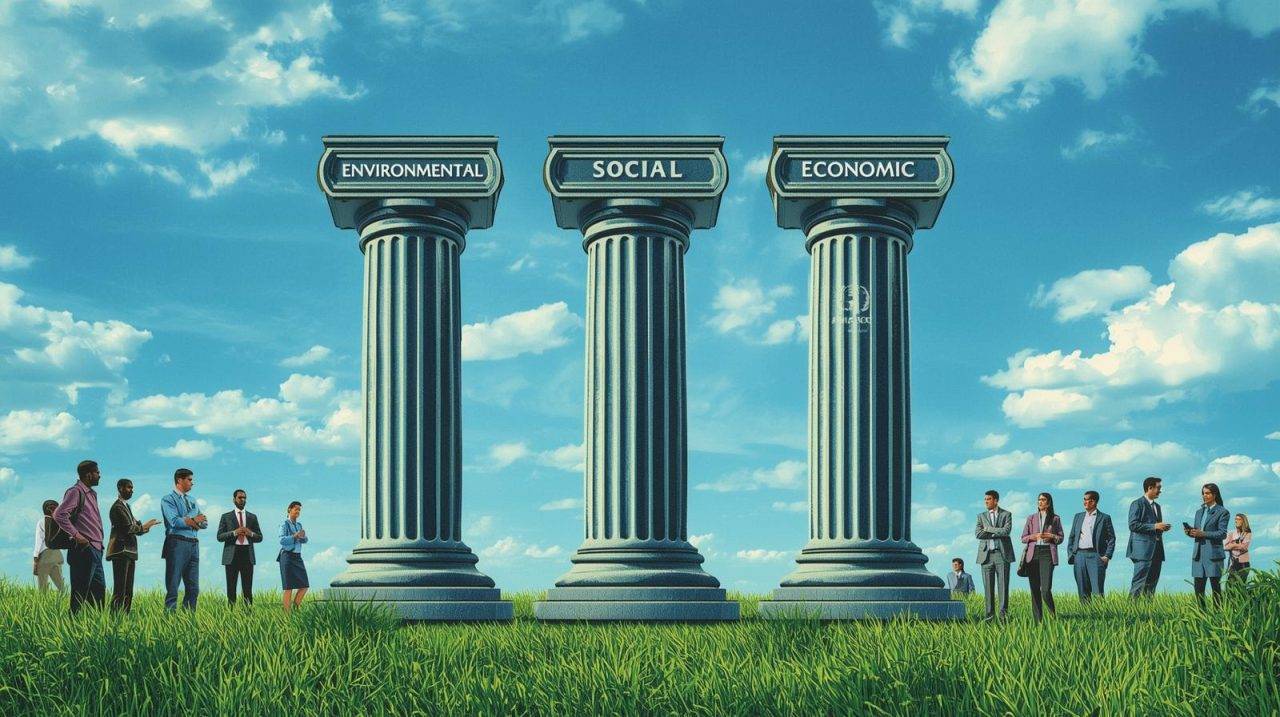
The classic three-pillar model—environmental, social, and economic—offers a helpful starting point. Yet in practice, this elegant Venn diagram often collapses. The social sphere, encompassing worker safety and community welfare, frequently becomes the weakest leg of the stool.
This imbalance isn’t merely academic. It has real-world consequences. Processes designed solely to shrink carbon footprints can inadvertently create new hazards for employees. The 1987 Brundtland Commission provided the seminal definition, calling for “development that meets the needs of the present without compromising the ability of future generations to meet their own needs.” True sustainability cannot pick and choose between pillars.
2.1. The Three Pillars of Sustainability: Environment, Social, and Economic
Let’s examine this tripartite framework more closely. The environmental pillar commands attention through visible, measurable crises. Companies track carbon emissions, water usage, and waste with sophisticated managementsystems.
The economic pillar focuses on viability, profit, and long-term growth. It asks whether business models can endure. The social pillar, however, has historically suffered from ambiguity.
What exactly constitutes social sustainability? It includes occupational health, human rights, fair labor practices, and community relations. Unlike counting tons of CO₂, measuring dignity proves more complex.
This complexity led to neglect. Corporate reporting often highlighted green achievements while burying worker safety data. The social sphere became the quiet cousin at the sustainability table.
Such siloing creates risk. A company praised for renewable energy use might simultaneously fail to protect its workers. This contradiction undermines any claim to genuine responsibility.
2.2. The UN Sustainable Development Goals (SDGs): A 2030 Blueprint
Enter the United Nations Sustainable Development Goals. Adopted in 2015, this framework forcefully reintegrates the social element into the global agenda. The 17 SDGs and their 169 targets provide a concrete 2030 blueprint.
Governments, businesses, and civil society now have a shared language for alignment. The goals transform abstract ideals into specific objectives. Several SDGs connect directly to workplace safety and health.
SDG 3 pursues “Good Health and Well-being” for all ages. SDG 8 champions “Decent Work and Economic Growth.” Its Target 8.8 explicitly aims to “protect labour rights and promote safe and secure working environments for all workers.”
SDG 12 advocates for “Responsible Consumption and Production.” This links the safety of manufacturing processes to the lifecycle impacts of products. The SDGs don’t allow companies to compartmentalize their efforts.
This framework serves as a critical bridge. It translates lofty principles into actionable business programs. For leaders, understanding the SDGs is no longer optional.
Credible commitment to progress requires engaging with all three pillars simultaneously. The goals offer a map for navigating this integrated terrain. They highlight opportunities to create value that encompasses people, planet, and profit.
For stakeholders—from investors to consumers—the SDGs provide a yardstick. They enable scrutiny of whether corporate performance matches rhetorical promises. This alignment moves discourse beyond greenwashing toward substantive accountability.
The blueprint clarifies how safety and health work intersects with broader development goals. It reveals connections across supplychains and operational areas. In doing so, it redefines what comprehensive sustainability truly means.
3. Understanding the U.S. Agencies: OSHA and NIOSH
American workplace protection operates through a complementary dual-agency framework that often confuses even seasoned professionals. One body writes the rules and wields the enforcement hammer. The other conducts the science that makes those rules evidence-based.
This division isn’t bureaucratic redundancy. It’s a deliberate strategy to separate regulatory authority from scientific investigation. Understanding this distinction is crucial for any business navigating compliance and aiming for genuine safety leadership.
The two entities work in tandem but have fundamentally different DNA. Their separate mandates create a more robust system for protecting workers. Together, they form the backbone of the U.S. approach to occupational risk management.
3.1. OSHA: The Occupational Safety and Health Administration
The Occupational Safety and Health Administration is the nation’s workplace watchdog. Congress tasked it with setting and enforcing standards to assure safe and healthful conditions. For decades, its public identity was reactive—arriving after incidents—and prescriptive—issuing detailed regulations.
This traditional model has clear limits. The standard-setting process moves slowly through bureaucratic channels. Mere compliance with existing rules cannot prevent all injuries or illnesses. OSHA leadership recognized this gap, prompting a strategic rethink.
In 2016, the agency published a seminal white paper titled “Sustainability in the Workplace.” This document resulted from over eighty conversations with experts and reviews. It marked a conscious pivot toward proactive engagement with broader societal movements.
The paper’s thesis was revealing. OSHA acknowledged its traditional tools were insufficient alone. It called for engaging with “big, proactive, diverse” forces to become a transformative agent for worker well-being.
This shift redefines the agency’s mandate beyond inspection checklists. OSHA now advocates integrating occupational health and safety into corporate sustainability strategies. It pushes for inclusion in green building certifications and global reporting frameworks.
The move reflects a pragmatic understanding. Leveraging the momentum of the sustainability movement offers untapped potential. It creates new pathways to advance core worker protection goals that regulations alone cannot reach.
3.2. NIOSH: The National Institute for Occupational Safety and Health
While OSHA regulates, the National Institute for Occupational Safety and Health researches. This agency lives within the Centers for Disease Control and Prevention. Its mission is to generate scientific knowledge about workplace hazards and recommend preventive solutions.
NIOSH’s role in the sustainability conversation is foundational but less visible. It produces the evidence needed to identify emerging risks before they become crises. This is especially critical in fast-evolving areas like green technology and advanced manufacturing.
Consider the rise of solar panel installation or lithium-ion battery production. These “green” sectors create novel occupational health challenges. NIOSH scientists study these processes to develop effective best practices.
The institute’s work directly informs both OSHA standards and corporate EHS managementsystems. Its research provides the data backbone for intelligent prevention programs. Without this science, companies would be navigating new risks in the dark.
In the context of global development goals, NIOSH’s contribution is indispensable. Achieving targets related to occupational diseases or workplace mental health requires robust data. The institute’s investigations turn abstract health objectives into actionable prevention strategies.
NIOSH operates as a quiet engine of innovation. It equips professionals and policymakers with the tools to build safer futures. Its stakeholder status in broader sustainabilityefforts ensures the science of worker protection informs holistic progress.
Together, these agencies form a powerful, if sometimes misunderstood, partnership. OSHA provides the policy and advocacy muscle. NIOSH delivers the scientific and innovative spark. Their distinct but synergistic functions are key to seeing how the American framework contributes to safer, more sustainable work.
This understanding dispels common confusion. It also highlights a critical truth: lasting protection requires both the rule of law and the light of science. For businesses committed to genuine performance, engaging with both halves of this system unlocks significant opportunities.
4. What is EHS? Environmental, Health, and Safety Management
The operational machinery that transforms lofty corporate promises about worker welfare into tangible daily protections has a name. Environmental, Health, and Safety management represents the integrated framework organizations deploy across three critical domains.
This discipline prevents harm to workers and the natural environment simultaneously. It moves beyond checking regulatory boxes toward systematic risk management.
EHS functions as the organizational “engine room.” Here, broad aspirations about corporate responsibility meet specific operational procedures. Training protocols, monitoring systems, and continuous improvement cycles all originate from this central function.
The framework typically follows the Plan-Do-Check-Act cycle. This iterative approach aligns with international standards like ISO 14001 for environmental management and ISO 45001 for occupational health and safety.
From Compliance to Strategic Integration
Traditional compliance activities operated in silos. Environmental teams tracked emissions separately from safety departments recording injuries. Modern EHS dismantles these artificial barriers.
A robust management system directly supports multiple global development goals. It ensures safe working conditions aligned with decent work objectives. It promotes worker well-being through preventive healthprograms.
The system also manages chemicals and waste responsibly throughout supply chains. This operational discipline turns philosophical commitment into verifiable action.
The Data Backbone of Credible Reporting
In today’s investment landscape, the EHS function generates essential intelligence. It produces the credible data on social and environmental performance that stakeholders demand.
This represents a fundamental evolution in measurement. Organizations now track leading indicators rather than merely counting past failures.
Training hours completed by employees
Risk assessments conducted proactively
Near-miss reports analyzed for prevention
These metrics reveal an organization’s preventive capacity. They align with the proactive ethos of genuine responsibility efforts.
Technology as an Indispensable Partner
Modern EHS management would be impossible without specialized software platforms. These tools aggregate data, enable analytics, and facilitate transparent reporting at scale.
Software helps track alignment with related global objectives. It brings positive change to society while boosting overall productivity through streamlined processes.
For businesses, this technological capability transforms EHS from a cost center to a value creator. It manages risks, protects reputation, and drives operational efficiency simultaneously.
The Strategic Business Imperative
Forward-thinking companies recognize EHS as a core strategic function. Practices aligned with global frameworks attract investors and boost confidence in long-term stability.
This perspective reveals significant opportunities. A company with strong EHS foundations demonstrates resilience against operational shocks. It shows capacity for managing complex impacts of its products and services.
For professionals, this integration represents career evolution. EHS specialists now contribute directly to corporate strategy rather than merely enforcing rules.
Without a strong EHS foundation, corporate claims regarding social and environmental responsibility remain superficial and unverifiable.
The framework serves as the essential implementation mechanism for any credible strategy. It ensures that commitments to people and planet translate into daily operational reality.
This operational discipline represents more than regulatory necessity. It embodies the practical convergence of ethical ambition with business intelligence. In doing so, it redefines what comprehensive organizational excellence truly means.
5. The Critical Intersection: Sustainability Standardization for OSHA, NIOSH, and EHS
A fundamental disconnect plagues modern corporate responsibility. The metrics for a product’s environmental footprint are meticulously charted. The safety of its makers, however, often remains a statistical ghost.
This gap is where the critical intersection lies. It’s the point where regulatory advocacy, scientific research, and operational systems must converge. Their common goal is to embed worker well-being into the very fabric of global progress reporting.
Standardization provides the essential glue. It refers to the creation of common frameworks, metrics, and disclosure rules. Organizations like GRI and SASB develop these to allow consistent measurement of sustainabilityperformance.
Without it, claims about social responsibility are merely anecdotal. The 2016 OSHA white paper spotlighted this exact problem. It noted that while occupational safety and health are a theoretical component of sustainability models, practice tells a different story.
The paper cited a revealing case. The Sustainability Consortium mapped the chicken supply chain for environmental hotspots. Yet, it completely failed to identify worker safety risks. This was despite notoriously high injury rates in poultry processing plants.
This omission illustrates a systemic blind spot. When lifecycle analyses ignore manufacturing hazards, they render the workforce invisible. True sustainability cannot be measured by carbon alone.
The Critical Intersection continuing
Each U.S. entity plays a distinct, vital role at this intersection.
OSHA’s function is advocacy and policy integration. The agency pushes for robust occupational health metrics within global reporting standards. It ensures worker protection is a material issue for companies and investors alike.
NIOSH contributes the scientific backbone. It researches what constitutes a “safe” green job or a leading indicator of healthperformance. This evidence base informs the very metrics used in standardization.
EHS management systems are the implementation vehicle. They collect the data on the ground. These systems ensure an organization can actually report against standardized metrics credibly.
United Nations SDG’s role
The United Nations sustainable development goals powerfully illustrate this convergence. They provide a pre-built, standardized set of global targets. OSHA, NIOSH, and EHS are the U.S.-centric mechanisms for contributing to goals like SDG 8 (Decent Work).
Challenges at this junction are significant. They include overcoming deep historical silos between environmental and social teams. Defining universally accepted occupational safety metrics is another hurdle. Creating verification processes for social claims remains complex.
The opportunities, however, are transformative. A harmonized approach allows safetydata to flow seamlessly into sustainability reports. This informs smarter investment decisions. It can drive a race to the top in workplace conditions across supplychains.
For businesses, engaging here is a strategic imperative. It moves management from reactive compliance to proactive value creation. It satisfies stakeholders demanding transparency on social impacts.
Standardization metrics of the critical intersection
The table below contrasts the fragmented past with the integrated future enabled by standardization.
Element
Fragmented Model
Integrated, Standardized Model
Focus of Analysis
Environmental lifecycle alone (e.g., carbon, water). Social factors are an afterthought.
Holistic impact assessment. Worker safety and health are analyzed alongside ecological footprints.
Data Collection
Siloed. Safety data stays in EHS software; sustainability teams use separate spreadsheets.
Unified. EHS systems feed directly into sustainability reporting platforms using common metrics.
Role of U.S. Agencies
OSHA regulates, NIOSH researches, but both operate separately from corporate sustainability efforts.
OSHA advocates for OSH in frameworks. NIOSH science informs metrics. Both are partners in holistic performance.
Stakeholder Communication
Separate reports for EHS compliance and sustainability branding, often with conflicting narratives.
One coherent narrative. Safety performance is presented as a core component of overall sustainability progress.
Business Value
Safety is a cost center; sustainability is a marketing effort. Little synergistic value.
Safety becomes a demonstrable asset. It drives ESG ratings, reduces risk, and attracts conscious capital.
This intersection is not just an academic crossing. It is the operational nexus where promises are turned into proof. Standardized frameworks bind agency mandates to practical management and global goals.
The path forward requires deliberate alignment. Companies must demand that reporting frameworks include material OSH metrics. Professionals must bridge internal silos. The ultimate goal is a system where protecting workers is unequivocal proof of a company‘s commitment to a better future.
6. OSHA’s Sustainability Mandate: Protecting Workers in a Green Economy
In 2016, a federal agency best known for workplace inspections published what amounted to a philosophical manifesto. This document, “Sustainability in the Workplace: A New Approach for Advancing Worker Safety and Health,” marked a strategic pivot. The Occupational Safety and Health Administration formally entered the global conversation about responsible progress.
The agency’s traditional identity centered on enforcement and rule-making. Its new stance embraced influence and collaboration. This shift recognized that market forces around environmental, social, and governance issues were reshaping corporate behavior with or without regulatory pressure.
OSHA’s sustainability mandate represents an attempt to harness this momentum. It aims to embed worker protection into the very definition of corporate responsibility. The goal is to ensure that the transition to a green economy does not leave employee well-being behind.
6.1. The 2016 OSHA White Paper: A Call to Action
The white paper emerged from extensive dialogue. Agency staff conducted over eighty conversations with experts across various fields. They reviewed numerous publications to understand the sustainability landscape.
This research revealed a troubling gap. Discussions about environmental metrics and carbon footprints were advancing rapidly. Occupational safety and health considerations, however, remained conspicuously absent from most frameworks.
The document’s central thesis was unequivocal. An employer is only truly sustainable when ensuring the safety, health, and welfare of its workers. A product, building, or supply chain cannot earn the “sustainable” label if its creation causes harm to people.
This reframing was deliberate and strategic. It positioned worker protection as a non-negotiable component of genuine responsibility. The paper served as both a diagnosis of the problem and a prescription for integration.
The agency identified seven key leverage points for action:
Reporting and metrics: Incorporating occupational health data into corporate sustainability disclosures
Investing: Encouraging investors to consider worker safety as a material factor
Business operations: Embedding safety into core management systems and daily practices
Standards: Working with organizations that develop sustainability certifications
Procurement: Influencing supply chain decisions through safety criteria
Education: Training future business leaders on the social dimension of sustainability
Research: Supporting studies that quantify the business value of safe workplaces
For EHS professionals, the document provided crucial ammunition. It gave them language and rationale to advocate for safety at strategic decision-making tables. It transformed their role from compliance officers to value creators.
6.2. Shifting the Safety Curve Through Sustainability
The white paper introduced a powerful visual concept: “Shifting the Safety Curve.” This graphic illustrated how integrating occupational health into sustainability could transform corporate commitment. It showed a continuum from minimal compliance to culture-based excellence.
Traditional regulatory approaches reached only a portion of workplaces. Many companies viewed safety as a cost center to be minimized. They complied with regulations but did little beyond what was legally required.
The sustainability movement offered a different path. It appealed to corporate identity, brand reputation, and investor relations. By linking worker protection to these powerful motivators, the agency could move more organizations along the curve.
OSHA’s role in this shift is not about creating new regulations. Instead, it acts as a catalyst and convener. The agency encourages businesses and standard-setting bodies to explicitly include occupational health in their frameworks.
This approach represents regulatory innovation. It complements enforcement authority with market influence. The goal is to create a race to the top in workplace conditions, driven by stakeholder expectations.
6.2.5. Shifting the Safety Curve Through Sustainability
The table below contrasts the traditional regulatory model with the sustainability-integrated approach:
Aspect
Traditional Regulatory Model
Sustainability-Integrated Model
Primary Driver
Fear of penalties and legal liability
Brand value, investor confidence, and market differentiation
Business Perception
Safety as a compliance cost center
Worker well-being as a strategic asset and value driver
Scope of Influence
Limited to workplaces directly regulated by OSHA
Extends across global supply chains and investment portfolios
Measurement Focus
Lagging indicators: injury rates and violation counts
Leading indicators: preventive programs, training hours, and culture assessments
Stakeholder Engagement
Primarily internal: safety managers and legal teams
Broad external: investors, customers, communities, and certification bodies
Change Mechanism
Command-and-control regulation and enforcement actions
Market signals, reporting frameworks, and voluntary standards
Long-term Impact
Incremental improvement within regulated sectors
Systemic transformation of how businesses define and demonstrate responsibility
The agency’s mandate positions it as a bridge between two worlds. It connects the traditional regulatory domain with the evolving landscape of ESG and sustainable investment. This bridging function amplifies its impact beyond what enforcement alone could achieve.
For companies, this shift presents both challenge and opportunity. It requires integrating safety data into sustainability reporting. It demands engagement with a broader set of stakeholders. The reward is enhanced resilience and access to conscientious capital.
The 2016 white paper remains a foundational document. It provides a roadmap for protecting workers in an economy increasingly focused on environmental and social performance. Its enduring relevance lies in its recognition that true progress cannot sacrifice people for planetary gains.
7. NIOSH’s Role: Research and Prevention for a Sustainable Workforce
If OSHA is the public face of workplace regulation, NIOSH is its indispensable, quiet intellect. This agency operates within the Centers for Disease Control and Prevention, focusing purely on the science of danger.
Its mandate is to investigate occupational hazards and forge preventive solutions. This research forms the bedrock for credible safety management and long-term workforce vitality.
The institute’s work is a critical counterbalance. It ensures the well-being of workers is not an afterthought in the calculus of progress. NIOSH was explicitly listed as a research stakeholder in OSHA’s landmark sustainability assessment.
This recognition underscores a vital truth. Lasting prevention requires evidence, not just enforcement.
Anticipating Hazards in a Green Economy
The shift toward renewable energy and circular economies creates novel risks. Solar panel installers face fall hazards and electrical dangers. Wind turbine technicians work at great heights in confined spaces.
Lithium-ion battery recycling involves toxic chemicals and fire risks. NIOSH scientists study these processes from the ground up. They develop best practices before injuries become commonplace.
This proactive research is a form of strategic foresight. It allows businesses to integrate safety into new industry designs from the start. The goal is to prevent harm, not merely document it after the fact.
The Science Behind Standards and Metrics
NIOSH provides the technical validity for the entire safety ecosystem. Its studies on exposure limits inform OSHA regulations. Its ergonomic analyses shape corporate programs.
In the realm of sustainabilitystandardization, this role is paramount. Frameworks like SASB and GRI propose specific occupational health metrics. NIOSH research answers a fundamental question: Are these metrics scientifically sound?
The institute’s data gives weight to social performance indicators. It transforms vague commitments to “worker well-being” into measurable, evidence-based criteria. This validation is essential for credible reporting.
Direct Contributions to Global Goals
NIOSH initiatives directly advance United Nations objectives. Its Total Worker Health® program exemplifies this link. This approach integrates protection from work-related injury with promotion of overall health.
This holistic model is a direct operational path to SDG 3: Good Health and Well-being. It moves beyond treating illness to fostering vitality.
Similarly, NIOSH research helps define “decent work” (SDG 8) in practical terms. What exposure level is truly safe? What managementsystems reduce psychosocial stress?
By grounding these concepts in science, NIOSH moves them from rhetorical aspirations to achievable operational targets. Its work ensures the ‘S’ in ESG has a substantive backbone.
The institute also studies the future of work itself. It examines the impacts of automation, gig labor, and climatechange on workplaces. This foresight allows professionals to build adaptive, resilient EHS systems.
Collaboration and Amplified Impact
NIOSH does not operate in an ivory tower. It actively collaborates with academic institutions and industry partners. These partnerships are force multipliers for its research.
Findings are disseminated through training, publications, and practical guidelines. They become standardized best practices across entire sectors. This collaborative model turns federal investment into widespread private-sector value.
The table below illustrates how specific NIOSH research domains create tangible impacts for a sustainable workforce.
NIOSH Research Domain
Key Occupational Health Focus
Direct Sustainability & SDG Impact
Total Worker Health®
Integrating physical safety with psychological well-being, chronic disease prevention, and health promotion.
Advances SDG 3 (Good Health). Provides metrics for the ‘Social’ pillar of ESG reporting. Enhances workforce resilience and productivity.
Emerging Technologies & Green Jobs
Anticipating hazards in solar, wind, battery tech, and nanotechnology. Developing safe work practices for new processes.
Ensures a “just transition” to a green economy. Prevents worker harm in sustainable industry sectors. Informs responsible product lifecycle assessments.
Psychosocial Safety & Future of Work
Studying stress, burnout, and mental health impacts of work organization, automation, and precarious employment.
Defines the qualitative aspects of “decent work” (SDG 8). Provides data for social performance indicators critical to investors.
Exposure Science & Epidemiology
Establishing recommended exposure limits (RELs) for chemicals, dusts, and physical agents through longitudinal data analysis.
Creates the evidence base for protective regulations and corporate standards. Validates the health impacts claimed in sustainability reports.
Research-to-Practice (r2p)
Translating scientific findings into practical tools, training, and guidelines for businesses and workers.
Bridges the gap between knowledge and action. Amplifies the return on research investment across supply chains.
Collaboration and Amplified Impact
Ultimately, NIOSH serves as the preventive conscience of the sustainability movement. Its rigorous science ensures that the pursuit of environmental and economic goals does not come at the cost of human well-being.
For companies, engaging with NIOSH resources is a strategic opportunity. It provides access to cutting-edge data that can future-proof safetyprograms. This turns occupational health from a compliance task into a demonstrable competitive advantage.
The institute’s role proves that building a sustainable future requires not just policy and management, but also the relentless, quiet pursuit of knowledge.
8. EHS as the Operational Engine for Sustainable Practices
Modern enterprises face a critical implementation challenge. They must convert high-level sustainability commitments into measurable, daily actions. This gap between aspiration and execution represents the most common failure point in organizational responsibility efforts.
If corporate responsibility is the destination, then the Environmental, Health, and Safety management system is the vehicle. This framework provides the operational machinery for the journey. It transforms strategic promises into tangible workplace reality.
The EHS function operationalizes responsibility by embedding it into core business processes. This includes procurement, design, manufacturing, and contractor management. Each domain becomes a point of leverage for positive change.
This system executes the practical “how” of organizational responsibility. It determines how to reduce waste, ensure safe operations, and monitor worker health. These actions directly support global development objectives.
A modern approach relies on leading indicators rather than lagging statistics. These include safety audit frequency and training completion rates for new technologies. Employee participation in health promotion programs also serves as a key metric.
8.1. EHS as the Operational Engine for Sustainable Practices
These proactive measures reveal an organization’s preventive capacity. They show commitment to building a resilient workforce and environment. Leading indicators provide early warning signals before incidents occur.
Technology acts as the indispensable force multiplier for EHS systems. Integrated software platforms automate data collection through electronic forms. They manage compliance calendars and streamline incident management.
This digital infrastructure centralizes occupational health records in one accessible location. It creates the transparent, auditable information required for credible responsibility reporting. Timely data flows directly into frameworks like GRI.
Software dashboards transform raw information into actionable insights. Managers can identify trends and allocate resources effectively. This demonstrates continuous improvement across all operational areas.
By streamlining routine compliance tasks, EHS systems free professionals to focus on strategic risk prevention. This shift enables culture-building initiatives with greater impact on long-term performance.
8.2. EHS as the Operational Engine for Sustainable Practices
The argument becomes clear through this operational lens. Without a robust, technology-enabled EHS engine, organizational responsibility remains aspirational. It risks becoming a collection of unverifiable claims rather than a driver of tangible results.
Each component of a best-practice EHS system contributes directly to global objectives. The table below illustrates these critical connections across specific operational domains.
8.3. EHS as the Operational Engine for Sustainable Practices
EHS System Component
Core Operational Function
Direct Contribution to Global Objectives
Business Value Created
Electronic Forms & Mobile Data Collection
Captures real-time field data on incidents, inspections, and audits from any location.
Provides evidence for safe work conditions (aligned with decent work goals). Enables tracking of environmental incidents.
Creates auditable trail for compliance. Reduces administrative burden on field workers. Improves data accuracy and timeliness.
Compliance Calendar & Task Management
Automates tracking of regulatory deadlines, training schedules, and permit renewals across the organization.
Ensures systematic adherence to laws protecting workers and the environment. Supports responsible operational practices.
Prevents costly violations and penalties. Demonstrates systematic management to stakeholders. Frees professionals for value-added work.
Incident Management & Corrective Actions
Standardizes reporting, investigation, and closure of safety and environmental incidents through structured workflows.
Directly advances workplace safety and prevention goals. Reduces negative impacts on people and planet.
Turns incidents into learning opportunities. Demonstrates commitment to continuous improvement. Builds trust with stakeholders.
Occupational Health & Wellness Module
Manages health surveillance, case management, exposure monitoring, and wellness program participation.
Directly supports worker well-being objectives. Provides data on health promotion efforts and outcomes.
Invests in human capital productivity. Reduces absenteeism and healthcare costs. Demonstrates care for employee welfare.
Risk Assessment & JSA Tools
Facilitates systematic identification, evaluation, and control of hazards before work begins.
Embeds prevention into operational planning. Aligns with proactive responsibility practices rather than reactive responses.
Prevents incidents before they occur. Optimizes resource allocation to highest risks. Creates predictable, stable operations.
Training & Competency Management
Tracks completion, schedules sessions, and manages certifications for all employees and contractors.
Builds capability for safe operations with new technologies and processes. Ensures skilled workforce for green transition.
Standardizes knowledge across the organization. Creates opportunities for employee development. Reduces skill-based errors.
Supplier & Contractor Management
Extends EHS standards and monitoring through the supply chain to external partners.
Manages third-party risks effectively. Ensures consistency of products and services. Protects brand reputation.
Dashboard Analytics & Reporting
Transforms operational data into visual insights on performance trends, leading indicators, and improvement areas.
Enables transparent communication of progress to all stakeholders. Supports credible annual responsibility reports.
Informs strategic decision-making with evidence. Identifies improvement opportunities. Demonstrates return on responsibility investments.
8.4. EHS as the Operational Engine for Sustainable Practices
This operational engine creates verifiable performance where rhetoric alone fails. Furthermore, it allows businesses to demonstrate actual progress rather than merely describing intentions. The system turns responsibility from a marketing exercise into a management discipline.
For companies seeking genuine advantage, the EHS framework offers more than compliance. It represents a strategic capability for navigating complex stakeholder expectations. This engine powers the transition from talking about change to actually delivering it.
The most forward-thinking organizations recognize this truth. They view their EHS systems as central to long-term viability rather than peripheral cost centers. This perspective unlocks significant value across all operational areas.
Ultimately, the operational engine determines whether responsibility remains theoretical or becomes transformational. It separates organizations that merely claim progress from those that can prove it through daily actions and measurable outcomes.
9. Mapping Safety and Health to the UN Sustainable Development Goals
The United Nations’ ambitious blueprint for global progress contains a powerful, often overlooked secret: workplace safety is woven directly into its fabric. This revelation transforms how businesses understand their role in the world’s most pressing development goals.
For professionals, this mapping exercise provides more than academic insight. It offers a practical translation guide between daily work and international targets. The connection turns routine compliance into strategic contribution.
Three goals stand out for their direct relevance to occupational health and safety. Each represents a different dimension of how protecting workers advances broader societal aims. Together, they form a comprehensive framework for responsible operations.
9.1. SDG 8: Decent Work and Economic Growth
Target 8.8 of this goal delivers unambiguous clarity. It explicitly calls for “safe and secure working environments for all workers.” This language mirrors the core mission of occupational safety agencies and management systems.
The alignment here is remarkably direct. Every job hazard analysis conducted, every piece of personal protective equipment issued, contributes to this specific United Nations target. These actions move beyond local compliance to global citizenship.
SDG 8 also addresses forced labor and child labor eradication. This expands the safety conversation beyond physical hazards to fundamental human rights. For companies with complex supply chains, this creates new monitoring responsibilities.
When a manufacturing plant implements lockout-tagout procedures, it’s not just following regulations. It’s actively building the “decent work” envisioned by global consensus.
This perspective reveals hidden opportunities. Safety programs can now be framed as contributions to economic dignity. Training sessions become investments in workforce capability rather than mere regulatory boxes to check.
9.2. SDG 3: Good Health and Well-being
Occupational health represents the frontline where this goal meets daily reality. Workplace exposures to chemicals, noise, or ergonomic stressors directly impact community health outcomes. Prevention here creates ripple effects far beyond the factory gate.
NIOSH’s Total Worker Health® initiative exemplifies this connection perfectly. It integrates traditional hazard control with wellness promotion. This holistic approach addresses both injury prevention and chronic disease mitigation.
The linkage to SDG 12 becomes evident through chemical management. Safely handling solvents protects workers from respiratory issues (advancing SDG 3) while preventing environmental contamination (supporting SDG 12). A single management action serves multiple objectives.
Mental health represents another critical intersection. Workplace stress reduction programs contribute directly to overall well-being targets. They demonstrate that decent work encompasses psychological safety alongside physical protection.
9.3. SDG 12: Responsible Consumption and Production
This goal traditionally focused on environmental metrics like waste reduction and resource efficiency. Its social dimension, however, proves equally significant. Target 12.4 specifically addresses the environmentally sound management of chemicals and wastes throughout their life cycle.
For EHS professionals, this is familiar territory with renewed purpose. Chemical hygiene plans and waste minimization efforts now contribute to internationally recognized development goals. The data collected gains strategic importance.
The goal encourages companies to adopt sustainable practices and integrate sustainability information into their reporting. This creates a powerful feedback loop. Safety performancedata becomes part of corporate responsibility narratives.
A revealing gap emerges through this mapping exercise. Traditional EHS systems often stop at the factory gate. Product safety during consumer use may fall outside their scope. Yet SDG 12’s lifecycle perspective suggests this represents an opportunity for expanded responsibility.
9.4.SDG 12: Responsible Consumption and Production
The table below illustrates how common occupational health and safety activities create tangible contributions across multiple goals simultaneously.
Common EHS Activity
Primary Safety/Health Function
SDG 8 Contribution
SDG 3 Contribution
SDG 12 Contribution
Job Hazard Analysis (JHA)
Identifies and controls workplace risks before work begins
Creates “secure working environment” through systematic risk control
Prevents injuries and acute health incidents
N/A (though may identify chemical handling risks)
Chemical Hygiene Plan Implementation
Manages exposure to hazardous substances through engineering controls, PPE, and monitoring
Protects workers from chemical hazards as part of safe conditions
May support efficient production processes with less physical strain and error
Contractor Safety Management
Extends safety standards to third-party workers on site through qualification, orientation, and oversight
Ensures “all workers” (including temporary/contract) have safe conditions
Protects health of extended workforce beyond direct employees
Can ensure contractors follow proper chemical and waste management procedures
Emergency Response Planning & Drills
Prepares organization and workers to respond effectively to incidents (fire, chemical release, etc.)
Enhances “secure” environment through preparedness for unexpected events
Minimizes health consequences of emergencies through timely, effective response
Prevents environmental contamination from uncontrolled incidents (e.g., chemical spills)
9.5. SDG 12: Responsible Consumption and Production
This mapping serves as more than an intellectual exercise. For businesses, it provides a universal language to communicate safetyefforts to global stakeholders. Investors, customers, and communities increasingly speak the dialect of the sustainable development goals.
The framework also reveals strategic priorities. Activities with multi-goal impact deserve particular attention and resources. Chemical management emerges as a superstar—simultaneously protecting people, supporting decent work, and enabling responsible production.
9.6. SDG 12: Responsible Consumption and Production
For professionals, this perspective transforms daily work from technical necessity to meaningful contribution. Conducting an inspection becomes part of building a safer world. Training a new employee advances economic dignity. The mundane gains monumental significance.
The ultimate insight is beautifully simple: protecting workers isn’t separate from building a sustainable future. It’s foundational to it. This mapping makes that truth operational, measurable, and communicable to all who need to understand it.
10. The ESG Connection: How Investment Principles Drive Safety Standards
A quiet revolution in finance is rewriting the rules of corporate value, placing human safety at its core. Environmental, Social, and Governance criteria have evolved from a niche concern to a mainstream determinant of capital allocation. This shift directly influences corporate behavior across global supply chains.
The movement represents more than ethical preference. It reflects a pragmatic reassessment of long-term risk and operational resilience. Investors now scrutinize workforce treatment as a proxy for management quality.
Poor safety performance signals deeper issues. It indicates potential operational weakness, cultural deficiencies, and latent liability. These factors can erode shareholder value over time.
The Occupational Safety and Health Administration acknowledges this connection. Its analysis suggests that firms with stronger ESG performance may attract more investment. This creates powerful market-driven leverage for workplace improvements.
For professionals, the ESG imperative transforms their role. Data and reports are no longer just for internal use or regulators. They become key inputs for investor relations and strategic communications.
10.1. The “S” in ESG: Social Factors and Worker Well-being
The social pillar is where occupational health finds its most potent financial leverage. This dimension encompasses how companies manage relationships with employees, suppliers, and communities. Worker safety sits squarely at its center.
Investors increasingly view strong social performance as an indicator of sustainable business practices. They recognize that mistreated workforces lead to turnover, litigation, and reputational damage. Conversely, protected workers contribute to stability and innovation.
The social factor extends beyond basic compliance. It includes fair wages, diversity, and community engagement. Yet physical and psychological safety remains the foundational element. Without it, other social efforts ring hollow.
This perspective reframes safety from a cost center to a value driver. It connects daily protection measures to long-term financial performance. The table below illustrates how social factors translate into investor considerations.
Social Factor
Investor Perception
Financial Impact
Workplace Injury Rates
Indicator of operational discipline and management system effectiveness
Direct costs (workers’ comp), indirect costs (downtime), and potential regulatory penalties
Employee Turnover
Proxy for organizational culture and worker satisfaction
Recruitment/training expenses, loss of institutional knowledge, productivity dips
Training Investment
Evidence of commitment to workforce capability and risk prevention
Higher skill levels, fewer errors, adaptability to new technologies and processes
Supply Chain Labor Practices
Reveals depth of responsibility management and brand risk exposure
Reputational damage from controversies, consumer boycotts, contractual disruptions
Health & Wellness Programs
Demonstrates holistic approach to human capital and productivity
Reduced absenteeism, lower healthcare costs, improved morale and engagement
This analytical framework creates tangible pressure for improvement. Companies must now demonstrate their social credentials with credible data. Empty promises no longer satisfy sophisticated investors.
10.2. SASB and PRI: Frameworks Prioritizing Health and Safety
Two influential frameworks translate these principles into actionable expectations. They provide structure for how investors evaluate corporate responsibility.
The Sustainability Accounting Standards Board offers industry-specific guidance. SASB identifies employee health and safety as a material issue for 26 out of 77 industries. This classification provides investors with comparable, financially relevant data.
SASB’s approach moves beyond generic reporting. It tailors metrics to sector-specific risks. For extractive industries, the focus might be on fatality rates. For healthcare, it could center on staff exposure to pathogens.
SASB standards create a de facto form of market standardization. They push organizations to report on leading indicators rather than just lagging injury statistics.
10.3. SASB and PRI: Frameworks Prioritizing Health and Safety
The United Nations Principles for Responsible Investment represents a massive coalition. With over 5,000 signatories, PRI urges incorporating ESG issues into investment analysis. This creates powerful demand for robust occupational safety disclosure.
PRI signatories commit to six principles that guide their ownership practices. These include seeking appropriate disclosure on ESG issues and promoting acceptance within the investment industry. The collective weight of these institutions reshapes corporate behavior.
Together, these frameworks establish clear expectations:
Transparency: Regular disclosure of safety performance data using consistent metrics
Materiality: Focus on issues that genuinely affect financial performance and stakeholder trust
Comparability: Standardized reporting that allows benchmarking across peers and sectors
Forward-looking: Emphasis on management systems and preventive capacity rather than just past incidents
The impact extends across organizational boundaries. EHS management systems must now feed data into sustainability reports. Professionals collaborate with finance and communications teams.
This integration represents a fundamental rewiring of how business value gets assessed. It places occupational health management at the heart of corporate strategy. The trend shows no signs of reversal.
Forward-thinking companies recognize the opportunity. They leverage strong safety performance to attract conscientious capital. They build resilience against the evolving expectations of global investors.
The analysis concludes with a clear imperative. ESG is not a passing trend but a permanent feature of modern finance. Organizations that master this connection will enjoy competitive advantage in the capital markets of tomorrow.
11. Key Mechanisms: Sustainability Reporting and Metrics
Corporate transparency has evolved from glossy brochures to rigorous data disclosure, transforming how organizations prove their commitment to worker protection. This shift represents more than cosmetic change—it’s a fundamental redefinition of corporate accountability.
The journey began with environmental reporting in the 1990s. Companies tracked emissions and resource use to demonstrate ecological responsibility. Over time, this expanded to encompass broader corporate social responsibility narratives.
Today, standardized disclosure serves as the primary mechanism for communicating ESG performance. It moves organizations from voluntary storytelling to structured, comparable data sharing. This evolution creates both challenges and opportunities for safety professionals.
Effective reporting does more than satisfy external stakeholders. It drives internal accountability and continuous improvement. The right metrics can transform safety from an operational function to a strategic asset.
11.1. Global Reporting Initiative (GRI) and Occupational Health
The Global Reporting Initiative stands as the most widely adopted framework worldwide. Its standards provide a comprehensive structure for disclosing economic, environmental, and social impacts. For occupational safety, GRI Series 403 offers specific guidance.
These standards cover essential areas like injury rates, worker training, and risk assessment. They require companies to report both the frequency and severity of work-related incidents. This creates a baseline for comparing performance across organizations.
GRI’s approach is multi-stakeholder in orientation. It seeks to address the concerns of workers, communities, and civil society alongside investors. The framework emphasizes transparency about negative impacts as well as positive achievements.
The Center for Safety and Health Sustainability developed a valuable resource in this context. Their Best Practices Guide for OSH in Sustainability Reports outlines optimal approaches. It recommends metrics like OSH staffing levels and board-level oversight.
GRI reporting transforms occupational health data from internal records into public commitments. It creates external pressure for improvement while providing a structured path for demonstration.
For EHS teams, engaging with GRI means systematizing data collection. They must ensure information meets the specific definitions required by the standards. This often requires collaboration across departments that traditionally operated in silos.
11.2. The Sustainability Accounting Standards Board (SASB) Materiality Map
The Sustainability Accounting Standards Board takes a distinctly different approach. SASB focuses exclusively on issues that are financially material for investors. Its framework identifies which sustainability topics genuinely affect corporate value in each industry.
Employee health and safety emerges as a common material topic across sectors. SASB identifies it as relevant for 26 out of 77 industry classifications. This recognition validates the financial significance of workplace protection.
SASB’s materiality map serves as a strategic filter. It helps companies determine which data points deserve investor attention. The framework prevents reporting overload by focusing on what truly matters for financial performance.
The materiality concept itself warrants examination. Material issues are those that could reasonably influence the decisions of stakeholders. They reflect an organization’s significant impacts or represent substantive concerns for those engaging with the business.
This investor-centric model creates powerful market incentives. Companies with strong safety performance can leverage it for capital access. Conversely, poor records may raise red flags for conscientious investors.
SASB standards push organizations toward leading indicators rather than lagging statistics. They encourage disclosure of preventive programs and managementsystems. This aligns with the proactive ethos of genuine responsibility efforts.
11.3. Leading vs. Lagging Indicators in Safety Performance
A critical evolution in safety measurement involves the indicators themselves. Traditional approaches relied heavily on lagging metrics like the Total Recordable Incident Rate. These statistics tell stories about past failures rather than future prevention.
Leading indicators represent a paradigm shift. They measure activities that predict and prevent incidents before they occur. Examples include safety training hours, audit completion rates, and near-miss reporting frequency.
These proactive metrics align perfectly with sustainable businesspractices. They provide insight into the strength of an EHS managementsystem before problems manifest. This forward-looking approach transforms measurement from retrospective to anticipatory.
The Occupational Safety and Health Administration highlighted this challenge in its analysis. The agency noted the difficulty of metric development and the need to identify important measures. This recognition underscores the complexity of meaningful measurement.
11.4. Leading vs. Lagging Indicators in Safety Performance
Leading indicators serve multiple purposes simultaneously. They guide internal management decisions about resource allocation. They demonstrate preventive capacity to external stakeholders. Perhaps most importantly, they create positive feedback loops that reinforce safe practices.
However, standardization challenges persist. Different organizations may define “training hours” or “audit completion” in varied ways. This creates noise for investors attempting to compare companies. The lack of uniform calculation methodologies remains an obstacle.
The table below contrasts the two dominant reporting frameworks and their approaches to occupational health metrics:
Communicates financially relevant performance to capital markets; affects valuation
Implementation Challenge
Requires extensive data collection across many impact areas; can be resource-intensive
Requires precise understanding of industry-specific materiality and investor expectations
Evolution Trend
Moving toward greater integration with other frameworks and SDG alignment
Merged with IFRS Foundation to create International Sustainability Standards Board (ISSB)
11.5. Leading vs. Lagging Indicators in Safety Performance
Building an effective metrics program requires balancing these approaches. Organizations must satisfy both comprehensive GRI expectations and focused SASB requirements. The most sophisticated businesses use data from both frameworks to drive improvement.
For EHS professionals, this integration represents a significant opportunity. It elevates their work from operational necessity to strategic contribution. The data they collect now informs critical decisions about capital allocation and market positioning.
The ultimate goal transcends mere compliance with reporting standards. Effective measurement creates transparency that builds trust with all stakeholders. It turns safety performance into demonstrable evidence of organizational excellence.
This evolution in reporting mechanisms reveals a deeper truth. The metrics an organization chooses to track signal its genuine priorities more clearly than any mission statement. In this context, leading safety indicators become the ultimate test of commitment to people alongside planet and profit.
12. Standards and Certifications: Building Sustainable Systems
The quest for corporate legitimacy has spawned an entire ecosystem of badges, seals, and certificates that promise to validate responsible practices. This marketplace of virtue signals creates both opportunities and pitfalls for organizations seeking credibility.
Standards provide the structural blueprint for systematic improvement. Certifications offer third-party verification of implementation. Together, they form the tangible proof points separating authentic commitment from marketing claims.
This examination explores two critical domains. First, the evolution of occupational health and safetymanagement standards. Second, the integration gap in green building certifications.
12.1. From OHSAS 18001 to ISO 45001
The journey toward systematic occupational safetymanagement began with OHSAS 18001. This British standard provided organizations with a framework for controlling risks. It represented an important step beyond reactive compliance.
In 2018, the International Organization for Standardization released ISO 45001. This marked a significant evolution in approach. The new standard emphasizes organizational context and worker participation.
ISO 45001 requires companies to consider how external factors affect their safetyperformance. This includes climatechange, regulatory shifts, and stakeholder expectations. The standard’s structure deliberately mirrors ISO 14001 and ISO 9001.
This alignment facilitates integrated managementsystems. Organizations can combine quality, environmental, and healthsystems into unified frameworks. Such integration is ideal for driving comprehensive responsibility efforts.
The standard’s emphasis on worker participation represents a philosophical shift. It recognizes that frontline employees possess crucial knowledge about workplace risks. Their involvement improves hazard identification and control effectiveness.
For businesses, certification under ISO 45001 signals more than regulatory adherence. It demonstrates systematic commitment to protecting human resources. This creates tangible value for investors and other stakeholders.
12.2. Green Building Standards (e.g., LEED) and Worker Safety
Green building certifications present a revealing case study in integration gaps. The Leadership in Energy and Environmental Design program dominates this space. LEED has revolutionized how buildings are evaluated for environmental performance.
The program focuses extensively on energy efficiency, water conservation, and material selection. Occupant health receives considerable attention through indoor air quality standards. Construction worker safety, however, has historically been absent.
The Occupational Safety and Health Administration highlighted this contradiction in its analysis. The agency’s paper includes pointed criticism of this oversight. It states unequivocally that a building cannot be considered sustainable if a worker is killed during its construction.
This omission reveals a fundamental flaw in how many green standards conceptualize responsibility. They measure environmental impacts while rendering the workforce invisible during production phases.
12.3. Green Building Standards (e.g., LEED) and Worker Safety
A growing movement seeks to address this gap. Some advocates push for construction safety prerequisites in green building standards. Others propose credits for implementing recognized safetyprograms during construction.
The logic is compelling. A building’s true sustainability must encompass its entire lifecycle. This includes the safety conditions during creation, not just operational efficiency afterward.
Similar pressures affect other product certifications. Furniture, apparel, and aluminum standards face demands to include social criteria. Consumers and investors increasingly question “green” products from unsafe factories.
For companies, pursuing these certifications involves more than earning plaques. It represents a disciplined process for implementing best practices. Third-party verification provides credibility that internal claims cannot match.
12.4. Green Building Standards (e.g., LEED) and Worker Safety
Standard/Certification
Primary Focus Areas
Worker Safety Integration
Business Value Proposition
ISO 45001
Occupational health and safety management systems; risk-based approach; worker participation; organizational context
Core focus – the entire standard is dedicated to protecting worker safety & health through systematic management
Demonstrates systematic commitment to human capital protection; facilitates integration with quality & environmental systems; satisfies investor ESG criteria
LEED (BD & Construction)
Energy efficiency, water conservation, sustainable materials, indoor environmental quality, innovation in design
Historically minimal to nonexistent; growing pressure to include construction safety prerequisites or credits; current focus is occupant health, not worker safety
Market differentiation for green buildings; operational cost savings through efficiency; meets regulatory incentives in some jurisdictions; addresses tenant demand for healthy spaces
ISO 14001
Environmental management systems; compliance with regulations; pollution prevention; continuous improvement
Indirect at best; may address worker safety through chemical management or emergency preparedness but not systematic OSH focus
Social equity, fair wages, community development, environmental protection in agricultural supply chains
Includes some worker safety provisions as part of decent work standards but not comprehensive OSH management system requirements
Premium pricing for certified products; brand differentiation based on ethical sourcing; consumer trust in supply chain integrity
WELL Building Standard
Human health and wellness in buildings; air, water, nourishment, light, fitness, comfort, mind
Focuses exclusively on occupant health and wellness; no provisions for construction or maintenance worker safety
Addresses growing demand for healthy workplaces; supports employee productivity and retention; aligns with corporate wellness programs
Responsible Business Alliance (RBA)
Labor rights, health & safety, environmental responsibility, ethics in electronics & manufacturing supply chains
Includes detailed health and safety standards for workers; requires management systems and worker training
Supply chain risk management; brand protection from labor controversies; meets customer requirements in electronics and manufacturing sectors
12.5. Green Building Standards (e.g., LEED) and Worker Safety
The future of standardization lies in truly integrated frameworks. These must address environmental, social, and economic outcomes simultaneously. The loophole allowing “green” products from unsafe factories must close.
For professionals, this evolution represents both challenge and opportunity. They must advocate for comprehensive standards that protect workers throughout value chains. Their expertise becomes essential for credible certification processes.
12.6. Green Building Standards (e.g., LEED) and Worker Safety
The most forward-thinking businesses recognize this convergence. From there they pursue certifications not as marketing exercises but as improvement disciplines. This approach transforms standards from external requirements into internal drivers of excellence.
Ultimately, certifications serve as the architecture of modern accountability. They provide the scaffolding upon which genuine responsibility efforts can be built and verified. In an era of heightened transparency, they offer the proof that rhetoric alone cannot provide.
13. The Role of Technology: EHS Software in Achieving SDG Targets
Behind every credible sustainability report lies an invisible technological architecture that transforms promises into proof. Spreadsheets and paper checklists once symbolized diligent corporate responsibility. Today, they represent a dangerous anachronism in the face of complex global challenges.
The scale of modern responsibility efforts renders manual systems obsolete. Organizations must track countless data points across global operations. Environmental, Health, and Safety software has emerged as the critical enabler for genuine achievement.
This digital infrastructure serves multiple strategic functions simultaneously. It automates compliance tracking while generating evidence for stakeholder communications. Most importantly, it creates the operational bridge between daily work and international development targets.
Technology platforms transform scattered information into coherent intelligence. They allow businesses to demonstrate progress rather than merely describe intentions. This capability represents a fundamental shift in how organizations prove their commitment.
13.1. Data Gathering, Analytics, and Transparency
Uniform data collection forms the foundation of credible responsibility reporting. Manual processes introduce inconsistencies that undermine stakeholder trust. Digital platforms solve this challenge through automated workflows and standardized forms.
Electronic form modules capture field information in real-time from any location. They ensure workers report incidents, inspections, and audits using consistent formats. This standardization creates comparable data across different facilities and regions.
Advanced analytics transform this raw information into actionable intelligence. Dashboard capabilities visualize performance trends and risk patterns. Professionals can identify improvement areas before problems escalate into incidents.
The transparency afforded by these systems is key to building trust. Investors and customers gain confidence in claims backed by auditable data trails from robust software platforms.
This technological capability directly supports global development objectives. Organizations can monitor their contribution to specific targets through customized metrics. The data infrastructure becomes the evidence backbone for annual responsibility reports.
Consider the occupational health module within modern platforms. It tracks employee participation in wellness programs and exposure monitoring results. This information demonstrates concrete progress toward health-related development goals.
The analytical power extends beyond internal management. It enables companies to benchmark their performance against industry peers. This competitive intelligence informs strategic investment decisions in prevention resources.
13.2. Streamlining Compliance and Incident Management
Regulatory landscapes evolve with increasing complexity, especially around environmental, social, and governance expectations. Manual tracking of permit renewals and training deadlines becomes impractical at scale. Technology provides the systematic solution.
Compliance calendar modules automate deadline monitoring across entire organizations. They alert professionals about upcoming requirements before due dates approach. This preventive functionality reduces regulatory risks and associated penalties.
Incident management workflows represent another critical innovation. Digital platforms standardize how organizations report, investigate, and resolve safety events. They ensure consistent follow-up on corrective actions across all operational areas.
These streamlined processes create tangible businessvalue. They reduce administrative burdens on field personnel while improving data accuracy. More importantly, they close the loop between incident occurrence and preventive improvement.
13.3. Streamlining Compliance and Incident Management
The table below contrasts traditional manual approaches with modern digital solutions:
Operational Domain
Manual, Paper-Based Approach
Digital EHS Platform Approach
Data Collection
Inconsistent forms across locations; delayed submission; transcription errors
Standardized electronic forms; real-time submission from mobile devices; automated validation
Automated calendar with alerts; centralized tracking; proactive management of requirements
Incident Management
Paper reports lost or delayed; inconsistent investigation processes; poor corrective action follow-up
Structured digital workflows; automated notifications; systematic root cause analysis; tracked corrective actions
Performance Analytics
Monthly or quarterly manual reports; limited trend analysis; delayed insights
Real-time dashboards; predictive analytics; immediate identification of risk patterns
Stakeholder Reporting
Manual compilation for annual reports; limited transparency; difficulty verifying claims
Automated report generation; auditable data trails; transparent communication of progress
SDG Alignment Tracking
Theoretical alignment without measurable data; anecdotal evidence of contribution
Quantified metrics linked to specific targets; demonstrable progress through collected data
Technology’s role extends beyond mere efficiency gains. It enables a fundamental reimagining of how organizations approach responsibility management. Digital platforms turn reactive compliance into proactive value creation.
For businesses navigating the transition to sustainable practices, this represents a strategic imperative. The investment in EHS technology is not an IT expense but a capability-building necessity. It creates the infrastructure required to thrive in an increasingly transparent economy.
The software serves as the operational bridge between aspiration and achievement. It ensures that commitments to people and planet translate into measurable daily actions. This technological enablement represents the quiet revolution making genuine responsibility possible at scale.
14. Challenges in Integration: Silos, Metrics, and Verification
Three formidable obstacles stand guard at the gates of genuine integration: departmental silos, metric confusion, and verification gaps. These barriers persist despite compelling logic for unified responsibility efforts.
Organizational structures and historical priorities create systemic roadblocks. Different budgets and reporting lines separate environmental teams from health departments. This fragmentation mirrors broader ecosystem challenges.
The path forward requires honest assessment of these hurdles. Identifying challenges represents the first step toward developing effective strategies. This section examines the most persistent integration barriers.
14.1. The Historical Focus on Environmental Over Social Sustainability
Corporate responsibility conversations developed an ironic imbalance over decades. Environmental concerns enjoyed clearer metrics and regulatory drivers. Social considerations, including occupational safety, remained fuzzier and less prioritized.
This historical bias created what one might call “carbon myopia.” Companies could proudly report reduced emissions while neglecting worker protection. The sustainability movement itself became siloed into separate categories.
The Occupational Safety and Health Administration noted this troubling pattern in practice. Their analysis revealed how key social considerations often lag behind environmental priorities. This separation undermines holistic progress toward global development objectives.
Environmental departments typically measure tangible outputs like tons of CO₂ or gallons of water. Social teams struggle with qualitative concepts like dignity and well-being. This measurement disparity reinforces the imbalance.
Investor attention has followed this historical pattern. Climate-related financial disclosures gained traction faster than social metrics. Market signals thus amplified rather than corrected the environmental bias.
The consequences extend beyond corporate reporting. Green building certifications might ignore construction worker safety. Sustainable product labels could originate from hazardous factories. This represents a fundamental flaw in responsibility frameworks.
“An employer is only truly sustainable when ensuring the safety, health, and welfare of its workers. A product cannot earn the ‘sustainable’ label if its creation causes harm to people.”
OSHA White Paper, 2016
Overcoming this historical bias requires deliberate rebalancing. Companies must allocate equal resources to social and environmental programs. Leadership must champion integrated rather than compartmentalized approaches.
14.2. The Lack of Standardized OSH Reporting in the U.S.
A critical systemic gap hampers progress: the absence of mandatory, standardized occupational safety and health disclosure. Unlike financial reporting or greenhouse gas emissions, OSH data lacks uniform requirements.
This creates a patchwork of voluntary disclosures that frustrates stakeholder analysis. Investors cannot reliably compare safety performance across companies. Communities struggle to assess true workplace conditions.
Frameworks like GRI and SASB exist but adoption remains inconsistent. Their voluntary nature means companies can selectively disclose favorable metrics. This undermines the credibility of entire reporting ecosystems.
14.3. The Lack of Standardized OSH Reporting in the U.S.
The verification problem compounds this challenge. Social and OSH data lacks robust third-party audit processes comparable to financial statements. Without independent verification, stakeholder confidence remains fragile.
Many organizations struggle with metric selection itself. They often default to lagging injury rates although, rather than leading indicators. These traditional metrics poorly predict future performance and system health.
The table below illustrates the reporting gap between environmental and social domains:
Reporting Aspect
Environmental Domain
Social Domain (OSH Focus)
Standardization Level
High – Established protocols for GHG, water, waste
Low – Voluntary frameworks with inconsistent adoption
This data deficiency creates a vicious cycle. Without standardized reporting, companies cannot demonstrate safety leadership effectively. Investors cannot reward superior performance through capital allocation.
The lack of verification processes presents another critical gap. Financial statements undergo rigorous external audit. Sustainability reports often receive minimal scrutiny beyond internal review.
14.4. The Lack of Standardized OSH Reporting in the U.S.
Overcoming these challenges requires coordinated action. Businesses must advocate for policy developments encouraging standardized disclosure. Internal silos between departments need deliberate dismantling.
Investment in data management systems enables credible reporting. Technology platforms can standardize collection across global operations. This creates the foundation for transparent communication.
Leading indicators deserve particular attention. Metrics like safety training hours and risk assessment completion predict preventive capacity. These forward-looking measures reveal system strength better than injury statistics.
The path toward integration acknowledges these obstacles without accepting them as permanent. Each challenge represents an opportunity for innovation and improvement. The subsequent sections explore strategies for overcoming these persistent barriers.
15. The Future Outlook: Regulation, Investment, and Corporate Culture
Tomorrow’s safety standards will be forged not in regulatory offices alone, but in boardrooms and investment committees. The trajectory is unmistakable. Forces of conscientious finance, activist stakeholders, and global development ambitions create irresistible momentum.
This convergence reshapes occupational health management fundamentally. It moves protection from technical compliance to strategic value creation. The coming decade will witness profound shifts in how organizations approach worker well-being.
Three domains will experience particularly significant transformation. Regulatory frameworks will evolve toward mandatory disclosure. Investment analysis will demand granular social performance data. Most importantly, corporate culture must reimagine safety’s role entirely.
15.1. Potential for Stricter ESG-Informed Regulations
Voluntary reporting represents the current phase of corporate transparency. The next stage involves mandatory disclosure with regulatory teeth. Europe’s Corporate Sustainability Reporting Directive offers a preview of this future.
This framework requires detailed reporting on social and environmental impacts. It includes specific metrics about working conditions and accident prevention. The directive demonstrates how policy can formalize market expectations.
The United States may follow similar pathways. Global commitment to the sustainable development goals hints at future compliance requirements. Businesses must prepare for stricter rules informed by environmental, social, and governance principles.
Regulatory evolution will likely focus on several key areas. Standardized occupational health metrics could become mandatory for public companies. Verification processes might resemble financial audit requirements. Supply chain transparency may extend to subcontractor working conditions.
This regulatory shift responds to market failures in voluntary systems. Without mandatory frameworks, companies can selectively disclose favorable data. This undermines investor confidence and stakeholder trust in corporate claims.
The investment community will continue refining its assessment tools. Analysts demand more granular, verified information on workforce safety. Leading indicator data gains particular importance for predicting future performance.
Future regulations will likely mandate disclosure of preventive programs rather than just incident statistics. This represents a fundamental reorientation from measuring failure to demonstrating capacity.
For professionals, this evolution creates both challenges and opportunities. Compliance becomes more complex but also more strategic. Data management systems gain critical importance for meeting disclosure requirements.
Organizations should begin preparing now. They can align current reporting with emerging frameworks like the European directive. This proactive approach reduces future compliance costs and disruption.
15.2. Viewing OSH as an Investment, Not an Expense
The most profound shift must occur in corporate mindset and culture. The narrative must change from viewing occupational safety as a compliance cost. Instead, organizations should recognize it as strategic investment in human capital.
This perspective calculates the return on prevention comprehensively. It considers reduced employee turnover and lower insurance premiums. Avoided litigation and enhanced productivity represent additional financial benefits.
The Occupational Safety and Health Administration’s analysis supports this investment thesis. Their paper suggests stronger environmental, social, and governance performance may attract more investment. This creates direct financial incentives for safety excellence.
Future-forward companies will integrate leadership at the highest levels. Chief Sustainability Officers and EHS Vice Presidents will collaborate directly with financial executives. This alignment ensures safety considerations inform capital allocation decisions.
15.3. Viewing OSH as an Investment, Not an Expense
The investment mindset recognizes several key returns:
Human capital preservation: Protected workers represent retained skills and institutional knowledge
Brand value enhancement: Safety leadership strengthens reputation with customers and communities
Talent attraction: Top performers seek employers demonstrating genuine care for well-being
Innovation capacity: Engaged, healthy workforces contribute more creative solutions
Technology adoption will accelerate this transformation. Artificial intelligence and predictive analytics play larger roles in risk identification. Consequently, these tools further blur lines between operational excellence and genuine responsibility.
The table below contrasts the traditional expense mindset with the emerging investment perspective:
Aspect
Traditional Expense Mindset
Strategic Investment Perspective
Primary Motivation
Avoiding regulatory penalties and legal liability
Building human capital, operational resilience, and brand equity
Budget Allocation
Minimal funding to meet basic compliance requirements
Strategic resourcing aligned with business objectives and risk profile
Performance Measurement
Lagging indicators: incident rates and violation counts
Leading indicators: training completion, risk assessment quality, employee engagement
Leadership Involvement
Delegated to middle management and technical specialists
Integrated into executive strategy and board-level oversight
Stakeholder Communication
Reactive disclosure after incidents or regulatory actions
Proactive demonstration of preventive capacity and value creation
Technology Utilization
Basic record-keeping systems for compliance documentation
Advanced analytics platforms for predictive risk management and performance optimization
Return Calculation
Viewed as sunk cost with no measurable financial return
Quantified through reduced turnover, lower insurance costs, enhanced productivity, and premium valuation
15.4. Viewing OSH as an Investment, Not an Expense
This emerging future makes distinctions increasingly seamless. Occupational Safety and Health Administration compliance, National Institute research, and management systems converge. They form integrated approaches to maximize protecting people thus, creating value.
Organizations embracing this integrated view gain significant advantages. They manage risks more effectively across complex global operations. They attract conscientious capital from investors prioritizing social performance. Most importantly, they build workforces capable of thriving amid rapid change.
The future belongs to those recognizing a fundamental truth. A safe, healthy, and engaged workforce represents the ultimate renewable resource. This human foundation supports all other aspects of lasting organizational success.
Preparing for this future requires action today. Businesses should audit current practices against emerging expectations. They can develop transition plans moving from compliance to investment thinking. The organizations starting this journey now will lead their industries tomorrow.
16. Conclusion: Building a Truly Sustainable Future for Work
The blueprint for a better future demands more than ecological metrics—although it requires safeguarding the people who build it. This journey reveals how occupational health and safety form the bedrock of genuine progress.
Robust management systems and best practices turn philosophical alignment into daily reality. They protect workers while, simultaneously creating measurable value for businesses and investors alike.
Technology serves as the indispensable engine. EHS software transforms compliance tracking into strategic insight thus, enabling companies to demonstrate real contributions to global objectives.
The path forward reframes protection as strategic investment. When safety and health become core to business performance, this assist us in building enterprises that thrive while honoring their human foundation.
Key Takeaways
Worker safety and occupational health are now central to global sustainability conversations.
Major U.S. safety agencies like OSHA and NIOSH have distinct yet complementary roles.
Environmental, Health, and Safety (EHS) management systems operationalize these principles.
The United Nations Sustainable Development Goals provide a framework for aligning safety efforts with global targets.
Standardized reporting and data collection are essential for demonstrating real progress.
Viewing safety as a strategic investment, not just a compliance cost, drives long-term value.
Technology platforms help businesses integrate and track these complex interconnected areas.
Over 40% of corporate environmental claims might be misleading or not backed up. It’s not just about lies versus truth. It’s a complex world where fake green claims hide many wrongdoings.
For global professionals and eco-aware consumers, it’s not enough to just be skeptical. You need a clear guide. Knowing the variants of greenwashing is key to avoiding them. This detailed breakdown shows us that greenwashing is not one thing, but many, each affecting society in different ways.
Understanding these types helps us move from vague worries to real actions. It lets us tell real progress from fake green promises. This knowledge is crucial for a market where true green efforts, not fake ones, lead the way.
What Is Greenwashing? Defining Modern Environmental Deception
Greenwashing is more than just false advertising. It’s a big problem that makes a huge gap between what companies say they do and what they really do. It uses tricks like unclear information and feelings to make people think companies are doing more for the environment than they are.
The Core Definition of Greenwashing in Today’s Market
The term greenwashing originally meant making false claims about being good for the environment. Now, it’s a complex strategy. It’s when companies make it seem like their products or actions are better for the planet than they actually are.
Greenwashing is the “disinformation disseminated by an organization so as to present an environmentally responsible public image.”
Source: Oxford Languages
This trickery isn’t always a clear lie. Often, it’s about picking and choosing what to say, using vague words, or doing small gestures that don’t really help. The goal is to look good without actually changing much.
Why Greenwashing Has Become Pervasive in Consumer Industries
There are many reasons greenwashing is everywhere. First, people want to buy things that are good for the planet, making companies want to look like they care. Sometimes, companies try to keep up with what people want without really changing.
Second, the rules for being green are not clear everywhere. This lets companies play by different rules in different places. Third, it’s hard to know what’s really going on in complex supply chains. A company might focus on one green thing while ignoring the rest.
Lastly, things meant to help like eco-labels and reports can be used to trick people. If not checked, they can help greenwashing instead of stopping it.
Distinguishing Between Authentic Sustainability and Greenwashing
It’s hard to tell the real deal from just a show. Real sustainability means making big changes and showing how they help. It’s honest and says what it’s going to do to get better.
Here’s how to tell the difference:
Specificity vs. Vagueness: Real claims are clear, like “cut carbon emissions by 40% by 2023”. Greenwashing uses vague terms like “eco-friendly” without explaining what it means.
Substance vs. Symbolism: True sustainability means changing how things are done and using clean technology. Greenwashing is about looking good with marketing or one-off projects that don’t really help.
Lifecycle vs. Highlight Reel: Real efforts look at and improve a product’s whole life, from start to end. Greenwashing picks one good thing to hide the bad.
Knowing the difference is key to spotting greenwashing. It’s about what a company does, not just what it says. And especially, what it proves.
The Evolution and Devolution of Greenwashing Strategies
Greenwashing has evolved, becoming more sophisticated while ethical standards have declined. This shows how technology and ethics have moved in opposite directions. It’s important to understand this to spot hidden environmental harm.
Early greenwashing was obvious. Now, it’s designed to trick people’s minds. This change shows companies are adapting to consumer awareness and rules.
Historical Perspective: How Greenwashing Tactics Have Changed
In the 1970s and 1980s, greenwashing was simple. Companies made big claims without proof. There were no strict rules, making it a free-for-all in environmental marketing.
From Blatant False Claims to Subtle Psychological Manipulation
Old greenwashing was based on false claims. A product might be called “100% eco-friendly” without proof. These claims were easy to spot.
Now, companies use tricks like the halo effect. They link products to nature to seem green. They also use vague terms like “green” to confuse people.
Companies use psychology to sell more. They make offers seem limited to create a sense of urgency. They also make more expensive products seem better for the planet.
Regulatory Attempts and Corporate Counter-Strategies
Regulators have tried to stop greenwashing. The U.S. Federal Trade Commission’s Green Guides aim to stop false claims. They cover topics like biodegradability and carbon offsets.
Companies have found ways to avoid being honest. They make claims that are technically true but misleading. This is called “claim splitting.”
“The most dangerous greenwashing isn’t the lie you can spot, but the half-truth you believe because it contains a fragment of reality.”
Companies also use “regulation arbitrage.” They follow the weakest environmental rules in different places. This makes them seem green in some markets while polluting in others.
The Increasing Sophistication of Greenwashing Techniques
Digital technology has made greenwashing better and accountability worse. Big data and social media let companies target their lies more effectively. They can tell different stories to different people.
Data-Driven Greenwashing in the Digital Age
Companies use data to tailor their green messages. They look at what you buy and what you like on social media. This way, they can make messages that seem personal.
They test different messages to see what works best. This makes it seem like they care about what you want, when really they just want to sell more.
They even predict what green issues will be big. They use machines to find out before everyone else does. This way, they can seem ahead of the curve.
How Social Media Has Transformed Greenwashing Approaches
Social media has changed greenwashing a lot. Companies use real people to promote their green messages. These people seem genuine, making it hard to tell what’s real.
Platforms like Instagram focus on looks over real change. They show off green products to make it seem like companies care. But, the reality is often different.
Algorithms on social media make certain content more popular. This means small actions get more attention than big changes. It’s all about making a good impression, not really helping the planet.
Historical Greenwashing (Pre-2000)
Contemporary Greenwashing (Post-2010)
Psychological Mechanism
Blatant false claims (“100% biodegradable”)
Technically true but misleading statements
Exploits trust in factual accuracy
Generic nature imagery
Personalized environmental narratives
Creates false personal connection
One-size-fits-all messaging
Demographically targeted content
Confirms existing biases
Regulatory avoidance
Regulatory loophole exploitation
Creates illusion of compliance
Static printed materials
Algorithmically optimized social content
Exploits engagement psychology
The table shows how greenwashing has changed. It’s moved from being obvious to being very subtle. The best lies are those that seem true.
This is a big problem. It shows companies are more interested in tricks than being honest. The battle against greenwashing is getting harder.
Greenwashing Types with Variants: A Complete Framework
To understand greenwashing better, we need a clear framework. Saying a company is “faking it” isn’t enough anymore. This section shows a detailed way to sort out greenwashing into three main types. Knowing this helps us check things more closely and make better choices.
Organizing Greenwashing by Method and Mechanism
Greenwashing isn’t all the same. It changes a lot based on how it’s done. By sorting it by method, we can find it more easily. This way, we go from just guessing to really looking into it.
Communication and Messaging-Based Variants
This type uses words and stories to trick us. It changes how we see environmental info. It uses vague words, feelings, and stories to make us think something is green when it’s not. The goal is to change what we think through what we hear.
Labeling, Certification and Claim Manipulation
This type plays on trust in labels and special terms. It uses fake eco-labels, wrong uses of certifications, and confusing terms. Companies might make their own labels or stretch the meaning of a certification. It tricks us by using trust symbols in the market.
The sneakiest types change how companies act and how we see them. They’re not just about one claim. They hide bad actions, blend in with the crowd, or use small green steps to hide big problems. We need to look at what companies do, not just what they say.
“A taxonomy of greenwashing is not academic; it’s a diagnostic tool. You need to know if you’re dealing with a surface-level marketing lie or a deep, strategic diversion to prescribe the right remedy.”
– Sustainability Governance Analyst
The Importance of Recognizing These Specific Variants
Why is it important to know the different types of greenwashing? A simple approach can’t catch all the tricks. Knowing the greenwashing types helps us become more careful. It lets us match our checks to what companies are doing.
How Different Variants Target Different Consumer Vulnerabilities
Each type uses different ways to trick us. Messaging tricks use stories and pictures. Labeling tricks use symbols of trust and knowledge to make choices easier.
Behavioral tricks, like blaming others, play on our sense of doing the right thing. Knowing what trick is being used helps us defend ourselves better.
Why a One-Size-Fits-All Approach to Detection Fails
Being skeptical of all green claims is not smart. A simple check might miss some tricks. For example, a fake label check won’t catch a company that’s just trying to look good by comparison.
Companies might use many tricks at once. They might use green talk to hide label tricks. To really spot these, we need to look closely. We must figure out if it’s a simple mistake, a fake label, or a big trick. The answer tells us what to do next. Real greenwashing is often a mix of these, and our framework helps sort it out.
Communication Manipulation: Greenhushing, Greenspinning and Greenlighting
Companies are getting better at hiding their true environmental impact. They use greenwashing tactics like greenhushing, greenspinning, and greenlighting. These methods distort the truth without making obvious lies. They work by using silence, strategic framing, and selective highlighting.
Unlike old-fashioned greenwashing, these new tactics control what information gets out. They are tricky to spot and challenge. Knowing about these tactics helps us see through fake green claims.
Greenhushing: The Strategic Withholding of Information
Greenhushing means companies hide environmental info to avoid being criticized. This is the opposite of making big green claims but serves the same goal: to fool people about their real impact. Companies fear that being too open would show they’re not doing enough.
How Companies Use Silence to Avoid Scrutiny
Greenhushing uses selective sharing and hiding. Companies might publish reports that just meet the minimum but leave out key details. They might not talk about big climate goals because they’re worried they can’t reach them.
This trick is popular in industries with big carbon footprints or complex supply chains. By saying less, they avoid harsh criticism and activist pressure. The silence is often more helpful than making bold claims that might backfire.
Some common greenhushing tricks include:
Leaving out Scope 3 emissions from carbon counts
Only sharing positive environmental news while ignoring the bad
Not talking about long-term climate risks in talks with investors
Using vague language that doesn’t make clear, measurable promises
Real Examples of Greenhushing in Major Corporations
Big tech companies are known for greenhushing. They only report direct emissions from their operations, ignoring the huge carbon footprint of their supply chains and products. This is a common practice.
The car industry also uses greenhushing. Some car makers focus on electric cars but quietly scale back plans to stop using gas engines. They talk about future plans but downplay current actions.
Banks have been accused of greenhushing too. They promote green investments but don’t share how much they still fund fossil fuels. This selective sharing gives a misleading view of their environmental impact.
Greenspinning: Repackaging Environmental Failures as Successes
Greenspinning turns environmental failures into wins. It’s like PR magic that changes how we see things. Unlike outright lies, greenspinning changes how we think by how things are framed.
The Art of Environmental Public Relations Manipulation
Greenspinning uses smart communication tricks. Companies might highlight small wins as big deals. They compare current performance to a worse past, making it seem like they’re doing great.
Language plays a big role in this trick. Words like “transition,” “journey,” and “evolution” make progress seem real, even if it’s not. Vague promises to go “net-zero by 2050” look ambitious but delay real action for decades.
Effective greenspinning often involves:
Calling small pollution cuts “environmental achievements” instead of just meeting rules
Showing delayed phase-outs of harmful practices as “responsible transitions”
Calling small changes “transformational breakthroughs”
Using future language (“we aim to,” “we plan to”) to seem committed without doing much
Case Studies: Greenspinning in Oil and Fashion Industries
The energy sector is great at greenspinning. Big oil companies now call themselves “energy companies” or “energy solutions providers.” They highlight small green investments while still growing fossil fuel use. One big oil company talks about going “net-zero” but keeps finding new oil fields.
Fast fashion is another example of greenspinning. Brands might launch a small “sustainable” line but market it a lot. This makes it seem like they’ve changed their whole business, even though they haven’t.
These examples show how greenspinning lets companies keep doing harm while looking good. It confuses consumers who see mixed messages about green responsibility.
Greenlighting: Emphasizing Minor Green Initiatives
Greenlighting shines a light on small green actions to hide bigger problems. It’s like theater lighting that focuses on some actors while others are in the dark. This tactic uses small steps as distractions from bigger issues.
How Small Actions Are Used to Divert Attention from Larger Issues
The psychology behind greenlighting is based on the “spotlight effect.” By focusing on a small, appealing action, companies draw attention away from bigger problems. This makes them seem more green than they really are.
Airlines are a perfect example of greenlighting. They promote carbon offset programs to make flying seem green. But they keep growing their fleets and routes, increasing emissions.
The food and drink industry uses similar tricks. A big food company might push paper straws or lightweight bottles a lot. These small changes get a lot of attention, hiding bigger environmental issues.
Greenlighting works because it offers clear, appealing actions that match what people want. Removing plastic straws or starting recycling programs are real improvements. But they get all the attention, hiding bigger environmental problems.
This tactic is especially useful in industries that can’t change their whole business model. By focusing on small green steps, companies can look like they’re making progress without really changing.
Labeling Deception: Greenrinsing, Greenlabeling and Greenclaim Inflation
When companies play with words, they also play with symbols. This leads to confusing labels and stats that we all have to deal with. Seals, badges, and promises are often used to trick us.
These tricks target our trust in different ways. Greenrinsing messes with long-term plans, greenlabeling confuses us right away, and greenclaim inflation distorts what we can measure. Together, they make it hard to make smart choices.
Greenrinsing: The Cycle of Changing Sustainability Goals
Imagine running on a treadmill where the finish line keeps moving back. That’s what greenrinsing is like. Companies set big goals but then change them before they have to do anything.
This makes it seem like they’re always making progress, even if they’re not. A goal to be carbon neutral by 2030 becomes 2040. Or, a plan to reduce plastic is replaced by something else. It never ends.
How Companies Repeatedly Reset Targets to Avoid Accountability
Corporate reports often start with big promises. These promises get a lot of attention and approval. But when the deadline comes, they find excuses to change their goals.
They say things like “market changes” or “new science” to justify the changes. This way, they look like they’re making responsible choices, even if they’re not.
Three common ways companies change their goals include:
Scope redefinition: Making the goal smaller
Timeline extension: Pushing the deadline back
Metric substitution: Changing the goal to something easier
Documented Cases of Greenrinsing in Corporate Sustainability Reports
Many big companies have been caught in greenrinsing. For example, a global drink company pushed back its goal to use 100% recycled packaging from 2025 to 2030. This change came after they didn’t make much progress on the original goal.
A fast-fashion brand kept lowering its goal for organic cotton. Each time, they set a new, less ambitious target. This made them less accountable.
“Sustainability targets should be milestones, not moving finish lines. When goals consistently shift further away, we must question whether the commitment is to improvement or merely to the appearance of improvement.”
Sustainability Reporting Analyst
The car industry shows clear examples too. Many car makers have delayed their plans for electric cars while making more SUVs. This shows they’re not really committed to change.
Greenlabeling: Misuse of Environmental Terminology and Certifications
Every supermarket aisle is filled with green promises. Greenlabeling uses confusing terms and fake certifications to trick us. It’s all about looking good without actually doing anything.
This works because we don’t have time to check everything. A quick look at the packaging decides if we buy it. Greenlabeling uses words and symbols to trick us into thinking it’s better than it is.
Common Misleading Labels: “Eco-Friendly,” “Natural,” “Green”
These terms sound good but mean nothing. “Natural” might mean a product has 1% plant stuff and 99% synthetic stuff. “Eco-friendly” could mean they used a little less packaging, but it’s still toxic.
The problem goes beyond just words. Some companies make their own “green” seals without anyone checking them. These fake badges look real but don’t mean much.
Consider these misleading claims:
“Contains natural ingredients” (which could be petroleum-derived)
“Green technology” (without lifecycle assessment)
“Environmentally conscious” (based on undefined criteria)
How to Verify Authentic Environmental Certifications
Real certifications are clear and checked by others. They need regular checks and follow strict rules. The best ones look at the whole life of a product, not just one part.
Certification
Governing Body
Key Focus Areas
Verification Process
Cradle to Cradle Certified®
Cradle to Cradle Products Innovation Institute
Material health, renewable energy, water stewardship, social fairness
Third-party assessment, multiple achievement levels (Basic to Platinum)
TRUE Certification
Green Business Certification Inc.
Zero waste, diversion from landfills, circular economy
Laboratory testing, manufacturer verification, random sampling
Look for certifications with clear standards. Make sure the group giving the certification isn’t just friends with the company. Real programs show their numbers and codes online.
If greenlabeling tricks us with words, greenclaim inflation tricks us with numbers. It makes big claims about how green a product or company is. A small change is called a “game-changer.”
This trick works because we want to believe our choices help the planet. Companies make these big claims to make us feel good about buying from them.
The Psychology Behind Overstated Sustainability Claims
Research shows these tricks work by playing on our minds. The halo effect makes us think a product is better just because it has one good thing. Saying a product is “30% recycled” might make us think it’s much greener.
Proportional distortion is another trick. Saying a product is “dramatically reduced” might sound big, but it might not be. The language makes it seem like a big change, even if it’s not.
Three ways these tricks work include:
Optimism bias: We want to believe in a greener world
Numerical innumeracy: We struggle to understand numbers and percentages
Trust in authority: We assume companies wouldn’t lie
Quantifying the Gap Between Claims and Reality
There’s a big difference between what companies say and what they actually do. A study found that “carbon neutral” shipping claims only covered 15-40% of emissions. This gap is because of mistakes or on purpose.
Another study looked at “water-saving” appliances. Marketing said they saved 30%, but real use showed only 8-12% savings. This difference is because of ideal lab tests versus real use.
Here’s a comparison of common exaggerated claims:
Claim Made
Typical Reality
Inflation Factor
Common Justification
“Carbon neutral” product
Partially offset emissions
2-3x
“Based on lifecycle assessment” (using favorable boundaries)
“Significantly reduced waste”
5-10% reduction
3-4x
“Compared to previous version” (without industry context)
“Renewable energy powered”
Partial renewable mix
1.5-2x
“Matching renewable certificates” (not direct procurement)
To spot greenclaim inflation, look for real numbers and context. Don’t trust vague claims like “greener” or “more sustainable.” Look for specific, detailed information.
The tricks of greenrinsing, greenlabeling, and greenclaim inflation are a big problem. They make us trust companies more than we should. But if we know these tricks, we can demand better.
Behavioral Greenwashing: Greenshifting, Greencrowding and Greenmasking
Greenwashing has evolved from simple tricks to complex social engineering. It now manipulates behavior and perception at a deep level. This shift targets the psychological and social sides of sustainability.
These tactics include shifting blame to consumers, hiding in a sea of mediocrity, and using charity to hide wrongdoings. It’s key to spot when these tactics are used to hinder progress.
Greenshifting: Transferring Environmental Responsibility to Consumers
Greenshifting is a trick where companies make you think you’re responsible for the environment. It makes big problems seem like they can be solved by changing your own habits.
The “Your Carbon Footprint” Narrative and Its Flaws
The idea of carbon footprints started with BP in 2004. It made people think climate change is all about personal choices. This idea has spread, distracting from the real problem of corporate emissions.
Studies show that just 100 companies cause 71% of global emissions. This makes it clear that greenshifting shifts blame away from big polluters.
“The greatest trick the fossil fuel industry ever pulled was convincing the world that climate change was about your choices, not theirs.”
Environmental Sociologist Dr. Rebecca Jones
How Greenshifting Appears in Advertising and Corporate Messaging
Greenshifting uses certain words and images in ads and messages:
Imperative language: “You can make a difference,” “Your choice matters,” “Be part of the solution”
Visual framing: Images focusing on consumer actions rather than production processes
Product positioning: “Eco-friendly” options that require premium prices from consumers
Educational campaigns: Teaching consumers about recycling while opposing extended producer responsibility laws
Fast food companies are a good example. They promote reusable cups and plant-based options but keep unsustainable practices. This makes consumers feel guilty and responsible for environmental issues.
Greencrowding: Hiding Within Industry-Wide Mediocrity
Greencrowding happens when companies all agree on low environmental standards. This way, no one feels pressured to do better. It’s a collective problem where everyone stays stuck in place.
The Collective Action Problem in Environmental Standards
Industries often set their own environmental standards. These standards are usually the lowest common denominator. This way, everyone can meet them easily.
The greencrowding pattern is clear:
Industry leaders resist strict rules by proposing weak standards
These standards are set at levels that even the least progressive members can meet
Companies celebrate “industry-wide progress” while secretly opposing stricter rules
The mediocre standard becomes the new goal, slowing down real progress
This approach turns environmental progress into a collective shield. When everyone moves slowly together, no one gets left behind—and no one gets ahead.
Examples of Greencrowding in Fast Fashion and Plastics Industries
The fashion and plastics industries show classic greencrowding. Major brands set modest goals like 30% recycled content by 2030. Critics say these goals are too easy to achieve.
Industry
Collective Initiative
Actual Impact
Greenwashing Mechanism
Fast Fashion
Fashion Pact (2019)
Vague commitments with no enforcement
Safety in numbers against regulation
Plastics
Alliance to End Plastic Waste
Focuses on waste management, not production reduction
Redirects attention from source problem
Automotive
Voluntary fuel efficiency standards
Slower progress than regulatory mandates would achieve
Industry-controlled timeline
The plastics industry is a clear example. Big producers promote recycling while increasing virgin plastic production. This greencrowding strategy has delayed bans on single-use plastics and extended producer responsibility laws in many places.
Greenmasking: Using CSR to Conceal Harmful Practices
Greenmasking uses Corporate Social Responsibility (CSR) to hide environmental harm. It’s the philanthropic side of greenwashing, where good deeds cover up ongoing damage.
Corporate Social Responsibility as a Smokescreen
CSR can be good, but it’s used to hide wrongdoings. Companies might fund reforestation while clear-cutting forests elsewhere. They might support environmental education while fighting climate laws.
Greenmasking works because of several psychological factors:
The halo effect: Good deeds in one area make the whole company seem better
Attention diversion: Media focuses on charity efforts, not on the company’s wrongdoings
Moral licensing: People think they can do wrong because they’ve done something good
Complexity overwhelm: Many initiatives make it hard to see the real picture
This creates the CSR paradox. The biggest environmental offenders often have the most visible sustainability efforts.
How to Identify When CSR Is Being Used for Greenmasking
To spot greenmasking, look for these signs:
Strategic alignment: Do CSR efforts really address the company’s environmental impacts?
Proportionality: Is the charity spending meaningful compared to the harm caused?
Transparency: Are both good and bad impacts reported fairly?
Policy consistency: Does the company support environmental laws that match its CSR claims?
Long-term commitment: Are the CSR efforts sustained beyond just publicity?
The fossil fuel industry is a prime example. Big oil companies have renewable divisions and climate funds but still grow their fossil fuel business. Their reports highlight these efforts while downplaying their emissions—a classic greenmasking tactic that slows down the energy shift.
Greenshifting, greencrowding, and greenmasking are the most advanced greenwashing tactics. They don’t just lie; they change how we see and act. Spotting these tricks is the first step to taking back environmental responsibility.
Additional Greenwashing Variants: Greenwishing and Green Botching
There’s a gray area where good intentions go wrong. Greenwishing and green botching are terms for when plans fail. They can hurt trust as much as lies, needing careful thought to tell them apart.
Greenwishing: Hopeful But Empty Sustainability Promises
Greenwishing is when companies make big environmental promises without a solid plan. They say things like they’ll be carbon-neutral by 2050 or use 100% recyclable packaging. But they don’t show how they’ll get there.
The difference between a good goal and greenwashing is clear. A good goal has steps to follow, money to spend, and progress to report. Greenwashing just promises without showing how it will happen.
The Difference Between Aspiration and Deception
Good goals push us forward. They need clear steps, regular updates, and someone to be accountable. Greenwashing, on the other hand, just promises without showing how it will happen.
“A pledge without a plan is merely a PR statement. It asks for credit today for work that may never be done.”
It’s about claiming to lead in sustainability without doing the hard work. It’s about getting credit now for something that might never happen.
How Greenwishing Manifests in Corporate Planning
Greenwishing shows up in business plans and talks to investors. A company might say they’re going green without actually doing it. They might promise to be carbon-neutral but keep using fossil fuels.
This way, they can keep doing things as usual. They just pretend to be thinking about the future.
Green Botching: Incompetent Implementation of Green Initiatives
Green botching is when good ideas go wrong. It happens when a plan is so poorly done that it hurts the environment. It’s ironic: something meant to help ends up causing harm.
When Poor Execution Becomes a Form of Greenwashing
When does a mistake become greenwashing? It happens when a company chooses to highlight the good idea instead of fixing the problem. They market the failed project as a green success, misleading everyone.
Case Examples of Well-Intentioned But Poorly Executed Sustainability
There are many examples of green botching:
Biodegradable Plastics Contaminating Streams: Some plastics are marketed as biodegradable but need special facilities to break down. When thrown away normally, they ruin recyclables.
Carbon-Offset Reforestation Failures: Projects that plant trees to capture carbon often harm local ecosystems. They use non-native species that damage soil and biodiversity.
Inefficient Green Products: Some energy-saving appliances use more power than they save. Eco-products can also create more waste than regular ones.
These examples show that results matter, not just good intentions. The Explorer looks for new solutions, but the Sage makes sure they work. This way, good ideas don’t turn into failures.
The Greenwashing Effect on Sustainability and UNSDGs
Greenwashing is more than just misleading consumers. It harms the global effort for sustainability, affecting the United Nations Sustainable Development Goals. This damage is what we call the greenwashing effect of sustainability overall. It confuses people and diverts resources away from real progress.
Companies that greenwash are not just bending marketing rules. They are part of a bigger problem that threatens the 2030 Agenda for Sustainable Development. This section looks at how these tricks damage trust, slow down innovation, and hurt key UNSDGs.
Long-Term Consequences of Greenwashing for Sustainable Development
The greenwashing variants’ long term effect in sustainable development goes beyond just tricking consumers. It creates lasting barriers to progress, changing markets and policies in negative ways.
Erosion of Public Trust in Environmental Science and Policy
When people see exaggerated green claims that don’t match reality, they start to doubt everything. This doubt affects both real environmental science and corporate spin. It leads to “claim fatigue,” where even true sustainability information is questioned.
This erosion has real effects. Support for tough environmental policies drops. People are less willing to pay more for sustainable products. As one sustainability analyst said,
“Greenwashing doesn’t just sell a false product; it sells a false narrative about what’s possible, making real solutions seem either insufficient or unnecessarily extreme.”
How Greenwashing Slows Genuine Technological and Social Innovation
Greenwashing creates bad incentives in the market. When companies make superficial changes or make vague “carbon neutral” claims, they don’t have to invest in real innovation. Money goes to marketing instead of research and development.
This hurts breakthrough technologies that need a lot of investment. Why spend on real circular production when just adding a recycling symbol works? The greenwashing effect of sustainability overall acts like a tax on innovation, slowing down the development and use of real solutions.
Greenwashing’s Impact on Specific United Nations Sustainable Development Goals
Greenwashing harms the UNSDGs in specific ways. Each goal has a target that greenwashing can undermine through different means.
UNSDG 12: Responsible Consumption and Production
Goal 12 aims for sustainable consumption and production. Greenwashing tricks like greenlabeling and greenclaim inflation directly harm this goal. They distort the information needed for consumers to make good choices.
When products have misleading environmental certifications or exaggerated claims, the market signals are wrong. Consumers trying to follow UNSDG 12 principles find themselves lost in a sea of false claims.
UNSDG 13: Climate Action
Goal 13 calls for urgent action on climate change. The greenwashing trick greenshifting is a big threat to this goal. It shifts the responsibility for carbon reduction from companies to consumers, letting companies avoid making real changes.
This creates “responsibility diffusion,” where everyone is supposed to be responsible but big polluters don’t change. The greenwashing variants’ long term effect in sustainable development here is especially bad: it keeps emissions high while making it seem like everyone is doing something about climate change.
UNSDG 14: Life Below Water and UNSDG 15: Life on Land
Goals 14 and 15, about aquatic and terrestrial ecosystems, face threats from greenmasking. Companies doing harm to biodiversity often do big conservation projects. They plant trees while cutting down forests elsewhere, or fund coral research while polluting waterways.
These CSR projects create “offset mythology,” the idea that environmental harm in one place can be balanced by benefits in another. This misunderstands ecosystem specifics and undermines the holistic approach needed by UNSDGs 14 and 15.
Greenwashing Variant
Primary UNSDG Undermined
Mechanism of Undermining
Greenlabeling
UNSDG 12 (Responsible Consumption)
Corrupts consumer information needed for sustainable choices
Greenshifting
UNSDG 13 (Climate Action)
Transfers corporate responsibility to individuals, avoiding systemic change
Greencrowding
UNSDG 14/15 (Life Below Water/On Land)
Allows industry-wide mediocre standards that collectively harm ecosystems
Greenmasking
Multiple UNSDGs
Uses superficial CSR projects to conceal ongoing harmful practices
Using UNSDGs to Elude Greenwashing Tactics
The UNSDGs can be a powerful tool against greenwashing. Their comprehensive and interconnected nature helps cut through false claims and find real sustainability.
How UNSDG Frameworks Help Identify Authentic vs. Deceptive Efforts
The UNSDGs work as a system—progress in one goal often depends on progress in others. This interconnectedness shows the narrow, siloed claims of greenwashing. A company claiming sustainability progress should show positive impacts across multiple goals, not just one.
For example, a fashion brand might highlight water reduction (touching UNSDG 6) while ignoring poor labor conditions (contradicting UNSDG 8). The UNSDG framework forces a holistic assessment that reveals such selective reporting. This approach is a strong way to UNSDGs in eluding greenwashing—using the goals’ comprehensive nature as a verification tool.
UNSDGs as Tools to Counter Greencrowding and Greenmasking Specifically
Two variants are especially vulnerable to UNSDG-based analysis. Greencrowding—hiding in industry-wide mediocrity—falls apart when measured against specific UNSDG targets. While a whole sector might claim “industry average” sustainability, UNSDG metrics demand real progress toward concrete targets like specific emission reductions or conservation areas.
Similarly, UNSDGs for eluding greenmasking work by requiring a real connection between CSR initiatives and core business impacts. A mining company’s tree-planting program doesn’t offset habitat destruction if measured against UNSDG 15’s specific biodiversity indicators. The goals provide the detailed metrics needed to tell real integration from superficial decoration.
Investors and regulators are using UNSDG alignment as a due diligence filter. Funds focused on UNSDGs to elude greencrowding check if companies do better than sector benchmarks. This creates market pressure for real leadership, not just average performance.
The irony is clear: the framework that greenwashing threatens may become its most effective constraint. As UNSDG reporting standards get better, they create “claim accountability”—where environmental claims must show real progress toward global targets, not just sound good.
Conclusion
Greenwashing is a complex issue, not just one trick. It includes many strategies like greenhushing and greenspinning. Knowing these tactics is key to holding companies accountable.
This framework helps us check if companies are really doing what they say. It lets us look beyond their marketing to see if they’re taking real action. The United Nations Sustainable Development Goals are a good way to measure if they’re making progress.
True sustainability means being open and showing real results, not just talking about it. The real impact on the environment is more important than any greenwashing campaign. By carefully checking these claims, we can push for real change.
Key Takeaways
Corporate sustainability claims are often misleading, creating a complex landscape of environmental deception.
Understanding the specific variants of greenwashing is essential for effective navigation and critical assessment.
This knowledge acts as a taxonomy, mapping a diverse ecosystem of deceptive practices beyond a single definition.
Recognizing these types empowers professionals and consumers to make informed, responsible choices.
The ultimate goal is to advance genuine sustainability progress in line with global frameworks like the UNSDGs.
The global pursuit of a better future is framed by an ambitious blueprint. This blueprint, the 2030 Agenda from the United Nations, seeks to balance economic, social, and environmental health.
It sets 17 interconnected goals for planetary and human well-being. Two major bodies operate within this complex landscape. Their mandates appear, at first glance, to be opposites.
One champions the vital role of recreation, tourism, and community joy. The other is the global authority on labor rights and decent work. This analysis explores their paradoxical dance.
Can the drive for meaningful work and the pursuit of fulfilling leisure truly synergize? The current state of sustainable development suggests an urgent need for such fusion. Progress on key targets, like those under Goal 8, is lagging.
This examination will map how these institutions navigate subsidies, frameworks, and global partnerships. It questions if their combined force is the missing key to unlocking the agenda’s full potential.
Introducing the Architects: WLO and ILO in the Global Arena
At the heart of the sustainable development conversation stand two pivotal institutions with seemingly opposing mandates. One advocates for the intrinsic value of free time and joy. The other defends the fundamental rights of the working hour.
Their interplay is critical to the sustainable development puzzle. This section details their core functions and surprising alignment.
The World Leisure Organization (WLO): Championing Recreation, Community, and Tourism
The World Leisure Organization operates from a delightfully simple premise. It posits that access to recreation and cultural expression is a cornerstone of human dignity.
Its work, however, extends far beyond mere pleasure. It actively fuels community cohesion and local economic growth.
Key initiatives focus on sustainable tourism and smart urban planning. The organization promotes ecotourism models that preserve natural habitats.
It forges partnerships with bodies like the UNWTO and fair trade networks. These alliances help transform local community ventures into viable enterprises.
From cooperative farms to urban green spaces, the WLO’s domain proves leisure is an economic catalyst. It supports initiatives that blend tourism, agriculture, and environmental stewardship.
The International Labor Organization (ILO): The Standard-Bearer for Decent Work and Social Justice
In contrast, the International Leisure Organization wields the formidable tools of international law and policy. As a united nations agency, its mandate is binding and tripartite.
It champions decent work as a non-negotiable foundation for development. This includes fair wages, safe conditions, and social dialogue.
The organization sets global labor standards and conventions. It also advocates for robust social protection floors for all people.
Recent data underscores the scale of its challenge. In 2024, 57.8% of the global workforce remained in informal employment.
Labor rights compliance has declined since 2015. Persistent gender pay gaps further illustrate the need for its work.
The ILO’s Global Accelerator on Jobs and Social Protection for Just Transitions aims to create 400 million decent jobs. It seeks to extend protection to 4 billion individuals.
This quantifiable mission highlights its role as custodian for SDG 8 indicators. Its analysis reveals progress is uneven across the goal’s dimensions.
Convergence on the 2030 Agenda: A Shared Destination, Different Paths
Despite disparate starting points, both entities converge on the 2030 agenda. They recognize that true well-being requires integrated policies.
The World Leisure Organization’s path emphasizes grassroots vitality and local cooperative models. It highlights sectors like tourism, which contributed 3.1% to global GDP in 2022.
The International Leisure Organization’s path focuses on national labor market reform and binding standards. It stresses macroeconomic stability and formal employment creation.
Their convergence is operational, not just philosophical. Consider the promotion of green jobs within the tourism sector.
Or ensuring that community development initiatives provide decent work. Here, the line between leisure and labour productively blurs.
The irony is rich but instructive. An institution dedicated to free time and another governing work time find common cause. They meet in the united nations framework demanding balance for sustainable development.
World Leisure Organization vs International Labor Organization 2030 UNSDG: Complementary Forces for Sustainable Development
Economic vitality and human well-being in the 21st century demand an integrated approach. This approach curiously bridges play and pay.
The mandates of these two entities are not a zero-sum game. Instead, they function as a synergistic engine for holistic progress.
Their collaboration addresses the core pillars of the global agenda. It turns potential conflict into a powerful, complementary force.
Driving Inclusive Economic Growth: From Tourism GDP to Productive Employment
The complementary dynamic is clearest in economic terms. One promotes sectors like tourism for sustainable economic growth.
The other ensures this growth creates full productive employment. Data reveals both progress and persistent gaps.
Tourism’s contribution to global GDP recovered to 3.1% in 2022. This signals a rebound in a vital sector for many economies.
Yet, broader inclusive sustainable economic progress is sluggish. Global GDP per capita growth has slowed considerably.
More critically, a vast portion of global work remains informal. This is where the International Labor Organization’s focus on productive employment decent work becomes essential.
Without this labor lens, economic recovery can simply perpetuate precarious jobs. The following table highlights key tensions and targets.
SDG 8 Progress Snapshot Using 2022-2025 UN Data
A compact, data-driven analysis shows mixed progress across SDG 8 targets from 2022 to 2025. This snapshot highlights measurable trends and policy implications for jobs, tourism, and community resilience.
SDG 8 Indicator
Recent Data (2024 est.)
Core Challenge
Target 8.1: GDP per capita growth
2.0%
Stagnant productivity
Target 8.3: Informal employment
57.8% of workforce
Lack of decent work & protections
Target 8.5: Unemployment rate
5.0% (record low)
High youth employment disparities
Target 8.9: Tourism direct GDP
3.1% (2022)
Ensuring growth translates to quality jobs
Target 8.1 — GDP per capita
Real GDP per capita plunged about 3.8–4.4% in 2020, rebounded 5.0–5.5% in 2021, then slowed to 1.0–1.9% in 2023. Estimates put growth near 1.8–2.0% in 2024 and 1.5% in 2025.
Target 8.2 — Productivity
Labor productivity stalled below 0.5% in 2022–2023 and rose to ~1.5% in 2024. Low productivity constrains wage gains and locks many economies into low‑wage service trajectories.
Target 8.3 — Informal employment
Informality remains high at ~57.8% in 2024, adding an estimated 34 million informal workers. Slow formalization limits social protection and enforcement.
Targets 8.5 & 8.6 — Unemployment, youth, and gender
Headline unemployment hovered near 5.0–5.2% (2023–2024). Youth remain roughly three times more likely to be unemployed. About 1 in 5 young people are NEET; young women face the highest risk.
Target 8.8 — Labour rights
Compliance with labour rights fell 7% from 2015 to 2023, with sharp drops in least developed economies and notable erosion in developed ones. This weakens collective bargaining and supply chain protections.
Target 8.9 — Tourism recovery
Tourism reached about 82% of 2019 levels in 2022 and added 3.1% to global GDP, but recovery is uneven; small island states lag at ~43% of pre‑pandemic activity.
Target
Key metric
2024 snapshot
Policy implication
8.1
GDP per capita growth
~1.8–2.0%
Limited fiscal space for public investment
8.2
Productivity growth
~1.5% (rebound)
Need for skills, tech adoption
8.3
Informal share of employment
~57.8%
Accelerate formalization, extend protection
8.9
Tourism recovery
82% of 2019 (uneven)
Measure job quality and local value capture
The International Labor Organization’s (ILO) Global Accelerator initiative directly confronts these gaps. It aims to create millions of new positions with proper employment decent work standards.
This ensures the economic activity championed by the WLO results in dignified livelihoods. It is the difference between growth and equitable development.
Building Resilient Communities: Social Protection, Skills, and Local Initiatives
Resilience is forged where systemic safety nets meet grassroots action. ILO’s work on social protection provides a critical buffer against shocks.
WLO’s community development models foster local ownership and skills. Together, they support cooperative enterprises and fair trade tourism networks.
These partnerships ensure tourism revenues benefit local workers directly. They align with frameworks that prioritize community equity over extraction.
Leisure education programs can also teach transferable skills. This prepares individuals for a changing economy while strengthening community bonds.
The result is a virtuous cycle. Protected workers engage in vibrant local economies. Thriving communities, in turn, create more stable decent work environments.
Safeguarding the Environment: Ecotourism, Green Jobs, and Carbon Neutrality
The environmental imperative demands the most explicit synergy. World Leisure Organization’s promotion of ecotourism and sustainable travel models preserves natural capital.
International Labor Organization’s mandate for a just transition ensures this shift creates green jobs. It prevents workers from being stranded in declining, polluting industries.
Both entities implicitly endorse management standards like those from ISO. These provide a framework for measuring and improving sustainability performance.
Their aligned efforts contribute to the overarching mission of carbon neutrality. The pursuit of 2050 Net Zero goals finds unlikely allies.
Tourism operators seek market differentiation through sustainability. Labor unions demand safe and sustainable workplaces for their members.
This convergence is operationalized at global events. Climate summits and tourism expos now share a common language.
It is a language of change that links healthy ecosystems with healthy, dignified livelihoods. The complementary force is now a practical necessity.
Contrasting Approaches: Policy Tools, Scale, and Organizational Networks
The path from principle to practice diverges sharply when comparing their tools, scale, and alliances. Their synergy on the 2030 agenda is genuine, yet their operational forms could not be more different.
This analysis dissects the fundamental contrasts. It reveals how voluntary persuasion and binding law, local agility and national machinery, create a complex but complementary ecosystem for agenda sustainable progress.
Mandate & Policy Instruments: Voluntary Frameworks vs. International Labor Standards
The core contrast lies in authority. One entity functions through the soft power of advocacy and best practice. The other wields the hard power of international law.
The ILO’s unique tripartite governance allows it to set binding conventions. These define decent work, safety, and protection. Enforcement, however, remains a persistent challenge.
A reported 7% global decline in labour rights compliance from 2015 to 2023 highlights this struggle. In response, its policy briefs call for increased multilateral action.
The ILO advocates integrating policy responses through initiatives like the Global Coalition for Social Justice, directly addressing systemic constraints.
In stark contrast, the WLO’s influence flows from voluntary sustainability charters and certification schemes. Its success is measured by adoption rates, not legal compliance.
Tourism’s recovery, linked to Target 8.9, is often propelled by such sector-led initiatives. This creates a nimble, market-responsive model for change.
Operational Scale: Grassroots Community Development vs. National Labor Market Reform
Their operational theaters are equally distinct. One engages in the slow, complex machinery of state-level reform. The other thrives in the agile space of local initiative.
The ILO’s work necessitates navigating national labor markets and social protection systems. It deals with macroeconomic policies and debt burdens that constrain many countries.
This focus is essential for creating employment at scale and tackling issues like youth employment disparities. It is a top-down, systemic endeavor.
Conversely, the WLO catalyzes grassroots community development. It partners with local cooperatives on tourism or cultural projects that are culturally embedded.
The irony is instructive. While one battles unsustainable debt at the national level, the other might be launching a community tourism venture in the same indebted nation. This illustrates the multi-level complexity of modern development.
Partner Ecosystems: Fair Trade, UNWTO, and Coops vs. Governments, UN Agencies, and Worker Unions
Their alliance networks paint the clearest picture of their strategic identities. One builds a coalition focused on ethical niches. The other operates in the halls of sovereign power.
The World Leisure Organization’s constellation includes the World Fair Trade Organization (WFTO), Fairtrade International, and the United Nations World Tourism Organization (UNWTO). This network prioritizes ethical consumption and sustainable niche markets.
It is a partnership model designed for innovation and market transformation within specific sectors of economies.
The ILO’s ecosystem is fundamentally different. It partners with governments, core agenda sustainable development agencies, and global federations of worker and employer unions.
This is a network built for social dialogue and universal systemic change. It aims to reshape labor indicators across all dimensions and countries, not just specific industries.
This divergence is visible at major global summits. The ILO is typically in policy negotiation rooms. Its counterpart is often showcasing transformative case studies in innovation pavilions.
Dimension of Contrast
WLO Approach
ILO Approach
Primary Policy Tools
Voluntary frameworks, certifications, advocacy
Binding international labour standards, conventions
Operational Scale
Grassroots, community-focused, agile
National/global, labor market reform, systemic
Core Partner Network
Fair Trade bodies, UNWTO, local cooperatives
Governments, UN agencies, worker/employer unions
Key Measure of Success
Adoption of best practices, market growth in niche sectors
Compliance with standards, formal employment creation, rights protection
These contrasting forms create a spectrum of strengths and vulnerabilities. The binding approach struggles with universal enforcement. The voluntary model may lack transformative scale.
Yet, within the 2030 agenda‘s complex landscape, this very dichotomy is a source of resilience. It allows for action at every level, from the international treaty to the village cooperative.
Conclusion: Synergizing Leisure and Labor for a Sustainable 2050
Sustaining progress to mid-century will depend on a synergistic policy framework championed by distinct global actors. The World Leisure Organization’s vision for community vitality and the International Leisure Organization’s imperative for decent work must fuse to inform public policy. This integration moves beyond siloed thinking, creating plans where economic growth and human well-being are jointly measured.
The path to 2050, particularly for Net Zero targets, is a potent test. Success requires the International Leisure Organization’s just transition for workers and the World Leisure Organization’s sustainable tourism models. This ensures ecological change does not sacrifice justice for people.
Current data reveals a paradox. Record low unemployment masks profound deficits in social protection and job quality in many countries. True sustainable development requires this qualitative shift. The future may see the line between a green job and a leisure activity delightfully blurred. Stakeholders must support this synergy for the entire 2030 agenda to succeed.
Key Takeaways
The 2030 Agenda provides a comprehensive framework for global progress across three core dimensions.
The World Leisure Organization and the International Labor Organization have distinct but potentially complementary missions.
Sustainable development requires integrating economic, social, and environmental policies.
Decent work (SDG 8) is a central pillar of the United Nations’ development goals, yet progress is challenging.
The relationship between labor and leisure is more synergistic than contradictory in building resilient societies.
Globalism creates a complex operational environment for international bodies with overlapping goals.
Future collaboration between diverse sectors may be crucial for achieving long-term sustainability targets.
November 2025 is set to be a month of big environmental and cultural focus. Global Entrepreneurship Week and National Recycling Week will be key. Around the world, many holidays and observances will stress the need for sustainability.
From Antigua’s Independence Day to Cambodia’s, and All Saints’ Day, the month is packed with different traditions. These events not only celebrate rich cultures but also encourage us to think about sustainable practices.
As we mark these important days, there’s a push to make eco-friendly living a part of our daily lives. It’s a chance to reflect and make a positive change.
The Global Tapestry of November Celebrations
November is filled with celebrations from around the world. These events show the diversity of cultures and the connections between people. They highlight the richness of human experiences and our global unity.
Cultural Significance of November Observances
November is a month of great cultural importance. It is filled with celebrations that reflect the history and traditions of different societies.
Diversity of Global Celebrations
The variety of November celebrations shows our world’s multicultural nature. Events like Diwali in India and Thanksgiving in the United States each hold unique cultural meanings.
Historical Context of November Holidays
Many November holidays have deep historical roots. For example, All Saints’ Day and All Souls’ Day come from Christian traditions. Bonfire Night remembers a key event in the UK.
Sustainability as a Lens for Traditional Celebrations
As we focus more on the environment, we’re looking at old celebrations in a new way. This change helps reduce the environmental impact of our celebrations.
Evolving Practices for Environmental Consciousness
Celebrations are changing to be more eco-friendly. For instance, Diwali now uses eco-friendly materials, and Thanksgiving aims to reduce waste.
Balancing Tradition with Ecological Responsibility
It’s a challenge to keep traditions alive while being green. But, we can do it by using local materials, cutting down on energy, and choosing eco-friendly transport. This is especially true on World Sustainable Transport Day.
Celebration
Traditional Practice
Sustainable Alternative
Diwali
Using non-biodegradable decorations
Using biodegradable or recycled materials for decorations
Thanksgiving
Excessive food waste
Planning meals, using up leftovers, and composting food waste
Bonfire Night
Using traditional fireworks
Opting for eco-friendly fireworks or alternative celebrations
Independence Days Across Continents: Sustainable Commemorations
Countries around the world are now celebrating their independence in greener ways. As they mark their freedom, they’re also thinking about the planet. This shift shows a growing focus on eco-friendly celebrations.
Caribbean and Latin American Independence Celebrations
In the Caribbean and Latin America, independence days are filled with joy and pride. These events honor history and also encourage green practices.
Antigua, Dominican Republic, and Barbados Independence Days
Antigua, the Dominican Republic, and Barbados celebrate their freedom with great fanfare. Their November days highlight cultural traditions. By cutting down on plastic and supporting local crafts, these celebrations can be greener.
Revolution Day Mexico and Independence of Cuenca
Mexico’s Revolution Day and Ecuador’s Cuenca Independence on November 3rd are big deals. Adding eco-friendly touches like energy-saving lights and green decorations can make these events better for the environment.
African and Asian Nations’ Sovereignty Observances
African and Asian countries also celebrate their freedom with passion. These events are a chance to blend tradition with sustainability.
Angola, Mauritania, and Cambodia Independence Days
Angola, Mauritania, and Cambodia mark their freedom with cultural festivities. Using digital invites and local materials can help reduce waste and carbon emissions.
Lebanon Independence Day and Bosnia & Herzegovina National Day
Lebanon and Bosnia & Herzegovina celebrate their freedom with joy. By choosing eco-friendly fireworks and decorations, they can make their celebrations more sustainable.
Eco-Friendly National Celebrations
As countries celebrate their freedom, they’re making a conscious effort to be kinder to the planet. This includes cutting down on waste and finding green alternatives to old traditions.
Reducing Carbon Footprint of Public Events
Public events during independence celebrations can be made greener. Using energy-efficient tools and encouraging people to travel together or by bike can help.
Sustainable Alternatives to Fireworks and Decorations
There are many sustainable alternatives to fireworks and decorations. Drone shows and decorations made from biodegradable or recycled materials can make celebrations more eco-friendly.
Festival of Lights: Diwali and Sustainable Practices
Diwali, a festival deeply rooted in Hindu tradition, is being reimagined with eco-friendly practices. This is to reduce its environmental footprint. As we celebrate the triumph of light over darkness, it’s crucial to think about our impact on the planet.
Diwali Celebrations Around the World
Diwali is celebrated with great fervor across the globe. Different cultures add their unique twist to the traditional practices. It’s a time for family gatherings, feasting, and illuminating homes with diyas and lights.
Lakshmi Puja and Naraka Chaturdashi Traditions
Lakshmi Puja is a significant part of Diwali celebrations. It involves worshiping Goddess Lakshmi for prosperity and good fortune. Naraka Chaturdashi marks the victory of Lord Krishna over the demon Narakasura.
Kali Puja and Govardhan Puja Observances
In some regions, Diwali is associated with Kali Puja, honoring Goddess Kali. Govardhan Puja is celebrated to commemorate Lord Krishna’s lifting of the Govardhan Hill. This symbolizes the importance of nature and conservation.
Eco-Friendly Alternatives to Traditional Celebrations
As Diwali celebrations evolve, there’s a growing shift towards eco-friendly practices. Some of these include:
Using LED lights, which consume less energy and last longer than traditional bulbs.
Opting for sustainable decorations that can be reused or recycled.
LED Lights and Sustainable Decorations
LED lights are not only energy-efficient but also reduce carbon emissions. Sustainable decorations, such as those made from natural materials or recycled products, add to the festive ambiance while minimizing waste.
Non-Toxic Colors and Eco-Friendly Rangoli
The use of non-toxic colors and eco-friendly materials for Rangoli designs is becoming increasingly popular. This reduces the environmental impact of traditional Diwali celebrations.
Community Initiatives for Sustainable Diwali
Communities are playing a vital role in promoting sustainable Diwali practices through various initiatives.
Noise and Air Pollution Reduction Campaigns
Campaigns aimed at reducing noise and air pollution during Diwali are gaining momentum. They encourage the use of eco-friendly fireworks and limit firecracker usage.
Waste Management Strategies for Festivals
Effective waste management strategies are being implemented to handle the increased waste generated during Diwali. This includes recycling programs and proper disposal methods.
Indigenous and Cultural Heritage Observances
November is a time to remember the importance of keeping indigenous cultures alive. It’s a month filled with celebrations that honor the traditions and contributions of indigenous communities around the world.
National Native American Heritage Month
In the United States, November is National Native American Heritage Month. It’s a time to recognize the rich cultural diversity and historical significance of Native American communities. This month is key for promoting understanding and appreciation of indigenous cultures.
Honoring Indigenous Ecological Knowledge
Native American communities have traditional ecological knowledge that’s crucial for sustainable environmental practices. Their understanding of nature and conservation methods offer valuable insights into managing natural resources effectively.
Sustainable Practices from Native American Traditions
Many Native American traditions focus on living in harmony with nature. For example, “mitakuye oyasin,” or “we are all related,” shows the interconnectedness of all living beings. It encourages sustainable practices.
Regional Cultural Celebrations
Besides National Native American Heritage Month, November also hosts various regional cultural celebrations. These events showcase the unique cultural identities of different communities.
Kannada Rajyothsava and Karnataka Cultural Identity
In India, Karnataka celebrates Kannada Rajyothsava on November 1st. This day commemorates the formation of the state. It’s marked by cultural events that highlight the region’s rich heritage.
Kut Festival and Kamehameha I’s Birthday Observances
The Kut Festival, celebrated in some parts of India, and the observance of Kamehameha I’s birthday in Hawaii, are examples of regional cultural celebrations in November. These events honor historical figures and cultural traditions.
Preserving Heritage Through Sustainable Practices
It’s vital to preserve cultural heritage while adopting sustainable practices. This ensures the long-term conservation of indigenous cultures. Various means, like using sustainable materials in traditional crafts and promoting eco-friendly cultural tourism, can help achieve this.
Traditional Crafts and Sustainable Materials
Using sustainable materials in traditional crafts preserves cultural heritage and supports environmental conservation. Artisans are increasingly adopting eco-friendly materials and practices.
Cultural Tourism and Environmental Conservation
Cultural tourism, when managed sustainably, can support the conservation of cultural heritage sites and promote environmental stewardship. It’s essential to balance tourism with conservation efforts.
Cultural Celebration
Date
Significance
National Native American Heritage Month
November
Honors Native American cultures and contributions
Kannada Rajyothsava
November 1st
Celebrates the formation of Karnataka state
Kamehameha I’s Birthday
June 11th (sometimes observed in November in some contexts)
Honors the historical figure Kamehameha I
Religious Observances and Eco-Spirituality
The month of November is filled with religious events that show a deep link between faith and caring for the Earth. These events offer chances for spiritual growth and taking care of our planet.
All Saints Day and All Souls Day Traditions
All Saints Day and All Souls Day are important in many Christian traditions. They honor the dead and pray for their souls. Now, there’s a shift towards more eco-friendly ways to celebrate.
Day of the Dead Celebrations and Sustainability
The Day of the Dead is celebrated in some Latin American cultures. It blends indigenous and Catholic traditions. People use local materials and eco-friendly decorations to celebrate.
Eco-Friendly Memorial Practices
There’s a growing trend towards eco-friendly ways to remember loved ones. This includes biodegradable decorations and sustainable funeral services. It’s a way to honor them while being kind to the Earth.
Eastern Religious Celebrations
Eastern religions also highlight the importance of caring for the Earth. Celebrations like Sage Nanak Jayanti in Sikhism and Hindu festivals show the link between faith and the environment.
The Enlightened Sage Nanak Jayanti and Sustainable Langar
SageNanak Jayanti is celebrated with langar, community kitchens serving vegetarian meals. Many gurdwaras are now using sustainable practices, like reducing food waste and eco-friendly servingware.
Sigd Day and Chhath Puja Eco-Practices
Events like Sigd Day in Ethiopian Orthodox tradition and Chhath Puja in Hinduism encourage eco-friendly actions. For example, using natural materials and saving water during rituals.
Spiritual Connections to Environmental Stewardship
Many religions teach the importance of taking care of the Earth. Faith-based environmental projects are becoming more common. Religious groups are leading in sustainability and conservation efforts.
Faith-Based Environmental Initiatives
Faith-based environmental projects aim to reduce waste and conserve resources. They promote eco-friendly practices within religious communities. These efforts are driven by spiritual values and a sense of responsibility.
Religious Communities Leading Sustainability Efforts
Religious groups are now at the forefront of sustainability. They have green roofs and community gardens. These projects show the strong bond between faith and caring for the Earth.
November 2025 Holidays Observances in Retrospect of Sustainability: Global Impact
The global impact of November 2025 holidays on sustainability is complex. The world celebrates many cultural, religious, and national events. These celebrations have a big environmental footprint.
Carbon Footprint Analysis of Global Celebrations
An in-depth look at November’s global celebrations shows key concerns. Massive energy use and travel are major contributors to the carbon footprint.
Energy Consumption During Holiday Seasons
Energy use goes up during holidays with more lighting and heating. LED lights can cut energy use by up to 75% compared to old bulbs.
Travel and Transportation Environmental Impacts
Holiday travel and transport lead to more greenhouse gas emissions. Eco-friendly transportation options like electric or hybrid cars help reduce this.
Sustainable Transformation of Traditional Practices
Changing traditional practices to be more sustainable is key. This can happen through policy changes, government efforts, and global cooperation.
Policy Changes and Government Initiatives
Governments can support sustainable holiday practices. They can offer benefits for using renewable energy.
International Cooperation for Sustainable Celebrations
Working together internationally is crucial. It helps share best practices and set global standards for green celebrations.
Case Studies of Eco-Friendly Holiday Initiatives
Many places have started eco-friendly holiday projects. These examples show how to lessen environmental harm.
Success Stories from Different Regions
Scandinavia leads in eco-friendly Christmas markets. They use sustainable materials and energy-saving lights.
Measuring and Reporting Sustainability Improvements
It’s important to track and share how green initiatives are doing. Regular checks and clear reports help see progress.
Environmental Awareness Observances in November
November is a key month for environmental awareness. It’s filled with observances that focus on important environmental issues. These efforts aim to promote sustainability and encourage conservation worldwide.
Wildlife Conservation Awareness Events
November sees several events for wildlife conservation. These events highlight endangered species and their habitats. They are essential for educating people and boosting conservation efforts.
Manatee Awareness Month Initiatives
November is Manatee Awareness Month. It’s dedicated to protecting these gentle creatures and their homes. Educational programs, habitat restoration, and advocacy for manatee conservation are key initiatives.
Polar Bear Week and Climate Change Education
Polar Bear Week in November focuses on climate change’s impact on polar bears. Educational programs and campaigns aim to raise awareness about the need for climate action.
Sustainability-Focused Observances
November also features several sustainability observances. These events promote eco-friendly practices and sustainable living. They encourage individuals and organizations to adopt environmentally responsible behaviors.
National Recycling Week Programs
National Recycling Week in November encourages recycling and waste reduction. It includes community recycling drives, educational workshops, and campaigns to cut down on waste.
World Sustainable Transport Day Innovations
World Sustainable Transport Day highlights the need for green transport solutions. It showcases innovations in electric vehicles, public transport, and non-motorized transport. These efforts aim to create a greener future for travel.
Grassroots Movements and Corporate Sustainability
Grassroots movements and corporate entities are crucial for environmental sustainability. Their efforts and commitments are key to driving change.
Community-Led Environmental Campaigns
Community-led campaigns mobilize local communities to address environmental issues. They often focus on local concerns like pollution, deforestation, or wildlife conservation.
Business Sector Sustainability Commitments
The business sector is making significant sustainability commitments. They include reducing carbon footprints, implementing sustainable supply chains, and promoting eco-friendly products.
Food and Agricultural Celebrations: Sustainable Gastronomy
November is filled with food and agricultural celebrations that focus on eco-friendly eating. These events celebrate local food traditions and the need for sustainable food systems.
Beverage and Food Festivals
November sees many beverage and food festivals worldwide. These festivals celebrate local food and traditions while encouraging sustainable eating.
Beaujolais Nouveau Day and Sustainable Viticulture
Beaujolais Nouveau Day, on the third Thursday of November, is a wine festival that supports sustainable viticulture. Winemakers use eco-friendly methods like organic farming and lower carbon footprints.
National Louisiana Day and Mississippi Day Culinary Traditions
National Louisiana Day and Mississippi Day celebrate the rich food traditions of these areas. They promote using sustainable seafood and local ingredients in traditional dishes.
Agricultural Fairs and Sustainable Farming
Agricultural fairs in November showcase sustainable farming. These events highlight eco-friendly farming methods and new farming techniques.
Pushkar Camel Fair Eco-Initiatives
The Pushkar Camel Fair has started eco-initiatives like waste management and sustainable livestock care. These efforts aim to lessen the fair’s environmental impact.
Sustainable Livestock Management Practices
Sustainable livestock management is key in farming today. Practices like rotational grazing and less antibiotic use are being used to make farming more sustainable.
Celebration
Sustainable Practice
Impact
Beaujolais Nouveau Day
Organic viticulture
Reduced chemical use
Pushkar Camel Fair
Waste management
Reduced environmental impact
National Louisiana Day
Sustainable seafood
Promotes eco-friendly seafood practices
Plant-Based Traditions and Dietary Sustainability
November also celebrates plant-based traditions and dietary sustainability. Events like World Vegan Day encourage eating plant-based.
World Vegan Day Impact and Growth
World Vegan Day has grown a lot, with more people choosing veganism. This growth helps reduce greenhouse gas emissions and improves animal welfare.
Traditional Plant-Based Celebrations Across Cultures
Many cultures have traditional plant-based celebrations. These events show the variety of plant-based food and encourage sustainable eating.
Economic and Social Sustainability in November Observances
November is filled with celebrations that show us the importance of economic and social sustainability. The world comes together to support entrepreneurship, inclusivity, and community service. These efforts are key to creating a better future for all.
Entrepreneurship and Sustainable Business
Entrepreneurship drives economic growth, and November is a big month for it. Global Entrepreneurship Week happens then, focusing on green business and sustainable practices.
Global Entrepreneurship Week Green Initiatives
During Global Entrepreneurship Week, we see new eco-friendly startups and sustainable business ideas. It encourages entrepreneurs to be green, helping our planet and economy.
Social Enterprise Day and Triple Bottom Line
Social Enterprise Day, part of Global Entrepreneurship Week, talks about the triple bottom line: people, planet, and profit. It shows that businesses can make money while helping society and the environment.
Inclusive Economic Observances
November also celebrates inclusive economic practices. Women Entrepreneurship Day and Africa Industrialization Day highlight the need for diverse and fair economic growth.
Women Entrepreneurship Day and Sustainable Leadership
Ideally, Women Entrepreneurship Day honors women in business and promotes sustainable leadership. It helps make the economy more fair and sustainable by empowering women.
Africa Industrialization Day and Green Manufacturing
Africa Industrialization Day focuses on green manufacturing and sustainable practices in Africa. It shows the balance between economic growth and protecting our environment.
Community Service and Social Sustainability
November is also about community service and social sustainability. Uniquely, National Philanthropy Day and Family Volunteer Day encourage people to help others and give back.
National Philanthropy Day Impact
National Philanthropy Day celebrates the good work of giving and volunteering. It promotes a culture of helping others and community service.
Family Volunteer Day Environmental Projects
Family Volunteer Day is about family projects that help the environment. It teaches young people about taking care of our planet and helping others.
Observance
Date
Focus
Global Entrepreneurship Week
November 16-22
Sustainable Business Practices
Women Entrepreneurship Day
November 19
Women in Business
Africa Industrialization Day
November 20
Green Manufacturing
In conclusion, November’s events remind us of the importance of sustainability. By supporting entrepreneurship, inclusivity, and community service, we work towards a better world.
Conclusion: Embracing Sustainable Traditions for Future Generations
November holidays and observances are a chance to focus on the environment. Celebrations around the world show us the value of green traditions. They teach us to care for our planet.
By being eco-friendly, we cut down on waste and save resources. This makes our celebrations better for the Earth. It also keeps our cultural traditions alive.
Making our celebrations sustainable keeps them exciting for future generations. We can enjoy our cultural roots while protecting the environment. This way, we build a greener future together.
Thanks to our efforts, future generations will celebrate their heritage and care for the Earth. This is because we started using green practices in November’s holidays and observances.
Key Takeaways
Diverse cultural celebrations in November 2025 promote sustainability.
Global Entrepreneurship Week and National Recycling Week highlight eco-friendly practices.
Antigua and Cambodia’s Independence Days showcase cultural heritage.
All Saints’ Day encourages reflection on sustainable living.
Sustainability is increasingly integrated into global observances.
For decades, the ground beneath our feet was largely ignored in global discussions. Then came a shift. The United Nations designated December 5th as World Soil Day in 2014. This move transformed soil from a niche concern into a worldwide priority.
Healthy soil is the foundation of our food systems. Approximately 95% of what we eat depends on it. Yet, degradation threatens this vital resource. Proper soil management could boost food production by up to 58%. That’s a game-changer for global nutrition.
Soil also plays a critical role in fighting climate change. It captures around 80% of terrestrial carbon. This makes it a powerful ally for a stable climate. Plus, it hosts nearly 59% of Earth’s species. Biodiversity thrives where we rarely look.
The hidden hunger crisis affects two billion people. Soils supply most essential elements plants need. Without healthy soils, food lacks nutrients. Global Soil Week emerged to turn awareness into action. It brings experts together to create real solutions.
The Historical Foundation of Global Soil Awareness
International policy makers long treated the earth beneath our feet as an afterthought. This oversight persisted despite its fundamental role in human survival. The turning point came when scientific evidence could no longer be ignored.
Origins and UN Designation
The United Nations finally acknowledged this critical resource in 2014. December 5th became the official day of recognition. This designation marked a shift from neglect to global priority.
Before this milestone, farmers and rural communities understood the value of healthy soil. They witnessed its direct impact on food production and quality. Their traditional knowledge often surpassed official policies.
Evolution from Scientific Concern to Global Movement
Researchers had documented soil degradation for decades. Their warnings initially was disregarded. The transformation began when environmental and food security concerns merged.
Scientific data gradually influenced international discourse. Evidence showed how proper management practices could transform agriculture. This created momentum for broader action.
The movement expanded beyond academic circles. It embraced practical solutions for farmers worldwide. This approach recognized that theory alone wouldn’t ensure our future food supply.
FAO’s Role in Establishing International Governance
The Food and Agriculture Organization emerged as a key player. Their 80th anniversary in 2025 celebrates eight decades of work. Their commitment to food security shaped global approaches.
FAO’s Global Soil Partnership supports nations in protection efforts. It helps translate science into actionable policies. The partnership acknowledges different regional challenges.
Several initiatives demonstrate this practical approach:
Initiative
Focus Area
Impact Scale
RECSOIL
Carbon sequestration in agricultural lands
Global climate benefits
Global Soil Doctors
Farmer education and capacity building
Local implementation
Green Cities
Urban soil restoration
300+ cities worldwide
The RECSOIL initiative cleverly addresses climate concerns through agriculture. It makes soil health relevant to carbon-focused policymakers. This strategic framing has increased political support.
Capacity building remains essential for real change. The Global Soil Doctors Programme bridges knowledge gaps. It connects research with practical management practices.
Urban areas now recognize their role in soil health. The Green Cities Initiative involves over 300 municipalities. This expansion shows soil’s relevance beyond traditional agriculture.
International governance developed through incremental steps. This pragmatic approach built consensus gradually. The commitment to long-term food security sometimes conflicts with short-term priorities.
These efforts collectively address our planetary survival needs. They recognize that healthy soil supports not just agriculture but entire ecosystems. The impact extends to urban and rural communities alike.
Looking to the future, these foundations support sustainable agriculture worldwide. They represent a growing understanding of our interdependence with the ground beneath us.
Global Impact and Policy Development Over Time
European policymakers finally acknowledged what farmers knew for centuries: the ground beneath our feet holds the key to our collective future. This realization sparked the most ambitious regional framework for land protection ever attempted.
European Union’s Comprehensive Soil Strategy Framework
The EU Soil Strategy for 2030 represents a monumental shift in environmental policy. It establishes a comprehensive framework for protecting and restoring degraded lands across member states.
Approximately 70% of European soils suffer from poor condition. This startling statistic forced action at the highest levels. The strategy addresses erosion, carbon loss, and biodiversity decline simultaneously.
Implementation faces significant political hurdles. Different nations prioritize farming needs versus conservation goals. The tension between scientific urgency and practical reality shapes final outcomes.
Mission Soil and the 2030 Biodiversity Targets
Mission Soil stands among Horizon Europe’s most critical initiatives. It shares priority with cancer research and climate adaptation—a telling placement.
The mission accelerates the transition to healthy lands through 100 living labs. These practical testing grounds bridge research and real-world application. They represent innovative approaches to age-old problems.
Targets aim for healthy soils by 2050. This long-term vision often conflicts with short political cycles. The mission acknowledges that proper land management requires decades, not election terms.
The Soil Monitoring Directive: A Legislative Milestone
The Soil Monitoring Directive achieved final approval in late 2025. The EU Council adopted it on September 29, followed by European Parliament endorsement on October 23.
This legislation marks a hard-won victory after years of negotiation. Original ambitions became diluted through political compromise. Yet it establishes crucial monitoring standards across the continent.
The directive addresses erosion’s impact on entire ecosystems. It recognizes that conservation efforts must integrate land use, water management, and biodiversity protection. Carbon sequestration presents both opportunity and challenge for modern farming.
European policies increasingly influence global standards. Their approaches may shape international development and trade relationships. The world watches as Europe tackles this fundamental planetary issue.
Regional Implementations and Sustainable Practices
The translation of international land policies into regional practices uncovers a complex tapestry of adaptation and resistance. Local contexts shape conservation outcomes in unexpected ways. This year marks critical milestones for several regional initiatives.
Africa’s Soil Conservation Challenges and AGRA’s Initiatives
African landscapes face unique conservation hurdles. Approximately 65% of the continent’s arable land suffers damage. Soil erosion affects about 30% of African territory.
These challenges demand context-specific solutions. The Alliance for a Green Revolution in Africa (AGRA) bridges policy and practice. Their training programs equip farmers with essential skills.
AGRA promotes sustainable management practices including crop rotation and cover crops. These techniques address food security concerns directly. Smallholder farmers learn methods that protect their livelihoods.
Adoption rates vary across different communities. Economic incentives and cultural traditions influence implementation success. The program’s impact becomes visible over multiple growing seasons.
Urban Soil Management: From Theory to Practice
City expansion creates new conservation dilemmas. Urban growth threatens up to 3% of global food production. This poses direct challenges to future food security.
By 2050, two-thirds of the world’s population will reside in urban areas. This projection makes urban land management essential for collective survival. Cities consume fertile land through relentless expansion.
The tension between development and conservation represents a classic sustainability dilemma. Economic growth often overshadows environmental concerns in rapidly developing regions. Practical solutions must balance competing priorities.
Urban planning increasingly incorporates land health considerations. This year has seen innovative approaches to peri-urban agricultural protection. These efforts demonstrate growing commitment to integrated development.
SPADES Program: Integrating Soil Science into Spatial Planning
The SPADES program exemplifies technical innovation meeting practical application. It works with 17 pilot sites to integrate land considerations into spatial planning. This initiative bridges science and policy effectively.
Collaboration between technical experts and local authorities remains crucial. The program developed two essential tools for implementation:
Tool
Primary Function
Application Scope
Evaluation Framework
Assesses soil-inclusive planning instruments
Policy development and review
Diagnosis Workbook
Practical assessment tool for local conditions
Field implementation and monitoring
These tools help translate complex science into actionable approaches. They address the gap between research findings and practical management practices. The program’s solutions consider diverse regional contexts.
Successful implementations in one region often fail when transplanted without modification. This underscores the importance of localized adaptation strategies. The SPADES approach recognizes that effective conservation requires contextual understanding.
Long-term commitment to land health demands sustained investment in both technical capacity and community engagement. Impacts may take years or decades to manifest in measurable outcomes. This reality tests the patience of policymakers seeking quick solutions.
World Soil Day and Global Soil Week in Context of Sustainability in Retrospect
The decade-long journey from awareness to measurable impact reveals both triumphs and persistent challenges. What began as specialized agricultural concern has matured into comprehensive sustainability thinking. This evolution reflects deeper understanding of our fundamental relationship with the ground beneath us.
Assessing the Tangible Outcomes of Decadal Efforts
Ten years of dedicated effort have yielded concrete results alongside ongoing difficulties. The movement has successfully transitioned from theoretical discussions to practical implementations. Recognition programs now celebrate excellence in land stewardship worldwide.
The Glinka World Soil Prize and King Bhumibol World Soil Day Award exemplify this progress. Supported by Russia and Thailand respectively, these awards incentivize innovative management practices. They transform abstract concepts into competitive achievements.
Urban applications have particularly demonstrated creative problem-solving. The 2025 theme “Healthy Soils for Healthy Cities” captured this expanding vision. It acknowledged that land health matters beyond traditional farming contexts.
The Shift from Awareness to Measurable Action
Moving beyond rhetoric requires implementation mechanisms and accountability frameworks. Many environmental movements struggle with this transition phase. The soil sustainability movement currently faces this implementation gap.
The FAO’s demonstration sponge park illustrates practical urban applications. This transformed space in front of building A shows multiple benefits simultaneously. It manages water, supports biodiversity, and improves local microclimates.
Urban lands perform essential ecosystem services often overlooked. They regulate temperature through natural cooling processes. They filter and store water, reducing flooding risks during heavy rainfall.
These spaces also contribute to food security through urban agriculture. They improve air quality by capturing particulate matter. They support diverse species within city environments.
Urban Soil Function
Practical Benefit
Sustainability Impact
Temperature Regulation
Reduces urban heat island effect
Lowers energy consumption for cooling
Water Filtration
Improves water quality naturally
Reduces treatment costs and pollution
Carbon Sequestration
Stores atmospheric carbon
Contributes to climate change mitigation
Biodiversity Support
Hosts urban wildlife and pollinators
Maintains ecological balance in cities
Food Production
Enables urban agriculture
Enhances local food security
Interconnectedness of Soil Health with Broader Sustainability Goals
Land quality increasingly appears as connecting tissue between sustainability challenges. It links climate action, food security, and urban resilience simultaneously. This interconnectedness makes it strategic leverage point for comprehensive improvement.
Pressure on urban lands continues growing through sealing and contamination. Rapid city expansion creates tension between development and conservation needs. Balancing these competing priorities requires innovative planning approaches.
The integration of land health into broader frameworks represents significant progress. It reflects more holistic environmental understanding than isolated agricultural concern. This maturation signals the movement’s coming of age.
Progress or regression in land quality creates ripple effects across multiple sustainability dimensions. This interconnected reality demands coordinated policy responses. It also offers opportunities for synergistic solutions that address multiple challenges simultaneously.
Conclusion
The journey from awareness to action reveals both progress and persistent gaps. Conservation efforts must expand beyond farms to entire ecosystems. This approach recognizes nature’s interconnected systems.
FAO’s ambitious goal targets 1000 cities by 2030. This year could mark a turning point for urban integration. The One Health framework links land vitality to human wellbeing.
Collaborative solutions are essential for meaningful impact. No single nation can address these challenges alone. Communities worldwide must share knowledge and resources.
Long-term commitment conflicts with short political cycles. Yet farmers‘ survival and global food security depend on healthy lands. The ultimate measure of success will be resilient food systems and thriving ecosystems.
Key Takeaways
World Soil Day, established in 2014, raised global awareness about soil’s importance.
Healthy soils are crucial for food production, providing up to 95% of our food.
Sustainable soil management could increase food output by more than half.
Soil acts as a major carbon sink, capturing 80% of terrestrial carbon.
Soil health directly impacts human nutrition and fights hidden hunger.
Global Soil Week helps translate soil awareness into practical strategies.
Soil biodiversity supports nearly 59% of all species on Earth.
This website is saving the energy of your screen as it is not being used. It's part of a global effort to lower the planet's electrical consumption and CO2 emission level. Resume browsing