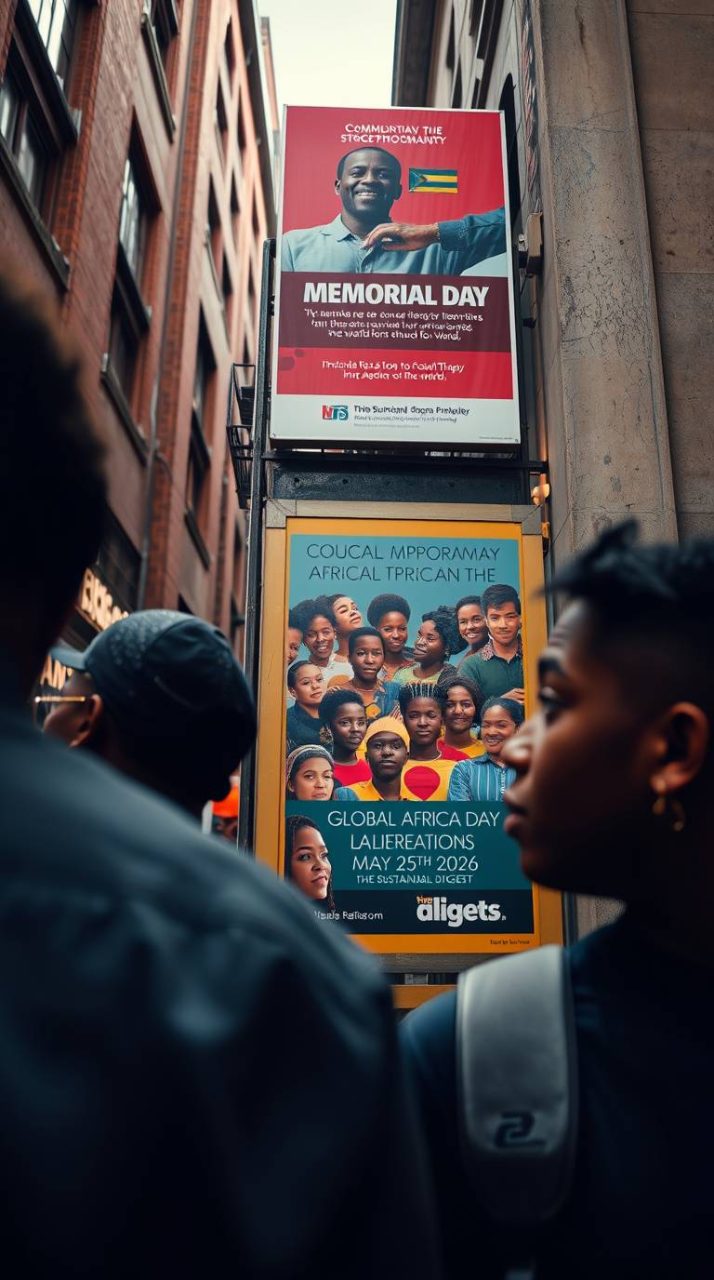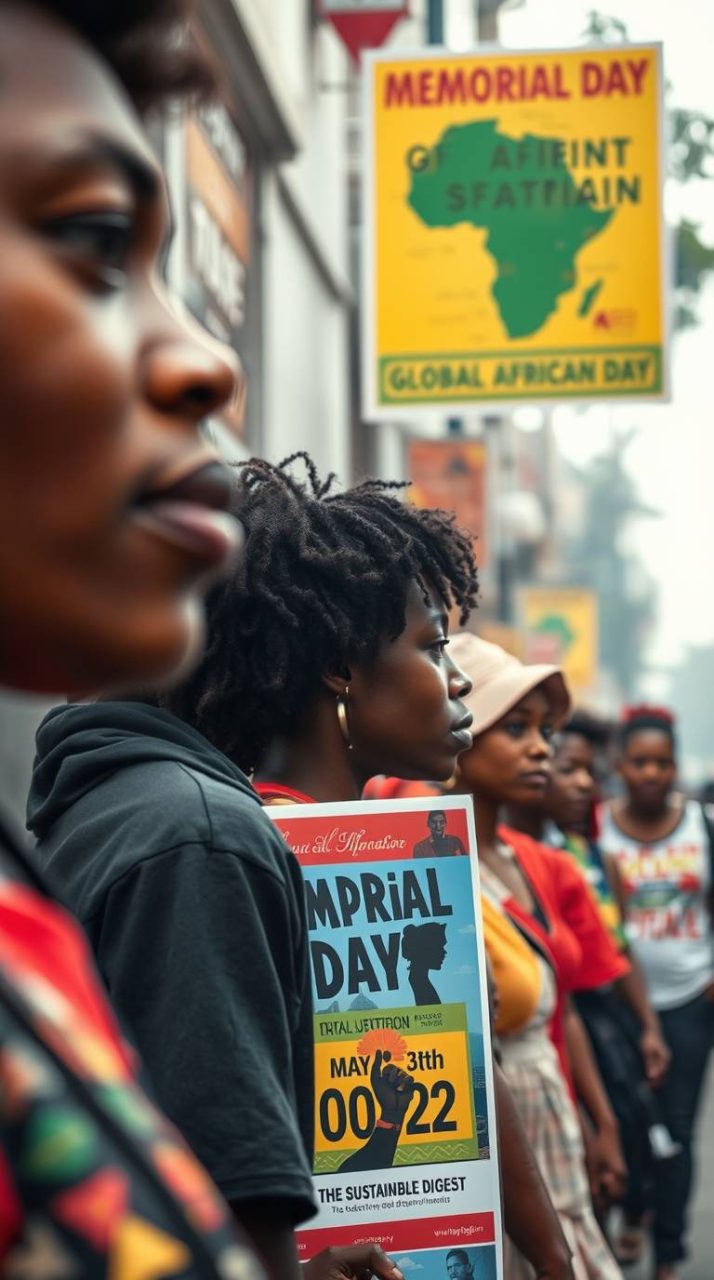
The convergence of significant observances on May 25, 2026, presents a unique moment for reflection and action. This day marks the intersection of Global African, African Liberation, and Memorial Day, creating a profound opportunity for millions worldwide. Each observance carries its own weight, but together, they symbolize a collective journey toward justice and remembrance.

Historically, this date is rich with meaning. It commemorates the first Congress of Independent African States. In which, it was held in 1958 in Accra, Ghana. A half a decade later, the founding of the Organization of African Unity in 1963 took place. These milestones laid the groundwork for a modern understanding of identity and liberation.
As we approach this pivotal day, the solemnity of Memorial Day aligns with the revolutionary spirit of African Liberation. Observers note that this year’s events will resonate deeply. In particularly in light of ongoing discussions about historical justice and systemic reform. By exploring the significance of this Liberation Day, we can appreciate how these movements progressed. Thus having shaped political identities across the diaspora.
Introduction to Global Celebrations on May 25, 2026
On May 25, 2026, a unique convergence of celebrations offers a profound opportunity for communities to engage and reflect. This date will not only mark the observance of Africa Day and African Liberation but also highlight the ongoing journey toward justice and equity.
The significance of this day is amplified by recent events. In 2026, the United Nations General Assembly recognized the transatlantic slave trade as a crime against humanity. This pivotal acknowledgment transforms every Africa Day celebration, urging communities to reflect on historical injustices.
Moreover, the African Union has launched a Decade of Reparations, which will span from 2026 to 2036. This initiative emphasizes that the struggle for sovereignty is an ongoing process. As people around the world prepare for this event, it serves as a reminder that the fight for justice continues today.
Key Points to Consider
The UN’s recognition of the slave trade reshapes the narrative of Africa Day.
Communities in the United States and the diaspora reflect on reparations.
The African Union’s focus on liberation highlights ongoing struggles.
Events in Accra, Ghana, will showcase how the diaspora organizes for change.
This celebration reinforces that justice is a current and active pursuit.
Historical Origins and Unique Significance
A closer look at the historical context of African unity uncovers a rich tapestry of struggle and triumph. The transition from the 1958 African Freedom Day to the 1963 formation of the Organization of African Unity marked a pivotal shift in continental strategy. This evolution demonstrates how African countries moved from fragmented resistance to a unified front against colonial exploitation.
In 1963, 31 independent African heads of state met in Addis Ababa to solidify the foundation for what we now recognize as the African Union. This gathering aimed to support freedom fighters and diminish military access for colonial nations across the continent. By renaming the event to African Liberation Day, the founders ensured that the focus remained on the ongoing struggle for total sovereignty.
Today, the world recognizes that the charter signed by these representatives in 1963 was intended to improve living standards for all member states. This legacy of unity and liberation continues to inspire movements across the globe.
Year
Event
Significance
1958
African Freedom Day Established
Symbolized the determination to end foreign domination
1963
Formation of OAU
Foundation for African unity and cooperation
2002
Establishment of AU
Continued commitment to sovereignty and development
2026 Global African Day 2026 African Liberation Day 2026 Memorial Day: A Convergence of Legacy and Modern Impact
On this pivotal date, various observances converge, creating a rich tapestry of remembrance and activism. The proximity of Memorial Day to Juneteenth sparks essential discussions about the United States’ role in both historical and contemporary oppression.
In 1833, the UK government paid ยฃ20 million in compensation to enslavers after abolishing slavery. This act underscores the ongoing economic ramifications of slavery that resonate today.
The close timing of these observances compels a dialogue on historical injustices.
The UKโs abstention from the 2026 UN reparations vote highlights enduring anti-Blackness in institutional frameworks.
For the African diaspora, this year symbolizes a defiance against the narrative that slavery’s end brought immediate equality.
The fight for liberation day recognition addresses not only the past but also the current practices of global governments.
Linking Memorial Day’s tribute to the broader fight for freedom day calls for a more truthful recounting of history.
Awareness is growing that the wealth transferred in 1833 remains central to modern reparations discussions.
Social Impact and Community Mobilization: Ubuntu, Sakofa, and Global Unity
The celebration of liberation serves as a reminder of the strength found in collective action and shared histories. This year’s observance emphasizes the power of community mobilization through the metaphors of Ubuntu and Sakofa.
The summit in Accra, Ghana, under the theme of sustainable peace, illustrates how nationalism and socialism can be harmonized for the collective good. Local initiatives, such as those in Philadelphia, showcase the work of leaders like Dr. Molefi K. Asante, bridging theory and grassroots action.
Moreover, the African Union’s support for the Africans Rising movement aligns with the goal of integrating globalism and internationalism to uplift the diaspora. This event is not just a celebration; it is a platform for cultural empowerment, urging collaboration between government and civil society.
Ubuntu, a Southern African philosophy encapsulated in the phrase “I am because we are,” emphasizes that the liberation of African peoples is a collective endeavor. This principle resonates profoundly during the celebrations, as the freedom of one is intertwined with the freedom of all. The coordinated global mobilization on this day illustrates the collective spirit that Ubuntu embodies.
Sankofa, represented by a bird looking backward while moving forward, serves as a metaphor for the need to learn from the past. This philosophy is particularly relevant in 2026, as it aligns with the UN’s reparations resolution and the African Union’s Decade of Reparations. The insistence on historical accountability is crucial for building a meaningful future.
Nationalism presents another layer of complexity. The Casablanca Group’s vision of immediate continental federation contrasts sharply with the Monrovia Group’s preference for gradual economic cooperation. This ongoing debate shapes the African Union’s Agenda 2063 and the Decade of Reparations, as leaders strive to balance national sovereignty with the quest for unity.
Contemporary diaspora movements embody these philosophies through what can be termed “Sankofa internationalism.” This practice involves looking back to the organizational models of the Pan-African Congress while building transnational networks. For instance, Africans Rising’s African Liberation Week 2026 connects organizations across the UK, US, Canada, and the Caribbean with groups on the continent.
The symbolic interpretation of the convergence reveals that the presence of Memorial Day alongside African Liberation Day expands the meaning of both observances. Ubuntu challenges us to extend our remembrance beyond national boundaries, recognizing that the sacrifices honored on both days are part of a single, interconnected human struggle for dignity.
As we approach this pivotal moment, the ideological foundations of Ubuntu, Sankofa, globalism, and socialism guide real-world mobilization. From leadership forums in Nairobi to reparations advocacy in Accra, the events of May 25 demand global attention and action.
Sustainability, Environmentalism, and Cooperative Development for the Future
The observances surrounding liberation highlight the urgent need for sustainable practices in our communities. Events such as the African Liberation Walk in Kenya serve as a call to action, emphasizing the necessity for sustainable infrastructure. This walk from KICC to Uhuru Park symbolizes a commitment to environmental stewardship.
Moreover, the Accra summit’s theme of “Assuring Sustainable Water, Technology, Peace & Security for Agenda 2063” directly addresses critical institutional improvements. By focusing on water and technology, leaders aim to ensure that African countries can thrive independently, without the burden of external debt.
As the diaspora in the United States and beyond contributes to funding local environmental initiatives, we must recognize that the legacy of the Organization of African Unity is incomplete without a modern commitment to sustainability. This time of reflection reminds us that the realization of true freedom depends on our ability to build systems that endure beyond any single event.
Conclusion
The intersection of historic observances invites people worldwide to engage in a renewed commitment to liberation. This unique moment offers a chance to integrate lessons from the past with future aspirations, enabling communities to foster resilience and equity.
Africa Day remains a vital institution for promoting unity; however, it must be paired with the radical action inherent in the African Liberation tradition. As we advance, the diaspora must lead the charge in advocating for reparations and sustainable development for all nations.
This liberation day serves as a final call to action, reminding us that our collective destiny is shaped by the work we do today. Together, we can forge a path toward a more just and equitable world.
Key Takeaways
The convergence of these observances creates a unique moment for reflection.
May 25 holds historical significance tied to African independence movements.
This day unites solemn remembrance with a call for liberation.
Ongoing global discourse enhances the relevance of these events.
Understanding this day can illuminate the political identity of the diaspora.
The 2026 Black History Month reveals a clear truth regarding our shared environmental future. Modern sustainability is not a new trend but a reclaimed legacy rooted in ancestral wisdom. This era marks a shift where mission-driven work aligns with long-standing traditions of community care.
In Illinois, the impact of this movement is clear, with over 180,000 firms currently operating today. These entities represent 13% of all state businesses and employ 54,000 people. This innovation reflects a deep commitment to both people and the planet (and perhaps a bit of savvy).
The world now recognizes that ecological health requires economic justice. By exploring Enterprise Development through a historical lens, we see how early systems inform today’s leaders. This analysis examines how these traditions continue to shape a more resilient society while building generational wealth.
The Historical Arc of Black Sustainability Leadership: Pre-Colonial to Contemporary Times
To appreciate modern green initiatives, one must trace the resilient thread of sustainability through the vast timeline of the African diaspora. This journey reveals that black history is deeply intertwined with ecological stewardship and communal care. From ancient agricultural methods to urban business cooperatives, the commitment to the environment remains a constant feature of the Black experience.
Pre-Colonial African Environmental Wisdom and Resource Management
Long before modern technology, African societies mastered intricate environmental management systems. They utilized communal land stewardship and complex crop rotation to preserve vital resources. These methods ensured that the earth remained fertile for future generations.
These systems supported people and ecosystems for centuries without causing ecological degradation. Their sophisticated biodiversity preservation techniques sustained life effectively. Modern sustainability experts are only now beginning to fully appreciate the depth of this ancestral knowledge.
Survival and Sustainability During the Industrial Revolution
Forced migration disrupted many traditional practices, yet the spirit of resilience ensured their survival in new environments. Enslaved communities adapted African agricultural knowledge to cultivate provision grounds. They also created herbal medicine systems using indigenous plants to maintain community health.
During the industrial era, Black Americans faced exclusion from mainstream economic opportunities. In response, pioneers like Anthony Overton and Jesse Binga created cooperative business models that prioritized community wealth. They proved that social entrepreneurship could thrive even under systemic oppression.
Leader
Key Achievement
Era/Year
Jesse Binga
Founded the first private Black-owned bank (Binga State Bank)
1921
John H. Johnson
First African American to appear on the Forbes 400
1982
Anthony Overton
Established Overton Hygienic Company and Chicago Bee
1898
Ida B. Wells
Challenged discriminatory practices for inclusive business
1893
Civil Rights Era to Modern Environmental Justice Movements
The struggle for equality evolved over many years to address the harsh reality of environmental racism. Advocacy highlighted how discriminatory policies left Black communities exposed to toxic waste and pollution. This realization galvanized a movement that connected civil rights to ecological health.
This era remains a pivotal chapter in black history, showing how activism secures a healthier future for all. Leaders fought for the right to clean air and safe water in marginalized neighborhoods. Their efforts paved the way for modern policies that link social equity with environmental protection.
Contemporary Black Innovation in Sustainable Business Practices
Today, a new wave of social entrepreneurship reflects a rich culture of learning and adaptation. Modern business leaders synthesize ancestral wisdom with cutting-edge technology to drive progress. They create enterprises that address climate change while building economic power.
During history month, we celebrate this continuous arc of innovation and leadership. By honoring black history, we recognize a legacy of stewardship that remains vital for global sustainability over time. This ongoing, time-tested commitment ensures that future generations will inherit both a thriving planet and a more equitable economy.
“The success of the community is built upon the sustainable management of our shared assets.”
Enterprise Development, 2026 Black History Month, Social Entrepreneurship: The Current Economic Landscape
Peering through the analytical lens of 2026, one finds that Black social entrepreneurs are no longer just filling gaps; they are constructing entire ecosystems of equity. This year’s black history month serves as a vital checkpoint for progress, highlighting how the community uses commerce to solve ancient problems. These leaders blend profit with purpose, ensuring that every dollar spent circulates back into local neighborhoods.
The shift toward sustainable models suggests a deep-seated desire to move beyond traditional retail. Entrepreneurs now prioritize long-term ecological health and social welfare over short-term financial gains. This analytical shift marks a new era in the American economic story.
By the Numbers: Black-Owned Business Impact in 2026
Current data from the state of Illinois reveals a robust landscape of entrepreneurial activity. Black-owned firms now make up 13% of all businesses in the region, totaling over 180,000 active units. These enterprises generate a significant impact by employing more than 54,000 residents across various sectors.
Longevity remains a cornerstone of this economic success. Nearly one-third of these firms have operated for over a decade, proving that resilience is a standard feature, not a fluke. When provided the right opportunity, these ventures act as anchors for generational wealth and local stability.
Black Women as Catalysts for Sustainable Enterprise Development
Black women currently stand at the vanguard of this movement. They represent 64% of Black business owners, leveraging unique perspectives to solve complex social issues. Their representation in the market signals a fundamental shift toward leadership that values empathy and sustainability.
Social entrepreneurship is not just about a product; it is about the courage to rewrite the social contract through the power of the marketplace.
These women often lead firms in education, social services, and professional consulting. Their focus on the collective good drives significant growth in the green economy. By centering community needs, they create a blueprint for future generations to follow.
Spotlighting Sustainable Black-Owned Businesses
Concrete examples of this philosophy abound in 2026. These businesses demonstrate how social entrepreneurship principles work in the real world. They show that ethical sourcing and community-driven missions are viable paths to success.
Southside Blooms: Youth Employment Through Sustainable Agriculture
Southside Blooms operates as a farm-to-vase nonprofit that tackles youth unemployment and urban blight. Their expansion into North Lawndale in early 2026 shows how a mission-rooted business can scale effectively. They transform vacant lots into productive flower farms, proving that environmental care can coexist with job creation.
Based in Peoria, this company represents the cutting edge of the plant-based revolution. As the city’s first 100% vegan bakery, Riley’s combines cultural innovation with environmental consciousness. They challenge conventional food industry norms while providing delicious, sustainable alternatives to their customers.
The Irie Cup: Sustainable Sourcing and Holistic Self-Care
The Irie Cup uses a family-owned model to promote ethical tea procurement. This home-based entrepreneurial tradition has evolved into a community wellness resource that educates the public on holistic health. They prioritize transparent supply chains, ensuring that their growth never comes at the expense of global farmers.
Business Name
Primary Focus
Social Impact Pillar
Southside Blooms
Sustainable Floriculture
Youth Employment
Riley’s Vegan Sweets
Plant-Based Food
Environmental Health
The Irie Cup
Ethical Tea Sourcing
Holistic Wellness
Illinois Tech Firms
Professional Services
Economic Equity
The 17 UN Sustainable Development Goals: Practical Applications in Black Social Entrepreneurship
Mapping the 17 UN Sustainable Development Goals onto the landscape of Black social enterprise reveals a sophisticated alignment between global targets and local activism. These goals are not just abstract ideals; they are active blueprints for impact within the African American business sector. By examining these connections, we see how entrepreneurs transform global mandates into neighborhood realities.
Goals 1-3: No Poverty, Zero Hunger, and Good Health
The initial cluster of UN goals addresses the most fundamental human needs. During black history month, it is vital to recognize how social enterprises serve as primary engines for these essential requirements. They bridge the gap between systemic neglect and community-driven abundance.
Community Employment Programs and Economic Opportunity
Enterprises like Southside Blooms create immediate economic opportunity by employing at-risk youth in the floral industry. This model provides more than a paycheck; it builds a stable community through meaningful work. By offering dignified jobs, these businesses directly combat poverty while fostering a sense of purpose.
Sustainable Food Systems and Nutrition Access
Riley’s Vegan Sweets & Eats serves as Peoria’s first 100% vegan bakery, proving that health-conscious options are a right, not a luxury. Such businesses improve access to nutritious food in areas often overlooked by traditional retailers. They demonstrate that healthy people are the foundation of a thriving, sustainable economy.
Goals 4-6: Quality Education, Gender Equality, and Clean Water
The pursuit of education and equality is a cornerstone of the Black entrepreneurial spirit. These goals ensure that the next generation of leaders has the tools and the equity required to succeed. By centering these values, businesses become more than commercial entities; they become institutions of social change.
Educational Programming and Leadership Development
Many Black-owned businesses integrate learning directly into their operational models through formal programs. Whether it is teaching sustainable farming or business management, these initiatives provide the resources needed for self-sufficiency. This focus on education ensures that knowledge remains a communal asset rather than a private privilege.
Women-Led Business Advancement
In Illinois, 64% of Black-owned businesses are led by women, highlighting a significant shift in leadership demographics. These enterprises provide vital support for gender equality by placing women at the helm of economic development. This leadership ensures that diverse perspectives guide the future of education and community health.
Business Name
Primary SDG Focus
Core Community Benefit
Southside Blooms
Goal 8: Decent Work
Youth employment and urban greening
Riley’s Vegan Sweets
Goal 3: Good Health
Plant-based nutrition in food deserts
The Irie Cup
Goal 12: Consumption
Sustainable sourcing and self-care
Goals 7-9: Affordable Energy, Decent Work, and Industry Innovation
Innovation in Black enterprises often involves reimagining how industries can serve the public good. These goals focus on building resilient infrastructure and fostering sustainable industrialization. This approach ensures that economic growth does not come at the expense of environmental or social well-being.
Green Business Practices and Job Creation
Sustainable flower growth and design businesses exemplify how green industries can revitalize urban spaces. These models prove that environmental opportunity and job creation can go hand-in-hand. By prioritizing planet-friendly methods, they set a new standard for responsible commercial operations.
Technological Innovation in Black Enterprises
Innovation is not always about high-tech gadgets; sometimes it is about the way a business interacts with its environment. Black entrepreneurs are leading the way by adopting clean energy and efficient production methods. This forward-thinking approach ensures long-term viability in a rapidly changing global market.
Goals 10-12: Reduced Inequalities, Sustainable Cities, and Responsible Consumption
Reducing inequality requires a deliberate effort to redistribute access to wealth and power. Black social entrepreneurs tackle this by demanding equitable access to capital for their ventures. They build businesses that serve as anchors for sustainable city development and ethical consumption.
Equitable Access to Capital and Resources
Despite historical barriers, nearly one-third of Black-owned businesses in Illinois have thrived for over a decade. This longevity depends on securing the financial resources necessary to scale and sustain operations. Providing a fair community investment landscape is essential for reaching these global equity targets.
Community-Centered Urban Development
Businesses that prioritize the local community transform urban landscapes into vibrant, sustainable hubs. By repurposing vacant lots for agriculture or retail, they create a sense of belonging and ownership. This way of developing cities ensures that growth benefits the residents who have lived there the longest.
Goals 13-15: Climate Action, Life Below Water, and Life on Land
Environmental stewardship is deeply rooted in the history of Black land ownership and agricultural wisdom. Many social enterprises use their programs to reconnect learning with the natural world. They treat climate action as a non-negotiable part of their business DNA.
Environmental Stewardship in Business Operations
Companies like The Irie Cup emphasize sustainable sourcing as a fundamental business principle. They recognize that protecting “Life on Land” is critical for the long-term health of their supply chains. This commitment shows that environmental care is a core part of modern Black social entrepreneurship.
Sustainable Sourcing and Conservation Practices
Conservation is not a secondary thought but a primary strategy for mission-driven Black businesses. By choosing ethically sourced ingredients and materials, they reduce their overall carbon footprint. This practice honors ancestral relationships with the earth while protecting future biodiversity.
Goals 16-17: Peace, Justice, and Partnerships for the Goals
The final UN goals emphasize that progress requires collective action and systemic justice. No business is an island, especially when the goal is widespread social change. During black history month, the focus on collaborative networks becomes even more pronounced.
Advocacy for Policy Change and Economic Justice
Black entrepreneurs often lead the charge for change in local and national policy. They advocate for laws that promote economic justice and fair market access for all people. This advocacy ensures that the legal framework supports, rather than hinders, sustainable development.
Collaborative Networks for Sustainable Development
Sustainable progress is only possible through strong partnerships between businesses, government, and citizens. Collaborative networks allow Black social entrepreneurs to amplify their impact and share best practices. By working together, these people ensure that the vision of a sustainable future becomes a shared reality.
Black-Led Organizations and Chambers Driving Sustainable Economic Equity
In the landscape of 2026, Black-led organizations serve as the essential scaffolding for equitable economic development across Illinois. These institutions provide the infrastructure that individual entrepreneurs need to scale their impact effectively. By offering coordinated support, they ensure that this history month is defined by progress rather than just reflection.
Illinois Black Chamber of Commerce and Statewide Networks
The Illinois Black Chamber of Commerce acts as a powerful engine for state level change. It provides advocacy that helps small firms navigate complex regulatory environments. Experienced leaders within the network offer mentorship to bridge the gap between startup ideas and sustainable growth.
Membership offers more than just a directory listing. It provides direct access to capital resources and procurement opportunities. This collective power allows business owners to compete for large-scale contracts that were previously out of reach.
Regional efforts through the Black Business AllianceโPeoria Chapter ensure that growth is not limited to the largest cities. These organizations recognize that economic equity matters across all geographic boundaries. They connect local talent with regional supply chains to boost resilience.
The Quad County African American Chamber expands these opportunities across Kane, Kendall, DuPage, and Will counties. This alliance fosters a collaborative business environment. It transforms isolated local efforts into a unified regional economic force.
Chicago Urban League and Community Economic Development
The Chicago Urban League represents the evolution of civil rights into modern economic empowerment. Their programs focus on community development as the foundation for entrepreneurship. They provide technical training that helps founders master financial literacy and digital transformation.
By connecting emerging leaders with established corporate partners, they create a pipeline for success. Their work proves that systemic equity requires intentional investment in human capital. This approach turns historical challenges into future economic opportunities.
Cultural Celebrations Amplifying Black Business Success
Cultural events serve a dual purpose by blending economic support with social culture. They turn public awareness into direct revenue for local creators and artisans. This engagement ensures that the spirit of the history month translates into tangible financial growth.
From February 8-22, 2026, this event focuses on uplifting the food and beverage sector. It is a time to celebrate black culinary excellence through direct consumer action. This recognition builds lasting relationships between owners and the neighborhoods they serve.
During black history month, this initiative transforms passive observation into active spending. It highlights the vital role that restaurants play in local economies. These celebrations create a cycle of visibility that supports long-term sustainability.
Leadership, Advocacy, and Mentorship: Building the Next Generation of Social Entrepreneurs
Building a sustainable future for Black social entrepreneurship relies on a triple threat: historical wisdom, contemporary leadership, and the relentless advocacy of mentors. These elements combine to form a robust framework where individual success fuels collective growth. When we look back, we see that the seeds of modern enterprise were sown by those who refused to accept the status quo.
Every moment spent studying these pioneers reveals a blueprint for resilience. Their stories teach us that social change and economic power are often two sides of the same coin. By integrating these lessons today, we ensure that the next generation of people in the industry has a solid foundation to stand on.
Pioneering Black Business Leaders: From Jesse Binga to Oprah Winfrey
Institutional legacy began with pioneers like Jesse Binga, who opened the first privately-owned African American bank in 1921. Others like Anthony Overton, who established his hygienic company in 1898, and Ida B. Wells challenged discriminatory practices through journalism. These leaders demonstrated Black economic capacity over many years of intense struggle.
These early successes provided the template for John H. Johnson, who became the first African American on the Forbes 400 in 1982. Oprah Winfrey later expanded what was believed possible by becoming the first Black woman billionaire. Her leadership through Harpo Productions showed how media content can drive both profit and social change.
Leader
Historical Milestone
Economic Impact
Jesse Binga
Binga State Bank (1921)
First private Black-owned bank
John H. Johnson
Forbes 400 List (1982)
Validated Black publishing power
Oprah Winfrey
Billionaire Status
Global media institution building
Today’s Corporate and Community Leaders Shaping Sustainable Futures
Modern leadership continues through figures like Nicholas Bruce and Sirmara Campbell, who use their access to shape sustainable futures. Today, leaders like Brandon Fair and Shalisa Humphrey occupy vital positions in finance and the industry. Their professional experience allows them to advocate for systemic equity in every company they serve.
Furthermore, Otto Nichols and Zaldwaynaka Scott bridge the gap between real estate, education, and economic development. They use their leadership roles to mentor emerging entrepreneurs who face unique questions in the current market. This experience is crucial for maintaining representation in high-level corporate programs.
The Power of Platforms: Entertainment and Social Change
The entertainment industry serves as more than just culture; it is a massive driver of economic growth. During a Howard University event, Renata Colbert noted that the film industry supports over 2,000,000 jobs in the world. Productions like “Superman” bringing $82 million to Georgia prove that creative content matters for local stability.
“Policy creates that avenue… even the most innovative business content can be constrained by regulatory frameworks.”
โ Renata Colbert, Motion Picture Association
Economic impact extends to cities like D.C., where “House of Dynamite” infused $5 million into the local home economy. This part of the industry proves that culture and commerce are deeply intertwined. Such an event highlights how platforms can provide recognition for marginalized voices while creating jobs.
Mentorship as a Cornerstone of Sustainable Success
Effective mentorship requires more than sharing advice; it involves creating a support system for the next generation. During history month, it matters to recognize how intergenerational dialogue fosters deep learning. Experienced leaders help students navigate the way toward professional recognition and success.
Through years of experience, mentors provide the access that formal education often misses. They answer difficult questions about navigating corporate programs and staying true to one’s mission. This learning process is a vital part of sustaining leadership across decades.
Understanding Policy and Its Impact on Enterprise Development
Mentors must teach that advocacy for better policy creates the necessary avenues for success. Policy literacy ensures that social growth is not limited by legislative barriers. In every history month, we see that the most successful people were those who understood the rules of the game.
Creating Safe Spaces for Artists and Entrepreneurs
Monique Davis-Carey emphasized that our responsibility is creating a safe space for creators to thrive. This environment allows for authentic expression and protects the integrity of the artistic moment. Such a home for innovation ensures that representation remains a priority in the industry.
Authentic Networking and Resource Mobilization
Authentic networking, as modeled by the rapper Noochie, focuses on genuine connection rather than transactions. This way of building relationships reflects cultural values of community and shared access. It helps mobilize resources to ensure every moment contributes to the collective good in the space of social enterprise.
Conclusion
As history month 2026 begins, it becomes clear that the legacy of Black social entrepreneurship is the ultimate roadmap for global progress. This time allows us to celebrate black history by acknowledging that sustainability is a reclaimed legacy of resilience. Today, modern innovation draws directly from centuries of community-centered resource management that sustained people through every era.
Mission-driven organizations use the 17 UN Sustainable Development Goals to create a new way of doing business. These visionary leaders ensure that every individual has the opportunity to thrive while protecting our collective future. During this history month 2026, we recognize that mission-driven enterprises create comprehensive community impact rather than focusing on narrow profit generation.
Within our state, access to resources and mentorship helps new ventures flourish into sustainable landmarks. We celebrate black excellence and support local events like Restaurant Week to drive real economic change. This content reminds us that history month 2026 transforms a simple celebration into a powerful engine for long-term engagement.
When we celebrate black history during black history month, we invest in an equitable and inclusive future. Every history month reminds us that resilience requires both individual excellence and the strength of collective support. During this history month 2026, we honor the past by empowering the business leaders of today. As black history month concludes, this history month serves as a permanent reminder that prosperity and purpose are complementary goals for all.
Core Pillar
Business Application
Sustainable Goal
Heritage
Reclaiming ancestral wisdom
Climate Action
Economy
Mission-driven growth
Decent Work
Equity
Inclusive leadership
Reduced Inequality
Key Takeaways
Ecological care is a long-standing tradition within these communities.
Local firms in Illinois drive significant employment and regional growth.
Social Entrepreneurship mission-driven business models reclaim ancestral economic power.
Upcoming celebrations highlight the link between justice and ecology.
Progress is rooted in cultural memory and community resilience.
Impact-focused ventures act as vehicles for systemic change.
The current focus on labor and the earth highlights how people interact with nature with peculiar perspective during Black History Month. It is also a great time to study Environmental Justice and social growth. We see that the fight for fair pay is much like the fight for clean air and water.
In the past, african americans helped build this nation with skill and care. They used smart ways to farm and manage the land from the very start. These ecological efforts were vital to survival and national growth.
Sadly, most school books leave out these vital stories of nature and work. They also gloss over details during Black History Month. Theses stories and the individuals of this narrative however, were the first to use many green methods we see today on modern farms. Their stewardship was born from necessity and a deep connection to the soil.
Now, black history month 2026 shows us that nature and equity go hand in hand. Leaders like A. Philip Randolph linked civil/labor/human rights to the struggle against industrial harm. This connection remains a cornerstone of modern advocacy.
Leaders saw that pollution often follows the color line with unfortunate accuracy. Getting true balance means that everyone should have a safe and green home for their families. Civil rights must include the right to a healthy, sustainable world.
The Legacy of Black Environmental Stewardship: Setting the Context
While mainstream narratives often celebrate figures like John Muir, the deep-rooted history of Black environmental stewardship remains an unsung pillar of conservation. For too long, the conventional story of environmentalism has focused on white, middle-class concerns. This perspective ignores the vital contributions of black people who have defended their land for centuries. This erasure suggests that protecting the planet is a recent interest for minority groups, but the reality is far more complex.
Long before “sustainability” became a popular corporate buzzword, African American families practiced resource conservation as a way of life. This stewardship was not just about loving nature; it was a strategy for survival and resilience. Indigenous African wisdom regarding agriculture and water management traveled across the Atlantic with enslaved peoples. These communities transformed scarcity into abundance through sheer ingenuity, even when they lacked legal rights to the soil they enriched.
The Legacy of Black Environmental Stewardship: Setting the ContextContinuing…
Mainstream movements often separated nature from people, yet Black stewardship recognized that human health and ecological health are the same. This black history shows that environmental action and social justice are inseparable priorities. Environmental justice emerged from a need to protect both the land and the people who depend on it most directly. This legacy proves that the fight for environmental justice is a fundamental part of black history, black history month, and American progress.
Focus Area
Mainstream Narrative
Black Stewardship Legacy
Primary Goal
Wilderness preservation for recreation
Cooperative land use and survival
View of Nature
Separate from human society
Inseparable from human dignity
Methodology
Exclusionary land management
Sustainable resource allocation
Understanding this historical context changes how we view modern climate challenges. It reveals that solutions for our planet already exist in ancestral practices and grassroots movements. Strong leaders have consistently demonstrated that we cannot fix the environment without also addressing racial inequity. The following points highlight how this stewardship took shape over time:
Agricultural Ingenuity: Enslaved people used African farming techniques to sustain themselves and build American wealth without receiving credit.
Resilient Gardens: During the Great Depression, victory gardens became essential tools for food security and community autonomy.
Protest as Protection: Civil Rights leaders targeted polluting industries long before modern regulations existed.
Interconnected Health: Grassroots activists proved that clean air and water are basic human rights for everyone, not just the elite.
The environment is not just where we go for a hike; it is where we live, work, play, and pray.
From Pre-Colonial Sustainability to Industrial Exploitation
The transition from sacred land stewardship in Africa to the brutal plantation systems of the Americas marks the genesis of environmental injustice. This shift reflects a move from ecological harmony to a system of extraction and discrimination. Understanding this era is crucial to black history and the origins of modern climate activism.
Indigenous African Environmental Wisdom and Sacred Land Practices
Pre-colonial African societies developed sophisticated environmental management systems. They recognized land as a sacred trust rather than an extractable commodity. These communities practiced crop rotation and managed water through collective governance to ensure long-term survival.
Modern permaculture is only now “rediscovering” these techniques with considerable fanfare and notably less humility. These practices embodied what we now define as sustainability. They integrated human life into the natural cycle rather than standing apart from it.
However, they understood it as a spiritual relationship with the Earth. This spiritual bond acknowledged human dependence on natural systems and ecological balance. Such values ensured high diversity across the landscape for future generations.
Wangari Maathai, founder of the Green Belt Movement, later revived these connections. By empowering women to plant millions of trees, she linked conservation to human dignity. Her work showed that protecting ecosystems is a powerful tool for poverty reduction.
Native American leaders also shared this view of the sacred Earth during the formation of the environmental justice movement. They helped early advocates see the planet as a living entity that requires protection. This cross-cultural wisdom remains a cornerstone of ecological resistance.
Slavery, Agricultural Labor, and the Foundation of Environmental Injustice
The transatlantic slave trade did not just extract human beings; it severed them from their environmental knowledge. It then exploited that very expertise to build agricultural wealth in the Americas. This forced labor transformed landscapes while denying enslaved peoples any agency over the land.
This era marks a painful chapter in black historymonth and black history in general. The plantation system created Americaโs original “sacrifice zones.” These were landscapes that lacked variety because they served monoculture cash crops for global trade.
Enslaved workers bore the brunt of this environmental degradation without seeing the profits. This established the template for modern environmental racism and industrial pollution. Post-emancipation systems like sharecropping continued this exploitation under new names.
Planners concentrated environmental hazards in Black communities through deliberate structural choices. Yet, despite these barriers, Black communities maintained their ecological wisdom and fought for progress. This resilience highlights the enduring contributions black ancestors made to the land.
Feature
Pre-Colonial African Societies
Industrial Plantation System
Land Perception
Sacred trust and community heritage
Extractable commodity and capital
Ecological Goal
Biodiversity and long-term balance
Monoculture and immediate profit
Human Relation
Spiritual stewardship and interdependence
Forced labor and exploitation
The Birth of Environmental Justice: Warren County’s Pivotal Protest
While many view conservation as a quest for pristine wilderness, the residents of Warren County redefined it as a struggle for survival. In 1981, North Carolina officials designated this predominantly Black and economically distressed county as a dump site for 60,000 tons of PCB-contaminated soil.
The state chose this location despite a shallow water table that posed a direct threat to the local groundwater. This decision suggested that officials believed poverty and race would equal a lack of resistance. They were profoundly mistaken.
This attempt to bypass safety standards in a marginalized area became a catalyst for change across the united states. It proved that the fight for a clean environment was inseparable from the fight for human dignity and equality.
1981-1982: When Civil Rights Met Environmental Action
The resistance in Warren County signaled a massive shift where the traditional environmental movement finally adopted the tactics of the streets. Local residents and activists organized six weeks of non-violent protests to block 6,000 trucks filled with carcinogenic soil.
People and individuals of kind literally laid their bodies on the road to stop the delivery of toxic waste. This courageous act of civil rights defiance led to over 500 arrests. It was the first time citizens were jailed for defending their right to a non-toxic neighborhood.
These demonstrations quickly captured national attention, forcing the broader public to look at the ugly reality of hazardous waste disposal. The protest proved that “green” issues were not just for the wealthy, but a matter of life and death for the disenfranchised, marginalized, and lower working class.
While the landfill was eventually built, the social cost was too high for the government to ignore. This specific moment in North Carolina history created the framework for what we now call environmental justice.
Rev. Benjamin Chavis and the Definition of Environmental Racism
While serving time in the Warren County Jail, civil rights leader Rev. Benjamin Chavis formulated a concept that changed the political landscape forever. He realized that the targeting of his community was not an accident of geography, but a symptom of systemic racism.
“Environmental racism is racial discrimination in environmental policy-making and the enforcement of regulations and laws, the deliberate targeting of communities of color for toxic waste facilities.”
Rev. Benjamin Chavis
This definition provided a necessary name for the racism embedded in land-use policy. It allowed other communities, from Cancer Alley in Louisiana to Flint, Michigan, to see that their local crises were part of a national pattern.
The struggle in Warren County lasted decades, as the toxic chemicals were not fully remediated until 2004. However, the movement it birthed remains a powerful force in modern civil rights advocacy. Environmental justice is no longer a niche concern; it is a central demand for a fair society.
Key Milestone
Historical Significance
Outcome/Impact
1981 Location Choice
Warren County selected for PCB dump.
Sparked the first major intersection of race and environment.
1982 Mass Protests
Over 500 arrests of non-violent activists.
Garnered global media coverage for the cause.
Chavis’s Definition
Coined the term environmental racism.
Provided a legal and social framework for future advocacy.
2004 Site Cleanup
Final detoxification of the Warren County site.
Proved the long-term cost of discriminatory waste policies.
Founding Figures: The Architects of Environmental Justice
Identifying systemic failures is one thing, but proving they are the result of deliberate policy requires a special kind of courage and academic precision. These visionary leaders did not merely observe the world; they deconstructed the hidden biases within our physical landscapes. By blending rigorous research with community heart, they forced the world to acknowledge that ecology and equity are inseparable.
Dr. Robert Bullard: Proving Systemic Environmental Racism
Dr. Robert Bullard is widely recognized as the father environmental justice. In the early 1980s, his pioneering research provided the first systematic evidence of environmental racism. Robert Bullard famously mapped toxic facility locations against demographic data in Houston to reveal shocking patterns.
He discovered that race, more than income, predicted where waste was dumped. Dr. Robert published his landmark book Dumping in Dixie in 1990, showing how black communities were unfairly targeted. His work proved that dr. robert bullard was right: environmental policy often protected some neighborhoods while sacrificing others.
By using data, robert bullard transformed community complaints into an undeniable academic discipline. Dr. Robert shifted the focus toward justice and public health. Today, the legacy of dr. robert bullard continues to guide urban planning. Finally, robert bullard remains a voice for the voiceless while dr. robert helped define a new era of civil rights.
Hazel M. Johnson: Grassroots Power in Chicago’s Altgeld Gardens
While scholars mapped data, Hazel M. Johnson organized the streets of Chicago. Known as the “Mother of Environmental Justice,” she founded People for Community Recovery in 1979. Her neighborhood, Altgeld Gardens, sat in a “toxic doughnut” of industrial facilities and waste sites.
Johnson didn’t wait for outside experts to validate her reality. She empowered residents to document their own health crises, from asthma to cancer clusters. Her work proved that lived experience is a powerful form of justice.
She brought national attention to the harms facing black communities, demanding that zip codes shouldn’t dictate lifespans. Johnson showed that grassroots leaders can force institutional accountability. She proved that community monitoring is just as vital as laboratory science.
Wangari Maathai: Connecting Conservation to Human Dignity
Across the ocean, Wangari Maathai expanded the movement’s scope to a global scale. As the first African woman to win the Nobel Peace Prize, she founded the Green Belt Movement in 1977. She recognized that planting trees was a tool for both ecological restoration and human rights.
Maathai empowered women to plant tens of millions of trees to combat soil erosion and climate change. She linked environmental conservation directly to sustainable livelihoods and political freedom. Her work demonstrated that you cannot protect the land without protecting the people who depend on it.
“The tree is a wonderful symbol for the peace and hope which can come from a sustainable management of our environment.”
โ Wangari Maathai
Her legacy ensures that modern sustainability efforts remain rooted in community dignity and social empowerment. Maathaiโs courage showed that environmentalism divorced from social equity is fundamentally incomplete.
Figure
Recognized As
Primary Method
Key Contribution
Robert Bullard
Father of Environmental Justice
Data Mapping & Research
Proved race as the primary predictor of waste siting.
Hazel Johnson
Mother of Environmental Justice
Grassroots Organizing
Led community monitoring in Chicago’s Altgeld Gardens.
Wangari Maathai
Nobel Peace Prize Laureate
The Green Belt Movement
Linked tree-planting with women’s rights and democracy.
2026 Black History Month, Environmental Justice, and Civil/Labor/Human Rights: The Contemporary Movement
As we observe 2026 black history month, the dialogue surrounding environmental justice has evolved into a sophisticated blend of activism and commerce. This era demands a profound reckoning with how racial justice and ecological health intersect. Modern movements for civil and labor rights now find their most potent expression in the intersection of climate action and socioeconomic equity.
The contemporary landscape of this history month reflects a dynamic shift toward systemic change and economic empowerment. We see a transition from reactive protests to proactive, sustainable industry building. This evolution honors the legacy of justice while forging new paths for the next generation of pioneers.
Leah Thomas and the Rise of Intersectional Environmentalism
Leah Thomas has fundamentally shifted the green narrative by coining the term “Intersectional Environmentalist.” Her framework acknowledges that environmental harm disproportionately impacts marginalized communities of color. Through her platform and book, she advocates for a brand of sustainability that is inclusive and inherently just.
Thomas argues that protecting the planet requires an unwavering commitment to social equity and the dismantling of systemic barriers. Her work demands that mainstream organizations move beyond superficial diversity initiatives. She insists on a fundamental restructuring that centers those bearing the heaviest environmental burdens.
“We cannot save the planet without uplifting the voices of those most impacted by its destruction, ensuring that our green future is accessible to everyone.”
Her approach articulates that environmentalism ignoring race or class merely perpetuates existing inequities. By focusing on environmental justice, Thomas ensures that conservation efforts do not ignore the plight of urban pollution hotspots. This intellectual shift has become a cornerstone of the movement during this history month.
The rise of Black-owned sustainable businesses proves that environmental leaders extend far beyond traditional activism. Every ceo in this space demonstrates that building a better economy requires integrating ethics into the very foundation of a company. They are proving that profitability and planetary health are not mutually exclusive goals.
Aurora James: Ethical Fashion and the 15 Percent Pledge
Aurora James, the ceo of Brother Vellies, has redefined luxury through the lens of traditional African craftsmanship. Her brand uses vegetable-tanned leathers and recycled tire materials to create high-end goods. This model enriches source communities rather than extracting from them in a predatory manner.
Beyond fashion, James launched the 15 Percent Pledge to address economic inequality in retail spaces. This initiative urges major retailers to dedicate shelf space proportional to the Black population. It recognizes that rights to economic participation are essential for long-term community sustainability.
Karen Young and SaVonne Anderson: Sustainable Consumer Products
Karen Young founded OUI the People to tackle the beauty industryโs massive plastic waste problem. Inspired by her upbringing in Guyana, she promotes refillable glass bottles and durable stainless steel razors. Her company challenges the “disposable” culture that often harms low-income neighborhoods and others through landfill overflow.
SaVonne Andersonโs Aya Paper Co. provides an eco-friendly alternative in the greeting card market. Her products use 100% recycled materials and plastic-free production methods right here in the U.S. By prioritizing diversity in supply chains, she shows how small consumer choices support a larger green future.
Linda Mabhena-Olagunju and Sinah Mojanko: African Energy and Recycling Leadership
In South Africa, Linda Mabhena-Olagunju leads DLO Energy Resources Group, a powerhouse in renewable energy. She develops large-scale wind and solar farms that combat climate change while closing energy gaps. Her leadership ensures that Black women are at the forefront of the continentโs green energy transition.
Sinah Mojankoโs Tiyamo Recycling transforms waste management into a vehicle for economic opportunity. Her model empowers unemployed individuals to become entrepreneurs within the recycling sector. This approach solves social and ecological challenges simultaneously, proving that justice can be found in the circular economy.
Leader
Organization
Key Innovation
Social Impact
Leah Thomas
Intersectional Environmentalist
Intersectional Framework
Centering marginalized voices
Aurora James
Brother Vellies / 15% Pledge
Recycled Tire Materials
Economic retail equity
Linda Mabhena-Olagunju
DLO Energy Resources
Wind and Solar Farms
Renewable energy access
Karen Young
OUI the People
Refillable Glass Systems
Plastic waste reduction
The Ongoing Struggle: Environmental Racism in Contemporary America
Forty years after the first major protests, the systems of environmental racism still work with a quiet efficiency. It remains vital for black communities to stay informed about these geography-based hazards. Today, the maps of risk often trace the same lines drawn by historical exclusion.
The Statistics Behind Environmental Inequality Today
Rev. Benjamin Chavis points to a hard truth about our modern era. Roughly 20% of all african americans are exposed environmental hazards today. In contrast, less than 2% of white families face these same risks.
This tenfold gap persists regardless of wealth or education levels in these communities. Experts often call this “policy violence” because it stems from choices made in high-level offices. Older african americans die three times more often from pollution-related illnesses than their white peers.
These numbers prove that racism exists in the very air some people breathe. In Flint, Michigan, the water crisis showed the lethal side of bad environmental policy. Corroded pipes poisoned a majority-Black city because officials prioritized costs over public health.
Similarly, “Cancer Alley” in Louisiana exposes communities to toxic air from chemical plants. Industrial waste and air toxins often target these specific areas. This leaves residents exposed environmental poisons that whiter areas successfully avoid.
Policy Rollbacks and the Dismantling of Environmental Justice Protections
National progress often depends on who sits in the Oval Office. The Biden administration used the Inflation Reduction Act to fund climate solutions and equity projects. These efforts gave hope to many who seek better environmental protection.
However, recent political changes often lead to a dismantling of these vital safety nets. Federal policy shifts have led to the removal of justice-focused language from many official records. Cutting budgets for these programs acts as a form of active discrimination.
Leaders often treat environmental protection for the vulnerable as a luxury rather than a right. This trend confirms that racial discrimination in the united states is not just a ghost of the past. It is an ongoing choice made by current lawmakers.
Even with these rollbacks, grassroots power remains a beacon of hope. People are organizing to fight for a cleaner climate and safer neighborhoods. They understand that a single policy change can harm their health for generations.
By building local strength, they resist the environmental racism and systemic racism that dictates where toxic waste is dumped. Their persistence proves that collective action is the best shield for black communities.
Community Group
Primary Environmental Hazard
Key Statistic or Impact
Puerto Rican Residents
Respiratory Irritants
Double the national asthma incidence
Hopi Nation
Heavy Metal Contamination
75% of water supply contains arsenic
Cancer Alley (LA)
Petrochemical Carcinogens
Cancer rates far above national average
Older Black Adults
Industrial Particulates
3x mortality rate from air pollution
Flint, Michigan
Lead-Tainted Water
State-wide denial of toxic pipe corrosion
Conclusion: From Labor Rights to Environmental JusticeโBuilding Our Collective Future
The 2026 Black History Month theme, “African Americans and Labor,” reveals that environmental justice is essentially labor justice. Fighting for fair wages and breathable air are inseparable goals for communities seeking equity. Workers breathing fumes on factory floors and families in nearby homes face the same exploitative system.
History (through Black History Month) shows us this connection through the work of A. Philip Randolph and Addie Wyatt. They bridged labor rights with civil rights during the 1963 March on Washington. Even Frederick Douglass championed economic justice alongside abolition, proving that workplace dignity sustains life for everyone.
These early contributions paved the way for the 1991 People of Color Environmental Leadership Summit. This landmark event established 17 principles that the United Nations now recognizes. Analysis by the father of environmental justice, Dr. Robert Bullard, helped activists expose the patterns of racial discrimination.
Today, the modern environmental movement faces complex hurdles, including legislative rollbacks and the global climate crisis. We simply cannot address climate change while tolerating the survival of environmental justice gaps. A resilient future demands that we dismantle the siloed approach to social rights and ecological health.
Building collective progress depends on staying involved, as Reverend Benjamin Chavis often emphasizes to his followers. We must honor civil rights icons by pushing for justice in every zip code. True change occurs when people refuse to let their spirits be broken by the immense challenges ahead.
Celebrating the 2026 theme means transforming commemoration into a deep, lasting commitment to the earth and its people. Every step toward sustainability is a step toward progress for all of humanity. Strong action today ensures that the next generation inherits a planet defined by balance and fairness.
The global pursuit of a better future is framed by an ambitious blueprint. This blueprint, the 2030 Agenda from the United Nations, seeks to balance economic, social, and environmental health.
It sets 17 interconnected goals for planetary and human well-being. Two major bodies operate within this complex landscape. Their mandates appear, at first glance, to be opposites.
One champions the vital role of recreation, tourism, and community joy. The other is the global authority on labor rights and decent work. This analysis explores their paradoxical dance.
Can the drive for meaningful work and the pursuit of fulfilling leisure truly synergize? The current state of sustainable development suggests an urgent need for such fusion. Progress on key targets, like those under Goal 8, is lagging.
This examination will map how these institutions navigate subsidies, frameworks, and global partnerships. It questions if their combined force is the missing key to unlocking the agenda’s full potential.
Introducing the Architects: WLO and ILO in the Global Arena
At the heart of the sustainable development conversation stand two pivotal institutions with seemingly opposing mandates. One advocates for the intrinsic value of free time and joy. The other defends the fundamental rights of the working hour.
Their interplay is critical to the sustainable development puzzle. This section details their core functions and surprising alignment.
The World Leisure Organization (WLO): Championing Recreation, Community, and Tourism
The World Leisure Organization operates from a delightfully simple premise. It posits that access to recreation and cultural expression is a cornerstone of human dignity.
Its work, however, extends far beyond mere pleasure. It actively fuels community cohesion and local economic growth.
Key initiatives focus on sustainable tourism and smart urban planning. The organization promotes ecotourism models that preserve natural habitats.
It forges partnerships with bodies like the UNWTO and fair trade networks. These alliances help transform local community ventures into viable enterprises.
From cooperative farms to urban green spaces, the WLO’s domain proves leisure is an economic catalyst. It supports initiatives that blend tourism, agriculture, and environmental stewardship.
The International Labor Organization (ILO): The Standard-Bearer for Decent Work and Social Justice
In contrast, the International Leisure Organization wields the formidable tools of international law and policy. As a united nations agency, its mandate is binding and tripartite.
It champions decent work as a non-negotiable foundation for development. This includes fair wages, safe conditions, and social dialogue.
The organization sets global labor standards and conventions. It also advocates for robust social protection floors for all people.
Recent data underscores the scale of its challenge. In 2024, 57.8% of the global workforce remained in informal employment.
Labor rights compliance has declined since 2015. Persistent gender pay gaps further illustrate the need for its work.
The ILO’s Global Accelerator on Jobs and Social Protection for Just Transitions aims to create 400 million decent jobs. It seeks to extend protection to 4 billion individuals.
This quantifiable mission highlights its role as custodian for SDG 8 indicators. Its analysis reveals progress is uneven across the goal’s dimensions.
Convergence on the 2030 Agenda: A Shared Destination, Different Paths
Despite disparate starting points, both entities converge on the 2030 agenda. They recognize that true well-being requires integrated policies.
The World Leisure Organization’s path emphasizes grassroots vitality and local cooperative models. It highlights sectors like tourism, which contributed 3.1% to global GDP in 2022.
The International Leisure Organization’s path focuses on national labor market reform and binding standards. It stresses macroeconomic stability and formal employment creation.
Their convergence is operational, not just philosophical. Consider the promotion of green jobs within the tourism sector.
Or ensuring that community development initiatives provide decent work. Here, the line between leisure and labour productively blurs.
The irony is rich but instructive. An institution dedicated to free time and another governing work time find common cause. They meet in the united nations framework demanding balance for sustainable development.
World Leisure Organization vs International Labor Organization 2030 UNSDG: Complementary Forces for Sustainable Development
Economic vitality and human well-being in the 21st century demand an integrated approach. This approach curiously bridges play and pay.
The mandates of these two entities are not a zero-sum game. Instead, they function as a synergistic engine for holistic progress.
Their collaboration addresses the core pillars of the global agenda. It turns potential conflict into a powerful, complementary force.
Driving Inclusive Economic Growth: From Tourism GDP to Productive Employment
The complementary dynamic is clearest in economic terms. One promotes sectors like tourism for sustainable economic growth.
The other ensures this growth creates full productive employment. Data reveals both progress and persistent gaps.
Tourism’s contribution to global GDP recovered to 3.1% in 2022. This signals a rebound in a vital sector for many economies.
Yet, broader inclusive sustainable economic progress is sluggish. Global GDP per capita growth has slowed considerably.
More critically, a vast portion of global work remains informal. This is where the International Labor Organization’s focus on productive employment decent work becomes essential.
Without this labor lens, economic recovery can simply perpetuate precarious jobs. The following table highlights key tensions and targets.
SDG 8 Progress Snapshot Using 2022-2025 UN Data
A compact, data-driven analysis shows mixed progress across SDG 8 targets from 2022 to 2025. This snapshot highlights measurable trends and policy implications for jobs, tourism, and community resilience.
SDG 8 Indicator
Recent Data (2024 est.)
Core Challenge
Target 8.1: GDP per capita growth
2.0%
Stagnant productivity
Target 8.3: Informal employment
57.8% of workforce
Lack of decent work & protections
Target 8.5: Unemployment rate
5.0% (record low)
High youth employment disparities
Target 8.9: Tourism direct GDP
3.1% (2022)
Ensuring growth translates to quality jobs
Target 8.1 โ GDP per capita
Real GDP per capita plunged about 3.8โ4.4% in 2020, rebounded 5.0โ5.5% in 2021, then slowed to 1.0โ1.9% in 2023. Estimates put growth near 1.8โ2.0% in 2024 and 1.5% in 2025.
Target 8.2 โ Productivity
Labor productivity stalled below 0.5% in 2022โ2023 and rose to ~1.5% in 2024. Low productivity constrains wage gains and locks many economies into lowโwage service trajectories.
Target 8.3 โ Informal employment
Informality remains high at ~57.8% in 2024, adding an estimated 34 million informal workers. Slow formalization limits social protection and enforcement.
Targets 8.5 & 8.6 โ Unemployment, youth, and gender
Headline unemployment hovered near 5.0โ5.2% (2023โ2024). Youth remain roughly three times more likely to be unemployed. About 1 in 5 young people are NEET; young women face the highest risk.
Target 8.8 โ Labour rights
Compliance with labour rights fell 7% from 2015 to 2023, with sharp drops in least developed economies and notable erosion in developed ones. This weakens collective bargaining and supply chain protections.
Target 8.9 โ Tourism recovery
Tourism reached about 82% of 2019 levels in 2022 and added 3.1% to global GDP, but recovery is uneven; small island states lag at ~43% of preโpandemic activity.
Target
Key metric
2024 snapshot
Policy implication
8.1
GDP per capita growth
~1.8โ2.0%
Limited fiscal space for public investment
8.2
Productivity growth
~1.5% (rebound)
Need for skills, tech adoption
8.3
Informal share of employment
~57.8%
Accelerate formalization, extend protection
8.9
Tourism recovery
82% of 2019 (uneven)
Measure job quality and local value capture
The International Labor Organization’s (ILO) Global Accelerator initiative directly confronts these gaps. It aims to create millions of new positions with proper employment decent work standards.
This ensures the economic activity championed by the WLO results in dignified livelihoods. It is the difference between growth and equitable development.
Building Resilient Communities: Social Protection, Skills, and Local Initiatives
Resilience is forged where systemic safety nets meet grassroots action. ILO’s work on social protection provides a critical buffer against shocks.
WLO’s community development models foster local ownership and skills. Together, they support cooperative enterprises and fair trade tourism networks.
These partnerships ensure tourism revenues benefit local workers directly. They align with frameworks that prioritize community equity over extraction.
Leisure education programs can also teach transferable skills. This prepares individuals for a changing economy while strengthening community bonds.
The result is a virtuous cycle. Protected workers engage in vibrant local economies. Thriving communities, in turn, create more stable decent work environments.
Safeguarding the Environment: Ecotourism, Green Jobs, and Carbon Neutrality
The environmental imperative demands the most explicit synergy. World Leisure Organization’s promotion of ecotourism and sustainable travel models preserves natural capital.
International Labor Organization’s mandate for a just transition ensures this shift creates green jobs. It prevents workers from being stranded in declining, polluting industries.
Both entities implicitly endorse management standards like those from ISO. These provide a framework for measuring and improving sustainability performance.
Their aligned efforts contribute to the overarching mission of carbon neutrality. The pursuit of 2050 Net Zero goals finds unlikely allies.
Tourism operators seek market differentiation through sustainability. Labor unions demand safe and sustainable workplaces for their members.
This convergence is operationalized at global events. Climate summits and tourism expos now share a common language.
It is a language of change that links healthy ecosystems with healthy, dignified livelihoods. The complementary force is now a practical necessity.
Contrasting Approaches: Policy Tools, Scale, and Organizational Networks
The path from principle to practice diverges sharply when comparing their tools, scale, and alliances. Their synergy on the 2030 agenda is genuine, yet their operational forms could not be more different.
This analysis dissects the fundamental contrasts. It reveals how voluntary persuasion and binding law, local agility and national machinery, create a complex but complementary ecosystem for agenda sustainable progress.
Mandate & Policy Instruments: Voluntary Frameworks vs. International Labor Standards
The core contrast lies in authority. One entity functions through the soft power of advocacy and best practice. The other wields the hard power of international law.
The ILO’s unique tripartite governance allows it to set binding conventions. These define decent work, safety, and protection. Enforcement, however, remains a persistent challenge.
A reported 7% global decline in labour rights compliance from 2015 to 2023 highlights this struggle. In response, its policy briefs call for increased multilateral action.
The ILO advocates integrating policy responses through initiatives like the Global Coalition for Social Justice, directly addressing systemic constraints.
In stark contrast, the WLO’s influence flows from voluntary sustainability charters and certification schemes. Its success is measured by adoption rates, not legal compliance.
Tourism’s recovery, linked to Target 8.9, is often propelled by such sector-led initiatives. This creates a nimble, market-responsive model for change.
Operational Scale: Grassroots Community Development vs. National Labor Market Reform
Their operational theaters are equally distinct. One engages in the slow, complex machinery of state-level reform. The other thrives in the agile space of local initiative.
The ILO’s work necessitates navigating national labor markets and social protection systems. It deals with macroeconomic policies and debt burdens that constrain many countries.
This focus is essential for creating employment at scale and tackling issues like youth employment disparities. It is a top-down, systemic endeavor.
Conversely, the WLO catalyzes grassroots community development. It partners with local cooperatives on tourism or cultural projects that are culturally embedded.
The irony is instructive. While one battles unsustainable debt at the national level, the other might be launching a community tourism venture in the same indebted nation. This illustrates the multi-level complexity of modern development.
Partner Ecosystems: Fair Trade, UNWTO, and Coops vs. Governments, UN Agencies, and Worker Unions
Their alliance networks paint the clearest picture of their strategic identities. One builds a coalition focused on ethical niches. The other operates in the halls of sovereign power.
The World Leisure Organization’s constellation includes the World Fair Trade Organization (WFTO), Fairtrade International, and the United Nations World Tourism Organization (UNWTO). This network prioritizes ethical consumption and sustainable niche markets.
It is a partnership model designed for innovation and market transformation within specific sectors of economies.
The ILO’s ecosystem is fundamentally different. It partners with governments, core agenda sustainable development agencies, and global federations of worker and employer unions.
This is a network built for social dialogue and universal systemic change. It aims to reshape labor indicators across all dimensions and countries, not just specific industries.
This divergence is visible at major global summits. The ILO is typically in policy negotiation rooms. Its counterpart is often showcasing transformative case studies in innovation pavilions.
Dimension of Contrast
WLO Approach
ILO Approach
Primary Policy Tools
Voluntary frameworks, certifications, advocacy
Binding international labour standards, conventions
Operational Scale
Grassroots, community-focused, agile
National/global, labor market reform, systemic
Core Partner Network
Fair Trade bodies, UNWTO, local cooperatives
Governments, UN agencies, worker/employer unions
Key Measure of Success
Adoption of best practices, market growth in niche sectors
Compliance with standards, formal employment creation, rights protection
These contrasting forms create a spectrum of strengths and vulnerabilities. The binding approach struggles with universal enforcement. The voluntary model may lack transformative scale.
Yet, within the 2030 agenda‘s complex landscape, this very dichotomy is a source of resilience. It allows for action at every level, from the international treaty to the village cooperative.
Conclusion: Synergizing Leisure and Labor for a Sustainable 2050
Sustaining progress to mid-century will depend on a synergistic policy framework championed by distinct global actors. The World Leisure Organization’s vision for community vitality and the International Leisure Organization’s imperative for decent work must fuse to inform public policy. This integration moves beyond siloed thinking, creating plans where economic growth and human well-being are jointly measured.
The path to 2050, particularly for Net Zero targets, is a potent test. Success requires the International Leisure Organization’s just transition for workers and the World Leisure Organization’s sustainable tourism models. This ensures ecological change does not sacrifice justice for people.
Current data reveals a paradox. Record low unemployment masks profound deficits in social protection and job quality in many countries. True sustainable development requires this qualitative shift. The future may see the line between a green job and a leisure activity delightfully blurred. Stakeholders must support this synergy for the entire 2030 agenda to succeed.
Key Takeaways
The 2030 Agenda provides a comprehensive framework for global progress across three core dimensions.
The World Leisure Organization and the International Labor Organization have distinct but potentially complementary missions.
Sustainable development requires integrating economic, social, and environmental policies.
Decent work (SDG 8) is a central pillar of the United Nations’ development goals, yet progress is challenging.
The relationship between labor and leisure is more synergistic than contradictory in building resilient societies.
Globalism creates a complex operational environment for international bodies with overlapping goals.
Future collaboration between diverse sectors may be crucial for achieving long-term sustainability targets.
The period between August 18th and 24th is filled with important events for Sustainable Development. On August 19th, World Humanitarian Day celebrates the vital work of humanitarian workers. They risk their lives to help others in need.
Another important day is the International Day for the Remembrance of the Slave Trade and its Abolition on August 23rd. It reminds us of past injustices and the ongoing battle against slavery today.
World Water Week runs from August 23rd to September 1st. It focuses on the need for sustainable water management and access to clean water. This is a key part of achieving sustainable development.
The Importance of August Observances in Advancing Sustainable Development
August is packed with global awareness days and cultural celebrations. These events are key for pushing forward sustainable development. They help bring attention to important issues like environmental protection and social justice.
How Global Awareness Days Drive Policy and Action
Global awareness days are crucial for shaping policies and inspiring action. They focus on big challenges like climate change and human rights. For example, the International Day of Indigenous Peoples raises awareness about indigenous rights and struggles. This encourages governments and organizations to create more inclusive policies.
The Role of Cultural Celebrations in Promoting Sustainability
Cultural celebrations also play a big role in promoting sustainability. Events like Indonesia Constitution Day on August 18th celebrate national heritage. They also highlight the role of good governance in achieving sustainable goals. These celebrations blend cultural values with sustainability goals, leading to a more complete approach to development.
In summary, August’s observances are more than just symbols. They are drivers of change. By using these global awareness days and cultural celebrations, we can make real progress towards a sustainable future.
Aug18th to24th Global Observances and Holidays within Sustainable Development
Between August 18th and 24th, the world comes together for several key events. These events are important for moving forward on sustainable development goals. This time is filled with global observances and holidays that bring attention to important issues and encourage international cooperation.
Week-at-a-Glance: Key Events and Their Significance
The week is filled with important events. World Humanitarian Day on August 19th highlights the need for humanitarian work and the challenges faced by aid workers. Also, International Day for the Remembrance of the Slave Trade and its Abolition on August 23rd reminds us of the slave trade’s history and its lasting effects.
August 18th:Indonesia Constitution Day – focusing on governance for sustainability.
August 19th:World Humanitarian Day – focusing on humanitarian challenges and resilience.
August 23rd:International Day for the Remembrance of the Slave Trade and its Abolition – reflecting on historical injustices and modern slavery.
August 24th:Ukraine Independence Day – celebrating resilience and sustainability efforts.
Historical Context and Evolution of Late August Observances
These observances have changed over time, showing shifts in global priorities and challenges. For example, World Humanitarian Day now focuses on keeping humanitarian workers safe. The International Day for the Remembrance of the Slave Trade and its Abolition also educates us about the slave trade’s past and its effects today.
The importance of these events is in how they can change public opinion, shape policies, and push for sustainable development. By knowing their history and how they’ve changed, we can see why they’re still important today.
World Humanitarian Day (August19): Supporting Human Dignity
On August 19, the world comes together to honor World Humanitarian Day. This day celebrates the brave and compassionate people who risk everything to help others. It also shines a light on the big challenges they face in dangerous places.
Origins and Purpose
World Humanitarian Day was started by the United Nations in 2008. It remembers the UN bombing in Baghdad on August 19, 2003. This bombing killed 22 people, including Sergio Vieira de Mello, the UN’s Special Representative to Iraq.
The day is to get people all over the world to support humanitarian causes. It’s also to thank humanitarian workers who risk their lives to help others.
2023 Themes and Global Activities
The theme for World Humanitarian Day 2023 is “#ItTakesAVillage.” It shows how important it is for everyone to work together to help those in need. There will be many activities around the world, like campaigns, fundraising, and community programs.
Humanitarian Work’s Connection to Sustainable Development Goals
Humanitarian work is closely tied to the Sustainable Development Goals (SDGs). It helps achieve goals like reducing poverty, improving health and education, and fighting for gender equality. Humanitarian aid lays the groundwork for lasting development, especially in areas hit by conflict or disaster.
SDG
Humanitarian Contribution
SDG 1: No Poverty
Emergency relief and support for economic recovery
SDG 3: Good Health and Well-being
Provision of medical aid and health services
SDG 4: Quality Education
Support for educational infrastructure and resources
By supporting humanitarian work, we’re not just saving lives in the moment. We’re also investing in a better future for everyone.
International Day for the Remembrance of the Slave Trade and its Abolition (August23)
This day, on August 23rd, reminds us of the slave trade’s dark history. It also looks at its lasting impact today. It’s a day to remember the past, understand today, and dream of a slavery-free future.
Historical Significance and UNESCO’s Role
UNESCO created this day to honor those who suffered in the slave trade. It’s a time to reflect on slavery’s past and present effects. UNESCO works hard to spread awareness through education and culture.
Modern Slavery Issues and Sustainable Development
Even though the slave trade ended, slavery still exists today. It affects millions of people. This day emphasizes the need to fight modern slavery as part of the Sustainable Development Goals.
Aspect
Historical Context
Modern Relevance
Slave Trade
Transatlantic slave trade
Modern slavery and human trafficking
UNESCO’s Role
Preservation of historical memory
Educational initiatives and cultural programs
Global Commemoration
Remembrance events
Awareness campaigns and advocacy
Global Commemoration Activities and Educational Initiatives
There are many ways to honor this day. Events include ceremonies, cultural shows, and learning programs. These activities remember the past and talk about slavery today.
The third week of August is filled with important days for the environment. These days focus on saving our planet, from protecting biodiversity to making food systems sustainable. They remind us all how crucial it is to work together to save our planet.
International Orangutan Day: Biodiversity Protection
August 19 is International Orangutan Day. It shines a light on orangutans and why we must save their homes. Orangutans are not just cute animals; they are key to keeping their ecosystems healthy. Saving their forests also helps with carbon sequestration and supports many species.
World Mosquito Day: Public Health and Climate Change
World Mosquito Day is on August 20. It focuses on how mosquitoes affect our health. Diseases like malaria and dengue fever are big problems, especially in warm places. Climate change is making mosquitoes spread diseases more, which is a big concern for health and the environment.
World Plant Milk Day: Sustainable Food Systems
August 22 is World Plant Milk Day. It celebrates the good things about plant-based milk. Making plant milk uses less water and land than dairy milk. This day encourages us to think about the environmental impact of what we eat and supports eating in a way that’s better for our planet.
These important days in late August show us how connected saving biodiversity, keeping people healthy, and eating sustainably are. By learning more and taking action, we can help make a better future for everyone.
World Water Week (Beginning August24): Addressing Global Water Challenges
The world will gather in Stockholm for World Water Week starting August 24. This event is crucial for tackling global water challenges. Experts, policymakers, and stakeholders will come together to discuss water security and sustainable development.
Key Themes and Focus Areas for2023
The 2023 World Water Week will focus on several key themes. These include water security, sustainable water management, and climate change’s impact on water resources. Sessions, workshops, and presentations will explore these topics, offering insights into current challenges and solutions.
Water Security and Sustainable Development
Water security is closely tied to sustainable development. Access to clean water and sanitation is key for achieving the United Nations’ Sustainable Development Goals (SDGs), especially SDG 6. The week will emphasize the need to integrate water security into development plans.
Theme
Focus Area
Relevance to SDGs
Water Security
Access to clean water and sanitation
SDG 6: Clean Water and Sanitation
Sustainable Water Management
Efficient use of water resources
SDG 12: Responsible Consumption and Production
Climate Change Impact
Mitigating the effects of climate change on water
SDG 13: Climate Action
Participation Opportunities for Organizations and Individuals
World Water Week offers many ways for organizations and individuals to get involved. You can attend sessions, present research, or join side events. It’s a chance to network, collaborate, and work towards a water-secure future.
Social Justice and Peace Observances
August is a key month for global awareness. It has several observances from the 18th to the 24th. These focus on social justice and peace efforts. They remind us of the ongoing challenges and the work towards a just and peaceful world.
International Day Commemorating Victims of Religious Violence
The International Day Commemorating Victims of Religious Violence is on August 22. It calls for fighting religious intolerance and violence. This day stresses the need for tolerance, understanding, and respect for all religions.
European Day of Remembrance for Victims of Stalinism and Nazism
On August 23, Europe remembers the victims of Stalinism and Nazism. It reflects on the horrors these regimes caused. This day is about keeping history alive to stop future human rights abuses.
Be An Angel Day
Be An Angel Day is also on August 22. It urges people to do kind acts and show compassion. It shows that small actions can help make society more peaceful and just.
These observances are important for raising awareness and inspiring action. Key efforts include:
Educational programs to promote tolerance and understanding
Community service projects that foster compassion and empathy
Advocacy campaigns to address systemic injustices and human rights violations
By joining these observances, we can help a bigger movement towards justice and peace. Reflecting on these days, we see the strength of working together for a fairer world.
National Independence and Cultural Celebrations
Between August 18th and 24th, many countries celebrate their freedom. These events show how freedom and sustainable living are linked. They also celebrate cultural traditions and the strength needed to reach sustainable goals.
Ukraine Independence Day (August24): Resilience and Sustainability
Ukraine celebrates its freedom from the Soviet Union on August 24th. This day is important for Ukrainians and the world. It shows Ukraine’s strength in tough times and its push for a better future.
Afghanistan Independence Day (August19): Development Challenges
Afghanistan marks its freedom from Britain on August 19th. This day reminds us of Afghanistan’s big challenges. The world must help Afghanistan overcome these to achieve a better future.
Indonesia Constitution Day (August18): Governance for Sustainability
Indonesia celebrates its constitution on August 18th. This day shows how good leadership is key to a sustainable future. Indonesia’s story teaches us about the role of effective governance in national progress.
The following table summarizes key aspects of these national independence and cultural celebrations:
Country
Celebration Date
Significance
Ukraine
August 24
Resilience and sustainability in the face of geopolitical challenges
Afghanistan
August 19
Complex development challenges and the need for international support
Indonesia
August 18
Importance of good governance for sustainable development
In conclusion, these celebrations show different ways countries work towards a sustainable future. By learning about each country’s journey, we can all support their efforts towards a better world.
Media and Communication Observances: Spreading Awareness
Media and communication observances help us understand global challenges. In August, we see many important observances. They show how media, communication, and transportation are key to reaching sustainable development goals.
World Photo Day (August 19): Documenting Environmental Change
World Photo Day is on August 19. It celebrates photography and its role in highlighting important issues. Photos can show how human actions affect the planet, encouraging us to take action.
National Radio Day (August 20): Communication for Development
National Radio Day is on August 20. It emphasizes radio’s role in communication and development. Radio is crucial for reaching people in remote areas, offering information, education, and fun.
National Aviation Day (August 19): Sustainable Transportation
National Aviation Day is also on August 19. It looks at aviation’s role in transportation and its green potential. The industry is exploring eco-friendly options like sustainable fuels and better aircraft designs.
Observance
Date
Focus Area
World Photo Day
August 19
Documenting Environmental Change
National Radio Day
August 20
Communication for Development
National Aviation Day
August 19
Sustainable Transportation
These observances do more than just raise awareness. They motivate us to work towards a greener future. By using media, communication, and transportation wisely, we can achieve sustainable development goals.
How These Observances Align with UN Sustainable Development Goals
The SDGs help us see why late August’s global events are important. From August 18th to 24th, many observances match up with SDGs. This shows a wide-ranging effort towards sustainable development.
Many of these events support Social Development Goals (SDGs 1-6). For example, World Humanitarian Day on August 19th fits with SDG 1 (No Poverty) and SDG 3 (Good Health and Well-being). It shows how humanitarian work helps reduce poverty and improve health worldwide.

Social Development Goals (SDGs 1-6)
SDG 1: No Poverty – Supported through humanitarian efforts highlighted on World Humanitarian Day.
SDG 3: Good Health and Well-being – Advanced through public health observances like World Mosquito Day on August 20th.
SDG 4: Quality Education – Promoted through educational initiatives on International Day for the Remembrance of the Slave Trade and its Abolition on August 23rd.
Days like International Orangutan Day on August 19th and World Plant Milk Day on August 22nd focus on the environment. They stress the need to protect biodiversity and promote sustainable food systems. These efforts align with SDGs 12 (Responsible Consumption and Production) and 15 (Life on Land).
Economic and Institutional Goals (SDGs 8-10, 16-17)
Events like Ukraine Independence Day on August 24th and Afghanistan Independence Day on August 19th highlight SDG 16 (Peace, Justice, and Strong Institutions). They celebrate national sovereignty and strong institutions. World Water Week, starting on August 24th, also focuses on SDG 6 (Clean Water and Sanitation) and SDG 8 (Decent Work and Economic Growth). It emphasizes water security and sustainable management.
Looking at these events through the SDG lens helps us see their combined effect. It shows how they work together to create a more sustainable and fair world.
Practical Ways to Participate in August Sustainable Development Observances
August is filled with sustainable development observances. The world needs our help to make a difference. We can all take part in activities that support these causes.
Educational Activities and Learning Resources
Learning about sustainable development goals is key. Organizations can create workshops, webinars, and online courses. For example, World Humanitarian Day on August 19 can be celebrated with educational programs.
Here are some educational ideas:
Developing curriculum materials for schools
Hosting expert-led webinars on sustainable development topics
Creating online courses on platforms like Coursera or edX
Community Engagement and Local Action
Getting involved in your community is important. You can help with events, clean-up campaigns, and awareness drives. For instance, World Water Week starting on August 24 can be marked with water conservation efforts.
Observance
Community Engagement Idea
World Humanitarian Day (Aug 19)
Organize a charity run or fundraising event
International Day for the Remembrance of the Slave Trade and its Abolition (Aug 23)
Host a historical exhibition or cultural event
World Water Week (Starting Aug 24)
Conduct water conservation workshops
Digital Campaigns and Global Advocacy
Digital campaigns can spread the word about sustainable development. Social media is a great tool for this. For example, a campaign for World Photo Day on August 19 can ask people to share environmental photos.
By using these strategies, we can all help make a difference in August. Together, we can work towards a more sustainable future.
Conclusion: Leveraging Global Observances for a More Sustainable Future
As we face the challenges of global sustainability, using global observances is key. From August 18th to 24th, important events showed us the need for working together. They highlighted the importance of a sustainable future.
These events, like World Humanitarian Day and International Day for the Remembrance of the Slave Trade, show how social justice, environmental care, and economic growth are linked. By joining in, we can help make the world more just and green.
To build a sustainable future, we must keep spreading awareness and pushing for policy changes. This way, we can grow a culture of sustainability in every part of society. It’s about changing our communities and the world’s governance.
Let’s use global observances to make real changes and impact sustainable development. Together, we can make a better, more resilient future for everyone.
Key Takeaways
World Humanitarian Day on August 19th honors humanitarian workers.
The International Day for the Remembrance of the Slave Trade and its Abolition is observed on August 23rd.
World Water Week starts on August 23rd, focusing on sustainable water management.
These events are crucial for raising awareness about sustainable development issues.
They promote global cooperation and action towards achieving sustainable development goals.
The seventh month of the year was a remarkable convergence point for the environment and culture. Traditional celebrations met modern sustainability goals. This mix led to new chances for community involvement and policy changes.
From Smart Irrigation Month to National Culture Consciousness Week, many events showed our growing care for the planet. Ceremonies like Shark Week drew attention and helped marine conservation. This shows how celebrations can lead to real environmental actions.
World Snake Day and Celebration of the Horse Day showed this trend well. These simple events started important talks on saving habitats and protecting species. The Rath Yatra festival also showed how traditions can boost conservation messages.
This detailed look at July 2025 shows how mixing celebrations with sustainability efforts worked well. It shows the power of working together on awareness campaigns.
Environmental Conservation and Climate Action Through July 2025 Observances
In July 2025, the world came together for environmental celebrations. These events showed how strategic alignment of cultural festivities with environmental objectives boosts conservation messages. At the same time, they kept the spirit of celebration alive.
Canada Day led the way with carbon-neutral celebrations. This innovation brought environmental awareness into patriotic events. Ghana Republic Day focused on renewable energy, showing it’s key to national growth.
World Nature Conservation Day and Global Environmental Initiatives
World Nature Conservation Day saw a big push for nature protection. Urban biodiversity targets set during Hong Kong Special Administrative Region Establishment Day showed big goals. These efforts led to real policy changes and community actions.
World Mangrove Day Ecosystem Protection Results
World Mangrove Day helped coastal areas improve carbon sequestration. Marine life in mangrove areas showed big improvements. These results proved that community efforts can make a big difference.
Global Energy Independence Day Renewable Energy Progress
Global Energy Independence Day showed off new solar and wind energy ideas. Many places made big steps towards using renewable energy. This marked a big change towards sustainable energy worldwide.
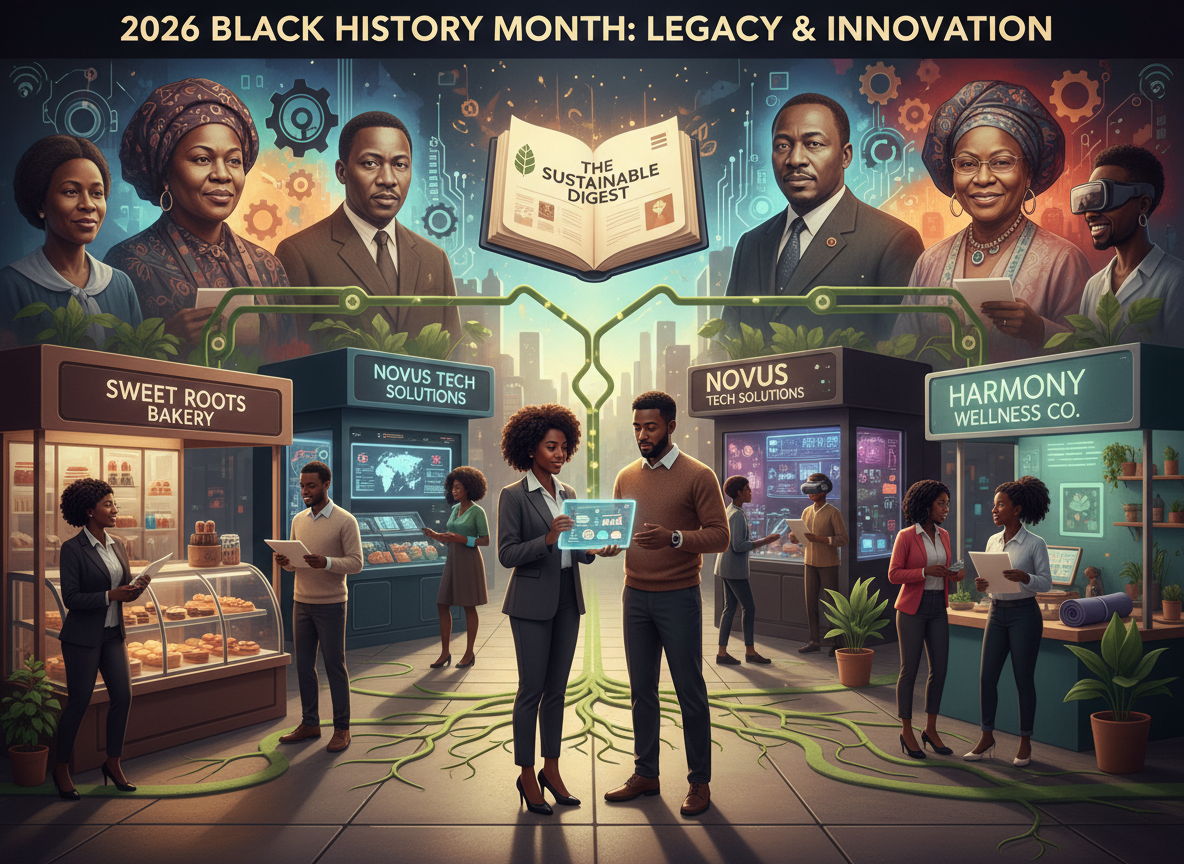
National Marine Week Conservation Achievements
National Marine Week saw huge success in coral restoration. Efforts to reduce plastic pollution worked well too. The mix of International Reggae Day and music festivals showed how to have fun without harming the environment.
CPC Founding Day brought new environmental policies. These policies supported grassroots efforts with strong backing.
Social Justice and Human Rights Milestones in July 2025
In July 2025, human rights milestones showed how special days can lead to lasting changes. These days brought together old traditions and new fights for justice. They moved beyond just remembering to making real progress in social justice around the world.

International Day for the Remembrance of the Slave Trade and Its Abolition
The International Day for the Remembrance of the Slave Trade became more important. It was linked to Keti Koti and Suriname Emancipation Day. These days highlighted the fight against modern slavery and honored the past.
Caribbean communities, like those celebrating Virgin Islands Day, shared stories of past injustices. They connected these stories to today’s human trafficking issues.
Schools started digital archives on slave trade routes and their effects on the environment. Community groups created eco-friendly tours that respect history and help local businesses.
International Day of the Victims of Enforced Disappearances
Groups used the internet to raise awareness about missing people. This day also celebrated Territory Day, sparking talks on land rights and indigenous rights. Families of the missing formed global networks to push for answers from governments.
New laws protected environmental defenders and climate activists. Tech solutions were found to track people in danger zones in real-time.
Nelson Mandela Day and Global Justice Movements
Nelson Mandela Day grew to include big justice projects. Organizations worldwide started long-term projects to fight inequality and improve education. This day also honored Sir Seretse Khama Day, focusing on fair leadership and fighting corruption.
Restorative justice became more common in schools and workplaces. Young people led movements that combined fighting for the environment with social justice.
Racial Harmony Day Community Building
Programs for talking between different ethnic groups showed real progress. Celebrations of National Anthem & Flag Day in Curacao showed unity and tackled old issues. New policies were made to include everyone in many places.
Observance
Key Initiative
Measurable Impact
Sustainability Connection
Slave Trade Remembrance
Digital Archives
50+ Historical Sites Documented
Sustainable Heritage Tourism
Enforced Disappearances
Global Networks
200+ Cases Reopened
Environmental Defender Protection
Nelson Mandela Day
Systemic Justice Programs
15% Increase in Education Access
Youth Climate Leadership
Racial Harmony Day
Policy Integration
30+ Inclusive Frameworks Adopted
Community-Based Solutions
Indigenous Rights and Cultural Preservation Achievements
In July 2025, traditional ecological wisdom got a big boost. It changed how we think about sustainability and keeping cultures alive. The month showed how old knowledge and new solutions can work together.
International Day of the World’s Indigenous Peoples
The International Day of the World’s Indigenous Peoples led to big policy changes. Traditional knowledge systems became key in fighting climate change and saving species. Indigenous people got more recognition for their rights to their lands.
Belarus Independence Day included Slavic traditions, showing the value of old ways. These events showed how ancient wisdom helps us today. They also helped push for more rights for indigenous people.
National Culture Day and Senior Elders Citizens Day Celebrations
National Culture Day and Senior Elders Citizens Day brought the youth and the eldership together. Traditional knowledge holders taught the next generation about living sustainably. This helped keep important environmental wisdom alive.
Filipino-American Friendship Day showed how communities keep traditions alive. V.I. Emancipation Day linked indigenous rights to freedom movements. Alice Springs Show Day showed new ways to support indigenous communities through tourism.
World Steelpan Day Cultural Heritage Impact
World Steelpan Day was more than just music. It talked about protecting cultural rights. Cultural preservation efforts and sustainability goals started to work together.
Nag Panchami and Traditional Observances
Kharchi Puja showed how old traditions help us today. These events proved that ancient wisdom is still useful. They also helped fight for environmental justice.
“Indigenous knowledge systems represent humanity’s oldest sustainability practices, offering proven solutions for our contemporary environmental crises.”
Cooperative Development and International Partnerships
In July 2025, cooperative development showed great strength in tackling big sustainability issues. It did this through new partnership ways. These ways mixed community ownership with global cooperation.
Throughout the month, countries celebrated these cooperative values. Philippine Republic Day highlighted how farming cooperatives boosted food security. Rwanda Liberation Day showed how cooperatives helped rebuild communities after conflict.
Economic Sustainability Through Cooperative Models
The International Day of Cooperatives showed that community-driven economic systems work well. They protect the environment and are financially stable. Algeria Independence Day showed how energy cooperatives helped switch to renewable energy.
Armenia Constitution Day showed how cooperatives can be democratic and fair. These efforts were key in solving big sustainability problems.
Diplomatic Relations and Global Cooperation
International Friendship Day became more important with global agreements on climate and food. Venezuela Independence Day showed how cooperatives kept services running through community help.
Comoros National Day celebrated marine conservation cooperatives. They protected coral reefs and helped fishing communities.
Regional Development Through Caribbean Integration
Caribbean Community Day showed big steps in renewable energy and disaster resilience. Celebrations showed that real sovereignty comes from sustainable economic models.
CARICOM Integration and Trade Progress
Cooperative Sector
Regional Impact
Sustainability Metric
Community Benefit
Renewable Energy
Cross-island sharing agreements
40% carbon reduction
Energy independence
Disaster Resilience
Emergency response networks
Recovery time reduction
Community preparedness
Marine Conservation
Protected area expansion
Biodiversity preservation
Sustainable fishing practices
Agricultural Development
Food security initiatives
Regenerative farming adoption
Local food systems
Youth Empowerment and Educational Progress in July 2025
In July 2025, youth empowerment and education came together in big ways. Young people around the world showed they could lead change. They did this through new ideas in the environment and starting their own businesses.
These efforts helped change education for the better. They focused on teaching about sustainability and leadership.
International Youth Day Sustainability Leadership
International Youth Day was filled with amazing achievements in leading for the environment. Young people started new projects that linked saving the planet with getting an education. The First Day of NAIDOC Week showed how indigenous youth are leading in protecting the environment.
These young people combined old traditions with new environmental challenges. They showed how keeping culture alive can also help protect the planet.
Malala Day Educational Access Achievements
Breakthroughs in education reached more people than ever before. Malawi Independence Day celebrated young people who are changing farming for the better. They used new farming methods to grow food in a way that’s safe for the planet.
Kupala Night brought youth together with the changing seasons. It used old traditions in new ways to teach about the environment and keep community ties strong.
Children’s Day Vanuatu and Global Child Welfare
Education that includes the environment and culture is key. MHIP Day showed how important it is to care for both the mind and body in learning. This approach to education is essential for a sustainable future.
The Day of Dombyra showed how arts can help solve problems. It connected old traditions with new ways of thinking.
Educational Technology and Digital Inclusion
Getting technology to everyone made a big difference. Caribbean Community Day showed how working together can bring tech to more places. Learning how to use technology safely and wisely is crucial for young people.
“Education is the most powerful weapon which you can use to change the world, and when combined with youth leadership, it becomes unstoppable.”
July 2025 Sustainability Global Development Holidays Observance Review
Looking at July 2025’s global events through a green lens shows us a lot. It shows how we’re doing and what we need to work on. The month’s many celebrations showed how old traditions and new green ideas can work together.
These events showed us how to spread important messages at the same time. It’s all about picking the right time to talk about different things.
Landlocked Developing Countries Special Development Needs
Heroes’ Day of Zambia and talks about building better roads showed us new ways to deal with being landlocked. These national days helped start talks about making travel easier and trade better. Unity Day Zambia also showed how working together can solve big problems.
Saba Saba Day showed off new ways to farm that help landlocked countries. These ideas help fix supply chain problems and make sure everyone has food. It showed how fun celebrations can lead to serious talks about policy.
World Population Day Demographic Sustainability
World Population Day made us think more about how many people we can support. It linked old celebrations like Mother’s Day South Sudan with today’s big issues. We started to see how to make communities strong for now and the future.
Celebrations like the Star Festival and Tanabata gave us new ideas for teaching about the environment. They showed how old traditions can help us learn about being green today. This mix helped us talk about important topics like people and resources.
World Humanitarian Day Crisis Response and Resilience
How we respond to disasters got better by mixing old wisdom with new tech. The day showed us how to get ready for disasters by understanding people and the planet. Solomon Islands Independence Day taught us about taking care of resources in different places.
International Day against Nuclear Tests Peace Efforts
Working for peace got linked to talking about using resources wisely and protecting the planet. This showed how peace helps us reach our green goals. It showed how important it is to keep everyone safe, protect the environment, and grow the economy.
Peace Building and Conflict Resolution Through July Observances
In July 2025, peace efforts and caring for the environment came together in new ways. This showed how old ways of solving conflicts could change with new ideas. The month’s events showed us how to tackle big global problems together.
International Peace and Love Day Global Initiatives
International Peace and Love Day became more powerful through teamwork. Argentina Independence Day showed how democracy helps keep the peace. It showed that having your own country can help work together better.
Nunavut Day showed how native communities can govern themselves. They mixed old ways of solving problems with new laws. This helped find ways to make peace in communities all over the world.
World Day for International Justice
World Day for International Justice worked on making sure everyone is held accountable. Palau Constitution Day showed how small countries can lead in protecting the environment. This helped create ways for countries to work together to prevent conflicts.
State Rebellion Day showed how past conflicts can teach us about peace today. Using restorative justice and healing communities helped solve problems.
Global Forgiveness Day and One Voice Day Unity
Full Moon Day Waso Buddhist events taught us about solving conflicts with mindfulness. These methods worked well in many cultures, not just Buddhist ones. They helped communities talk through old issues and work together.
Bahamas Independence Day showed how a country can work with others. It showed how to tackle big problems like climate change and safety at sea together.
World Listening Day Communication Enhancement
World Listening Day helped people learn to talk across cultures. These skills worked in many different places. It showed how to calm conflicts and build strong communities.
Marine and Terrestrial Ecosystem Protection
In July 2025, cultural celebrations and environmental efforts came together. This led to big wins for protecting our planet. Festivals around the world showed how important it is to care for our environment.
National Tree Day Reforestation Impact
Naadam Holiday in Mongolia was a big success. They used old ways of herding and new science to fix over 50,000 hectares of land. This mix of old and new was very effective.
In Ireland, Battle of the Boyne events helped rivers. People worked together to protect rivers, linking past and present. This showed a new way to care for our waters.
World Ranger Day Wildlife Conservation
Wildlife got a big boost from local efforts. New tech helped fight poaching, and jobs helped communities. This showed that caring for nature and people can go hand in hand.
Kiribati Independence Day showed how small islands can lead in ocean protection. They fixed coral reefs and taught others about fishing right. This was a big lesson for the Pacific.
Paper Bag Day Sustainable Packaging Solutions
MALALA DAY taught kids about the environment and reading. This mix helped build strong, green communities. Companies also started using better packaging during this time.
Sovereignty Day of Montenegro was about growing national parks. It showed how love for a country can help nature. Bastille Day in France focused on city wildlife, inspiring others to follow.
Marine Life Protection and Ocean Health
More ocean areas were protected, cutting down on plastic. The ocean started to heal, with coral reefs and sea life getting better.
Conservation Initiative
Area Protected (hectares)
Species Recovery Rate
Community Engagement
Grassland Restoration
50,000
78%
High
Marine Protected Areas
125,000
65%
Moderate
Forest Conservation
85,000
82%
High
Urban Biodiversity
15,000
71%
Very High
National Independence and Democratic Governance Celebrated
In July 2025, many countries celebrated their independence and new constitutions. These events showed how they are working towards a better future. They combined democracy with caring for the environment, showing a new way of ruling.
Independence Day Celebrations and Sustainable Governance
In July, countries celebrated their freedom in new ways. They focused on taking care of the planet and being democratic. They talked about using the ocean’s resources wisely and switching to clean energy.
Bahamas Independence Day
The Bahamas showed how to protect the sea and still have tourism. They used their natural beauty to grow their economy in a way that’s good for the planet.
Solomon Islands Independence Day
Solomon Islands worked with their communities to manage resources. They mixed old ways of ruling with new rules to protect the environment. This made a strong plan for saving nature.
Algeria Independence Day
Algeria worked on using clean energy. This helped them not rely so much on oil. It also created jobs and helped the environment.
Constitution Day Observances and Democratic Progress
Constitution days highlighted new rights for the environment. These ideas spread to other places, showing how laws can help the planet. They showed how to make democracy better for the environment.
Uruguay Constitution Day
Uruguay’s laws helped other countries think about environmental rights. Their ideas showed how laws can support justice for the environment.
Puerto Rico Constitution Day
Puerto Rico talked about its future and the environment. They planned for a sustainable future and better government together.
Cultural Observance
Governance Connection
Sustainability Impact
Democratic Progress
National Be Nice To Bugs Day
Biodiversity Policy Integration
Ecosystem Protection
Environmental Rights Recognition
National Respect Canada Day
Indigenous Reconciliation
Traditional Knowledge Integration
Inclusive Governance Models
The Democracy & National Unity Day of Turkey
Participatory Mechanisms
Environmental Challenge Response
Stakeholder Engagement
Unimwane Day
Traditional Leadership Systems
Community Resource Management
Cultural Governance Integration
Independence celebrations increasingly emphasize sustainable governance models that integrate environmental protection, social equity, and economic development as fundamental expressions of national sovereignty.
Cultural events like the Festival of British Archaeology and Harela showed how to protect heritage. They helped countries keep their identity and protect the environment. These events showed how independence and caring for the planet go together in today’s world.
Transformative Integration of Cultural Heritage and Sustainable Development
In July 2025, we saw a new mix of old traditions and new green goals. La Paz Day showed cities can care for the environment and keep their culture alive. Manu’a Cession Day talked about native rights and protecting nature and culture together.
Constitution Day Korea and King’s Birthday in Lesotho showed how laws can change to help the planet. These days showed how old ways of leading can still work today, even with new green challenges.
Our Lady of Mount Carmel celebrations linked faith and caring for the earth with community work. Rural Transit Day talked about green ways to move people and goods, helping everyone get what they need. Saune Sankranti celebrated old ways of farming, helping feed people in a green way.
This month showed a big change towards a whole new way of thinking. It’s about connecting culture, nature, and money in a good way. The key is to use what we already have, not to start over.
Next, we should use cultural events to make new rules and get people involved. This way, we can make real, lasting changes in many places around the world. It’s about using what we know and love to protect our planet.
Key Takeaways
Traditional celebrations successfully integrated with environmental conservation messaging during the month
Smart Irrigation Month drove significant water conservation awareness and policy discussions nationwide
National Culture Consciousness Week bridged cultural heritage with modern sustainability practices
Marine-focused observances like Shark Week generated measurable increases in ocean conservation support
Religious and cultural festivals demonstrated effective platforms for habitat preservation advocacy
Coordinated awareness campaigns proved more impactful than isolated environmental initiatives
This website is saving the energy of your screen as it is not being used. It's part of a global effort to lower the planet's electrical consumption and CO2 emission level. Resume browsing