2026 SDSN Sustainable Development Report annual review analysis

2026 SDSN Sustainable Development Report annual update review analysis

The latest edition of the 2026 SDSN Sustainable Development Report marks a significant moment in global efforts toward a more equitable future. It reflects a decade of data and progress since the adoption of the 2030 Agenda by all UN Member States. This document serves as a crucial tool for understanding the trajectory of development across nations.

In this year’s report, the SDSN Sustainable Development Solutions Network has identified eight key priorities aimed at accelerating progress through 2030 and beyond. This strategic shift emphasizes the importance of looking forward, rather than solely reflecting on past achievements.

Moreover, the report features insights from two innovative surveys that gauge both expert opinions and public perceptions regarding the barriers to implementing these vital goals. As nations navigate complex challenges, the findings serve as a guide for policymakers and stakeholders alike.

As we delve into the details, it becomes clear that the rankings of countries such as Finland, Sweden, and Denmark are not just a celebration of their achievements. They represent a commitment to long-term strategies that foster positive impacts both domestically and internationally.
1. Introduction to the SDSN and UN DESA Roles in Sustainable Development

At the forefront of global initiatives, the Sustainable Development Solutions Network and the United Nations Department of Economic and Social Affairs collaborate to advance significant goals. Their combined efforts have shaped the landscape of international development, particularly since the adoption of the 2030 Agenda in 2015.

1.1 Historical Background of the Sustainable Development Solutions Network

The Sustainable Development Solutions Network emerged as a brain trust under UN auspices. Since 2015, it has mobilized global academic and research expertise to tackle the most intractable challenges facing all 193 member states. This initiative emphasizes collaborative approaches to sustainable development.

1.2 Overview of the United Nations Department of Economic and Social Affairs

UN DESA’s long-term history as the Secretariat’s economic social arm stretches back decades. However, its role crystallized dramatically after 2015, when it became the backbone for the High-Level Political Forum. This forum serves as the custodian of the Voluntary National Review process across 193 member states.

1.3 Synergies between SDSN and UN DESA in Global SDG Efforts

The synergy between SDSN and UN DESA is evident in their complementary data collection efforts. SDSN leverages its global network of academics to track the evolving landscape of sustainable development. Meanwhile, UN DESA maintains the official SDG indicator framework that informs monitoring processes.

Since 2016, both organizations have strengthened governance systems through bilateral relationships with national and regional governments. This collaboration is crucial for effective implementation of the sustainable development goals.

OrganizationRoleKey Contributions
Sustainable Development Solutions NetworkMobilizes research expertiseAddresses complex challenges in 193 member states
United Nations Department of Economic and Social AffairsServes as the Secretariat’s economic social armCustodian of Voluntary National Review process
CollaborationData collection and governanceStrengthens systems for sustainable development

Short-term progressions have seen both institutions grappling with the declining emphasis on sustainable development in high-level discussions. This trend underscores the urgency of their collaborative efforts in fostering a sustainable future.

2. Evolution and Annual Development of the 2026 SDSN Sustainable Development Report

A dramatic visualization of the evolution of the Sustainable Development Report, featuring a timeline that showcases key milestones with symbolic iconsโ€”like renewable energy, education, and community growthโ€”interwoven through a vibrant landscape. In the foreground, diverse professionals in business attire discuss and analyze reports, radiating a sense of collaboration. The middle ground is filled with visuals representing data visualization elements, such as graphs and charts, seamlessly merging with lush greenery and cityscapes, symbolizing progress. In the background, a warm golden sunset casts dramatic lighting, creating an optimistic atmosphere. The overall mood is one of hope and collective advancement toward sustainability. The image embodies the essence of "The Sustainable Digest" and reflects the themes of evolution and development.

The evolution of these reports mirrors the dynamic nature of global development efforts and the pressing need for accountability. Since 2015, the series has transformed from a basic scorecard into a comprehensive tool for assessing progress across nations.

2.1 The Report’s Genesis and Long-Term Development Since 2015

The sustainable development report series began its journey in 2015. It aimed to hold all 193 UN Member States accountable to the newly established SDGs. Over the years, it has evolved into a multidimensional analytical framework, as seen in the latest edition.

2.2 Annual Update Process and Collaborative Mechanisms (2016-2026)

Each annual update since 2016 has introduced methodological refinements. The early editions primarily focused on country rankings. However, later versions incorporated spillover indices and trend analyses. By the latest edition, comprehensive survey data from expert networks and the public have been included.

The collaborative mechanisms behind the annual updates involve a well-coordinated effort. SDSN’s secretariat collaborates with regional offices in Asia, Europe, and North America. An expanding network of local chairs and managers ensures the accuracy of data across all 193 countries.

2.3 Integration of Expert and Public Surveys in Report Refinement

The integration of expert and public surveys marks a significant methodological evolution. The latest edition includes the “2026 Expert Survey on Government Efforts for the SDGs,” covering 64 countries and the European Union. Additionally, it features the “2026 Survey on SDG Challenges and Means for Implementation,” which gathered insights from 1,098 respondents across 127 countries.

Annual decisions have been influenced by the shifting landscape of international development. For instance, the 2019 edition introduced the six SDG Transformations framework, while the 2020 edition addressed the impacts of the COVID-19 pandemic. The latest edition now pivots toward priorities beyond 2030 as the deadline approaches.

Initially affiliated with a university press, the report has matured into a globally recognized authority on SDG progress. Each edition builds on the previous year’s lessons, expanding the universe of data available for cross-country comparisons.

Importantly, all report materialsโ€”including the full PDF, Excel database with scores and ratings, codebook, and methodology documentationโ€”are available for free. This commitment to democratizing data reflects the guiding principles that have shaped the report’s evolution since 2016.
3. Analysis of SDSN Expert and Large-Scale Surveys on SDG Implementation

The recent expert survey sheds light on the effectiveness of government initiatives related to the SDGs. It highlights how these efforts have been integrated into public management practices. This analysis draws on qualitative data collected from experts across various countries, providing a nuanced understanding of SDG implementation challenges.

3.1 The 2026 Expert Survey on Government Efforts

This year’s expert survey represents a methodological triumph in qualitative data collection. It mobilized 65 responses across 64 countries and the European Union. The survey assessed how deeply the SDG framework has penetrated national public management practices since 2018.

Countries like Canada, Denmark, Ghana, and Italy have made significant strides in incorporating the SDG framework into their governmental practices. In contrast, Australia, the United States, and Venezuela have not prioritized the SDGs in their public management frameworks.

3.2 Insights from the 2026 Large-Scale Survey on SDG Challenges

The large-scale survey, encompassing 1,098 respondents from 127 countries, provides a broader perspective on SDG outcomes. An overwhelming 78% of respondents believe that SDG outcomes in their countries have either improved or stagnated from 2015 to 2025.

However, the survey also identified significant barriers to SDG implementation. Notably, 89% of respondents pointed to the failure to implement approved strategies as a critical challenge. Additionally, 87% highlighted the shifting geopolitical landscape as another major hurdle.

3.3 Implications of Survey Findings on Policy and Implementation Practices

The findings from both surveys underscore the unique value of the SDSN in curating insights for the updated report. By triangulating expert assessments, public perceptions, and quantitative indicators, the network provides a multidimensional picture of government efforts.

This comprehensive approach informs the eight priorities for accelerating SDG progress through 2030 and beyond. It reveals that while bureaucratic structures remain in place, the political commitment at the highest levels is waning, as evidenced by the decline in heads of state referencing the SDGs in official speeches.

4. Role and Impact of Voluntary National and Local Reviews in Global SDG Monitoring

A modern conference room bustling with activity, showcasing a diverse group of professionals engaged in a dynamic discussion about Voluntary National and Local Reviews for Sustainable Development Goals (SDGs). In the foreground, a confident woman in business attire gestures toward a digital presentation displaying colorful charts and maps illustrating global progress. In the middle ground, colleagues (all in professional business attire) collaborate, surrounded by documents and laptops, creating a sense of teamwork and innovation. The background features large windows with a city skyline view, bathed in natural light, symbolizing transparency and hope. The mood is energetic and optimistic, reflecting the importance of collective efforts in global monitoring. The overall atmosphere is professional yet inspiring, encapsulated in a clean, contemporary design, embodying the essence of "The Sustainable Digest."

The mechanisms for Voluntary National and Local Reviews have emerged as pivotal tools in tracking global progress. Since 2016, 190 countries have participated in the Voluntary National Review (VNR) process. This achievement represents a remarkable feat of global accountability architecture, particularly in contrast to the three holdouts: Haiti, Myanmar, and the United States.

In 2026, 36 countries are scheduled to present updated reviews of their SDG action plans. Notably, there are no first-time presenters this year. Togo and Uruguay will present their fifth VNRs, showcasing their sustained engagement with this important mechanism. This evolution reflects how the VNR process has transformed from a one-off reporting exercise into an iterative policy learning cycle over the past decade.

The growth of Voluntary Local Reviews (VLRs) tells an equally compelling story. Subnational authorities in 48 countries have produced 386 VLRs from 2016 to 2026. Brazil, Malaysia, Mexico, and Argentina alone account for nearly half of these reviews. The number of VLR submissions surged by 69% from 62 in 2024 to 105 in 2025, indicating a robust local-level momentum for sustainable development.

4.5 Role and Impact of Voluntary National and Local Reviews in Global SDG Monitoring continuing..

UN DESA’s role as the institutional custodian of both VNRs and VLRs has expanded significantly. The Department maintains comprehensive databases tracking participation trends and provides technical support to governments preparing their reviews. This support ensures that these accountability mechanisms feed into the broader SDG implementation monitoring ecosystem.

The absence of the United States from the VNR process, alongside Haiti and Myanmar, highlights a significant gap in global SDG progress monitoring. This is particularly concerning given the country’s influence on international spillover effects, which the SDSN’s spillover index tracks across multiple indicators.

Ultimately, the VNR and VLR mechanisms embody the principle of country-led accountability that underpins the 2030 Agenda. UN DESA’s support infrastructure has evolved from basic reporting templates to sophisticated data platforms, enabling cross-country comparisons and peer learning among the 190 participating countries.

CountryVNR PresentationsVLR Count
Togo515
Uruguay510
Brazil472
Malaysia444
Mexico435
Argentina434
United States00

5. 2026 SDSN Sustainable Development Report Annual Update Review Analysis: Key Findings and Priorities

In this edition, we explore the vital discoveries and strategic priorities emerging from the latest global development evaluations. The 2026 findings reaffirm the Nordic dominance in sustainable development, with Finland, Sweden, and Denmark topping the rankings. However, the sdg index dashboards reveal a more complex narrative.

The spillover index illustrates how the consumption patterns of wealthier nations can negatively impact progress towards achieving the sustainable development goals in the Global South. This nuance is crucial for understanding the interconnectedness of global development efforts.

5.1 Overview of 2026 SDSN Report Rankings and Trends

The rankings from the development report 2026 indicate that while some countries excel, there are underlying issues that need addressing. The interactive maps within the report showcase the performance of nations on each of the 17 goals, providing a clear picture of where efforts are succeeding and where they are lacking.

5.2 Priority Areas and Emerging Issues in the Post-2030 Sustainable Development Agenda

The report identifies eight key priorities for accelerating sdg progress through 2030 and beyond. A remarkable consensus among experts reveals that at least 75% agree on six critical priorities for the post -2030 agenda. These include:

  • Strengthening means for implementation, focusing on governance and data.
  • Developing international guidelines on SDG synergies and trade-offs.
  • Incorporating artificial intelligence into future frameworks.
  • Reforming the global financial architecture to address budgeting gaps.
  • Ensuring stability in the framework while maintaining continuity in goals.
  • Better reflecting and incorporating international spillovers.

5.3 SDSN and UN DESA’s Collaborative Role in Shaping International Development Policies

The collaborative dynamic between SDSN and UN DESA plays a pivotal role in shaping international development policies. Their joint efforts highlight the importance of aligning government strategies with budget allocations. The findings indicate a persistent gap between adopting strategies and allocating necessary resources, which must be addressed in future negotiations.

Dr. Guillaume Lafortune’s recent publication emphasizes the need for a credible framework to guide the post -2030 agenda. This intellectual groundwork will help bridge the gap between academic rigor and practical policy applications, ensuring that future efforts are both informed and effective.

As we look toward 2030 and beyond, the sdg index dashboards serve not just as a report card but as a strategic compass. They provide actionable insights on where government efforts have succeeded and where they have stalled, guiding priorities for the future.
6. Conclusion

The synthesis of findings highlights the intricate tapestry of global initiatives at play. This edition showcases how the collaborative efforts of key organizations have matured over time. The convergence of expertise from various countries and institutions illustrates a commitment to advancing meaningful progress.

Moreover, the eight identified priorities serve as a roadmap for future actions. They not only address past shortcomings but also pave the way for innovative solutions. The free availability of data further exemplifies a dedication to transparency and accessibility.

As we navigate the path toward a more equitable future, the development process between these organizations stands as a model. It demonstrates how ongoing collaboration can yield actionable insights, ensuring that the global dialogue on sustainable development remains vibrant and impactful.

Key Takeaways

  • This report synthesizes ten years of data since the 2015 adoption of the 2030 Agenda.
  • It identifies eight priorities to enhance progress toward global goals.
  • Insights from expert and public surveys inform actionable strategies.
  • Top-ranking countries showcase effective long-term commitments.
  • Interactive tools allow for exploration of historical data trends.

UN SDG#8 global economic peculiarity

UN SDG#8 multi-layered paradigm shift pecuilar adaptation economic development

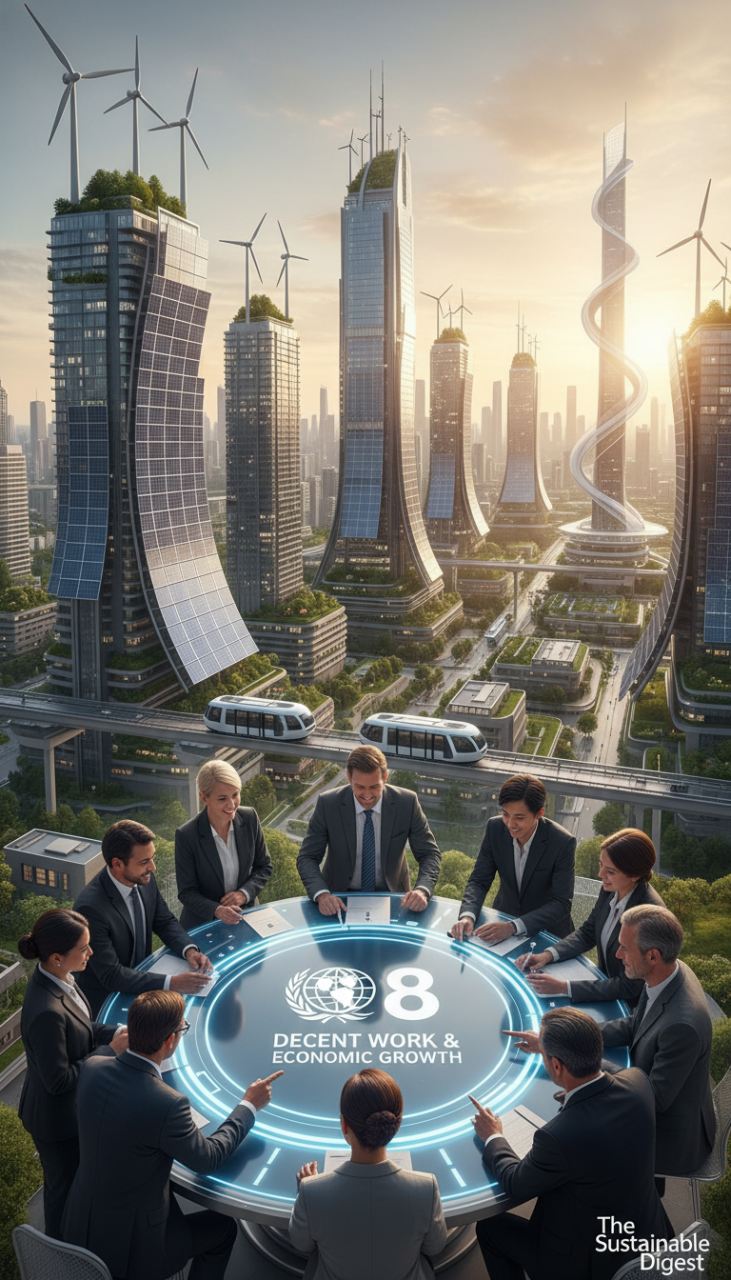
The world’s nations agreed on a set of ambitious targets to steer collective progress. Known as the Sustainable Development Goals, this framework aims for a more sustainable and equitable planet by 2030. Among these, the eighth goal, holds a distinct position. The focus on the UN SDG#8 global economy theme is rather important for the aggregation of multi-regional and continental events all at once.

It champions sustained, inclusive, and sustainable economic growth. More importantly, it pushes for full, productive employment and decent work for every person. This focus makes it a cornerstone of the entire global agenda.

Yet, the path to this ideal is fraught with modern challenges. A volatile international landscape, marked by rapid technological change and geopolitical tensions, tests traditional models. Achieving true prosperity now requires a fundamental rethink of how we define growth.

The real test lies in moving from lofty policy to ground-level action. It’s about bridging the gap between international boardrooms and local realities. Major institutions and evolving tech are powerful forces reshaping labor markets.

This analysis digs into that complex transformation. It explores how the unique demands of our era shape the pursuit of dignified work and resilient development.

Overview of UN SDG#8 Global Economy through Volatility

Economic headlines often celebrate falling unemployment, but the deeper story of job quality tells a different tale. Pursuing decent work for all now unfolds against a backdrop of stark recovery and lingering fragility.

Examining the Global Economic Landscape

The global unemployment rate hit a record low of 5.0% in 2024. Yet, this statistic masks a less celebrated reality. Agencies like the International Labour Organization and UNCTAD highlight that over half of all workersโ€”57.8%โ€”remain in informal employment.

This vast informal sector lacks basic social security. It represents a critical gap in achieving true employment decent work.

Indicator2015 BenchmarkPost-Pandemic Peak (2021)Recent Trend (2023-2024)
Global Real GDP per Capita GrowthModerate5.5%Slowed to 1.9%
Global Unemployment Rate6.0%Improving5.0% (Record Low)
Workforce in Informal EmploymentHighPersistent57.8%

Post-Pandemic Economic Recovery Trends

The powerful GDP rebound of 2021 proved fleeting. Growth slowed markedly by 2023. Analyses from the UNDP and UNEP point to persistent trade tensions and soaring debt as brakes on sustainable economic growth.

“Recovery must be measured not just in output, but in the security and dignity of jobs created.”

UN Agency Synthesis

Institutions like the WTO and UN Economic and Social Council stress that lasting progress requires fixing structural gaps widened by the crisis. The goal is economic growth that lifts the most vulnerable.

Bodies such as UNIDO and the World Tourism Organization now focus on aligning national policies with this broader vision of decent work.

Decent Work and Economic Growth in Uncertain Times

A contemplative scene illustrating "Decent Work and Economic Growth in Uncertain Times" features a diverse group of professionals in a modern office setting. In the foreground, a middle-aged woman in a smart blazer reviews reports on a digital tablet, while a young man in a neat button-up shirt discusses strategies with her. In the middle ground, a large window reveals a city skyline under a cloudy sky, symbolizing uncertainty. The background shows distant figures engaged in brainstorming, with graphs and charts projected on screens, indicating economic growth. Soft, natural lighting filters through the window, creating a thoughtful, optimistic atmosphere. The composition captures the essence of professional collaboration against the backdrop of a fluctuating economy. The Sustainable Digest.

Social justice in the workplace has become a litmus test for true economic progress. In an era of volatility, the quality of jobs defines resilience more than their quantity.

Worker Protections and Social Justice

Advocacy groups like the Board of Peace argue that protecting labor rights is foundational to social justice. Global compliance with these rights has, ironically, fallen by 7 percent since 2015.

This decline exposes a gap between policy and practice. The stark figure of 160 million children in child labor underscores the urgent need for stronger enforcement.

Linking Productivity to Sustainable Development

True productivity is not just about output. It requires a shift toward productive employment decent models that value people’s well-being.

Consider the 21.7 percent of young people classified as NEET in 2023. Providing them with meaningful decent work is a top priority for lasting economic growth.

Integrating social justice into employment decent work strategies is no longer optional. It is the core of building a workforce that can withstand uncertainty.

Influence of Global Institutions on SDG8 Policies

Policy doesn’t emerge from a vacuum. It’s forged in the meetings of influential global bodies. These institutions set the tone for national labor and growth policies worldwide.

UN Agencies and World Economic Forum Initiatives

The World Economic Forum facilitates high-level dialogues on technology’s role in the future of working. It pushes for digital integration into global frameworks.

UN agencies often collaborate with this forum. Their joint aim is to ensure economic growth doesn’t undermine human rights. The goal is to anchor decent work in tech-driven progress.

InstitutionPrimary FocusKey StakeholdersPolicy Influence
World Economic ForumTech integration & elite consensusCorporate leaders, governmentsShapes high-level agenda
World Social ForumEquity & grassroots advocacyCivil society, unionsChallenges market-centric models

The Role of the World Social Forum and Regional Alliances

The World Social Forum provides a loud counterpoint. It champions the informal sector and marginalized communities. This platform challenges top-down economic models.

Regional alliances, like ASEAN or the African Union, increasingly adopt international guidelines. They harmonize labor standards to promote sustainable development. Aligning these varied efforts is key to achieving broad decent work targets.

UN SDG#8 global economy’s peculiar adaptation to a multi-layered paradigm shift

A vibrant cityscape at dawn reflecting a multi-layered paradigm shift in economic development, symbolizing UN SDG#8. In the foreground, diverse professionals in business attire collaborate around a transparent digital interface, showcasing innovative solutions. The middle ground features modern buildings integrated with greenery, representing sustainable practices. Background skyscrapers symbolize growth and stability against a soft pastel sky. Warm, golden lighting bathes the scene, enhancing the optimistic and forward-looking atmosphere. Use a slightly elevated angle to capture the bustling streets below and the interaction among people. This composition conveys a sense of progress and collaboration within todayโ€™s global economy, inspired by โ€œThe Sustainable Digest.โ€

Measuring a nation’s health by GDP alone is like judging a book by its cover. The real story of progress is found in the quality of life for its people. This represents a fundamental paradigm shift in how success is defined.

The new approach values unpaid labor, care work, and community support systems. It recognizes the massive, often invisible, informal economy. These elements form the bedrock of social stability, especially in emerging nations.

Fostering decent work is central to this new vision. Jobs must offer security, fair pay, and dignity to build resilient labor markets. This focus on quality, not just quantity, is essential for sustainable growth.

Old Metrics FocusNew Metrics Focus
Gross Domestic Product (GDP) growth rateSocial reproduction & environmental health
Formal employment numbersQuality of all work, including informal sectors
Short-term financial outputLong-term community & ecosystem resilience

Ultimately, this shift ensures that the pursuit of economic advancement strengthens, rather than depletes, our social and natural foundations. It is the only path to genuine, lasting development.

Geopolitical Impacts on Economic Policy

Recent years have provided stark, real-world lessons on how geopolitics can unravel decades of economic planning. National strategies for prosperity are now rigorously tested by external shocks far beyond any single government’s control.

Sri Lanka vs. Venezuela: A Comparative Analysis

Sri Lanka’s collapse showcased the dangers of unsustainable debt. It damaged and comprised essential public services and shattered job security for millions.

Venezuela’s trajectory highlights a different peril. Deep political instability has systematically corroded labor rights and the state’s ability to foster productive employment. Both cases devastated their national economies.

Consequences of the Ukraine and Iran Wars

The war in Ukraine triggered massive volatility in global energy and food markets. This directly hampered stable economic growth in many developing countries.

Ongoing tensions related to Iran further complicate international trade routes. They create an environment where securing and maintaining decent work becomes a formidable challenge.

These conflicts prove that true development is inextricably linked to global peace. Policymakers must now design national strategies that can withstand such turmoil to protect the pursuit of decent work.

Technological Disruption and the 4th Industrial Revolution

A futuristic cityscape representing technological disruption and the 4th Industrial Revolution. In the foreground, diverse professionals in business attire collaborate around advanced holographic displays, showcasing graphs and data. In the middle, autonomous vehicles navigate smart streets lined with solar-powered buildings and drone corridors. The background features towering skyscrapers intertwined with greenery, symbolizing sustainability and innovation. Bright, dynamic lighting conveys a sense of optimism and progress, casting colorful reflections on glass surfaces. The lens angle captures both the bustling street level and the impressive skyline, creating depth. The atmosphere radiates energy and transformation, demonstrating the intersection of technology and urban life. The image is intended for "The Sustainable Digest," emphasizing the impact of technology on todayโ€™s global economy.

Automation and AI are rewriting the rulebook for what constitutes valuable labour in the 21st century. This era, often called the Fourth Industrial Revolution, merges digital, physical, and biological systems.

Global labour productivity growth rebounded to 1.5 percent in 2024. This signals a shift from the near stagnation of the previous two years.

AI’s Influence on Global Productivity

Artificial intelligence is the central force in this transformation. It drives efficiency in manufacturing and service sectors alike.

This boost in output, however, carries a significant caveat. While AI enhances productivity, it simultaneously threatens traditional job security for millions.

Ensuring decent work in this automated age demands proactive strategy. Policies must prioritize reskilling workforces to meet new technological demands.

Managed carefully, this integration can prevent widened inequality. The benefits of development must be shared broadly to sustain progress.

By leveraging this revolution, nations can unlock new avenues for economic growth. The goal remains a future where the human element of working is not lost but elevated.

Emerging Economic Models and Cooperative Business Approaches

When a major airline teeters on the brink, it reveals more than financial distressโ€”it exposes the fragility of traditional corporate structures. This vulnerability is sparking interest in more resilient alternatives. Cooperative business models, where employees hold ownership stakes, are gaining serious traction.

These approaches fundamentally rewire a company’s priorities. They place the security and dignity of the workforce at the center of operations. This shift is particularly relevant in volatile sectors like aviation.

Case Study: Spirit Airlines and the Cooperative Model

Spirit Airlines’ well-publicized financial struggles led to a radical proposal. Discussions emerged about restructuring not through another merger, but as an airline cooperative. This model would give workers a direct stake in the company’s success.

Such a transition could transform unstable work into more secure, decent work. Employees would gain a voice in decisions affecting their livelihoods. This fosters a sense of ownership that often boosts productivity and service quality.

The cooperative path aligns with broader goals of inclusive economic growth. It ensures the benefits of development are shared more fairly. For industries in flux, it offers a viable blueprint for preserving essential services while creating better opportunities.

The Role of Subsidies and Financial Reforms in Stimulating Growth

A dynamic scene illustrating the concept of subsidies and financial reforms driving economic growth. In the foreground, a diverse group of professionals in business attire collaborates around a table, surrounded by digital screens displaying upward-trending graphs and economic data. In the middle ground, vibrant icons of industries such as renewable energy, agriculture, and technology symbolize the sectors benefiting from subsidies. The background features a skyline of modern buildings, representing a thriving urban economy. Soft, warm lighting enhances the optimistic atmosphere, creating a sense of innovation and collaboration. The image conveys a message of progress and sustainability, reflecting the importance of financial strategies in achieving economic growth. The Sustainable Digest logo subtly framed in the corner, without any text or watermarks.

Subsidies and financial overhauls are not just economic levers; they’re strategic bets on a nation’s future stability. The right mix can unlock stalled progress, while the wrong one deepens fiscal holes.

Targeted financial support for small businesses is a prime example. It helps informal ventures join the formal economy, creating more decent work opportunities. This direct injection is crucial for local economic growth.

Broader financial reforms are equally vital. They tackle crippling debt burdens that strangle ambition in many regions. Clearing this red tape allows capital to flow toward sustainable development projects.

The goal is a system where businesses thrive and workers gain formal protections. This transition from precarious gigs to secure, decent work is the bedrock of a resilient labor market.

Smart policies must balance support with responsibility. Strategic subsidies for key affiliates, like green tech firms, should avoid long-term debt traps. The fiscal discipline ensures today’s stimulus doesn’t become tomorrow’s crisis.

Subsidy FocusPrimary TargetIntended Outcome
Small Business GrantsInformal Sector SMEsFormalization & Job Creation
Training & ReskillingExisting WorkforceHigher Productivity & Security
Green TechnologySustainable EnterprisesLong-term Ecological Resilience

Regional Alliances Shaping Economic Policies

The chessboard of international economics is increasingly dominated by powerful regional blocs. These alliances move beyond mere trade agreements to craft shared rules for prosperity.

Their collective influence now rivals that of traditional global institutions. They coordinate strategies that directly impact labor markets and investment flows.

BRICS, ASEAN, African Union, and the European Union

The BRICS coalition promotes South-South cooperation, challenging older financial architectures. It offers member countries a platform to advocate for alternative models of development.

ASEAN and the European Union are standard-setters. They export stringent labor and environmental regulations through their vast trade networks.

In Africa, the African Union and the newer Alliance of Sahel States (AES) prioritize market integration. Their goal is to boost regional stability and economic growth by reducing internal barriers.

These blocs provide crucial forums for sharing best practices on worker rights. Harmonizing standards is a key step toward ensuring decent work across diverse economies.

Ultimately, their collaboration amplifies voices in global governance. It ensures policies better reflect local needs, fostering more inclusive progress and decent work opportunities.

Integrating Environmental Sustainability into Economic Policies

A vibrant, futuristic cityscape showcasing resource-efficient green technology initiatives. In the foreground, diverse professionals in business attire collaborate over a digital tablet, analyzing sustainability data, surrounded by greenery and eco-friendly elements like solar panels and wind turbines. The middle ground features sleek, modern buildings with vertical gardens and green roofs, harmonizing with nature. The background reveals a clear blue sky and gently curving pathways lined with automated electric vehicles and lush foliage. Utilize soft, natural lighting to create an optimistic and inspiring atmosphere. The perspective is slightly elevated, providing a panoramic view of this innovative urban environment, emphasizing the integration of sustainability in economic policies. This image reflects the theme of "The Sustainable Digest."

True resilience in any economy now depends on its ability to harmonize industrial output with ecological limits. This integration is no longer optional; it’s the foundation for long-term growth environmental stability.

Consider tourism, which contributed 3.1 percent to global GDP in 2022. Its future relies on adopting sustainable practices. More broadly, improving global resource efficiency consumption production is critical. It decouples economic growth from environmental harm.

Resource Efficiency and Green Technology Initiatives

Green technology is the practical engine of this shift. Initiatives help industries boost their resource efficiency consumption. This reduces waste and lowers operational costs.

The 10-year framework on sustainable consumption and production provides a vital roadmap. It guides nations in enhancing global resource efficiency while pursuing development.

Prioritizing resource efficiency does more than protect the planet. It sparks innovation and creates new avenues for decent work. Jobs in renewable energy and circular economies offer security and purpose.

Ultimately, smart efficiency consumption strategies build economies that thrive within planetary boundaries. They ensure that progress today doesn’t compromise tomorrow’s decent work opportunities.

Challenges in Formalizing Informal Employment Globally

A bustling urban scene illustrating the challenges of formalizing informal employment globally. In the foreground, a diverse group of individuals dressed in professional business attire are engaging in a discussion, showcasing determination and the complexities of transitioning from informal to formal employment. The middle ground features a busy marketplace with informal workers, such as street vendors, highlighting the contrast between informal and formal sectors. In the background, tall office buildings symbolize the formal economy, under a cloudy sky that suggests both opportunity and uncertainty. Utilize soft, natural lighting to create a realistic atmosphere while capturing the mood of ambition and struggle. The image should be rich in detail, depicting various elements like paperwork, business tools, and the vibrant energy of city life. The Sustainable Digest prominently reflected through subtle branding in the environment.

Formalizing the world’s informal jobs is like trying to map a shadowโ€”the task is enormous and progress is painfully slow. Over two billion workers operated informally in 2023, representing a staggering 58% of the global workforce.

This vast informal sector is the primary barrier to achieving universal decent work. People in these roles typically lack legal contracts, social security, and basic safety protections.

The informality rate has declined by less than one percentage point since 2015. This glacial pace highlights the deep structural roots of the problem.

Governments need targeted development strategies that incentivize formalization. Simplifying business registration and offering tax benefits can encourage the transition.

Key ChallengeImpact on LabourPotential Policy Lever
Lack of Legal RecognitionNo access to justice or minimum wageStreamlined formalization pathways
Absence of Social SecurityHigh vulnerability to economic shocksPortable benefit schemes
Limited Access to FinanceInability to grow or investMicro-credit and grant programs

Addressing these root causes is essential. It transforms precarious labour into secure, decent work, fueling more stable and inclusive economic growth.

Bridging the Gender Gap in Decent Work Environments

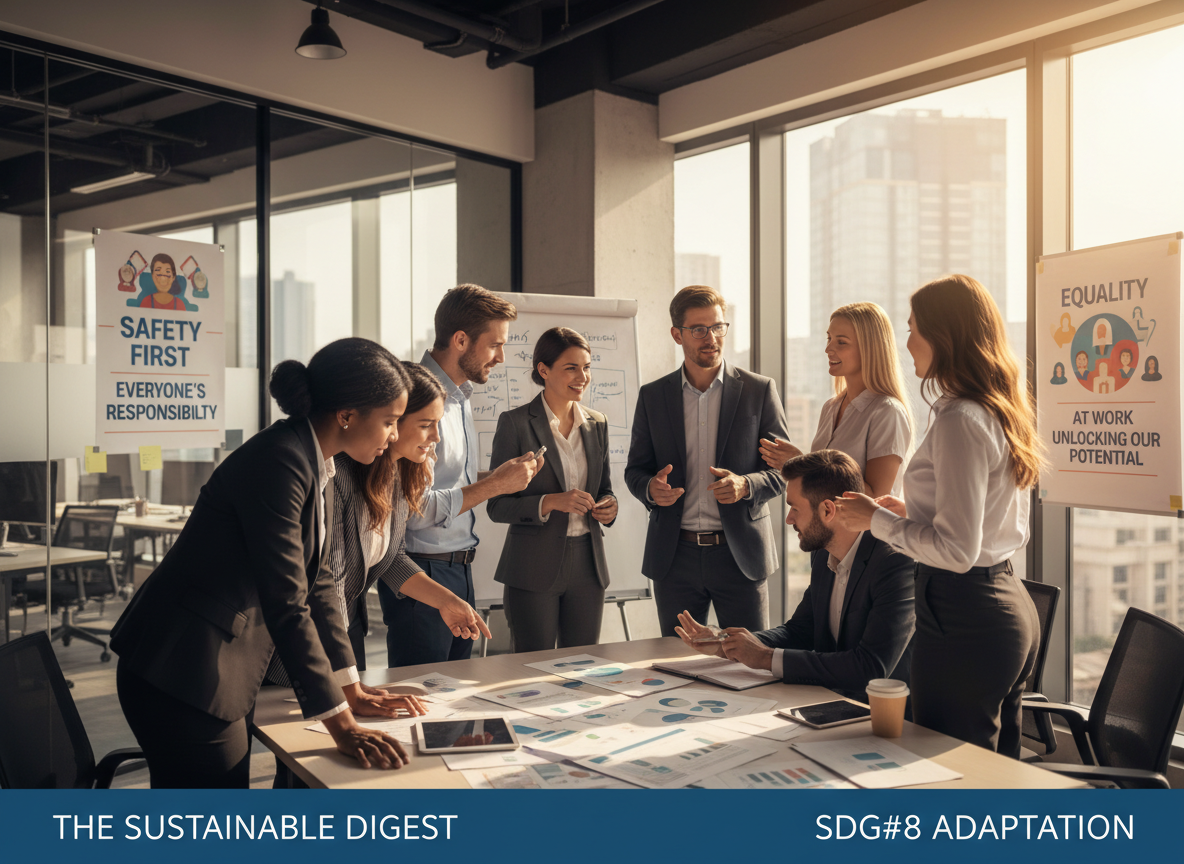
A vibrant and inspiring office scene depicting a diverse group of professionals collaborating to bridge the gender gap in decent work environments. In the foreground, two women of different ethnicities, one Asian and one Black, are engaging in a focused discussion over a laptop at a sleek conference table, both dressed in smart business attire. In the middle ground, a mixed-gender team is brainstorming ideas on a whiteboard, showcasing a harmonious workplace atmosphere. The background features large windows with natural light streaming in, highlighting a bright and open office space adorned with plants and motivational posters. The overall mood is positive and forward-thinking, emphasizing equality and collaboration. Capture this scene with a warm color palette and a slightly blurred depth of field to focus on the subjects. The Sustainable Digest.

A 14 percent pay differential might seem like a statistic, but it represents a systemic leak in the global economy’s productivity pipeline. Achieving true decent work for all is impossible while this gap persists.

Promoting Equal Pay and Career Advancement

The median gender pay gap across 102 countries sits at about 14 percent. This isn’t just unfair; it’s inefficient. Equal pay for communities and cultures doing comparable work is a fundamental correction to a flawed market.

Furthermore, women are twice as likely as men to be classified as NEETโ€”not in employment, education, or training. This represents a massive waste of talent and ambition.

DisparityImpactPolicy Focus
14% Pay GapReduced lifetime earnings & consumptionTransparent salary ranges & audits
2x NEET RateLost productivity & social exclusionTargeted re-entry programs & childcare
Underrepresentation in LeadershipNarrowed decision-making perspectiveMentorship & inclusive promotion pathways

Bridging these divides is essential for inclusive economic growth. When women advance, economies diversify and strengthen. Smart development strategy must actively dismantle the barriers holding half the workforce back.

This creates more robust and equitable decent work environments for all genders and ethnicities alike.

The Intersection of AI and Economic Development

A futuristic financial hub showcasing the intersection of artificial intelligence and economic development. In the foreground, a diverse group of professionals in business attire engages in a collaborative discussion around holographic data displays. The middle ground features a sleek, modern office filled with digital interfaces illustrating economic growth metrics, AI algorithms, and sustainability models. In the background, a vibrant city skyline represents progress and innovation, with green spaces intertwined among towering skyscrapers. The lighting is bright and optimistic, emanating from the holographic displays and large windows that let in natural light. The mood conveys a sense of collaboration, forward-thinking, and ambition, encapsulating the essence of AI-driven financial services in today's global economy. The Sustainable Digest.

The quiet revolution in banking isn’t happening on Wall Street; it’s unfolding on smartphones across the developing world. This digital shift is a foundational layer for modern progress.

Access to formal financial services is a powerful catalyst. It moves people from the economic sidelines into the active marketplace.

Digital Transformation of Financial Services

Global account ownership tells a clear story of rapid inclusion. In just seven years, access to banks or regulated institutions jumped significantly.

YearAdults with an AccountNotable Change
201462%Baseline
202176%+14 percentage points

This isn’t just about storing money. Digital tools are transforming how individuals secure loans and insurance, building personal resilience.

Innovative Strategies for Enhanced Productivity

Artificial intelligence drives the next wave. It powers sophisticated credit assessments, reaching those previously deemed ‘unbankable’.

These AI-driven innovations do more than streamline processes. They create entirely new categories of decent work in the digital economy.

Roles in fintech support, data analysis, and cybersecurity emerge. This expands opportunities for secure, productive work.

Continued investment in digital infrastructure is non-negotiable. It ensures the benefits of this technological leap are shared widely, fueling broader economic growth and more decent work opportunities.

Policy Implications for a Sustainable Future

A professional business meeting set in a modern office environment, focused on policy discussions for a sustainable future. In the foreground, a diverse group of three individuals in professional attire is engaged in animated conversation around a sleek conference table, with digital devices displaying data visualizations. The middle layer features a large window with greenery and solar panels visible outside, symbolizing environmental integration. In the background, a city skyline with sustainable architecture provides a visionary outlook. Soft, natural lighting filters through the window, creating a warm and hopeful atmosphere, while a sense of collaboration is emphasized. This image reflects the essence of "policy implications for a sustainable future." The Sustainable Digest.

Effective national reforms are the missing link between ambitious global targets and the lived reality of workers. Moving from paper promises to tangible progress requires a clear-eyed look at what actually works.

Recommendations for National Economic Reforms

Many nations have launched youth employment strategies, but proof of their success remains thin. The next step is rigorous, evidence-based implementation that creates genuine decent work opportunities for young people.

A wholesale reform of the financial system is non-negotiable. It must tackle crippling national debts and ensure equitable pay for the next generation. This fiscal overhaul is the bedrock for sustainable economic growth.

Governments should implement policies that foster innovation and support formalizing the economy. This protects the rights of all working people. Strengthening social safety nets and investing in education are also critical.

These reforms prepare people for the modern labor market. By aligning national policies with broader goals, countries build a more resilient framework. It benefits all people.

A sustainable future hinges on executing these policies effectively. The goal is inclusive development where growth lifts everyone. This is how nations translate high ideals into better lives for their people.

Conclusion

True prosperity is not a statistic; it is the experience of secure and meaningful employment. Reaching this goal demands a concerted global effort to tackle deep structural challenges.

Policies must actively protect worker rights and share the benefits of development widely. Integrating technology and formalizing informal sectors are critical steps.

These actions build a more inclusive and resilient economy. International bodies, regional alliances, and national governments must collaborate.

Their shared commitment can forge a future where work is a universal source of dignity. This is the foundation for sustained economic growth and genuine decent work for all.

Key Takeaways

  • The Sustainable Development Goals provide a shared blueprint for global progress toward a 2030 deadline.
  • Goal 8 uniquely ties broad economic advancement to the concrete reality of decent work for all.
  • Current global volatility necessitates new models for sustainable and inclusive growth.
  • Successful implementation is as critical as the policy design itself.
  • International organizations and technological innovation are key drivers changing the future of work.
  • Building economic systems that are both inclusive and resilient is a modern imperative.
This website is saving the energy of your screen as it is not being used. It's part of a global effort to lower the planet's electrical consumption and CO2 emission level. Resume browsing
Click anywhere to resume browsing
Verified by MonsterInsights