One woman’s effort to learn and understand primates within a biodiverse rich ecology could change science forever. In conjunction with efforts of Rachel Carson’s epiphany of dire environmental impacts of both the 1st and 2nd industrial revolution, post-World War development expansion, Jane Goodall’s concentration on initial observation, can be misinterpreted as overly idiosyncratic microcosmic. Furthermore, the progression of her study and growth of these relationships within the total ecosystem in this case, South Eastern to Southern Africa would span across generations.
Dr. Jane Goodall ventured into the Gombe forests of Western Tanzania in 1960 with little more than a notebook and binoculars. This research redefined the arbitrary boundary we once drew between home sapien sapiens and our primal primate cousins. Her childhood curiosity in London blossomed into a lifelong calling—one that eventually forced humanity to rethink its rather inflated sense of self.
The conservation movement owes its modern soul to her integrated vision. She recognized that biodiversity loss and human inequity are not separate tragedies but a single, tangled tapestry. By insisting that we all thrive only when nature does, she brought much-needed empathy to a field historically allergic to emotion.
Her life mission creates a direct bridge to the 17 UN Sustainable Development Goals. This framework empowers communities to protect the world and its ecosystems; it effectively translates high-level policy into local action. Today, her impact remains an actionable template for habitat preservation and evidence-based climate priorities.
Jane Goodall’s Revolutionary Approach to Conservation
In 1960, a young woman without a degree stepped into the forests of Tanzania and changed science forever. She arrived at Gombe Stream National Park with little more than a pair of binoculars and a notebook. This unconventional start allowed her to bypass rigid academic biases that often limited other scientists.
From Gombe to Global Movement
Her early work involved sitting quietly for months to gain the trust of the local chimpanzees. She watched their daily lives with a level of patience that few trained professionals possessed at the time. This slow approach eventually revealed the complex social structures of our closest relatives.
Decades later, an aerial view of the region revealed a startling truth about habitat loss. She saw that the vast national park had become a tiny island in a sea of deforestation. The sight shocked her and shifted her focus from pure observation to active conservation.
She realized that protecting animals required supporting the human communities living nearby. This moment crystallized her understanding that wildlife survival and human welfare are permanently linked. It marked the transition from a local study to a worldwide environmental crusade.
Redefining Human-Nature Relationships Through Empathy
Dr. Jane famously gave names like David Greybeard and Flo to her subjects rather than numbers. Many academics criticized this choice as being unscientific or overly emotional. However, she proved that empathy could actually enhance the quality of scientific research.
By acknowledging the emotional lives of these animals, she expanded the moral framework of ethology. Her research demonstrated that humans are not as separate from the natural world as we once dared to believe. It turned a cold discipline into one fueled by respect and connection.
Feature
Traditional Ethology
Goodall’s Methodology
Subject Naming
Assigned numbers only
Personal names (e.g., Goliath)
Data Collection
Detached observation
Empathy-driven immersion
Subject View
Biological objects
Social chimpanzees with personalities
The Discovery That Changed Conservation Forever
The most famous discovery involved chimpanzees using grass stems to fish for termites. This proved they could make and use tools, a trait previously thought to be uniquely human. It forced the scientific community to fundamentally rethink humanity’s place in the animal kingdom.
Such insights expanded ethical considerations for how we relate to all habitats. Modern conservation now relies on this interconnected view where humans and chimpanzees share a common biological heritage. This legacy ensures that science remains both rigorous and deeply compassionate.
“Now we must redefine tool, redefine Man, or accept chimpanzees as human.”
— Louis Leakey
Understanding Jane Goodall Day and Its Significance
The establishment of Jane Goodall Day marks a transition from admiring a scientist to adopting her rigorous methodology. It serves as a structured opportunity for people to align their daily choices with the health of the environment. This annual observance transcends simple commemoration by offering a pragmatic framework for modern action.
The Origin and Purpose of Jane Goodall Day
This event emerged from decades of grassroots activism and steady institutional growth. It evolved from recognizing one scientist’s achievements into a global platform for coordinated action spanning many years. During Climate Week NYC 2025, dr. jane goodall highlighted our shared responsibility to protect the Earth.
Her recent appearance with the Planetary Guardians emphasized that current stewardship shapes the world for future generations. This day functions as a vital checkpoint for evaluating our collective progress toward sustainability goals. It encourages a shift from passive observation to active, value-driven conservation advocacy.
Celebrating a Legacy of Compassionate Activism
The legacy of jane goodall challenges the false choice between scientific rigor and emotional engagement. She famously reframed hope as a “tool, not a feeling,” requiring active maintenance rather than passive optimism. This philosophical stance has a profound impact on how we view environmental civic infrastructure today.
“So if we all care, as we do, about the future of this beautiful planet and life on it, then we need to work to help our children to make the world a better place for them.”
Dr. Jane Goodall
By replicating her persistent methodology, individuals can honor jane goodall through meaningful, community-centered problem-solving. This approach ensures that her vision remains a living, breathing guide for global development. Pragmatic hope remains the primary engine for incremental progress in a changing climate.
Jane Goodall Global Impact Environmental Stewardship Habitat Preservation
Jane Goodall global impact environmental stewardship habitat preservation began when she realized that protecting chimpanzees required more than just observing them from a distance. In 1977, she founded the Jane Goodall Institute to combine rigorous scientific study with deep community engagement. This shift moved conservation away from the old model of “fortress” protection that frequently excluded or displaced local people.
Dr. Goodall understood that the survival of wildlife is inseparable from the well-being of the humans who share the land. By focusing on the human-wildlife bond, her work turned environmental protection into a shared mission rather than an outside imposition. This holistic view ensures that both nature and people can thrive in a balanced, sustainable way.
The Tapestry of Life: Interconnected Ecosystems and Communities
Scientific data reveals that roughly 80% of the planet’s remaining biodiversity exists within indigenous territories. This reality makes it a scientific necessity to engage with local communities as the primary guardians of the Earth. The goodall institute prioritizes these partnerships to ensure that indigenous knowledge leads the way in protecting vital resources.
By treating communities as equals, the Institute empowers them to manage their own ancestral lands effectively. These communities help restore natural areas that have faced degradation from climate change or over-exploitation. This collaborative strategy ensures that the tapestry of life remains intact for future generations.
The TACARE Model: Community-Centered Conservation
The Take Care (TACARE) program serves as the signature methodology for the Jane Goodall Institute. It operates on the simple but powerful logic that when people thrive, the surrounding forest and wildlife also benefit. This community-centered approach improves soil health and provides sustainable ways for families to earn a living.
Through TACARE, residents establish forest reserves that act as protective buffers for their villages. These green zones help prevent devastating landslides and manage soil erosion during heavy rains. When the local community sees the direct benefits of conservation, they become the strongest advocates for protecting the land.
Technology-Enhanced Habitat Protection and Monitoring
Modern efforts led by jane goodall now use advanced digital tools to monitor vast landscapes in real-time. Village forest monitors use smartphones and satellite data to track changes across critical habitat zones. These partners collect standardized information that allows for transparent and accountable land management.
This data is shared with government partners and the goodall institute to manage over 6 million hectares of land in Africa. High-tech monitoring ensures that remote areas receive the attention they need to stay healthy and vibrant. It bridges the gap between local field work and global habitat protection strategies.
Conservation Feature
Traditional Approach
TACARE Model
Primary Focus
Exclusionary Protection
Community Well-being
Data Collection
External Scientists
Local Village Monitors
Land Use
Restricted Access
Participatory Planning
Environmental Goal
Species Isolation
Ecosystem Restoration
Connecting Jane Goodall’s Legacy to the 17 UN Sustainable Development Goals
While some see the 17 UN Sustainable Development Goals as a checklist, Jane Goodall has spent decades treating them as a living, breathing reality. Her holistic philosophy suggests that we cannot protect nature without also supporting the humans who live alongside it. By linking ecological health with human dignity, her work bridges the gap between environmental activism and global development.
“You cannot get through a single day without having an impact on the world around you. What you do makes a change, and you have to decide what kind of change you want to make.”
— Jane Goodall
The Jane Goodall Institute (JGI) applies this wisdom by treating the planet as a single, woven tapestry. Their work proves that civic resilience is the first step toward environmental resilience. When people gain control over their resources, they naturally become the best guardians of the future.
Environmental Sustainability: Climate Action, Life Below Water, and Life on Land (SDGs 13, 14, 15)
Jane Goodall’s efforts directly tackle the most pressing ecological threats by restoring forests and sequestering carbon. These reforestation projects serve as a powerful tool for climate change mitigation. By expanding green corridors, JGI protects habitats and prevents wildlife loss on a massive scale.
The protection of watersheds ensures high water quality, which supports life below water and terrestrial ecosystems alike. Preserving these habitats is vital for the survival of chimpanzees and other endangered species. These actions demonstrate that climate stability depends on healthy, vibrant biological systems.
Social Equity and Human Development: Poverty, Hunger, Health, Education, Gender Equality, Clean Water, and Reduced Inequalities (SDGs 1, 2, 3, 4, 5, 6, 10)
The TACARE model addresses social equity by empowering communities through microcredit and health education. This method helps reduce poverty and improves soil health for better food security. By providing clean water projects, JGI ensures that basic human needs are met before asking locals to prioritize conservation.
Education programs build local capacity and create new environmental leaders.
Women’s empowerment initiatives advance gender equality and improve community wellness.
Participatory planning reduces the gap between external authorities and local humans.
Economic Growth and Sustainable Communities: Decent Work, Innovation, Sustainable Cities, and Responsible Consumption (SDGs 8, 9, 11, 12)
Goodall’s programs create work opportunities that align with nature rather than destroying it. Innovation plays a key role, as JGI uses modern mapping tools to monitor wildlife and forest health. These technology partnerships allow humans to coexist with chimpanzees more effectively.
SDG Category
Action Area
Key Impact
Economic Growth
Sustainable Livelihoods
Provides work that preserves natural resources.
Innovation
Satellite Mapping
Enhances habitat protection and monitoring accuracy.
Communities
Village Reserves
Promotes responsible consumption and local governance.
Enabling Systems: Affordable Energy, Peace and Justice, and Partnerships for the Goals (SDGs 7, 16, 17)
Sustainable development requires strong systems, such as affordable energy and peaceful governance. Reducing the pressure on forests helps communities transition to cleaner energy sources. Collaborative partnerships between JGI and global networks show how we can fight climate change together.
Goodall’s focus on education and food security builds a foundation for lasting peace. Her legacy reminds us that the 17 SDGs are mutually reinforcing systems. By protecting the world today, we ensure a stable climate for the generations to come.
Taking Action on Jane Goodall Day in the Modern Climate Context
Translating Jane Goodall’s legacy into modern practice requires a sophisticated blend of scientific literacy and grassroots action. Dr. Goodall famously emphasizes that you cannot get through a single day without having an impact on the world around you. What you do makes a difference, and you must decide what kind of difference you want to make.
In the face of climate change, her example calls for repairing ecosystems and the human capacity to believe in repair itself. This persistent engagement bridges the gap between scientific data and civic practice. We must move beyond admiration and scale the “think globally, act locally” method into a shared planetary fabric.
Individual Actions That Create Collective Impact
Moving beyond symbolic gestures involves coordinating daily consumption choices across global networks of engaged people. These individual efforts create a measurable collective impact when viewed through the lens of modern environmental science. Change occurs when we view environmental work as essential maintenance rather than a distant utopian dream.
By participating in habitat restoration, individuals contribute to building resilience for our entire planet. Reassessing how we use resources at home acts as a reset point for our personal environmental footprints. These small acts of care link together to form a robust defense against biodiversity loss.
Integrating Climate Science with Daily Environmental Choices
Modern climate change research reveals how energy use and dietary patterns directly influence habitat preservation. Scientific literacy allows individuals to understand how their home energy decisions affect distant forests and wildlife. Making informed solutions part of your routine turns abstract data into tangible environmental benefits.
Choosing sustainable resource allocation reduces carbon emissions and protects the climate for future generations. This pragmatic framework helps overcome climate fatigue by focusing on achievable, cumulative goals. Every informed change in purchasing behavior supports the broader systems that sustain life on land.
Supporting the Jane Goodall Institute’s Conservation Programs
Supporting the Jane Goodall Institute means investing in community-centered solutions that address the root causes of environmental decay. Programs like TACARE demonstrate that effective conservation requires tackling poverty and education access simultaneously. These efforts ensure that local communities maintain natural systems long after external funding ends.
Direct support for the goodall institute aids in the protection of chimpanzees and their vital forest corridors. You can amplify these solutions by advocating for policies that protect wildlife or by joining a Roots & Shoots chapter. Financial contributions provide the resources needed to safeguard chimpanzees and restore the habitat they need to thrive.
Roots & Shoots and Youth Empowerment for Environmental Change
Empowering the next generation is the fundamental engine of the global roots shoots movement. Jane Goodall founded this initiative in 1991 with only twelve students in Tanzania. Today, it operates as a massive, decentralized network across 100 countries. Young people design locally relevant solutions through this program. It represents her most scalable contribution to conservation. This effort fosters a deep, lifelong responsibility for the world.
Youth Leadership in Post-Modern Environmental Stewardship
Modern conservation requires more than traditional education; it demands active participation. Dr. Jane views youth not as passive recipients but as innovative leaders with high digital fluency. These young people utilize their creativity to drive conservation innovation across diverse communities. By providing a platform for their ideas, the program reframes youth as the primary agents of planetary health.
Local Action with Global Reach: 10,000 Groups Across 100 Countries
The roots shoots framework encourages empathy for all living things through practical, place-based tasks. Whether restoring a degraded forest or building wildlife corridors, young people learn that local actions have a global impact. This model provides the hope needed to face complex challenges in nature.
Through over 10,000 groups, youth translate their environmental concern into measurable success for their communities. They bridge the gap between scientific knowledge and civic action. The roots shoots program ensures that the legacy of jane goodall flourishes in every corner of the world.
Conclusion
The legacy of dr. jane goodall proves that hope is not a passive emotion but the work of a lifetime. Her pioneering research on chimpanzees redefined the relationship between humans and animals. By protecting forests and critical habitats, we preserve the health of our shared planet and every form of life.
Jane Goodall emphasizes that community involvement is essential for lasting solutions to habitatloss. Through years of active conservation efforts, she has shown that when nature thrives, people thrive too. Small individual actions create the change needed to secure a sustainable future for everyone.
Investing in our home means addressing climate shifts and protecting diverse areas from destruction. This integrated work ensures that every life on this world has a place to grow. We must recognize that we are not separate from the environment, but strong threads within its vital fabric.
Strategic Dimension
Actionable Pathway
Planetary Outcome
Individual Level
Conscious Daily Consumption
Climate Resilience
Community Level
Local Habitat Protection
Biodiversity Restoration
Global Level
Youth Empowerment
Sustainable Development
Key Takeaways
Her research at Gombe shifted primatology toward an integrated, empathetic science.
The philosophy links biological health directly with social equity and community well-being.
Her institute provides a replicable model for addressing climate crises through programs like TACARE.
The work supports the 17 UN Sustainable Development Goals, specifically targeting biodiversity.
Youth empowerment via Roots & Shoots translates individual admiration into collective action.
The commemorative day serves as a framework for local ecological restoration and climate science.
Women’s History Month often highlights familiar faces while overlooking the african woman. Wangarĩ Maathai emerged from colonial Kenya to challenge the heavy environmental costs of the machine age. Her pioneering activism successfully bridged the gap between local survival and international policy.
While the Western world celebrates industrial progress, her grassroots approach addressed poverty and gender inequality directly. This legendary figure became the first woman in her region to earn a doctorate before launching a massive movement. The positiveimpact of her work remains a cornerstone of humanitarianism across the Africa continent and far beyond.
She navigated the rise of globalism with a unique brand of eco-activism that empowered local communities. Today, global leaders look to her 2004 Nobel Peace Prize win as a turning point for sustainable development. It is high time we recognize how she reshaped the Global South through democratic governance and grit. Her legacy serves as a roadmap for modern sustainability and international cooperation.
The Making of a Revolutionary: Wangarĩ Maathai’s Journey Through Modernity and African Independence
To grasp the genius of wangari maathai, one must first explore the fertile soil of her early years, where tradition met the sudden gale of modernity. The machine age brought industrial expansion across the globe, yet it often ignored the delicate balance of African ecosystems.
During this era, Western development models promised progress but frequently exported ecological disruption to the Global South. Maathai navigated this shifting landscape, witnessing her nation transition from colonial rule to self-governance. Her journey reflects a unique blend of scientific rigor and deep-rooted cultural wisdom.
Birth in Colonial Kenya and the Dawn of African Independence Movements
wangari muta maathai entered the world in 1940 in Ihithe, a small village nestled in the Nyeri district of Kenya. At that time, the British colonial administration still held a firm grip on the land and its resources. However, the dawn of African independence movements began to stir across the continent during her childhood.
Growing up as a young woman in a colonial setting meant facing limited opportunities and social barriers. The transition from a colonial territory to an independent nation shaped her understanding of power and justice. This period of decolonization provided the backdrop for her later efforts to reclaim both the land and the rights of her people.
Education in the Age of Globalism and Internationalism
Her academic path started at St. Cecilia’s Intermediate Primary School and continued at Loreto High School. During these years, it was incredibly rare for female students to complete secondary education in Kenya. Her exceptional performance eventually caught the attention of international organizations seeking to foster global leadership.
In 1960, the Joseph P. Kennedy Jr. Foundation selected her for a prestigious scholarship to study in the United States. She traveled to Kansas to attend Mount St. Scholastica College, where she earned a biology degree in 1964. Shortly after, she moved to the University of Pittsburgh to complete a Master of Science degree in biological sciences by 1966.
Scholarship to America and the Machine Age Context
Maathai arrived in America during the peak of the Cold War and the civil rights movement. The United States was fully embracing the machine age, characterized by rapid industrial growth and urban expansion. This context allowed her to see how Western nations prioritized technological progress over environmental stability.
She witnessed how industrial development often came at a high cost to natural landscapes. These observations stayed with her as she analyzed how developing nations adopted similar, often destructive, models. This international perspective eventually fueled her desire to find more sustainable paths for her home country.
First East and Central African Woman to Earn a Doctorate
Upon returning to Kenya, she broke significant academic barriers at the university nairobi. In 1971, she made history as the first woman in East and Central Africa to receive a doctorate, specializing in veterinary anatomy. Her persistence in a male-dominated field proved her resilience and intellectual depth.
Her achievements did not stop with her PhD; she also became the first woman to serve as a professor in Kenya in 1976. These milestones allowed her to bridge the gap between high-level scientific research and the practical needs of local communities. She used her position to advocate for a more inclusive approach to science and education.
Women’s History Month: Recognizing Maathai Among Global Female Leaders
As we celebrate Women’s History Month, we must recognize wangari maathai as a pioneer who stood alongside the world’s most influential figures. She redefined leadership by centering the voices of rural women who were often excluded from the halls of power. Her approach showed that true progress requires listening to those who work the land every day.
Unlike other leaders who focused solely on policy, she emphasized the power of grassroots action. “The environment is very central to our lives,” she often reminded her peers. Her legacy continues to inspire millions to take responsibility for the health of their own neighborhoods.
The environment is very central to our lives. If you destroy the environment, you destroy the source of your life.
— Wangarĩ Maathai
From Academia to Activism: Understanding Environmental Degradation and Poverty
Her transition into activism began through her work with the Kenya Red Cross and the National Council of Women of Kenya. While working with these groups, wangari muta maathai noticed a troubling trend among rural families. She saw a clear link between environmental degradation and the increasing poverty in the countryside.
Rural women struggled to find clean water, firewood, and nutritious food because the forests were disappearing. She realized that she could not just teach science while the people’s primary resources were vanishing. As an activist, she decided to use her knowledge from the university nairobi to launch a movement that would heal both the land and the community.
Academic Milestone
Year
Institution
Historical Significance
Bachelor of Science
1964
Mt. St. Scholastica
Part of the “Kennedy Airlift” scholars
Master of Science
1966
University of Pittsburgh
Advanced biological research in the US
Doctorate (PhD)
1971
University of Nairobi
First woman PhD in East/Central Africa
Full Professorship
1976
University of Nairobi
First female professor in Kenyan history
The Green Belt Movement: Revolutionizing Environmental Conservation and Women’s Empowerment
In 1977, Wangarĩ Maathai transformed the act of planting a tree into a revolutionary tool for social change. Her vision proved that environmental conservation could directly empower the most vulnerable populations. By linking the health of the land to human dignity, she created a blueprint for global sustainability.
Founding the Movement: 1977 and the Birth of Grassroots Environmental Action
Maathai established the green belt movement to address Kenya’s rapid deforestation. Rural women struggled daily to find enough firewood and clean water for their families. This scarcity of resources often led to village conflicts and deeper poverty.
The belt movement offered a practical, earth-centered solution to these crises. Through the green belt, Maathai encouraged locals to plant trees to stabilize the environment. This movement soon grew from a small project into a massive national force.
Tree Planting as Political and Social Activism in Post-Modern Kenya
Planting a seedling became a bold act of resistance against state corruption. The green belt movement paid women kenya for every tree that survived past three months. This small income provided financial independence and improved access to firewood and water.
Beyond the soil, the belt movement taught leadership and nutrition to its members. The green belt initiative effectively turned ordinary citizens into active environmental conservation advocates. This movement demonstrated that ecological restoration and poverty relief go hand in hand while planting trees.
Confronting Government Opposition: Uhuru Park and Karura Forest Battles
The green belt movement faced heavy pressure from President Daniel Moi’s regime. In the late 1980s, Maathai successfully blocked a skyscraper project in Uhuru Park. Even when the government labeled the belt movement as “subversive,” she refused to back down.
Maathai later entered parliament after years of being targeted by the state. She also protected the Karura Forest through the green belt, despite physical attacks from guards. Her resilience showed that the movement could challenge powerful political interests and win.
From 30,000 Trained Women to 51 Million Trees: Quantifiable Impact
The green belt movement eventually facilitated the planting of over 51 million trees across Kenya. Over 30,000 women kenya received specialized training in conservation trades like beekeeping. These efforts secured food sources and restored local watersheds through the belt movement and the green belt.
Nobel Peace Prize 2004: Global Recognition of Environmental Humanitarianism
In 2004, Maathai made history by winning the nobel peace prize for her work. She was the first African woman to receive this specific peace prize. This nobel peace award validated her belief that a healthy environment is the foundation of democracy. Through the belt movement and the green belt, she changed the world.
“The planting of trees is the planting of ideas.”
— Wangarĩ Maathai
Achievement
Impact Metric
Key Focus
Green belt movement
51 million trees
Reforestation
Belt movement Training
30,000 Professionals
Female Empowerment
Green belt in Parliament
98% Vote Share
Policy Change
Nobel peace prize
2004 Peace Prize
Nobel peace Legacy
Wangarĩ Maathai Impact Kenya Africa Global South Eco-Activism Humanitarianism and the United Nations Sustainable Development Goals
Examining the vast reach of Maathai’s influence reveals a profound connection between grassroots activism and the united nations Sustainable Development Goals. Achim Steiner, the former Executive Director of UNEP, once famously described her as a “force of nature.” Her vision proved that local efforts could address a global change in how we manage natural resources.
Maathai understood that the health of the environment is inseparable from the stability of peace. Between 1990 and 2015, the world lost 129 million hectares of forest, an area roughly the size of South Africa. This massive degradation contributes heavily to carbon emissions, yet Maathai offered practical solutions through community-led reforestation.
Comprehensive Impact Across Africa’s 54 Nations
The Green Belt movement did not stop at the Kenyan border; it became a template for the entire continent. Maathai’s model of empowerment has since inspired environmental initiatives in over 30 countries, helping to combat rural hunger and water crises.
East African Region: Kenya, Tanzania, Uganda, Rwanda, Burundi, and Beyond
In East Africa, the model addressed regional deforestation and water scarcity directly. Collaborative work among these nations focused on protecting shared watersheds. This approach empowered communities to secure their own ecological futures through tree planting.
West African Nations: Nigeria, Ghana, Senegal, and Green Belt Adaptations
Programs in Nigeria and Senegal adapted her methods to fight desertification. These efforts focused on agricultural land degradation and climate adaptation. Women in these nations received leadership training to manage conservation-based livelihoods effectively.
Southern African Countries: South Africa, Zimbabwe, Botswana, and Conservation Movements
Maathai’s philosophy resonated in Southern Africa by linking protection of the environment to social justice. Activists in South Africa and Zimbabwe used her blueprints to advocate for land rights. They connected ecological health with post-apartheid empowerment agendas.
North African Nations: Environmental Awareness in Egypt, Morocco, and Tunisia
In North Africa, her model demonstrated how grassroots action could address severe climateissues. Organizations in Egypt and Tunisia used her strategies to challenge authoritarian governance. They focused on water security and sustainable resource management.
Transforming the Global South: Asia, Latin America, and Environmental Justice
The impact extended to Asia and Latin America, where communities faced similar environmental degradation. Her integrated approach helped these regions tackle poverty while restoring their landscapes. By centering the rights of the marginalized, she redefined the meaning of environmental justice for the Global South.
Influence on Western World Environmental Movements and Policy
Maathai challenged the narrative that environmentalism was a luxury for the Western world. She urged developed nations to look beyond top-down solutions. Her 10 trees per person philosophy became a global standard for offsetting carbon. This challenged the time-worn idea that only North American or European activists could lead the movement.
Bilateral Relationship with All 17 UN Sustainable Development Goals
Maathai’s work directly aligns with the united nations framework for a sustainable future. Her holistic vision addressed the root causes of poverty and climate change simultaneously. Below is how her legacy supports each specific goal.
“When resources are degraded, we start competing for them, whether at the local level in Kenya, where we had tribal clashes over land and water, or at the global level, where we are fighting over water, oil, and minerals. One way to promote peace is to promote sustainable management and equitable distribution of resources.”
Wangarĩ Maathai
SDG 1 No Poverty: Economic Empowerment Through Sustainable Livelihoods
She fought poverty by providing women with paid work in tree nurseries. This created sustainable income streams for rural families.
SDG 2 Zero Hunger: Food Security and Agricultural Advancement
Planting fruit trees improved food security and advanced local agriculture. Better soil fertility led to higher crop yields for small farmers.
SDG 3 Good Health and Well-Being: Clean Environment and Community Health
A cleaner environment reduced respiratory issues by providing better access to traditional firewood. Protected ecosystems ensured cleaner air for all.
SDG 4 Quality Education: Community Empowerment and Education Seminars
Maathai used education seminars to teach communities about their rights. These sessions provided vital knowledge on ecological preservation.
SDG 5 Gender Equality: Women’s Rights and Leadership Development
Her focus on women’s leadership directly advanced gender equality. She placed women at the center of ecological decision-making.
SDG 6 Clean Water and Sanitation: Watershed Protection and Water Sources
Reforestation protected vital watersheds, ensuring a steady supply of fresh water. This work prevented the drying up of local streams.
SDG 7 Affordable and Clean Energy: Firewood Solutions and Energy Access
She promoted sustainable firewood solutions to meet energy needs. This reduced the time spent by women searching for fuel.
SDG 8 Decent Work and Economic Growth: Green Jobs and Income Generation
The movement created green jobs for over 30,000 trained women. This fostered economic growth in marginalized rural areas.
SDG 10 Reduced Inequalities: Addressing Rural Poverty and Marginalization
By empowering the rural poor, she helped bridge the gap between urban and rural life. This addressed systemic poverty and social exclusion.
SDG 11 Sustainable Cities and Communities: Urban Green Spaces Protection
Her battles for Uhuru Park protected urban green spaces from development. This ensured cities remained livable for future generations.
SDG 12 Responsible Consumption and Production: Reduce, Reuse, Repair Philosophy
She championed a philosophy of reducing and reusing resources. This change in consumption patterns helped preserve natural wealth.
SDG 13 Climate Action: Reforestation and Carbon Sequestration
Planting 51 million trees directly addressed climate change through carbon sequestration. This remains a cornerstone of global climate action.
SDG 15 Life on Land: Biodiversity, Forests, and Desertification Combat
Her work restored forests and fought the degradation of land. This protected biodiversity across various African ecosystems.
SDG 16 Peace, Justice and Strong Institutions: Democracy and Political Accountability
She linked the environment to democratic rights. Her demands for accountability helped build stronger, more transparent institutions.
SDG 17 Partnerships for the Goals: International Collaboration and UN Engagement
Maathai led the Billion Tree Campaign, fostering global partnerships. This effort eventually grew into the Trillion Tree Campaign.
Indirect Connections: SDG 9 Industry, Innovation and Infrastructure
Her innovative grassroots organizing changed how conservation infrastructure is built. She proved that human capital is the best innovation.
Indirect Connections: SDG 14 Life Below Water Through Ecosystem Protection
Protecting upstream watersheds improved the health of downstream marine life. Healthy forests prevent siltation from reaching the oceans.
Impact Category
Primary Strategy
Key Global Result
Climate Change
Massive Reforestation
51 Million Trees Sequestering Carbon
Social Justice
Women’s Leadership
Empowerment of 30,000+ Rural Women
Global Policy
UN Collaboration
Billion Tree Campaign Evolution
Conflict Resolution
Resource Management
Reduction in Local Land and Water Clashes
The Living Legacy: Understudies, Successors, and Disciples Carrying the Torch Forward
While many historical figures leave behind only cold monuments, Maathai left a vibrant, self-sustaining ecosystem of dedicated leaders. Her departure in 2011 was not an end, but a transition to a distributed leadership model. This strategy ensures her mission thrives long after her lifetime.
The movement she started continues to grow through specific individuals and institutional structures. These successors apply her integrated approach to solve modern challenges like climate change and social inequality.
Wanjira Mathai: Continuing Her Mother’s Environmental Mission
Wanjira Mathai serves as the primary steward of her mother’s vision. As a member of the Goldman Prize Jury and a director at the World Resources Institute, she bridges grassroots efforts with global policy. She ensures the movement’s methodology remains central to modern climate discourse.
This family succession provides a unique continuity. Wanjira blends traditional wisdom with contemporary strategic insights to reach international audiences effectively. Her steadfast commitment keeps the original spark of the Green Belt Movement alive in the halls of global power.
Green Belt Movement Leadership and Trained Environmental Champions
The institutional weight of the Green Belt Movement remains a cornerstone of environmental work today. Having expanded to over 30 nations, the movement utilizes community seminars to foster democratic governance. Over 30,000 women have received training in conservation trades across Kenya.
These graduates act as environmental champions within their own communities. They adapt the model to local contexts, creating a multiplier effect. By teaching others about leadership and civic engagement, they prove that environmentalism is inseparable from social justice.
Entity
Scale of Influence
Primary Focus
Wanjira Mathai
Global Leadership
Policy and Resource Strategy
Green Belt Movement
30+ Nations
Community Empowerment
Trained Champions
30,000+ Individuals
Grassroots Conservation
Global Disciples: From Billion Tree Campaign to Trillion Tree Campaign
Maathai’s “Billion Tree Campaign” has evolved into the more ambitious “Trillion Tree Campaign.” This shift reflects a scaling of her original vision from local groves to a planetary necessity. International organizations now treat large-scale reforestation as a primary tool for climate mitigation. Any modern activist following this path owes a debt to her pioneering activists who first proved that small actions could lead to global shifts.
Contemporary African Women Environmental Activists Inspired by Maathai
Today, a new wave of defenders draws inspiration from Maathai’s courage. These individuals address water scarcity and deforestation in almost every country on the continent. They often face government opposition while advocating for human rights and sustainable development. Their resilience mirrors Maathai’s own battles for Uhuru Park and Karura Forest.
“Wangari Maathai’s death left a gaping hole among the ranks of women leaders.”
— Hillary Clinton
The Wangari Maathai Institute for Peace and Environmental Studies now institutionalizes her approach. It combines research with policy advocacy to resolve conflicts through sustainable resource management. This academic foundation ensures that her “distributed leadership” model will continue to train future generations of disciples.
Conclusion: Rising Up and Walking Forward in Maathai’s Footsteps
Though she passed away over a decade ago, Maathai’s call to “rise up and walk” resonates louder than ever. During her life, she proved that a single woman could transform a country by linking green spaces to human rights. In the years since 2011, her vision has become a global directive for those facing rapid change.
Wangarĩ Maathai insisted that humanity must reach a higher moral ground to survive. This shift in consciousness is a necessity for every community member today. Her peace-building efforts showed that environmental justice is the only way to ensure lasting stability for the Global South and beyond.
She spent her final years fighting for environmental conservation despite facing arrests and threats. She left us simple steps: plant ten trees, volunteer, and practice the philosophy of reduce, reuse, and repair. This commitment to life remains her greatest gift, proving that any member of society can protect our future.
We must continue to cherish the peace and life she worked so hard to build. Her legacy is not just a historical chapter; it is an active movement that requires our participation. By following her lead, we can challenge powerful institutions and restore our shared home.
Core Legacy Pillar
Individual Action
Global Outcome
Environmental Stewardship
Plant 10 trees to offset carbon
Climate change mitigation
Democratic Activism
Volunteer time to community
Stronger civic institutions
Sustainable Living
Reduce, reuse, and repair
Resource conservation
Key Takeaways
Wangarĩ Maathai founded the Green Belt Movement in 1977 to combat deforestation.
Became the first woman in Central and East Africa to earn a PhD.
Mobilized communities to plant over 51 million trees across the region.
Received the Nobel Peace Prize in 2004 for her contribution to sustainable development.
Linked environmental conservation directly with women’s rights and democracy.
Influenced global policy by proving that grassroots action drives international change.
Global progress often mirrors the rhythm of our collective memory. By examining various sustainability events, we bridge the gap between historical awareness plus modern ecological goals.
Events like World Wetlands Day highlight the fragile beauty of our water systems. Simultaneously, World Pulses Day emphasizes how simple crops can transform our food security models; these efforts define our shared journey.
Cultural festivals also play a vital role. We honor the Philippine-American War Memorial plus the Day of Remembrance and Respect to Victim of the Communist Regime; such dates ground our search for a stable society.
Observing Mozambican Heroes Day reminds us that social equity is a core part of long-term survival. These diverse national days ensure our path toward a greener world remains inclusive plus deeply rooted.
Understanding Sustainability Through Global Celebrations in February 2026
February 2026 is filled with global celebrations that highlight the link between sustainability and fairness. These events show the importance of working together and adopting green practices.
The World Day of Social Justice on February 20 is a key event. It focuses on solving problems like poverty and joblessness. These issues are key to a sustainable future. By fighting for fairness, we help make the world more equal and support green growth.
The International Day of Human Fraternity on February 4 is also important. It encourages people from different faiths to talk and understand each other. This unity is vital for solving big problems like climate change.
February also celebrates indigenous cultures. For example, Waitangi Day on February 6 in New Zealand honors the Treaty of Waitangi. It shows the value of respecting indigenous rights and their role in caring for the land. Sami National Day on February 6 also celebrates the Sami people’s traditions in Scandinavia and Russia.
Lui-Ngai-Ni is another important event. It’s celebrated by the Naga people in India. It’s a time for the community to gather, showing the importance of unity and sustainable farming.
These celebrations in February 2026 remind us of the many ways to support sustainability. By learning about and celebrating these events, we can build a more inclusive and green world.
Environmental and Ecological Observances Promoting Planetary Health
February 2026 is filled with important environmental and ecological observances. These events remind us of the need for conservation and sustainability. They help keep our ecosystem in balance.
World Wetlands Day and Aquatic Ecosystem Protection
World Wetlands Day is on February 2. It shows how vital wetlands are for our planet. They help keep water clean, prevent floods, and home many species. This year’s theme calls for quick action to save these important places.
Key actions to protect wetlands include:
Restoring damaged wetlands
Using land in a sustainable way
Spreading the word about wetlands’ value
Wildlife Conservation Days: Arabian Leopards, Bonobos, and Pangolins
February is also home to several wildlife conservation days. These include the International Day of the Arabian Leopard, World Bonobo Day, and World Pangolin Day. They aim to raise awareness about these endangered animals and the need for conservation.
“The conservation of species like the Arabian leopard, bonobo, and pangolin requires not only national but international cooperation and commitment.”
Humpback Whale Awareness Month and Marine Sustainability
February is Humpback Whale Awareness Month. It’s a time to focus on keeping our oceans healthy. Humpback whales are key to the health of our seas, and saving them is essential.
Efforts to protect humpback whales include:
Lowering ship strikes with better rules
Stopping them from getting caught in fishing nets
Keeping their homes clean from pollution
National Bird Feeding Month and Backyard Biodiversity
National Bird Feeding Month in February encourages us to help birds in our backyards. Feeding birds can greatly help local ecosystems and support bird populations.
To make a big difference, you can:
Use different bird feeders to attract more species
Plant native plants that birds can eat
Keep feeding areas clean and safe
Agricultural Sustainability and Food Systems Innovation
February 2026 is a time to focus on solving climate change and ensuring everyone has enough food. Several important days in February highlight the need for sustainable farming and new food systems.
World Pulses Day and Sustainable Protein Sources
World Pulses Day is on February 10, 2026. It’s a big deal for finding better protein sources. Pulses, like beans and lentils, are full of protein and help keep soil healthy.
They’re also good for you, packed with fiber and vitamins. Plus, they’re better for the planet than meat, needing less water and land.
Canada’s Agriculture Day and Farmer’s Day
Canada’s Agriculture Day is on February 15, 2026. It celebrates the farmers who feed the country. It shows off their hard work and innovative farming.
This day also honors Farmer’s Day. It’s a chance to thank farmers for their hard work and support sustainable farming.
Observance
Date
Significance
World Pulses Day
February 10, 2026
Promotes sustainable protein sources and pulse production
Canada’s Agriculture Day
February 15, 2026
Recognizes the contributions of Canadian agriculture and farmers
National Hemp Day
February 4, 2026
Highlights the potential of hemp in industrial agriculture
Alternative Crops and Heritage Foods
National Hemp Day and Industrial Agriculture
National Hemp Day is on February 4, 2026. It celebrates hemp’s many uses and its role in sustainable farming. Hemp is great for making clothes and food, needing less water and pesticides.
Medjool Date Day and Desert Agriculture
Medjool Date Day is on February 18, 2026. It focuses on date palms, which grow well in deserts. They provide food and jobs for desert communities.
Vegan Cuisine Month and Plant-Based Food Systems
Vegan Cuisine Month in February 2026 encourages trying plant-based foods. It’s good for the planet and can make us healthier. It shows how diverse and nutritious plant-based foods can be.
Plant-based diets are good for the environment and our health. They can prevent diseases and make us feel better.
Cultural Heritage Preservation as Sustainable Development
Preserving cultural heritage is more than just looking back. It’s a smart move for a better future. It helps communities stay strong, protects the environment, and encourages new ways to live sustainably.
Indigenous Peoples’ Celebrations and Traditional Knowledge
Indigenous peoples’ celebrations show us how to live in harmony with nature. These events keep cultural traditions alive. They also teach us about living in a way that’s good for the planet.
Waitangi Day: Maori Culture and Environmental Stewardship
Waitangi Day is on February 6th. It marks the Treaty of Waitangi signing in 1840. It’s a time to think about New Zealand’s history, its culture, and the bond between the Maori and nature.
Sami National Day: Arctic Indigenous Rights
Sami National Day is on February 6th. It honors the Sami people’s culture and rights in the Arctic. It’s a day to remember the importance of saving indigenous cultures and knowledge as the climate changes.
Lui-Ngai-Ni: Naga Cultural Festival
Lui-Ngai-Ni is a big festival for the Naga people in Northeast India. It celebrates their rich culture with dances, music, and feasts. It’s a chance for the Naga to share and preserve their traditions.
African Heritage and Health Week
African Heritage and Health Week focuses on health in African communities. It shows how cultural heritage shapes health practices. It encourages a holistic approach to health that includes traditional knowledge.
Carnival Traditions Across Continents
Carnival is celebrated with excitement worldwide. Each place has its own twist and history. These celebrations bring people together and boost local economies.
Brazil Carnival and South American Celebrations
Brazil Carnival is famous for its colorful parades and street parties. Argentina, Uruguay, Venezuela, and Ecuador also have big carnivals. Each one shows off its unique culture.
European Carnival Observances: Fastelavn, Maslenitsa Week, Battle of the Oranges Ivrea
Europe has its own carnival traditions. Fastelavn is in Denmark and Norway, Maslenitsa Week in Eastern Europe, and the Battle of the Oranges in Italy. These events are full of cultural heritage and history.
Heritage Recognition Months and Weeks
There are months and weeks to honor cultural heritage. These times let communities reflect on their history and culture. They remind us of the importance of preserving heritage for the future.
African American Heritage Month and African American Read-In
African American Heritage Month/2026 Black History Month is in February in the U.S. It celebrates African American contributions and experiences. The African American Read-In promotes literacy and honors African American literature and culture.
Heritage Observance
Date
Significance
African American Heritage Month/2026 Black History Month
February
Celebrates African American contributions and experiences
From Africa to Virginia Month
February
Commemorates the arrival of Africans in Virginia
Nova Scotia Heritage Day
Third Monday in February
Celebrates Nova Scotia’s cultural heritage
National Secondhand Wardrobe Week
February
Promotes sustainable fashion practices
Social Justice and Human Rights: Foundations of Sustainable Communities
Sustainability is closely tied to social justice and human rights. This is shown by key days in February 2026. This month highlights the importance of sustainability, which goes beyond just protecting the environment. It also means creating fair societies.
International Human Rights Observances
February 2026 is filled with important days that show the role of human rights in building sustainable communities. These include:
World Day of Social Justice
The World Day of Social Justice is on February 20. It focuses on solving issues like poverty and unemployment. Social justice is key to sustainable development because it ensures everyone has a fair share.
International Day of Human Fraternity
This day, on February 4, celebrates unity and solidarity. It reminds us that human fraternity is essential for sustainable communities.
World Interfaith Harmony Week
World Interfaith Harmony Week is in the first week of February. It encourages dialogue among faiths, promoting peace. This is vital for creating harmonious, sustainable societies.
Ending Violence and Discrimination
February also has days focused on stopping violence and discrimination. These are crucial for making communities inclusive and sustainable.
International Day of Zero Tolerance to Female Genital Mutilation
On February 6, this day raises awareness about female genital mutilation. It fights for its end, pushing for gender equality and human rights.
Abolition of Slavery Day and Torture Abolition Day
February 23 and 26 are days against slavery and torture, respectively. They highlight the need to protect human dignity and stop human rights abuses.
“The struggle for human rights is a long and winding road, but it is one that we must continue to tread with courage and conviction.”
Historical Justice and Remembrance
February is also a time to remember and learn from history. It has observances focused on historical justice and remembrance.
Day of Remembrance and Respect to Victims of the Communist Regime
On February 25, some countries remember victims of communist regimes. It’s a day to reflect on the past and stand by democratic values and human rights.
Observance
Date
Significance
Day of Remembrance and Respect to Victims of the Communist Regime
February 25
Honors victims of communist regimes
Commemoration of the Batepa Massacre
February 27 (São Tomé and Principe)
Remembers the victims of the Batepa Massacre
National Apology Day
Varies by country
A day for nations to acknowledge past wrongdoings
Equity and Inclusion Initiatives
February also supports equity and inclusion through various initiatives and observances.
Ethnic Equality Month and North American Inclusion Month
These observances highlight the need for ethnic equality and inclusion. They remind us to address disparities and ensure equal opportunities for all.
Ethnic Equality Month promotes understanding and respect among ethnic groups.
North American Inclusion Month encourages inclusivity across the continent.
In conclusion, February 2026 is a significant month for social justice and human rights. It has many observances that show their importance in building sustainable communities. By recognizing and participating in these days, we can work towards a more just and equitable world.
National Liberation and Independence Days: Sovereignty for Sustainable Futures
February 2026 brings a chance to look at how sovereignty and sustainable futures are linked. These days celebrate big moments in history. They also show our ongoing fight for freedom and growth.
African Liberation and Independence Movements
Africa has many stories of freedom and independence. In February 2026, several African countries will celebrate.
Angola Liberation Day
Angola Liberation Day remembers the start of the fight for freedom in 1961. It’s a key part of Angola’s history.
Mozambican Heroes Day
Mozambican Heroes Day honors those who fought for Mozambique’s freedom. It’s a time to think about their sacrifices and the progress made.
Gambia Independence Day
The Gambia celebrates its freedom from British rule. This marks a big step towards self-rule and freedom.
Guyana Republic Day
Although in South America, Guyana is tied to the African diaspora. Its Republic Day is a key moment in its political journey.
Caribbean and Pacific Independence Celebrations
The Caribbean and Pacific also celebrate independence. These celebrations show the global fight for freedom.
Grenada Independence Day
Grenada’s independence day celebrates its freedom from colonial rule. It’s a significant moment in Grenada’s history.
Saint Lucia Independence Day
Saint Lucia’s independence day looks back on its journey to self-determination. It’s a day to reflect on progress and challenges.
Father Lini Day (Vanuatu)
Father Lini Day in Vanuatu honors a key figure in Vanuatu’s fight for freedom. It shows the role of leaders in achieving freedom.
Asian Sovereignty and Liberation Observances
Asia has many stories of freedom and independence. Each has its own history and significance.
Kashmir Day
Kashmir Day shows support for the Kashmiri people’s fight for rights. It’s a day to stand with those seeking freedom.
Liberation Day Afghanistan
Afghanistan’s Liberation Day remembers important moments in its history. It reflects on its journey to stability and freedom.
National Day Brunei
Brunei’s National Day celebrates its independence and sovereignty. It highlights Brunei’s unique culture and politics.
Mizoram State Day
Mizoram State Day in India is a celebration of regional identity. It shows the complexities of sovereignty within a larger nation.
Middle Eastern and North African Independence Days
The Middle East and North Africa have their own independence days. These days reflect the region’s complex history and politics.
February 17th Revolution (Libyan Revolution Day)
The February 17th Revolution in Libya is a key moment in its recent history. It marks a significant event in Libya’s fight for freedom.
European Statehood Restoration
Europe also celebrates statehood restoration days. These days highlight the continent’s complex history and the importance of freedom.
Estonia Independence Day
Estonia’s Independence Day celebrates its declaration of freedom. It’s a crucial moment in Estonia’s history.
Day of Restoration of the State of Lithuania
Lithuania’s Day of Restoration remembers when Lithuania became an independent state again. It reflects on its journey to freedom.
Liberation Day San Marino
San Marino’s Liberation Day is a unique celebration. It highlights the country’s historical importance and enduring freedom.
2026 February Holidays and Observances for Sustainability in Retrospect
Looking back at February 2026, we see a month filled with holidays and observances. These events celebrate cultural heritage and national identity. They also promote unity, solidarity, and environmental awareness.
Unity and Solidarity Celebrations
February 2026 is filled with unity and solidarity celebrations worldwide. Unity Day Burundi reminds us of the country’s journey to peace. It shows the nation’s commitment to unity among its people.
Union Day is celebrated in many places, marking the unity of states or territories. It shows the power of unity and cooperation among different groups.
Federal Territory Day (Malaysia) is also in February. It highlights Malaysia’s federal territories and promotes national unity.
Regional and Provincial Observances
February 2026 also has regional and provincial observances. These events show the diversity and richness of local cultures. For example, Northland Anniversary Day (New Zealand) and the Royal Hobart Regatta (Tasmania) celebrate regional heritage and community engagement.
The Royal Hobart Regatta is one of Australia’s oldest events. It attracts visitors worldwide. It celebrates Tasmanian culture and promotes maritime heritage.
Other regional observances include Islander Day (Prince Edward Island), Louis Riel Day (Manitoba), and Andalusia Day (Spain). Each highlights the unique history and cultural identity of its region.
National Identity and Patriotic Days
February 2026 also has national identity and patriotic days. National Flag of Canada Day celebrates Canadian identity and unity.
National Foundation Day (Japan) and Georgia Day reflect on the history and cultural heritage of their countries.
In the United States, days like Texas Day, Statehood Day in Arizona, National Iowa Day, and National California Day promote state pride. They acknowledge the unique contributions of each state to the nation’s history and identity.
February 2026 also has thematic awareness weeks for sustainability. National Green Week encourages environmentally friendly practices.
National FFA Week (Future Farmers of America) promotes agricultural education and sustainability. It highlights the importance of agriculture in achieving a sustainable future.
Philippine Industry and Made-in-the-Philippines Products Week celebrates the country’s industrial achievements. It promotes local products, supporting economic sustainability and development.
These observances help us understand sustainability better. They show the importance of unity, cultural heritage, and environmental awareness for a sustainable future.
Religious and Spiritual Observances Supporting Environmental Stewardship
In February 2026, many faiths highlight the link between spiritual practices and caring for the planet. These events show the diversity of traditions worldwide. They also show a shared goal to protect our environment.
Lunar New Year Celebrations and Renewal
The Lunar New Year is celebrated in many cultures. It’s a time for renewal and reflection. Families and communities come together to honor their heritage and look forward to the new year.
Korean New Year (Seollal)
Korean New Year, or Seollal, is a big holiday in Korea. It’s celebrated over three days with ancestral rituals and traditional foods. The festive atmosphere includes traditional games and folk performances.
Chinese New Year and Chinese Spring Festival
Chinese New Year, also known as the Spring Festival, is very important. It’s a time for family reunions and traditional foods. The celebration includes lion dances, fireworks, and giving red envelopes with money to children.
Chinese New Year is more than just festivities. It symbolizes renewal and hope for a prosperous year. It emphasizes family, community, and traditional practices.
Tet Holiday (Vietnam)
Tet, or the Lunar New Year, is Vietnam’s most important holiday. It’s a time for families to come together and celebrate the arrival of spring. Traditional foods, decorations, and festivities are key to the celebration.
Losar (Tibetan New Year) and Sonam Losar
Losar is the Tibetan New Year, starting the new year on the Tibetan calendar. It’s celebrated with traditional dances and feasting. Sonam Losar honors the farming community and the harvest season.
Tsagaan Sar (Mongolian New Year)
Tsagaan Sar is the traditional Mongolian New Year. It’s a time for families to gather and exchange gifts. The celebration is rich in cultural heritage and symbolic rituals.
Christian Observances and Seasonal Transitions
Christian observances in February 2026 include important events in the Christian calendar. These events symbolize spiritual renewal and the transition between seasons.
Candlemas Day and Imbolc
Candlemas Day, on February 2, marks the presentation of Jesus at the Temple. It’s also associated with the purification of the Virgin Mary. Imbolc, a Gaelic festival, is observed around the same time, signaling the midpoint between the winter solstice and the spring equinox.
Shrove Monday, Fat Thursday, and Mardi Gras
These celebrations precede the Christian season of Lent, a period of fasting and reflection. Shrove Monday and Fat Thursday are days of feasting before Lent. Mardi Gras, or Fat Tuesday, is a carnival celebration known for its vibrant parades and festivities.
Ash Wednesday and Beginning of Lent
Ash Wednesday marks the beginning of Lent, a 40-day period of fasting, reflection, and spiritual renewal. It’s a significant moment in the Christian calendar, encouraging believers to reflect on their faith and actions.
Observance
Date
Significance
Candlemas Day
February 2
Presentation of Jesus at the Temple
Ash Wednesday
Variable
Beginning of Lent
Mardi Gras
Variable
Carnival celebration before Lent
Islamic Observances
Islamic observances in February 2026 include significant events crucial to the Islamic calendar. These events emphasize spiritual growth, community, and reflection.
Ramadan Begins
Ramadan is the Islamic holy month of fasting. It’s a period of spiritual reflection and community. Muslims fast from dawn to sunset, abstaining from food and drink, to develop self-control and empathy for those in need.
Islamic Revolution Day (Iran)
Islamic Revolution Day commemorates the 1979 revolution in Iran. It’s a significant event in the country’s history. It’s observed with various events and reflections on the revolution’s impact.
Hindu and Buddhist Celebrations
Hindu and Buddhist celebrations in February 2026 include significant observances. These highlight the diversity and richness of these spiritual traditions.
Basant Panchami
Basant Panchami is a Hindu festival celebrating the arrival of spring. It’s dedicated to the goddess Saraswati, associated with knowledge, music, and arts. The festival is marked by wearing yellow attire, flying kites, and cultural performances.
Maghi Purnima
Maghi Purnima is a Buddhist observance on the full moon day of the month of Magha. It’s a day for spiritual practice, charity, and communal gatherings.
These religious and spiritual observances in February 2026 reflect the diversity of global cultures. They underscore a shared commitment to environmental stewardship and sustainability. By embracing their spiritual practices, individuals and communities can foster a deeper connection with the natural world.
Historical Commemorations and Modern Peace-Building
In February 2026, we see a mix of remembering the past and working towards a better future. This mix is key to understanding how to achieve global peace and sustainability.
War Remembrances and Lessons for Sustainable Peace
War remembrances remind us of the harm caused by conflict. They teach us the value of diplomacy and working together internationally.
Philippine-American War Memorial
The Philippine-American War Memorial is important. It shows the complex history between the Philippines and the United States. It reminds us of the war’s effects and the need to understand their shared past.
Anniversary of the Liberation of the Battle of Manila
The Anniversary of the Liberation of the Battle of Manila is key. It honors the sacrifices of World War II. It also shows the importance of keeping history alive to avoid future wars.
Remember the Maine Day
Remember the Maine Day remembers the USS Maine’s sinking, starting the Spanish-American War. It teaches us about the dangers of conflict and the need for diplomacy.
Treaties and Diplomatic Milestones
Treaties and diplomatic milestones are vital for international relations. They help countries work together and solve conflicts peacefully.
Treaty of Guadalupe Hidalgo
The Treaty of Guadalupe Hidalgo ended the Mexican-American War in 1848. It changed North America’s geography and politics. It shows how agreements can change history.
Revolutionary Movements and Social Change
Revolutionary movements have shaped our world. They fight for justice and rights. They show how social change and stability are connected.
EDSA People Power Commemoration Week
The EDSA People Power Commemoration Week celebrates the peaceful revolution in the Philippines in 1986. It marked a big step towards democracy.
The Day of Illustrious Puerto Ricans
The Day of Illustrious Puerto Ricans honors notable figures in Puerto Rico’s history. It celebrates their impact on the island’s culture and identity.
Peace and Understanding Initiation
Efforts to promote peace and understanding are vital. They help nations and communities work together and respect each other.
World Peace and Understanding Day (Rotary)
World Peace and Understanding Day, celebrated by Rotary International, stresses the need for peace and understanding. It aims for a more sustainable and fair world.
Global Tourism Resilience Day
Global Tourism Resilience Day focuses on sustainable tourism. It supports local communities and promotes cultural exchange. It helps build global understanding and peace.
Community Resilience and Sustainable Lifestyle Observances
February 2026 is packed with observances that boost community strength and green living. These events cover many areas, from green travel to personal health. They show how we can work together for a better future.
Transportation and Mobility Sustainability
February 2026 is all about green travel. Bike To Work Month encourages cycling to cut down on fossil fuel use and emissions.
Hula in the Coola Day and Qatar Sports Day push for more exercise. They help make our communities healthier and more active.
Event
Date
Focus Area
Bike To Work Month
Throughout February
Sustainable Transportation
Hula in the Coola Day
February 8
Active Living
Qatar Sports Day
February 12
Sports and Active Living
Seasonal and Environmental Awareness Days
February is also a time to focus on nature and the environment. Groundhog Day, Hedgehog Day, and Marmot Day are fun but also teach us about wildlife and nature.
Travel Africa Day supports eco-friendly travel. It helps local economies and protects nature.
Groundhog Day, Hedgehog Day, and Marmot Day
These days, on February 2, remind us of the value of certain animals in nature. They also highlight the need to protect them.
Innovation and Advancement for Sustainability
Innovation is crucial for a greener world. February 2026 celebrates new ideas in many fields. National Inventors’ Day on February 11 honors inventors who help us progress.
Be Electrific Day on February 8 and American Association for the Advancement of Science Week push for science to make our world better.
Creative and Cultural Sustainability
Cultural sustainability is a big focus in February 2026. National Arts Month shows how art enriches our lives. American Painters Day and National Haiku Writing Month celebrate specific art forms.
Preseren Day in Slovenia celebrates its cultural heritage. It reminds us of the importance of keeping our cultural roots alive.
Personal and Community Wellness
Days like National Get Up Day and Self Renewal Day boost personal health. Relationship Wellness Month helps us build strong bonds with others.
Optimist Day and Spiritual Teachers Month spread joy and spiritual growth. They help our communities thrive.
Solidarity and Service Organizations
Days like USO Day and Scout Sabbath honor groups that help our communities. They show the power of working together.
Symbolic Days and Awareness Initiatives
February 2026 also has special days to raise awareness. Day of Ashakalia, Reclaim Social Day, and Disaster Day focus on important issues. They unite us in solidarity.
Conclusion: Building Sustainable Futures Through Collective Remembrance and Action
February 2026 brings many holidays and observances. These events are more than just cultural celebrations. They are key to taking action for sustainability.
These celebrations highlight the connection between humans and the planet. They show how our actions affect the environment and society.
By joining in these events, we learn the value of living sustainably. World Wetlands Day and the Lunar New Year remind us of our duty to protect the planet. They also encourage fair development for all.
Let’s use these celebrations to inspire real change. We can live greener lives and support policies that care for the environment and people. Together, we can build a better future.
Creating a sustainable world is a team effort. It needs everyone’s help, from individuals to governments. By learning from our past, we can make a brighter future for all.
Key Takeaways
Linking historical remembrance with future environmental goals.
Protecting critical water ecosystems via wetland preservation.
Improving global nutrition through pulse crop awareness.
Recognizing social equity as a pillar of green development.
Promoting international unity via diverse cultural celebrations.
Honoring specific memorial dates to build societal resilience.
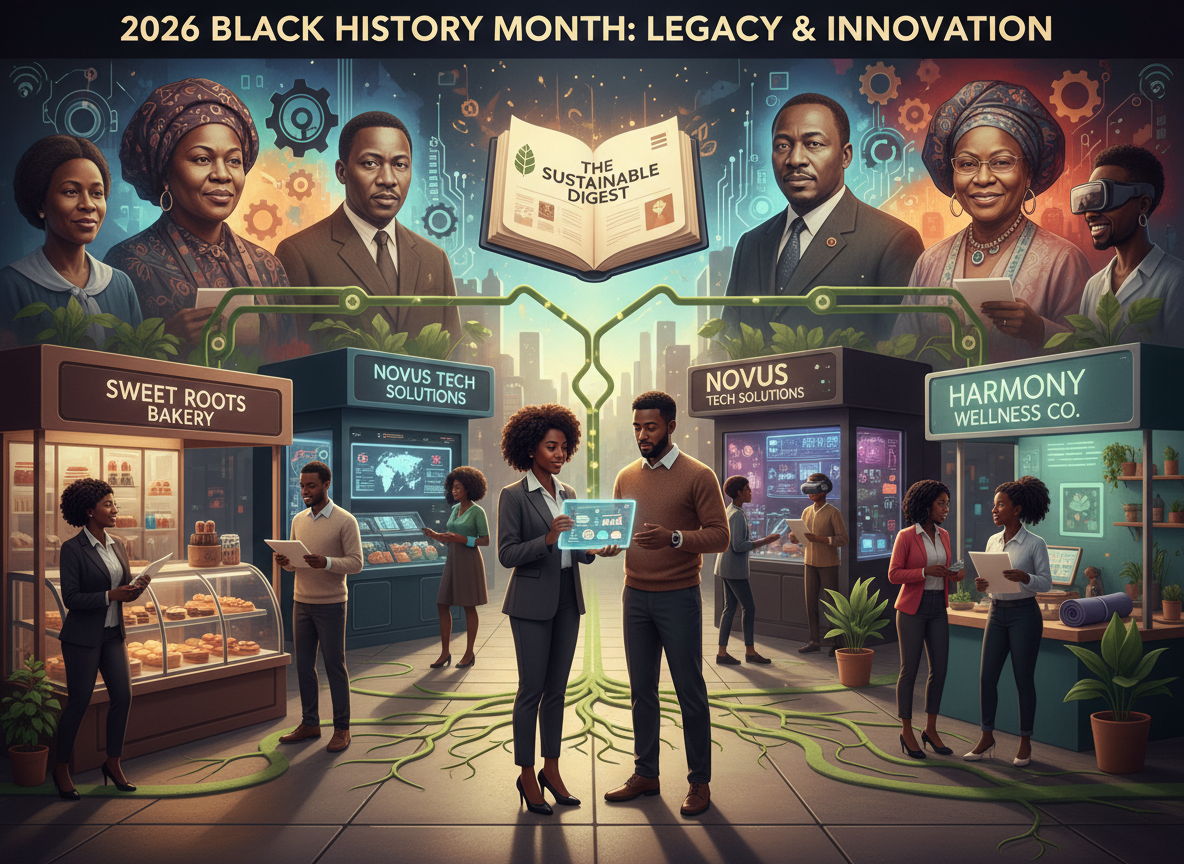
The 2026 Black History Month reveals a clear truth regarding our shared environmental future. Modern sustainability is not a new trend but a reclaimed legacy rooted in ancestral wisdom. This era marks a shift where mission-driven work aligns with long-standing traditions of community care.
In Illinois, the impact of this movement is clear, with over 180,000 firms currently operating today. These entities represent 13% of all state businesses and employ 54,000 people. This innovation reflects a deep commitment to both people and the planet (and perhaps a bit of savvy).
The world now recognizes that ecological health requires economic justice. By exploring Enterprise Development through a historical lens, we see how early systems inform today’s leaders. This analysis examines how these traditions continue to shape a more resilient society while building generational wealth.
The Historical Arc of Black Sustainability Leadership: Pre-Colonial to Contemporary Times
To appreciate modern green initiatives, one must trace the resilient thread of sustainability through the vast timeline of the African diaspora. This journey reveals that black history is deeply intertwined with ecological stewardship and communal care. From ancient agricultural methods to urban business cooperatives, the commitment to the environment remains a constant feature of the Black experience.
Pre-Colonial African Environmental Wisdom and Resource Management
Long before modern technology, African societies mastered intricate environmental management systems. They utilized communal land stewardship and complex crop rotation to preserve vital resources. These methods ensured that the earth remained fertile for future generations.
These systems supported people and ecosystems for centuries without causing ecological degradation. Their sophisticated biodiversity preservation techniques sustained life effectively. Modern sustainability experts are only now beginning to fully appreciate the depth of this ancestral knowledge.
Survival and Sustainability During the Industrial Revolution
Forced migration disrupted many traditional practices, yet the spirit of resilience ensured their survival in new environments. Enslaved communities adapted African agricultural knowledge to cultivate provision grounds. They also created herbal medicine systems using indigenous plants to maintain community health.
During the industrial era, Black Americans faced exclusion from mainstream economic opportunities. In response, pioneers like Anthony Overton and Jesse Binga created cooperative business models that prioritized community wealth. They proved that social entrepreneurship could thrive even under systemic oppression.
Leader
Key Achievement
Era/Year
Jesse Binga
Founded the first private Black-owned bank (Binga State Bank)
1921
John H. Johnson
First African American to appear on the Forbes 400
1982
Anthony Overton
Established Overton Hygienic Company and Chicago Bee
1898
Ida B. Wells
Challenged discriminatory practices for inclusive business
1893
Civil Rights Era to Modern Environmental Justice Movements
The struggle for equality evolved over many years to address the harsh reality of environmental racism. Advocacy highlighted how discriminatory policies left Black communities exposed to toxic waste and pollution. This realization galvanized a movement that connected civil rights to ecological health.
This era remains a pivotal chapter in black history, showing how activism secures a healthier future for all. Leaders fought for the right to clean air and safe water in marginalized neighborhoods. Their efforts paved the way for modern policies that link social equity with environmental protection.
Contemporary Black Innovation in Sustainable Business Practices
Today, a new wave of social entrepreneurship reflects a rich culture of learning and adaptation. Modern business leaders synthesize ancestral wisdom with cutting-edge technology to drive progress. They create enterprises that address climate change while building economic power.
During history month, we celebrate this continuous arc of innovation and leadership. By honoring black history, we recognize a legacy of stewardship that remains vital for global sustainability over time. This ongoing, time-tested commitment ensures that future generations will inherit both a thriving planet and a more equitable economy.
“The success of the community is built upon the sustainable management of our shared assets.”
Enterprise Development, 2026 Black History Month, Social Entrepreneurship: The Current Economic Landscape
Peering through the analytical lens of 2026, one finds that Black social entrepreneurs are no longer just filling gaps; they are constructing entire ecosystems of equity. This year’s black history month serves as a vital checkpoint for progress, highlighting how the community uses commerce to solve ancient problems. These leaders blend profit with purpose, ensuring that every dollar spent circulates back into local neighborhoods.
The shift toward sustainable models suggests a deep-seated desire to move beyond traditional retail. Entrepreneurs now prioritize long-term ecological health and social welfare over short-term financial gains. This analytical shift marks a new era in the American economic story.
By the Numbers: Black-Owned Business Impact in 2026
Current data from the state of Illinois reveals a robust landscape of entrepreneurial activity. Black-owned firms now make up 13% of all businesses in the region, totaling over 180,000 active units. These enterprises generate a significant impact by employing more than 54,000 residents across various sectors.
Longevity remains a cornerstone of this economic success. Nearly one-third of these firms have operated for over a decade, proving that resilience is a standard feature, not a fluke. When provided the right opportunity, these ventures act as anchors for generational wealth and local stability.
Black Women as Catalysts for Sustainable Enterprise Development
Black women currently stand at the vanguard of this movement. They represent 64% of Black business owners, leveraging unique perspectives to solve complex social issues. Their representation in the market signals a fundamental shift toward leadership that values empathy and sustainability.
Social entrepreneurship is not just about a product; it is about the courage to rewrite the social contract through the power of the marketplace.
These women often lead firms in education, social services, and professional consulting. Their focus on the collective good drives significant growth in the green economy. By centering community needs, they create a blueprint for future generations to follow.
Spotlighting Sustainable Black-Owned Businesses
Concrete examples of this philosophy abound in 2026. These businesses demonstrate how social entrepreneurship principles work in the real world. They show that ethical sourcing and community-driven missions are viable paths to success.
Southside Blooms: Youth Employment Through Sustainable Agriculture
Southside Blooms operates as a farm-to-vase nonprofit that tackles youth unemployment and urban blight. Their expansion into North Lawndale in early 2026 shows how a mission-rooted business can scale effectively. They transform vacant lots into productive flower farms, proving that environmental care can coexist with job creation.
Based in Peoria, this company represents the cutting edge of the plant-based revolution. As the city’s first 100% vegan bakery, Riley’s combines cultural innovation with environmental consciousness. They challenge conventional food industry norms while providing delicious, sustainable alternatives to their customers.
The Irie Cup: Sustainable Sourcing and Holistic Self-Care
The Irie Cup uses a family-owned model to promote ethical tea procurement. This home-based entrepreneurial tradition has evolved into a community wellness resource that educates the public on holistic health. They prioritize transparent supply chains, ensuring that their growth never comes at the expense of global farmers.
Business Name
Primary Focus
Social Impact Pillar
Southside Blooms
Sustainable Floriculture
Youth Employment
Riley’s Vegan Sweets
Plant-Based Food
Environmental Health
The Irie Cup
Ethical Tea Sourcing
Holistic Wellness
Illinois Tech Firms
Professional Services
Economic Equity
The 17 UN Sustainable Development Goals: Practical Applications in Black Social Entrepreneurship
Mapping the 17 UN Sustainable Development Goals onto the landscape of Black social enterprise reveals a sophisticated alignment between global targets and local activism. These goals are not just abstract ideals; they are active blueprints for impact within the African American business sector. By examining these connections, we see how entrepreneurs transform global mandates into neighborhood realities.
Goals 1-3: No Poverty, Zero Hunger, and Good Health
The initial cluster of UN goals addresses the most fundamental human needs. During black history month, it is vital to recognize how social enterprises serve as primary engines for these essential requirements. They bridge the gap between systemic neglect and community-driven abundance.
Community Employment Programs and Economic Opportunity
Enterprises like Southside Blooms create immediate economic opportunity by employing at-risk youth in the floral industry. This model provides more than a paycheck; it builds a stable community through meaningful work. By offering dignified jobs, these businesses directly combat poverty while fostering a sense of purpose.
Sustainable Food Systems and Nutrition Access
Riley’s Vegan Sweets & Eats serves as Peoria’s first 100% vegan bakery, proving that health-conscious options are a right, not a luxury. Such businesses improve access to nutritious food in areas often overlooked by traditional retailers. They demonstrate that healthy people are the foundation of a thriving, sustainable economy.
Goals 4-6: Quality Education, Gender Equality, and Clean Water
The pursuit of education and equality is a cornerstone of the Black entrepreneurial spirit. These goals ensure that the next generation of leaders has the tools and the equity required to succeed. By centering these values, businesses become more than commercial entities; they become institutions of social change.
Educational Programming and Leadership Development
Many Black-owned businesses integrate learning directly into their operational models through formal programs. Whether it is teaching sustainable farming or business management, these initiatives provide the resources needed for self-sufficiency. This focus on education ensures that knowledge remains a communal asset rather than a private privilege.
Women-Led Business Advancement
In Illinois, 64% of Black-owned businesses are led by women, highlighting a significant shift in leadership demographics. These enterprises provide vital support for gender equality by placing women at the helm of economic development. This leadership ensures that diverse perspectives guide the future of education and community health.
Business Name
Primary SDG Focus
Core Community Benefit
Southside Blooms
Goal 8: Decent Work
Youth employment and urban greening
Riley’s Vegan Sweets
Goal 3: Good Health
Plant-based nutrition in food deserts
The Irie Cup
Goal 12: Consumption
Sustainable sourcing and self-care
Goals 7-9: Affordable Energy, Decent Work, and Industry Innovation
Innovation in Black enterprises often involves reimagining how industries can serve the public good. These goals focus on building resilient infrastructure and fostering sustainable industrialization. This approach ensures that economic growth does not come at the expense of environmental or social well-being.
Green Business Practices and Job Creation
Sustainable flower growth and design businesses exemplify how green industries can revitalize urban spaces. These models prove that environmental opportunity and job creation can go hand-in-hand. By prioritizing planet-friendly methods, they set a new standard for responsible commercial operations.
Technological Innovation in Black Enterprises
Innovation is not always about high-tech gadgets; sometimes it is about the way a business interacts with its environment. Black entrepreneurs are leading the way by adopting clean energy and efficient production methods. This forward-thinking approach ensures long-term viability in a rapidly changing global market.
Goals 10-12: Reduced Inequalities, Sustainable Cities, and Responsible Consumption
Reducing inequality requires a deliberate effort to redistribute access to wealth and power. Black social entrepreneurs tackle this by demanding equitable access to capital for their ventures. They build businesses that serve as anchors for sustainable city development and ethical consumption.
Equitable Access to Capital and Resources
Despite historical barriers, nearly one-third of Black-owned businesses in Illinois have thrived for over a decade. This longevity depends on securing the financial resources necessary to scale and sustain operations. Providing a fair community investment landscape is essential for reaching these global equity targets.
Community-Centered Urban Development
Businesses that prioritize the local community transform urban landscapes into vibrant, sustainable hubs. By repurposing vacant lots for agriculture or retail, they create a sense of belonging and ownership. This way of developing cities ensures that growth benefits the residents who have lived there the longest.
Goals 13-15: Climate Action, Life Below Water, and Life on Land
Environmental stewardship is deeply rooted in the history of Black land ownership and agricultural wisdom. Many social enterprises use their programs to reconnect learning with the natural world. They treat climate action as a non-negotiable part of their business DNA.
Environmental Stewardship in Business Operations
Companies like The Irie Cup emphasize sustainable sourcing as a fundamental business principle. They recognize that protecting “Life on Land” is critical for the long-term health of their supply chains. This commitment shows that environmental care is a core part of modern Black social entrepreneurship.
Sustainable Sourcing and Conservation Practices
Conservation is not a secondary thought but a primary strategy for mission-driven Black businesses. By choosing ethically sourced ingredients and materials, they reduce their overall carbon footprint. This practice honors ancestral relationships with the earth while protecting future biodiversity.
Goals 16-17: Peace, Justice, and Partnerships for the Goals
The final UN goals emphasize that progress requires collective action and systemic justice. No business is an island, especially when the goal is widespread social change. During black history month, the focus on collaborative networks becomes even more pronounced.
Advocacy for Policy Change and Economic Justice
Black entrepreneurs often lead the charge for change in local and national policy. They advocate for laws that promote economic justice and fair market access for all people. This advocacy ensures that the legal framework supports, rather than hinders, sustainable development.
Collaborative Networks for Sustainable Development
Sustainable progress is only possible through strong partnerships between businesses, government, and citizens. Collaborative networks allow Black social entrepreneurs to amplify their impact and share best practices. By working together, these people ensure that the vision of a sustainable future becomes a shared reality.
Black-Led Organizations and Chambers Driving Sustainable Economic Equity
In the landscape of 2026, Black-led organizations serve as the essential scaffolding for equitable economic development across Illinois. These institutions provide the infrastructure that individual entrepreneurs need to scale their impact effectively. By offering coordinated support, they ensure that this history month is defined by progress rather than just reflection.
Illinois Black Chamber of Commerce and Statewide Networks
The Illinois Black Chamber of Commerce acts as a powerful engine for state level change. It provides advocacy that helps small firms navigate complex regulatory environments. Experienced leaders within the network offer mentorship to bridge the gap between startup ideas and sustainable growth.
Membership offers more than just a directory listing. It provides direct access to capital resources and procurement opportunities. This collective power allows business owners to compete for large-scale contracts that were previously out of reach.
Regional efforts through the Black Business Alliance—Peoria Chapter ensure that growth is not limited to the largest cities. These organizations recognize that economic equity matters across all geographic boundaries. They connect local talent with regional supply chains to boost resilience.
The Quad County African American Chamber expands these opportunities across Kane, Kendall, DuPage, and Will counties. This alliance fosters a collaborative business environment. It transforms isolated local efforts into a unified regional economic force.
Chicago Urban League and Community Economic Development
The Chicago Urban League represents the evolution of civil rights into modern economic empowerment. Their programs focus on community development as the foundation for entrepreneurship. They provide technical training that helps founders master financial literacy and digital transformation.
By connecting emerging leaders with established corporate partners, they create a pipeline for success. Their work proves that systemic equity requires intentional investment in human capital. This approach turns historical challenges into future economic opportunities.
Cultural Celebrations Amplifying Black Business Success
Cultural events serve a dual purpose by blending economic support with social culture. They turn public awareness into direct revenue for local creators and artisans. This engagement ensures that the spirit of the history month translates into tangible financial growth.
From February 8-22, 2026, this event focuses on uplifting the food and beverage sector. It is a time to celebrate black culinary excellence through direct consumer action. This recognition builds lasting relationships between owners and the neighborhoods they serve.
During black history month, this initiative transforms passive observation into active spending. It highlights the vital role that restaurants play in local economies. These celebrations create a cycle of visibility that supports long-term sustainability.
Leadership, Advocacy, and Mentorship: Building the Next Generation of Social Entrepreneurs
Building a sustainable future for Black social entrepreneurship relies on a triple threat: historical wisdom, contemporary leadership, and the relentless advocacy of mentors. These elements combine to form a robust framework where individual success fuels collective growth. When we look back, we see that the seeds of modern enterprise were sown by those who refused to accept the status quo.
Every moment spent studying these pioneers reveals a blueprint for resilience. Their stories teach us that social change and economic power are often two sides of the same coin. By integrating these lessons today, we ensure that the next generation of people in the industry has a solid foundation to stand on.
Pioneering Black Business Leaders: From Jesse Binga to Oprah Winfrey
Institutional legacy began with pioneers like Jesse Binga, who opened the first privately-owned African American bank in 1921. Others like Anthony Overton, who established his hygienic company in 1898, and Ida B. Wells challenged discriminatory practices through journalism. These leaders demonstrated Black economic capacity over many years of intense struggle.
These early successes provided the template for John H. Johnson, who became the first African American on the Forbes 400 in 1982. Oprah Winfrey later expanded what was believed possible by becoming the first Black woman billionaire. Her leadership through Harpo Productions showed how media content can drive both profit and social change.
Leader
Historical Milestone
Economic Impact
Jesse Binga
Binga State Bank (1921)
First private Black-owned bank
John H. Johnson
Forbes 400 List (1982)
Validated Black publishing power
Oprah Winfrey
Billionaire Status
Global media institution building
Today’s Corporate and Community Leaders Shaping Sustainable Futures
Modern leadership continues through figures like Nicholas Bruce and Sirmara Campbell, who use their access to shape sustainable futures. Today, leaders like Brandon Fair and Shalisa Humphrey occupy vital positions in finance and the industry. Their professional experience allows them to advocate for systemic equity in every company they serve.
Furthermore, Otto Nichols and Zaldwaynaka Scott bridge the gap between real estate, education, and economic development. They use their leadership roles to mentor emerging entrepreneurs who face unique questions in the current market. This experience is crucial for maintaining representation in high-level corporate programs.
The Power of Platforms: Entertainment and Social Change
The entertainment industry serves as more than just culture; it is a massive driver of economic growth. During a Howard University event, Renata Colbert noted that the film industry supports over 2,000,000 jobs in the world. Productions like “Superman” bringing $82 million to Georgia prove that creative content matters for local stability.
“Policy creates that avenue… even the most innovative business content can be constrained by regulatory frameworks.”
— Renata Colbert, Motion Picture Association
Economic impact extends to cities like D.C., where “House of Dynamite” infused $5 million into the local home economy. This part of the industry proves that culture and commerce are deeply intertwined. Such an event highlights how platforms can provide recognition for marginalized voices while creating jobs.
Mentorship as a Cornerstone of Sustainable Success
Effective mentorship requires more than sharing advice; it involves creating a support system for the next generation. During history month, it matters to recognize how intergenerational dialogue fosters deep learning. Experienced leaders help students navigate the way toward professional recognition and success.
Through years of experience, mentors provide the access that formal education often misses. They answer difficult questions about navigating corporate programs and staying true to one’s mission. This learning process is a vital part of sustaining leadership across decades.
Understanding Policy and Its Impact on Enterprise Development
Mentors must teach that advocacy for better policy creates the necessary avenues for success. Policy literacy ensures that social growth is not limited by legislative barriers. In every history month, we see that the most successful people were those who understood the rules of the game.
Creating Safe Spaces for Artists and Entrepreneurs
Monique Davis-Carey emphasized that our responsibility is creating a safe space for creators to thrive. This environment allows for authentic expression and protects the integrity of the artistic moment. Such a home for innovation ensures that representation remains a priority in the industry.
Authentic Networking and Resource Mobilization
Authentic networking, as modeled by the rapper Noochie, focuses on genuine connection rather than transactions. This way of building relationships reflects cultural values of community and shared access. It helps mobilize resources to ensure every moment contributes to the collective good in the space of social enterprise.
Conclusion
As history month 2026 begins, it becomes clear that the legacy of Black social entrepreneurship is the ultimate roadmap for global progress. This time allows us to celebrate black history by acknowledging that sustainability is a reclaimed legacy of resilience. Today, modern innovation draws directly from centuries of community-centered resource management that sustained people through every era.
Mission-driven organizations use the 17 UN Sustainable Development Goals to create a new way of doing business. These visionary leaders ensure that every individual has the opportunity to thrive while protecting our collective future. During this history month 2026, we recognize that mission-driven enterprises create comprehensive community impact rather than focusing on narrow profit generation.
Within our state, access to resources and mentorship helps new ventures flourish into sustainable landmarks. We celebrate black excellence and support local events like Restaurant Week to drive real economic change. This content reminds us that history month 2026 transforms a simple celebration into a powerful engine for long-term engagement.
When we celebrate black history during black history month, we invest in an equitable and inclusive future. Every history month reminds us that resilience requires both individual excellence and the strength of collective support. During this history month 2026, we honor the past by empowering the business leaders of today. As black history month concludes, this history month serves as a permanent reminder that prosperity and purpose are complementary goals for all.
Core Pillar
Business Application
Sustainable Goal
Heritage
Reclaiming ancestral wisdom
Climate Action
Economy
Mission-driven growth
Decent Work
Equity
Inclusive leadership
Reduced Inequality
Key Takeaways
Ecological care is a long-standing tradition within these communities.
Local firms in Illinois drive significant employment and regional growth.
Social Entrepreneurship mission-driven business models reclaim ancestral economic power.
Upcoming celebrations highlight the link between justice and ecology.
Progress is rooted in cultural memory and community resilience.
Impact-focused ventures act as vehicles for systemic change.
January 2026 Sustainability Events & Summits USA is a guide for those with big goals in the U.S. It helps plan domestic flights and explain emissions. It also offers a plan to reduce emissions that can pass a budget meeting.
This guide maps sustainable events across the country. It includes conferences and community days that focus on environmentalism.
The United States sustainability calendar focuses on three areas: learning, influencing, and community action. It lists events from multi-day summits to one-day trainings and eco-friendly observances.
In 2026, sustainability focuses on real actions like decarbonization and climate risk. It’s not just about slogans. This guide looks for venues that use 100% renewables without bragging about it.
To find valuable events, this guide checks credibility. It looks at who organizes the event, the agenda, speakers, and outcomes. The goal is to attend fewer events but get more value and partnerships.
Eco-friendly travel and planning are key. This guide helps find ROI by focusing on networking and clean follow-ups. It’s a practical guide for those who want action, not just tote bags.
January 2026 events observances summits holidays conferences in Sustainability
In the U.S., January is a big month for sustainability. It’s when we start planning, making lists, and setting goals. It’s the time to get serious about making a difference.
For teams, January sets the stage for the first quarter. The best events are those that turn words into action.
What to expect
Summits are for big decisions and announcements. They focus on strategy and partnerships. Conferences offer more variety, with many topics and vendors.
Workshops and trainings are all about getting things done. They teach you how to use tools and follow best practices. Holidays and observances are for connecting with people and building community.
This guide helps you plan for green conferences in January 2026. Start by setting a goal, like learning or making deals. Then, find events that match your goals and audience.
Check the credibility of event organizers. Look at their past events, sponsors, and speakers. Plan your travel to reduce carbon emissions. Use virtual passes or shared rides when possible.
Pick the win: define one outcome that can be measured within 30 days.
Filter by theme: match sessions to your 2026 roadmap and reporting cycle.
Validate the host: confirm track depth, not just big logos.
Plan low-carbon: choose routes, lodging, and attendance modes that reduce emissions.
Capture and share: turn notes into action items, not a forgotten folder.
Key themes
January focuses on three main themes. Sustainable development includes planning and adapting to climate change. Environmentalism is about protecting nature and biodiversity.
Eco-friendly innovation is all about clean energy and sustainable technology. These themes are everywhere in January’s events, helping us stay focused and motivated.
Top environmental conferences January 2026 across the USA
In the U.S. calendar, environmental conferences in January 2026 often seem the same. They have big venues, big claims, and a tote bag that lasts longer than the keynote. To find the best, look for substance over style.
Good agendas dive deep into technical topics. They offer useful takeaways and feature real people on stage, not just presentations. The best events also show results, like working groups and pilots, that last beyond the event.
Climate, clean energy, and decarbonization tracks to prioritize
For climate action, focus on clean energy systems. Look for talks on grid modernization, renewable energy, storage, demand response, and building electrification. These sessions should highlight challenges, not just achievements.
Industrial decarbonization is also key. Look for discussions on industrial heat, process efficiency, and hydrogen. It’s important to check lifecycle emissions too.
Carbon management should go beyond slogans. It should cover Scope 1–3 emissions, supplier engagement, and reductions versus offsets. Real examples should include baselines, timeframes, and what didn’t work the first time.
Corporate sustainability and ESG leadership sessions to look for
Corporate sustainability sessions are worth attending if they focus on governance. Look for clear board oversight, accountability, and plans for when targets are missed. ESG talks should include ways to prevent greenwashing and ensure data accuracy.
Reporting that works for everyone is crucial. Look for practical solutions to meet investor, customer, and regulator demands without overwhelming reports.
Primary data plans; incentives; contract language examples
ESG assurance
Controls, audit trails, materiality, governance
Audit-ready workflows; system boundaries; accountability owners
Research, policy, and cross-sector collaboration opportunities
The best sustainable development events in January 2026 bring together different sectors. Look for university-government-industry partnerships, pilots, and standards work. In the U.S., funding and regional climate alliances are key to turning ideas into action.
For evaluation, check what gets published after the event. Look for proceedings, policy briefs, working groups, and post-event deliverables. When clean energy and decarbonization are treated as operational programs, the next steps are clear, owned, and measurable.
Sustainability summits January 2026 focused on policy, diplomacy, and global affairs
At the sustainability summits in January 2026, sustainability is seen as a way to govern, secure, and develop. It’s not just about adding a green touch to products. The discussions are more like policy talks, with a focus on global issues and carbon limits. For those in the U.S., these meetings are about turning climate goals into real rules and actions.
In U.S.-based events, diplomacy and international relations are very real. The talks often focus on climate promises, energy safety, and finding new resources. They also cover how to deal with climate-related migration, international funding, and trade rules.
These events are important for more than just governments. Companies look for clues on new rules that could affect their business. Non-profits seek chances to work together, and researchers follow the money and the topics that get attention. Cities and states look for ideas to use in their own policies.
To understand the impact, it’s key to know who’s making decisions. Big meetings set the tone, while secret talks shape the policies. Getting ready means having clear, short briefs and solid evidence that can stand up to questions.
Overall Sustainability focused global affairs impact
Stakeholder blocs: federal, state, and local agencies; multilateral institutions; business councils; civil society networks
Where leverage shows up: working groups, ministerial side meetings, draft communiqués, procurement and standards discussions
What to bring: data that travels, a one-page summary, and a realistic timeline for implementation
At these events in January 2026, the main goal is to translate big climate ideas into real policies. It’s about turning climate goals into rules for markets and public systems. This way, diplomacy is not just about talking but about designing systems that make promises real.
Eco-friendly events January 2026 for communities, campuses, and families
In the United States, eco-friendly events in January 2026 are more like neighborhood experiments than lectures. Libraries host repair cafés, and campuses have swap spots. City halls run campaigns that make the bus look cool. The goal is to make low-carbon choices seem normal, not special.
Many events focus on everyday things like food, energy, and materials. This is where we can really make a difference. For example, cooking demos can reduce food waste and improve grocery shopping. Home energy clinics can help you save money by making small changes.
Circular-economy pop-ups also appear in January. They help us think about our spending and what we really need.
Local sustainable living events January 2026 and citywide eco-initiatives
Local events often have practical programs that work well indoors and on a budget. The best events are clear about what to do, how much it costs, and how to measure success.
Low-waste challenges run by campuses or neighborhood groups; tracking is usually weekly, not daily, to keep participation realistic.
Buy-nothing swaps and reuse fairs that keep textiles and small appliances circulating; donation rules matter for safety and sorting.
Transit and commute drives that pair route planning with incentives; behavior change is easier when the schedule is clear.
Home efficiency clinics that cover insulation basics, smart thermostats, and rebate navigation; fewer surprises, fewer abandoned projects.
Nature, conservation, and wildlife observances to spotlight
Wildlife-themed dates anchor community programs without making conservation a fleeting trend. National Bird Day sparks talks about bird-safe buildings. Simple steps like reducing nighttime lighting and adding window markers can help.
SAVE THE EAGLES DAY connects with watershed health and responsible recreation. Eagles help track fish populations and water quality. Monitoring efforts and funding keep these connections real.
SQUIRREL APPRECIATION DAY and NATIONAL HOUSEPLANT APPRECIATION DAY make learning about biodiversity fun. Urban ecology lessons cover native trees and invasive plants. Indoor plant talks focus on care basics and improving air quality.
Volunteer-friendly cleanups, restoration days, and citizen science events
January offers many volunteer opportunities, but they vary by region and weather. Park and beach cleanups, invasive plant removal, and habitat restoration days happen even in cold weather. Tree planting is seasonal and location-dependent. Winter wildlife counts and community science projects also occur, focusing on quality data.
Activity type
Typical January setup
Partners that often host
Impact to track (beyond optics)
Key safety and quality notes
Park or beach cleanup
2–3 hours; check-in, route map, sorting station
City parks departments; watershed groups; Surfrider Foundation chapters
Item counts by category; repeat hotspot trends; disposal method
Gloves, sharps protocol, and disposal coordination; bags collected is not the same as waste prevented
Invasive removal
Small crews; tool briefing; bag-and-haul plan
County conservation districts; local land trusts; campus sustainability offices
Area cleared; regrowth checks; native replant survival rate
Species ID training; permits on protected land; avoid spreading seeds on boots and tools
Habitat restoration
Staged tasks; erosion control; planting where conditions allow
State parks; The Nature Conservancy programs; community nonprofits
Weather plan, PPE, and site boundaries; document methods for continuity
Citizen science (winter counts)
Short survey windows; defined protocols; shared reporting
Nature centers; universities; local conservation nonprofits
Complete checklists; observation effort; data verification rate
Stay on protocol; record conditions; use consistent timing to reduce bias
For organizers, the best collaborations involve parks departments, campus sustainability offices, and watershed groups. They handle permits, access, and data standards. For participants, the key is to show up prepared, follow the protocol, and measure progress seriously. Real progress is not accidental, even at eco-friendly events in January 2026.
Sustainability workshops January 2026 for professionals and teams
The most useful sustainability work is often not glamorous. Workshops in January 2026 focus on the basics: creating routines, cleaning up data, and aligning teams. It’s where good intentions meet the reality of spreadsheets.
In the U.S., these workshops lead to better decision-making and clearer roles. They help teams avoid last-minute scrambles before reports are due. When done right, they create a common language among finance, operations, legal, and sourcing teams, starting the momentum.
Practical trainings: reporting, lifecycle thinking, and sustainable procurement
Good programs treat ESG reporting as a workflow, not just a presentation. They cover data management, internal controls, and audit-ready documents. They also teach how to collect supplier data without it falling apart.
Teams also need to understand lifecycle assessments to make informed choices. A good module explains how to set boundaries, choose units, and interpret results. It helps avoid turning uncertainty into marketing.
For sourcing, training focuses on creating sustainable procurement plans. It teaches how to design policies, score bids, and write contracts that encourage sustainable purchasing. The best sessions use terms buyers understand, like lead time and total cost.
Operations workshops: waste reduction, water stewardship, and energy management
Operations workshops are direct and to the point. Waste reduction starts with audits and tracking contamination. They focus on how sites actually operate, including shifts and vendor constraints.
Water stewardship training begins with risk mapping. It looks at where facilities are, water basin stress, and demand from processes. Teams then create stewardship plans with clear goals and supplier connections.
Energy management workshops focus on systems and practices. They cover metering, baselines, and commissioning. Many also include building performance and fleet electrification planning to go beyond simple posters.
Career-building: certificates, continuing education, and leadership development
Certificates and CEUs are valuable if they lead to real influence. Leadership development helps managers handle challenges like budget tradeoffs and pushback. It teaches how to answer the question: “Is this required, or just nice?”
When picking a program, look for instructor expertise, real-world projects, and a strong peer group. Avoid programs that promise too much, like net-zero in a weekend. It’s best to keep your credit card safe.
Workshop focus
What participants practice
Artifacts to bring back to the job
Signals of a credible program
ESG reporting workflows
Data ownership maps, control checks, supplier data requests
RACI chart, reporting calendar, sample evidence log
Real datasets, scenario drills, review of internal controls
Lifecycle assessment
System boundaries, functional units, interpreting sensitivity
Energy roadmap, measurement plan, project pipeline with payback bands
Operations-friendly playbooks, verified savings methods, toolkits for teams
Prioritize trainings that include templates, datasets, scenario exercises, and outcomes that can be measured within a quarter.
Look for applied capstones that connect reporting, sourcing, and operations instead of treating each team as a separate planet.
Choose formats that fit the work: short sprints for busy teams, or multi-week cohorts when change management is the real constraint.
January 2026 sustainability observances and holidays to include in your content calendar
January observances are great as a content operations tool, not just for fun. They help teams, NGOs, universities, and creators share important messages. These messages should focus on making real changes in our daily lives.
When used right, these dates can make sustainability a part of our daily plans. But, if not, they can just be forgotten by the end of the day.
Clean energy and education
The International Day of Clean Energy is a chance to talk about important issues in the U.S. We can discuss grid reliability, high energy rates, and the slow process of getting permits.
This day also supports topics like training workers for clean energy jobs, managing the grid, and making sure everyone has access to clean energy upgrades.
The International Day of Education is a great time to share how we can make sustainability happen. We can talk about teaching people about sustainability, creating career paths, and quickly training people to adapt to climate change.
Wellness and community
Wellness content is more impactful when it talks about environmental issues like air quality, extreme heat, and safe water. It’s also important to focus on how communities come together during disasters.
World Religion Day and the International Day of Peaceful Coexistence can help us talk about climate action in a way that feels like a shared value. Sustainability is a social project, so it’s important to involve the community in taking care of our planet.
Nature and wildlife
National Bird Day and other animal appreciation days can help us talk about biodiversity. We can discuss creating habitats, monitoring urban wildlife, and planting native plants.
These days also give us a chance to talk about responsible pet and plant care. Even a post about houseplants can mention the importance of not introducing invasive species and using sustainable potting mixes.
Civic, tech, and ethics
DATA PRIVACY DAY is a great time to talk about the tech side of sustainability. We can discuss how smart meters, mobility data, and climate-risk platforms can help us save energy. But we also need to make sure we’re using data ethically, so we don’t turn “green” into surveillance.
National Technology Day and NATIONAL SECURITY TECHNICIAN DAY can help us talk about the impact of digital infrastructure. We can discuss the energy use of data centers, the lifecycle of devices, and the importance of responsible recycling.
NATIONAL HUMAN TRAFFICKING AWARENESS DAY is a chance to talk about the importance of responsible sourcing in our supply chains. We need to make sure we’re protecting workers and being transparent about where our products come from.
Additional January observances
National Green Juice Day is a chance to talk about food systems and packaging waste. It’s also a reminder that “green” doesn’t always mean sustainable.
NATIONAL CUT YOUR ENERGY COSTS DAY is all about sharing tips to save energy and money. We can talk about weatherizing homes, using smart thermostats, and managing energy demand.
National Imagination Day and National Thesaurus Day can help us improve our innovation and communication. When we use clear language and avoid jargon, sustainability can sound like a real plan, not just a buzzword.
Observance
Best content angle
Strong U.S. proof points to include
Simple activation format
International Day of Clean Energy
Reliability, affordability, permitting, and equitable access
Peak demand planning; interconnection timelines; weatherization and electrification tradeoffs
Short explainer series with one metric per post
International Day of Education
Skills-to-jobs bridge for clean tech and adaptation
Apprenticeships; community college programs; employer-led upskilling
Profile a training pathway and its outcomes
DATA PRIVACY DAY
Ethical data governance in sustainability tech
Smart meter protections; mobility data minimization; retention policies
One-page “data trust” checklist in plain language
National Technology Day
Digital sustainability and lifecycle impact
Data center efficiency; device reuse; responsible recycling
Before/after inventory snapshot with reduction targets
NATIONAL HUMAN TRAFFICKING AWARENESS DAY
Supply-chain due diligence and worker protection
Supplier codes of conduct; audits with remediation; traceability controls
Policy explainer with clear commitments and timelines
NATIONAL CUT YOUR ENERGY COSTS DAY
Household and workplace savings with verified actions
“Do three things this week” micro-campaign with tracking
State and heritage observances that can anchor regional sustainability storytelling
State and heritage observances are great for region-specific narrative anchors. They give local groups a timely topic that feels connected. For example, on NATIONAL MISSOURI DAY and NATIONAL ARKANSAS DAY, stories can focus on watershed health and soil resilience.
National Michigan Day and National Florida Day offer different views. Michigan highlights Great Lakes protection and cleaner manufacturing. Florida focuses on coastal resilience and hurricane readiness, which tourists notice.
Use simple, repeatable, and measurable formats. This means tracking water use, grid mix, and waste diversion. Highlighting innovations in utilities, universities, or small manufacturers is also effective.
State and heritage observances continuing
Observance
Regional sustainability angle
Story formats that travel well
Metrics that keep it credible
NATIONAL MISSOURI DAY
Watershed health and floodplain planning along major rivers; cleaner logistics and industrial efficiency
Policy update; community event roundup; place-based climate risk explainer
Nutrient runoff trends; flood loss estimates; facility energy intensity (kWh per unit output)
NATIONAL ARKANSAS DAY
Agriculture and soil resilience; forest stewardship and rural energy upgrades
Local innovation profile; “state of the state” snapshot; farm-to-market decarbonization brief
Coastal resilience; hurricane preparedness; biodiversity conservation and heat adaptation
Destination guide with low-impact options; resilience project roundup; insurance-and-risk explainer
Sea level rise projections; urban tree canopy; resilient building retrofits completed
Heritage and civics observances add depth without being too showy. KOREAN AMERICAN DAY is a chance to talk about diaspora entrepreneurship and clean-tech collaboration. Focus on real programs and outcomes, not just symbols.
RATIFICATION DAY and NATIONAL RELIGIOUS FREEDOM DAY offer a civic view on climate policy. They highlight public participation, community benefits, and fair decision-making.
Lifestyle events can still share important info. NATIONAL SHOP FOR TRAVEL DAY is a good time to discuss low-carbon travel. This includes sustainable hospitality and emissions-aware itineraries.
NATIONAL BALLOON ASCENSION DAY can also share important messages. Celebrations might seem light, but they can focus on waste prevention and sustainability standards.
How to choose the right green conferences January 2026 for your goals
Finding the right green conferences in January 2026 can feel overwhelming. It’s like trying to drink from a firehose while getting calendar invites. A better way is to focus on what fits your role, the total cost, and what you can bring back to work. This way, sustainability summits in January 2026 won’t just be expensive trips with a badge.
Audience fit: practitioners, executives, researchers, students, and advocates
Choosing the right audience is key. Many environmental conferences in January 2026 have different tracks. It’s important to check which tracks are most important and who will be there.
Practitioners benefit most from implementation clinics, vendor demos with hard specs, and peer problem-solving.
Executives should look for governance, risk, and benchmarking sessions that compare real operating models.
Researchers need methods-heavy panels, poster time, and cross-disciplinary critique that holds up under review.
Students gain from career fairs, mentorship hours, and applied case competitions.
Advocates should prioritize coalition spaces, policy access, and community-led programming.
Budgeting and logistics: registration, travel emissions, and eco-friendly lodging
When budgeting, consider the total cost of attending, not just the registration fee. Add travel, lodging, meals, and time away from work. Suddenly, what seemed like a good deal might not be.
Travel emissions should be part of your budget. For sustainability summits in January 2026, reduce emissions by choosing rail or public transit. Also, pick venues with good operations, like energy management and waste diversion.
Finding eco-friendly lodging is easier than you think. Look for venues with clear sustainability policies, efficient buildings, and refill options. These signs show they’re serious about being green.
Networking strategy: speaker outreach, side events, and partnerships
Networking is about making connections, not just collecting business cards. For environmental conferences in January 2026, send a brief note to speakers or organizers. This can lead to side events where real deals and research plans are made.
Request 15-minute meetings tied to a clear purpose (pilot scope, data sharing, procurement fit).
Use attendee lists with care; opt-in norms and respectful follow-ups beat spam every time.
Prioritize partnerships with mutual value, such as field trials, joint grant concepts, or supplier introductions.
Content strategy: how to turn sessions into blog posts, newsletters, and social clips
Planning your content is key to making green conferences in January 2026 useful after they’re over. The best attendees turn sessions into assets. This includes recap posts, executive memos, internal lunch-and-learns, newsletter briefs, and short social clips.
Good governance makes your content credible. Always attribute ideas, confirm permission before quoting, and avoid passing off marketing as analysis. This shortcut rarely ages well.
Decision lens
What to check before registering
Best-fit outcome
Common pitfall
Role alignment
Track depth, speaker mix, workshop vs. keynote balance
Skills, benchmarks, or research feedback matched to the attendee’s job
Choosing by hype instead of agenda density
Total cost
Registration, meals, local transit, time out of office
Blog posts, newsletters, and clips that support ongoing strategy
Publishing quotes without approval or context
Conclusion
This guide sees January as a starting point, not just a feel-good moment. It shows the key events in Sustainability across the U.S. These events include learning, networking, and local actions that make plans real.
It’s wise to pick fewer events with clear goals. For January 2026, aim to make one new partner, learn one new skill, fund one pilot, and close one reporting gap. Track progress in emissions, community hours, and decisions made.
Community actions should be just as serious as attending events. Eco-friendly activities in January help operations and reduce waste. They make a real difference in how we work and live.
Progress may not be dramatic, but it’s steady and team-based. January offers a chance to start fresh and set goals that can be measured. Use Sustainability events in January to create a rhythm that shows in results, not just words.
Key Takeaways
This guide sets January 2026 Sustainability Events & Summits USA as a long-form, U.S.-based planning resource.
The United States sustainability calendar is grouped by learning, influence, and community activation opportunities.
Expect a mix of multi-day conferences, one-day workshops, and eco-friendly observances with strong content value.
Credibility matters; organizers, agendas, speaker mix, and published outcomes help validate events.
The core 2026 focus areas include decarbonization, ESG disclosure, circularity, biodiversity, water stewardship, and tech ethics.
Planning is framed to support networking, partnerships, and content repurposing from sustainable development events January 2026.
Long before we called it “green building,” Indigenous architecture in what’s now the United States was already doing it right. These ancient homes were built to withstand extreme weather, using local materials and careful observation. They outperformed many modern “eco” homes in terms of cost and efficiency.
This article looks at proto-sustainability as a way to understand ancient wisdom. We explore how buildings were designed to work with their environment, respecting the cultures that built them. Every detail, like a wall assembly, is part of a larger system of care for the land.
We compare traditional U.S. buildings with modern off-grid homes like earthships and cob houses. Both use natural materials and smart designs to stay cool and warm. But, they differ in how they use industrial materials and follow building codes.
Next, we’ll take you on a tour of U.S. climates and dive into materials like cob, adobe, and rammed earth. We’ll also focus on water, site selection, and how buildings fit into their landscapes. Finally, we’ll offer advice on how to draw inspiration without disrespecting other cultures.
What Proto-Sustainability Means in Architecture
The concept of proto-sustainability is best understood by looking back. These buildings were designed to work well with local ecosystems and to be easily repaired. The goal was to keep them running year after year, without taking too much from the future.
Defining proto-sustainability vs. modern green building
Today, we often focus on modern green building standards. These include LEED scores and net-zero goals. Yet, the debate between green building and traditional architecture remains important.
Proto-sustainable design is more like a practical guide. It uses materials that are easy to find and maintain locally. These materials are also better for the environment because they don’t end up in landfills.
Lens
Proto-sustainable practice
Modern green building frameworks
Primary proof
Long performance in one place across generations
Modeled performance plus third-party rating or certification
Supply chain
Local sourcing; short transport; seasonal availability
Often global sourcing; specialized assemblies and imports
Maintenance model
Planned upkeep as routine community work
Scheduled service; sometimes specialist-driven maintenance
Materials mindset
Life-cycle building materials chosen for repair and reuse
Mix of low- and high-embodied-energy products, depending on budget and goals
Risk profile
Known performance under local weather patterns
Can be excellent, yet may rely on tight tolerances and precise installation
Why Indigenous knowledge systems matter today
Indigenous knowledge systems are not just stories. They are valuable data gathered through hard experience. This includes learning from weather and natural events.
Traditional ecological knowledge (TEK) offers insights that go beyond numbers. It connects the health of habitats, settlement patterns, and daily life. This approach tests design choices over seasons, not marketing cycles.
How climate, culture, and materials shaped design
In climate-adaptive architecture, design follows weather patterns. Buildings use thick walls, overhangs, and tight entries to manage temperature and wind. Raised floors help deal with moisture.
Culture also influences design. Buildings are designed to organize people, not just air. They reflect shared labor, privacy, and ceremonial life. In many places, “sustainable” meant “works here, repeatedly,” without harming local resources.
Proto-Sustainability ancient housing indigenous buildings earthships cob houses
The term Proto-Sustainability sounds new, but its roots are ancient. Builders long ago designed homes to work with nature. They aimed for comfort using less energy.
Today, we’re rediscovering these old ideas. They focus on how buildings work and use resources wisely. Indigenous architecture is more than just a prototype; it’s a living part of our culture.
Connecting ancient building logic to earthships and cob houses
Indigenous buildings managed heat with thick walls and smart openings. Earthships use earth-berming and heavy walls to keep temperatures stable. It’s like engineering a house to work like a system.
Cob houses are built with clay, sand, and straw. Their walls are dense and can be fixed in place. This method is not regress; it’s a smart use of materials.
Shared principles: thermal mass, passive solar, and local sourcing
Across time, the same ideas keep coming back. Passive solar homes use sun to warm them in winter and cool them in summer. Thermal mass walls store heat and release it slowly.
Building with local materials is key. It reduces transport needs and makes repairs easier. The right material choice is crucial for success.
Design focus
Common thread in older practices
How earthship design applies it
How cob house principles apply it
Typical constraint in the U.S.
Heat storage and release
Thick envelopes buffer daily temperature swings
Uses bermed shells and interior mass to stabilize indoor temps
Relies on dense earthen walls to moderate peaks and dips
Thermal mass walls can underperform without added insulation in cold zones
Solar orientation
Openings and room layout follow seasonal sun paths
Targets sun-facing glazing for winter gain and controlled shading
Pairs window placement with wall mass to reduce overheating
Lot shape, setbacks, and neighboring shade can limit exposure
Material sourcing
Use what is nearby and workable; replace parts over time
Often mixes local earth with salvaged industrial inputs like tires or bottles
Uses site or regional soil blends; repairs can reuse the same mix
Soil testing, moisture detailing, and lender expectations add friction
Moisture management
Form, roof lines, and site drainage protect walls
Depends on membranes, drainage layers, and precise detailing
Depends on plasters, capillary breaks, and roof overhangs
Building codes may require specific assemblies and inspections
Where modern interpretations diverge from traditional practice
Today’s buildings often focus on individual needs, not community. This is different from Indigenous structures, which were deeply connected to their people and land.
Modern builds might use industrial materials, while traditional ones relied on local resources. This can lead to higher environmental impacts, especially if materials are imported.
In cold climates, mass alone may not be enough to keep buildings warm. This doesn’t mean the ideas are wrong; it just shows they need to be adapted for today’s conditions.
Indigenous Building Principles That Reduce Environmental Impact
Before we worried about carbon, Indigenous builders built smartly. They used what was easy to carry and avoided hard-to-get resources. This simple rule helped many communities in the U.S. build sustainably.
Building with local, renewable, and salvaged materials
They chose materials based on what was nearby. They used earth, wood, reeds, grasses, stone, and hides. This choice saved time, tools, and energy.
Salvage building was also key. They reused materials after storms or repairs. This way, they didn’t waste anything. Today, we call this circular construction.
Designing for durability, repairability, and reuse
They built to last, not just to look good. They made walls thick, roofs overhang, and floors raised. This made their homes last longer with less work.
They also made houses easy to fix. They could replace parts without tearing everything down. This was better than modern buildings that hide problems until they’re expensive to fix.
Principle
Traditional performance logic
Environmental effect
Maintenance pattern
Use what the site offers
Earth, stone, timber, reeds, and grasses selected for climate fit and availability (local materials)
Less transport demand; fewer processing steps for low-impact building
Periodic harvesting and careful replenishment of renewable materials
Protect the structure
Thick walls, raised floors, and roof overhangs reduce sun, rain, and splash-back damage
Longer lifespan means fewer replacement cycles and less waste
Routine inspections; small fixes prevent large rebuilds
Make parts replaceable
Finish layers and sacrificial elements can be renewed without disturbing the core (repairable housing)
Lower material throughput over time; fewer landfill-bound removals
Re-plastering, patching, re-thatching done with basic tools
Keep materials in circulation
Recovered poles, stones, and boards reused when possible (salvage building)
Supports circular construction by extending component life
Sorting, storing, and reusing parts as needs change
Low-waste construction methods and closed-loop thinking
They built on-site to reduce waste. This meant less packaging and offcuts. They also made sure materials could go back to nature easily.
This way of building is still smart today. It’s about planning well and avoiding waste. It makes buildings last longer and need less fixing.
Earth-Based Materials: Cob, Adobe, Rammed Earth, and Clay
Earth can be a great material for building, but it needs careful handling. The success of earthen buildings depends on the soil, wall shape, and climate. It’s important to get the details right, especially with flashing.
Start with a solid base and a strong roof. This includes raised foundations, capillary breaks, and big roof overhangs. Then, focus on how the walls handle heat and moisture.
Cob house composition and performance basics
A cob house is made from clay-rich soil, sand, straw, and water. The mixture is pressed into walls by hand. These walls can hold weight if they’re thick enough.
The thickness of cob walls is not just for looks. It also helps with keeping warm and managing moisture. You can shape the walls easily, but remember to add lintels over openings.
Adobe bricks vs. cob walls in different climates
Adobe uses sun-dried bricks, making it easier to plan and fix. You can replace a single brick without redoing the whole wall.
Cob walls are built on-site, fitting well with unique designs. In hot areas, both types keep the inside cool. But in wet places, they need extra care to handle moisture.
Rammed earth: density, strength, and thermal stability
Rammed earth walls are made by pressing damp soil into forms. They are strong and keep heat well. You can even make them look modern.
Old mixes just used soil and compaction. Now, some add cement for strength. But this can increase carbon emissions.
Breathability, moisture control, and natural plasters
Earthen walls can handle indoor humidity. But they need protection from too much water. Also, they should be able to breathe.
Clay plaster is a good finish because it’s easy to fix. Lime can make it last longer in wet spots. Both work best when the wall can dry and the roof keeps rain away.
Material approach
How it is made
Strength and structure notes
Moisture and finish strategy
Best-fit climate signal in the U.S.
cob house walls
Clay-rich soil, sand, fiber, and water placed as a continuous mass
Thick walls carry load; curves add stability; openings need lintels and thoughtful reinforcement
Relies on drying potential; clay plaster or lime finish protects while staying compatible with vapor permeability
Performs well where rain is manageable with overhangs; needs extra care in humid or flood-prone areas
adobe construction
Sun-dried bricks laid with earthen mortar in modular courses
Predictable units support standard details; seismic strategies often include reinforcement and bond beams
Requires raised bases and durable exterior coats; finish choices should respect hygrothermal design
Strong match for hot-arid zones with high diurnal swing; detailing becomes decisive in mixed-wet climates
rammed earth walls
Soil compacted in forms in thin lifts; sometimes stabilized with cement
High density and compressive strength; stabilized mixes increase consistency but change the carbon story
Surface can be left exposed if protected from splash and runoff; compatible sealers must not trap moisture
Works across many regions when protected from driving rain; excels where thermal mass is a priority
Passive Heating, Cooling, and Ventilation Before Modern HVAC
Long before thermostats, Indigenous builders in North America used simple rules for comfort. They let the site do the work. This meant buildings faced the sun and winds, and were built to fit the climate.
Walls and floors used thermal mass to keep temperatures steady. Earth-berming and partial burial helped by using the ground’s stable temperatures. Shading strategies, like overhangs, cut glare and heat gain.
Ventilation was designed with purpose. Openings were placed to let in cool air and let out warm air. This natural flow was key to comfort.
In hot, dry areas, cooling was clever. Thermal mass absorbed heat during the day. At night, it released heat by opening pathways for cool air.
Cold comfort came from smart design. Buildings were placed to catch winter sun and were built to keep drafts out. This made heating more efficient.
Passive toolkit
How it works in practice
Primary comfort payoff
Orientation to sun and prevailing winds
Places entrances, courtyards, and main rooms where winter sun helps and harsh winds are deflected
Better solar gain with less infiltration
Operable openings for natural ventilation
Uses cross-breezes and adjustable vents to match daily and seasonal conditions
Lower indoor heat and improved air freshness
High/low vent pairing using stack effect
Lets rising warm air escape high while pulling cooler air in low, especially during cooking
More reliable airflow without fans
Thermal mass and night flushing
Stores heat in dense materials by day; releases and resets with cool night air
Cooler evenings and steadier temperatures
Shading strategies and sheltered outdoor space
Blocks high summer sun with overhangs, porches, and recessed walls
Reduced overheating and glare
Modern passive-house thinking is similar. It starts by reducing loads before adding equipment. The difference is in approach. Indigenous methods treated buildings as living systems, adjusted daily.
Regional Case Studies Across the United States
Across the map, Indigenous architecture United States shows how climate shapes buildings. The shape, material, and labor all depend on the local climate.
What works in one place might not work in another. Copying a design without adapting it is like wearing a parka in Phoenix. It’s not practical.
Southwest adobe and pueblo-style communities
In Southwest adobe pueblos, thick walls slow down temperature changes. This helps keep the inside temperature steady.
Small openings help control heat gain and loss. Shared walls also protect against wind and sun.
Building up instead of out is smart. Stacked rooms create shaded areas and stable temperatures all day.
Plains and Plateau earth lodges and seasonal strategies
On the Plains and Plateau, earth lodges were built with timber frames and soil layers. This helped keep out wind and hold warmth.
These lodges were built to move with the seasons. People followed the food and fuel cycles, not a calendar.
Entrances were low and layouts were compact. This helped manage drafts in open areas where wind was always strong.
Pacific Northwest plank houses and rain-ready design
In the Pacific Northwest, plank houses were built with lots of timber and big interiors. They were made for long, wet seasons.
Steep roofs and raised floors kept water out. Rain-screen traditions were used in the design to manage water.
Wood was chosen for its durability. It could shed moisture and dry out, unlike other materials.
Arctic and Subarctic snow and sod structures for insulation
Farther north, buildings were designed for survival. They had less surface area and fewer leaks to lose heat.
Snow shelters and earth-sheltered forms kept heat in. Insulation with sod was used when timber was scarce.
Region
Primary form
Key materials
Climate pressure addressed
Built-in performance tactic
Southwest
Southwest adobe pueblos
Adobe, clay plaster, local stone
Hot days, cool nights, intense sun
Thermal mass walls; small openings; shared, clustered massing
Steep roofs; raised edges; rain-screen traditions for drainage and drying
Arctic & Subarctic
Snow and sod structures
Snow, sod, earth, limited wood
Extreme cold and heat loss risk
Compact volume; reduced openings; insulation with sod to seal and buffer
Site Selection and Landscape Integration
In many Indigenous traditions, picking a site was not about a pretty view. It was about avoiding harsh weather. Builders looked at slope, soil, and shade like we read reports today. Landscape integration was a practical choice, not just for looks.
Designing for microclimates started with the sun. Winter sun is free and always there. South-facing slopes extended daylight warmth. Trees and shadows kept summer heat away.
Wind sheltering was simple yet effective. A hill, trees, or rocks could block wind without needing upkeep. Homes were placed where breezes could cool in summer but not freeze in winter.
Access to water was key, but it came with a risk of floods. Settlements were near water but also on higher ground. This kept homes safe from heavy rains.
The land was like a type of infrastructure. Berms, plants, and natural shapes guided water and kept temperatures steady. This approach disturbed the land as little as possible while meeting needs.
Landscape Integration processes
Terrain cues helped find where cold air settled and where sun hit first.
Resource proximity cut down on waste and unnecessary roads.
Patterned placement spread out risks and made access better over time.
Today, we use tools like solar studies and wind roses to understand what the land says. This approach is not just about looking back. It’s about respecting the land’s wisdom before we build on it.
Site factor
Observed Indigenous approach
Modern analysis equivalent
Performance benefit
Sun path
Preference for south-facing exposure and controlled shade
Solar orientation study with seasonal shading review
More winter warmth; less summer overheating
Wind and storms
Use of landforms and vegetation for wind sheltering
Wind rose + setback modeling + storm tracking
Lower heat loss; calmer outdoor work areas
Water and drainage
Near water sources, but with flood-aware placement
Watershed mapping + floodplain and runoff modeling
Reliable access; reduced flood and erosion risk
Soil and ground stability
Building on firm ground with predictable drainage
Geotechnical review + infiltration and slope checks
Fewer cracks and settlement issues; better moisture control
Habitat impact
Minimize disturbance to support ecological fit over time
Site disturbance limits + habitat assessment
Healthier soils; stronger long-term resilience
Movement and access
Placement aligned with travel routes and shared resources
Circulation planning + service access evaluation
Less energy spent moving goods; smoother daily routines
Community-Centered Design, Cultural Continuity, and Stewardship
In many Indigenous building traditions, sustainability was more than just a list of materials. It was a way of life. Buildings were tied to family, place, and work, carrying culture through generations. Decisions were made with care, resources were gathered wisely, and everyone was responsible when weather tested the walls.
Building as a communal process and knowledge transfer
Building together was like building social bonds. People worked, learned, and passed on skills as they went. Tasks were shared, so everyone knew how to fix things when needed.
This way of building taught patience and respect for nature. Materials were chosen based on the season, fitting the climate and terrain. This approach became part of their culture, not just a building phase.
Respecting sacred landscapes and cultural protocols
Where a home sits can hold deep meaning. Indigenous protocols guide what and where to build, to avoid disturbing sacred places. Modern designers must respect these rules, getting consent and understanding sovereignty.
This respect is key to stewardship ethics. It’s about who decides, who benefits, and who takes the risk. It’s not just about following rules, but about understanding the land and its people.
Longevity through maintenance traditions and shared responsibility
Long-lasting homes need regular care, not just repairs. Traditional practices keep homes healthy and strong. Modern promises of “maintenance-free” often mean higher costs and harder fixes.
Practice focus
Community approach
What it supports over time
Routine inspections after storms
Shared checklists and quick fixes during seasonal gatherings
Early detection of moisture, settling, and wind damage
Surface renewal (plaster, limewash, clay)
Local mixes adjusted to humidity, sun, and wall behavior
Moisture control, breathability, and easier repair cycles
Sacrificial components
Replaceable layers designed to wear out first
Protection of structural members and reduced material waste
Responsibility and governance
Clear norms for who maintains what and when
Continuity of care; fewer deferred repairs and failures
Durability is a shared effort, not just a product claim. Community design and communal building make this effort clear. Traditional maintenance and stewardship ethics keep it going strong. Together, they build a lasting legacy that goes beyond trends.
Water Wisdom: Harvesting, Drainage, and Resilience
In many Indigenous settlements, water planning was a top priority. This was because having water to drink was essential. The way water was managed showed a deep understanding of how to handle water effectively.
Rainwater collection concepts in traditional settlements
Rainwater harvesting was key in these communities. Roofs, courtyards, and footpaths directed water to storage areas. This approach reduced the need for a single water source.
Conservation was a big part of this system. It helped manage water use without wasting it. This careful approach shaped daily life, from water carrying to rationing.
Managing runoff, erosion, and flood risk with landform cues
Managing runoff was like reading the weather. Communities avoided floodplains and used terraces to control water flow. This kept homes safe from water damage.
Today, this approach is still important. It helps buildings withstand heavy rain and dry spells. Proper roof edges and grading are crucial for keeping foundations safe.
Material choices that support moisture resilience
Earthen buildings lasted long with the right care. Moisture management was key. Raised foundations and overhangs protected walls from water damage.
Modern practices follow similar principles. Good drainage and durable finishes are essential. This approach helps buildings last longer and withstand harsh weather.
Water challenge
Traditional response
Comparable modern practice in the United States
What it protects
Short, intense rainfall
Directed roof runoff to safe paths; kept wall bases dry through overhangs
Graded swales, downspout routing, and distributed infiltration
Foundations and earthen wall protection
Seasonal scarcity and drought
Rainwater harvesting with storage; careful household conservation
Cisterns, demand management, and drought planning
Reliable daily supply
Slope-driven washouts
Terraces, berms, and planted edges for erosion control
Check dams, vegetated buffers, and slope stabilization
Topsoil and access routes
Water at wall base
Sacrificial plasters; raised plinths; breathable finishes for moisture detailing
Capillary breaks, lime-based renders, and repairable claddings
Wall strength and indoor comfort
Overflow during storms
Clear drainage corridors; avoided natural low points for flood-resilient design
Floodplain avoidance, freeboard, and overflow routing
Living space and critical utilities
Comparing Traditional Indigenous Buildings and Modern Earthships
When we look at traditional Indigenous buildings and earthships, we see a big difference in purpose. Indigenous homes were built for community and shared work. Earthships, on the other hand, focus on individual freedom and avoiding utility bills.
Materials also play a key role in this comparison. Traditional buildings used natural materials like soil and wood. Earthships, while using natural materials, also include items like tires and bottles, making them more complex.
Systems thinking is another area where earthships and traditional buildings differ. Earthships can be very efficient in the right climate, especially with a well-designed greenhouse. But, they can also struggle with moisture and overheating, unlike traditional buildings that were often tested over time.
Traditional vs. Modern sustainable dwelling
Comparison lens
Traditional Indigenous buildings
Modern earthships
Primary purpose
Community continuity, shared skills, seasonal rhythms, and long-term stewardship
Off-grid experimentation, household autonomy, and integrated systems under one roof
Typical material profile
Biogenic and earthen materials; minimal processing and straightforward repair
Hybrid salvage plus industrial inputs (tires, bottles, concrete, liners); detailing is more technical
Operational strategy
Seasonal operation and climate-tuned form; comfort managed with habits and architecture
Indoor climate managed through mass, glazing, and water/air systems; earthship performance varies by region
Embodied impact
Lower embodied carbon in many cases; simpler end-of-life pathways and reuse
Potential landfill reduction; embodied carbon can rise with cement and specialized components
Regulatory and health friction
Often compatible with natural-material codes when properly engineered
Permitting can be harder; tire walls and airtight zones can raise air-quality and inspection concerns
Design meaning
Strong cultural context in architecture; forms reflect place, identity, and protocol
Aesthetic is often mistaken for tradition; borrowing principles differs from borrowing identity
It’s important to understand the cultural context of architecture. Climate design can be universal, but cultural symbols should not be used lightly. This is because cultural context in architecture is not just about looks.
For those planning and building, the choice between traditional and earthship homes is not easy. Simple designs are often easier to maintain, but earthships offer a unique challenge. Even a well-designed greenhouse can be a blessing or a curse, depending on how it’s built and the climate.
Design Takeaways for Sustainable Homebuilding Today
Building homes sustainably is simpler when we first ask: what does this site demand? Designing for the climate starts with understanding the sun, wind, rain, and soil. Using materials that fit the site is key, even if they seem natural.
When deciding between thermal mass and insulation, form is as important as material. A deep porch can be as effective as any technology in hot weather. It’s all about how well the design fits the climate.
The choice between thermal mass and insulation is a puzzle. Heavy walls can keep temperatures steady, but only if they’re right for the site. Insulation cuts energy use, but can trap moisture if not designed to dry.
Ventilation
A good ventilation strategy is crucial for air quality and moisture control. Even the smallest duct or vent can do the most important work.
Design teams should work together, not against each other. Using operable windows and heat pumps can reduce energy needs. The best design is like a weather forecast, guiding how the house interacts with the environment.
Ethical building strategies
Ethical design means more than just inspiration. It’s about respect and responsibility. Using Indigenous wisdom is valuable, but it must be done with care and consent.
In the U.S., building codes and insurers set the rules. A smart approach includes small tests and clear documentation. Understanding soil and moisture behavior is essential, no matter how beautiful the designs.
Decision point
Common option
What to check early
Why it matters in the U.S.
Form and orientation
Compact massing with tuned glazing
Overhang depth, summer shading, winter solar access
Supports climate-appropriate design across hot-arid, cold, and mixed-humid zones
Wall assembly
High mass wall, insulated frame, or hybrid
Thermal mass vs insulation balance; drying potential; dew-point risk
Reduces comfort swings and moisture damage without overbuilding
Fresh air and moisture
Natural + mechanical ventilation
Ventilation strategy, filtration needs, exhaust locations, makeup air
Improves indoor air quality and helps control humidity during wildfire smoke and humid summers
Permitting pathway
Prototype wall, lab tests, early plan review
Building codes earthen homes, engineering sign-off, insurer requirements
Prevents redesign late in the process, when budgets become “historical artifacts”
Keeps ethical design inspiration grounded in respect and real accountability
Prototype first: build a small wall or shed to observe drying, cracking, and detailing before scaling up.
Test what is local: confirm soil performance and stabilizer needs rather than trusting assumptions about “natural.”
Meet reviewers early: a short conversation can surface code paths, required reports, and inspection expectations.
Conclusion
This summary shows a key truth: many Indigenous buildings in the United States were made for the climate, not just for looks. They used the sun, wind, and shade wisely. Their walls were made from local materials and controlled moisture well.
Waste was low because they focused on fixing, reusing, and seasonal care. This approach made their buildings last long.
The lessons from Indigenous architecture teach us about care, not just warranties. Earth-friendly homes work best when they see maintenance as part of life. These sustainable design principles are seen in small details that prove their worth in storms.
Earthships and cob houses can be good choices if they fit the site and handle local weather. But, Indigenous architecture is more than just a style. It’s about the land, community, and freedom.
When we borrow Indigenous designs without understanding their context, we harm. This turns design into a form of taking without giving back.
The main lesson for building homes in the United States is to learn from the site. Respect its limits and design for repair from the start. Sustainability is about building a relationship with the land, not just adding features.
Build homes that last as long as the landscape, because they will. This approach is not just practical but also respectful of the environment.
Key Takeaways
proto-sustainability helps explain why many Indigenous architecture systems perform so well in local climates.
ancient housing often relied on thermal mass, passive solar gains, and smart airflow instead of mechanical systems.
sustainable building history looks different when vernacular design is treated as engineering, not folklore.
climate-responsive homes share principles across regions, but details change with weather, soils, and available fibers.
United States traditional buildings can inform modern practice without copying cultural meaning or sacred forms.
earthships and cob houses echo older strategies, yet diverge through industrial materials and code-driven constraints.
The coming year represents a pivotal moment for planetary climate action and international cooperation. Major gatherings will convene in strategic locations worldwide, bringing together diverse stakeholders to address our most pressing environmental challenges.
These events focus on practical solutions rather than mere pledges. From the Amazon rainforest to urban centers, leaders will tackle financing mechanisms, technology transfer, and indigenous knowledge integration.
The irony of flying thousands to remote locations for climate talks isn’t lost on observers. Yet these gatherings remain essential for multilateral progress and policy alignment across business sectors and civil society.
Introduction to the 2025 Sustainability Events Landscape
The calendar fills with gatherings that attempt to match urgency with action. These events create spaces where diplomacy meets practical implementation.
The Critical Role of Global Gatherings in Climate Action
Face-to-face negotiations remain irreplaceable despite digital alternatives. The chemistry of personal interaction drives breakthroughs that virtual meetings cannot achieve.
These assemblies function as diplomatic pressure valves. They allow for the nuanced conversations that build trust among nations and sectors.
The United Nations Ocean Conference exemplifies this approach. Scheduled for June in Nice, France, it focuses on mobilizing all actors for ocean conservation.
Similarly, the High-level Political Forum in July advances science-based solutions for the 2030 Agenda. Both events emphasize moving from talk to tangible progress.
Why This Period Represents a Pivotal Moment for Policy
Multiple convergence points create unprecedented momentum. The halfway mark to 2030 development goals demands honest assessment of what works.
Public pressure for measurable results has never been higher. Citizens and businesses alike demand accountability beyond mere pledges.
The geographic distribution of events signals important shifts. Host locations increasingly reflect climate justice principles rather than traditional Western hubs.
Conference Feature
Traditional Approach
2025 Evolution
Location Strategy
Western financial centers
Climate-vulnerable regions
Participation
Sector-specific silos
Cross-sector integration
Outcome Focus
Pledge creation
Implementation tracking
Accountability
Voluntary reporting
Built-in monitoring frameworks
This strategic sequencing creates a narrative arc from technical discussions to political decisions. Specialized meetings address implementation challenges that often hinder real-world impact.
The irony of discussing ecosystem collapse in air-conditioned centers isn’t lost on participants. Yet these necessary gatherings continue to drive the multilateral progress that piecemeal digital meetings cannot achieve.
Analysis reveals increasing cross-pollination between climate, development, and business sectors. While silos persist, the boundaries between these domains are becoming more permeable.
This period marks a clear shift from pledge-making to implementation monitoring. Most conferences now incorporate stocktake mechanisms and accountability frameworks that track real-world impact.
Flagship United Nations Climate and Development Conferences
The United Nations convenes several cornerstone gatherings that shape international environmental policy. These assemblies represent the formal machinery of multilateral cooperation, where diplomatic protocols meet urgent ecological realities.
Each event serves a distinct purpose within the broader ecosystem of global governance. From technical negotiations to high-level decision-making, they create the frameworks that guide national actions.
COP30: The Amazon Hosted Climate Summit in Brazil
Belém, Brazil hosts the thirtieth Conference of Parties in November. This location represents both poetic justice and logistical complexity.
Delegates will confront the Amazon’s ecological richness while negotiating its protection. The setting forces direct engagement with the ecosystems under discussion.
This gathering follows what many consider disappointing outcomes from previous meetings. The pressure for tangible results has never been higher.
UN Ocean Conference: Conserving Marine Ecosystems
Nice, France welcomes ocean advocates in June for this critical gathering. France and Costa Rica co-host the event focused on marine conservation.
The conference continues the tradition of discussing blue ecosystems in landlocked venues. However, the 2025 agenda emphasizes accelerating action over dialogue.
Participants will address pressing issues like overfishing and pollution. The focus remains on practical solutions rather than theoretical discussions.
UN Food Systems Summit +4 Stocktake: Assessing Progress
This evaluation occurs at a crucial juncture for global food security. It measures whether ambitious 2021 commitments translated into real agricultural changes.
The stocktake examines implementation across production, distribution, and consumption systems. It represents a honest assessment of what works and what doesn’t.
Food security remains one of our most pressing challenges. This meeting brings together diverse stakeholders to address systemic issues.
High-level Political Forum on Sustainable Development
This forum represents the UN’s mechanism for maintaining relevance amid criticism. It focuses particularly on Sustainable Development Goals 3, 5, 8, 14, and 17.
The gathering assesses progress toward the 2030 Agenda for Sustainable Development. It combines technical analysis with political decision-making.
Participants examine implementation gaps and financing mechanisms. The forum serves as a reality check for international commitments.
Bonn Climate Change Conference and AI for Good Global Summit
The Bonn conference in June serves as technical preparation for COP30. Negotiators work through detailed language that ultimately makes or breaks agreements.
Meanwhile, the AI for Good Summit in March explores technological applications for environmental protection. It examines how artificial intelligence can monitor deforestation and biodiversity loss.
These gatherings demonstrate the range of approaches needed for effective climate action. From technical details to innovative technologies, they collectively drive progress.
Regional and Specialized Sustainability Summits
Beyond the flagship United Nations gatherings, a diverse ecosystem of regional and specialized events addresses unique geographical and sectoral needs. These assemblies often produce more targeted outcomes than their global counterparts.
Africa Climate Summit: Continental Solutions in Ethiopia
Addis Ababa hosts the Africa Climate Summit from September 8-10. The event focuses on “Financing for Africa’s Resilient and Green Development.”
This gathering represents the continent’s assertive entry into climate leadership. It emphasizes practical solutions rather than victimhood narratives.
African leaders will address funding gaps and investment opportunities. The summit aims to position Africa as a hub for green innovation.
World Sustainable Development Summit: Asian Leadership
New Delhi welcomes participants from March 5-7 for this important gathering. The theme emphasizes “partnerships for accelerating sustainable development.”
India’s unique position as both major emitter and climate-vulnerable nation creates fascinating tensions. The summit attempts to position South Asia as an innovation hub for green technology.
This event brings together diverse stakeholders from across the region. It addresses specific challenges facing developing economies.
European assemblies continue their tradition of thorough documentation and incremental progress. While sometimes frustrating, this methodical approach yields consistent results.
These gatherings focus on policy implementation rather than grand declarations. European nations demonstrate how to translate climate commitments into actionable plans.
The careful balancing act between economic growth and environmental protection remains central. European events showcase both successes and ongoing struggles.
Sector-Specific Forums: Energy, Oceans, and Biodiversity
Specialized gatherings address the ironic reality that expertise often leads to fragmentation. Energy experts sometimes talk past biodiversity specialists despite obvious interconnections.
These forums attempt to bridge disciplinary divides through focused dialogue. They produce practical insights that larger conferences might overlook.
Key sector-specific events include:
World Bamboo Summit focusing on sustainable materials
Clean energy conferences addressing renewable transition
Circular economy workshops redesigning production systems
The Osaka World Expo 2025 attempts to rebrand world’s fairs as sustainability showcases. Its theme “Designing Future Society for Our Lives” faces scrutiny given the carbon footprint of such events.
Regional summits increasingly serve as testing grounds for innovative policies. They create what might be called “policy laboratories” for climate action.
The proliferation of specialized gatherings reflects both maturation and fragmentation. While expertise deepens, coordination challenges ironically require more events to solve.
Economic and Business-Focused Sustainability Gatherings
Corporate boardrooms and financial centers increasingly host discussions traditionally confined to environmental circles. These gatherings represent the business world’s growing engagement with ecological challenges.
They attempt to reconcile profit motives with planetary boundaries. The results often reveal fascinating tensions between economic growth and environmental protection.
World Economic Forum Annual Meeting: Corporate Leadership
The Davos gathering continues its delicate balancing act between genuine climate action and perceived greenwashing. Private jets ferry executives to discuss carbon reduction strategies.
This irony isn’t lost on observers yet the forum remains influential. It brings together corporate leaders who control significant resources for environmental projects.
The event focuses on practical solutions rather than theoretical debates. Discussions address supply chain sustainability and clean energy transitions.
Global Innovation and Technology Summits
Technology gatherings increasingly confront their own environmental footprint. They examine whether digital solutions genuinely reduce ecological impact.
These events explore fascinating paradoxes of modern environmentalism. Can we innovate our way out of problems created by previous innovations?
Key discussion topics include:
Artificial intelligence for monitoring deforestation
Blockchain for supply chain transparency
Energy-efficient data centers
Circular economy business models
Financial and Investment Conferences: Money 20/20 and Beyond
Financial gatherings finally acknowledge that climate risk equals financial risk. The conversion of this awareness into actual investment flows remains slow.
Money 20/20 represents this belated recognition within banking sectors. It addresses the growing divide between traditional and impact investors.
“Sustainable investing requires patience that conflicts with quarterly earnings expectations.”
These conferences reveal the financial sector’s struggle to align short-term profits with long-term planetary health. Financing mechanisms for green projects dominate discussions.
This gathering showcases companies addressing problems their business models helped create. Consumer goods firms profit from consumption while seeking to reduce its environmental impact.
The forum emphasizes supply chain transparency and waste reduction. Participants share strategies for sustainable packaging and responsible sourcing.
Key focus areas include:
Plastic reduction commitments
Carbon-neutral logistics
Water conservation techniques
Ethical labor practices
These efforts attempt to bridge the notorious “say-do gap” in corporate environmentalism. Measurable progress often lags behind ambitious announcements.
The World Green Economy Summit addresses the central paradox of sustainable economics. How can we maintain economic growth while reducing environmental impact?
Similarly, the Semafor World Economy Summit attempts to connect economic policymakers with ecological realities. Both events face challenges overcoming entrenched growth paradigms.
Business gatherings increasingly serve as laboratories for sustainable practices. They test whether environmental responsibility can coexist with profit generation.
Grassroots and Community-Led Initiatives
While high-level gatherings dominate headlines, the most authentic climate action often emerges from community roots. These gatherings represent the vital counterbalance to top-down approaches, bringing diverse voices into the conversation.
Youth Climate Action: Global Youth Climate Summit
Belo Horizonte hosts 500 young leaders from the Global South in April. This gathering embodies the poignant reality that those least responsible for environmental damage must lead the cleanup.
The summit focuses on practical solutions rather than symbolic protests. Participants develop strategies for local implementation of global goals.
Young delegates address climate change with remarkable optimism despite inheriting complex challenges. Their energy injects fresh perspectives into often-stagnant discussions.
Cooperatives Movement: International Day and Banking Summit
The International Cooperative Alliance demonstrates that alternative economic models already exist. These time-tested approaches align perfectly with modern sustainability principles.
Cooperative gatherings explore how member-owned businesses can drive progress. They showcase democratic control and equitable distribution of resources.
“Cooperatives prove that economic success needn’t come at environmental expense.”
The movement’s longevity offers valuable insights for contemporary development models. Its emphasis on community benefit contrasts sharply with extractive practices.
Social Development and Innovation Gatherings
These events confront the uncomfortable truth that environmental and social issues are inseparable. The Second World Summit for Social Development addresses this interconnection directly.
Innovation forums like SXSW and Web Summit represent technology’s awkward relationship with climate action. They attempt to position tech as solution-provider rather than problem-source.
Key gatherings include:
Social Innovation Summit addressing grassroots solutions
Creative Problem Solving Institute fostering new approaches
Local Solutions: Model Forest Network and Regional Forums
The International Model Forest Network Forum in Canada demonstrates place-based conservation. This approach recognizes that effective climate action must respect local contexts.
Regional forums emphasize that global challenges require localized responses. They bridge the gap between international policy and community implementation.
Initiative Type
Traditional Approach
Grassroots Evolution
Decision Making
Top-down directives
Community consultation
Resource Allocation
Centralized funding
Local control
Success Metrics
Economic indicators
Holistic well-being
Knowledge Sources
Expert opinions
Lived experience
These gatherings prove that small-scale action can create large-scale change. They often achieve more with limited funding than better-resourced initiatives.
The ICBA Conference in Poland represents growing recognition that financial systems must serve sustainability goals. It explores how banking can support rather than undermine ecological health.
Grassroots movements demonstrate that meaningful progress often begins at community level. Their success challenges assumptions about where real climate action originates.
Implementation and Financing: From Policy to Action
The transition from ambitious declarations to tangible outcomes represents the ultimate test of international environmental commitments. This critical phase separates rhetorical flourishes from measurable impact on the ground.
Effective implementation requires sophisticated financing structures and robust accountability mechanisms. The gap between pledged amounts and actual needs remains starkly evident across all sectors.
Climate Finance Mechanisms and Funding Strategies
Financial commitments continue to demonstrate ironic disparities between responsibility and contribution. Nations most responsible for historical emissions often prove least willing to fund solutions.
The $300 billion pledged at recent gatherings represents both progress and profound inadequacy. This amount falls dramatically short of the estimated $1.3 trillion actually required for meaningful climate action.
Fourth International Conference on Financing for Development in Seville assesses progress since 2002. This gathering examines whether financial promises have translated into actual resource allocation.
Technology and Innovation for Sustainable Development
Technological gatherings confront the patent paradox that could determine planetary future. Proprietary solutions remain locked behind intellectual property barriers despite their potential value.
Transfer mechanisms face dual challenges of Northern protectionism and Southern capacity limitations. This creates implementation gaps that hinder global progress toward sustainable development goals.
Clean energy innovations demonstrate particular promise for reducing emissions. However, scaling these technologies requires overcoming significant financial and logistical challenges.
Public-Private Partnerships and Multi-stakeholder Approaches
These collaborations represent uncomfortable marriages between profit motives and planetary survival. Results vary dramatically depending on regulatory frameworks and oversight mechanisms.
Multi-stakeholder approaches frequently degenerate into talking shops rather than decision-making bodies. Participants often express frustration with the slow pace of concrete action.
“Effective partnerships require balancing corporate interests with environmental imperatives.”
Successful models demonstrate that cross-sector collaboration can drive meaningful change. They combine business efficiency with ecological responsibility in innovative ways.
Monitoring and Accountability Frameworks
These systems suffer from the “what gets measured gets managed” problem in environmental governance. Easy-to-quantify metrics often overshadow more important but complex outcomes.
Modern frameworks increasingly incorporate artificial intelligence and satellite monitoring technologies. This creates unprecedented transparency while raising legitimate privacy concerns.
Key monitoring challenges include:
Balancing quantitative data with qualitative assessments
Ensuring independent verification of reported progress
Adapting global standards to local contexts
Protecting community privacy while ensuring accountability
Accountability mechanisms must evolve beyond mere reporting requirements. They need to demonstrate actual environmental improvement rather than procedural compliance.
The integration of these various elements—financing, technology, partnerships, and monitoring—creates the foundation for effective implementation. Their successful coordination separates symbolic gestures from genuine progress.
Conclusion: The Collective Path Forward for Global Sustainability
The year’s gatherings demonstrate both the promise and paradox of international cooperation. These events bring together diverse voices yet face implementation gaps between pledges and real-world action.
Success hinges on translating dialogue into measurable progress. The true test lies not in declarations but in emission reductions and conservation outcomes.
Moving forward requires blending high-level policy with grassroots innovation. Effective climate action demands both global frameworks and local implementation.
These gatherings provide crucial platforms for collaboration across sectors. They create space for unexpected partnerships that drive meaningful change.
The path ahead acknowledges conferences as necessary but insufficient. Lasting impact comes from combining diplomatic efforts with community engagement and private sector commitment.
Key Takeaways
2025 features critical gatherings for climate action and sustainable development goals
COP30 in Brazil’s Amazon represents a symbolic and practical milestone
Events increasingly focus on implementation rather than pledging
Climate finance mobilization emerges as a central theme across conferences
Geographic distribution shows deliberate emphasis on Global South leadership
Welcome to our comprehensive exploration of sustainable solutions that transform environmental challenges into valuable assets. This article examines how innovative technologies are reshaping our approach to global development.
The modern world faces a curious paradox: what we once discarded as agricultural residue now holds remarkable potential. Through advanced conversion processes, these materials become powerful tools against climate change.
This analysis delves into the sophisticated relationship between ancient practices and modern science. We explore how controlled thermal decomposition creates permanent storage solutions while enhancing earth quality.
Our journey will reveal how integrated systems contribute to multiple global sustainability targets simultaneously. The transformation represents a paradigm shift in circular economy approaches to contemporary challenges.
Introduction to Sustainable Solutions: Green Energy and Waste Valorization
Modern environmental challenges present an ironic twist: the very materials causing problems also hold their solutions. This paradoxical relationship forms the foundation of contemporary sustainability approaches that transform liabilities into assets.
The current climate context demands more than incremental improvements. According to the Intergovernmental Panel on Climate Change, “the pace and scale of what has been done so far, and current plans, are insufficient to tackle climate change.” This assessment underscores the need for transformative rather than gradual solutions.
Defining the Circular Bioeconomy
A circular bioeconomy represents an economic system that eliminates discards through continuous biological resource utilization. This model fundamentally rethinks our relationship with organic materials, viewing them as perpetual value streams rather than temporary commodities.
Traditional linear models follow a take-make-dispose pattern that inevitably creates environmental burdens. The circular approach, by contrast, designs out waste through intelligent system thinking and technological innovation.
This framework understands discards not as problems but as undervalued resource opportunities. The sophisticated relationship between material valorization, nutrient cycling, and economic sustainability creates closed-loop systems that minimize environmental impact.
The Urgent Need for Integrated Climate and Waste Solutions
Current approaches often address climate and waste issues separately, missing crucial synergies. Integrated systems simultaneously tackle atmospheric carbon accumulation, resource depletion, and disposal challenges through unified strategies.
Biomass streams represent significant missed opportunities in conventional economic models. Proper management positions these materials as starting points for cascading environmental and economic benefits across multiple sectors.
The analytical framework presented here establishes how production processes epitomize circular economy principles in action. These systems demonstrate that what we once considered refuse actually contains the seeds of its own solution through clever valorization techniques.
This approach’s role in global development cannot be overstated. It offers a pathway where environmental responsibility and economic progress become mutually reinforcing rather than competing objectives.
What is Biomass? Understanding the Foundation of Biochar
Nature presents us with an elegant paradox: the very materials we once considered worthless now form the bedrock of transformative environmental solutions. This section examines the diverse organic substances that serve as the fundamental building blocks for advanced carbon conversion systems.
At its core, biomass represents organic matter derived from living or recently living organisms. These materials span agricultural, forestry, urban, and animal sources, each with unique characteristics that influence their conversion potential.
Agricultural Residues: From Crop Waste to Resource
The farming sector generates substantial residual materials that traditionally posed disposal challenges. Rice husks, corn stalks, and nut shells represent typical examples of these agricultural byproducts.
Through innovative processing, these residues transform from burdensome waste into valuable feedstock. This conversion exemplifies the circular economy principle where nothing goes to waste.
Forestry Waste: Utilizing Wood Byproducts
Timber operations produce significant amounts of unused woody materials. Sawdust, tree bark, and wood chips often accumulate as processing remnants with limited traditional use.
These forestry materials possess excellent properties for thermal conversion processes. Their consistent composition and carbon density make them ideal candidates for value creation.
Urban and Animal-Derived Biomass Streams
Municipal systems generate organic materials that typically end in landfills. Paper mill sludge, yard trimmings, and food scraps represent underutilized urban biomass sources.
Animal agriculture contributes manure and other agricultural byproducts that can be converted to stable carbon. These materials offer dual benefits of waste reduction and resource creation.
Biomass Category
Common Examples
Conversion Suitability
Annual Availability (US)
Agricultural Residues
Corn stalks, rice husks, nut shells
High carbon content, uniform composition
~400 million tons
Forestry Waste
Sawdust, bark, wood chips
Excellent thermal properties, consistent
~230 million tons
Urban Biomass
Yard trimmings, food waste, sludge
Variable composition, requires processing
~180 million tons
Animal-Derived
Manure, agricultural byproducts
High nutrient content, moisture management
~150 million tons
The selection of appropriate feedstock proves critical for both environmental integrity and economic viability. Different biomass types require tailored processing parameters for optimal results.
This diversity enables decentralized production models that can adapt to local availability. The sophisticated understanding of biomass characteristics forms the foundation for effective carbon management systems.
Biochar 101: The Powerful Waste-to-Carbon Technology
Industrial innovation has achieved a remarkable inversion: converting liabilities into assets. This section explores how thermal conversion transforms organic materials into stable carbon with multiple environmental benefits.
The production process represents a sophisticated approach to material valorization. Through controlled thermal decomposition, what was once considered refuse becomes a valuable resource for environmental applications.
Biochar vs. Charcoal: Key Differences in Purpose and Production
While superficially similar, these materials serve fundamentally different purposes. Charcoal targets combustion energy release, while biochar focuses on long-term environmental applications.
The manufacturing intent separates these carbon-rich materials completely. One seeks temporary heat generation; the other aims for permanent environmental enhancement through stable carbon integration.
The Science of Pyrolysis: Transforming Organic Matter
Pyrolysis operates through thermal decomposition without combustion. This oxygen-limited environment prevents complete material breakdown, creating stable carbon structures instead.
Temperature parameters critically influence the final product’s characteristics. Different heating ranges produce varying bio-oil, syngas, and solid carbon ratios from the same starting materials.
The process demonstrates elegant simplicity masking sophisticated environmental benefits. This thermal conversion simultaneously addresses waste reduction and carbon management challenges through integrated solutions.
Different biomass types respond uniquely to pyrolysis conditions. This variability requires careful process adjustment to optimize output quality and environmental performance.
The resulting material offers exceptional stability as a permanent carbon repository. Its molecular structure resists decomposition, making it ideal for long-term environmental applications.
This technology bridges disposal challenges with climate solution opportunities. It represents a practical approach where environmental responsibility meets technological innovation effectively.
The Production Process: From Waste Biomass to Stable Carbon
Manufacturing presents an intriguing dichotomy where technological sophistication meets grassroots ingenuity. This transformation journey spans from village workshops to industrial complexes, each with distinct advantages and limitations.
The conversion pathway demonstrates how simple thermal principles can yield complex environmental benefits. Different approaches serve diverse market segments while addressing common sustainability challenges.
Artisanal Production: Community-Scale Kilns and Benefits
Small-scale operations empower local communities through accessible technology. These systems typically utilize modified barrel designs or brick constructions.
Village-level manufacturing offers significant social advantages. It creates local employment opportunities while utilizing readily available feedstock materials.
Quality consistency remains the primary challenge for artisanal operations. Without sophisticated monitoring equipment, output characteristics may vary between batches.
Emission control represents another consideration for small-scale setups. Basic designs may not capture all process gases effectively.
Industrial Production: High-Tech Reactors for Scalability
Large facilities employ continuous-feed pyrolysis reactors for maximum throughput. These automated systems maintain precise temperature controls throughout operation.
Standardized output quality becomes the hallmark of industrial manufacturing. Sophisticated monitoring systems ensure consistent product specifications batch after batch.
Feedstock logistics present the greatest challenge at this scale. Sourcing sufficient organic materials requires extensive supply chain management.
The capital investment for industrial plants significantly exceeds artisanal setups. However, operational efficiency offsets initial costs through higher production volumes.
Critical Production Parameters: Temperature and Output
Thermal conditions fundamentally determine the final product’s characteristics. Temperature ranges between 400-700°C produce vastly different material properties.
Residence time and heating rate equally influence the conversion outcome. Faster heating typically yields more liquid byproducts versus solid carbon.
The relationship between input materials and output quality remains paramount. Different organic substances require tailored processing parameters for optimal results.
Production Scale
Typical Capacity
Capital Investment
Quality Consistency
Emission Control
Community Impact
Artisanal/Kiln
1-10 tons/month
$2,000-20,000
Variable
Basic
High
Medium-Scale
10-100 tons/month
$50,000-500,000
Moderate
Standard
Medium
Industrial
100+ tons/month
$1M+
High
Advanced
Low
Temperature thresholds above 550°C ensure maximum carbon stability in the final product. This thermal range promotes aromatic condensation reactions that create persistent molecular structures.
The manufacturing approach selection balances technical requirements with social considerations. Neither scale inherently outperforms the other—they serve different purposes within the broader sustainability landscape.
Process optimization requires understanding both technical parameters and practical constraints. The most effective systems combine scientific precision with operational practicality.
Why Biochar is a Superior and Permanent Carbon Sink
Elemental composition tells a compelling story of longevity that defies conventional decomposition timelines. This material’s exceptional durability positions it among nature’s most effective carbon management solutions.
The distinction between temporary and permanent storage separates superficial approaches from genuinely transformative climate solutions. Not all carbon capture methods offer equivalent environmental benefits or longevity.
The Science of Carbon Sequestration and Storage
Carbon removal technologies vary dramatically in their permanence and effectiveness. Some approaches temporarily store atmospheric carbon while others create near-permanent repositories.
Biochar represents the latter category through its unique molecular structure. The pyrolysis process creates aromatic carbon rings that resist microbial breakdown and chemical degradation.
This stability stems from the thermal conversion’s effect on organic materials. High temperatures rearrange molecular bonds into configurations that nature struggles to decompose.
Assessing Permanence: H/C and O/C Ratios
Laboratory analysis provides quantitative measures for predicting environmental persistence. Scientists use simple elemental ratios to forecast complex long-term behavior.
The hydrogen-to-carbon (H/C) and oxygen-to-carbon (O/C) ratios serve as reliable indicators. Materials meeting H/C ≤ 0.4 and O/C ≤ 0.2 demonstrate exceptional durability characteristics.
These thresholds represent critical boundaries for carbon permanence certification. Materials exceeding these values undergo more rapid decomposition in environmental conditions.
The irony lies in how elementary measurements predict sophisticated environmental performance. Simple laboratory tests can forecast whether carbon will persist for decades or millennia.
This analytical rigor forms the foundation of carbon credit certification standards. Projects must demonstrate these chemical characteristics to qualify as permanent removal solutions.
Long-Term Stability in Soil and Other Applications
Research confirms remarkable persistence across diverse environmental conditions. Studies document carbon remaining stable for over 1,000 years in various applications.
Soil incorporation represents the most common use case for this durable material. The carbon integrates with earth components while maintaining its structural integrity.
Beyond agricultural applications, researchers explore construction materials and filtration systems. These alternative uses leverage the same permanence characteristics for different environmental benefits.
The material’s persistence outperforms other nature-based carbon solutions significantly. Forest growth and soil organic matter provide valuable but less durable storage options.
This superior permanence meets the strictest requirements for climate accounting frameworks. It represents one of few solutions that genuinely qualify as permanent carbon removal.
Green Energy and Biomass: The Synergy of Carbon Removal and Renewable Heat
Thermal conversion achieves an elegant duality where environmental remediation generates valuable byproducts. This process transforms organic materials while capturing excess thermal output for practical applications.
The pyrolysis reaction liberates substantial thermal energy alongside solid carbon creation. This surplus represents an often-overlooked co-benefit that enhances overall system efficiency.
Harnessing Surplus Energy from Pyrolysis
Modern reactors capture and utilize thermal output that would otherwise dissipate. This recovered energy can power adjacent operations or supply external consumers.
The quantity and quality of energy output vary with feedstock characteristics. Denser materials typically yield higher thermal values per unit processed.
Sophisticated heat exchange systems maximize energy capture efficiency. These configurations transform what was once waste heat into valuable renewable resources.
Decarbonizing Industrial Heat and District Systems
Industrial thermal demands represent significant emission sources globally. Pyrolysis facilities can supply carbon-neutral heat to manufacturing operations through direct partnerships.
District heating networks benefit particularly from consistent thermal output. These community-scale systems require reliable baseload supply that matches well with continuous pyrolysis operations.
The Heat-as-a-Service model offers intriguing advantages for both producers and consumers. Long-term contracts provide price stability while guaranteeing renewable energy supply.
This approach demonstrates how integrated thinking creates multiple value streams. One process simultaneously addresses organic material management, carbon sequestration, and renewable energy generation.
The scalability of these integrated systems supports broader energy transition goals. From small community installations to industrial complexes, the model adapts to various contexts and requirements.
Financial models must account for both carbon credits and energy sales to accurately reflect total value. This dual-revenue structure enhances project economics while maximizing environmental benefits.
Certification and Standards: Ensuring Environmental Integrity
Environmental verification presents an ironic paradox: the very solutions designed to save our planet require extensive proof of their worth. This validation ecosystem ensures that climate technologies deliver measurable benefits rather than merely promising theoretical advantages.
The certification landscape has evolved into a sophisticated framework of independent assessment. These protocols guard against greenwashing while establishing credible benchmarks for environmental performance.
Leading Methodologies: Puro.earth, VCS-Verra, and EBC
Several prominent standards have emerged as industry benchmarks for carbon removal validation. Puro.earth focuses specifically on engineered carbon removal methods with rigorous permanence requirements.
VCS-Verra brings decades of carbon market experience to its methodology development. The European Biochar Certificate (EBC) and World Biochar Certificate (WBC) provide comprehensive frameworks covering production quality and environmental impact.
Each program addresses different aspects of project development and verification. Some emphasize carbon accounting while others focus on product quality and safety standards.
The selection of appropriate methodology depends on project scale and intended markets. International recognition often requires compliance with multiple certification frameworks.
The Role of Life-Cycle Assessment in Project Validation
Life-Cycle Assessment (LCA) provides the analytical foundation for credible carbon accounting. This systematic approach quantifies environmental impacts across a project’s entire lifespan.
ISO 14040/44 standards govern proper LCA implementation for carbon removal projects. The cradle-to-grave methodology accounts for all emissions from feedstock collection to final application.
Third-party verification of LCA results ensures methodological rigor and accuracy. This independent review prevents overestimation of net carbon benefits while identifying optimization opportunities.
The sophistication of LCA analysis has become increasingly important for market credibility. Comprehensive assessments now include social and economic impacts alongside environmental metrics.
Third-Party Verification for Credibility and Trust
Independent validation serves as the critical bridge between innovation and market acceptance. Third-party auditors bring objectivity and expertise that internal assessments cannot match.
The verification process examines every aspect of project implementation and documentation. Auditors assess feedstock sustainability, additionality, and monitoring protocols against methodology requirements.
This external scrutiny ultimately enhances project value and investor confidence. Verified credits command premium prices in carbon markets due to their demonstrated integrity.
The evolving standards landscape continues to adapt to new technological applications. Certification frameworks now address diverse use cases from agricultural enhancement to construction materials.
Quality assurance through rigorous verification represents essential protection for climate impact integrity. Rather than bureaucratic hurdles, these standards provide the foundation for scalable, trustworthy carbon markets.
Revitalizing the Earth: The Impact of Biochar on Soil Health
The relationship between stable carbon and earth vitality demonstrates how environmental solutions can address multiple challenges simultaneously. This integrated approach transforms carbon management into a comprehensive strategy for agricultural enhancement.
Research reveals that carbon-rich amendments deliver benefits extending far beyond atmospheric carbon reduction. These materials fundamentally alter soil characteristics in ways that support sustainable agricultural practices.
Enhancing Water Retention and Nutrient Availability
The porous nature of these carbon materials creates exceptional water-holding capacity. This sponge-like characteristic reduces irrigation requirements significantly during dry periods.
Farmers observe reduced water stress in crops treated with these amendments. The material captures moisture during rainfall and releases it gradually to plant roots.
Nutrient management undergoes similar improvement through cation exchange capacity enhancement. Fertilizers become more effective as nutrients remain available rather than leaching away.
This slow-release mechanism represents a sophisticated approach to nutrient cycling. Plants receive consistent nourishment while reducing fertilizer application frequency.
Improving Soil Microbiology and Structure
Microbial communities flourish in the presence of carbon amendments. The porous structure provides ideal habitat conditions for beneficial microorganisms.
Soil biology diversity increases dramatically following application. This microbial enhancement supports natural nutrient cycling and disease suppression.
Physical structure improvement represents another critical benefit. Heavy soils become more workable while sandy soils gain better cohesion and moisture retention.
The material’s stability ensures long-term structural benefits without frequent reapplication. This permanence distinguishes it from organic amendments that decompose rapidly.
Boosting Agricultural Productivity and Resilience
Crop yields demonstrate consistent improvement across diverse growing conditions. Studies show average yield increases of 10-25% following proper application.
Drought resistance improves significantly due to enhanced water retention capabilities. Plants withstand water stress more effectively, reducing crop failure risk.
The economic benefits for farmers become apparent through reduced input costs and improved output. Fertilizer requirements decrease while crop quality and quantity increase.
Long-term studies confirm sustained improvements years after initial application. This durability makes the investment economically viable for agricultural operations.
Contaminated land remediation represents another valuable application. Heavy metals and pollutants become immobilized, restoring land to productive use.
The multifaceted benefits position this approach as a comprehensive solution for modern agriculture. It addresses productivity, sustainability, and resilience simultaneously.
Transforming Waste Byproducts into Environmental Assets
Economic systems reveal an intriguing contradiction: materials once considered worthless now drive environmental innovation. This paradigm shift represents one of modern sustainability’s most compelling developments, where disposal challenges become value creation opportunities.
The transformation process fundamentally reimagines our relationship with organic discards. Rather than viewing these substances as problems requiring management, advanced systems recognize their inherent potential for environmental benefit.
Diverting Organic Waste from Landfills and Incineration
Current disposal methods create significant environmental burdens despite their widespread use. Landfills generate methane emissions while incineration releases atmospheric pollutants from otherwise valuable materials.
The scale of organic discards destined for conventional disposal methods remains staggering. Approximately 60% of municipal solid waste consists of compostable organic materials that could undergo valorization instead.
Methane emissions from landfills represent particularly concerning environmental impacts. This potent greenhouse gas possesses 28-36 times the warming potential of carbon dioxide over a century.
Analytical approaches calculate avoided emissions through diversion strategies. These methodologies account for both direct emission reductions and secondary environmental benefits from material repurposing.
Creating Value from what was Once a Liability
The economic transformation proves equally remarkable as the environmental benefits. Systems that previously consumed resources for waste management now generate revenue through clever material processing.
Different organic streams require tailored approaches for optimal valorization. Agricultural residues demand different handling than urban organic materials or industrial byproducts.
Integrated management systems prioritize highest-value utilization pathways for each material type. This sophisticated understanding maximizes both economic returns and environmental benefits.
The circular economy model fundamentally repositions organic discards within economic systems. Materials complete full cycles from production to consumption to reintegration rather than linear disposal.
Waste Stream
Current Disposal Method
Valorization Potential
Methane Reduction Potential
Economic Value Created
Agricultural Residues
Open burning/field decomposition
High carbon content
85-90% reduction
$50-150/ton
Food Waste
Landfilling
Medium nutrient value
95% reduction
$30-80/ton
Yard Trimmings
Composting/landfilling
High bulk density
75-85% reduction
$40-100/ton
Wood Processing Waste
Incineration/landfilling
Excellent thermal properties
80-90% reduction
$60-120/ton
Policy frameworks play crucial roles in incentivizing these transformations at scale. Regulatory structures must evolve to support rather than hinder waste-to-resource conversions.
The economic case becomes increasingly compelling as technology advances and markets develop. Viewing organic discards as resources rather than waste represents both environmental necessity and economic opportunity.
This approach simultaneously addresses waste reduction and climate objectives through integrated solutions. The sophisticated relationship between material management and environmental protection creates powerful synergies.
Biochar’s Pivotal Role in Achieving the UNSDGs
Global development frameworks present an interesting contradiction where single solutions can address multiple objectives simultaneously. This integrated approach represents a sophisticated departure from traditional single-issue interventions that dominated previous sustainability efforts.
The material’s unique characteristics position it as a rare multi-tool in the sustainability arsenal. Rather than addressing isolated challenges, it creates cascading benefits across diverse development domains through clever system integration.
SDG 2: Zero Hunger through Sustainable Agriculture
Agricultural productivity gains demonstrate the technology’s immediate practical value. Studies show consistent yield improvements of 10-25% across various crops and growing conditions.
This enhancement stems from multiple mechanisms working together. Improved water retention, nutrient availability, and soil structure create optimal growing environments.
The economic benefits for smallholder farmers prove particularly significant. Reduced input costs combined with increased output create sustainable livelihood improvements.
SDG 6: Clean Water and Sanitation via Pollution Filtration
Water purification applications leverage the material’s exceptional adsorption properties. Heavy metals, pesticides, and other contaminants bind effectively to its porous surface.
This filtration capability addresses both point-source and diffuse pollution challenges. Industrial wastewater and agricultural runoff both benefit from treatment applications.
Developing regions gain particular advantages from low-cost filtration options. Simple systems using locally produced materials provide accessible water quality solutions.
SDG 7: Affordable and Clean Energy from Pyrolysis
The thermal conversion process generates surplus energy alongside solid carbon production. This renewable heat can power adjacent operations or supply external consumers.
Decentralized energy generation supports community-level energy security. Smaller pyrolysis units can provide thermal energy for local industries or district heating systems.
This integrated approach demonstrates remarkable efficiency in resource utilization. One process simultaneously manages organic materials while creating valuable energy outputs.
SDG 13: Climate Action through Direct Carbon Removal
Carbon sequestration represents the most direct climate contribution. The stable carbon form persists for centuries, providing genuine permanent storage.
This permanence qualifies the approach under stringent carbon accounting frameworks. It meets criteria that many nature-based solutions cannot satisfy regarding durability.
The technology’s scalability supports broader climate mitigation targets. From small community projects to industrial operations, it adapts to various implementation contexts.
Additional sustainable development goals benefit indirectly from widespread adoption. Decent work creation, sustainable cities, and terrestrial ecosystem protection all receive support.
Measurement frameworks continue evolving to quantify these diverse contributions accurately. Standardized reporting protocols ensure credible claims regarding multiple objective advancement.
Policy makers increasingly recognize technologies that deliver across multiple sustainability domains simultaneously. This multi-benefit approach represents efficient resource allocation for development priorities.
The 2030 Agenda implementation benefits from practical solutions that bridge environmental and social objectives. Integrated approaches like this demonstrate how clever thinking can address complex challenges effectively.
Social and Economic Co-Benefits of a Biochar Economy
Economic development reveals an intriguing inversion where traditionally disadvantaged areas become hubs of environmental innovation. This transformation creates value chains that extend far beyond carbon management into community revitalization and job creation.
The social dimension of these systems demonstrates how environmental solutions can drive comprehensive regional development. Rather than focusing solely on technical outcomes, successful projects integrate human and economic factors.
Job Creation in Rural and Remote Communities
Employment opportunities emerge across the entire value chain from collection to application. These positions range from technical roles to logistical support and field implementation.
Remote regions with limited economic alternatives benefit particularly from decentralized production models. Companies like Novocarbo strategically locate Carbon Removal Parks in areas needing employment diversification.
Training programs develop local expertise in sustainable practices and technical operations. This knowledge transfer creates lasting capacity beyond individual project timelines.
The ironic development pattern positions marginalized regions as centers of climate innovation. Areas once overlooked now host cutting-edge environmental technology operations.
Economic Growth through Innovation and Local Sourcing
Local biomass sourcing creates circular economic models that retain value within communities. Farmers and landowners receive payments for materials previously considered waste products.
Innovative business models ensure benefits are shared across stakeholders rather than concentrated. This approach builds community support and enhances project sustainability.
Distribution networks for final products create additional entrepreneurial opportunities. The economic multiplier effect extends through transportation, retail, and application services.
Measurement frameworks now capture social return on investment alongside environmental metrics. This analytical approach quantifies community benefits that traditional accounting might overlook.
The sophisticated understanding of integrated value creation positions these initiatives as comprehensive development strategies. They address environmental challenges while building resilient local economies.
Community acceptance becomes essential for long-term project success and scaling. Projects designed with local input typically achieve better outcomes than externally imposed solutions.
Scaling Up: Implementation Strategies for Communities and Industry
Implementation paradoxically demands both expansion and localization simultaneously. This delicate balance represents the core challenge in transforming theoretical potential into practical impact across diverse contexts.
The scaling dilemma presents an interesting contradiction where success requires standardized processes and customized approaches. Effective implementation bridges this gap through sophisticated understanding of local conditions and technical requirements.
Project Development from Concept to Operation
Successful initiatives begin with comprehensive feasibility assessment. This analytical phase examines feedstock availability, market dynamics, and regulatory frameworks.
The development process progresses through detailed engineering design and financial modeling. Each stage requires careful validation against both technical specifications and community needs.
Commissioning represents the critical transition from planning to execution. This phase tests equipment performance and operational protocols under real-world conditions.
Ongoing operation demands continuous monitoring and optimization. Performance tracking ensures environmental integrity while maximizing economic returns.
Overcoming Logistical and Technical Barriers
Feedstock collection presents the first major logistical challenge. Efficient systems must balance collection radius with transportation costs and material quality.
Storage and handling require careful management to prevent degradation. Different organic materials demand specific conditions to maintain conversion suitability.
Technical barriers often involve equipment reliability and process consistency. These challenges vary significantly between artisanal and industrial operations.
Community engagement proves equally important as technical excellence. Local support facilitates smoother implementation and long-term sustainability.
The sophisticated approach to barrier resolution combines engineering solutions with social understanding. This dual perspective addresses both mechanical and human factors effectively.
Implementation excellence ultimately determines whether promising technologies achieve meaningful impact. The bridge between innovation and application requires both technical precision and contextual intelligence.
The Investment Landscape: Carbon Markets and Project Viability
Financial markets demonstrate an intriguing paradox where environmental protection becomes economically viable through clever market mechanisms. This sophisticated relationship between climate action and investment returns represents one of modern sustainability’s most fascinating developments.
The carbon credit ecosystem has evolved into a complex financial marketplace. Projects must navigate rigorous validation processes while demonstrating both environmental integrity and economic sustainability.
Understanding Additionality in Carbon Credit Projects
Additionality stands as the cornerstone of credible climate finance. This concept ensures that carbon credits represent genuine environmental benefits rather than business-as-usual activities.
Projects must satisfy three distinct additionality criteria to qualify for carbon markets. Environmental additionality requires proving that biomass would have emitted CO₂ if not processed through thermal conversion.
Financial additionality demonstrates that carbon credits are essential for project viability. Regulatory additionality confirms that no existing laws mandate the activity being undertaken.
The analytical rigor behind additionality verification prevents market distortions. This thorough examination separates legitimate climate contributions from opportunistic claims.
Financial Models and the Role of Carbon Finance
Successful initiatives combine multiple revenue streams for economic resilience. Carbon credit sales typically complement product revenue and energy value creation.
The investment case rests on carbon removal permanence and co-benefits valuation. Projects must demonstrate both immediate financial returns and long-term environmental impact.
Innovative financing structures help de-risk investment in emerging technologies. These models balance investor protection with project development needs.
The evolving regulatory landscape continues to shape carbon credit demand and pricing. Policy developments directly impact project viability and investment attractiveness.
Carbon markets serve as essential enabling mechanisms for scaling climate solutions. They bridge the gap between environmental necessity and economic practicality through sophisticated market design.
Project developers must navigate complex certification requirements while maintaining operational efficiency. This balancing act requires both technical expertise and financial acumen.
The future of climate finance depends on robust, transparent carbon markets. These systems transform environmental responsibility into economic opportunity through clever market architecture.
Future Trends and Innovations in Biochar Technology
Technological evolution demonstrates an interesting reversal where traditional materials find revolutionary applications. The innovation frontier constantly expands beyond conventional uses into unexpected sectors.
Research institutions and private companies collaborate to unlock new potential. These partnerships accelerate development across diverse industries.
Emerging Applications in Construction and Filtration
Building materials represent a promising new application area. Adding carbon-rich substances to concrete reduces embodied emissions significantly.
These composite materials demonstrate enhanced insulation properties. They also improve moisture regulation within structures.
Water treatment systems benefit from exceptional adsorption capabilities. Heavy metals and organic pollutants bind effectively to porous surfaces.
Municipal filtration installations show remarkable efficiency improvements. The material’s longevity ensures sustained performance without frequent replacement.
Industrial wastewater management adopts these filtration solutions. They offer cost-effective alternatives to conventional treatment methods.
Advances in Pyrolysis Technology and Efficiency
Modern reactors achieve unprecedented thermal efficiency. Advanced heat recovery systems capture more energy from each conversion cycle.
Automation improves consistency across production batches. Sophisticated sensors maintain optimal temperature parameters throughout operation.
Modular designs enable scalable deployment across different settings. Smaller units serve community needs while larger installations supply industrial demand.
Continuous-feed systems enhance operational productivity. They reduce downtime between processing cycles significantly.
Quality control mechanisms become increasingly sophisticated. Real-time monitoring ensures output meets strict specifications consistently.
The innovation pipeline extends from laboratory concepts to commercial applications. Research collaborations accelerate technology transfer across global markets.
Cost reduction remains essential for broader adoption. Efficiency improvements make these solutions more accessible to diverse users.
Integrated systems maximize value extraction through cascading utilization. Multiple applications ensure comprehensive resource optimization.
Getting Involved: How to Support and Integrate Biochar Solutions
Market participation reveals an elegant symmetry where diverse stakeholders converge around shared environmental objectives. This collaborative ecosystem demonstrates how individual actions collectively drive systemic change through coordinated engagement.
The pathway to involvement varies significantly across different participant categories. Each group contributes unique value while benefiting from distinct advantages.
Options for Farmers, Businesses, and Policymakers
Agricultural producers can implement these materials through straightforward application methods. Many operations begin with purchased amendments to test effectiveness before considering on-site production.
Farm-based manufacturing represents the next logical progression for larger operations. Small kilns enable growers to convert crop residues directly into valuable soil enhancements.
Commercial enterprises discover opportunities throughout the value chain. From biomass collection to final product distribution, numerous business models support economic viability.
Policy makers wield significant influence through regulatory frameworks and incentive structures. Strategic interventions can accelerate adoption while ensuring environmental integrity.
ClimateSeed supports building diversified carbon project portfolios that include high-quality initiatives. Their approach ensures projects meet rigorous standards while delivering tangible benefits for climate and communities.
Building a Diversified Carbon Project Portfolio
Investment strategies benefit from thoughtful diversification across project types and geographies. This analytical approach balances risk while maximizing environmental impact.
Different project scales serve distinct investment objectives effectively. Small community initiatives offer social co-benefits while large industrial operations provide scale efficiencies.
Partnership models connect stakeholders across the ecosystem strategically. These collaborations leverage complementary strengths for comprehensive solution development.
Implementation support services address critical development phases comprehensively. From certification to operational management, professional assistance enhances project success.
Stakeholder Group
Primary Engagement Options
Investment Range
Implementation Timeline
Support Services Needed
Farmers
Application only, On-farm production
$5,000-50,000
1-6 months
Technical training, Application guidance
Businesses
Value chain participation, Project development
$100,000-5M
6-24 months
Market analysis, Certification support
Policymakers
Incentive programs, Regulatory frameworks
Varies by jurisdiction
12-36 months
Impact assessment, Policy design
Investors
Project financing, Portfolio development
$500,000-10M
3-18 months
Due diligence, Risk management
The sophisticated understanding of engagement pathways creates resilient participation models. Stakeholder involvement proves essential for developing inclusive markets that serve diverse needs.
Practical implementation begins with assessment of local conditions and available resources. This foundation ensures appropriate solution selection matched to specific circumstances.
The integration journey typically progresses from simple adoption to comprehensive implementation. This gradual approach allows learning and adjustment throughout the process.
Successful engagement requires both technical knowledge and relationship building. The most effective initiatives combine scientific precision with community collaboration.
Conclusion: Integrating Biomass and Biochar for a Sustainable Future
Sustainable development presents a fascinating duality where challenges contain their own remedies. This integrated approach transforms liabilities into assets through clever technological applications.
The analysis demonstrates how organic materials become valuable resources. These solutions address multiple environmental objectives simultaneously.
Proper management creates cascading benefits across ecosystems. It supports global development while enhancing natural systems.
Future progress depends on scaling these integrated approaches. Stakeholders across sectors must embrace practical, permanent climate strategies.
Key Takeaways
Agricultural residues can be converted into valuable environmental resources
Modern technology combines ancient practices with contemporary science
Integrated systems address multiple sustainability goals at once
Circular economy approaches transform challenges into opportunities
Earth enhancement and carbon management work together effectively
Global development benefits from innovative conversion technologies
This website is saving the energy of your screen as it is not being used. It's part of a global effort to lower the planet's electrical consumption and CO2 emission level. Resume browsing