

The world’s nations agreed on a set of ambitious targets to steer collective progress. Known as the Sustainable Development Goals, this framework aims for a more sustainable and equitable planet by 2030. Among these, the eighth goal, holds a distinct position. The focus on the UN SDG#8 global economy theme is rather important for the aggregation of multi-regional and continental events all at once.
It champions sustained, inclusive, and sustainable economic growth. More importantly, it pushes for full, productive employment and decent work for every person. This focus makes it a cornerstone of the entire global agenda.
Yet, the path to this ideal is fraught with modern challenges. A volatile international landscape, marked by rapid technological change and geopolitical tensions, tests traditional models. Achieving true prosperity now requires a fundamental rethink of how we define growth.
The real test lies in moving from lofty policy to ground-level action. It’s about bridging the gap between international boardrooms and local realities. Major institutions and evolving tech are powerful forces reshaping labor markets.
This analysis digs into that complex transformation. It explores how the unique demands of our era shape the pursuit of dignified work and resilient development.

Overview of UN SDG#8 Global Economy through Volatility
Economic headlines often celebrate falling unemployment, but the deeper story of job quality tells a different tale. Pursuing decent work for all now unfolds against a backdrop of stark recovery and lingering fragility.
Examining the Global Economic Landscape
The global unemployment rate hit a record low of 5.0% in 2024. Yet, this statistic masks a less celebrated reality. Agencies like the International Labour Organization and UNCTAD highlight that over half of all workers—57.8%—remain in informal employment.
This vast informal sector lacks basic social security. It represents a critical gap in achieving true employment decent work.
| Indicator | 2015 Benchmark | Post-Pandemic Peak (2021) | Recent Trend (2023-2024) |
|---|---|---|---|
| Global Real GDP per Capita Growth | Moderate | 5.5% | Slowed to 1.9% |
| Global Unemployment Rate | 6.0% | Improving | 5.0% (Record Low) |
| Workforce in Informal Employment | High | Persistent | 57.8% |
Post-Pandemic Economic Recovery Trends
The powerful GDP rebound of 2021 proved fleeting. Growth slowed markedly by 2023. Analyses from the UNDP and UNEP point to persistent trade tensions and soaring debt as brakes on sustainable economic growth.
“Recovery must be measured not just in output, but in the security and dignity of jobs created.”
UN Agency Synthesis
Institutions like the WTO and UN Economic and Social Council stress that lasting progress requires fixing structural gaps widened by the crisis. The goal is economic growth that lifts the most vulnerable.
Bodies such as UNIDO and the World Tourism Organization now focus on aligning national policies with this broader vision of decent work.
Decent Work and Economic Growth in Uncertain Times

Social justice in the workplace has become a litmus test for true economic progress. In an era of volatility, the quality of jobs defines resilience more than their quantity.
Worker Protections and Social Justice
Advocacy groups like the Board of Peace argue that protecting labor rights is foundational to social justice. Global compliance with these rights has, ironically, fallen by 7 percent since 2015.
This decline exposes a gap between policy and practice. The stark figure of 160 million children in child labor underscores the urgent need for stronger enforcement.
Linking Productivity to Sustainable Development
True productivity is not just about output. It requires a shift toward productive employment decent models that value people’s well-being.
Consider the 21.7 percent of young people classified as NEET in 2023. Providing them with meaningful decent work is a top priority for lasting economic growth.
Integrating social justice into employment decent work strategies is no longer optional. It is the core of building a workforce that can withstand uncertainty.
Influence of Global Institutions on SDG8 Policies
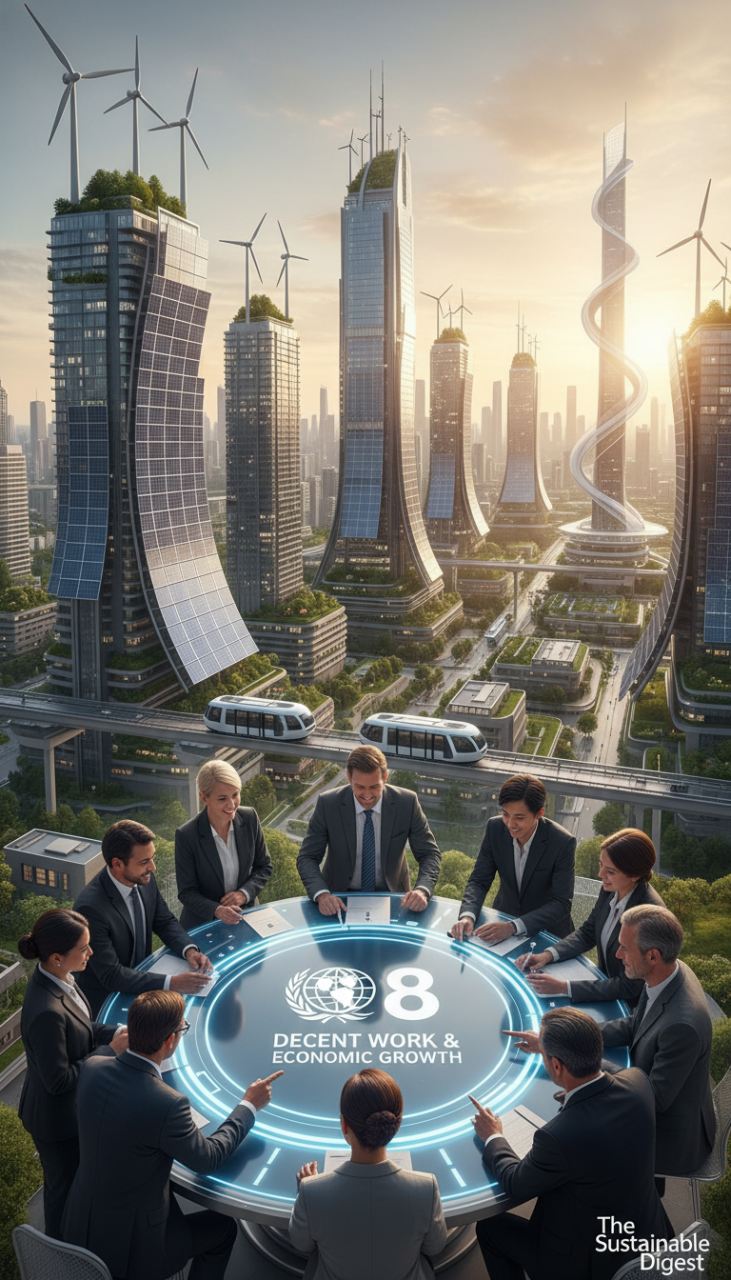
Policy doesn’t emerge from a vacuum. It’s forged in the meetings of influential global bodies. These institutions set the tone for national labor and growth policies worldwide.
UN Agencies and World Economic Forum Initiatives
The World Economic Forum facilitates high-level dialogues on technology’s role in the future of working. It pushes for digital integration into global frameworks.
UN agencies often collaborate with this forum. Their joint aim is to ensure economic growth doesn’t undermine human rights. The goal is to anchor decent work in tech-driven progress.
| Institution | Primary Focus | Key Stakeholders | Policy Influence |
|---|---|---|---|
| World Economic Forum | Tech integration & elite consensus | Corporate leaders, governments | Shapes high-level agenda |
| World Social Forum | Equity & grassroots advocacy | Civil society, unions | Challenges market-centric models |
The Role of the World Social Forum and Regional Alliances
The World Social Forum provides a loud counterpoint. It champions the informal sector and marginalized communities. This platform challenges top-down economic models.
Regional alliances, like ASEAN or the African Union, increasingly adopt international guidelines. They harmonize labor standards to promote sustainable development. Aligning these varied efforts is key to achieving broad decent work targets.
UN SDG#8 global economy’s peculiar adaptation to a multi-layered paradigm shift

Measuring a nation’s health by GDP alone is like judging a book by its cover. The real story of progress is found in the quality of life for its people. This represents a fundamental paradigm shift in how success is defined.
The new approach values unpaid labor, care work, and community support systems. It recognizes the massive, often invisible, informal economy. These elements form the bedrock of social stability, especially in emerging nations.
Fostering decent work is central to this new vision. Jobs must offer security, fair pay, and dignity to build resilient labor markets. This focus on quality, not just quantity, is essential for sustainable growth.
| Old Metrics Focus | New Metrics Focus |
|---|---|
| Gross Domestic Product (GDP) growth rate | Social reproduction & environmental health |
| Formal employment numbers | Quality of all work, including informal sectors |
| Short-term financial output | Long-term community & ecosystem resilience |
Ultimately, this shift ensures that the pursuit of economic advancement strengthens, rather than depletes, our social and natural foundations. It is the only path to genuine, lasting development.
Geopolitical Impacts on Economic Policy

Recent years have provided stark, real-world lessons on how geopolitics can unravel decades of economic planning. National strategies for prosperity are now rigorously tested by external shocks far beyond any single government’s control.
Sri Lanka vs. Venezuela: A Comparative Analysis
Sri Lanka’s collapse showcased the dangers of unsustainable debt. It damaged and comprised essential public services and shattered job security for millions.
Venezuela’s trajectory highlights a different peril. Deep political instability has systematically corroded labor rights and the state’s ability to foster productive employment. Both cases devastated their national economies.
Consequences of the Ukraine and Iran Wars
The war in Ukraine triggered massive volatility in global energy and food markets. This directly hampered stable economic growth in many developing countries.
Ongoing tensions related to Iran further complicate international trade routes. They create an environment where securing and maintaining decent work becomes a formidable challenge.
These conflicts prove that true development is inextricably linked to global peace. Policymakers must now design national strategies that can withstand such turmoil to protect the pursuit of decent work.
Technological Disruption and the 4th Industrial Revolution

Automation and AI are rewriting the rulebook for what constitutes valuable labour in the 21st century. This era, often called the Fourth Industrial Revolution, merges digital, physical, and biological systems.
Global labour productivity growth rebounded to 1.5 percent in 2024. This signals a shift from the near stagnation of the previous two years.
AI’s Influence on Global Productivity
Artificial intelligence is the central force in this transformation. It drives efficiency in manufacturing and service sectors alike.
This boost in output, however, carries a significant caveat. While AI enhances productivity, it simultaneously threatens traditional job security for millions.
Ensuring decent work in this automated age demands proactive strategy. Policies must prioritize reskilling workforces to meet new technological demands.
Managed carefully, this integration can prevent widened inequality. The benefits of development must be shared broadly to sustain progress.
By leveraging this revolution, nations can unlock new avenues for economic growth. The goal remains a future where the human element of working is not lost but elevated.
Emerging Economic Models and Cooperative Business Approaches
When a major airline teeters on the brink, it reveals more than financial distress—it exposes the fragility of traditional corporate structures. This vulnerability is sparking interest in more resilient alternatives. Cooperative business models, where employees hold ownership stakes, are gaining serious traction.
These approaches fundamentally rewire a company’s priorities. They place the security and dignity of the workforce at the center of operations. This shift is particularly relevant in volatile sectors like aviation.
Case Study: Spirit Airlines and the Cooperative Model

Spirit Airlines’ well-publicized financial struggles led to a radical proposal. Discussions emerged about restructuring not through another merger, but as an airline cooperative. This model would give workers a direct stake in the company’s success.
Such a transition could transform unstable work into more secure, decent work. Employees would gain a voice in decisions affecting their livelihoods. This fosters a sense of ownership that often boosts productivity and service quality.
The cooperative path aligns with broader goals of inclusive economic growth. It ensures the benefits of development are shared more fairly. For industries in flux, it offers a viable blueprint for preserving essential services while creating better opportunities.
The Role of Subsidies and Financial Reforms in Stimulating Growth

Subsidies and financial overhauls are not just economic levers; they’re strategic bets on a nation’s future stability. The right mix can unlock stalled progress, while the wrong one deepens fiscal holes.
Targeted financial support for small businesses is a prime example. It helps informal ventures join the formal economy, creating more decent work opportunities. This direct injection is crucial for local economic growth.
Broader financial reforms are equally vital. They tackle crippling debt burdens that strangle ambition in many regions. Clearing this red tape allows capital to flow toward sustainable development projects.
The goal is a system where businesses thrive and workers gain formal protections. This transition from precarious gigs to secure, decent work is the bedrock of a resilient labor market.
Smart policies must balance support with responsibility. Strategic subsidies for key affiliates, like green tech firms, should avoid long-term debt traps. The fiscal discipline ensures today’s stimulus doesn’t become tomorrow’s crisis.
| Subsidy Focus | Primary Target | Intended Outcome |
|---|---|---|
| Small Business Grants | Informal Sector SMEs | Formalization & Job Creation |
| Training & Reskilling | Existing Workforce | Higher Productivity & Security |
| Green Technology | Sustainable Enterprises | Long-term Ecological Resilience |
Regional Alliances Shaping Economic Policies
The chessboard of international economics is increasingly dominated by powerful regional blocs. These alliances move beyond mere trade agreements to craft shared rules for prosperity.
Their collective influence now rivals that of traditional global institutions. They coordinate strategies that directly impact labor markets and investment flows.
BRICS, ASEAN, African Union, and the European Union
The BRICS coalition promotes South-South cooperation, challenging older financial architectures. It offers member countries a platform to advocate for alternative models of development.
ASEAN and the European Union are standard-setters. They export stringent labor and environmental regulations through their vast trade networks.
In Africa, the African Union and the newer Alliance of Sahel States (AES) prioritize market integration. Their goal is to boost regional stability and economic growth by reducing internal barriers.
These blocs provide crucial forums for sharing best practices on worker rights. Harmonizing standards is a key step toward ensuring decent work across diverse economies.
Ultimately, their collaboration amplifies voices in global governance. It ensures policies better reflect local needs, fostering more inclusive progress and decent work opportunities.
Integrating Environmental Sustainability into Economic Policies

True resilience in any economy now depends on its ability to harmonize industrial output with ecological limits. This integration is no longer optional; it’s the foundation for long-term growth environmental stability.
Consider tourism, which contributed 3.1 percent to global GDP in 2022. Its future relies on adopting sustainable practices. More broadly, improving global resource efficiency consumption production is critical. It decouples economic growth from environmental harm.
Resource Efficiency and Green Technology Initiatives

Green technology is the practical engine of this shift. Initiatives help industries boost their resource efficiency consumption. This reduces waste and lowers operational costs.
The 10-year framework on sustainable consumption and production provides a vital roadmap. It guides nations in enhancing global resource efficiency while pursuing development.
Prioritizing resource efficiency does more than protect the planet. It sparks innovation and creates new avenues for decent work. Jobs in renewable energy and circular economies offer security and purpose.
Ultimately, smart efficiency consumption strategies build economies that thrive within planetary boundaries. They ensure that progress today doesn’t compromise tomorrow’s decent work opportunities.
Challenges in Formalizing Informal Employment Globally

Formalizing the world’s informal jobs is like trying to map a shadow—the task is enormous and progress is painfully slow. Over two billion workers operated informally in 2023, representing a staggering 58% of the global workforce.
This vast informal sector is the primary barrier to achieving universal decent work. People in these roles typically lack legal contracts, social security, and basic safety protections.
The informality rate has declined by less than one percentage point since 2015. This glacial pace highlights the deep structural roots of the problem.
Governments need targeted development strategies that incentivize formalization. Simplifying business registration and offering tax benefits can encourage the transition.
| Key Challenge | Impact on Labour | Potential Policy Lever |
|---|---|---|
| Lack of Legal Recognition | No access to justice or minimum wage | Streamlined formalization pathways |
| Absence of Social Security | High vulnerability to economic shocks | Portable benefit schemes |
| Limited Access to Finance | Inability to grow or invest | Micro-credit and grant programs |
Addressing these root causes is essential. It transforms precarious labour into secure, decent work, fueling more stable and inclusive economic growth.
Bridging the Gender Gap in Decent Work Environments

A 14 percent pay differential might seem like a statistic, but it represents a systemic leak in the global economy’s productivity pipeline. Achieving true decent work for all is impossible while this gap persists.
Promoting Equal Pay and Career Advancement
The median gender pay gap across 102 countries sits at about 14 percent. This isn’t just unfair; it’s inefficient. Equal pay for communities and cultures doing comparable work is a fundamental correction to a flawed market.
Furthermore, women are twice as likely as men to be classified as NEET—not in employment, education, or training. This represents a massive waste of talent and ambition.
| Disparity | Impact | Policy Focus |
|---|---|---|
| 14% Pay Gap | Reduced lifetime earnings & consumption | Transparent salary ranges & audits |
| 2x NEET Rate | Lost productivity & social exclusion | Targeted re-entry programs & childcare |
| Underrepresentation in Leadership | Narrowed decision-making perspective | Mentorship & inclusive promotion pathways |
Bridging these divides is essential for inclusive economic growth. When women advance, economies diversify and strengthen. Smart development strategy must actively dismantle the barriers holding half the workforce back.
This creates more robust and equitable decent work environments for all genders and ethnicities alike.
The Intersection of AI and Economic Development

The quiet revolution in banking isn’t happening on Wall Street; it’s unfolding on smartphones across the developing world. This digital shift is a foundational layer for modern progress.
Access to formal financial services is a powerful catalyst. It moves people from the economic sidelines into the active marketplace.
Digital Transformation of Financial Services
Global account ownership tells a clear story of rapid inclusion. In just seven years, access to banks or regulated institutions jumped significantly.
| Year | Adults with an Account | Notable Change |
|---|---|---|
| 2014 | 62% | Baseline |
| 2021 | 76% | +14 percentage points |
This isn’t just about storing money. Digital tools are transforming how individuals secure loans and insurance, building personal resilience.
Innovative Strategies for Enhanced Productivity
Artificial intelligence drives the next wave. It powers sophisticated credit assessments, reaching those previously deemed ‘unbankable’.
These AI-driven innovations do more than streamline processes. They create entirely new categories of decent work in the digital economy.
Roles in fintech support, data analysis, and cybersecurity emerge. This expands opportunities for secure, productive work.
Continued investment in digital infrastructure is non-negotiable. It ensures the benefits of this technological leap are shared widely, fueling broader economic growth and more decent work opportunities.
Policy Implications for a Sustainable Future

Effective national reforms are the missing link between ambitious global targets and the lived reality of workers. Moving from paper promises to tangible progress requires a clear-eyed look at what actually works.
Recommendations for National Economic Reforms
Many nations have launched youth employment strategies, but proof of their success remains thin. The next step is rigorous, evidence-based implementation that creates genuine decent work opportunities for young people.
A wholesale reform of the financial system is non-negotiable. It must tackle crippling national debts and ensure equitable pay for the next generation. This fiscal overhaul is the bedrock for sustainable economic growth.
Governments should implement policies that foster innovation and support formalizing the economy. This protects the rights of all working people. Strengthening social safety nets and investing in education are also critical.
These reforms prepare people for the modern labor market. By aligning national policies with broader goals, countries build a more resilient framework. It benefits all people.
A sustainable future hinges on executing these policies effectively. The goal is inclusive development where growth lifts everyone. This is how nations translate high ideals into better lives for their people.

Conclusion
True prosperity is not a statistic; it is the experience of secure and meaningful employment. Reaching this goal demands a concerted global effort to tackle deep structural challenges.
Policies must actively protect worker rights and share the benefits of development widely. Integrating technology and formalizing informal sectors are critical steps.
These actions build a more inclusive and resilient economy. International bodies, regional alliances, and national governments must collaborate.
Their shared commitment can forge a future where work is a universal source of dignity. This is the foundation for sustained economic growth and genuine decent work for all.
Key Takeaways
- The Sustainable Development Goals provide a shared blueprint for global progress toward a 2030 deadline.
- Goal 8 uniquely ties broad economic advancement to the concrete reality of decent work for all.
- Current global volatility necessitates new models for sustainable and inclusive growth.
- Successful implementation is as critical as the policy design itself.
- International organizations and technological innovation are key drivers changing the future of work.
- Building economic systems that are both inclusive and resilient is a modern imperative.