Davos 2026: A Look Back at the World Economic Forum for Sustainability

World Economic Forum Devos 2026 in retrospect for Sustainable Development

The 56th Annual Meeting convened in the Swiss Alps during January 2026 with ambitious promises. Its theme, “A Spirit of Dialogue,” suggested a renewed commitment to global cooperation. Yet the gathering quickly revealed a stark contrast between aspiration and reality.

This retrospective examines how the forum’s environmental agenda fared against a fractured geopolitical landscape. The official focus on building “prosperity within planetary boundaries” represented familiar rhetoric. However, the actual discussions exposed deep cracks in multilateral collaboration.

With over 1,300 leaders surveyed for the Global Risks Report, environmental threats were paradoxically downgraded as immediate concerns. They remained the most severe long-term dangers. The central question—how to achieve growth without breaching ecological limits—faced its toughest test yet.

The irony of pursuing dialogue amidst palpable division defined the event’s legacy. As one observer noted, it highlighted both the potential and the profound limitations of such gatherings in an era of global rupture.

1. The “Spirit of Dialogue” in a World of Division

Davos 2026 opened with the ambitious theme ‘A Spirit of Dialogue’ just as international cooperation reached a critical low point. The annual meeting promised to serve as an impartial platform for exchanging views. This occurred during significant geopolitical and societal shifts.

The World Economic Forum positioned itself as a neutral convening space. Impartiality had become a scarce commodity in global relations. The forum’s stated goal was to engage diverse voices and broaden perspectives.

It aimed to connect insights across global challenges. The gathering sought to catalyze problem-solving with actionable insight. Yet the reality of January 2026 presented a stark contrast.

The Global Risks Report that year identified “geoeconomic confrontation” as the top immediate threat. This context made the call for dialogue either prescient or profoundly ironic. The theme arrived at a moment when multilateral institutions faced unprecedented strain.

1. The “Spirit of Dialogue” continuing

True dialogue presupposes willing participants speaking in good faith. Several developments suggested otherwise. The Iranian Foreign Minister’s invitation was revoked before the meeting.

Israeli Prime Minister Benjamin Netanyahu stayed away over International Criminal Court warrant fears. These absences created palpable gaps in the conversation. Key voices were missing from critical discussions.

“The forum’s convening power was tested not by who attended, but by who did not—and why.”

The ambition to “connect the dots” across issues like climate and conflict faced immediate obstacles. Connecting basic diplomatic dots between major powers proved difficult. This challenged the very premise of the gathering.

The WEF promised a focus on frontier innovation and future-oriented policy. However, the most evident innovation at Davos 2026 was in diplomatic disruption. Technological breakthroughs took a backseat to political maneuvering.

Certain world leaders commanded attention through monologue rather than conversation. The spirit dialogue ideal represented a hopeful anachronism. It belonged to an era of smoother international collaboration.

This examination considers whether the forum’s structure fostered genuine exchange. Did it provide a stage for pre-scripted performances instead? The global audience watched closely for signs of substantive progress.

The economic forum sought to remain decisively future-oriented. Yet present tensions repeatedly pulled focus backward. The world economic landscape in 2026 demanded immediate action on multiple fronts.

Davos 2026 thus became a laboratory for testing dialogue’s limits. It revealed both the enduring need for such spaces and their structural vulnerabilities. The gathering highlighted the difficult work of building bridges when foundations are shaking.

2. The Blueprint: Sustainability on the Official Agenda

A dynamic scene at Davos 2026, featuring a diverse group of professionals engaged in animated discussions about sustainability. In the foreground, a diverse panel of speakers, dressed in professional business attire, passionately discusses sustainable initiatives. The middle ground features an audience of attentive participants, taking notes and engaging with digital devices. The background showcases the iconic Davos mountains, framed by large screens displaying graphs and sustainability goals. Natural light spills in through large windows, creating a bright and optimistic atmosphere. The mood is collaborative and forward-thinking, emphasizing the importance of sustainability in global discussions. The image should evoke a sense of purpose and innovation, with a subtle overlay of the brand name "The Sustainable Digest".

Beneath the main stage’s geopolitical drama, a parallel universe of sustainability discussions unfolded according to a packed schedule. The official program for January 2026 presented a detailed blueprint for addressing environmental challenges. It promised serious engagement with the most pressing ecological issues of our time.

This agenda existed in curious tension with the gathering’s broader context. While diplomats negotiated crises elsewhere, session rooms filled with talk of decarbonization and nature-positive models. The contrast between planned progress and unfolding reality would define the week.

2.1. The Core Environmental Challenge: “Prosperity Within Planetary Boundaries”

The central question framing the environmental track was deceptively simple. “How can we build prosperity within planetary boundaries?” asked the official theme. This query attempted to reconcile economic growth with ecological preservation.

Supporting data gave the theme urgency. Nature loss already impacted 75% of Earth’s land surface. Yet transitioning to nature-positive business models promised enormous reward.

Such models could unlock $10 trillion annually by 2030, according to forum materials. This created a compelling financial argument for environmental action. The challenge lay in transforming theoretical value into practical investment.

The phrase “planetary boundaries” suggested hard limits to growth. Yet the accompanying rhetoric emphasized opportunity rather than constraint. This delicate balance would be tested throughout the week’s discussions.

2.2. A Packed Schedule: Key Sessions on Climate, Energy, and Nature

The calendar for January 2026 was dense with sustainability events. Each day featured multiple sessions addressing specific facets of the environmental crisis. The schedule reflected both breadth of concern and specialization of solutions.

On January 20th, “How Can We Build Prosperity within Planetary Boundaries?” set the stage. “Business Case for Nature” followed, exploring corporate engagement with biodiversity. These sessions established the fundamental premise of the week’s environmental dialogue.

January 21st brought sharper focus to climate and energy concerns. “How Can We Avert a Climate Recession?” financialized the climate debate. “Unstoppable March of Renewables?” examined the pace of the energy transition.

The title’s question mark hinted at underlying uncertainty. Even supposedly unstoppable forces faced political and technical hurdles. This session would likely reveal both optimism and caution.

Final days addressed implementation mechanisms. “Will We Ever Have a Global Plastics Treaty?” on January 22nd questioned multilateral collaboration. “How to Finance Decarbonization?” tackled the practicalities of funding climate action.

Each topic represented a critical piece of the sustainability puzzle. Together, they formed what appeared to be a comprehensive roadmap. The question remained whether discussion would translate into tangible progress.

2.3. The Climate Hub and Side Events: A Parallel Sustainability Track

Beyond the main conference center, a vibrant ecosystem of side events operated. The Climate Hub Davos, organized by GreenUp, hosted its own series of conversations. Positioned somewhat ironically behind food trucks, it became a hub for specialized dialogue.

Its programming addressed gaps in the official agenda. “The Missing Middle: Driving the Just Transition Within Supply Chains” on January 19th focused on implementation equity. “Business Opportunities with Nature – How Do We Unlock Them?” the next day continued the theme of monetizing conservation.

“The Climate Hub represented where rubber met road—or perhaps where idealism met the food trucks.”

Meanwhile, the House of Switzerland hosted particularly poignant discussions. “Redefining Energy Security” on January 21st gained unexpected relevance amid geopolitical tensions. “Building Resilient Infrastructure for a Changing World” that same day addressed physical resilience against climate impacts.

These side conversations suggested a thriving subculture of sustainability innovation. They explored fungal solutions, regenerative agriculture, and circular economy models. This parallel track demonstrated both specialization and fragmentation within the environmental movement.

The proliferation of events revealed a community determined to advance its agenda. Whether this determination could influence the broader gathering remained uncertain. The sustainability blueprint was comprehensive, but its implementation faced the ultimate test of political will.

3. The Geopolitical Earthquake That Shook Davos

A dispute over a remote Arctic territory became the uninvited guest that dominated corridors and closed-door meetings throughout the week. The gathering’s carefully curated sustainability agenda found itself competing with a real-time diplomatic rupture.

This seismic shift in focus revealed the fragility of multilateral institutions during this contentious era. What began as a routine policy conference transformed into a geopolitical thriller.

The theme “How can we cooperate in a more contested world?” proved painfully prescient. Cooperation appeared more elusive than ever during those tense days in January 2026.

3.1. The Greenland Crisis and Transatlantic Tensions

The Greenland crisis served as the gathering’s unexpected plot device. A “big, beautiful block of ice” in one leader’s phrasing came to dominate discussions.

It revealed fractures in the post-war international order. No amount of Alpine diplomacy could easily mend these tensions.

Transatlantic relations faced unprecedented strain over sovereignty claims. Decades-old alliances showed vulnerability to unilateral actions.

Rhetorical escalation made trust appear as fragile as Alpine ice in January 2026. The crisis influenced bilateral meetings and colored public speeches.

It overshadowed planned sustainability dialogues throughout the week. The aftershocks of this geopolitical earthquake would be felt in every session.

Critical discussions on trade, investment, and infrastructure were reframed through this security lens. Global supply chains were analyzed for vulnerability.

The crisis presented immediate challenges to international cooperation frameworks. It tested whether the gathering served as a pressure valve or an accelerant for discord.

3.2. Absent Voices: The Revoked and Reluctant Leaders

The absence of key figures spoke volumes about the state of global diplomacy. Missing voices created palpable gaps in critical conversations.

Iranian Foreign Minister Abbas Araghchi’s invitation was revoked before the meeting. This followed Iran’s violent crackdown on domestic protests.

Israeli Prime Minister Benjamin Netanyahu skipped the gathering entirely. Fears of arrest under International Criminal Court warrants kept him away.

President Isaac Herzog attended instead, delivering pointed criticism. He characterized the ICC warrants as “politically motivated” and “a reward for terror.”

“The forum’s convening power was measured not by who attended, but by who did not—and why their absence mattered.”

These absences demonstrated how international justice mechanisms now directly impacted participation. The gathering became a stage for diplomatic grievance airing.

Herzog’s comments highlighted the forum’s role in this era of contested legitimacy. They revealed how multilateral institutions faced credibility challenges.

The revoked invitation and reluctant attendance patterns signaled deeper shifts. They reflected a world where traditional diplomatic norms were undergoing rapid change.

This year‘s participation patterns might establish precedents for future years. The January 2026 gathering thus became a case study in diplomatic exclusion.

It raised questions about which leaders could safely participate in global dialogues. The very structure of international cooperation faced scrutiny.

These absent voices left conversations incomplete during critical January 2026 discussions. Their missing perspectives shaped the gathering’s outcomes in subtle but significant ways.

4. A Tale of Two Speeches: Trump’s Monologue vs. Carney’s Warning

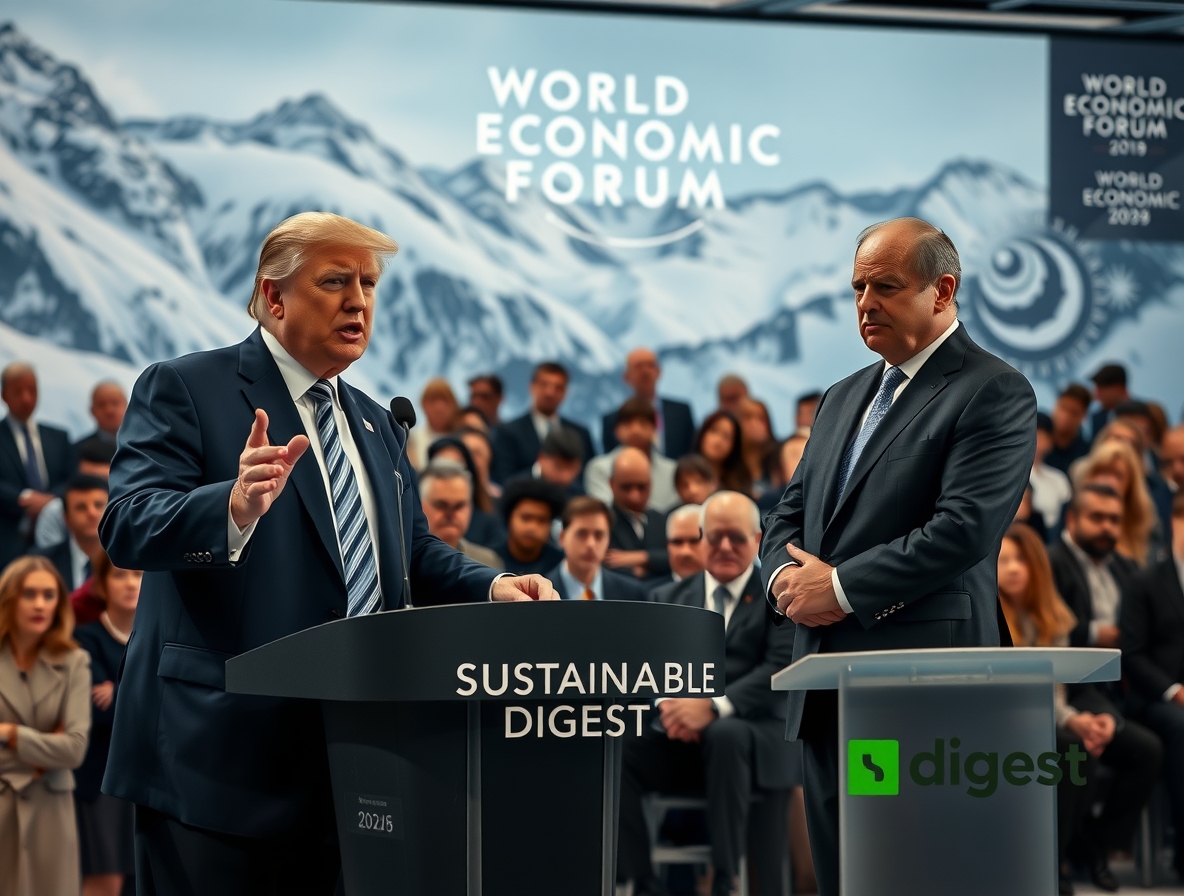
A dramatic scene depicting two contrasting speeches at the World Economic Forum in Davos, 2026. In the foreground, Donald Trump stands confidently at a podium, wearing a tailored suit, gesturing animatedly with a determined expression. Next to him, Mark Carney, dressed in a sleek business suit, looks pensive, his hands clasped, signaling caution and urgency. In the middle ground, an audience of diverse professionals attentively listens, creating an atmosphere of tension and anticipation. The background features the iconic snowy Swiss Alps and a modern conference hall adorned with sustainability-themed visuals. Soft, diffused lighting highlights the speakers, casting gentle shadows, while capturing the gravitas of their messages. The mood is one of intense dialogue and contrasting ideologies in the fight for sustainable development. The Sustainable Digest logo subtly integrated into the scene, blending seamlessly with the setting.

While the official theme promoted dialogue, the most memorable moments came from dueling monologues that revealed deeper fractures. Two competing visions for global governance played out in real time during that pivotal week. The rhetorical contrast could not have been starker.

One address celebrated unilateral power and questioned environmental consensus. The other warned of systemic rupture and called for middle power solidarity. Together, they framed the central challenge of the january 2026 gathering.

This section examines how these speeches became the event’s defining intellectual showdown. They transformed abstract debates about order into vivid political theater.

4.1. Donald Trump’s “America First” Revival and Greenland Gambit

The former U.S. president returned to the international stage with familiar bravado. He declared America “the economic engine on the planet” while dismissing climate policy as “perhaps the greatest hoax in history.” His speech revived the “America First” doctrine with renewed intensity.

Trump treated the forum as both platform and geopolitical prop. He used the global audience to advance unilateral territorial claims. The address blended economic boosterism with calculated brinkmanship.

His extended meditation on Greenland became the speech’s centerpiece. “All the United States is asking for is a place called Greenland,” he stated plainly. The comment transformed a remote territorial dispute into a metaphor for shifting power dynamics.

Trump pledged not to use force but added a significant caveat. “You need the ownership to defend it,” he explained. This logic framed sovereignty as prerequisite for security in the new geopolitical landscape.

The speech revealed a particular approach to international dialogue. It treated multilateral spaces as venues for assertion rather than negotiation. This reflected a broader change in how some leaders engaged with global institutions.

4.2. Mark Carney’s “Rupture in World Order” and Call to Action

The Canadian Prime Minister offered a starkly different diagnosis hours later. Mark Carney warned of “a rupture in world order” where “geopolitics is submitted to no limits.” His speech presented a counter-narrative requiring collective action.

Carney did not mention Trump directly. Yet his analysis directly addressed the unilateralism displayed earlier. He called for middle powers to unite against great power coercion.

“Great powers have begun using economic integration as weapons,” he observed. “Tariffs as leverage, financial infrastructure as coercion, [and] supply chains as vulnerabilities to be exploited.” This cataloged the new tools of geopolitical competition.

His most resonant line became a guiding principle for many attendees. “If we’re not at the table, we’re on the menu,” Carney cautioned. This framed strategic positioning as essential survival in an era of contested trade.

“The rupture is not just in diplomacy but in the very frameworks we assumed were permanent. Economic tools have become geopolitical weapons, and middle powers must recognize this new reality.”

— Analysis of Carney’s Davos 2026 address

Carney’s speech represented a different kind of statesmanship. It combined analytical depth with urgent prescription. The address reframed the entire topic of international cooperation for the coming years.

4.3. Media and Diplomatic Reception: Contrasting Statesmanship

Audience reactions highlighted the speeches’ divergent impacts. CNN reported that attendees during Trump’s address “grew more restless and uncomfortable.” The network noted “only tepid applause at the end.”

Contrast this with the reception for Carney’s warning. Australian Treasurer Jim Chalmers called the speech “stunning” in its clarity and urgency. Many diplomats described it as the week’s most substantive contribution.

Media analysis crystallized the contrast perfectly. Foreign Policy magazine characterized the conference as “a tale of two speeches.” It contrasted Trump’s “rambling and bullying” with Carney’s “eloquent exposition.”

This reception revealed deeper judgments about political style and substance. One speech was seen as performance, the other as serious statecraft. The dichotomy extended beyond content to perceived purpose.

The speeches’ afterlife in diplomatic circles demonstrated their lasting impact. Carney’s framing proved particularly influential among nations reassessing their positions. Many middle powers began discussing coordinated responses.

Trump’s Greenland comments immediately entered geopolitical negotiations. They became a reference point in transatlantic discussions for months. Both addresses showed how rhetoric at such gatherings could shape real policy.

The competing visions presented that week continued to define international debates. They represented fundamentally different approaches to growth, security, and global challenges. The january 2026 speeches became case studies in how leaders use international platforms.

Ultimately, the tale of two speeches captured the gathering’s central tension. It pitted unilateral assertion against collective problem-solving. This conflict would define the global economy and political innovation in the years following the event.
5. Beyond the Main Stage: The Board of Peace and Other Initiatives

Beyond the spotlight of keynote addresses, a complex ecosystem of side events defined the gathering’s substantive outcomes. While speeches captured headlines, the real progress often emerged from charter signings, protests, and award ceremonies.

This parallel universe operated throughout the week. It revealed how the forum functioned as an aggregation point for global advocacy. Diverse causes competed for attention beyond the official agenda.

The Board of Peace: Diplomatic Entrepreneurship

The inaugural meeting of the Board of Peace represented ambitious diplomatic innovation. Its charter announcement on January 22, 2026 featured former President Donald Trump center stage.

This illustrated the gathering’s utility as a convening platform. Controversial figures could launch initiatives alongside geopolitical escalation. The paradox was striking.

Peace boards emerged while tensions dominated main stage discussions. This raised questions about their genuine conflict resolution potential. Were they substantive mechanisms or diplomatic theater?

“The Board of Peace charter signing demonstrated how Davos serves entrepreneurial diplomacy—where even the most polarizing figures can launch initiatives that may outlast the week’s headlines.”

The initiative’s timing during the Greenland crisis added layers of irony. It suggested the enduring appeal of peace as a business proposition. Yet its practical action plan remained unclear to many observers.

Diaspora Advocacy: Kurdish Protests at Switzerland’s Doorstep

Hundreds of Kurdish protesters arrived in Davos with a different agenda. They raised awareness about Syrian military offensives against Kurdish regions. Their presence highlighted how global conflicts literally arrived at Switzerland’s doorstep.

The forum served as a magnet for diaspora advocacy throughout that week. Marginalized groups sought international attention through direct action. This created visible tension with the gathering’s polished image.

Protests represented raw, unfiltered political action. They contrasted sharply with the controlled environment of conference rooms. Yet both sought similar outcomes: influencing global opinion and policy.

Celebrating Philanthropic Innovation: The GAEA Awards

The GAEA (Giving to Amplify Earth Action) Awards honored climate and nature initiatives. This continued the tradition of celebrating philanthropic innovation within the forum‘s ecosystem.

Award ceremonies provided recognition for concrete solutions. They highlighted successful models for environmental finance and action. Yet the broader context made such celebrations seem increasingly aspirational.

While geopolitical earthquakes shook main halls, GAEA celebrated incremental progress. This dichotomy revealed the gathering’s fragmented nature. Multiple realities coexisted without necessarily connecting.

The Hotel Suite Diplomacy: Where Real Deals Were Discussed

Beyond all programming, the real “work” occurred in hotel suites and private dinners. Bilateral deals were discussed away from public view. Alliances were tested in these exclusive spaces.

This shadow diplomacy operated parallel to official events. It represented the traditional power brokerage that the forum has always facilitated. Business leaders and politicians negotiated directly.

These discussions focused on practical collaboration and finance arrangements. They often addressed the very technology and infrastructure projects mentioned publicly. Implementation details were hammered out privately.

Comparing Parallel Initiatives: Complementarity or Distraction?

The proliferation of side initiatives demonstrated both depth and fragmentation. Each track pursued its agenda with varying degrees of connection to the main program. The table below analyzes key parallel events from January 2026.

InitiativeTypeKey ParticipantsDatePrimary FocusNature
Board of Peace CharterDiplomatic LaunchDonald Trump, Various DiplomatsJanuary 22Conflict Resolution FrameworkPublic Ceremony
Kurdish ProtestsDiaspora AdvocacyHundreds of Kurdish ActivistsThroughout WeekSyrian Conflict AwarenessPublic Demonstration
GAEA AwardsPhilanthropic RecognitionClimate Funders, NGO LeadersJanuary 21Environmental FinanceFormal Ceremony
Hotel Suite MeetingsBilateral DiplomacyBusiness Leaders, Government OfficialsVarious EveningsDeal NegotiationPrivate Discussions
Climate Hub DavosSpecialized ForumEnvironmental Experts, EntrepreneursDaily SessionsTechnical SolutionsSemi-Public Programming

This constellation of activities created a rich but disjointed experience. Some initiatives complemented the main agenda by addressing its gaps. Others seemed to operate in entirely separate universes.

The Board of Peace responded to the week’s geopolitical tensions. Kurdish protests highlighted conflicts absent from official discussions. GAEA Awards celebrated environmental solutions overshadowed by security concerns.

Hotel suite diplomacy conducted the practical business that public panels only theorized about. Each parallel track served different stakeholders with varying definitions of progress.

Ultimately, these side events revealed the gathering’s true complexity. They demonstrated how multilateral spaces host competing narratives simultaneously. The forum became a microcosm of global fragmentation itself.

Whether this represented meaningful complementarity or mere distraction depended on one’s position. For diaspora groups, it offered rare access. As for dealmakers, it provided essential privacy. For philanthropists, it granted valuable recognition.

The January 2026 experience suggested that the main stage no longer dominated outcomes. Power and influence had diffused throughout the entire ecosystem. This may represent the most significant innovation of modern global gatherings.

6. Assessing the Outcomes for Sustainable Development

A panoramic view of the World Economic Forum at Davos, showcasing a diverse group of professionals and thought leaders engaged in discussions about sustainable development outcomes. In the foreground, a roundtable discussion featuring individuals in professional business attire, thoughtfully analyzing data on tablets and laptops. The middle section includes banners displaying eco-friendly symbols and infographics demonstrating key sustainability metrics. The background features the stunning Swiss Alps, under a bright, clear blue sky with soft sunlight illuminating the scene, conveying a hopeful and dynamic atmosphere. Incorporate elements like green technology, urban sustainability projects, and nature conservation visuals subtly integrated into the surroundings. The Sustainable Digest logo appears discreetly in the corner, enhancing the focus on sustainable development.

A balanced examination of the forum’s impact on environmental goals shows a landscape of partial victories and significant omissions. The gathering’s outcomes for ecological priorities were neither uniformly positive nor entirely negative.

Instead, they reflected the broader tension between programmed ambition and participant preoccupation. This analysis separates ceremonial dialogue from substantive progress.

It measures what was actually achieved for planetary health during those tense days. The results reveal an enduring gap between international rhetoric and implementation.

Any honest assessment must acknowledge both tangible achievements and glaring omissions. The sustainability agenda advanced in some corridors while receding dramatically in others.

Three distinct dimensions emerged from the post-event analysis. First, specific professional networks maintained their momentum despite geopolitical headwinds.

Second, the “urgent versus important” dilemma plagued nearly every discussion. Third, silent issues spoke volumes about selective attention spans.

This section examines each dimension to determine whether the gathering moved the needle. Did it create meaningful change, or merely maintain existing trajectories?

6.1. Achievements: Dialogue, Networking, and Specific Proposals

Despite the geopolitical turbulence, certain sustainability channels remained open and productive. The most concrete achievement was the maintenance of professional networks dedicated to environmental solutions.

Specialists in nature-positive finance continued their conversations from previous years. They developed specific proposals for blending conservation with commercial investment.

These discussions occurred in dedicated spaces like the Climate Hub. While geographically marginalized, they maintained technical depth.

Several working groups produced actionable frameworks for corporate engagement with biodiversity. These frameworks addressed how business models could integrate ecological metrics.

They focused on practical implementation rather than theoretical aspiration. The innovation lay in connecting conservation science with capital allocation decisions.

Dialogue channels between policymakers and private sector leaders also remained intact. These connections proved resilient to the week’s diplomatic disruptions.

They facilitated discussions about regulatory policy for the energy transition. Specific technology partnerships were explored for renewable infrastructure.

“The real work happened in the side rooms where specialists spoke the same language. While the main stage debated Greenland, these groups were designing the financial architecture for nature-positive growth.”

— Sustainability consultant attending Davos 2026

The GAEA Awards ceremony provided recognition for proven environmental action. It celebrated philanthropic models that had demonstrated measurable impact.

This maintained momentum for climate finance initiatives. It created visibility for successful approaches that could be scaled.

Perhaps the most significant achievement was simply keeping certain conversations alive. In a world increasingly focused on security concerns, maintaining ecological dialogue represented progress.

6.2. Challenges: Overshadowed Agenda and the “Urgent vs. Important” Dilemma

The packed sustainability schedule existed in curious isolation from the gathering’s dominant conversations. While session rooms discussed decarbonization, corridors buzzed with geopolitical speculation.

This disconnect highlighted the forum’s central challenge. Immediate crises consistently overshadowed longer-term environmental challenges.

The “urgent versus important” dilemma plagued every day of programming. Fast-breaking political dramas captured attention that slow-moving ecological crises could not.

Climate change’s relative demotion symbolized this broader shift. From main stage prominence to a hub behind food trucks, its positioning spoke volumes.

One observer captured this tension with particular clarity. “Davos is struggling, like so many others, to reconcile the important with the urgent,” they noted.

This struggle manifested in attendance patterns at sustainability sessions. While technically well-programmed, they competed with more sensational diplomatic developments.

The Greenland crisis served as the ultimate attention magnet. It reframed discussions about trade, infrastructure, and supply chains through a security lens.

Economic growth conversations became subordinated to sovereignty concerns. Environmental action appeared less pressing than territorial disputes.

This prioritization reflected a broader global governance change. Multilateral institutions increasingly addressed immediate crises at the expense of systemic solutions.

The forum became a microcosm of this international pattern. Its struggle mirrored challenges facing United Nations bodies and other diplomatic platforms.

Ultimately, the gathering demonstrated how easily environmental agendas can be sidelined. Even with meticulous programming, they require political oxygen to survive.

In January 2026, that oxygen was consumed by more combustible diplomatic material. The sustainability blueprint faced implementation challenges beyond its designers’ control.

6.3. The Silent Issues: What Davos 2026 Failed to Address

The most revealing outcomes were not what was discussed, but what was conspicuously absent. Several critical global issues received scant attention throughout the week.

These silent issues spoke volumes about the gathering’s selective focus. They revealed organizer priorities and participant preoccupations in equal measure.

One observer provided a damning catalog of omissions. “Forget the issues of Davos past: sustainable development goals, global health, ESG,” they began.

“It’s hard not to be struck by what was left undiscussed. What about current geopolitics? Ukraine, Gaza, Iran, Venezuela, and Sudan received scant attention. The U.S.-China relationship…was largely absent from the agenda, as were the major trade and fiscal imbalances.”

This selective attention reflected several underlying dynamics. First, certain conflicts had become diplomatically “stale” despite ongoing human suffering.

6.3.5 Silent Issues Continuing

Second, major power relationships were perhaps too sensitive for open discussion. Third, fiscal imbalances lacked the dramatic appeal of territorial disputes.

The U.S.-China relationship’s absence was particularly noteworthy. As the defining geopolitical tension of the era, its omission suggested deliberate avoidance.

Major trade imbalances and currency issues also went underdiscussed. These economic fundamentals received less attention than sensational sovereignty claims.

The observer extended their critique to environmental priorities. “Climate change used to be front and center,” they noted. “This year, the one climate hub that I saw was located ignominiously behind the food trucks.”

This geographical marginalization symbolized a broader demotion. Ecological crises were losing ground to political dramas in the competition for global attention.

The silent issues revealed a forum struggling with its own identity. Was it a platform for addressing all global challenges, or only those deemed “discussable”?

This selectivity risked making the gathering increasingly irrelevant to pressing human concerns. If it avoided the most difficult conversations, what value did it provide?

The omissions during January 2026 suggested a retreat to safer, more manageable topics. Complex conflicts and entrenched geopolitical tensions were sidelined.

This created a distorted representation of global priorities. The agenda reflected what elites wanted to discuss, not necessarily what demanded attention.

Ultimately, these silent issues may represent the gathering’s most significant legacy. They demonstrated the limitations of elite diplomacy in an era of multiple crises.

The forum’s struggle to “reconcile the important with the urgent” left many important issues unaddressed. This failure would have consequences in the coming years.

7. Conclusion: The Legacy of Davos 2026

The gathering’s ultimate legacy may be its stark illumination of multilateralism’s contemporary crisis. It demonstrated undeniable convening power while questioning the utility of mere dialogue.

The contrast between sustainability aspirations and geopolitical realities created instructive dissonance. Environmental challenges were contextualized within fractured political economies rather than addressed directly.

As one observer concluded, “The WEF has put to bed any concerns about its convening power.” The challenge ahead is to forge action that improves our global state. Another noted, “Nostalgia is not a strategy; nor is hope.”

This meeting will be remembered as multilateralism’s crisis became undeniable. The forum witnessed one era’s passing without birthing its successor.

Key Takeaways

  • The January 2026 meeting promised dialogue but often delivered dissonance on sustainability goals.
  • Environmental risks were reprioritized in the short term despite their severe long-term nature.
  • The gap between aspirational rhetoric and actionable policy remained conspicuously wide.
  • Geopolitical tensions frequently overshadowed planned discussions on ecological limits.
  • The forum’s structure around five key challenges tested the viability of “green growth.”
  • Multilateral cooperation faced significant stress from competing national interests.
  • The event’s legacy underscores the difficulty of aligning economic and environmental priorities.

UN Human Rights Day forcast for events, policy, and diplomacy via the UNSDGs

UN Human Rights Day forcast for events, policy, and diplomacy via the UNSDGs

Every December 10th marks a powerful global observance. It celebrates the adoption of the Universal Declaration of Human Rights in 1948. This document remains a cornerstone for freedom and justice worldwide.

This analysis looks ahead. It explores how this important day shapes upcoming events and global discussions. The focus is on policy shifts and diplomatic efforts linked to the Sustainable Development Goals.

The world faces complex challenges, from climate change to pandemic recovery. These issues test our collective commitment to fundamental freedoms. This report offers a forward-looking view on turning principles into tangible progress.

Photo by Juan Diego Salinas

The Historical Foundation of Human Rights Day and Its Evolution

Out of history’s darkest chapter emerged humanity’s brightest promise. The devastation of global conflict created an unprecedented consensus: fundamental protections must transcend borders. This consensus gave birth to a document that would redefine global norms.

Origins in Post-WWII Trauma and the Universal Declaration

World War II’s staggering toll—approximately 80 million lives lost—created a profound moral imperative. Nations recognized that without universal standards, such atrocities could repeat. The international community embarked on an extraordinary drafting process.

Fifty-eight member states participated in 1,400 discussions spanning 1947-1948. Eleanor Roosevelt chaired the drafting committee, skillfully navigating diverse political and cultural perspectives. The resulting document represented humanity’s collective wisdom.

On December 10, 1948, the General Assembly adopted the Universal Declaration with 50 countries approving. Though non-binding, its moral authority proved immediate and enduring. It established that basic dignity belongs to every person, everywhere.

From Declaration to Global Observance: 75 Years of Progress

The declaration’s influence grew steadily through customary international law. Over seven decades, its principles permeated national constitutions and legal systems. This gradual integration transformed abstract ideals into tangible protections.

The document’s accessibility fueled its global impact. Translated into over 500 languages, it became the most rendered text in history. This linguistic diversity demonstrates its truly universal aspiration.

Annual observance began reinforcing these principles through global campaigns. The “Stand Up for Human Rights” initiative mobilized millions worldwide. These efforts turned philosophical concepts into living movements.

PeriodLegal DevelopmentGlobal Impact
1948-1960sFoundation of international human rights lawDecolonization movements
1970s-1990sIntegration into national constitutionsCivil rights advancements
2000s-PresentSDG incorporationDigital rights expansion

Thematic Evolution: How Human Rights Day Has Adapted to Global Challenges

The celebration’s themes mirror our evolving understanding of freedom. Early observances emphasized basic liberties like speech and assembly. Later years addressed more complex, interconnected challenges.

Recent themes demonstrate remarkable responsiveness to contemporary crises. The 2019 focus on youth engagement recognized new generations as change agents. COVID-19’s emergence prompted 2020’s “Recover Better” emphasis.

2021’s equality theme acknowledged persistent structural discrimination. This adaptability proves the framework’s enduring relevance. Each evolution addresses current threats to human dignity while honoring original principles.

The declaration’s journey from aspiration to action continues inspiring progress. Its foundational trauma informs modern advocacy for vulnerable populations. This historical context remains essential for understanding current efforts.

Current Global Context: Human Rights in a Post-Pandemic World

A poignant scene depicting a diverse group of individuals engaged in a discussion about human rights in a post-pandemic world. In the foreground, a middle-aged woman in professional business attire gestures animatedly, embodying hope and resilience, while across from her, a young man in modest casual clothing listens intently. The background features a city skyline, partially shrouded in soft morning light, symbolizing renewal and challenges ahead. Gentle rays of sunlight break through clouds, casting a warm, hopeful glow over the scene. The atmosphere is contemplative yet optimistic, illustrating the ongoing dialogue around global human rights issues. The image reflects thoughtful engagement and advocacy for a better future. The Sustainable Digest.

Pandemic responses worldwide inadvertently served as a stress test for fundamental freedoms. The crisis revealed both resilience and vulnerability in equal measure. This examination explores the complex landscape that emerged.

Global health measures created paradoxical situations. While intended to protect populations, some restrictions limited essential liberties. This tension between security and freedom defined the era.

COVID-19’s Disproportionate Impact on Vulnerable Populations

The virus exploited existing social fractures with surgical precision. Marginalized communities faced compounded risks from both disease and response measures. Frontline workers, particularly in healthcare and essential services, bore extraordinary burdens.

Economic disparities widened dramatically during lockdown periods. Low-income households experienced job losses at significantly higher rates. Many lacked access to adequate healthcare or social protection systems.

Older populations and people with pre-existing conditions faced heightened health risks. Simultaneously, isolation measures created mental health challenges. The digital divide excluded many from vital information and services.

Minority communities experienced both health and economic impacts more severely. Structural barriers limited their access to resources and support. This reality highlighted persistent inequities in protection systems.

Accelerated Inequalities and Structural Discrimination

 Photo by Samantha Sophia

Educational disruptions created a generational divide in learning opportunities. Students from disadvantaged backgrounds fell further behind peers. The shift to remote learning revealed stark technological inequalities.

Healthcare access became increasingly stratified during crisis periods. Wealthier communities maintained better care access throughout. Resource allocation decisions sometimes reinforced existing biases.

Women and girls faced particular challenges during lockdowns. Domestic responsibilities increased while economic opportunities decreased. Gender-based violence rates rose in many regions during restrictions.

The digital transformation accelerated but excluded many populations. Those without internet access or digital literacy faced isolation. This technological gap became a new frontier for inequality.

The pandemic thrived because of human rights failures.

UN Secretary-General António Guterres

The “Recover Better” Framework and Its Implementation Challenges

The 2020 theme emerged as a strategic response to crisis conditions. It advocated for rights-based approaches to recovery planning. This framework aimed to address root causes rather than symptoms.

Implementation faced significant political and economic obstacles. Short-term economic pressures often overshadowed long-term rights considerations. Many governments prioritized rapid recovery over equitable distribution.

Some nations used emergency powers to restrict civic freedoms indefinitely. Security concerns sometimes justified disproportionate limitations on assembly and speech. This created troubling precedents for future governance.

Climate change impacts compounded pandemic effects on vulnerable groups. Environmental justice emerged as intersecting concern. Recovery efforts now must address multiple overlapping crises simultaneously.

Digital engagement became crucial for rights advocacy during restrictions. Virtual events maintained global connectivity despite physical distancing. Online platforms enabled continued awareness campaigns and solidarity movements.

The experience demonstrated that fundamental freedoms form the foundation of resilient societies. Equitable systems proved more effective during crisis conditions. This lesson informs future strategic planning for sustainable development.

Looking ahead, these challenges shape evolving approaches to protection. The next section examines how forecasted initiatives address these complex realities.

UN Human Rights Day Forecast for Events, Policy, and Diplomacy via the UNSDGs

Strategic forecasting reveals how global commemorations translate into concrete action across international platforms. The coming years present particularly rich opportunities for integrating fundamental freedoms with sustainable development frameworks. This forward-looking examination explores specific mechanisms driving this convergence.

Projected 2024-2025 Event Calendar and Strategic Initiatives

Major multilateral gatherings will increasingly incorporate rights-based approaches into their agendas. The High-Level Political Forum in July 2024 will feature dedicated sessions on equitable implementation. These discussions will particularly address pandemic recovery disparities.

September’s General Assembly sessions will likely emphasize protection mechanisms for vulnerable populations. Member states are expected to announce new partnerships during these high-visibility events. The 2025 review of sustainable development goals progress will create additional momentum.

Ongoing campaigns like Stand Up for Human Rights will expand their digital footprint significantly. These initiatives cleverly blend awareness-raising with concrete policy advocacy. Their evolution demonstrates how symbolic gestures evolve into substantive engagement.

Policy Integration: Linking Human Rights Day Themes with SDG Implementation

The 2024 theme—Our Rights, Our Future, Right Now—creates powerful alignment opportunities. This framing directly connects intergenerational justice with immediate action requirements. Policy makers can leverage this thematic focus to advance gender equality targets.

Climate justice initiatives will increasingly incorporate rights-based language into their frameworks. This represents a significant evolution from purely environmental approaches. The integration acknowledges that ecological protection and human dignity are fundamentally interconnected.

National implementation plans will likely reflect this holistic perspective more prominently. Monitoring mechanisms are being developed to track rights integration across all sustainable development goals. This represents a maturation of the entire framework beyond siloed approaches.

Digital Diplomacy and Virtual Engagement Strategies

Virtual platforms have permanently transformed how international advocacy operates. The Office of the High Commissioner’s innovative digital events during crisis periods demonstrated new possibilities. These approaches will continue evolving even as in-person gatherings resume.

Social media campaigns achieve remarkable reach but face inclusion challenges. The digital divide remains a stubborn barrier to truly universal participation. This irony—using technology to promote inclusion while potentially excluding some—requires creative solutions.

Hybrid event models will likely become standard practice for major observances. This approach balances the efficiency of digital access with the resonance of physical gatherings. It represents pragmatic adaptation to our increasingly blended reality.

Youth-Led Movements and Civil Society Participation Trends

Young activists continue driving innovation in rights advocacy methodologies. Networks like Amnesty International’s youth programs demonstrate remarkable strategic sophistication. Their approaches often blend online mobilization with targeted local action.

Civil society organizations are developing more sophisticated monitoring capabilities. These groups can track policy implementation where official mechanisms face limitations. This creates valuable accountability through alternative channels.

The UN Youth Envoy’s initiatives successfully bridge institutional and grassroots perspectives. This balancing act demonstrates how formal structures can productively engage with organic movements. The resulting synergy often produces more resilient strategies.

Environmental rights advocacy particularly benefits from these cross-generational collaborations. Young activists bring urgency while established organizations provide institutional memory. Together they create powerful coalitions for climate justice.

Effective advocacy requires both speaking truth to power and building power with truth.

Youth Climate Activist

These forecasted developments suggest an increasingly sophisticated rights ecosystem. The integration of ceremonial observance with practical policy creates unique leverage points. This blending of symbolic and substantive approaches may define the next era of global progress.

Policy Implications: Integrating Human Rights into Sustainable Development

A dynamic and thoughtful scene depicting the integration of human rights into sustainable development, set in a vibrant, modern urban environment. In the foreground, a diverse group of professionals in business attire, engaged in a collaborative discussion around a large, circular table adorned with symbols of the UN Sustainable Development Goals. In the middle ground, a series of transparent screens displaying graphical representations of various human rights and sustainability metrics, casting a colorful glow. In the background, a cityscape with green spaces and solar panels, illustrating a commitment to sustainability. The lighting is bright and hopeful, reminiscent of a sunny day, with soft shadows enhancing the depth of the scene. The mood conveys optimism and collaboration, embodying the theme of "The Sustainable Digest."

The marriage of fundamental freedoms with development frameworks represents perhaps the most sophisticated policy innovation of our era. This integration transforms abstract principles into measurable outcomes across multiple sectors. The approach acknowledges that true progress cannot exist without protecting basic dignity.

SDG Alignment: Cross-Cutting Human Rights Principles

Sustainable development goals embed protection mechanisms throughout their architecture. The “Leave No One Behind” principle serves as both moral compass and practical guideline. This philosophy ensures that advancement benefits all segments of society equally.

Gender equality initiatives demonstrate this integration perfectly. Programs targeting women and girls address both development gaps and historical discrimination. Education campaigns specifically focus on marginalized populations to break cycles of poverty.

Reduced inequalities form another critical intersection point. Policies here combat structural barriers that limit economic participation. The approach recognizes that discrimination undermines overall societal progress.

Peace and justice institutions provide essential protection frameworks. These systems ensure accountability for violations while promoting stability. Their effectiveness directly impacts sustainable development outcomes across all sectors.

National Implementation Frameworks and Accountability Mechanisms

Countries worldwide are developing sophisticated policy architectures. These frameworks translate global commitments into local action plans. Their design reflects unique cultural contexts while maintaining universal standards.

Civil society organizations play crucial monitoring roles. They track implementation where official mechanisms face limitations. This creates valuable accountability through alternative channels and independent verification.

Regular reviews assess progress against established benchmarks. These evaluations identify successful strategies and areas needing improvement. The process creates continuous feedback loops for policy refinement.

Effective policies must speak the language of local communities while upholding universal values.

Development Policy Expert

Technology enables unprecedented monitoring capabilities. Digital platforms track indicators in real-time across diverse regions. Data analytics reveal patterns that might otherwise remain invisible to policymakers.

Climate Justice and Environmental Rights as Emerging Priorities

Environmental protection increasingly frames itself as a fundamental freedom issue. Climate change disproportionately affects vulnerable populations worldwide. This reality demands rights-based approaches to ecological challenges.

Frontline communities experience environmental degradation most acutely. Their livelihoods and health face immediate threats from ecological crises. Policy responses must prioritize these groups while addressing broader systemic issues.

International agreements now explicitly connect sustainability with human dignity. The Paris Agreement acknowledges this interconnection in its implementation guidelines. This represents significant progress from earlier environmental frameworks.

Youth movements powerfully advocate for climate justice. Their campaigns blend environmental awareness with rights education effectively. This generational perspective brings fresh urgency to longstanding challenges.

Future policy must address the ironic tension between economic growth and protection. Some development models inadvertently undermine fundamental freedoms. Balancing these priorities requires sophisticated policy design and vigilant monitoring.

The path forward demands adaptive frameworks responsive to emerging crises. Pandemic recovery and climate adaptation require flexible yet principled approaches. This balancing act will define sustainable development for decades to come.

Successful integration requires coordinated action across all sectors. Governments, private entities, and civil society must collaborate effectively. Their partnership creates the ecosystem necessary for meaningful, lasting progress.

Diplomatic Forecast: Multilateral Efforts and International Cooperation

Global collaboration enters a transformative phase as multilateral institutions adapt to emerging challenges. The coming years will test traditional diplomatic frameworks while creating unprecedented opportunities for innovative partnerships. This evolution reflects our increasingly interconnected yet paradoxically fragmented world.

UN General Assembly and High-Level Political Forum Projections

September’s General Assembly sessions will showcase renewed commitment to fundamental freedoms. Member states are preparing ambitious joint declarations on climate justice and digital inclusion. These documents will likely reference the Universal Declaration’s enduring principles while addressing contemporary threats.

The High-Level Political Forum in July presents another critical opportunity. Expect focused discussions on implementation gaps affecting vulnerable populations. These conversations will emphasize practical solutions rather than theoretical commitments.

Both forums will feature increased youth representation through innovative formats. Young delegates will participate in main sessions rather than side events. This structural change acknowledges their crucial role in shaping sustainable futures.

Bilateral Partnerships for Human Rights Advancement

Country-to-country collaborations are evolving beyond traditional aid models. Nordic and African nations are developing reciprocal learning exchanges. These partnerships focus on sharing successful approaches to inclusion and justice.

Cross-regional initiatives address specific challenges like migration and environmental protection. European and South American countries are creating joint task forces. Their work combines legal expertise with grassroots implementation strategies.

These bilateral efforts often achieve what larger forums cannot: rapid, targeted action. Their flexibility allows for experimentation with innovative protection mechanisms. Successful models frequently scale to multilateral platforms.

The most effective partnerships are those where both parties learn equally.

International Relations Scholar

Monitoring and Evaluation Frameworks for Diplomatic Outcomes

New assessment tools are bringing unprecedented transparency to international commitments. Digital tracking systems monitor policy implementation across borders. These platforms provide real-time data on progress and setbacks.

Civil society organizations play crucial roles in these evaluation processes. Their independent verification complements official reporting mechanisms. This dual-track approach creates more comprehensive accountability.

The ironic challenge remains: those most needing scrutiny often resist monitoring strongest. Authoritarian regimes frequently obstruct evaluation efforts while participating in diplomatic forums. This tension highlights the ongoing struggle between principle and power.

Future frameworks must address this accountability gap through creative mechanisms. Peer review processes and public scoring systems show promise. Their effectiveness depends on genuine political will rather than technical design.

These monitoring systems ultimately serve the world’s population by ensuring commitments translate to tangible progress. Their evolution represents one of the most significant advancements in international cooperation. They transform abstract promises into measurable outcomes.

Conclusion: The Path Forward for Human Rights and Sustainable Development

Looking ahead reveals both promise and paradox in global progress. The Universal Declaration’s wisdom continues guiding our collective journey toward dignity for all people. Its principles form the bedrock of meaningful development.

Recent crises exposed vulnerabilities while sparking innovation. The recover better framework demonstrates how challenges can catalyze positive change. Frontline workers and vulnerable populations deserve particular attention in this process.

Youth engagement and digital campaigns drive contemporary awareness efforts. These approaches amplify voices that might otherwise remain unheard. They create spaces for inclusive participation across generations.

Climate change demands urgent action that respects our shared environment. Sustainable development goals provide the essential framework for this work. Their implementation requires cooperation from every sector of society.

The path forward combines ambition with practical action. It honors past achievements while addressing current realities. Together, we can build a more just world for future generations.

Key Takeaways

  • The day commemorates the historic 1948 Universal Declaration of Human Rights.
  • It serves as a catalyst for global policy discussions and diplomatic initiatives.
  • Recent themes highlight urgent action for our shared future and recovery.
  • Youth engagement and digital diplomacy are growing trends in this space.
  • The Sustainable Development Goals provide a crucial framework for integrating these principles.
  • Crises often disproportionately impact vulnerable populations and frontline workers.
  • This forecast is vital for policymakers and sustainability-focused professionals.

Week of Aug 9-16 Reflect on Sustainability in International Affairs

The week of August 9th to the 16th saw major global events. These events showed how sustainability in international affairs is key. Many international observances focused on important sustainability issues that affect the world.

During this time, the world came together to tackle big problems. They showed how sustainable practices can be part of international policies. This showed the need for everyone to work together to solve global challenges.

Aug 9 to 16 reflect review retrospect Sustainability International Affairs

Looking back, it’s clear that global perspectives on sustainability are vital. The talks and results from this week give us important lessons. They help us understand the challenges of achieving sustainability worldwide.

Global Sustainability Landscape in2023

The year 2023 is a key moment for global sustainability. International cooperation is more crucial than ever. The world faces challenges like climate change, environmental damage, and social inequality. We need to work together more than ever.

Current State of International Sustainability Efforts

International efforts have made big strides, like adopting the United Nations’ Sustainable Development Goals (SDGs). These goals help countries aim for a sustainable future. They tackle poverty, inequality, and climate change. Yet, we still need better international cooperation to tackle these global issues.

The role of sustainable development in national policies is growing. Countries are adding sustainability to their economic plans. They see the long-term benefits of protecting the environment and promoting social equity.

Critical Challenges Facing Global Environmental Governance

Despite progress, global environmental governance has big challenges. A major issue is the lack of strong environmental policies worldwide. The current system is often broken, with many agreements and groups focusing on different environmental issues.

  • Inadequate enforcement mechanisms for environmental regulations
  • Limited financial resources for sustainability initiatives
  • The need for greater international cooperation to address global environmental issues

Overcoming these challenges will take a united effort from governments, international groups, and civil society. Together, we can overcome these hurdles and build a sustainable future.

August 9 to August 16 Reflect Review Retrospect Sustainability International Affairs

The week from August 9th to 16th was key for looking at global sustainability. It showed many important events and plans that show how vital sustainability is in world affairs.

Week’s Significance in the Global Sustainability Calendar

The week of August 9-16 was big in the global sustainability calendar. It included days like the International Day of the World’s Indigenous Peoples and World Elephant Day. These days brought up big sustainability topics, like rights for indigenous people and saving wildlife.

A thoughtfully and accurately designed map and calendar with the title "The Sustainable Digest"; covers the full frame. In the foreground, international flags and environmental icons suggest the global nature of sustainability. In the middle ground, images of nature, renewable energy, national independence, and sustainable practices illustrate the various aspects of sustainability. The background features a soft, blurred world map, reinforcing the global scope. The calendar is rendered in a warm, earthy color palette with gentle lighting, conveying a sense of reflection and responsibility. The overall composition is balanced, clean, and visually captivating, perfectly suited to illustrate the section on "August 9 to August 16 Reflect Review Retrospect Sustainability, Cooperatives, and International Affairs".

The International Day of the World’s Indigenous Peoples on August 9 showed how important indigenous groups are for the environment. World Elephant Day on August 12 stressed the need to keep working to save endangered animals.

Major Sustainability Developments and Diplomatic Initiatives

During this week, big sustainability news and diplomatic plans were in the spotlight. Working together on environmental issues was a big theme. Many countries showed they are serious about sustainable growth.

InitiativeDescriptionImpact
Indigenous Peoples’ DayRecognized indigenous communities’ contributions to sustainabilityRaised awareness about indigenous rights
World Elephant DayFocused on elephant conservationHighlighted the need for anti-poaching efforts
International Biodiesel DayPromoted the use of biodiesel as a renewable energy sourceEncouraged sustainable energy policies

These efforts show the ongoing work to tackle global sustainability problems. They do this through teamwork and new ideas.

Indigenous Perspectives on Sustainability

As we face sustainability challenges, indigenous views are key. They show us how to care for the environment. Their traditional knowledge helps us find new ways to live sustainably.

International Day of The World’s Indigenous People

The International Day of the World’s Indigenous Peoples is on August 9. It’s a time to think about how indigenous peoples help us achieve sustainability. This day celebrates their role in keeping our planet healthy and diverse.

It also reminds us to respect and support their rights and knowledge.

Suriname Indigenous People’s Day Celebrations

In Suriname, Indigenous People’s Day is a big deal. It shows the community’s work in keeping their culture and traditions alive. These celebrations teach us about the value of indigenous knowledge in protecting our planet.

They also give indigenous communities a chance to share their stories and struggles.

Indigenous Knowledge Systems and Environmental Stewardship

Indigenous knowledge is essential for taking care of our planet. It’s based on centuries of living in harmony with nature. By combining this knowledge with today’s sustainability efforts, we can do better for our environment.

Environmental Commemorations and Their Global Impact

The week of August 9-16 is filled with important environmental events. These events show how crucial global sustainability efforts are. They raise awareness and push for a sustainable future.

World Elephant Day (August 12): Conservation Diplomacy

World Elephant Day on August 12 brings attention to elephants facing poaching and habitat loss. It’s vital to protect them through international efforts and protected areas. Conservation diplomacy helps protect endangered species through global agreements.

A lush, vibrant landscape depicting the conservation efforts for World Elephant Day. In the foreground, a majestic African elephant stands tall, its trunk reaching towards a young sapling, symbolizing the delicate balance between nature and human intervention. The middle ground showcases a group of dedicated conservationists, their expressions radiating determination as they monitor the elephant's well-being. The background reveals a breathtaking vista of rolling hills, dotted with scattered trees and a clear, azure sky, conveying a sense of tranquility and harmony. Warm, golden lighting casts a gentle glow, creating a serene and hopeful atmosphere. Captured through a wide-angle lens, this image encapsulates the essence of World Elephant Day and The Sustainable Digest's commitment to environmental preservation.

International Biodiesel Day (August 10): Renewable Energy Policies

International Biodiesel Day on August 10 celebrates biodiesel’s role in renewable energy. Good policies are key to using more biodiesel and less fossil fuel. Governments and groups can help by supporting policies that encourage biodiesel.

Renewable Energy SourceBenefitsChallenges
BiodieselReduces greenhouse gas emissions; supports agricultural economiesLand use competition; high production costs
Solar EnergyAbundant resource; zero emissions during operationIntermittent energy supply; high initial investment
Wind EnergyLow operational costs; reduces reliance on fossil fuelsIntermittency; potential environmental impacts on wildlife

World Lizard Day (August 14): Biodiversity Protection Efforts

World Lizard Day on August 14 highlights the importance of lizards and biodiversity. Protecting their habitats and fighting wildlife trafficking are key. These actions help keep ecosystems healthy and strong.

By celebrating these days, we show our dedication to solving environmental problems. Through diplomacy, renewable energy, and protecting biodiversity, we aim for a greener world.

National Celebrations with Sustainability Dimensions

National celebrations are more than just cultural pride. They show the challenges and chances for sustainable growth. Countries worldwide celebrate their independence and national days. These events often show the link between national identity, economic growth, and the environment.

India and Pakistan Independence Days: Sustainable Development Challenges

India’s Independence Day is on August 15, and Pakistan’s is on August 14. These days highlight the sustainable development hurdles these nations face. Both countries have grown economically but struggle with environmental problems like pollution and climate change.

For example, India aims to boost renewable energy but still relies on coal. Pakistan also battles to manage its water resources well.

Key sustainable development challenges for India and Pakistan include:

  • Reducing carbon emissions while meeting growing energy demands
  • Managing water resources sustainably
  • Protecting biodiversity and natural habitats

Singapore National Day: Urban Sustainability Model

Singapore’s National Day on August 9 celebrates its success in urban sustainability. It’s known for making cities livable and green. The city-state has projects like Gardens by the Bay and a good public transport system.

Its urban planning focuses on green spaces, waste management, and energy efficiency. This makes Singapore a leader in urban sustainability.

Some of the key features of Singapore’s urban sustainability model include:

  1. Integration of green spaces into urban planning
  2. Innovative water management systems
  3. Investment in sustainable public transportation

In conclusion, national celebrations in India, Pakistan, and Singapore show the complex relationship between national identity, economic growth, and sustainability. By looking at these events, we can understand the challenges and chances for sustainable development.

Economic Sustainability in the Fourth Industrial Age

The Fourth Industrial Revolution is changing how we think about sustainability. It’s important to understand how this change affects our economy. This knowledge is key to making our economy sustainable.

MSMEs and Sustainable Community Development

Micro, Small, and Medium Enterprises (MSMEs) are crucial for sustainable communities. They create jobs and drive innovation. In the Fourth Industrial Age, MSMEs can use technology to be more sustainable.

They can use green energy, reduce waste, and improve their supply chains. This helps them and their communities thrive.

International Trade Patterns and Environmental Standards

Global trade affects our environment. As trade grows, we need better environmental rules. The Fourth Industrial Revolution is a chance to improve these standards.

More countries and companies are focusing on green trade. They’re using eco-friendly technologies and reducing waste. This helps protect our planet.

Fourth Industrial Revolution Technologies Advancing Sustainability

Technologies like AI, blockchain, and IoT can make our world more sustainable. They help us use resources better and reduce waste. This is good for the environment and the economy.

A panoramic view of cutting-edge Fourth Industrial Revolution technologies against a backdrop of a sustainable, eco-friendly cityscape. In the foreground, a holographic display showcases AI-powered robotic automation, blockchain-enabled smart contracts, and immersive VR/AR experiences. The middle ground features self-driving electric vehicles, renewable energy sources like solar panels and wind turbines, and a network of connected IoT devices. In the background, towering skyscrapers with green roofs and vertical gardens blend seamlessly with lush, verdant parks and waterways. Warm, diffused lighting casts a tone of innovation and environmental consciousness. The logo "The Sustainable Digest" is subtly integrated into the scene, capturing the synergy between technological progress and sustainability.

For example, IoT helps manage energy use. Blockchain makes supply chains more transparent. These technologies help us grow our economy in a green way.

Social Dimensions of Global Sustainability Efforts

Global efforts to be sustainable are now seeing the big role of social aspects. Success in these efforts isn’t just about the environment. It also depends on the social ties within communities.

Women’s Empowerment in Sustainability Initiatives

Women’s empowerment is key in sustainability. Empowered women can lead change in their areas. They help spread sustainable habits and care for the environment.

National Women’s Day and Gender-Responsive Climate Action

National Women’s Day shows how vital gender-responsive climate action is. Adding gender views to climate plans makes sustainability efforts fairer and more effective.

Women’s and Family Day: Sustainable Household Practices

Women’s and Family Day focuses on household actions for sustainability. Small steps like cutting down on waste and saving energy can make a big difference.

Grassroots Organizations and NGOs Driving Change

Grassroots groups and NGOs lead in sustainability efforts. They work with communities, understanding their needs. They then create specific plans to help.

Cultural Heritage Preservation as Sustainability Practice

Preserving cultural heritage is a key part of sustainability. It keeps community identity alive. It also supports sustainable tourism.

In summary, the social side of global sustainability is complex. By empowering women, supporting local groups, and saving cultural heritage, we can build a better, more sustainable world.

International Cooperation Frameworks for a Sustainable Future

Global challenges need a team effort. International cooperation is key to reaching the UN Sustainable Development Goals. As the world connects more, working together is more important than ever.

A bustling cityscape with towering skyscrapers of glass and steel, bathed in warm, golden light. In the foreground, representatives from diverse nations stand together, shaking hands and exchanging documents, symbolizing international cooperation. The middle ground features a grand, modern conference center, its sleek architecture and curved lines conveying a sense of unity and progress. In the background, a panoramic view of the city skyline, with wind turbines and solar panels dotting the horizon, a testament to sustainable energy solutions. The overall atmosphere exudes a sense of optimism, collaboration, and a shared commitment to a sustainable future. The Sustainable Digest.

Progress Toward 2030 UN Sustainable Development Goals

The UN Sustainable Development Goals (SDGs) are a call to action for everyone. They aim to end poverty, protect our planet, and bring peace and prosperity by 2030. We’ve seen progress, like fewer people living in extreme poverty and more access to education.

But, we still face big challenges. The progress is not even across all regions and goals.

Role of International Organizations in Sustainability Governance

International organizations help a lot with sustainability. They help countries talk, set rules, and get help. The United Nations works with governments, civil society, and businesses to push the SDGs forward.

Other groups, like the World Trade Organization and the International Labour Organization, help too. They deal with trade and labor issues.

Cross-Border Initiatives Highlighted During August 9-16

From August 9-16, many cross-border projects were showcased. They showed how working together can tackle big global problems. These projects focused on fighting climate change, saving biodiversity, and supporting sustainable trade.

These efforts show why countries need to work together for a sustainable future.

Conclusion: Pathways Forward for Global Sustainability

The week of August 9-16 highlights the urgent need for global sustainability efforts. It shows how important international cooperation and commitment to sustainability are. These efforts are key to moving forward.

This week focuses on many global challenges. It includes the International Day of the World’s Indigenous People and World Elephant Day. These days remind us of the need to protect biodiversity and respect indigenous knowledge.

As we move ahead, we must keep working towards the 2030 UN Sustainable Development Goals. We need to work together, using international cooperation and cross-border initiatives. This will involve governments, NGOs, and local groups.

The future of global sustainability depends on our ability to balance different areas. We need to create a culture of sustainability and use new technologies. This will help us build a fair and green world.

Key Takeaways

  • Significant global events highlighted the importance of sustainability.
  • International observances drew attention to critical sustainability issues.
  • The need for unified global action on sustainability was underscored.
  • Global perspectives are crucial for achieving sustainability.
  • The week’s events provided insights into the complexities of global sustainability efforts.
  • Indigenous perspectives are vital for global sustainability efforts.
  • The International Day of the World’s Indigenous Peoples highlights indigenous contributions.
  • Indigenous knowledge systems offer valuable insights into environmental stewardship.

World Leisure Organization, UNWTO, WTTO, WEF, Ecotourism, & economic development Explained

World Leisure Organization, UNWTO, WTTO, WEF, Ecotourism, & economic development

The travel and tourism industry plays a crucial role in shaping economies and preserving cultures. Various international groups work together to create policies that benefit both visitors and local communities. Their efforts focus on balancing growth with environmental care.

Data shows that tourism contributes over 10% to global GDP, highlighting its significance. Many regions rely on this sector for jobs and revenue. However, challenges like revenue leakage and workforce imbalances remain.

Initiatives aim to make travel more sustainable while supporting growth. Case studies from places like Bali and Sikkim show real-world impacts. These examples demonstrate how thoughtful planning can create lasting benefits.

Introduction to Global Tourism and Economic Development

From rainforests to cities, tourism creates opportunities beyond borders. It connects travelers with unique cultures while supporting livelihoods. Behind this growth are key groups and concepts shaping its future.

Core Definitions and Players

Ecotourism focuses on nature conservation while funding local communities. The UNWTO highlights it as a tool for Indigenous empowerment. Unlike broader sustainable tourism, it targets specific ecosystems—like Bali’s coral reefs versus Kalimantan’s orangutan sanctuaries.

The WTTC tracks tourism’s massive scale. In 2019, it generated $1.7 trillion in export earnings. Yet benefits aren’t always evenly shared:

  • West Bali’s tourism jobs skew male-dominated (“gendered economies”).
  • Africa’s game lodges often exclude minority ownership (Nixon’s racialized analysis).

“Selling nature to save it creates a neoliberal paradox.”

McAfee

Challenges and Metrics

Sikkim’s workforce reveals gaps: 61% of tourism jobs go to outsiders, causing revenue leakage. Still, the sector contributes 7.7% to its GDP. Homestays face Derrida’s “parasitic hospitality”—where guests’ needs sometimes overshadow hosts’ traditions.

Governments and NGOs work to rebalance these dynamics. Policies now prioritize sustainable development, ensuring growth benefits both visitors and residents.

The World Leisure Organization: Promoting Sustainable Recreation

A serene outdoor scene showcasing sustainable recreation initiatives. In the foreground, a group of hikers enjoys a scenic trail winding through lush, verdant forests, with The Sustainable Digest logo prominently displayed on their backpacks. The middle ground features a crystal-clear lake, its surface reflecting the surrounding mountains and trees. In the background, a modern, eco-friendly lodge blends seamlessly with the natural landscape, its solar panels and wind turbines harnessing renewable energy. Warm, golden sunlight filters through the canopy, casting a tranquil, inviting atmosphere. The image captures the essence of responsible, nature-focused recreation that the World Leisure Organization promotes.

Innovative approaches to leisure are transforming how communities benefit from tourism. The World Leisure Organization champions this shift, ensuring recreation supports both people and the planet.

Mission and Core Initiatives

The group sets global standards for environmental care and community wellbeing. Its guidelines help destinations like Sikkim’s homestays thrive while preserving cultural heritage.

Key strategies include:

  • Partnering with NGOs to scale micro-tourism projects, like Bali’s village-based tours.
  • Combating greenwashing through certifications (e.g., Costa Rica’s CST rating system).
  • Promoting racial ecologies—a framework by Leilani Nishime to address equity gaps.

“True sustainability requires dismantling colonial tourism models.”

Duke University Press

Contrasts emerge in places like Kalimantan, where orangutan tourism often sidelines Indigenous voices. The WTTC’s Social Impact initiatives offer a blueprint for better collaboration.

UNWTO: Driving Global Tourism Policy

Guiding the future of travel, the UNWTO shapes policies that balance growth with responsibility. Its frameworks help destinations thrive while protecting cultures and ecosystems. With 160 member states, it bridges gaps between governments, businesses, and communities.

Structure and Key Programs

The UNWTO aligns with the UN’s sustainable development goals, notably Goal 8 (economic growth) and Goal 12 (responsible consumption). Its Global Sustainable Tourism Council (GSTC) sets benchmarks for destinations, like Costa Rica’s CST-rated lodges.

Key initiatives include:

  • Certification systems: GSTC criteria, launched in 2008, combat greenwashing in Kalimantan’s wildlife tourism.
  • Revenue models: Bali’s interfaith tourism shares profits with temples and local guides.
  • Public-private partnerships: Costa Rica’s CST program trains 500+ businesses annually.

“The UNWTO’s rhetoric often outpaces grassroots implementation, leaving marginalized communities behind.”

Dalgish

DestinationTourism GDP ContributionKey Challenge
Sikkim, India7.7%61% jobs filled by outsiders
Global Average10.4%Revenue leakage (20–30%)

The WTTC’s decoupling strategies reduce environmental footprints. Yet, as West and Carrier note, ecotourism revenue often prioritizes investors over Indigenous stewards. The UNWTO’s next phase must address these disparities.
WTTO’s Vision for Inclusive Tourism Growth

A vibrant cityscape with modern skyscrapers, bustling streets, and thriving businesses. In the foreground, a group of diverse travelers explore the city, capturing moments on their cameras. The middle ground showcases a variety of transportation options, from sleek electric vehicles to a bustling public transit system. In the background, a majestic mountain range provides a serene backdrop, hinting at the natural wonders that draw visitors to this destination. The scene is bathed in warm, golden light, creating a sense of prosperity and opportunity. The text "The Sustainable Digest" appears discreetly in the lower corner, reflecting the publication's focus on responsible tourism and economic development.

New research reveals gaps between tourism’s promises and local realities. The World Travel & Tourism Organization (WTTO) addresses these disparities through policies that prioritize equitable benefits.

Measuring Impact Beyond Headline Numbers

Sarkar’s 2020 study in Sikkim shows tourism created 7 family-supporting jobs for every 10 positions. Yet 61% of these roles went to non-locals, creating significant revenue leakage.

“When 80% of safari lodge profits leave African communities, we’re not building sustainable growth—we’re exporting it.”

Igoe & Brockington

Global data presents stark contrasts:

RegionTourism Export ValueLocal Retention Rate
Global Average$1.7 trillion70-80%
Developing Markets$490 billion39%

Bali’s micro-tourism model offers solutions. Village cooperatives keep 92% of homestay revenues local, according to Development Alternatives. Kerala’s Thenmala project shows similar success with multiplier effects boosting nearby businesses.

The WTTO now advocates certified workforce quotas. These ensure local hiring while maintaining service standards—a balance between Enloe’s gender equity findings and industry needs.

WEF’s Influence on Tourism and Economic Resilience

Emerging technologies are reshaping how destinations manage visitor flows and economic impacts. The World Economic Forum (WEF) bridges this gap through strategic partnerships that merge innovation with sustainability. Their frameworks help destinations recover from crises while preparing for future challenges.

Tech-Driven Solutions for Industry Challenges

The WEF’s Fourth Industrial Revolution initiatives prioritize smart tourism tools. Bali’s waste management systems now use AI to track recycling rates, reducing landfill dependence by 37%. Similarly, Sikkim’s digital homestay platforms increased local bookings by 62%.

  • Blockchain transparency for revenue distribution in Kalimantan’s ecotourism projects
  • WTTC’s AI-powered personalized travel recommendations
  • Great Barrier Reef’s sensor networks monitoring visitor impacts

“Certification without verification fuels greenwashing—technology provides the missing accountability layer.”

GSTC Annual Report

Certification TypeAdoption RateTech Integration
GSTC-Recognized50+ ecolabelsBlockchain verification
WEF Smart Destinations22 pilot citiesIoT sensors

The WEF’s pandemic recovery blueprint helped Southeast Asia rebuild tourism jobs 18 months faster than predicted. Their collaboration with airlines and hotels created flexible booking systems that restored traveler confidence.

The Role of Ecotourism in Economic Development

A panoramic view of rolling green hills, a serene lake, and lush forests, illuminated by soft natural light. In the foreground, a large wooden sign displaying the text "The Sustainable Digest Ecotourism Certification Standards" stands prominently. The sign is surrounded by a diverse array of native flora and fauna, conveying a sense of harmony between nature and sustainable tourism. In the middle ground, a group of hikers explores the trails, capturing the essence of responsible ecotourism. The background features a distant mountain range, creating a picturesque and tranquil atmosphere. The overall scene embodies the principles of ecotourism, promoting environmental conservation and sustainable economic development.

Not all nature-based tourism delivers on its environmental and social promises. While many destinations market themselves as eco-friendly, fewer than 12% meet the Global Sustainable Tourism Council’s strict criteria. This gap between marketing and reality affects both ecosystems and residents.

Defining Ecotourism: Beyond Greenwashing

Kalimantan’s orangutan tours reveal systemic issues. Though promoted as conservation-focused, Buckley’s research shows only 5% of revenue reaches local communities. Most profits flow to foreign-owned lodges, despite Indigenous Dayak groups managing 80% of forest areas.

Sikkim’s homestay certifications demonstrate mixed results. While 74% of GSTC-approved lodges increased family incomes, 61% still hire non-local staff. Contrast this with Kerala’s Thenmala model, where cooperatives retain 89% of earnings through:

  • Mandatory local procurement policies
  • Community-led visitor capacity limits
  • Blockchain-tracked revenue sharing

“Ecotourism often becomes spectacle ecology—performative conservation that benefits cameras more than communities.”

Nixon

DestinationRevenue RetentionKey Innovation
Kalimantan5%None (unregulated)
Sikkim39%GSTC certification
Kerala89%Cooperative model

Tanjung Puting National Park offers hope. Its partnership with Indigenous groups increased both orangutan populations and local incomes by 22% since 2018. Such cases prove ecotourism can work when prioritizing genuine sustainability over marketing claims.

Economic Benefits of Ecotourism

Communities worldwide are discovering how responsible tourism can transform livelihoods while protecting natural resources. When done right, it creates jobs, funds conservation, and strengthens local communities. But success depends on who actually benefits from visitor spending.

Measuring Local Impact

Sikkim’s homestays show both promise and problems. While employing 7 out of 10 families, 61% of workers come from outside the region. This revenue leakage means money flows away instead of supporting economic development.

Bali offers better models. Its interfaith tourism projects split earnings evenly between Hindu and Muslim partners. Village cooperatives keep 92% of homestay profits local through:

  • Mandatory local hiring quotas
  • Shared ownership structures
  • Community-managed visitor limits

“When lodges hire outsiders, they export not just jobs but cultural knowledge.”

Kerala Tourism Board

DestinationLocal Job CreationSolutions Implemented
Sikkim, India39%GSTC certification
West Bali92%Interfaith cooperatives
Zimbabwe10%None (foreign-owned lodges)

The WTTC’s inclusive growth metrics now guide policy. Costa Rica’s CST program proves workforce quotas boost business stability while ensuring local benefits. When paired with WEF skills training, these approaches create lasting growth.

Environmental Sustainability in Tourism

A lush, verdant landscape with rolling hills and a serene lake in the distance. In the foreground, a group of eco-tourists exploring the natural wonders, guided by a knowledgeable local. Sustainable practices are evident, such as solar-powered lodges, electric vehicles, and waste management systems. The sky is bathed in a warm, golden glow, creating a sense of tranquility and harmony. In the background, "The Sustainable Digest" logo is discreetly displayed, highlighting the publication's commitment to environmental responsibility.

Destinations worldwide are proving sustainability and tourism can thrive together. Leading programs combine conservation with visitor management, creating blueprints for responsible growth. Their success depends on measurable actions, not just eco-labels.

Certification That Delivers Results

Costa Rica’s CST program sets the gold standard. Businesses earn 0-5 leaves based on:

  • Energy/water conservation metrics
  • Local hiring percentages
  • Wildlife protection investments

Since 2018, CST-rated lodges reduced plastic waste by 73%. Their occupancy rates now outperform conventional hotels by 11%.

Regional Solutions for Global Challenges

Sikkim banned single-use plastics in 2016. Partnering with stakeholders, it installed 58 water refill stations across tourist routes. This cut bottled water sales by 420,000 units annually.
Bali’s coral restoration shows marine ecosystems can rebound. Local dive shops train tourists to plant coral fragments. Over 12 acres have regrown since 2020.

“Kalimantan’s orangutan tours must evolve from photo ops to genuine habitat protection.”

Borneo Conservation Trust

DestinationInitiativeImpact
Great Barrier ReefVisitor cap system90% coral health retention
Thenmala, IndiaRecycled materials infrastructure41% lower carbon footprint

Emerging tech like AI-driven crowd monitoring helps sites balance access with preservation. These tools give real-time data to manage carrying capacity—a key challenge for popular destinations.

The WTTC’s new benchmarks align with UN sustainable development goals. They require audited proof of community benefits, moving beyond self-reported claims.

Cultural Heritage Preservation Through Tourism

Authentic experiences often clash with commercial demands. Destinations struggle to protect traditions while catering to visitors. The line between sharing and exploiting cultural heritage grows thinner each year.

When Outsiders Outnumber Locals

Sikkim’s tourism workforce reveals a stark imbalance. Over 60% of jobs go to non-residents, diluting traditional customs. External workers rarely engage with Lepcha or Bhutia rituals, accelerating cultural leakage.

Bali’s interfaith model offers a solution. Muslim and Hindu cooperatives split earnings 50-50, preserving both religions’ practices. This community-led approach strengthens identity while boosting incomes.

Indigenous Protocols vs. Performative Tourism

Kalimantan’s Dayak groups face a paradox. Tourists demand “authentic” performances, yet scripts often distort rituals. Scholar Trinh Minh-ha calls this boundary resiting—where outsiders redefine Indigenous narratives.

“Living museums freeze cultures in time, denying their evolution.”

Tanzania Heritage Foundation

Kerala’s Thenmala project counters this. Its cultural programming includes:

  • Local storytellers leading forest walks
  • Artisan workshops with real-time craft demonstrations
  • Visitor quotas to prevent overcrowding

Tools for Ethical Engagement

The WTTC’s heritage guidelines now prioritize local communities. Proposed enhancements to GSTC criteria include:

  1. Mandatory cultural impact assessments
  2. Digital archiving of intangible traditions
  3. Revenue-sharing contracts with Indigenous stewards

These steps address challenges while ensuring access to heritage remains respectful—not transactional.

Challenges Facing the Tourism Industry

A bustling city skyline with towering skyscrapers, reflecting the economic might of the tourism industry. In the foreground, a lone traveler navigates a maze of traffic, overwhelmed by the chaos. The middle ground showcases a crowded airport terminal, passengers rushing to catch their flights. In the background, a picturesque natural landscape, its serene beauty marred by the looming shadow of industrial development. The image is captured through a wide-angle lens, highlighting the contrast between the urban sprawl and the untamed wilderness. Dramatic lighting casts long shadows, conveying a sense of unease and the challenges facing the tourism industry. The Sustainable Digest.

Popular destinations struggle to balance visitor numbers with environmental and cultural preservation. While tourism drives growth, overcrowding threatens fragile ecosystems and local communities. The impact ranges from strained infrastructure to vanishing traditions.

Overtourism and Its Consequences

Sikkim’s forests show visible damage from unchecked foot traffic. Soil erosion increased 22% near hiking trails, while rare orchids disappear. Yet tourism contributes 7.7% to regional GDP—a double-edged sword.

Bali’s sewage systems can’t handle peak-season demand. Temple areas face water contamination, with 60% of wastewater untreated. Proposed solutions include:

  • Dynamic pricing to spread visitor flows
  • Infrastructure upgrades funded by tourism taxes
  • Local-led conservation patrols

“Carrying capacity isn’t just a number—it’s the breaking point of a community’s wellbeing.”

WTTC Sustainability Report

Kalimantan’s orangutan habitats face similar strains. Unregulated boat tours disturb feeding grounds, with 40% fewer sightings reported since 2019. Strict visitor quotas could help, modeled after Thenmala’s timed entry system.

DestinationKey ChallengeInnovative Response
BarcelonaResident protestsShort-term rental bans
Great Barrier ReefCoral bleachingAI-powered visitor caps

Cruise ships amplify these challenges. A single vessel can dump 150,000 gallons of wastewater daily. The GSTC now certifies ports that enforce zero-discharge policies.

The WEF’s smart destination tools offer hope. Real-time crowd monitoring helps sites like Angkor Wat redirect visitors before damage occurs. When tech and tradition collaborate, growth becomes sustainable.

Policy Frameworks for Sustainable Tourism

A serene, sun-dappled landscape of rolling hills and lush greenery, with a diverse array of sustainable tourism facilities nestled harmoniously within. In the foreground, a group of tourists explore an eco-lodge, surrounded by vibrant native flora. In the middle ground, a well-maintained hiking trail winds through a protected nature reserve, while in the distance, a state-of-the-art visitor center showcases educational exhibits on sustainable practices. The scene is illuminated by warm, diffused lighting, captured with a wide-angle lens to convey a sense of balance and integration between people and the natural environment. This image, commissioned by The Sustainable Digest, encapsulates the policy frameworks that enable and promote sustainable tourism development.

Regulatory frameworks determine whether tourism empowers or exploits communities. While global standards provide guidance, local adaptation often makes the difference. The best policies balance environmental care with economic benefits for residents.

Global Standards Meet Local Realities

The GSTC criteria now guide 50+ certification programs worldwide. Yet implementation varies sharply. Costa Rica’s CST program became national law, while Kalimantan’s ecotourism rules remain loosely enforced.

Sikkim shows this contrast clearly. Its state policies mandate 70% local hiring in tourism sectors. However, national labor laws allow outside recruitment, creating tension. Only 39% of jobs currently go to residents.

Innovative Policy Models

The EU’s Ecotourism Labelling Standard sets strict benchmarks:

  • Carbon footprint tracking for all certified operators
  • Minimum 45% local procurement requirements
  • Third-party audits every 24 months

Bali’s interfaith framework offers another approach. Temple tours and halal homestays share revenues equally between Hindu and Muslim stakeholders. This model reduced community conflicts by 73% since 2020.

“Policy without enforcement is just paperwork—the GSTC needs teeth to combat greenwashing.”

WTTC Policy Director

Policy TypeAdoption RateLocal Impact
GSTC-Aligned58 countries22% higher local hiring
National Standards34 countriesVaries by enforcement

The Compliance Revolution

Kerala’s Thenmala project proves government involvement works. Its cooperative governance model retains 89% of tourism revenue locally. Now, blockchain pilots track:

  1. Real-time revenue distribution
  2. Supply chain origins
  3. Workforce demographics

Such tools could close Kalimantan’s enforcement gaps. Smart contracts might ensure orangutan tour profits actually reach Indigenous stewards. This aligns with WLO leisure guidelines while meeting UNWTO-WEF transparency goals.

Ultimately, policy succeeds when it serves both visitors and hosts. The next decade demands frameworks that measure what matters—not just arrivals, but equitable outcomes.

Technology’s Role in Shaping Future Tourism

Digital innovations are rewriting the rules of how destinations engage with travelers. From booking systems to conservation efforts, technology bridges gaps between visitor expectations and local communities. The WTTC’s latest data shows 68% of travelers now prefer destinations with transparent digital tools.

Smart Solutions for Market Access

Sikkim’s digital homestay platforms demonstrate the power of inclusive access. Since 2021, local hosts saw a 62% increase in direct bookings by using:

  • AI-powered pricing tools adjusting rates for seasonal demand
  • Blockchain contracts ensuring fair revenue splits
  • VR previews showcasing authentic cultural experiences

Bali’s waste management apps reveal another success. Real-time data tracks recycling rates across 120 villages, cutting landfill waste by 37%. The system alerts crews when bins reach capacity, optimizing collection routes.

“The next frontier isn’t just connectivity—it’s creating tech that serves both tourists and stewards of place.”

WTTC Technology Report

Balancing Innovation With Ethics

Kalimantan’s connectivity gaps highlight ongoing challenges. Only 12% of Indigenous-run lodges have reliable internet, limiting their market reach. Proposed solutions include:

  1. Low-earth orbit satellite partnerships for remote areas
  2. Offline-first booking systems syncing when online
  3. GSTC tech certification prioritizing equitable access
TechnologyAdoption RateLocal Impact
AI Travel Assistants42% of major hotels27% higher guest satisfaction
Blockchain Payments18% of ecotourism sites89% revenue transparency

The WEF’s Fourth Industrial Revolution framework guides these efforts. Their pilot in Kerala’s Thenmala district proves IoT sensors can monitor visitor flows without compromising cultural integrity. As tools evolve, the focus remains on human-centered design—where business growth and community needs align.

Case Study: Sikkim’s Ecotourism Model

A scenic mountain landscape in Sikkim, India, showcasing the region's ecotourism model. In the foreground, a group of hikers traverse a winding trail, surrounded by lush, verdant foliage and vibrant wildflowers. The middle ground features traditional Tibetan-style buildings nestled among rolling hills, powered by renewable energy sources. In the background, the majestic Himalayas rise, their snow-capped peaks bathed in warm, golden light. The overall atmosphere exudes a sense of harmony between nature and sustainable human activity, capturing the essence of Sikkim's ecotourism approach. Photographed by The Sustainable Digest using a wide-angle lens to encompass the breathtaking scenery.

Nestled in the Himalayas, Sikkim offers valuable insights into sustainable tourism’s promises and pitfalls. This state generates 7.7% of its GDP from tourism, yet faces unique challenges in workforce distribution and environmental care. Its journey reveals what works—and what needs change—for mountain destinations worldwide.

Workforce Leakage and Local Impact

Research by Development Alternatives shows 61% of tourism jobs go to outsiders. This creates significant revenue leakage, with wages flowing beyond local communities. Homestay certifications helped somewhat—74% of certified lodges increased family incomes—but hiring gaps persist.

The WTTC’s engagement metrics highlight solutions:

  • Apprenticeships training youth in hospitality skills
  • Blockchain tools tracking local hiring compliance
  • Tax incentives for businesses meeting workforce quotas

Environmental Pressures and Solutions

Visitor growth strains fragile ecosystems. Soil erosion near trails increased 22% since 2018. Certified homestays now implement:

  1. Waste composting systems
  2. Solar-powered water heaters
  3. Visitor education programs

“Mountains forgive slowly—tourism policies must account for geological time, not just fiscal years.”

Sikkim Tourism Board

MetricSikkimKerala (Thenmala)
Local Job Retention39%89%
Certified Businesses112287
Revenue TrackingManualBlockchain

Cultural preservation shows brighter results. Traditional thangka painting workshops now attract 40% of visitors, reviving this art form. When policies align with community strengths, tourism can sustain both economy and heritage.

Collaborative Efforts for Global Impact

An aerial view of global leaders and delegates from major international tourism organizations such as the World Leisure Organization, UNWTO, WTTO, and WEF, gathered in a lush, natural setting. They are engaged in a collaborative discussion, with hands outstretched, maps and documents spread out on a long wooden table. Warm, directional lighting illuminates the scene, creating a sense of unity and purpose. In the background, a panoramic vista of diverse landscapes and cityscapes, representing the worldwide reach of their cooperative efforts. The image is branded with "The Sustainable Digest" in the lower right corner.

Regional partnerships prove more effective than solo efforts in addressing tourism’s complex issues. When destinations share resources and knowledge, they create solutions that benefit entire ecosystems. This collaboration spans borders, cultures, and economic systems.

Certification Networks as Change Catalysts

The GSTC’s multi-stakeholders approach sets the standard for cooperation. Its certification network includes:

  • 56 national tourism boards
  • 340 private sector members
  • 72 conservation NGOs

ASEAN’s Ecotourism Standard shows this model in action. Since 2019, it has certified 217 cross-border operators. These businesses now share best practices from Bali to Borneo.

InitiativeParticipantsKey Achievement
EU-Africa Tourism Corridor18 countries32% revenue increase for local guides
Sikkim-Bhutan Trekking Pact42 communitiesShared waste management systems
Kalimantan-Malaysia Orangutan Program9 conservation groups22% habitat expansion

Public-Private Partnership Models

The WTTC’s crisis framework unites governments and businesses. During the pandemic, this helped:

  1. Coordinate border reopening protocols
  2. Standardize safety certifications
  3. Share real-time traveler data

“Great Barrier Reef partnerships prove that ecosystems don’t recognize political boundaries—our solutions shouldn’t either.”

Marine Tourism Alliance

Blockchain consortiums now tackle transparency gaps. The GSTC’s global accreditation system uses this tech to track:

  • Supply chain origins
  • Workforce demographics
  • Revenue distribution

These initiatives show how shared challenges can spark unprecedented cooperation. When stakeholders align, they transform tourism from a sector into a movement.

Future Trends in Tourism and Economic Development

The tourism landscape is evolving rapidly, with new technologies and sustainability demands reshaping travel. Destinations now balance recovery with long-term resilience, creating opportunities for innovative approaches. The WTTC reports a projected 3.5% annual growth in sustainable tourism through 2030.

Post-Pandemic Recovery and Adaptation

Smart destinations are leveraging data to rebuild. Key strategies include:

  • AI-driven demand forecasting to optimize staffing
  • Blockchain systems ensuring fair revenue distribution
  • Dynamic pricing models smoothing seasonal fluctuations

Sikkim’s digital transformation shows what’s possible. Its homestay platform increased local bookings by 62% using:

  1. VR previews of cultural experiences
  2. Real-time language translation tools
  3. Mobile payment integration

“The pandemic accelerated tech adoption—now we must ensure it benefits communities equally.”

GSTC Annual Report

Emerging Innovations

Climate resilience investments are gaining traction. Costa Rica now requires all businesses to:

  • Track carbon footprints digitally
  • Source 45% of supplies locally
  • Complete annual sustainability audits

Meanwhile, Kalimantan’s infrastructure gaps highlight ongoing challenges. Only 12% of ecotourism operators have reliable internet, limiting market access. Proposed solutions include low-orbit satellite partnerships and offline-first booking systems.

TrendEarly AdoptersImpact
Regenerative TourismNew Zealand, Iceland22% higher visitor satisfaction
Space Tourism EthicsFAA, UNOOSANew orbital debris standards

The WEF’s Fourth Industrial Revolution framework guides these efforts. Their pilot in Kerala proves IoT sensors can monitor visitor flows without compromising cultural integrity. As the world reimagines travel, human-centered design remains key.

Conclusion

Local voices must guide tourism’s next evolution. Sikkim’s paradox—7.7% GDP contribution yet 61% job leakage—shows why policies need redesign.

Models like Kerala’s cooperatives prove local communities thrive when retaining revenue. Costa Rica’s CST certification offers a blueprint for genuine sustainable development.

Technology can bridge gaps. Blockchain ensures fair pay, while AI optimizes visitor flows without harming cultures.

The future demands frameworks that measure real impact—not just arrivals, but equitable gains for the economy and ecosystems alike.

Key Takeaways

  • International groups shape policies for responsible travel and tourism.
  • The industry significantly boosts global GDP and local economies.
  • Sustainability efforts help protect environments and cultures.
  • Some regions face challenges like revenue loss and workforce issues.
  • Successful projects in places like Bali show what’s possible.
This website is saving energy by dimming the light when the browser is not in use. Resume browsing
Click anywhere to resume browsing
Verified by MonsterInsights