Discover Proto-Sustainability: Ancient Indigenous Buildings

Proto-Sustainability ancient housing indigenous buildings earthships cob houses

Long before we called it “green building,” Indigenous architecture in what’s now the United States was already doing it right. These ancient homes were built to withstand extreme weather, using local materials and careful observation. They outperformed many modern “eco” homes in terms of cost and efficiency.

This article looks at proto-sustainability as a way to understand ancient wisdom. We explore how buildings were designed to work with their environment, respecting the cultures that built them. Every detail, like a wall assembly, is part of a larger system of care for the land.

We compare traditional U.S. buildings with modern off-grid homes like earthships and cob houses. Both use natural materials and smart designs to stay cool and warm. But, they differ in how they use industrial materials and follow building codes.

Next, we’ll take you on a tour of U.S. climates and dive into materials like cob, adobe, and rammed earth. We’ll also focus on water, site selection, and how buildings fit into their landscapes. Finally, we’ll offer advice on how to draw inspiration without disrespecting other cultures.

What Proto-Sustainability Means in Architecture

The concept of proto-sustainability is best understood by looking back. These buildings were designed to work well with local ecosystems and to be easily repaired. The goal was to keep them running year after year, without taking too much from the future.

Defining proto-sustainability vs. modern green building

Today, we often focus on modern green building standards. These include LEED scores and net-zero goals. Yet, the debate between green building and traditional architecture remains important.

Proto-sustainable design is more like a practical guide. It uses materials that are easy to find and maintain locally. These materials are also better for the environment because they don’t end up in landfills.

LensProto-sustainable practiceModern green building frameworks
Primary proofLong performance in one place across generationsModeled performance plus third-party rating or certification
Supply chainLocal sourcing; short transport; seasonal availabilityOften global sourcing; specialized assemblies and imports
Maintenance modelPlanned upkeep as routine community workScheduled service; sometimes specialist-driven maintenance
Materials mindsetLife-cycle building materials chosen for repair and reuseMix of low- and high-embodied-energy products, depending on budget and goals
Risk profileKnown performance under local weather patternsCan be excellent, yet may rely on tight tolerances and precise installation
Woman, Indigenous, Ecuador image.

Why Indigenous knowledge systems matter today

Indigenous knowledge systems are not just stories. They are valuable data gathered through hard experience. This includes learning from weather and natural events.

Traditional ecological knowledge (TEK) offers insights that go beyond numbers. It connects the health of habitats, settlement patterns, and daily life. This approach tests design choices over seasons, not marketing cycles.

How climate, culture, and materials shaped design

In climate-adaptive architecture, design follows weather patterns. Buildings use thick walls, overhangs, and tight entries to manage temperature and wind. Raised floors help deal with moisture.

Culture also influences design. Buildings are designed to organize people, not just air. They reflect shared labor, privacy, and ceremonial life. In many places, “sustainable” meant “works here, repeatedly,” without harming local resources.

Proto-Sustainability ancient housing indigenous buildings earthships cob houses

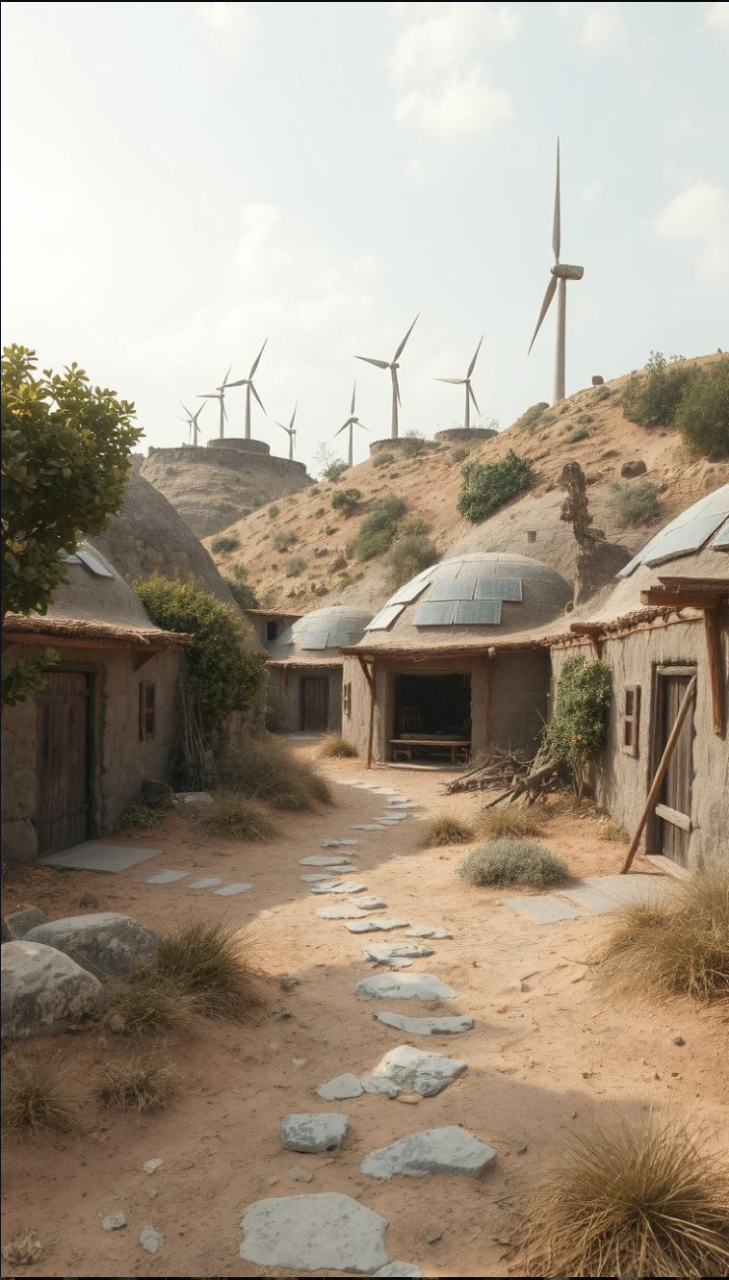
A serene landscape showcasing ancient indigenous housing that embodies proto-sustainability. In the foreground, a group of intricately designed cob houses made of earth and natural materials, each featuring rounded edges and organic shapes. The middle ground reveals a cluster of earthships, solar panels integrated into their architecture, surrounded by flourishing gardens of native plants. The background features rolling hills dotted with greenery and a vibrant sky at golden hour, casting warm light that enhances the earth tones of the structures. The atmosphere is peaceful and harmonious, suggesting a deep connection with nature. Capture this scene with a wide-angle lens to encompass the depth and beauty of the surroundings. This image is created for "The Sustainable Digest".

The term Proto-Sustainability sounds new, but its roots are ancient. Builders long ago designed homes to work with nature. They aimed for comfort using less energy.

Today, we’re rediscovering these old ideas. They focus on how buildings work and use resources wisely. Indigenous architecture is more than just a prototype; it’s a living part of our culture.

Connecting ancient building logic to earthships and cob houses

Indigenous buildings managed heat with thick walls and smart openings. Earthships use earth-berming and heavy walls to keep temperatures stable. It’s like engineering a house to work like a system.

Cob houses are built with clay, sand, and straw. Their walls are dense and can be fixed in place. This method is not regress; it’s a smart use of materials.

Shared principles: thermal mass, passive solar, and local sourcing

Across time, the same ideas keep coming back. Passive solar homes use sun to warm them in winter and cool them in summer. Thermal mass walls store heat and release it slowly.

Building with local materials is key. It reduces transport needs and makes repairs easier. The right material choice is crucial for success.

Design focusCommon thread in older practicesHow earthship design applies itHow cob house principles apply itTypical constraint in the U.S.
Heat storage and releaseThick envelopes buffer daily temperature swingsUses bermed shells and interior mass to stabilize indoor tempsRelies on dense earthen walls to moderate peaks and dipsThermal mass walls can underperform without added insulation in cold zones
Solar orientationOpenings and room layout follow seasonal sun pathsTargets sun-facing glazing for winter gain and controlled shadingPairs window placement with wall mass to reduce overheatingLot shape, setbacks, and neighboring shade can limit exposure
Material sourcingUse what is nearby and workable; replace parts over timeOften mixes local earth with salvaged industrial inputs like tires or bottlesUses site or regional soil blends; repairs can reuse the same mixSoil testing, moisture detailing, and lender expectations add friction
Moisture managementForm, roof lines, and site drainage protect wallsDepends on membranes, drainage layers, and precise detailingDepends on plasters, capillary breaks, and roof overhangsBuilding codes may require specific assemblies and inspections

Where modern interpretations diverge from traditional practice

Today’s buildings often focus on individual needs, not community. This is different from Indigenous structures, which were deeply connected to their people and land.

Modern builds might use industrial materials, while traditional ones relied on local resources. This can lead to higher environmental impacts, especially if materials are imported.

In cold climates, mass alone may not be enough to keep buildings warm. This doesn’t mean the ideas are wrong; it just shows they need to be adapted for today’s conditions.

Indigenous Building Principles That Reduce Environmental Impact

Before we worried about carbon, Indigenous builders built smartly. They used what was easy to carry and avoided hard-to-get resources. This simple rule helped many communities in the U.S. build sustainably.

Building with local, renewable, and salvaged materials

They chose materials based on what was nearby. They used earth, wood, reeds, grasses, stone, and hides. This choice saved time, tools, and energy.

Salvage building was also key. They reused materials after storms or repairs. This way, they didn’t waste anything. Today, we call this circular construction.

Designing for durability, repairability, and reuse

They built to last, not just to look good. They made walls thick, roofs overhang, and floors raised. This made their homes last longer with less work.

They also made houses easy to fix. They could replace parts without tearing everything down. This was better than modern buildings that hide problems until they’re expensive to fix.

PrincipleTraditional performance logicEnvironmental effectMaintenance pattern
Use what the site offersEarth, stone, timber, reeds, and grasses selected for climate fit and availability (local materials)Less transport demand; fewer processing steps for low-impact buildingPeriodic harvesting and careful replenishment of renewable materials
Protect the structureThick walls, raised floors, and roof overhangs reduce sun, rain, and splash-back damageLonger lifespan means fewer replacement cycles and less wasteRoutine inspections; small fixes prevent large rebuilds
Make parts replaceableFinish layers and sacrificial elements can be renewed without disturbing the core (repairable housing)Lower material throughput over time; fewer landfill-bound removalsRe-plastering, patching, re-thatching done with basic tools
Keep materials in circulationRecovered poles, stones, and boards reused when possible (salvage building)Supports circular construction by extending component lifeSorting, storing, and reusing parts as needs change

Low-waste construction methods and closed-loop thinking

They built on-site to reduce waste. This meant less packaging and offcuts. They also made sure materials could go back to nature easily.

This way of building is still smart today. It’s about planning well and avoiding waste. It makes buildings last longer and need less fixing.

Earth-Based Materials: Cob, Adobe, Rammed Earth, and Clay

A serene scene featuring rammed earth walls, showcasing their textured surface and natural hues of browns and ochres. In the foreground, detailed close-ups of the wall’s layered construction reveal the organic materials used, including clay and straw. The middle ground features a rustic building displaying these walls integrated into a culturally relevant structure, surrounded by native plants and sustainable landscaping. In the background, a clear blue sky accentuates the warmth of the sunlight, casting gentle shadows that highlight the architectural details. The atmosphere is tranquil and earthy, reflecting a harmonization with nature. Use soft, natural lighting and a wide-angle lens to create an inviting perspective. The Sustainable Digest.

Earth can be a great material for building, but it needs careful handling. The success of earthen buildings depends on the soil, wall shape, and climate. It’s important to get the details right, especially with flashing.

Start with a solid base and a strong roof. This includes raised foundations, capillary breaks, and big roof overhangs. Then, focus on how the walls handle heat and moisture.

Cob house composition and performance basics

A cob house is made from clay-rich soil, sand, straw, and water. The mixture is pressed into walls by hand. These walls can hold weight if they’re thick enough.

The thickness of cob walls is not just for looks. It also helps with keeping warm and managing moisture. You can shape the walls easily, but remember to add lintels over openings.

Adobe bricks vs. cob walls in different climates

Adobe uses sun-dried bricks, making it easier to plan and fix. You can replace a single brick without redoing the whole wall.

Cob walls are built on-site, fitting well with unique designs. In hot areas, both types keep the inside cool. But in wet places, they need extra care to handle moisture.

Rammed earth: density, strength, and thermal stability

Rammed earth walls are made by pressing damp soil into forms. They are strong and keep heat well. You can even make them look modern.

Old mixes just used soil and compaction. Now, some add cement for strength. But this can increase carbon emissions.

Breathability, moisture control, and natural plasters

Earthen walls can handle indoor humidity. But they need protection from too much water. Also, they should be able to breathe.

Clay plaster is a good finish because it’s easy to fix. Lime can make it last longer in wet spots. Both work best when the wall can dry and the roof keeps rain away.

Material approachHow it is madeStrength and structure notesMoisture and finish strategyBest-fit climate signal in the U.S.
cob house wallsClay-rich soil, sand, fiber, and water placed as a continuous massThick walls carry load; curves add stability; openings need lintels and thoughtful reinforcementRelies on drying potential; clay plaster or lime finish protects while staying compatible with vapor permeabilityPerforms well where rain is manageable with overhangs; needs extra care in humid or flood-prone areas
adobe constructionSun-dried bricks laid with earthen mortar in modular coursesPredictable units support standard details; seismic strategies often include reinforcement and bond beamsRequires raised bases and durable exterior coats; finish choices should respect hygrothermal designStrong match for hot-arid zones with high diurnal swing; detailing becomes decisive in mixed-wet climates
rammed earth wallsSoil compacted in forms in thin lifts; sometimes stabilized with cementHigh density and compressive strength; stabilized mixes increase consistency but change the carbon storySurface can be left exposed if protected from splash and runoff; compatible sealers must not trap moistureWorks across many regions when protected from driving rain; excels where thermal mass is a priority

Passive Heating, Cooling, and Ventilation Before Modern HVAC

Long before thermostats, Indigenous builders in North America used simple rules for comfort. They let the site do the work. This meant buildings faced the sun and winds, and were built to fit the climate.

Walls and floors used thermal mass to keep temperatures steady. Earth-berming and partial burial helped by using the ground’s stable temperatures. Shading strategies, like overhangs, cut glare and heat gain.

Ventilation was designed with purpose. Openings were placed to let in cool air and let out warm air. This natural flow was key to comfort.

In hot, dry areas, cooling was clever. Thermal mass absorbed heat during the day. At night, it released heat by opening pathways for cool air.

Cold comfort came from smart design. Buildings were placed to catch winter sun and were built to keep drafts out. This made heating more efficient.

Passive toolkitHow it works in practicePrimary comfort payoff
Orientation to sun and prevailing windsPlaces entrances, courtyards, and main rooms where winter sun helps and harsh winds are deflectedBetter solar gain with less infiltration
Operable openings for natural ventilationUses cross-breezes and adjustable vents to match daily and seasonal conditionsLower indoor heat and improved air freshness
High/low vent pairing using stack effectLets rising warm air escape high while pulling cooler air in low, especially during cookingMore reliable airflow without fans
Thermal mass and night flushingStores heat in dense materials by day; releases and resets with cool night airCooler evenings and steadier temperatures
Shading strategies and sheltered outdoor spaceBlocks high summer sun with overhangs, porches, and recessed wallsReduced overheating and glare

Modern passive-house thinking is similar. It starts by reducing loads before adding equipment. The difference is in approach. Indigenous methods treated buildings as living systems, adjusted daily.

Regional Case Studies Across the United States

Indigenous architecture in the United States, showcasing traditional structures such as adobe homes, longhouses, and earth lodges nestled in a natural landscape. In the foreground, detailed textures of weathered wood and earth materials reflect ancient building techniques. The middle ground features a cluster of these architectural forms, surrounded by native flora like sage and wildflowers, all under a blue sky with scattered clouds. In the background, rolling hills create a sense of depth and history. The lighting is warm and golden, suggesting late afternoon. The atmosphere is peaceful and natural, symbolizing sustainability and harmony with the environment. The image is devoid of human figures, allowing focus solely on the architecture. The Sustainable Digest.

Across the map, Indigenous architecture United States shows how climate shapes buildings. The shape, material, and labor all depend on the local climate.

What works in one place might not work in another. Copying a design without adapting it is like wearing a parka in Phoenix. It’s not practical.

Southwest adobe and pueblo-style communities

In Southwest adobe pueblos, thick walls slow down temperature changes. This helps keep the inside temperature steady.

Small openings help control heat gain and loss. Shared walls also protect against wind and sun.

Building up instead of out is smart. Stacked rooms create shaded areas and stable temperatures all day.

Plains and Plateau earth lodges and seasonal strategies

On the Plains and Plateau, earth lodges were built with timber frames and soil layers. This helped keep out wind and hold warmth.

These lodges were built to move with the seasons. People followed the food and fuel cycles, not a calendar.

Entrances were low and layouts were compact. This helped manage drafts in open areas where wind was always strong.

Pacific Northwest plank houses and rain-ready design

In the Pacific Northwest, plank houses were built with lots of timber and big interiors. They were made for long, wet seasons.

Steep roofs and raised floors kept water out. Rain-screen traditions were used in the design to manage water.

Wood was chosen for its durability. It could shed moisture and dry out, unlike other materials.

Arctic and Subarctic snow and sod structures for insulation

Farther north, buildings were designed for survival. They had less surface area and fewer leaks to lose heat.

Snow shelters and earth-sheltered forms kept heat in. Insulation with sod was used when timber was scarce.

RegionPrimary formKey materialsClimate pressure addressedBuilt-in performance tactic
SouthwestSouthwest adobe pueblosAdobe, clay plaster, local stoneHot days, cool nights, intense sunThermal mass walls; small openings; shared, clustered massing
Plains & PlateauEarthen lodgesTimber frame, earth cover, grassesHigh winds and winter coldEarth-sheltering; low profile; insulated roof layers
Pacific NorthwestPlank housesCedar planks, heavy beams, bark fibersPersistent rain and humiditySteep roofs; raised edges; rain-screen traditions for drainage and drying
Arctic & SubarcticSnow and sod structuresSnow, sod, earth, limited woodExtreme cold and heat loss riskCompact volume; reduced openings; insulation with sod to seal and buffer
Man, Musical instrument, Indigenous image.

Site Selection and Landscape Integration

In many Indigenous traditions, picking a site was not about a pretty view. It was about avoiding harsh weather. Builders looked at slope, soil, and shade like we read reports today. Landscape integration was a practical choice, not just for looks.

Designing for microclimates started with the sun. Winter sun is free and always there. South-facing slopes extended daylight warmth. Trees and shadows kept summer heat away.

Wind sheltering was simple yet effective. A hill, trees, or rocks could block wind without needing upkeep. Homes were placed where breezes could cool in summer but not freeze in winter.

Access to water was key, but it came with a risk of floods. Settlements were near water but also on higher ground. This kept homes safe from heavy rains.

The land was like a type of infrastructure. Berms, plants, and natural shapes guided water and kept temperatures steady. This approach disturbed the land as little as possible while meeting needs.

Landscape Integration processes

  • Terrain cues helped find where cold air settled and where sun hit first.
  • Resource proximity cut down on waste and unnecessary roads.
  • Patterned placement spread out risks and made access better over time.

Today, we use tools like solar studies and wind roses to understand what the land says. This approach is not just about looking back. It’s about respecting the land’s wisdom before we build on it.

Site factorObserved Indigenous approachModern analysis equivalentPerformance benefit
Sun pathPreference for south-facing exposure and controlled shadeSolar orientation study with seasonal shading reviewMore winter warmth; less summer overheating
Wind and stormsUse of landforms and vegetation for wind shelteringWind rose + setback modeling + storm trackingLower heat loss; calmer outdoor work areas
Water and drainageNear water sources, but with flood-aware placementWatershed mapping + floodplain and runoff modelingReliable access; reduced flood and erosion risk
Soil and ground stabilityBuilding on firm ground with predictable drainageGeotechnical review + infiltration and slope checksFewer cracks and settlement issues; better moisture control
Habitat impactMinimize disturbance to support ecological fit over timeSite disturbance limits + habitat assessmentHealthier soils; stronger long-term resilience
Movement and accessPlacement aligned with travel routes and shared resourcesCirculation planning + service access evaluationLess energy spent moving goods; smoother daily routines

Community-Centered Design, Cultural Continuity, and Stewardship

A vibrant, community-centered design scene showcasing ancient Indigenous buildings nestled in a lush, green landscape. In the foreground, a diverse group of people in modest yet professional attire engage collaboratively, designing and sharing cultural motifs, emphasizing stewardship and connection. The middle ground features intricately crafted Indigenous structures made of natural materials, harmonizing with the surrounding environment. The background reveals rolling hills under a golden sunset, casting warm, inviting light that creates a sense of warmth and belonging. The image captures the essence of cultural continuity, with traditional symbols skillfully integrated into the design. Use a wide-angle lens to enhance the sense of space and community. The atmosphere is peaceful, inspiring, and filled with hope for a sustainable future. The Sustainable Digest.

In many Indigenous building traditions, sustainability was more than just a list of materials. It was a way of life. Buildings were tied to family, place, and work, carrying culture through generations. Decisions were made with care, resources were gathered wisely, and everyone was responsible when weather tested the walls.

Building as a communal process and knowledge transfer

Building together was like building social bonds. People worked, learned, and passed on skills as they went. Tasks were shared, so everyone knew how to fix things when needed.

This way of building taught patience and respect for nature. Materials were chosen based on the season, fitting the climate and terrain. This approach became part of their culture, not just a building phase.

Respecting sacred landscapes and cultural protocols

Where a home sits can hold deep meaning. Indigenous protocols guide what and where to build, to avoid disturbing sacred places. Modern designers must respect these rules, getting consent and understanding sovereignty.

This respect is key to stewardship ethics. It’s about who decides, who benefits, and who takes the risk. It’s not just about following rules, but about understanding the land and its people.

Longevity through maintenance traditions and shared responsibility

Long-lasting homes need regular care, not just repairs. Traditional practices keep homes healthy and strong. Modern promises of “maintenance-free” often mean higher costs and harder fixes.

Practice focusCommunity approachWhat it supports over time
Routine inspections after stormsShared checklists and quick fixes during seasonal gatheringsEarly detection of moisture, settling, and wind damage
Surface renewal (plaster, limewash, clay)Local mixes adjusted to humidity, sun, and wall behaviorMoisture control, breathability, and easier repair cycles
Sacrificial componentsReplaceable layers designed to wear out firstProtection of structural members and reduced material waste
Responsibility and governanceClear norms for who maintains what and whenContinuity of care; fewer deferred repairs and failures

Durability is a shared effort, not just a product claim. Community design and communal building make this effort clear. Traditional maintenance and stewardship ethics keep it going strong. Together, they build a lasting legacy that goes beyond trends.

Water Wisdom: Harvesting, Drainage, and Resilience

In many Indigenous settlements, water planning was a top priority. This was because having water to drink was essential. The way water was managed showed a deep understanding of how to handle water effectively.

Rainwater collection concepts in traditional settlements

Rainwater harvesting was key in these communities. Roofs, courtyards, and footpaths directed water to storage areas. This approach reduced the need for a single water source.

Conservation was a big part of this system. It helped manage water use without wasting it. This careful approach shaped daily life, from water carrying to rationing.

Managing runoff, erosion, and flood risk with landform cues

Managing runoff was like reading the weather. Communities avoided floodplains and used terraces to control water flow. This kept homes safe from water damage.

Today, this approach is still important. It helps buildings withstand heavy rain and dry spells. Proper roof edges and grading are crucial for keeping foundations safe.

Material choices that support moisture resilience

Earthen buildings lasted long with the right care. Moisture management was key. Raised foundations and overhangs protected walls from water damage.

Modern practices follow similar principles. Good drainage and durable finishes are essential. This approach helps buildings last longer and withstand harsh weather.

Water challengeTraditional responseComparable modern practice in the United StatesWhat it protects
Short, intense rainfallDirected roof runoff to safe paths; kept wall bases dry through overhangsGraded swales, downspout routing, and distributed infiltrationFoundations and earthen wall protection
Seasonal scarcity and droughtRainwater harvesting with storage; careful household conservationCisterns, demand management, and drought planningReliable daily supply
Slope-driven washoutsTerraces, berms, and planted edges for erosion controlCheck dams, vegetated buffers, and slope stabilizationTopsoil and access routes
Water at wall baseSacrificial plasters; raised plinths; breathable finishes for moisture detailingCapillary breaks, lime-based renders, and repairable claddingsWall strength and indoor comfort
Overflow during stormsClear drainage corridors; avoided natural low points for flood-resilient designFloodplain avoidance, freeboard, and overflow routingLiving space and critical utilities
A serene landscape showcasing a comparison between traditional Indigenous buildings and modern Earthships. In the foreground, depict a circular Indigenous dwelling made from natural materials like wood and clay, featuring a thatched roof and intricate carvings. In the middle, illustrate a sleek Earthship made from recycled materials, with curved walls and solar panels, surrounded by a lush garden of native plants. The background features a clear blue sky and distant mountains, creating a harmonious atmosphere. Use warm, natural lighting to evoke a sense of tranquility, capturing the essence of sustainability. The perspective should be slightly elevated, highlighting both architectural styles in a balanced view. This image is intended for The Sustainable Digest, reflecting the theme of environmental harmony.

Comparing Traditional Indigenous Buildings and Modern Earthships

When we look at traditional Indigenous buildings and earthships, we see a big difference in purpose. Indigenous homes were built for community and shared work. Earthships, on the other hand, focus on individual freedom and avoiding utility bills.

Materials also play a key role in this comparison. Traditional buildings used natural materials like soil and wood. Earthships, while using natural materials, also include items like tires and bottles, making them more complex.

Systems thinking is another area where earthships and traditional buildings differ. Earthships can be very efficient in the right climate, especially with a well-designed greenhouse. But, they can also struggle with moisture and overheating, unlike traditional buildings that were often tested over time.

Traditional vs. Modern sustainable dwelling

Comparison lensTraditional Indigenous buildingsModern earthships
Primary purposeCommunity continuity, shared skills, seasonal rhythms, and long-term stewardshipOff-grid experimentation, household autonomy, and integrated systems under one roof
Typical material profileBiogenic and earthen materials; minimal processing and straightforward repairHybrid salvage plus industrial inputs (tires, bottles, concrete, liners); detailing is more technical
Operational strategySeasonal operation and climate-tuned form; comfort managed with habits and architectureIndoor climate managed through mass, glazing, and water/air systems; earthship performance varies by region
Embodied impactLower embodied carbon in many cases; simpler end-of-life pathways and reusePotential landfill reduction; embodied carbon can rise with cement and specialized components
Regulatory and health frictionOften compatible with natural-material codes when properly engineeredPermitting can be harder; tire walls and airtight zones can raise air-quality and inspection concerns
Design meaningStrong cultural context in architecture; forms reflect place, identity, and protocolAesthetic is often mistaken for tradition; borrowing principles differs from borrowing identity

It’s important to understand the cultural context of architecture. Climate design can be universal, but cultural symbols should not be used lightly. This is because cultural context in architecture is not just about looks.

For those planning and building, the choice between traditional and earthship homes is not easy. Simple designs are often easier to maintain, but earthships offer a unique challenge. Even a well-designed greenhouse can be a blessing or a curse, depending on how it’s built and the climate.

Ancient Indigenous buildings seamlessly integrated into a lush, sustainable landscape, showcasing climate-appropriate design principles. In the foreground, a diverse group of professionals, dressed in modest casual attire, examine eco-friendly materials like rammed earth, bamboo, and recycled wood. In the middle ground, a cluster of intricately designed structures with organic shapes and green roofs, featuring large windows that maximize natural light and ventilation. The background reveals a vibrant forest, harmonizing with the architecture. Soft, golden hour lighting bathes the scene, enhancing the warm, inviting atmosphere. The composition is captured from a low angle, emphasizing the grandeur of the buildings while inviting a sense of connection to nature. A serene, inspirational mood embodies the essence of sustainable homebuilding for modern times. The Sustainable Digest logo is subtly represented in the design elements.

Design Takeaways for Sustainable Homebuilding Today

Building homes sustainably is simpler when we first ask: what does this site demand? Designing for the climate starts with understanding the sun, wind, rain, and soil. Using materials that fit the site is key, even if they seem natural.

When deciding between thermal mass and insulation, form is as important as material. A deep porch can be as effective as any technology in hot weather. It’s all about how well the design fits the climate.

The choice between thermal mass and insulation is a puzzle. Heavy walls can keep temperatures steady, but only if they’re right for the site. Insulation cuts energy use, but can trap moisture if not designed to dry.

Ventilation

A good ventilation strategy is crucial for air quality and moisture control. Even the smallest duct or vent can do the most important work.

Design teams should work together, not against each other. Using operable windows and heat pumps can reduce energy needs. The best design is like a weather forecast, guiding how the house interacts with the environment.

Ethical building strategies

Ethical design means more than just inspiration. It’s about respect and responsibility. Using Indigenous wisdom is valuable, but it must be done with care and consent.

In the U.S., building codes and insurers set the rules. A smart approach includes small tests and clear documentation. Understanding soil and moisture behavior is essential, no matter how beautiful the designs.

Decision pointCommon optionWhat to check earlyWhy it matters in the U.S.
Form and orientationCompact massing with tuned glazingOverhang depth, summer shading, winter solar accessSupports climate-appropriate design across hot-arid, cold, and mixed-humid zones
Wall assemblyHigh mass wall, insulated frame, or hybridThermal mass vs insulation balance; drying potential; dew-point riskReduces comfort swings and moisture damage without overbuilding
Fresh air and moistureNatural + mechanical ventilationVentilation strategy, filtration needs, exhaust locations, makeup airImproves indoor air quality and helps control humidity during wildfire smoke and humid summers
Permitting pathwayPrototype wall, lab tests, early plan reviewBuilding codes earthen homes, engineering sign-off, insurer requirementsPrevents redesign late in the process, when budgets become “historical artifacts”
Reference and storytellingLearning from Indigenous precedentsAttribution, consent, avoiding sacred motifs, fair compensationKeeps ethical design inspiration grounded in respect and real accountability
  • Prototype first: build a small wall or shed to observe drying, cracking, and detailing before scaling up.
  • Test what is local: confirm soil performance and stabilizer needs rather than trusting assumptions about “natural.”
  • Meet reviewers early: a short conversation can surface code paths, required reports, and inspection expectations.

Conclusion

This summary shows a key truth: many Indigenous buildings in the United States were made for the climate, not just for looks. They used the sun, wind, and shade wisely. Their walls were made from local materials and controlled moisture well.

Waste was low because they focused on fixing, reusing, and seasonal care. This approach made their buildings last long.

The lessons from Indigenous architecture teach us about care, not just warranties. Earth-friendly homes work best when they see maintenance as part of life. These sustainable design principles are seen in small details that prove their worth in storms.

Earthships and cob houses can be good choices if they fit the site and handle local weather. But, Indigenous architecture is more than just a style. It’s about the land, community, and freedom.

When we borrow Indigenous designs without understanding their context, we harm. This turns design into a form of taking without giving back.

The main lesson for building homes in the United States is to learn from the site. Respect its limits and design for repair from the start. Sustainability is about building a relationship with the land, not just adding features.

Build homes that last as long as the landscape, because they will. This approach is not just practical but also respectful of the environment.

Key Takeaways

  • proto-sustainability helps explain why many Indigenous architecture systems perform so well in local climates.
  • ancient housing often relied on thermal mass, passive solar gains, and smart airflow instead of mechanical systems.
  • sustainable building history looks different when vernacular design is treated as engineering, not folklore.
  • climate-responsive homes share principles across regions, but details change with weather, soils, and available fibers.
  • United States traditional buildings can inform modern practice without copying cultural meaning or sacred forms.
  • earthships and cob houses echo older strategies, yet diverge through industrial materials and code-driven constraints.

Prehistoric Anthropology, Archaeology, and Climate Sustainability and its impact through the ages

Prehistoric anthropology archaeology geography impact climate sustainability

This article treats deep Earth history as a working laboratory. It traces the record from the Hadean to a debated Anthropocene to show how oxygenation, icehouse episodes, and mass extinctions rewired global cycles and habitats.

The narrative links geology, palaeobiology, and human evidence so readers gain a long-run perspective on how systems adapt and fail. Field data and stratigraphy form the core evidence; artifacts and settlement patterns act as behavioral logs across years and millennia.

The aim is practical: to turn deep-time knowledge into clearer models for today’s managers and designers. Readers will see a four-part arc—Precambrian baselines, Phanerozoic pivots, Quaternary shifts and a Holocene case—each offering lessons about feedbacks, resilience, and trade-offs.

Deep-Time Baselines: Precambrian foundations for Earth’s environmental and ecological systems

From core formation to the first oceans, Earth’s early chapters fixed many long-term boundary conditions. These foundational events shaped how atmosphere, hydrosphere, and lithosphere interacted across vast years.

Hadean and Eoarchean: planet assembly and an emerging hydrosphere

Accretion and core differentiation produced a stabilizing crust. Volatile delivery and early outgassing seeded surface waters. Those nascent environments set the stage for later biological experiments.

Archean: first biospheres and continental growth

Microbial mats and stromatolites began biologically mediated carbon cycling. Emergent continental fragments changed weathering, which moderated greenhouse gases and altered ocean redox conditions.

Paleoproterozoic Great Oxidation Event

Rising oxygen rewired surface chemistry: oxidative weathering, methane drawdown, and cooling tendencies followed. These changes restructured nutrient delivery and ecological conditions.

Mesoproterozoic: relative calm and nutrient limits

Tectonic quiescence and low phosphorus in oceans enforced long-lived steady states. Limited oxygen gradients constrained complexity and damped variability in ecosystems over long years.

Neoproterozoic: extremes to multicellularity

Near-global glaciations alternated with greenhouse recoveries, amplifying climate variability. Post-glacial oxygen and micronutrient pulses opened ecological niches and supported multicellular innovations.

Methodological note: Isotopic records (C, S, Sr), sedimentology, and paleobiology together reveal patterns linking tectonics, atmosphere-ocean chemistry, and ecosystems—precursors to later systems and modern interpretations of environmental changes and their impacts.

Phanerozoic pivots: Biodiversity booms, mass extinctions, and ecosystem restructuring

A lush Phanerozoic landscape, teeming with diverse life. In the foreground, a vibrant ecosystem of towering ferns, cycads, and ancient horsetail plants. Across the middle ground, a shimmering prehistoric lake reflects the sky, surrounded by towering gymnosperms and amphibious tetrapods. In the distance, rugged mountains rise, capped with glaciers under a golden-hued, diffuse lighting. Capture the dynamic interplay of life, extinction, and the resilience of the biosphere for "The Sustainable Digest".

Across the Phanerozoic, bursts of innovation and sudden collapses repeatedly reconfigured habitats and resource flows. That long-run record shows how biological novelty and external stressors combine to alter ecosystems, from shallow seas to ancient floodplains.

Cambrian: Novel body plans and trophic intensification

The Cambrian Explosion introduced diverse body plans and new predators. Food webs grew more complex and nutrient cycling sped up.

These changes altered marine environments and set new baselines for ecological stability over geologic years.

Ordovician–Silurian: Marine diversification and the first plants ashore

Marine life diversified further while simple plants colonized land. Weathering increased, drawing down CO2 and triggering early cooling.

Glaciations during this interval illustrate how biological feedbacks can amplify natural variability.

Devonian–Carboniferous: Forests, coal, and oxygen shifts

Expanding forests buried vast carbon in coal seams. Oxygen rose and temperatures trended downward.

Terrestrial landscapes matured, creating new habitats and changing how populations accessed resource and nutrients.

Permian to Mesozoic: Crisis and greenhouse recovery

Siberian Traps volcanism ushered in aridity, ocean anoxia, and the greatest extinction; ecosystems simplified and food webs collapsed.

The Mesozoic greenhouse favored reptilian radiations until a bolide at the end of the Cretaceous reset available niches and landscapes.

Cenozoic cooling: From Paleogene warmth to Neogene preconditioning

Early Paleogene warmth gave way to Oligocene ice initiation and Neogene oscillations. Long-term cooling preconditioned later ice ages.

This perspective emphasizes that carbon burial and mass die-offs are tightly coupled to environmental forcing; rapid change can produce outsized effects on recovery pathways.

Quaternary variability to Holocene stability: Human settlement patterns amid climate change

Quaternary rhythms set the stage for shifting coastlines, retreating ice, and new human routes across northern landscapes.

Pleistocene context: The Gelasian, Calabrian, Chibanian, and Late Pleistocene mark repeated glacial-interglacial swings. Ice sheets carved corridors and shorelines, shaping where groups could move and forage.

Pleistocene (Gelasian–Late)

By 15,000 years ago melting ice sheets warmed North America; rivers reorganized and wetlands formed. A short stasis led to the Younger Dryas reversal near 12,900 years ago, returning near-ice age conditions for centuries.

15,000–11,500 years ago

Temperatures rebounded to near-modern by 11,500 years ago, stabilizing habitability. Excavations in the Roanoke River Valley reveal repeated site use, stone tool manufacture, and charcoal suitable for radiocarbon dating.

“River terraces preserve campsites and sediment records that link local landform change to wider regional signals.”

IntervalKey effectHuman response
PleistoceneGlacial-interglacial shiftsMobility, corridor use
15,000–11,500 years agoRapid warming + Younger DryasSite reuse, opportunistic camps
Holocene (Greenlandian–Meghalayan)Reduced variability, stable riversDenser settlement, early agriculture

Anthropocene frames how human land-use and greenhouse forcing now rival natural drivers, tightening expectations for water, flood risk, and resource planning.

Archaeology in action: Roanoke River Valley evidence for climate-landscape-people dynamics

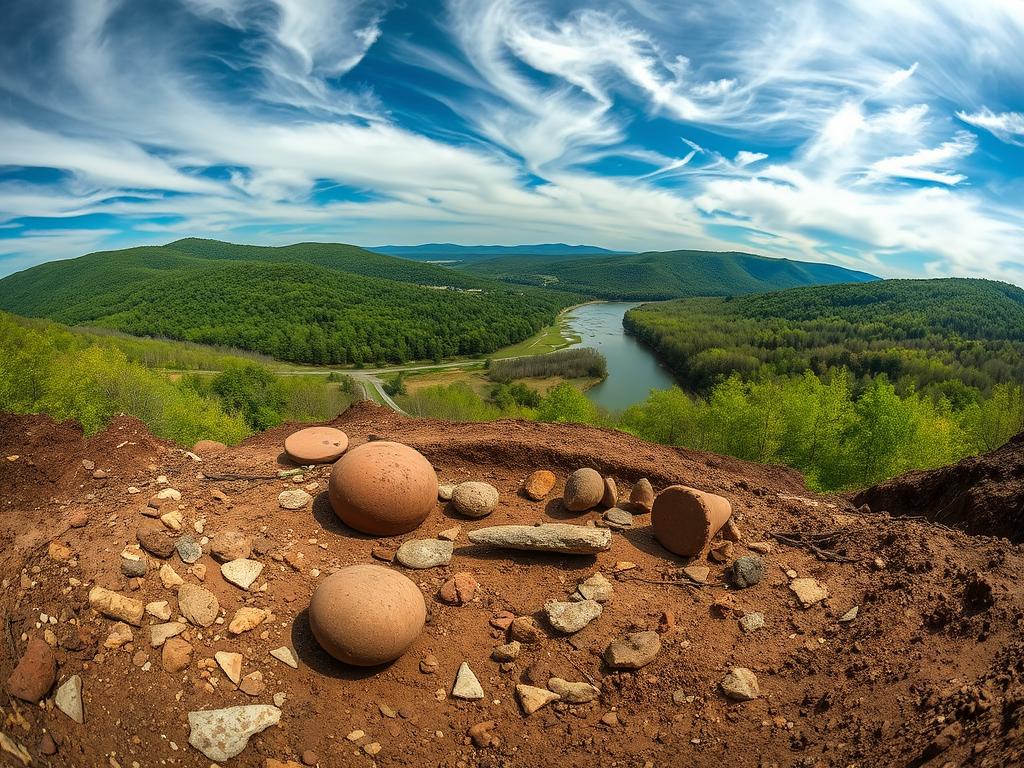
A picturesque Roanoke River valley landscape, with rolling hills, lush forests, and a meandering river cutting through the terrain. In the foreground, ancient stone tools and pottery shards litter the ground, remnants of past human settlements. The middle ground features a dig site, where archaeologists meticulously uncover clues about the lives and adaptations of the region's prehistoric inhabitants. In the background, a dramatic sky filled with wispy clouds, hinting at the region's dynamic climate history. The scene is captured with a wide-angle lens, creating a sense of depth and immersion. This image, commissioned for "The Sustainable Digest," encapsulates the interplay between archaeology, climate, and the human experience in the Roanoke River valley.

Fieldwork along the Roanoke River reveals how river corridors guided human choices across millennia; terraces and camps tell a story of repeated occupation and strategic location selection.

Repeated occupations over millennia

River terraces preserve campsites used seasonally or yearly for roughly 5,000 years, with key occupations dated about 10,000–13,000 years ago. Stone tool flakes, hearth charcoal, and refitting debris form a robust chain of evidence that these sites were revisited as resources fluctuated.

Data and methods

Excavations by teams from NC State, the Smithsonian, and National Geographic combined radiocarbon dating of charcoal with sediment cores and particle-size analyses. This methodological triangulation lets archaeologists link human layers to episodes of terrace formation or incision.

River dynamics and risk

The pattern shows how groups optimized mobility and resource use; transported lithics indicate regional networks. Comparative work in other valleys clarifies when local river behavior drove site choice versus wider regional shifts.

  • Practical takeaway: Where terrace evidence shows instability, development should respect geomorphic warnings; stable surfaces merit conservation and cultural protection.

Prehistoric anthropology archaeology geography impact climate sustainability

Integrating site finds and landscape signals reveals how people adjusted subsistence and settlement when conditions shifted.

Integrating evidence: Combine artifact and feature-level data with geomorphic maps and proxies (charcoal, particle-size, geochemistry) to reconstruct coupled human–environment systems over long years.

Modeling adaptation: Parameterize settlement patterns and subsistence choices using past variability. Sensitivity tests show small hydrologic or temperature changes can cascade through resource networks and occupations.

Population dynamics and decision-making: Demographic pulses align with stable landscapes; contractions follow channel migration or drought. Comparative, journal anthropological reviews synthesize convergent ways societies reorganize under stress.

Evidence typeSignalManagement cue
Site artifacts & hearthsOccupation intensity, subsistence shiftsProtect cultural sites; integrate into zoning
Geomorphology (terraces, floodplains)Surface stability, channel migrationMap buffers; avoid high-risk development
Environmental proxiesFire, drought, temperature trendsTrigger early-warning and scenario planning

Policy relevance: Align hazard mapping with community rights and land stewardship. Practical tools —multi-criteria analysis and early indicators—translate past knowledge into equitable land-use decisions today.

Conclusion

Deep records from oceans and rocks show repeated environmental turns that shape living systems and human choices. From Precambrian oxygenation through Phanerozoic extinctions and Quaternary ice age cycles, the long view shows that change is recurrent and often abrupt.

The rapid swings 15,000–11,500 years ago remind planners that systems can reorganize within decades; those years ago are a cautionary baseline for today’s accelerated forcing.

Archaeologists and earth scientists together link settlement, grain-size signals, and river behavior to reveal how populations use land and adapt location choices.

Policy must protect adaptive capacity: flexible land use, iterative monitoring, and cultural refugia. Cross-disciplinary groups produce better hazard maps and more equitable outcomes for communities across years to come.

Key Takeaways

  • Deep-time records provide a baseline for understanding long-run system behavior.
  • Oxygenation events and tectonics reshaped carbon and nutrient cycles.
  • Human decisions are recorded in artifacts that bridge environment and policy.
  • Interdisciplinary methods (stratigraphy, geochemistry, settlement studies) strengthen inference.
  • Past variability offers practical lessons for modern resource and risk planning.

Global Carbon: pricing, taxes, crediting, projects, footprint, REC, ESC, storage Explained

Global Carbon: pricing, taxes, crediting, projects, footprint, REC, ESC, storage

This Ultimate Guide frames how price signals, compliance schemes, voluntary credits, and renewables fit for U.S. decision-makers and international planners.

The landscape hit a record in 2022: revenues neared USD 100 billion and EU allowances reached €100. Yet most emissions still trade at modest levels; fewer than 5% face prices near the $50–$100/tCO2 range suggested for 2030.

Readers will get clear, practical steps on procurement choices—unbundled renewables, PPAs, and green tariffs—and guidance on integrity standards such as Core Carbon Principles and CORSIA. The piece contrasts direct instruments (tax and ETS) with hybrid standards and voluntary instruments that complement compliance systems.

Expect concise analysis of supply trends: renewables drove most credit issuance, nature-based registrations rose, and removals technology is growing under stricter quality screens. U.S.-specific notes touch on RGGI, SREC differences by state, and the federal solar ITC through 2032.

Carbon pricing at present: where markets, taxes, and credits stand now

Today’s price signals mix steady market gains with glaring coverage gaps that shape near-term decisions.

What a “price on carbon” means today for climate and energy decisions

A price on carbon is a monetary signal embedded in consumption and production choices; it nudges investment toward low-emitting assets and away from legacy polluters.

The tool works by raising the cost of emissions and making abatement economically visible. In 2022 revenues approached nearly USD 100 billion, while the EU ETS breached a symbolic €100 level — proof that robust signals can persist despite shocks.

Coverage versus price: why both matter for impact

Impact requires two levers: sufficient price levels to change marginal decisions, and broad coverage so a large share of emissions respond.

  • About 23% of global emissions were under ETS or levy systems by April 2023.
  • Fewer than 5% of ghg emissions faced direct prices in the $50–$100/tCO2 band, so many sectors remain exposed.

Markets and credits (compliance vs voluntary) both influence cost curves; only direct pricing enforces statutory abatement. Corporates should set internal price signals, align procurement, and rely on quality offsets to bridge near-term gaps. Solid data tracking is essential to forecast exposure and hedge procurement risks.

The pillars of pricing: carbon taxes, ETS, and hybrid systems

An intricately detailed, photorealistic image depicting the pillars of carbon pricing - a complex system of carbon taxes, emissions trading schemes (ETS), and hybrid systems. Showcase the inner workings of an ETS, with close-up views of emission allowances, trading platforms, and the intricate web of regulations. Capture the macro-level interactions between governments, industries, and the carbon market, set against a backdrop of modern cityscapes and industrial landscapes. Convey a sense of urgency and the high stakes involved, with muted tones and dramatic lighting. Prominently feature the brand "The Sustainable Digest" in the lower right corner.

The policy toolkit breaks into three practical choices: a per‑unit levy, a capped allowance market, and hybrids that mix benchmarks with trading. Each design shapes incentives and risk differently for firms and regulators.

Carbon tax fundamentals and current ranges in practice

A tax sets a transparent per‑ton price on emissions (or fuel). It is easy to administer and makes revenue predictable; governments can return funds as dividends or cut other levies.

Examples include Singapore’s planned rise to about USD 38–60 from 2026 and Canada’s pathway toward roughly USD 127 by 2030. Higher‑income jurisdictions often reach prices above $50 per tonne; middle‑income ones pilot lower levels while building measurement systems.

Emissions Trading Systems: caps, allowances, and trading

ETS create a cap on total emissions; regulators issue allowances (EUAs, UKAs, NZUs, KAU) that firms buy, sell, or bank. The cap delivers quantity certainty while markets reveal marginal abatement costs.

Hybrid models: OBPS, EPS, and regional cap-and-trade like RGGI

Hybrids try to shield trade‑exposed sectors. Output‑based performance standards (OBPS) and emissions performance standards (EPS) set benchmarks instead of pure per‑unit charges.

  • RGGI auctions allowances and directs proceeds to regional programs.
  • Hybrids reduce leakage but add design complexity and reliance on strong MRV for compliance.

Global price signals and coverage by region, based on World Bank 2023

Regional price bands reveal as much about institutional capacity as they do about political will. As of April 2023, 73 instruments covered roughly 23% of emissions worldwide. Yet less than 5% of ghg emissions faced a high‑level signal in the $50–$100/tCO2 range.

High-income versus middle-income bands

High‑income jurisdictions often cluster above $50 per ton; the european union’s ETS even hit €100, reinforcing strong market responses and revenue recycling.

Middle‑income systems mostly price under $10. Exceptions—Beijing and Guangdong pilots, Mexico’s subnational measures, and Latvia’s tax—show how pilots build MRV and administrative muscle.

Why coverage matters as much as price

A high signal on a sliver of emissions is not the same as modest signals applied broadly. A $75/t signal on 5% of emissions underperforms a $25/t signal covering half the economy when the goal is near‑term structural change.

  • Constraints: fossil fuel subsidies and energy volatility can blunt signals.
  • Capacity: MRV and admin readiness are gating factors for expansion.
  • Implication: closing the

Revenues from carbon pricing: record highs and how funds are used

Governments saw nearly USD 100 billion arrive from emissions-related instruments in 2022, shifting the budget conversation.

Most of that cash came from traded allowances rather than direct levies. About 69% of receipts were generated by ETS mechanisms, while roughly 31% came from tax-based schemes. The EU’s system alone produced about $42 billion in 2022 — nearly seven times its 2017 level — as auctioning replaced free allocation.

How countries recycle proceeds

Use of funds varies but trends are clear: roughly 46% of revenue is earmarked for targeted programs, 29% flows to general budgets, 10% serves as direct transfers (social cushioning), and 9% offsets other taxes.

Revenue SourceShare (2022)Main Uses
ETS (auctioning)69%Clean energy, innovation, adaptation
Tax-based levies31%Budget support, rebates, targeted transfers
EU auctioning$42BMarket tightening, transition aid, R&D

Policy implications

Predictable recycling improves public support and compliance. In the U.S., RGGI shows how reinvestment in efficiency and community programs builds durability.

Yet revenues remain price‑sensitive: allowance downturns or tax adjustments can cut fiscal inflows and weaken program credibility. Sound data tracking and transparent use of proceeds help stabilize expectations for investors and households alike.

Compliance markets around the world: EU ETS, China ETS, UK, K-ETS, NZ, Australia

A panoramic landscape showcasing the intricate workings of global carbon markets. In the foreground, a detailed illustration of the EU Emissions Trading System (EU ETS), with its trading platforms, registries, and compliance mechanisms. In the middle ground, smaller vignettes depict the China ETS, UK ETS, K-ETS, NZ ETS, and Australia's carbon pricing schemes. The background features a montage of renewable energy projects, carbon storage facilities, and sustainable technologies. The scene is bathed in warm, golden light, conveying the sense of progress and innovation in the world of climate finance. The brand "The Sustainable Digest" is subtly integrated into the artwork. Photorealistic rendering with a blend of macro and micro perspectives.

Compliance markets now form the backbone of many national climate strategies; each system creates unique signals for firms and regulators.

EU ETS and UK ETS: alignment, divergence, and EUA pricing dynamics

The european union’s ETS remains the largest by value and a global price benchmark. Its auction cadence and market design drive allowance liquidity and long-term expectations.

The UK launched an independent ETS in 2021. Designs share DNA, but governance differences have produced divergent EUA and UKA prices paths and trading patterns.

China’s power-sector ETS and expected sectoral expansion

China’s system started in 2021 and covers roughly 40% of national emissions through the power sector. Authorities plan phased expansion to steel, cement, and other heavy industries.

That expansion will reshape regional supply-demand dynamics and create larger cross-border hedging needs for firms exposed to Asian markets.

K-ETS, NZ ETS, and Australia’s ACCUs: coverage and policy evolution

South Korea’s K-ETS (2015) now covers about 75% of S1+S2 emissions and is in a liquidity-building phase.

New Zealand’s scheme covers more than half the national total; agricultural treatment remains an open policy frontier under review.

Australia relies on ACCUs as domestic offset-like units, with a cost-containment cap rising to AUD $75/tonne (CPI+2). These rules influence corporate hedging, procurement timing, and exposure across both allowances and offsets.

Voluntary carbon market and standardized contracts

A new set of futures—segmented by supply type and verification—lets buyers hedge quality risk ahead of delivery.

N-GEO: nature-based baskets

N-GEO packs verified AFOLU credits (Verra) into a tradable instrument. It aggregates forest and land‑use supply to smooth price swings and capture co‑benefits; buyers get bundled nature exposure with predictable forward quantities.

GEO: CORSIA-aligned aviation units

GEO mirrors ICAO CORSIA rules and draws from Verra, ACR, and CAR. That alignment tightens eligibility and raises baselines for aviation-grade integrity; it helps airlines meet offsets for international emissions while improving market trust.

C-GEO and Core Carbon Principles

C-GEO focuses on tech-based, non-AFOLU units that meet the Integrity Council’s CCPs. The CCPs set a quality floor—MRV rigor, permanence, governance—and narrow seller pools; the result is clearer pricing for high-integrity credits.

ContractSupply TypeKey Benefit
N-GEONature-based (Verra)Co-benefits; cheaper forward supply
GEOCORSIA-eligible (Verra/ACR/CAR)Aviation-grade acceptance; tighter eligibility
C-GEOTech removals (CCP-aligned)Higher integrity; lower permanence risk

Practical advice: blend N-GEO, GEO, and C-GEO to balance cost, quality, and forward certainty; use futures for trading and hedging. Note that some compliance regimes may recognize limited voluntary units under strict rules.

Projects and supply: renewable energy, nature-based solutions, and REDD+

A panoramic landscape showcasing an array of renewable energy projects, bathed in warm, golden hour lighting. In the foreground, a sprawling solar farm with sleek, reflective panels capturing the sun's rays. In the middle ground, towering wind turbines gracefully spinning, their blades cutting through the crisp air. In the distance, a gleaming hydroelectric dam nestled between lush, rolling hills. The scene is punctuated by pops of green foliage, hinting at the integration of nature-based solutions. The entire composition is captured with a cinematic, wide-angle lens, conveying a sense of scale and ambition. The Sustainable Digest brand name is subtly woven into the natural environment.

Patterns of supply now show dominant renewable energy output alongside a surging nature-based pipeline.

Renewable energy projects accounted for roughly 55% of issued units in 2022 and about 52% of retirements; wind and solar led issuance while falling technology costs reduced additionality concerns for large installations.

That decline in cost suggests issuance from new renewable energy schemes may taper as grid parity widens; buyers should expect shifting supply mixes over multi-year horizons.

Nature-based supply and REDD+

Nature-based solutions made up about 54% of new registrations in 2022, driven by biodiversity and livelihoods co-benefits; avoided deforestation (REDD+) and improved forest management remain core AFOLU sources.

  • REDD+ design focuses on avoided loss, leakage controls, and permanence buffers to manage long-term risk.
  • Latin America—Brazil, Colombia, Chile—updated forestry rules in 2023, expanding pipelines and governance.

Risks persist: baseline integrity, permanence, and social safeguards determine investability and unit performance over time.

Buyer advice: match geography and methodology to claimed outcomes (avoided emissions vs removals); prefer blended portfolios and multi-year contracts to hedge supply and quality risk.

Renewable Energy Credits (RECs) and SRECs: how they work and how to buy

Renewable energy certificates certify one megawatt-hour of clean generation; they capture the attribute of green power, not the physical electron. Think of a serial-numbered proof of production.

The issuance process includes a unique registry serial, a generation timestamp, and a formal retirement step to prevent double counting. These tracked credits let buyers claim renewable energy use while grids mix electrons.

Procurement pathways

  • Unbundled certificates deliver speed and flexibility; they are lowest-friction for offsetting consumption.
  • PPAs provide additionality and long-term price certainty for a larger renewable energy project.
  • Utility green tariffs and green pricing are simple on-ramps for organizations that prefer a managed offering.
  • On-site self-generation produces SRECs or surplus certificates that can offset local loads or be sold into the market.

Prices and policy basics

SRECs—solar-specific certificates—vary widely by state, often ranging from about $10 to $400; some wind certificates trade as low as $1–$8. The U.S. federal solar investment tax credit (ITC) is 30% for systems installed through 2032, which affects payback and overall cost.

Practical buyer advice

Match vintage and geography to program rules and distribute purchases across sites for proportional coverage. For compliance users, ensure certificate attributes meet local requirements and that retirement is verifiable to avoid claims that conflict with emissions accounting.

RECs vs carbon credits: different instruments, different impacts

Detailed photorealistic image of a diverse range of renewable energy sources, including wind turbines, solar panels, hydroelectric dams, geothermal plants, and biofuel production facilities. The scene showcases the interconnected nature of these technologies, with clean energy infrastructure seamlessly integrated into natural landscapes. Vibrant colors, sharp focus, and dramatic lighting create a sense of power and progress. In the foreground, a central display prominently features the logo "The Sustainable Digest", highlighting the publication's focus on renewable energy and sustainability. The overall composition conveys the message of a sustainable future powered by clean, renewable sources.

RECs and carbon credits play distinct roles in corporate climate strategy. One documents renewable electricity attributes in kWh; the other represents a tonne of avoided or removed CO2e.

Offsetting electricity (kWh) versus GHG mitigation (tCO2e)

Market-based Scope 2 accounting recognizes renewable energy certificates for electricity use. That helps firms claim green energy consumption without changing grid flows.

By contrast, a carbon credit quantifies a reduction or removal of carbon emissions. Those units address Scope 1 or Scope 3 exposures where allowed.

  • Clarity: RECs = attribute per kWh; carbon credits = tonne-level mitigation.
  • Accounting: use market-based certificates for electricity; apply high-quality offsets for residual emissions.
  • Integrity: disclose boundaries, vintage, and methodology to avoid double claims.

Combine efficiency, on-site renewable energy, and then select verified credits for remaining emissions. Over-reliance on unbundled certificates can look cosmetic and risk reputation. A balanced portfolio gives both energy claims and real emissions results.

ESC and performance-based approaches: EPS, OBPS, and sector benchmarks

Where full economy-wide charges stall, performance approaches offer a pragmatic path for hard-to-abate industries. Canada’s OBPS taxes emissions above output-based benchmarks; the UK operates an EPS model; several U.S. states use similar standards.

How they work: intensity targets tie allowable pollution to production output. Facilities that beat the benchmark can earn tradable compliance units; those that lag must pay or purchase units to meet obligations.

Policy position: hybrids fill gaps where full caps or levies face political or administrative hurdles; they also reduce leakage risk for trade-exposed firms. Benchmarks often sit alongside an ets or free allocation, shaping who gets credits and who pays.

  • Design note: benchmarks reward intensity improvements rather than absolute cuts.
  • Market interaction: over-performance creates supply of compliance units that trade in secondary markets.
  • Industry advice: audit baselines, plan capital upgrades, and register performance early to monetize gains where allowed.

For companies, the practical step is simple: measure ghg and output carefully, test upgrades against benchmarks, and treat these systems as another compliance channel in carbon risk planning.

Carbon storage and removals in markets: from nature to tech

A breathtaking landscape showcasing the future of carbon storage and removal technologies. In the foreground, a towering carbon capture facility stands proud, its sleek design and efficient operation a testament to human ingenuity. The midground reveals lush, verdant forests, nature's own carbon sinks, with intricate leaf structures and vibrant hues. In the distance, rugged mountains rise, their rocky peaks capped with pristine snow, a symbol of the delicate balance between technology and the natural world. Lighting is soft and directional, casting gentle shadows and highlighting the textures of the scene. The overall mood is one of hopeful optimism, a vision of a sustainable future where "The Sustainable Digest" chronicles the progress of carbon management.

Not all removals are created equal; the market is learning to pay a premium for permanence. Nature-based options (afforestation, reforestation, improved forest management) supply broad volumes, while engineered solutions (DACCS, mineralization) deliver durability at higher cost.

Nature-based versus tech-based crediting

Removals remove CO2 from the atmosphere; avoided emissions prevent further releases. Markets now price that difference—true removals command higher rates because they reduce legacy concentration.

Permanence and risk differ sharply. Tech-based removals tend to offer stronger durability; nature-based supply needs buffers, monitoring, and active stewardship to manage reversal risk.

  • Cost profile: tech = premium; nature = larger supply but integrity scrutiny.
  • Procurement tip: match a carbon offset type to your claim—removal vs reduction—and budget limits.
  • Standards matter: CCPs and CORSIA-style rules push clearer disclosure and better MRV.

Buyers should blend units: use nature for volume and tech removals to meet permanence needs and reputation goals.

Measuring your carbon footprint and using credits/RECs credibly

A modern, well-lit office space, with large windows letting in natural light. In the foreground, a desk with a laptop, calculator, and various carbon measurement tools - emissions calculators, energy usage monitors, and carbon accounting software. The mid-ground features a team collaborating, discussing data and analyzing charts on the screen. In the background, a wall-mounted display shows a detailed carbon footprint analysis, with different sectors and emissions sources highlighted. The overall mood is focused, professional, and data-driven. "The Sustainable Digest" logo is subtly incorporated into the scene.

Accurate measurement and clear rules turn good intentions into credible climate claims. Start by defining boundaries for Scope 1, Scope 2 (location vs market-based), and Scope 3 so inventories reflect actual operational exposure.

Scopes, market-based accounting, and avoiding double counting

Market-based Scope 2 accounting recognizes renewable certificates; standardized registries use serial numbers and retirements to prevent duplicate claims. Voluntary retirement reached roughly 196 million units in 2022, showing market maturation.

Document contracts, attestations, and registry retirements clearly; auditors expect traceable records. This practice reduces reputational risk and improves compliance readiness.

Integrating efficiency, renewables, and high-quality offsets

Follow a hierarchy: improve efficiency first, then buy renewables through PPAs or on-site systems (the U.S. solar ITC offers a 30% incentive through 2032), and use high-quality credits only for truly residual emissions.

Practical tip: set an internal carbon price to steer capital and align procurement with expected external signals. Transparent reporting, registry exclusivity, and strong data governance keep claims defensible.

Global Carbon: pricing, taxes, crediting, projects, footprint, REC, ESC, storage

A striking photograph showcasing the diverse forms and textures of carbon in its natural and industrial states. The image features a central close-up of a graphite pencil tip, revealing the intricate, layered structure of this allotrope. Surrounding it, a series of macro and micro shots depict the raw mineral form of graphite, the amorphous structure of activated charcoal, and the geometric patterns of carbon nanotubes. Woven throughout, subtle hints of "The Sustainable Digest" branding create a cohesive, visually compelling narrative about the global carbon cycle. Dramatic lighting and a muted color palette evoke the seriousness and importance of the subject matter.

This section ties price signals, coverage regimes, and procurement tools into a compact playbook for decision-makers. It links major program examples—EU ETS at the €100 milestone, the UK ETS after Brexit, China’s power-sector ETS (~40% coverage), K-ETS (~75% of S1+S2), New Zealand’s economy-wide scheme, and Australia’s ACCUs cap (AUD 75, CPI+2)—to practical buying choices.

Key connections to remember:

  • Compliance and voluntary domains interact; standards like CORSIA and CCPs raise the quality floor for credits.
  • Procurement playbook: unbundled certificates, SRECs/on-site solar, long-term PPAs, green tariffs, and verified offsets or removals.
  • VCM instruments (N-GEO, GEO, C-GEO) provide nature, aviation, and tech pathways for forward coverage.

Practical note: U.S. buyers should watch EU, UK, and China price signals as strategic indicators. A blended approach—using renewables for immediate claims and high-integrity credits for residual co2—keeps plans defensible and aligned with evolving market dynamics.

What U.S. buyers should know now: RGGI pathways, PPAs, and procurement strategy

Expansive aerial view of a diverse renewable energy landscape, featuring gleaming wind turbines, sprawling solar farms, and hydroelectric dams nestled in lush, verdant surroundings. Intricate close-ups showcase the inner workings of these cutting-edge technologies, from the intricate solar panel arrays to the towering wind turbine blades. A sense of clean, efficient power emanates throughout, complemented by a vibrant, optimistic atmosphere. The overall scene conveys a vision of a sustainable future, one where "The Sustainable Digest" celebrates humanity's progress towards a greener, more environmentally conscious world.

For U.S. procurement teams, the key decision is balancing speed, certainty, and reputation when buying renewable energy and complementary credits. This choice affects exposure to allowance costs, wholesale prices, and compliance risk.

Choosing between unbundled certificates, on-site solar, and long-term PPAs

Unbundled certificates are fast and flexible; they suit near-term claims and short windows (21 months for some programs). On-site solar gives operational value and pairs with the 30% federal solar tax credit through 2032.

Long-term PPAs (10–20 years) add additionality and hedge against volatile wholesale prices; they also help finance large energy projects.

OptionSpeedAdditionality / HedgeTypical Tenor
Unbundled certificatesFastLow additionalityShort (0–3 yrs)
On-site solarMediumOperational value; ITC benefitAsset life (20+ yrs)
Long-term PPASlowHigh; price hedge10–20 yrs

Applying CORSIA-grade and nature-based credits in U.S. portfolios

Use GEO (CORSIA-grade) and N-GEO/C-GEO blends to cover residual emissions. Carbon credits that meet CCP standards improve quality signals and reduce reputational risk.

Note RGGI auctions can push allowance costs into retail rates; buyers should model that exposure and consider incentive programs, SREC variability by state, and PPA tenor when planning trade-offs.

Outlook to 2030: scaling prices, coverage, and integrity

An expansive vista of a bustling financial district, towering skyscrapers reaching toward the sky. In the foreground, a close-up of a digital display, showcasing fluctuating carbon prices against a backdrop of cascading numbers and charts. The scene is bathed in warm, golden light, creating a sense of urgency and anticipation. Subtle reflections dance across the sleek, glass facades, hinting at the complex interplay of global markets. The Sustainable Digest logo is discretely embedded within the scene, a testament to the publication's expertise in this domain. A striking balance of micro and macro perspectives, conveying the scale and significance of carbon pricing in the evolving landscape of sustainability.

Expect stronger financial nudges over the next decade as regulators tighten limits and extend coverage into new sectors.

World Bank scenarios point to a $50–$100/tCO2 band by 2030 to align with temperature goals. Today, fewer than 5% of global emissions face that signal; roughly 73 instruments cover about 23% of emissions.

That gap means policy design will determine whether prices actually climb or merely ping regional markets. Key levers include tighter caps, reduced free allocation, escalator fees, and sector expansion into heavy industry and transport.

Implications for markets and supply

Expect three shifts: wider systems coverage, higher per‑ton values, and stronger integrity rules. The EU ETS milestones show how rapid tightening can lift market signals.

  • Coverage: more jurisdictions will add or link trading systems and hybrid benchmarks.
  • Integrity: CCPs and CORSIA-style norms will raise baselines, permanence, and transparency.
  • Supply: AFOLU pipelines will mature while tech removals win a price premium for durability.

For U.S. buyers the practical steps are clear: set an internal price, lock long-term PPAs where possible, and pre-position for higher-quality offset supply to manage exposure and reputational risk.

Conclusion

Total conclusion of carbon and climate context

Policy signals, rising receipts, and stronger standards have nudged the market toward maturity; 2022 revenues neared USD 100 billion while voluntary retirements reached roughly 196 million units.

Coverage remains uneven: about 73 instruments now touch ~23% of global emissions, and fewer than 5% of emissions face the $50–$100 per‑ton band. Nature-based registrations supplied roughly 54% of new supply in recent years.

The practical playbook is unchanged: cut energy use first; deploy renewables and long-term contracts; then buy high-quality credits for residual emissions. Internal pricing, clear governance, and transparent claims will matter as signals tighten.

Integrity and scale must advance together; only that tandem will deliver durable change across the world in the coming years.

Key Takeaways

  • 2022 revenues reached record levels while price exposure remains uneven across regions.
  • Direct pricing (tax/ETS), performance standards, and voluntary credits play different roles.
  • Renewable credits dominate supply; nature-based and tech removals are expanding.
  • U.S. options include RGGI pathways, SREC variability, and the 30% solar ITC.
  • Only a small share of emissions face near-$50–$100 prices today; scale and integrity are urgent for 2030.

2025 Earth Overshoot Day National Marine Week Doughnut Economics Buen Vivir SDGs

2025 Earth Overshoot Day National Marine Week Doughnut Economics Buen Vivir SDGs

Every year, humanity reaches a critical milestone—the point where our resource consumption exceeds what the planet can regenerate. This moment, calculated by the Global Footprint Network, serves as a stark reminder of ecological imbalance. In 2025, this date falls earlier than ever, signaling urgent action is needed.

The gap between demand and supply varies globally. Some nations exhaust their share by February, while others stretch resources until December. This disparity highlights both challenges and opportunities for sustainable solutions.

Balancing economic growth with environmental limits requires innovative thinking. Alternative models and conservation efforts, like those during National Marine Week, offer pathways forward. Aligning with global goals could theoretically delay this milestone by weeks—if systemic changes are implemented.

Understanding Earth Overshoot Day 2025: A Global Ecological Alarm

Resource depletion rates now outpace nature’s ability to recover. The Global Footprint Network tracks this imbalance, calculating when humanity exhausts its annual ecological budget. In 2025, the deficit deepens—148 days of “overspend” loom ahead.

What This Milestone Measures

The date marks when demand for resources surpasses what ecosystems can regenerate. It’s like maxing out a credit card but with forests, fisheries, and carbon sinks. The Footprint Network crunches 15,000+ data points across 200 nations to pinpoint this moment.

Country-Specific Trends: Feast or Famine?

Disparities are stark. The U.S. hits its limit by March 13—three months earlier than the global average. Meanwhile, Vietnam stretches resources until July. Below, extremes from the 2025 data:

CountryOvershoot DateChange from 2024
QatarFebruary 6
LuxembourgFebruary 17–1 day
Dominican RepublicDecember 28–52 days
ArmeniaJune 10+11 days

The U.S. Reality Check

Americans consume five times more resources per capita than the global average. Despite minor improvements (–1 day from 2024), systemic shifts—like the Netherlands’ –32 day drop through wind energy—remain rare. The pandemic’s 2020 “delay” (24 days) proved temporary; rebound effects erased gains by 2023.

This isn’t just about dates—it’s about redefining progress. When Armenia’s footprint grows amid economic decline, or Mongolia cuts 10 days through policy, the data demands smarter solutions.

National Marine Week and the Fight Against Ecological Deficit

A serene underwater scene showcasing the vibrant marine ecosystems and their vital role in carbon absorption. In the foreground, schools of tropical fish dart among vibrant coral reefs, their colorful fins reflecting the warm, golden sunlight filtering down from the surface. In the middle ground, kelp forests sway gently, their fronds undulating in the current. In the background, a breathtaking vista of the ocean floor, dotted with anemones, sponges, and other diverse marine life. The image is captured with a wide-angle lens, conveying a sense of scale and the interconnectedness of this delicate, life-sustaining ecosystem. Commissioned by The Sustainable Digest.

The ocean silently shoulders humanity’s ecological debt, absorbing what land cannot. Marine systems provide half the planet’s oxygen and capture 30% of carbon emissions—yet their decline accelerates the earth overshoot timeline. Protecting these natural resources isn’t optional; it’s arithmetic for survival.

Marine Ecosystems as Carbon Sinks and Resource Regenerators

Mangroves and seagrasses store four times more carbon than rainforests per hectare—a fact overshadowed by deforestation debates. Indonesia’s November 18 overshoot date links directly to coral reef loss; healthy reefs could delay global deficit by 18 days. Meanwhile, Iceland’s +3-day improvement proves sustainable fishing’s impact.

“The sea, the great unifier, is man’s only hope. Now, as never before, the old phrase has a literal meaning: we are all in the same boat.”

Jacques Cousteau

How Overfishing and Pollution Accelerate Overshoot

Japan’s tuna depletion worsens its deficit by 5 days, while Spain’s May 23 milestone reflects Mediterranean microplastics choking ecosystems. Annual plastic waste (8M tons) equals dumping a garbage truck into the sea every minute. The solution? Scale innovations like 40M km² seaweed farms—marine permaculture that regenerates natural resources.

  • Blue carbon potential: Coastal wetlands offset emissions equal to 1.5 billion cars.
  • Funding gap: SDG 14 needs $35B/year to reverse biodiversity loss by 2030.

Doughnut Economics and Buen Vivir: Alternative Frameworks for Balance

Traditional economic models are cracking under ecological pressure, revealing the need for radical redesign. As the *global footprint* expands, two frameworks—one modern, one ancient—offer blueprints to recalibrate human progress within planetary limits.

Balancing Human Needs and Planetary Boundaries

Oxford economist Kate Raworth’s Doughnut Model visualizes a safe space between 9 ecological ceilings and 12 social foundations. Currently, four boundaries are breached: climate, biosphere integrity, land use, and biochemical flows. Amsterdam’s 2020 adoption slashed its overshoot impact by 14%, proving cities can thrive within the “doughnut’s” ring.

The model flips *economic growth* dogma. It prioritizes regenerative systems over extraction—like Barcelona’s circular economy parks, which repurpose 85% of urban waste. Raworth’s critique? *”20th-century economics in space-age packaging”* fails to account for nature’s ledger.

Indigenous Wisdom for Sustainable Living

Ecuador’s 2008 constitution enshrined *Buen Vivir* (“good living”), an Andean philosophy valuing harmony over GDP. Bolivia’s July 12 overshoot date (-2 days vs. 2024) reflects its *resource*-light traditions: *chacra* farms boast 300% more biodiversity than monocultures.

  • Gross Ecosystem Product: China’s alternative metric values Tibet’s wetlands at $1.1 trillion—triple its GDP.
  • Global impact: Scaling *Buen Vivir* could add 42 overshoot days by aligning consumption with ecological rhythms.

“We don’t inherit the earth from our ancestors; we borrow it from our children.”

Native American Proverb

These frameworks share a truth: *sustainable living* isn’t austerity—it’s smarter design. From Amsterdam’s canals to Andean terraces, *change* begins where growth meets balance.

The Role of SDGs in Delaying Earth Overshoot Day

A vibrant, photorealistic landscape depicting the intersection of the Sustainable Development Goals (SDGs) and circular economy solutions. In the foreground, a diverse array of sustainable technology and practices are showcased, including solar panels, wind turbines, water purification systems, and recycling facilities. The middle ground features a bustling urban environment with green spaces, electric vehicles, and people engaged in sustainable living. In the background, a serene natural setting with lush forests, clean waterways, and thriving wildlife symbolizes the harmony between human progress and environmental preservation. The scene is illuminated by warm, directional lighting, captured through a wide-angle lens to emphasize the scale and interconnectedness of these elements. The overall mood is one of optimism, innovation, and a commitment to a sustainable future, as represented by the subtle branding of "The Sustainable Digest" in the lower corner.

Waste is no longer an endpoint—it’s the raw material for systemic change. The SDGs provide a blueprint to transform linear economies into regenerative loops. When paired with corporate actions and policy levers, these goals could delay ecological deficit by months, not minutes.

SDG 12 and 14: The Dynamic Duo

Responsible consumption (SDG 12) and marine conservation (SDG 14) share a symbiotic relationship. Combined, they offer 23% potential overshoot reduction by 2030. Kamikatsu, Japan, proves this works—its 80% recycling rate dwarfs the national 20% average.

Reconomy’s circular economy solutions delayed overshoot by 12 minutes in 2024. Small? Maybe. Scalable? Absolutely. Patagonia’s Worn Wear program cuts garment CO2 by 73%, turning used gear into revenue streams.

From Boardrooms to Billions

Tech is accelerating the shift. AI-driven logistics slash retail waste by 31%, while the EU’s 2026 Digital Product Passport will trace supply chains like a sustainability Fitbit. The ROI? 14% cost savings for businesses adopting circular models.

“Legislation isn’t just red tape—it’s the new green tape.”

Anonymous Policy Analyst

Thirty-eight nations now enforce Extended Producer Responsibility (EPR) laws, mandating companies to manage product lifecycles. Below, a snapshot of 2025’s trailblazers:

CountryEPR Law ScopeImpact
GermanyPackaging, electronics72% recycling rate
South KoreaFood waste, textiles–3 overshoot days
CanadaPlastics, batteries$1.2B saved annually

The next frontier? Overshoot Impact Bonds—financial instruments tying returns to footprint reduction. Because when the planet wins, portfolios shouldn’t lose.

Conclusion: Pathways to a Regenerative Future

A regenerative future isn’t a utopian dream—it’s a mathematical necessity. Combined measures, from policy shifts to circular economy adoption, could slash the ecological deficit by 72 days. The new “Overshoot Coefficient” metric quantifies progress, turning abstract goals into actionable data.

Linear models are bankrupting nature; circular systems unlock a $4.5 trillion opportunity. Imagine carbon markets trading overshoot days like commodities—a futures market for the sustainable future. As one analyst quipped, “Humanity’s ecological spreadsheet needs pivot tables.”

The antidote? Not less civilization, but better-designed systems. A 3% annual shift in consumption patterns could balance the ledger by 2050. The choice is clear: innovate or overspend.

FAQ

What does Earth Overshoot Day represent?

It marks the date when humanity’s demand for ecological resources exceeds what the planet can regenerate in a year. The Global Footprint Network calculates this by comparing biocapacity and consumption patterns.

How does National Marine Week connect to ecological balance?

Oceans absorb carbon and sustain biodiversity, acting as critical buffers against overshoot. Protecting marine health through sustainable practices helps delay resource depletion.

What is Doughnut Economics?

A model developed by Kate Raworth that balances human well-being within planetary boundaries. It prioritizes regenerative systems over unchecked growth, aligning with sustainability goals.

How does Buen Vivir differ from Western economic models?

Rooted in Indigenous Andean philosophy, Buen Vivir emphasizes harmony with nature over GDP growth. It advocates for community-centric resource management and cultural preservation.

Which SDGs directly impact overshoot timelines?

SDG 12 (responsible consumption) and SDG 14 (marine conservation) are pivotal. Reducing waste and protecting oceans can significantly lower humanity’s ecological footprint.

Why do some countries overshoot earlier than others?

High-income nations often exhaust resources faster due to intensive consumption. The U.S., for example, hits its overshoot date by March, while others align closer to the global average.

Key Takeaways

  • Humanity currently uses resources equivalent to 1.7 Earths annually.
  • The overshoot date has moved up by over five months since 1971.
  • Countries experience this imbalance at vastly different times.
  • Conservation initiatives can help shift the timeline.
  • Systemic changes are crucial for long-term sustainability.

Comprehensive Guide to UN SDG#7 Emissions Reporting

United Nations SDG#7 Scope 1,2,3,4 emissions GHG Reporting Carbon Climate

Global efforts to tackle environmental challenges need real action from businesses. The seventh Sustainable Development Goal focuses on making energy accessible and modern. It also aims to fight global warming. This makes a clear connection between a company’s energy choices and its environmental impact.

Companies using renewable energy face complex tracking needs. Showing how much energy they use helps others see if they’re being eco-friendly. Robust disclosure frameworks let companies show they’re cutting down on harmful outputs. This supports global goals for sustainability.

Switching to clean energy needs to follow set standards. These standards help measure how much pollution is being cut from operations and supply chains. Getting third-party verification makes these reports more believable. This builds trust with investors and regulators.

As industries move to sustainable practices, knowing how to report is key. This guide looks at ways to document energy-related environmental impacts. It also covers how to meet international standards. Later sections will offer strategies for different company sizes and types.

The Critical Role of SDG#7 in Global Climate Action

Global energy systems face a big challenge. They need to meet growing demand while cutting down on carbon emissions. United Nations Sustainable Development Goal 7 (SDG#7) offers a solution. It aims to make energy both affordable and clean, helping to reduce emissions.

This goal could change how we view energy and fight climate change worldwide.

UN Sustainable Development Goal 7 Explained

SDG#7 aims to get everyone access to modern energy by 2030. It also wants to increase the use of renewable energy. This goal is special because it connects solving energy poverty with protecting the environment.

It shows that we can meet human needs and protect the planet at the same time.

Affordable and Clean Energy Mandate

More than 700 million people still don’t have electricity. Most live in sub-Saharan Africa and South Asia. SDG#7 suggests using solar energy and hydropower energy to solve this problem.

These solutions don’t rely on old, polluting ways of making energy. They offer a chance for developing countries to jump straight to cleaner energy.

The International Energy Agency (IEA) says using more renewable energy could cut CO₂ emissions by 12 gigatons a year by 2030. That’s like removing all emissions from cars and trucks today. Clean energy is key to fighting climate change.

Energy Sector’s Emissions Impact

Fossil fuels are still the main source of energy, causing 73% of greenhouse gas emissions, according to 2023 IEA data. Switching to wind energy, solar, and other renewables is crucial to meet Paris Agreement goals.

Current Global Energy Emissions Statistics

Energy SourceGlobal Share (%)Annual CO₂ Emissions (Gt)
Coal2715.3
Oil3112.4
Natural Gas237.5
Renewables190.9

Transition Imperatives for 2030 Agenda

Developing countries have big challenges in updating their energy systems. While rich countries replace old infrastructure, countries like India and Nigeria need to build new, smart grids. These grids will handle decentralized sustainable energy solutions.

The World Bank says we need $1.7 trillion a year in investments until 2030 to meet SDG#7 goals.

To grow renewable energy faster, we need better policies and technology sharing. Solar and wind energy are growing, but not fast enough. We need more international help and new ideas from businesses to meet our climate goals.

Understanding Scope 1 Emissions in Energy Production

A vast industrial landscape, smoke billowing from towering chimneys. In the foreground, a team of technicians monitors a network of sensors, tracking Scope 1 emissions from the energy production facility. The scene is bathed in warm, golden light, casting long shadows across the scene. The Sustainable Digest logo prominently displayed, underscoring the importance of responsible energy practices. High-resolution, cinematic, photorealistic.

Operational emissions make up 60% of the energy sector’s carbon footprint. This is a big problem that needs quick solutions. These emissions come from sources the company owns or controls. This makes them key for following rules and understanding the environment’s impact.

Energy companies need to track these emissions well. They must do this to meet new environmental rules and keep their operations running smoothly.

Direct Emission Sources

Fossil fuel combustion processes are the main cause of Scope 1 emissions in the energy sector. Power plants burning coal, oil, or natural gas release CO₂. This happens through boilers, turbines, and flare stacks.

Using better combustion systems can cut these emissions by 12-18%. This can be done without losing energy output.

Fugitive Emissions From Operations

Methane leaks during extraction and transport are big contributors to climate change. Now, infrared cameras and drones can find leaks 40% faster than before. A 2023 Chevron study showed a big drop in fugitive emissions.

Upgrading compressor seals and vapor recovery units cut emissions by 63% in the Permian Basin. This is a big success.

Measurement and Reporting Standards

Rules make sure emissions reports are the same everywhere. The table below shows some key rules:

StandardEPA Subpart WISO 14064
Reporting FrequencyAnnualFlexible
VerificationThird-party auditInternal or external
CoverageOil & gas onlyAll industries

GHG Protocol Corporate Standards

This framework asks companies to report on all combustion sources. ExxonMobil found $17M in energy savings in 2022. They did this by using flare gas recovery systems.

Using carbon offsetting programs can be very helpful. Duke Energy worked with American Forests to create carbon credits. These credits offset 22% of their emissions from burning fuel.

Managing Scope 2 Emissions Through Energy Procurement

Companies are using energy buying strategies to fight Scope 2 emissions. These are indirect greenhouse gases from electricity, heat, or steam bought. They make up almost 40% of global energy-related CO2 emissions. So, how companies buy energy is key to fighting climate change.

Indirect Emissions From Purchased Energy

Scope 2 emissions change based on energy source. Tools like WattTime now track hourly carbon intensity. This lets companies use energy when it’s cleaner.

Electricity Generation Mix Analysis

It’s important to check the power grid’s energy mix. For example, a facility in the Midwest might have higher emissions than one in California. The EPA’s Power Profiler tool helps show these differences.

Location vs Market-Based Accounting

Companies can choose two ways to report emissions:

ApproachCalculationBest For
Location-BasedUses grid average emissionsBaseline reporting
Market-BasedAccounts for renewable contractsGreen power claims

Microsoft uses both methods. It shows its actual use of renewable energy through its 24/7 carbon-free energy program.

Renewable Energy Certificates (RECs)

RECs prove green power acquisition. Each one equals 1 MWh of clean energy. But, their impact depends on how they’re used:

Tracking Renewable Energy Purchases

VPPAs secure long-term prices and fund new clean energy projects. Physical RECs support existing projects but don’t grow new ones. A 2023 study by BloombergNEF found VPPAs cut emissions 63% faster than standard RECs.

RE100 Initiative Compliance

Microsoft aims to be 100% renewable. It uses solar VPPAs and battery storage RECs. Now, it matches 95% of its energy demand with zero-carbon sources worldwide.

“Our procurement model proves scalable decarbonization is achievable without sacrificing operational reliability.”

Microsoft Sustainability Report 2023

Addressing Scope 3 Emissions Across Value Chains

A vibrant cityscape with a focus on emissions monitoring and sustainability initiatives. In the foreground, a futuristic dashboard displays real-time data on Scope 3 emissions across the value chain, with various color-coded graphs and charts. In the middle ground, a bustling urban environment with modern skyscrapers and electric vehicles navigating the streets. In the background, a horizon filled with renewable energy infrastructure, such as wind turbines and solar panels, signifying a commitment to clean energy. The scene is illuminated by a warm, golden-hour lighting, conveying a sense of progress and optimism. The "The Sustainable Digest" brand logo is subtly integrated into the design, lending an air of authority and expertise.

Direct emissions get a lot of attention, but indirect emissions make up over 70% of a company’s carbon footprint. These emissions come from raw material extraction to product disposal. This means companies need to work closely with suppliers, logistics partners, and customers.

15 Categories of Indirect Emissions

The Greenhouse Gas Protocol breaks down Scope 3 emissions into 15 categories. This creates challenges and opportunities for measuring emissions. Two areas often missed are:

Upstream/Downstream Transportation

Transportation emissions make up 11% of global supply chain impacts. Companies like Walmart have cut freight emissions by 15% using route optimization software and hybrid vehicles. Key strategies include:

Transport PhaseEmission SourcesReduction Tactics
UpstreamSupplier deliveries to factoriesConsolidated shipments
DownstreamProduct distribution to retailersElectric fleet adoption

Employee Commuting and Business Travel

Microsoft’s 2022 report shows 8% of its Scope 3 emissions come from employee travel. Companies like Microsoft use carbon neutral solutions. They offer public transit passes and video conferencing for meetings.

Supply Chain Engagement Strategies

Amazon’s Climate Pledge Fellowship is a great example of how to engage suppliers. Since 2020, it has trained over 200 suppliers in emissions accounting. The program offers financial incentives and technical support for sustainable sourcing initiatives.

Vendor Sustainability Requirements

Now, leading manufacturers require environmental disclosures. They do this through:

  • Annual sustainability audits
  • Material traceability certifications
  • Energy efficiency benchmarks

Science-Based Targets Initiatives

Over 1,200 companies have set Scope 3 reduction plans based on SBTi. These environmental impact regulations push suppliers to use renewable energy and meet 1.5°C pathways.

TechnologyApplicationImpact
BlockchainRaw material tracking63% faster emissions data collection
AI AnalyticsSupplier performance monitoring28% reduction in non-compliant vendors

IBM’s blockchain platform verifies 40% of its semiconductor suppliers’ emissions in real time. This shows how digital tools help manage value chains transparently.

Emerging Focus on Scope 4 Avoided Emissions

Scope 4 emissions mark a big change in how we look at environmental impact. They show how clean energy solutions stop greenhouse gases compared to fossil fuels. This gives us key insights for fighting climate change.

Quantifying Climate Positive Impacts

Tesla’s 2023 Impact Report shows this shift by counting 20 million metric tons of CO₂ equivalents avoided. This is thanks to electric vehicles and solar energy systems. Their method fits with new ways to measure sustainable development.

Clean Energy Technology Deployment

Wind turbines and solar farms stop 2.6 billion tons of CO₂ every year. That’s like taking 550 million cars off the road. A World Resources Institute study says the impact is bigger than expected.

Grid Decarbonization Contributions

Big battery systems let us use renewable energy all day, every day. This cuts down on using dirty plants. In California, emissions fell by 38% during peak hours with these systems.

Reporting Methodological Challenges

The World Business Council for Sustainable Development says:

“Without standardized protocols, double counting risks could undermine Scope 4 credibility”

Double Counting Risks

WRI’s Additionality Guidance stops double counting in renewable energy certificates (RECs). For example, a wind farm’s energy can’t count for both corporate PPAs and national climate goals at the same time.

ISO 14064-1:2018 Standards

This international standard has three key rules for Scope 4 reporting:

  • Baseline scenario validation
  • Technology-specific emission factors
  • Third-party verification requirements

GHG Reporting Frameworks for Energy Sector

A high-resolution, detailed illustration of "GHG Reporting Frameworks" for the energy sector. The scene depicts a group of interconnected, colorful geometric shapes and icons representing various emissions reporting standards, guidelines, and frameworks such as the Greenhouse Gas Protocol, ISO 14064, TCFD, and others. These elements are arranged in a visually striking, well-balanced composition, set against a backdrop of clean, minimalist architecture in muted tones. The lighting is soft and diffused, creating depth and highlighting the detailed textures. The overall mood is professional, informative, and aligned with the brand "The Sustainable Digest".

Understanding greenhouse gas reporting is key. It involves both rules and voluntary steps. Energy companies must follow laws and show leadership in sustainability.

Mandatory Compliance Programs

Energy producers face strict rules on emissions reporting. Two main programs shape US rules:

EPA Greenhouse Gas Reporting Program

The EPA’s GHGRP requires yearly reports for big emitters. Companies must track emissions from fuel use and flaring. Now, they also report biogenic CO2 from biomass plants.

SEC Climate Disclosure Rules

New SEC rules will ask public companies to share:

  • How climate risks affect their business
  • Scope 1 and Scope 2 emissions
  • Financial impacts of climate over 1% of total items
FeatureSEC ProposalEU CSRD
Scope 3 ReportingRequired if materialMandatory for large companies
ImplementationPhased from 2024Effective 2024
AssuranceLimited initiallyFull audit required

Voluntary Reporting Initiatives

Some companies go beyond what’s required. They use extra frameworks to get green financing.

CDP Climate Change Questionnaire

Over 18,000 companies share data through CDP. Energy sector firms must report:

  • Goals for cutting emissions
  • How they use carbon credits
  • How they manage climate risks

TCFD Recommendations Implementation

Duke Energy shows how to do it right. Their reports include:

  • Plans for a 2°C and net-zero future
  • Linking executive pay to climate goals
  • Tracking investments in clean energy

Assessing what’s important is crucial. Top utilities use digital emissions tracking to cut errors by 38%, EY found.

Data Collection and Verification Best Practices

Detailed aerial view of a data collection and verification site, with multiple technicians in protective gear meticulously recording emissions data on digital tablets and instruments. The scene is bathed in warm, golden light from the setting sun, casting long shadows across the industrial equipment and machinery. In the background, The Sustainable Digest's logo is prominently displayed on a large banner, signifying the importance of this work towards sustainable development goals.

Accurate emissions management is key to meeting global climate goals. Companies need to use precise measurement and strict validation. This ensures transparency and helps in reducing carbon footprint.

Emissions Calculation Methodologies

Choosing the right calculation models is crucial for effective reporting. Tools like SAP’s system help by automating data collection. This reduces errors in environmental impact assessments.

Activity Data vs Emission Factors

Companies should know the difference between direct measurements and conversion rates:

Data TypeApplicationAccuracy
Activity DataFuel consumption recordsHigh precision
Emission FactorsGrid electricity analysisScenario-based

Continuous Monitoring Systems

IoT sensors offer detailed energy usage data for factories. This data is used in reporting software, helping in making quick changes to eco-friendly practices.

Third-Party Assurance Processes

Independent checks are vital for trustworthy reports. DNV’s program, used by 60% of Fortune 500 energy companies, checks three main areas:

  • Data collection protocols
  • Calculation methodology alignment
  • Uncertainty margin documentation

ISO 14065 Verification Requirements

This standard requires yearly checks of greenhouse gas reports. Validators look at technical skills and method consistency, especially for renewable energy claims.

Materiality Thresholds Determination

Companies must set error margins based on their size. A 5% margin is common for Scope 2 emissions. Scope 3 estimates might have wider ranges at first.

Renewable Energy Transition Strategies

A sprawling cityscape at dusk, bathed in warm hues as the sun dips below the horizon. In the foreground, a diverse array of renewable energy installations stand proud - sleek solar panels, towering wind turbines, and gleaming hydroelectric dams. The middle ground is dotted with electric vehicles silently navigating the streets, while in the background, skyscrapers and office buildings showcase the latest energy-efficient technologies. A sense of progress and optimism pervades the scene, as "The Sustainable Digest" logo hovers discreetly in the corner, signifying a vision for a sustainable future.

Companies around the world are finding new ways to meet sustainable development targets. They are doing this while keeping their finances and operations running smoothly. This section looks at two key ways to cut down on emissions: corporate energy deals and local power generation.

Corporate Power Purchase Agreements

Virtual PPAs let companies support green projects without needing to physically get the energy. These deals set a fixed price for the energy, giving companies budget stability. They also help clean up the grid faster. Google’s goal of using only carbon-free energy shows how this works.

Virtual PPA Financial Structures

These deals have a few main parts: fixed prices, how payments are made, and how long the deal lasts. For example, a 12-year deal might have a fixed price for 60% of the energy and a market-based price for the rest.

Additionality Requirements

Good PPAs must show that they create new green energy. The RE100 group makes sure projects are real and wouldn’t happen without corporate help. This ensures the deals actually cut down on emissions.

On-Site Generation Solutions

Local energy systems give companies control and make them more resilient. Big names like Walmart have put solar panels on 364 buildings. This makes 1.4 billion kWh of clean energy every year.

Solar PV System ROI Analysis

Businesses can get a good return on solar panels in 5-8 years. This is thanks to:

  • Federal Investment Tax Credit (30%)
  • State rebates
  • Lowering peak demand charges
FactorLeasing ModelCapital Purchase
Upfront Cost$0$1.2M (1MW system)
Long-Term Savings15-20%40-60%
MaintenanceProvider responsibilityOwner responsibility

Wind Energy Procurement Models

Community wind projects let different groups share the energy from one turbine. The Block Island Wind Farm sends 30MW to Rhode Island. This is thanks to deals between the company and the local government.

Now, 4,800 US facilities are powered by microgrids. These use solar panels and batteries to stay on during outages. California’s Blue Lake Rancheria microgrid kept services running during 15 PSPS events since 2019.

Accelerating Climate Action Through Transparent Reporting

Companies aiming to cut emissions need to use detailed reporting systems. This meets the growing needs of stakeholders. By sharing data on all emissions, they show they’re working on climate change and supporting UN SDG#7.

Investors want to see how companies are doing on the Paris Agreement. They look at how a company’s finances and environment are linked. Microsoft and Ørsted show how clear emissions reports help get green funding and improve operations. Getting checks from groups like SBTi makes these efforts believable.

Working together is key to fighting climate change. Tools like renewable energy certificates help track progress. Companies like Google and Apple show how working with suppliers can make a big difference.

We need to use the same numbers for both environmental and financial reports. The International Sustainability Standards Board is working on this. As rules get stricter, companies that report well will be ahead in the shift to zero-carbon economies.

FAQ

How does UN SDG#7 directly impact corporate emissions reporting frameworks?

UN Sustainable Development Goal #7 aims for clean energy and less carbon. Companies must report their emissions and use renewable energy. Big names like Microsoft and Google link their goals to the Paris Agreement.

What distinguishes Scope 4 emissions from traditional GHG reporting categories?

Scope 4 emissions count the good done by clean energy. This includes Tesla’s solar products and Vestas’ wind turbines. But, figuring out these numbers is still tricky.

How do RE100 Initiative requirements influence corporate energy procurement strategies?

RE100 members like Apple and Walmart aim for 100% renewable electricity. They use PPAs and RECs to meet this goal. Google shows how to keep energy carbon-free all the time.

What technologies enable accurate Scope 1 methane emissions tracking in oil/gas operations?

New tech like satellite monitoring and optical gas imaging helps track methane. Companies like Chevron use this to meet EPA rules. Baker Hughes and SAP help improve gas recovery rates.

How are SEC climate disclosure rules reshaping energy sector reporting practices?

The SEC now requires Scope 1-2 reports and Scope 3 details. This matches EU rules. Companies like Duke Energy must report more about climate risks. This change helps use ISO standards and third-party checks.

What supply chain strategies effectively reduce Scope 3 emissions in manufacturing?

Amazon’s Climate Pledge makes suppliers use renewable energy. Siemens tracks Scope 3 emissions with blockchain. Now, 73% of car part suppliers aim to cut emissions through AI.

How do corporate PPAs contribute to grid decarbonization beyond direct emissions reductions?

Virtual PPAs help build new wind farms. This makes grids cleaner. Every 100MW PPA can cut emissions by 12-18%, helping UN SDG#7 goals.

What verification standards ensure credibility in avoided emissions claims?

ISO 14064-1 and GHG Protocol standards check emissions claims. Companies like Schneider Electric get audited. This proves their clean energy work in off-grid areas.

Key Takeaways

  • Modern energy solutions directly influence corporate environmental accountability
  • Standardized tracking methods enable accurate progress measurement
  • Transparent reporting builds stakeholder confidence in sustainability claims
  • Energy consumption patterns reveal improvement opportunities
  • Verification processes strengthen data credibility
This website is saving energy by dimming the light when the browser is not in use. Resume browsing
Click anywhere to resume browsing
Verified by MonsterInsights