Davos 2026: A Look Back at the World Economic Forum for Sustainability

World Economic Forum Devos 2026 in retrospect for Sustainable Development

The 56th Annual Meeting convened in the Swiss Alps during January 2026 with ambitious promises. Its theme, “A Spirit of Dialogue,” suggested a renewed commitment to global cooperation. Yet the gathering quickly revealed a stark contrast between aspiration and reality.

This retrospective examines how the forum’s environmental agenda fared against a fractured geopolitical landscape. The official focus on building “prosperity within planetary boundaries” represented familiar rhetoric. However, the actual discussions exposed deep cracks in multilateral collaboration.

With over 1,300 leaders surveyed for the Global Risks Report, environmental threats were paradoxically downgraded as immediate concerns. They remained the most severe long-term dangers. The central questionโ€”how to achieve growth without breaching ecological limitsโ€”faced its toughest test yet.

The irony of pursuing dialogue amidst palpable division defined the event’s legacy. As one observer noted, it highlighted both the potential and the profound limitations of such gatherings in an era of global rupture.

1. The “Spirit of Dialogue” in a World of Division

Davos 2026 opened with the ambitious theme ‘A Spirit of Dialogue’ just as international cooperation reached a critical low point. The annual meeting promised to serve as an impartial platform for exchanging views. This occurred during significant geopolitical and societal shifts.

The World Economic Forum positioned itself as a neutral convening space. Impartiality had become a scarce commodity in global relations. The forum’s stated goal was to engage diverse voices and broaden perspectives.

It aimed to connect insights across global challenges. The gathering sought to catalyze problem-solving with actionable insight. Yet the reality of January 2026 presented a stark contrast.

The Global Risks Report that year identified “geoeconomic confrontation” as the top immediate threat. This context made the call for dialogue either prescient or profoundly ironic. The theme arrived at a moment when multilateral institutions faced unprecedented strain.

1. The “Spirit of Dialogue” continuing

True dialogue presupposes willing participants speaking in good faith. Several developments suggested otherwise. The Iranian Foreign Minister’s invitation was revoked before the meeting.

Israeli Prime Minister Benjamin Netanyahu stayed away over International Criminal Court warrant fears. These absences created palpable gaps in the conversation. Key voices were missing from critical discussions.

“The forum’s convening power was tested not by who attended, but by who did notโ€”and why.”

The ambition to “connect the dots” across issues like climate and conflict faced immediate obstacles. Connecting basic diplomatic dots between major powers proved difficult. This challenged the very premise of the gathering.

The WEF promised a focus on frontier innovation and future-oriented policy. However, the most evident innovation at Davos 2026 was in diplomatic disruption. Technological breakthroughs took a backseat to political maneuvering.

Certain world leaders commanded attention through monologue rather than conversation. The spirit dialogue ideal represented a hopeful anachronism. It belonged to an era of smoother international collaboration.

This examination considers whether the forum’s structure fostered genuine exchange. Did it provide a stage for pre-scripted performances instead? The global audience watched closely for signs of substantive progress.

The economic forum sought to remain decisively future-oriented. Yet present tensions repeatedly pulled focus backward. The world economic landscape in 2026 demanded immediate action on multiple fronts.

Davos 2026 thus became a laboratory for testing dialogue’s limits. It revealed both the enduring need for such spaces and their structural vulnerabilities. The gathering highlighted the difficult work of building bridges when foundations are shaking.

2. The Blueprint: Sustainability on the Official Agenda

A dynamic scene at Davos 2026, featuring a diverse group of professionals engaged in animated discussions about sustainability. In the foreground, a diverse panel of speakers, dressed in professional business attire, passionately discusses sustainable initiatives. The middle ground features an audience of attentive participants, taking notes and engaging with digital devices. The background showcases the iconic Davos mountains, framed by large screens displaying graphs and sustainability goals. Natural light spills in through large windows, creating a bright and optimistic atmosphere. The mood is collaborative and forward-thinking, emphasizing the importance of sustainability in global discussions. The image should evoke a sense of purpose and innovation, with a subtle overlay of the brand name "The Sustainable Digest".

Beneath the main stage’s geopolitical drama, a parallel universe of sustainability discussions unfolded according to a packed schedule. The official program for January 2026 presented a detailed blueprint for addressing environmental challenges. It promised serious engagement with the most pressing ecological issues of our time.

This agenda existed in curious tension with the gathering’s broader context. While diplomats negotiated crises elsewhere, session rooms filled with talk of decarbonization and nature-positive models. The contrast between planned progress and unfolding reality would define the week.

2.1. The Core Environmental Challenge: “Prosperity Within Planetary Boundaries”

The central question framing the environmental track was deceptively simple. “How can we build prosperity within planetary boundaries?” asked the official theme. This query attempted to reconcile economic growth with ecological preservation.

Supporting data gave the theme urgency. Nature loss already impacted 75% of Earth’s land surface. Yet transitioning to nature-positive business models promised enormous reward.

Such models could unlock $10 trillion annually by 2030, according to forum materials. This created a compelling financial argument for environmental action. The challenge lay in transforming theoretical value into practical investment.

The phrase “planetary boundaries” suggested hard limits to growth. Yet the accompanying rhetoric emphasized opportunity rather than constraint. This delicate balance would be tested throughout the week’s discussions.

2.2. A Packed Schedule: Key Sessions on Climate, Energy, and Nature

The calendar for January 2026 was dense with sustainability events. Each day featured multiple sessions addressing specific facets of the environmental crisis. The schedule reflected both breadth of concern and specialization of solutions.

On January 20th, “How Can We Build Prosperity within Planetary Boundaries?” set the stage. “Business Case for Nature” followed, exploring corporate engagement with biodiversity. These sessions established the fundamental premise of the week’s environmental dialogue.

January 21st brought sharper focus to climate and energy concerns. “How Can We Avert a Climate Recession?” financialized the climate debate. “Unstoppable March of Renewables?” examined the pace of the energy transition.

The title’s question mark hinted at underlying uncertainty. Even supposedly unstoppable forces faced political and technical hurdles. This session would likely reveal both optimism and caution.

Final days addressed implementation mechanisms. “Will We Ever Have a Global Plastics Treaty?” on January 22nd questioned multilateral collaboration. “How to Finance Decarbonization?” tackled the practicalities of funding climate action.

Each topic represented a critical piece of the sustainability puzzle. Together, they formed what appeared to be a comprehensive roadmap. The question remained whether discussion would translate into tangible progress.

2.3. The Climate Hub and Side Events: A Parallel Sustainability Track

Beyond the main conference center, a vibrant ecosystem of side events operated. The Climate Hub Davos, organized by GreenUp, hosted its own series of conversations. Positioned somewhat ironically behind food trucks, it became a hub for specialized dialogue.

Its programming addressed gaps in the official agenda. “The Missing Middle: Driving the Just Transition Within Supply Chains” on January 19th focused on implementation equity. “Business Opportunities with Nature – How Do We Unlock Them?” the next day continued the theme of monetizing conservation.

“The Climate Hub represented where rubber met roadโ€”or perhaps where idealism met the food trucks.”

Meanwhile, the House of Switzerland hosted particularly poignant discussions. “Redefining Energy Security” on January 21st gained unexpected relevance amid geopolitical tensions. “Building Resilient Infrastructure for a Changing World” that same day addressed physical resilience against climate impacts.

These side conversations suggested a thriving subculture of sustainability innovation. They explored fungal solutions, regenerative agriculture, and circular economy models. This parallel track demonstrated both specialization and fragmentation within the environmental movement.

The proliferation of events revealed a community determined to advance its agenda. Whether this determination could influence the broader gathering remained uncertain. The sustainability blueprint was comprehensive, but its implementation faced the ultimate test of political will.

3. The Geopolitical Earthquake That Shook Davos

A dispute over a remote Arctic territory became the uninvited guest that dominated corridors and closed-door meetings throughout the week. The gathering’s carefully curated sustainability agenda found itself competing with a real-time diplomatic rupture.

This seismic shift in focus revealed the fragility of multilateral institutions during this contentious era. What began as a routine policy conference transformed into a geopolitical thriller.

The theme “How can we cooperate in a more contested world?” proved painfully prescient. Cooperation appeared more elusive than ever during those tense days in January 2026.

3.1. The Greenland Crisis and Transatlantic Tensions

The Greenland crisis served as the gathering’s unexpected plot device. A “big, beautiful block of ice” in one leader’s phrasing came to dominate discussions.

It revealed fractures in the post-war international order. No amount of Alpine diplomacy could easily mend these tensions.

Transatlantic relations faced unprecedented strain over sovereignty claims. Decades-old alliances showed vulnerability to unilateral actions.

Rhetorical escalation made trust appear as fragile as Alpine ice in January 2026. The crisis influenced bilateral meetings and colored public speeches.

It overshadowed planned sustainability dialogues throughout the week. The aftershocks of this geopolitical earthquake would be felt in every session.

Critical discussions on trade, investment, and infrastructure were reframed through this security lens. Global supply chains were analyzed for vulnerability.

The crisis presented immediate challenges to international cooperation frameworks. It tested whether the gathering served as a pressure valve or an accelerant for discord.

3.2. Absent Voices: The Revoked and Reluctant Leaders

The absence of key figures spoke volumes about the state of global diplomacy. Missing voices created palpable gaps in critical conversations.

Iranian Foreign Minister Abbas Araghchi’s invitation was revoked before the meeting. This followed Iran’s violent crackdown on domestic protests.

Israeli Prime Minister Benjamin Netanyahu skipped the gathering entirely. Fears of arrest under International Criminal Court warrants kept him away.

President Isaac Herzog attended instead, delivering pointed criticism. He characterized the ICC warrants as “politically motivated” and “a reward for terror.”

“The forum’s convening power was measured not by who attended, but by who did notโ€”and why their absence mattered.”

These absences demonstrated how international justice mechanisms now directly impacted participation. The gathering became a stage for diplomatic grievance airing.

Herzog’s comments highlighted the forum’s role in this era of contested legitimacy. They revealed how multilateral institutions faced credibility challenges.

The revoked invitation and reluctant attendance patterns signaled deeper shifts. They reflected a world where traditional diplomatic norms were undergoing rapid change.

This year‘s participation patterns might establish precedents for future years. The January 2026 gathering thus became a case study in diplomatic exclusion.

It raised questions about which leaders could safely participate in global dialogues. The very structure of international cooperation faced scrutiny.

These absent voices left conversations incomplete during critical January 2026 discussions. Their missing perspectives shaped the gathering’s outcomes in subtle but significant ways.

4. A Tale of Two Speeches: Trump’s Monologue vs. Carney’s Warning

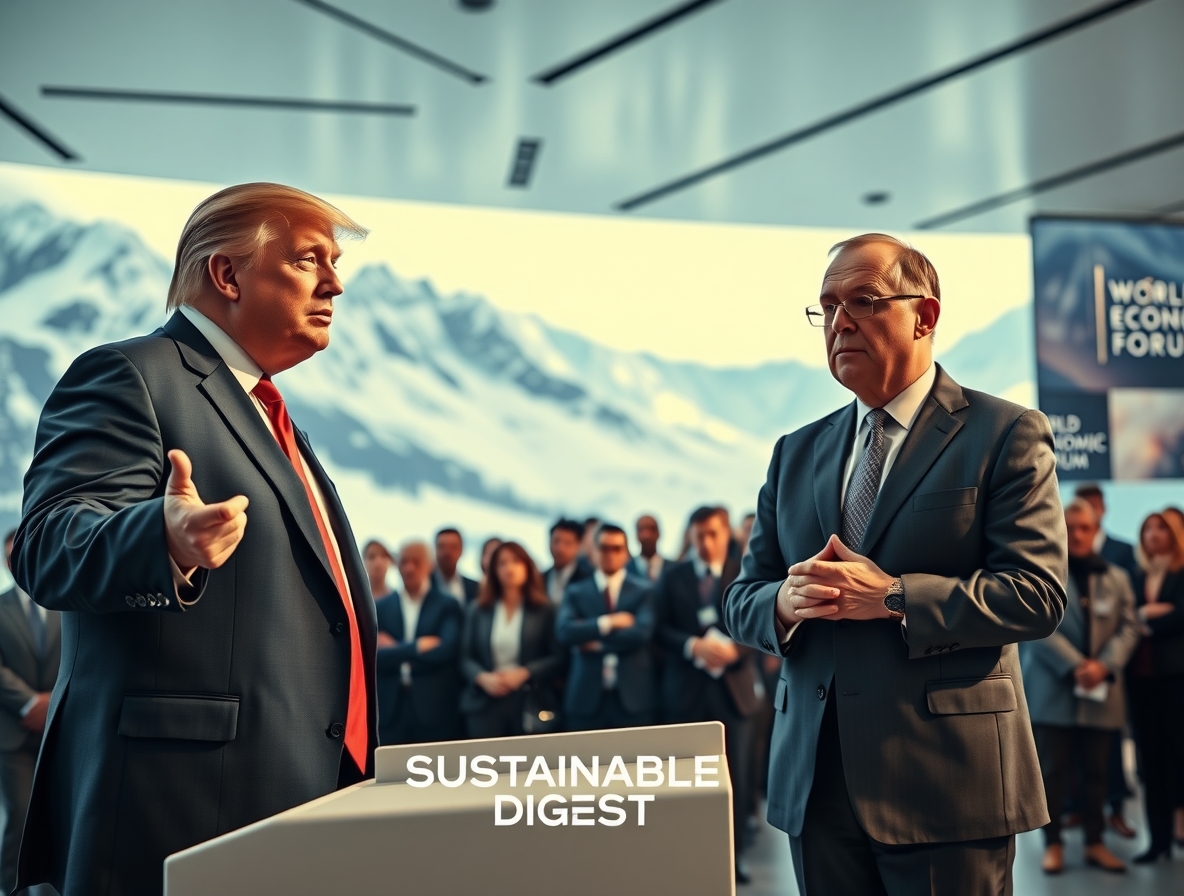
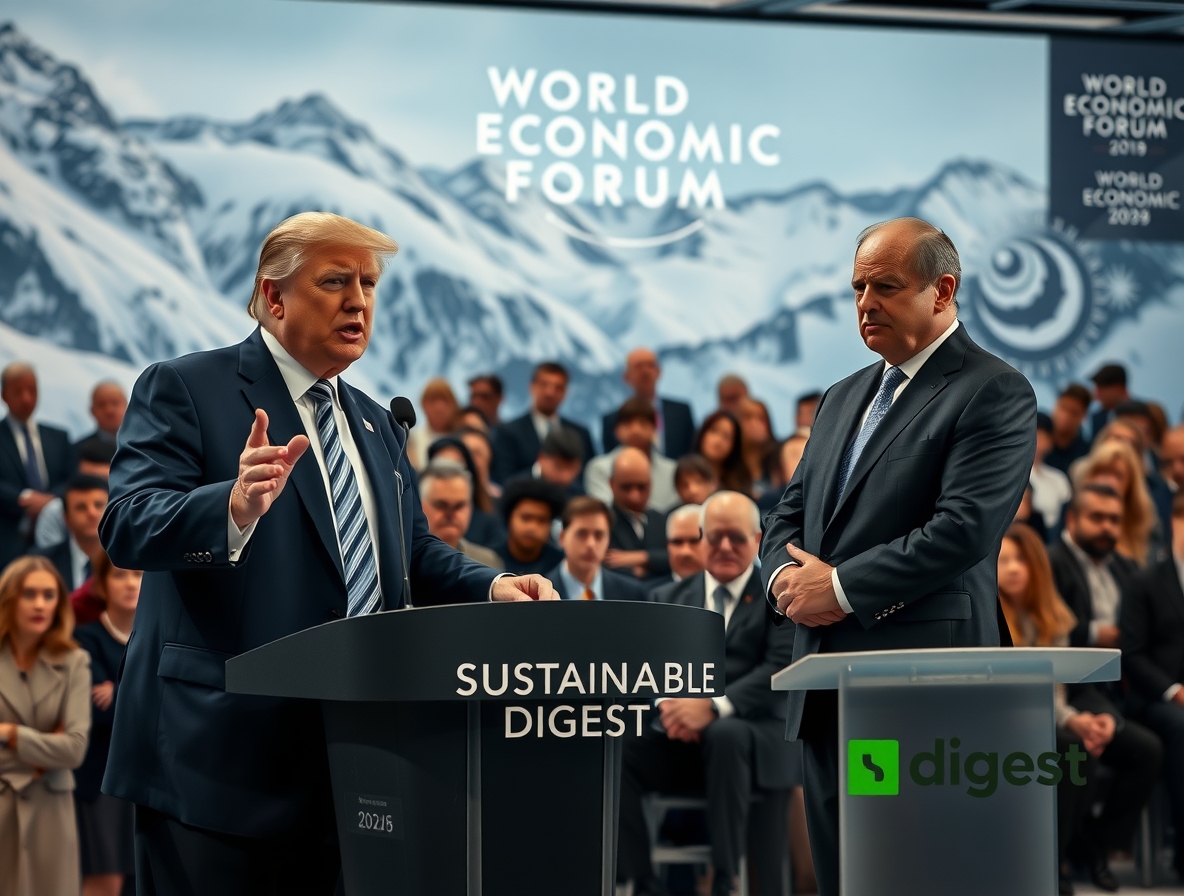
A dramatic scene depicting two contrasting speeches at the World Economic Forum in Davos, 2026. In the foreground, Donald Trump stands confidently at a podium, wearing a tailored suit, gesturing animatedly with a determined expression. Next to him, Mark Carney, dressed in a sleek business suit, looks pensive, his hands clasped, signaling caution and urgency. In the middle ground, an audience of diverse professionals attentively listens, creating an atmosphere of tension and anticipation. The background features the iconic snowy Swiss Alps and a modern conference hall adorned with sustainability-themed visuals. Soft, diffused lighting highlights the speakers, casting gentle shadows, while capturing the gravitas of their messages. The mood is one of intense dialogue and contrasting ideologies in the fight for sustainable development. The Sustainable Digest logo subtly integrated into the scene, blending seamlessly with the setting.

While the official theme promoted dialogue, the most memorable moments came from dueling monologues that revealed deeper fractures. Two competing visions for global governance played out in real time during that pivotal week. The rhetorical contrast could not have been starker.

One address celebrated unilateral power and questioned environmental consensus. The other warned of systemic rupture and called for middle power solidarity. Together, they framed the central challenge of the january 2026 gathering.

This section examines how these speeches became the event’s defining intellectual showdown. They transformed abstract debates about order into vivid political theater.

4.1. Donald Trump’s “America First” Revival and Greenland Gambit

The former U.S. president returned to the international stage with familiar bravado. He declared America “the economic engine on the planet” while dismissing climate policy as “perhaps the greatest hoax in history.” His speech revived the “America First” doctrine with renewed intensity.

Trump treated the forum as both platform and geopolitical prop. He used the global audience to advance unilateral territorial claims. The address blended economic boosterism with calculated brinkmanship.

His extended meditation on Greenland became the speech’s centerpiece. “All the United States is asking for is a place called Greenland,” he stated plainly. The comment transformed a remote territorial dispute into a metaphor for shifting power dynamics.

Trump pledged not to use force but added a significant caveat. “You need the ownership to defend it,” he explained. This logic framed sovereignty as prerequisite for security in the new geopolitical landscape.

The speech revealed a particular approach to international dialogue. It treated multilateral spaces as venues for assertion rather than negotiation. This reflected a broader change in how some leaders engaged with global institutions.

4.2. Mark Carney’s “Rupture in World Order” and Call to Action

The Canadian Prime Minister offered a starkly different diagnosis hours later. Mark Carney warned of “a rupture in world order” where “geopolitics is submitted to no limits.” His speech presented a counter-narrative requiring collective action.

Carney did not mention Trump directly. Yet his analysis directly addressed the unilateralism displayed earlier. He called for middle powers to unite against great power coercion.

“Great powers have begun using economic integration as weapons,” he observed. “Tariffs as leverage, financial infrastructure as coercion, [and] supply chains as vulnerabilities to be exploited.” This cataloged the new tools of geopolitical competition.

His most resonant line became a guiding principle for many attendees. “If we’re not at the table, we’re on the menu,” Carney cautioned. This framed strategic positioning as essential survival in an era of contested trade.

“The rupture is not just in diplomacy but in the very frameworks we assumed were permanent. Economic tools have become geopolitical weapons, and middle powers must recognize this new reality.”

โ€” Analysis of Carney’s Davos 2026 address

Carney’s speech represented a different kind of statesmanship. It combined analytical depth with urgent prescription. The address reframed the entire topic of international cooperation for the coming years.

4.3. Media and Diplomatic Reception: Contrasting Statesmanship

Audience reactions highlighted the speeches’ divergent impacts. CNN reported that attendees during Trump’s address “grew more restless and uncomfortable.” The network noted “only tepid applause at the end.”

Contrast this with the reception for Carney’s warning. Australian Treasurer Jim Chalmers called the speech “stunning” in its clarity and urgency. Many diplomats described it as the week’s most substantive contribution.

Media analysis crystallized the contrast perfectly. Foreign Policy magazine characterized the conference as “a tale of two speeches.” It contrasted Trump’s “rambling and bullying” with Carney’s “eloquent exposition.”

This reception revealed deeper judgments about political style and substance. One speech was seen as performance, the other as serious statecraft. The dichotomy extended beyond content to perceived purpose.

The speeches’ afterlife in diplomatic circles demonstrated their lasting impact. Carney’s framing proved particularly influential among nations reassessing their positions. Many middle powers began discussing coordinated responses.

Trump’s Greenland comments immediately entered geopolitical negotiations. They became a reference point in transatlantic discussions for months. Both addresses showed how rhetoric at such gatherings could shape real policy.

The competing visions presented that week continued to define international debates. They represented fundamentally different approaches to growth, security, and global challenges. The january 2026 speeches became case studies in how leaders use international platforms.

Ultimately, the tale of two speeches captured the gathering’s central tension. It pitted unilateral assertion against collective problem-solving. This conflict would define the global economy and political innovation in the years following the event.

5. Beyond the Main Stage: The Board of Peace and Other Initiatives

Beyond the spotlight of keynote addresses, a complex ecosystem of side events defined the gathering’s substantive outcomes. While speeches captured headlines, the real progress often emerged from charter signings, protests, and award ceremonies.

This parallel universe operated throughout the week. It revealed how the forum functioned as an aggregation point for global advocacy. Diverse causes competed for attention beyond the official agenda.

The Board of Peace: Diplomatic Entrepreneurship

The inaugural meeting of the Board of Peace represented ambitious diplomatic innovation. Its charter announcement on January 22, 2026 featured former President Donald Trump center stage.

This illustrated the gathering’s utility as a convening platform. Controversial figures could launch initiatives alongside geopolitical escalation. The paradox was striking.

Peace boards emerged while tensions dominated main stage discussions. This raised questions about their genuine conflict resolution potential. Were they substantive mechanisms or diplomatic theater?

“The Board of Peace charter signing demonstrated how Davos serves entrepreneurial diplomacyโ€”where even the most polarizing figures can launch initiatives that may outlast the week’s headlines.”

The initiative’s timing during the Greenland crisis added layers of irony. It suggested the enduring appeal of peace as a business proposition. Yet its practical action plan remained unclear to many observers.

Diaspora Advocacy: Kurdish Protests at Switzerland’s Doorstep

Hundreds of Kurdish protesters arrived in Davos with a different agenda. They raised awareness about Syrian military offensives against Kurdish regions. Their presence highlighted how global conflicts literally arrived at Switzerland’s doorstep.

The forum served as a magnet for diaspora advocacy throughout that week. Marginalized groups sought international attention through direct action. This created visible tension with the gathering’s polished image.

Protests represented raw, unfiltered political action. They contrasted sharply with the controlled environment of conference rooms. Yet both sought similar outcomes: influencing global opinion and policy.

Celebrating Philanthropic Innovation: The GAEA Awards

The GAEA (Giving to Amplify Earth Action) Awards honored climate and nature initiatives. This continued the tradition of celebrating philanthropic innovation within the forum‘s ecosystem.

Award ceremonies provided recognition for concrete solutions. They highlighted successful models for environmental finance and action. Yet the broader context made such celebrations seem increasingly aspirational.

While geopolitical earthquakes shook main halls, GAEA celebrated incremental progress. This dichotomy revealed the gathering’s fragmented nature. Multiple realities coexisted without necessarily connecting.

The Hotel Suite Diplomacy: Where Real Deals Were Discussed

Beyond all programming, the real “work” occurred in hotel suites and private dinners. Bilateral deals were discussed away from public view. Alliances were tested in these exclusive spaces.

This shadow diplomacy operated parallel to official events. It represented the traditional power brokerage that the forum has always facilitated. Business leaders and politicians negotiated directly.

These discussions focused on practical collaboration and finance arrangements. They often addressed the very technology and infrastructure projects mentioned publicly. Implementation details were hammered out privately.

Comparing Parallel Initiatives: Complementarity or Distraction?

The proliferation of side initiatives demonstrated both depth and fragmentation. Each track pursued its agenda with varying degrees of connection to the main program. The table below analyzes key parallel events from January 2026.

InitiativeTypeKey ParticipantsDatePrimary FocusNature
Board of Peace CharterDiplomatic LaunchDonald Trump, Various DiplomatsJanuary 22Conflict Resolution FrameworkPublic Ceremony
Kurdish ProtestsDiaspora AdvocacyHundreds of Kurdish ActivistsThroughout WeekSyrian Conflict AwarenessPublic Demonstration
GAEA AwardsPhilanthropic RecognitionClimate Funders, NGO LeadersJanuary 21Environmental FinanceFormal Ceremony
Hotel Suite MeetingsBilateral DiplomacyBusiness Leaders, Government OfficialsVarious EveningsDeal NegotiationPrivate Discussions
Climate Hub DavosSpecialized ForumEnvironmental Experts, EntrepreneursDaily SessionsTechnical SolutionsSemi-Public Programming

This constellation of activities created a rich but disjointed experience. Some initiatives complemented the main agenda by addressing its gaps. Others seemed to operate in entirely separate universes.

The Board of Peace responded to the week’s geopolitical tensions. Kurdish protests highlighted conflicts absent from official discussions. GAEA Awards celebrated environmental solutions overshadowed by security concerns.

Hotel suite diplomacy conducted the practical business that public panels only theorized about. Each parallel track served different stakeholders with varying definitions of progress.

Ultimately, these side events revealed the gathering’s true complexity. They demonstrated how multilateral spaces host competing narratives simultaneously. The forum became a microcosm of global fragmentation itself.

Whether this represented meaningful complementarity or mere distraction depended on one’s position. For diaspora groups, it offered rare access. As for dealmakers, it provided essential privacy. For philanthropists, it granted valuable recognition.

The January 2026 experience suggested that the main stage no longer dominated outcomes. Power and influence had diffused throughout the entire ecosystem. This may represent the most significant innovation of modern global gatherings.

6. Assessing the Outcomes for Sustainable Development

A panoramic view of the World Economic Forum at Davos, showcasing a diverse group of professionals and thought leaders engaged in discussions about sustainable development outcomes. In the foreground, a roundtable discussion featuring individuals in professional business attire, thoughtfully analyzing data on tablets and laptops. The middle section includes banners displaying eco-friendly symbols and infographics demonstrating key sustainability metrics. The background features the stunning Swiss Alps, under a bright, clear blue sky with soft sunlight illuminating the scene, conveying a hopeful and dynamic atmosphere. Incorporate elements like green technology, urban sustainability projects, and nature conservation visuals subtly integrated into the surroundings. The Sustainable Digest logo appears discreetly in the corner, enhancing the focus on sustainable development.

A balanced examination of the forum’s impact on environmental goals shows a landscape of partial victories and significant omissions. The gathering’s outcomes for ecological priorities were neither uniformly positive nor entirely negative.

Instead, they reflected the broader tension between programmed ambition and participant preoccupation. This analysis separates ceremonial dialogue from substantive progress.

It measures what was actually achieved for planetary health during those tense days. The results reveal an enduring gap between international rhetoric and implementation.

Any honest assessment must acknowledge both tangible achievements and glaring omissions. The sustainability agenda advanced in some corridors while receding dramatically in others.

Three distinct dimensions emerged from the post-event analysis. First, specific professional networks maintained their momentum despite geopolitical headwinds.

Second, the “urgent versus important” dilemma plagued nearly every discussion. Third, silent issues spoke volumes about selective attention spans.

This section examines each dimension to determine whether the gathering moved the needle. Did it create meaningful change, or merely maintain existing trajectories?

6.1. Achievements: Dialogue, Networking, and Specific Proposals

Despite the geopolitical turbulence, certain sustainability channels remained open and productive. The most concrete achievement was the maintenance of professional networks dedicated to environmental solutions.

Specialists in nature-positive finance continued their conversations from previous years. They developed specific proposals for blending conservation with commercial investment.

These discussions occurred in dedicated spaces like the Climate Hub. While geographically marginalized, they maintained technical depth.

Several working groups produced actionable frameworks for corporate engagement with biodiversity. These frameworks addressed how business models could integrate ecological metrics.

They focused on practical implementation rather than theoretical aspiration. The innovation lay in connecting conservation science with capital allocation decisions.

Dialogue channels between policymakers and private sector leaders also remained intact. These connections proved resilient to the week’s diplomatic disruptions.

They facilitated discussions about regulatory policy for the energy transition. Specific technology partnerships were explored for renewable infrastructure.

“The real work happened in the side rooms where specialists spoke the same language. While the main stage debated Greenland, these groups were designing the financial architecture for nature-positive growth.”

โ€” Sustainability consultant attending Davos 2026

The GAEA Awards ceremony provided recognition for proven environmental action. It celebrated philanthropic models that had demonstrated measurable impact.

This maintained momentum for climate finance initiatives. It created visibility for successful approaches that could be scaled.

Perhaps the most significant achievement was simply keeping certain conversations alive. In a world increasingly focused on security concerns, maintaining ecological dialogue represented progress.

6.2. Challenges: Overshadowed Agenda and the “Urgent vs. Important” Dilemma

The packed sustainability schedule existed in curious isolation from the gathering’s dominant conversations. While session rooms discussed decarbonization, corridors buzzed with geopolitical speculation.

This disconnect highlighted the forum’s central challenge. Immediate crises consistently overshadowed longer-term environmental challenges.

The “urgent versus important” dilemma plagued every day of programming. Fast-breaking political dramas captured attention that slow-moving ecological crises could not.

Climate change’s relative demotion symbolized this broader shift. From main stage prominence to a hub behind food trucks, its positioning spoke volumes.

One observer captured this tension with particular clarity. “Davos is struggling, like so many others, to reconcile the important with the urgent,” they noted.

This struggle manifested in attendance patterns at sustainability sessions. While technically well-programmed, they competed with more sensational diplomatic developments.

The Greenland crisis served as the ultimate attention magnet. It reframed discussions about trade, infrastructure, and supply chains through a security lens.

Economic growth conversations became subordinated to sovereignty concerns. Environmental action appeared less pressing than territorial disputes.

This prioritization reflected a broader global governance change. Multilateral institutions increasingly addressed immediate crises at the expense of systemic solutions.

The forum became a microcosm of this international pattern. Its struggle mirrored challenges facing United Nations bodies and other diplomatic platforms.

Ultimately, the gathering demonstrated how easily environmental agendas can be sidelined. Even with meticulous programming, they require political oxygen to survive.

In January 2026, that oxygen was consumed by more combustible diplomatic material. The sustainability blueprint faced implementation challenges beyond its designers’ control.

6.3. The Silent Issues: What Davos 2026 Failed to Address

The most revealing outcomes were not what was discussed, but what was conspicuously absent. Several critical global issues received scant attention throughout the week.

These silent issues spoke volumes about the gathering’s selective focus. They revealed organizer priorities and participant preoccupations in equal measure.

One observer provided a damning catalog of omissions. “Forget the issues of Davos past: sustainable development goals, global health, ESG,” they began.

“It’s hard not to be struck by what was left undiscussed. What about current geopolitics? Ukraine, Gaza, Iran, Venezuela, and Sudan received scant attention. The U.S.-China relationship…was largely absent from the agenda, as were the major trade and fiscal imbalances.”

This selective attention reflected several underlying dynamics. First, certain conflicts had become diplomatically “stale” despite ongoing human suffering.

6.3.5 Silent Issues Continuing

Second, major power relationships were perhaps too sensitive for open discussion. Third, fiscal imbalances lacked the dramatic appeal of territorial disputes.

The U.S.-China relationship’s absence was particularly noteworthy. As the defining geopolitical tension of the era, its omission suggested deliberate avoidance.

Major trade imbalances and currency issues also went underdiscussed. These economic fundamentals received less attention than sensational sovereignty claims.

The observer extended their critique to environmental priorities. “Climate change used to be front and center,” they noted. “This year, the one climate hub that I saw was located ignominiously behind the food trucks.”

This geographical marginalization symbolized a broader demotion. Ecological crises were losing ground to political dramas in the competition for global attention.

The silent issues revealed a forum struggling with its own identity. Was it a platform for addressing all global challenges, or only those deemed “discussable”?

This selectivity risked making the gathering increasingly irrelevant to pressing human concerns. If it avoided the most difficult conversations, what value did it provide?

The omissions during January 2026 suggested a retreat to safer, more manageable topics. Complex conflicts and entrenched geopolitical tensions were sidelined.

This created a distorted representation of global priorities. The agenda reflected what elites wanted to discuss, not necessarily what demanded attention.

Ultimately, these silent issues may represent the gathering’s most significant legacy. They demonstrated the limitations of elite diplomacy in an era of multiple crises.

The forum’s struggle to “reconcile the important with the urgent” left many important issues unaddressed. This failure would have consequences in the coming years.

7. Conclusion: The Legacy of Davos 2026

The gathering’s ultimate legacy may be its stark illumination of multilateralism’s contemporary crisis. It demonstrated undeniable convening power while questioning the utility of mere dialogue.

The contrast between sustainability aspirations and geopolitical realities created instructive dissonance. Environmental challenges were contextualized within fractured political economies rather than addressed directly.

As one observer concluded, “The WEF has put to bed any concerns about its convening power.” The challenge ahead is to forge action that improves our global state. Another noted, “Nostalgia is not a strategy; nor is hope.”

This meeting will be remembered as multilateralism’s crisis became undeniable. The forum witnessed one era’s passing without birthing its successor.

Key Takeaways

  • The January 2026 meeting promised dialogue but often delivered dissonance on sustainability goals.
  • Environmental risks were reprioritized in the short term despite their severe long-term nature.
  • The gap between aspirational rhetoric and actionable policy remained conspicuously wide.
  • Geopolitical tensions frequently overshadowed planned discussions on ecological limits.
  • The forum’s structure around five key challenges tested the viability of “green growth.”
  • Multilateral cooperation faced significant stress from competing national interests.
  • The event’s legacy underscores the difficulty of aligning economic and environmental priorities.

Greenwashing Types: Variants You Need to Know

Over 40% of corporate environmental claims might be misleading or not backed up. It’s not just about lies versus truth. It’s a complex world where fake green claims hide many wrongdoings.

For global professionals and eco-aware consumers, it’s not enough to just be skeptical. You need a clear guide. Knowing the variants of greenwashing is key to avoiding them. This detailed breakdown shows us that greenwashing is not one thing, but many, each affecting society in different ways.

Understanding these types helps us move from vague worries to real actions. It lets us tell real progress from fake green promises. This knowledge is crucial for a market where true green efforts, not fake ones, lead the way.

What Is Greenwashing? Defining Modern Environmental Deception

Greenwashing is more than just false advertising. It’s a big problem that makes a huge gap between what companies say they do and what they really do. It uses tricks like unclear information and feelings to make people think companies are doing more for the environment than they are.

The Core Definition of Greenwashing in Today’s Market

The term greenwashing originally meant making false claims about being good for the environment. Now, it’s a complex strategy. It’s when companies make it seem like their products or actions are better for the planet than they actually are.

Greenwashing is the “disinformation disseminated by an organization so as to present an environmentally responsible public image.”

Source: Oxford Languages

This trickery isn’t always a clear lie. Often, it’s about picking and choosing what to say, using vague words, or doing small gestures that don’t really help. The goal is to look good without actually changing much.

Why Greenwashing Has Become Pervasive in Consumer Industries

There are many reasons greenwashing is everywhere. First, people want to buy things that are good for the planet, making companies want to look like they care. Sometimes, companies try to keep up with what people want without really changing.

Second, the rules for being green are not clear everywhere. This lets companies play by different rules in different places. Third, it’s hard to know what’s really going on in complex supply chains. A company might focus on one green thing while ignoring the rest.

Lastly, things meant to help like eco-labels and reports can be used to trick people. If not checked, they can help greenwashing instead of stopping it.

Distinguishing Between Authentic Sustainability and Greenwashing

It’s hard to tell the real deal from just a show. Real sustainability means making big changes and showing how they help. It’s honest and says what it’s going to do to get better.

Here’s how to tell the difference:

  • Specificity vs. Vagueness: Real claims are clear, like “cut carbon emissions by 40% by 2023”. Greenwashing uses vague terms like “eco-friendly” without explaining what it means.
  • Substance vs. Symbolism: True sustainability means changing how things are done and using clean technology. Greenwashing is about looking good with marketing or one-off projects that don’t really help.
  • Lifecycle vs. Highlight Reel: Real efforts look at and improve a product’s whole life, from start to end. Greenwashing picks one good thing to hide the bad.

Knowing the difference is key to spotting greenwashing. It’s about what a company does, not just what it says. And especially, what it proves.

The Evolution and Devolution of Greenwashing Strategies

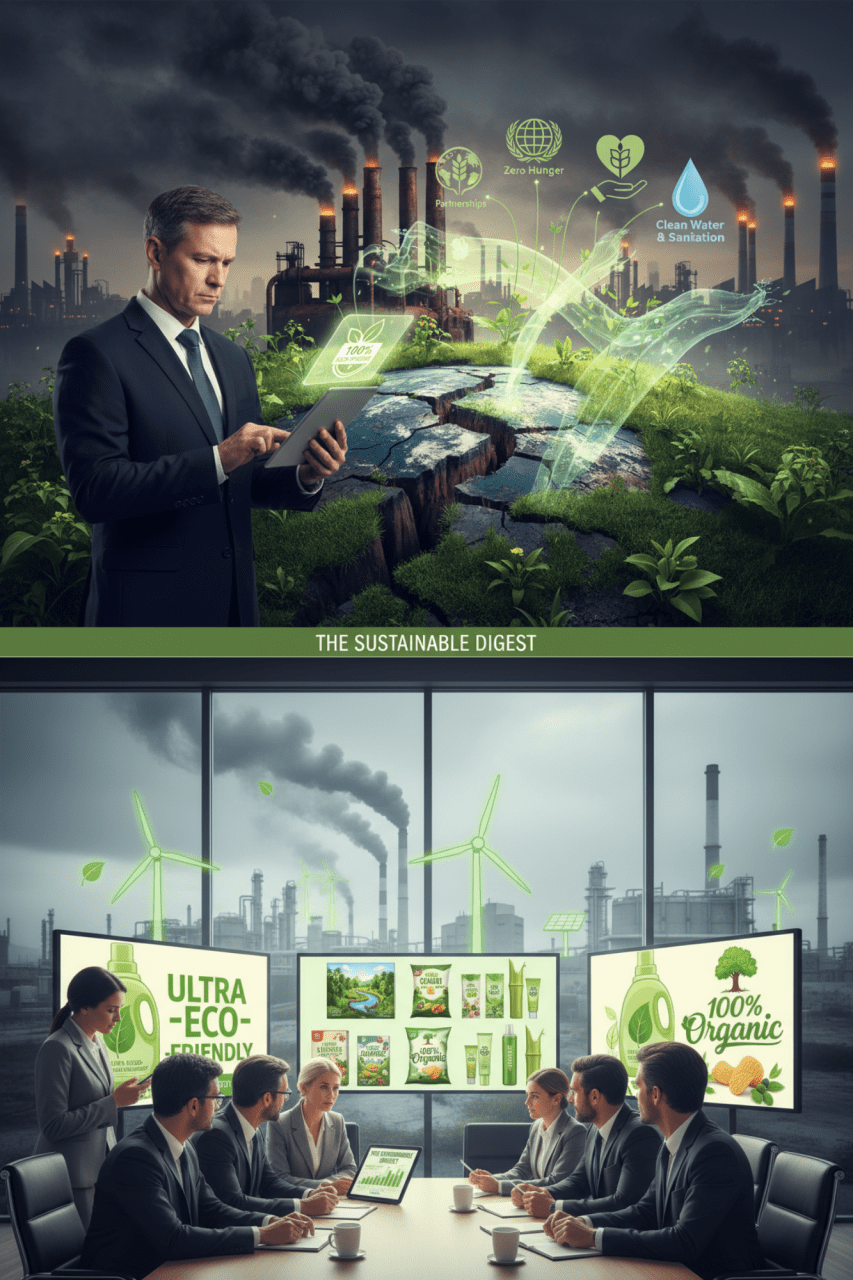
A visually engaging timeline illustrating the "Evolution of Greenwashing Strategies," created in a sleek, modern style. In the foreground, a series of distinct greenwashing tactics represented by symbolic iconsโ€”like a leaf with a magnifying glass, a recycling logo with a twist, and a facade of a green buildingโ€”each set against vibrant colors. The middle layer features a gradient timeline with milestones in green and gray tones, showing the progression of strategies from simple misleading claims to sophisticated deceptive marketing. In the background, faint silhouettes of cities and forests blend harmoniously, contrasting environmental ideals with corporate symbolism. Soft, diffused lighting casts gentle shadows, enhancing the professional atmosphere. This image reflects both innovation and caution, embodying the theme of evolving environmental marketing. The brand name "The Sustainable Digest" subtly incorporated as a design element in the lower corner.

Greenwashing has evolved, becoming more sophisticated while ethical standards have declined. This shows how technology and ethics have moved in opposite directions. It’s important to understand this to spot hidden environmental harm.

Early greenwashing was obvious. Now, it’s designed to trick people’s minds. This change shows companies are adapting to consumer awareness and rules.

Historical Perspective: How Greenwashing Tactics Have Changed

In the 1970s and 1980s, greenwashing was simple. Companies made big claims without proof. There were no strict rules, making it a free-for-all in environmental marketing.

From Blatant False Claims to Subtle Psychological Manipulation

Old greenwashing was based on false claims. A product might be called “100% eco-friendly” without proof. These claims were easy to spot.

Now, companies use tricks like the halo effect. They link products to nature to seem green. They also use vague terms like “green” to confuse people.

Companies use psychology to sell more. They make offers seem limited to create a sense of urgency. They also make more expensive products seem better for the planet.

Regulatory Attempts and Corporate Counter-Strategies

Regulators have tried to stop greenwashing. The U.S. Federal Trade Commission’s Green Guides aim to stop false claims. They cover topics like biodegradability and carbon offsets.

Companies have found ways to avoid being honest. They make claims that are technically true but misleading. This is called “claim splitting.”

“The most dangerous greenwashing isn’t the lie you can spot, but the half-truth you believe because it contains a fragment of reality.”

Sustainability Analyst, 2023 Corporate Ethics Report

Companies also use “regulation arbitrage.” They follow the weakest environmental rules in different places. This makes them seem green in some markets while polluting in others.

The Increasing Sophistication of Greenwashing Techniques

Digital technology has made greenwashing better and accountability worse. Big data and social media let companies target their lies more effectively. They can tell different stories to different people.

Data-Driven Greenwashing in the Digital Age

Companies use data to tailor their green messages. They look at what you buy and what you like on social media. This way, they can make messages that seem personal.

They test different messages to see what works best. This makes it seem like they care about what you want, when really they just want to sell more.

They even predict what green issues will be big. They use machines to find out before everyone else does. This way, they can seem ahead of the curve.

How Social Media Has Transformed Greenwashing Approaches

Social media has changed greenwashing a lot. Companies use real people to promote their green messages. These people seem genuine, making it hard to tell what’s real.

Platforms like Instagram focus on looks over real change. They show off green products to make it seem like companies care. But, the reality is often different.

Algorithms on social media make certain content more popular. This means small actions get more attention than big changes. It’s all about making a good impression, not really helping the planet.

Historical Greenwashing (Pre-2000)Contemporary Greenwashing (Post-2010)Psychological Mechanism
Blatant false claims (“100% biodegradable”)Technically true but misleading statementsExploits trust in factual accuracy
Generic nature imageryPersonalized environmental narrativesCreates false personal connection
One-size-fits-all messagingDemographically targeted contentConfirms existing biases
Regulatory avoidanceRegulatory loophole exploitationCreates illusion of compliance
Static printed materialsAlgorithmically optimized social contentExploits engagement psychology

The table shows how greenwashing has changed. It’s moved from being obvious to being very subtle. The best lies are those that seem true.

This is a big problem. It shows companies are more interested in tricks than being honest. The battle against greenwashing is getting harder.

Greenwashing Types with Variants: A Complete Framework

To understand greenwashing better, we need a clear framework. Saying a company is “faking it” isn’t enough anymore. This section shows a detailed way to sort out greenwashing into three main types. Knowing this helps us check things more closely and make better choices.

Organizing Greenwashing by Method and Mechanism

Greenwashing isn’t all the same. It changes a lot based on how it’s done. By sorting it by method, we can find it more easily. This way, we go from just guessing to really looking into it.

Communication and Messaging-Based Variants

This type uses words and stories to trick us. It changes how we see environmental info. It uses vague words, feelings, and stories to make us think something is green when it’s not. The goal is to change what we think through what we hear.

Labeling, Certification and Claim Manipulation

This type plays on trust in labels and special terms. It uses fake eco-labels, wrong uses of certifications, and confusing terms. Companies might make their own labels or stretch the meaning of a certification. It tricks us by using trust symbols in the market.

The sneakiest types change how companies act and how we see them. They’re not just about one claim. They hide bad actions, blend in with the crowd, or use small green steps to hide big problems. We need to look at what companies do, not just what they say.

โ€œA taxonomy of greenwashing is not academic; it’s a diagnostic tool. You need to know if you’re dealing with a surface-level marketing lie or a deep, strategic diversion to prescribe the right remedy.โ€

โ€“ Sustainability Governance Analyst

The Importance of Recognizing These Specific Variants

Why is it important to know the different types of greenwashing? A simple approach can’t catch all the tricks. Knowing the greenwashing types helps us become more careful. It lets us match our checks to what companies are doing.

How Different Variants Target Different Consumer Vulnerabilities

Each type uses different ways to trick us. Messaging tricks use stories and pictures. Labeling tricks use symbols of trust and knowledge to make choices easier.

Behavioral tricks, like blaming others, play on our sense of doing the right thing. Knowing what trick is being used helps us defend ourselves better.

Why a One-Size-Fits-All Approach to Detection Fails

Being skeptical of all green claims is not smart. A simple check might miss some tricks. For example, a fake label check won’t catch a company that’s just trying to look good by comparison.

Companies might use many tricks at once. They might use green talk to hide label tricks. To really spot these, we need to look closely. We must figure out if it’s a simple mistake, a fake label, or a big trick. The answer tells us what to do next. Real greenwashing is often a mix of these, and our framework helps sort it out.

Communication Manipulation: Greenhushing, Greenspinning and Greenlighting

A visually striking composition illustrating corporate communication greenwashing tactics. In the foreground, a group of diverse business professionals dressed in smart business attire engaged in animated discussion, holding green-tinted brochures marked with eco-friendly symbols. In the middle ground, a large, modern office space filled with plants and green imagery, showcasing visual contrasts between sincere environmental practices and misleading representations. The background features a sleek skyline, highlighting a juxtaposition of nature versus industrialization. Soft, natural lighting creates a warm, inviting atmosphere, while a slightly elevated angle captures the earnest expressions of the professionals. The overall mood conveys a sense of urgency and critical awareness, representing the insidious nature of greenhushing, greenspinning, and greenlighting, reflecting the brand "The Sustainable Digest."

Companies are getting better at hiding their true environmental impact. They use greenwashing tactics like greenhushing, greenspinning, and greenlighting. These methods distort the truth without making obvious lies. They work by using silence, strategic framing, and selective highlighting.

Unlike old-fashioned greenwashing, these new tactics control what information gets out. They are tricky to spot and challenge. Knowing about these tactics helps us see through fake green claims.

Greenhushing: The Strategic Withholding of Information

Greenhushing means companies hide environmental info to avoid being criticized. This is the opposite of making big green claims but serves the same goal: to fool people about their real impact. Companies fear that being too open would show they’re not doing enough.

How Companies Use Silence to Avoid Scrutiny

Greenhushing uses selective sharing and hiding. Companies might publish reports that just meet the minimum but leave out key details. They might not talk about big climate goals because they’re worried they can’t reach them.

This trick is popular in industries with big carbon footprints or complex supply chains. By saying less, they avoid harsh criticism and activist pressure. The silence is often more helpful than making bold claims that might backfire.

Some common greenhushing tricks include:

  • Leaving out Scope 3 emissions from carbon counts
  • Only sharing positive environmental news while ignoring the bad
  • Not talking about long-term climate risks in talks with investors
  • Using vague language that doesn’t make clear, measurable promises

Real Examples of Greenhushing in Major Corporations

Big tech companies are known for greenhushing. They only report direct emissions from their operations, ignoring the huge carbon footprint of their supply chains and products. This is a common practice.

The car industry also uses greenhushing. Some car makers focus on electric cars but quietly scale back plans to stop using gas engines. They talk about future plans but downplay current actions.

Banks have been accused of greenhushing too. They promote green investments but don’t share how much they still fund fossil fuels. This selective sharing gives a misleading view of their environmental impact.

Greenspinning: Repackaging Environmental Failures as Successes

Greenspinning turns environmental failures into wins. It’s like PR magic that changes how we see things. Unlike outright lies, greenspinning changes how we think by how things are framed.

The Art of Environmental Public Relations Manipulation

Greenspinning uses smart communication tricks. Companies might highlight small wins as big deals. They compare current performance to a worse past, making it seem like they’re doing great.

Language plays a big role in this trick. Words like “transition,” “journey,” and “evolution” make progress seem real, even if it’s not. Vague promises to go “net-zero by 2050” look ambitious but delay real action for decades.

Effective greenspinning often involves:

  1. Calling small pollution cuts “environmental achievements” instead of just meeting rules
  2. Showing delayed phase-outs of harmful practices as “responsible transitions”
  3. Calling small changes “transformational breakthroughs”
  4. Using future language (“we aim to,” “we plan to”) to seem committed without doing much

Case Studies: Greenspinning in Oil and Fashion Industries

The energy sector is great at greenspinning. Big oil companies now call themselves “energy companies” or “energy solutions providers.” They highlight small green investments while still growing fossil fuel use. One big oil company talks about going “net-zero” but keeps finding new oil fields.

Fast fashion is another example of greenspinning. Brands might launch a small “sustainable” line but market it a lot. This makes it seem like they’ve changed their whole business, even though they haven’t.

These examples show how greenspinning lets companies keep doing harm while looking good. It confuses consumers who see mixed messages about green responsibility.

Greenlighting: Emphasizing Minor Green Initiatives

Greenlighting shines a light on small green actions to hide bigger problems. It’s like theater lighting that focuses on some actors while others are in the dark. This tactic uses small steps as distractions from bigger issues.

How Small Actions Are Used to Divert Attention from Larger Issues

The psychology behind greenlighting is based on the “spotlight effect.” By focusing on a small, appealing action, companies draw attention away from bigger problems. This makes them seem more green than they really are.

Airlines are a perfect example of greenlighting. They promote carbon offset programs to make flying seem green. But they keep growing their fleets and routes, increasing emissions.

The food and drink industry uses similar tricks. A big food company might push paper straws or lightweight bottles a lot. These small changes get a lot of attention, hiding bigger environmental issues.

Greenlighting works because it offers clear, appealing actions that match what people want. Removing plastic straws or starting recycling programs are real improvements. But they get all the attention, hiding bigger environmental problems.

This tactic is especially useful in industries that can’t change their whole business model. By focusing on small green steps, companies can look like they’re making progress without really changing.

Labeling Deception: Greenrinsing, Greenlabeling and Greenclaim Inflation

When companies play with words, they also play with symbols. This leads to confusing labels and stats that we all have to deal with. Seals, badges, and promises are often used to trick us.

These tricks target our trust in different ways. Greenrinsing messes with long-term plans, greenlabeling confuses us right away, and greenclaim inflation distorts what we can measure. Together, they make it hard to make smart choices.

Greenrinsing: The Cycle of Changing Sustainability Goals

Imagine running on a treadmill where the finish line keeps moving back. That’s what greenrinsing is like. Companies set big goals but then change them before they have to do anything.

This makes it seem like they’re always making progress, even if they’re not. A goal to be carbon neutral by 2030 becomes 2040. Or, a plan to reduce plastic is replaced by something else. It never ends.

How Companies Repeatedly Reset Targets to Avoid Accountability

Corporate reports often start with big promises. These promises get a lot of attention and approval. But when the deadline comes, they find excuses to change their goals.

They say things like “market changes” or “new science” to justify the changes. This way, they look like they’re making responsible choices, even if they’re not.

Three common ways companies change their goals include:

  • Scope redefinition: Making the goal smaller
  • Timeline extension: Pushing the deadline back
  • Metric substitution: Changing the goal to something easier

Documented Cases of Greenrinsing in Corporate Sustainability Reports

Many big companies have been caught in greenrinsing. For example, a global drink company pushed back its goal to use 100% recycled packaging from 2025 to 2030. This change came after they didn’t make much progress on the original goal.

A fast-fashion brand kept lowering its goal for organic cotton. Each time, they set a new, less ambitious target. This made them less accountable.

“Sustainability targets should be milestones, not moving finish lines. When goals consistently shift further away, we must question whether the commitment is to improvement or merely to the appearance of improvement.”

Sustainability Reporting Analyst

The car industry shows clear examples too. Many car makers have delayed their plans for electric cars while making more SUVs. This shows they’re not really committed to change.

Greenlabeling: Misuse of Environmental Terminology and Certifications

Every supermarket aisle is filled with green promises. Greenlabeling uses confusing terms and fake certifications to trick us. It’s all about looking good without actually doing anything.

This works because we don’t have time to check everything. A quick look at the packaging decides if we buy it. Greenlabeling uses words and symbols to trick us into thinking it’s better than it is.

Common Misleading Labels: “Eco-Friendly,” “Natural,” “Green”

These terms sound good but mean nothing. “Natural” might mean a product has 1% plant stuff and 99% synthetic stuff. “Eco-friendly” could mean they used a little less packaging, but it’s still toxic.

The problem goes beyond just words. Some companies make their own “green” seals without anyone checking them. These fake badges look real but don’t mean much.

Consider these misleading claims:

  • “Contains natural ingredients” (which could be petroleum-derived)
  • “Green technology” (without lifecycle assessment)
  • “Environmentally conscious” (based on undefined criteria)

How to Verify Authentic Environmental Certifications

Real certifications are clear and checked by others. They need regular checks and follow strict rules. The best ones look at the whole life of a product, not just one part.

CertificationGoverning BodyKey Focus AreasVerification Process
Cradle to Cradle CertifiedยฎCradle to Cradle Products Innovation InstituteMaterial health, renewable energy, water stewardship, social fairnessThird-party assessment, multiple achievement levels (Basic to Platinum)
TRUE CertificationGreen Business Certification Inc.Zero waste, diversion from landfills, circular economyOn-site audits, documentation review, performance metrics
Forest Stewardship Council (FSC)Independent international organizationResponsible forest management, chain of custodyAnnual audits, traceability systems, performance monitoring
Energy StarU.S. Environmental Protection AgencyEnergy efficiency, greenhouse gas reductionLaboratory testing, manufacturer verification, random sampling

Look for certifications with clear standards. Make sure the group giving the certification isn’t just friends with the company. Real programs show their numbers and codes online.

Greenclaim Inflation: Exaggerating Environmental Benefits

If greenlabeling tricks us with words, greenclaim inflation tricks us with numbers. It makes big claims about how green a product or company is. A small change is called a “game-changer.”

This trick works because we want to believe our choices help the planet. Companies make these big claims to make us feel good about buying from them.

The Psychology Behind Overstated Sustainability Claims

Research shows these tricks work by playing on our minds. The halo effect makes us think a product is better just because it has one good thing. Saying a product is “30% recycled” might make us think it’s much greener.

Proportional distortion is another trick. Saying a product is “dramatically reduced” might sound big, but it might not be. The language makes it seem like a big change, even if it’s not.

Three ways these tricks work include:

  1. Optimism bias: We want to believe in a greener world
  2. Numerical innumeracy: We struggle to understand numbers and percentages
  3. Trust in authority: We assume companies wouldn’t lie

Quantifying the Gap Between Claims and Reality

There’s a big difference between what companies say and what they actually do. A study found that “carbon neutral” shipping claims only covered 15-40% of emissions. This gap is because of mistakes or on purpose.

Another study looked at “water-saving” appliances. Marketing said they saved 30%, but real use showed only 8-12% savings. This difference is because of ideal lab tests versus real use.

Here’s a comparison of common exaggerated claims:

Claim MadeTypical RealityInflation FactorCommon Justification
“Carbon neutral” productPartially offset emissions2-3x“Based on lifecycle assessment” (using favorable boundaries)
“Significantly reduced waste”5-10% reduction3-4x“Compared to previous version” (without industry context)
“Renewable energy powered”Partial renewable mix1.5-2x“Matching renewable certificates” (not direct procurement)

To spot greenclaim inflation, look for real numbers and context. Don’t trust vague claims like “greener” or “more sustainable.” Look for specific, detailed information.

The tricks of greenrinsing, greenlabeling, and greenclaim inflation are a big problem. They make us trust companies more than we should. But if we know these tricks, we can demand better.

Behavioral Greenwashing: Greenshifting, Greencrowding and Greenmasking

A conceptual illustration depicting "Behavioral Greenwashing" with a focus on greenshifting, greencrowding, and greenmasking. In the foreground, a professional wearing business attire thoughtfully examines a plant, a symbol of environmental concern, with a skeptical expression. In the middle, a bustling urban scene shows crowds of people holding green products, blending with billboards advertising eco-friendly initiatives, reflecting greencrowding. The background features a city skyline shrouded in a subtle green mist, symbolizing deception and greenmasking. Soft, natural lighting creates a sense of hope and awareness, emphasizing the contrast between genuine sustainability and the superficial attempts at eco-friendliness. The overall mood is thought-provoking and insightful, aligning with the theme of "The Sustainable Digest."

Greenwashing has evolved from simple tricks to complex social engineering. It now manipulates behavior and perception at a deep level. This shift targets the psychological and social sides of sustainability.

These tactics include shifting blame to consumers, hiding in a sea of mediocrity, and using charity to hide wrongdoings. It’s key to spot when these tactics are used to hinder progress.

Greenshifting: Transferring Environmental Responsibility to Consumers

Greenshifting is a trick where companies make you think you’re responsible for the environment. It makes big problems seem like they can be solved by changing your own habits.

The “Your Carbon Footprint” Narrative and Its Flaws

The idea of carbon footprints started with BP in 2004. It made people think climate change is all about personal choices. This idea has spread, distracting from the real problem of corporate emissions.

Studies show that just 100 companies cause 71% of global emissions. This makes it clear that greenshifting shifts blame away from big polluters.

“The greatest trick the fossil fuel industry ever pulled was convincing the world that climate change was about your choices, not theirs.”

Environmental Sociologist Dr. Rebecca Jones

How Greenshifting Appears in Advertising and Corporate Messaging

Greenshifting uses certain words and images in ads and messages:

  • Imperative language: “You can make a difference,” “Your choice matters,” “Be part of the solution”
  • Visual framing: Images focusing on consumer actions rather than production processes
  • Product positioning: “Eco-friendly” options that require premium prices from consumers
  • Educational campaigns: Teaching consumers about recycling while opposing extended producer responsibility laws

Fast food companies are a good example. They promote reusable cups and plant-based options but keep unsustainable practices. This makes consumers feel guilty and responsible for environmental issues.

Greencrowding: Hiding Within Industry-Wide Mediocrity

Greencrowding happens when companies all agree on low environmental standards. This way, no one feels pressured to do better. It’s a collective problem where everyone stays stuck in place.

The Collective Action Problem in Environmental Standards

Industries often set their own environmental standards. These standards are usually the lowest common denominator. This way, everyone can meet them easily.

The greencrowding pattern is clear:

  1. Industry leaders resist strict rules by proposing weak standards
  2. These standards are set at levels that even the least progressive members can meet
  3. Companies celebrate “industry-wide progress” while secretly opposing stricter rules
  4. The mediocre standard becomes the new goal, slowing down real progress

This approach turns environmental progress into a collective shield. When everyone moves slowly together, no one gets left behindโ€”and no one gets ahead.

Examples of Greencrowding in Fast Fashion and Plastics Industries

The fashion and plastics industries show classic greencrowding. Major brands set modest goals like 30% recycled content by 2030. Critics say these goals are too easy to achieve.

IndustryCollective InitiativeActual ImpactGreenwashing Mechanism
Fast FashionFashion Pact (2019)Vague commitments with no enforcementSafety in numbers against regulation
PlasticsAlliance to End Plastic WasteFocuses on waste management, not production reductionRedirects attention from source problem
AutomotiveVoluntary fuel efficiency standardsSlower progress than regulatory mandates would achieveIndustry-controlled timeline

The plastics industry is a clear example. Big producers promote recycling while increasing virgin plastic production. This greencrowding strategy has delayed bans on single-use plastics and extended producer responsibility laws in many places.

Greenmasking: Using CSR to Conceal Harmful Practices

Greenmasking uses Corporate Social Responsibility (CSR) to hide environmental harm. It’s the philanthropic side of greenwashing, where good deeds cover up ongoing damage.

Corporate Social Responsibility as a Smokescreen

CSR can be good, but it’s used to hide wrongdoings. Companies might fund reforestation while clear-cutting forests elsewhere. They might support environmental education while fighting climate laws.

Greenmasking works because of several psychological factors:

  • The halo effect: Good deeds in one area make the whole company seem better
  • Attention diversion: Media focuses on charity efforts, not on the company’s wrongdoings
  • Moral licensing: People think they can do wrong because they’ve done something good
  • Complexity overwhelm: Many initiatives make it hard to see the real picture

This creates the CSR paradox. The biggest environmental offenders often have the most visible sustainability efforts.

How to Identify When CSR Is Being Used for Greenmasking

To spot greenmasking, look for these signs:

  1. Strategic alignment: Do CSR efforts really address the company’s environmental impacts?
  2. Proportionality: Is the charity spending meaningful compared to the harm caused?
  3. Transparency: Are both good and bad impacts reported fairly?
  4. Policy consistency: Does the company support environmental laws that match its CSR claims?
  5. Long-term commitment: Are the CSR efforts sustained beyond just publicity?

The fossil fuel industry is a prime example. Big oil companies have renewable divisions and climate funds but still grow their fossil fuel business. Their reports highlight these efforts while downplaying their emissionsโ€”a classic greenmasking tactic that slows down the energy shift.

Greenshifting, greencrowding, and greenmasking are the most advanced greenwashing tactics. They don’t just lie; they change how we see and act. Spotting these tricks is the first step to taking back environmental responsibility.

Additional Greenwashing Variants: Greenwishing and Green Botching

There’s a gray area where good intentions go wrong. Greenwishing and green botching are terms for when plans fail. They can hurt trust as much as lies, needing careful thought to tell them apart.

Greenwishing: Hopeful But Empty Sustainability Promises

Greenwishing is when companies make big environmental promises without a solid plan. They say things like they’ll be carbon-neutral by 2050 or use 100% recyclable packaging. But they don’t show how they’ll get there.

The difference between a good goal and greenwashing is clear. A good goal has steps to follow, money to spend, and progress to report. Greenwashing just promises without showing how it will happen.

The Difference Between Aspiration and Deception

Good goals push us forward. They need clear steps, regular updates, and someone to be accountable. Greenwashing, on the other hand, just promises without showing how it will happen.

“A pledge without a plan is merely a PR statement. It asks for credit today for work that may never be done.”

It’s about claiming to lead in sustainability without doing the hard work. It’s about getting credit now for something that might never happen.

How Greenwishing Manifests in Corporate Planning

Greenwishing shows up in business plans and talks to investors. A company might say they’re going green without actually doing it. They might promise to be carbon-neutral but keep using fossil fuels.

This way, they can keep doing things as usual. They just pretend to be thinking about the future.

Green Botching: Incompetent Implementation of Green Initiatives

Green botching is when good ideas go wrong. It happens when a plan is so poorly done that it hurts the environment. It’s ironic: something meant to help ends up causing harm.

When Poor Execution Becomes a Form of Greenwashing

When does a mistake become greenwashing? It happens when a company chooses to highlight the good idea instead of fixing the problem. They market the failed project as a green success, misleading everyone.

Case Examples of Well-Intentioned But Poorly Executed Sustainability

There are many examples of green botching:

  • Biodegradable Plastics Contaminating Streams: Some plastics are marketed as biodegradable but need special facilities to break down. When thrown away normally, they ruin recyclables.
  • Carbon-Offset Reforestation Failures: Projects that plant trees to capture carbon often harm local ecosystems. They use non-native species that damage soil and biodiversity.
  • Inefficient Green Products: Some energy-saving appliances use more power than they save. Eco-products can also create more waste than regular ones.

These examples show that results matter, not just good intentions. The Explorer looks for new solutions, but the Sage makes sure they work. This way, good ideas don’t turn into failures.

The Greenwashing Effect on Sustainability and UNSDGs

Greenwashing is more than just misleading consumers. It harms the global effort for sustainability, affecting the United Nations Sustainable Development Goals. This damage is what we call the greenwashing effect of sustainability overall. It confuses people and diverts resources away from real progress.

Companies that greenwash are not just bending marketing rules. They are part of a bigger problem that threatens the 2030 Agenda for Sustainable Development. This section looks at how these tricks damage trust, slow down innovation, and hurt key UNSDGs.

Long-Term Consequences of Greenwashing for Sustainable Development

The greenwashing variants’ long term effect in sustainable development goes beyond just tricking consumers. It creates lasting barriers to progress, changing markets and policies in negative ways.

Erosion of Public Trust in Environmental Science and Policy

When people see exaggerated green claims that don’t match reality, they start to doubt everything. This doubt affects both real environmental science and corporate spin. It leads to “claim fatigue,” where even true sustainability information is questioned.

This erosion has real effects. Support for tough environmental policies drops. People are less willing to pay more for sustainable products. As one sustainability analyst said,

“Greenwashing doesn’t just sell a false product; it sells a false narrative about what’s possible, making real solutions seem either insufficient or unnecessarily extreme.”

How Greenwashing Slows Genuine Technological and Social Innovation

Greenwashing creates bad incentives in the market. When companies make superficial changes or make vague “carbon neutral” claims, they don’t have to invest in real innovation. Money goes to marketing instead of research and development.

This hurts breakthrough technologies that need a lot of investment. Why spend on real circular production when just adding a recycling symbol works? The greenwashing effect of sustainability overall acts like a tax on innovation, slowing down the development and use of real solutions.

Greenwashing’s Impact on Specific United Nations Sustainable Development Goals

Greenwashing harms the UNSDGs in specific ways. Each goal has a target that greenwashing can undermine through different means.

UNSDG 12: Responsible Consumption and Production

Goal 12 aims for sustainable consumption and production. Greenwashing tricks like greenlabeling and greenclaim inflation directly harm this goal. They distort the information needed for consumers to make good choices.

When products have misleading environmental certifications or exaggerated claims, the market signals are wrong. Consumers trying to follow UNSDG 12 principles find themselves lost in a sea of false claims.

UNSDG 13: Climate Action

Goal 13 calls for urgent action on climate change. The greenwashing trick greenshifting is a big threat to this goal. It shifts the responsibility for carbon reduction from companies to consumers, letting companies avoid making real changes.

This creates “responsibility diffusion,” where everyone is supposed to be responsible but big polluters don’t change. The greenwashing variants’ long term effect in sustainable development here is especially bad: it keeps emissions high while making it seem like everyone is doing something about climate change.

UNSDG 14: Life Below Water and UNSDG 15: Life on Land

Goals 14 and 15, about aquatic and terrestrial ecosystems, face threats from greenmasking. Companies doing harm to biodiversity often do big conservation projects. They plant trees while cutting down forests elsewhere, or fund coral research while polluting waterways.

These CSR projects create “offset mythology,” the idea that environmental harm in one place can be balanced by benefits in another. This misunderstands ecosystem specifics and undermines the holistic approach needed by UNSDGs 14 and 15.

Greenwashing VariantPrimary UNSDG UnderminedMechanism of Undermining
GreenlabelingUNSDG 12 (Responsible Consumption)Corrupts consumer information needed for sustainable choices
GreenshiftingUNSDG 13 (Climate Action)Transfers corporate responsibility to individuals, avoiding systemic change
GreencrowdingUNSDG 14/15 (Life Below Water/On Land)Allows industry-wide mediocre standards that collectively harm ecosystems
GreenmaskingMultiple UNSDGsUses superficial CSR projects to conceal ongoing harmful practices

Using UNSDGs to Elude Greenwashing Tactics

The UNSDGs can be a powerful tool against greenwashing. Their comprehensive and interconnected nature helps cut through false claims and find real sustainability.

How UNSDG Frameworks Help Identify Authentic vs. Deceptive Efforts

The UNSDGs work as a systemโ€”progress in one goal often depends on progress in others. This interconnectedness shows the narrow, siloed claims of greenwashing. A company claiming sustainability progress should show positive impacts across multiple goals, not just one.

For example, a fashion brand might highlight water reduction (touching UNSDG 6) while ignoring poor labor conditions (contradicting UNSDG 8). The UNSDG framework forces a holistic assessment that reveals such selective reporting. This approach is a strong way to UNSDGs in eluding greenwashingโ€”using the goals’ comprehensive nature as a verification tool.

UNSDGs as Tools to Counter Greencrowding and Greenmasking Specifically

Two variants are especially vulnerable to UNSDG-based analysis. Greencrowdingโ€”hiding in industry-wide mediocrityโ€”falls apart when measured against specific UNSDG targets. While a whole sector might claim “industry average” sustainability, UNSDG metrics demand real progress toward concrete targets like specific emission reductions or conservation areas.

Similarly, UNSDGs for eluding greenmasking work by requiring a real connection between CSR initiatives and core business impacts. A mining company’s tree-planting program doesn’t offset habitat destruction if measured against UNSDG 15’s specific biodiversity indicators. The goals provide the detailed metrics needed to tell real integration from superficial decoration.

Investors and regulators are using UNSDG alignment as a due diligence filter. Funds focused on UNSDGs to elude greencrowding check if companies do better than sector benchmarks. This creates market pressure for real leadership, not just average performance.

The irony is clear: the framework that greenwashing threatens may become its most effective constraint. As UNSDG reporting standards get better, they create “claim accountability”โ€”where environmental claims must show real progress toward global targets, not just sound good.

Conclusion

Greenwashing is a complex issue, not just one trick. It includes many strategies like greenhushing and greenspinning. Knowing these tactics is key to holding companies accountable.

This framework helps us check if companies are really doing what they say. It lets us look beyond their marketing to see if they’re taking real action. The United Nations Sustainable Development Goals are a good way to measure if they’re making progress.

True sustainability means being open and showing real results, not just talking about it. The real impact on the environment is more important than any greenwashing campaign. By carefully checking these claims, we can push for real change.

Key Takeaways

  • Corporate sustainability claims are often misleading, creating a complex landscape of environmental deception.
  • Understanding the specific variants of greenwashing is essential for effective navigation and critical assessment.
  • This knowledge acts as a taxonomy, mapping a diverse ecosystem of deceptive practices beyond a single definition.
  • Recognizing these types empowers professionals and consumers to make informed, responsible choices.
  • The ultimate goal is to advance genuine sustainability progress in line with global frameworks like the UNSDGs.

World Soil Day & Global Soil Week in context of sustainability

World Soil Day and Global Soil Week in context of sustainability in retrospect

For decades, the ground beneath our feet was largely ignored in global discussions. Then came a shift. The United Nations designated December 5th as World Soil Day in 2014. This move transformed soil from a niche concern into a worldwide priority.

Healthy soil is the foundation of our food systems. Approximately 95% of what we eat depends on it. Yet, degradation threatens this vital resource. Proper soil management could boost food production by up to 58%. That’s a game-changer for global nutrition.

Soil also plays a critical role in fighting climate change. It captures around 80% of terrestrial carbon. This makes it a powerful ally for a stable climate. Plus, it hosts nearly 59% of Earth’s species. Biodiversity thrives where we rarely look.

The hidden hunger crisis affects two billion people. Soils supply most essential elements plants need. Without healthy soils, food lacks nutrients. Global Soil Week emerged to turn awareness into action. It brings experts together to create real solutions.

The Historical Foundation of Global Soil Awareness

International policy makers long treated the earth beneath our feet as an afterthought. This oversight persisted despite its fundamental role in human survival. The turning point came when scientific evidence could no longer be ignored.

Origins and UN Designation

The United Nations finally acknowledged this critical resource in 2014. December 5th became the official day of recognition. This designation marked a shift from neglect to global priority.

Before this milestone, farmers and rural communities understood the value of healthy soil. They witnessed its direct impact on food production and quality. Their traditional knowledge often surpassed official policies.

Evolution from Scientific Concern to Global Movement

Researchers had documented soil degradation for decades. Their warnings initially was disregarded. The transformation began when environmental and food security concerns merged.

Scientific data gradually influenced international discourse. Evidence showed how proper management practices could transform agriculture. This created momentum for broader action.

The movement expanded beyond academic circles. It embraced practical solutions for farmers worldwide. This approach recognized that theory alone wouldn’t ensure our future food supply.

FAO’s Role in Establishing International Governance

The Food and Agriculture Organization emerged as a key player. Their 80th anniversary in 2025 celebrates eight decades of work. Their commitment to food security shaped global approaches.

FAO’s Global Soil Partnership supports nations in protection efforts. It helps translate science into actionable policies. The partnership acknowledges different regional challenges.

Several initiatives demonstrate this practical approach:

InitiativeFocus AreaImpact Scale
RECSOILCarbon sequestration in agricultural landsGlobal climate benefits
Global Soil DoctorsFarmer education and capacity buildingLocal implementation
Green CitiesUrban soil restoration300+ cities worldwide

The RECSOIL initiative cleverly addresses climate concerns through agriculture. It makes soil health relevant to carbon-focused policymakers. This strategic framing has increased political support.

Capacity building remains essential for real change. The Global Soil Doctors Programme bridges knowledge gaps. It connects research with practical management practices.

Urban areas now recognize their role in soil health. The Green Cities Initiative involves over 300 municipalities. This expansion shows soil’s relevance beyond traditional agriculture.

International governance developed through incremental steps. This pragmatic approach built consensus gradually. The commitment to long-term food security sometimes conflicts with short-term priorities.

These efforts collectively address our planetary survival needs. They recognize that healthy soil supports not just agriculture but entire ecosystems. The impact extends to urban and rural communities alike.

Looking to the future, these foundations support sustainable agriculture worldwide. They represent a growing understanding of our interdependence with the ground beneath us.

Global Impact and Policy Development Over Time

A visually striking representation of EU soil policy development, capturing key elements of sustainability and global impact. In the foreground, a diverse group of professionals in business attire engage in collaborative discussions around a large table filled with soil samples and policy documents. The middle layer presents a backdrop of lush, thriving landscapes, showcasing various soil types and healthy ecosystems transitioning into urban areas. In the background, a stylized map of Europe features overlaid data points symbolizing policy changes and initiatives over time. Soft, natural lighting enhances the scene, creating an optimistic atmosphere, while the focus is sharp on the human interaction, symbolizing collaboration for a sustainable future. This image is designed for "The Sustainable Digest."

European policymakers finally acknowledged what farmers knew for centuries: the ground beneath our feet holds the key to our collective future. This realization sparked the most ambitious regional framework for land protection ever attempted.

European Union’s Comprehensive Soil Strategy Framework

The EU Soil Strategy for 2030 represents a monumental shift in environmental policy. It establishes a comprehensive framework for protecting and restoring degraded lands across member states.

Approximately 70% of European soils suffer from poor condition. This startling statistic forced action at the highest levels. The strategy addresses erosion, carbon loss, and biodiversity decline simultaneously.

Implementation faces significant political hurdles. Different nations prioritize farming needs versus conservation goals. The tension between scientific urgency and practical reality shapes final outcomes.

Mission Soil and the 2030 Biodiversity Targets

Mission Soil stands among Horizon Europe’s most critical initiatives. It shares priority with cancer research and climate adaptationโ€”a telling placement.

The mission accelerates the transition to healthy lands through 100 living labs. These practical testing grounds bridge research and real-world application. They represent innovative approaches to age-old problems.

Targets aim for healthy soils by 2050. This long-term vision often conflicts with short political cycles. The mission acknowledges that proper land management requires decades, not election terms.

The Soil Monitoring Directive: A Legislative Milestone

The Soil Monitoring Directive achieved final approval in late 2025. The EU Council adopted it on September 29, followed by European Parliament endorsement on October 23.

This legislation marks a hard-won victory after years of negotiation. Original ambitions became diluted through political compromise. Yet it establishes crucial monitoring standards across the continent.

The directive addresses erosion’s impact on entire ecosystems. It recognizes that conservation efforts must integrate land use, water management, and biodiversity protection. Carbon sequestration presents both opportunity and challenge for modern farming.

European policies increasingly influence global standards. Their approaches may shape international development and trade relationships. The world watches as Europe tackles this fundamental planetary issue.

Regional Implementations and Sustainable Practices

The translation of international land policies into regional practices uncovers a complex tapestry of adaptation and resistance. Local contexts shape conservation outcomes in unexpected ways. This year marks critical milestones for several regional initiatives.

Africa’s Soil Conservation Challenges and AGRA’s Initiatives

African landscapes face unique conservation hurdles. Approximately 65% of the continent’s arable land suffers damage. Soil erosion affects about 30% of African territory.

These challenges demand context-specific solutions. The Alliance for a Green Revolution in Africa (AGRA) bridges policy and practice. Their training programs equip farmers with essential skills.

AGRA promotes sustainable management practices including crop rotation and cover crops. These techniques address food security concerns directly. Smallholder farmers learn methods that protect their livelihoods.

Adoption rates vary across different communities. Economic incentives and cultural traditions influence implementation success. The program’s impact becomes visible over multiple growing seasons.

Photo by Olu Eletu

Urban Soil Management: From Theory to Practice

City expansion creates new conservation dilemmas. Urban growth threatens up to 3% of global food production. This poses direct challenges to future food security.

By 2050, two-thirds of the world’s population will reside in urban areas. This projection makes urban land management essential for collective survival. Cities consume fertile land through relentless expansion.

The tension between development and conservation represents a classic sustainability dilemma. Economic growth often overshadows environmental concerns in rapidly developing regions. Practical solutions must balance competing priorities.

Urban planning increasingly incorporates land health considerations. This year has seen innovative approaches to peri-urban agricultural protection. These efforts demonstrate growing commitment to integrated development.

SPADES Program: Integrating Soil Science into Spatial Planning

The SPADES program exemplifies technical innovation meeting practical application. It works with 17 pilot sites to integrate land considerations into spatial planning. This initiative bridges science and policy effectively.

Collaboration between technical experts and local authorities remains crucial. The program developed two essential tools for implementation:

ToolPrimary FunctionApplication Scope
Evaluation FrameworkAssesses soil-inclusive planning instrumentsPolicy development and review
Diagnosis WorkbookPractical assessment tool for local conditionsField implementation and monitoring

These tools help translate complex science into actionable approaches. They address the gap between research findings and practical management practices. The program’s solutions consider diverse regional contexts.

Successful implementations in one region often fail when transplanted without modification. This underscores the importance of localized adaptation strategies. The SPADES approach recognizes that effective conservation requires contextual understanding.

Long-term commitment to land health demands sustained investment in both technical capacity and community engagement. Impacts may take years or decades to manifest in measurable outcomes. This reality tests the patience of policymakers seeking quick solutions.

World Soil Day and Global Soil Week in Context of Sustainability in Retrospect

The decade-long journey from awareness to measurable impact reveals both triumphs and persistent challenges. What began as specialized agricultural concern has matured into comprehensive sustainability thinking. This evolution reflects deeper understanding of our fundamental relationship with the ground beneath us.

Assessing the Tangible Outcomes of Decadal Efforts

Ten years of dedicated effort have yielded concrete results alongside ongoing difficulties. The movement has successfully transitioned from theoretical discussions to practical implementations. Recognition programs now celebrate excellence in land stewardship worldwide.

The Glinka World Soil Prize and King Bhumibol World Soil Day Award exemplify this progress. Supported by Russia and Thailand respectively, these awards incentivize innovative management practices. They transform abstract concepts into competitive achievements.

Urban applications have particularly demonstrated creative problem-solving. The 2025 theme “Healthy Soils for Healthy Cities” captured this expanding vision. It acknowledged that land health matters beyond traditional farming contexts.

The Shift from Awareness to Measurable Action

Moving beyond rhetoric requires implementation mechanisms and accountability frameworks. Many environmental movements struggle with this transition phase. The soil sustainability movement currently faces this implementation gap.

The FAO’s demonstration sponge park illustrates practical urban applications. This transformed space in front of building A shows multiple benefits simultaneously. It manages water, supports biodiversity, and improves local microclimates.

Urban lands perform essential ecosystem services often overlooked. They regulate temperature through natural cooling processes. They filter and store water, reducing flooding risks during heavy rainfall.

These spaces also contribute to food security through urban agriculture. They improve air quality by capturing particulate matter. They support diverse species within city environments.

Urban Soil FunctionPractical BenefitSustainability Impact
Temperature RegulationReduces urban heat island effectLowers energy consumption for cooling
Water FiltrationImproves water quality naturallyReduces treatment costs and pollution
Carbon SequestrationStores atmospheric carbonContributes to climate change mitigation
Biodiversity SupportHosts urban wildlife and pollinatorsMaintains ecological balance in cities
Food ProductionEnables urban agricultureEnhances local food security
Photo by Eddie Kopp

Interconnectedness of Soil Health with Broader Sustainability Goals

Land quality increasingly appears as connecting tissue between sustainability challenges. It links climate action, food security, and urban resilience simultaneously. This interconnectedness makes it strategic leverage point for comprehensive improvement.

Pressure on urban lands continues growing through sealing and contamination. Rapid city expansion creates tension between development and conservation needs. Balancing these competing priorities requires innovative planning approaches.

The integration of land health into broader frameworks represents significant progress. It reflects more holistic environmental understanding than isolated agricultural concern. This maturation signals the movement’s coming of age.

Progress or regression in land quality creates ripple effects across multiple sustainability dimensions. This interconnected reality demands coordinated policy responses. It also offers opportunities for synergistic solutions that address multiple challenges simultaneously.

Conclusion

The journey from awareness to action reveals both progress and persistent gaps. Conservation efforts must expand beyond farms to entire ecosystems. This approach recognizes nature’s interconnected systems.

FAO’s ambitious goal targets 1000 cities by 2030. This year could mark a turning point for urban integration. The One Health framework links land vitality to human wellbeing.

Collaborative solutions are essential for meaningful impact. No single nation can address these challenges alone. Communities worldwide must share knowledge and resources.

Long-term commitment conflicts with short political cycles. Yet farmerssurvival and global food security depend on healthy lands. The ultimate measure of success will be resilient food systems and thriving ecosystems.

Key Takeaways

  • World Soil Day, established in 2014, raised global awareness about soil’s importance.
  • Healthy soils are crucial for food production, providing up to 95% of our food.
  • Sustainable soil management could increase food output by more than half.
  • Soil acts as a major carbon sink, capturing 80% of terrestrial carbon.
  • Soil health directly impacts human nutrition and fights hidden hunger.
  • Global Soil Week helps translate soil awareness into practical strategies.
  • Soil biodiversity supports nearly 59% of all species on Earth.

Recap of October 2025 Holidays & Observances for Sustainability Part 1

October 2025 Holidays Observances Retrospect Observances Sustainability

October 2025 was a month of great change. It brought together awareness campaigns and traditional celebrations in a unique way. The calendar showed a mix of old customs and new environmental messages. This is Part 1 of a 2 part series of the October 2025’s global impact in

World Animal Month and World Habitat Awareness highlighted the importance of protecting our planet’s biodiversity. At the same time, National Cybersecurity Awareness Month showed us how digital actions can affect our environment.

This month showed us how old traditions can take on new meanings. By looking at them through an environmental lens, they became more meaningful.

This look back shows how these events shaped our global conversation about the environment. The mix of different observances created a lasting impact that went beyond the month.

Chamber of Commerce Observances in SustainabilityGuinea Iran World Habitat Awareness

October’s Sustainability Landscape: A Global Overview

October 2025 was a special month. It brought together cultural celebrations and a focus on the environment. This mix showed how old traditions can include new green values without losing their essence.

The Intersection of Cultural Events and Environmental Awareness

National days became chances to talk about the planet. Guinea Independence Day had tree-planting alongside parades. Iraq Independence Day showed off clean energy in its celebrations.

The Albuquerque International Balloon Fiesta went green. It used carbon-neutral ways and planted trees to make up for its gas use. This mix of old and new showed the month’s complex story.

Three big trends were seen worldwide:

  • Old events now include green practices
  • Independence days highlight the environment
  • Cultural events teach about sustainability

Why October 2025 Was Pivotal for Sustainability Movements

This October was special because many things came together. National Unity Day focused on working together for the planet. Animal Welfare Week got more people involved than ever before.

Lesotho Independence Day was linked with saving mountains. Boqueron Battle Victory Day and Francisco Morazan Day also added green to their stories.

This mix of events made a big wave of support for the planet. It showed that caring for the earth can make cultural events even better.

Month-Long Observances: Sustained Environmental Focus

A serene, futuristic cityscape bathed in warm, golden light. Sleek, eco-friendly buildings adorned with solar panels and wind turbines. In the foreground, a verdant, lush garden featuring diverse native flora, a testament to sustainable urban design. Holographic displays showcase real-time data on environmental metrics, energy usage, and cybersecurity protocols - the digital heartbeat of "The Sustainable Digest". Subtle hues of green, blue, and gray create a calming, harmonious atmosphere, reflecting the delicate balance between technology and nature. Soft shadows and reflections add depth and dimensionality to the scene. An inspiring vision of a sustainable, secure, and technologically-advanced future.

October 2025 saw more than just one-day events. It had month-long observances that kept environmental awareness high. These events touched on digital, agricultural, cultural, and ecological areas. They gave us chances to dive deep into the many sides of sustainability.

National Cybersecurity Awareness Month: Digital Sustainability

Cybersecurity and environmental protection merged as key topics. Today, digital tools help us monitor the environment. They track climate changes and manage renewable energy.

Protecting Digital Infrastructure for Environmental Systems

Environmental monitoring networks face cyber threats. Keeping these systems safe is crucial. It ensures climate data and renewable energy grid integrity. This digital defense helps meet sustainability goals by avoiding environmental service disruptions.

National Non-GMO Month and Vegetarian Month: Food System Sustainability

These two observances looked at food’s environmental impact from different sides. Non-GMO Month focused on how food is made. Vegetarian Month looked at what we eat. Together, they show how food choices affect our planet.

Agricultural Practices and Dietary Choices for Planetary Health

Modern diets often have big environmental costs. Yet, traditional farming methods are being rediscovered. They are often more sustainable than today’s large-scale farming.

National Indigenous Peoples Month: Traditional Ecological Wisdom

This month celebrated ancient ways of living in harmony with nature. Indigenous knowledge helps us manage resources and protect biodiversity. It also builds community resilience.

Ancient Sustainability Practices in Modern Context

Old practices like controlled burning and seed saving are still useful today. They help us adapt to climate change. These methods show the value of traditional knowledge in modern sustainability.

Squirrel Awareness Month: Urban Biodiversity Conservation

This observance might seem small, but it’s really about big urban issues. Squirrels help us understand the health of urban forests and how to connect habitats.

Local Wildlife Management and Habitat Preservation

Managing urban wildlife is a delicate balance. It involves creating green spaces and teaching communities. These efforts make every day a chance to care for our local ecosystems, like National Be Nice Day.

Animal Welfare and Biodiversity Conservation Events

October 2025 becomes a global stage for animal advocacy. It shows how conservation efforts reveal ecological interdependencies. The month’s events highlight how protection campaigns affect entire ecosystems.

World Animal Month and World Animal Day: Global Protection Efforts

World Animal Month makes October the top time for protecting animals worldwide. It ends on October 4th with World Animal Day. On this day, groups from 100 countries come together through education.

International Campaigns for Endangered Species and Habitats

Big partnerships launched to save endangered species. They worked on restoring habitats and involved local communities. This created lasting protection plans.

The “Last Chance” project aimed at species with less than 500 left. It used new tracking tech and genetic programs to save them from extinction.

Animal Welfare Week: Comprehensive Animal Rights Advocacy

Animal Welfare Week is all-inclusive, covering pets and wild animals. It shows that all animals deserve respect and care.

From Domestic Pets to Wildlife Conservation

People learned how caring for pets helps the environment. Programs showed how to keep pets safe and healthy. This reduces harm to wildlife.

Urban conservation efforts also grew. They showed how city folks can help nature by improving their own spaces.

Special Species Days: Sloths, Badgers, Frogs, and Reptiles

October focuses on specific animals. National Badger Day shows badgers’ role in ecosystems. International Sloth Day highlights their importance in rainforests.

Targeted Conservation for Specific Ecosystem Roles

These days focus on unique roles in nature. Frog days tackle their declining numbers. Reptile days talk about how temperature affects them.

Each day has its own conservation plan. It shows that saving species means understanding their roles in nature.

Wolf Awareness Week: Predator Ecology and Balance

Wolf Awareness Week shows how predators keep ecosystems balanced. It talks about how wolves control vegetation by managing prey.

Reintroduction Programs and Ecosystem Management

Wolf reintroduction projects are working well. They combine science and community education. This helps change old beliefs about predators.

The best projects involve local people in monitoring and sharing benefits. This turns potential conflicts into partnerships for conservation.

Conservation EventPrimary FocusEcological Impact LevelCommunity Involvement
World Animal DayComprehensive ProtectionGlobalHigh
National Badger DayEcosystem EngineeringRegionalMedium
Wolf Awareness WeekPredator-Prey BalanceLandscapeHigh
Frog Conservation DayAmphibian HealthWatershedMedium
Reptile Awareness DayTemperature SensitivityMicrohabitatLow

These events sometimes overlap with other October celebrations. Local Government Day helps with conservation partnerships. National Energy Geek Day inspires new tech for wildlife tracking.

October 2025 shows that animal welfare and conservation are connected. It proves that saving nature needs both science and community involvement.

Environmental Awareness and Habitat Conservation

A bustling metropolis set against a backdrop of towering skyscrapers and lush green spaces. In the foreground, a network of pedestrian walkways and bike paths wind through a vibrant, eco-friendly community. Residents move with purpose, surrounded by energy-efficient buildings adorned with solar panels and verdant rooftop gardens. The mid-ground showcases a public transportation hub, with sleek electric buses and trains carrying commuters efficiently. In the distance, a sprawling urban forest and wetlands create a harmonious balance between nature and the built environment. The scene is illuminated by a warm, golden light, evoking a sense of optimism and progress. "The Sustainable Digest"
In October 2025, we saw how space technology helps protect our planet. This month showed how global tech and local actions work together for the environment.

World Habitat Awareness: Sustainable Urban Development

World Habitat Awareness aimed to make cities green. Cities around the world started projects to make their spaces better for both people and nature.

Green Cities and Ecological Planning Initiatives

Cities started using new plans for the environment. They added green energy, parks, and ways to move around that don’t harm the planet. This made cities better for people and animals.

World Space Week: Technology for Earth Monitoring

World Space Week showed how space tech helps us protect Earth. Satellites gave us tools to watch over our planet like never before.

Satellite Applications in Environmental Conservation

Satellites track deforestation, pollution, and animal movements. This info helps groups protect nature. It gives us a big picture of Earth’s health.

National Energy Geek Day: Renewable Energy Advocacy

National Energy Geek Day honored those who make clean energy possible. It showed how important these experts are for a green future.

Community Engagement in Energy Transition

People and energy experts worked together to use clean energy. They made solar groups, small power grids, and ways to use less energy. This made sure clean tech fit each community’s needs.

InitiativeTechnology UsedCommunity ImpactEnvironmental Benefit
Urban Green SpacesGIS MappingImproved air qualityCarbon sequestration
Satellite MonitoringRemote SensingEarly warning systemsHabitat protection
Community SolarPhotovoltaic SystemsEnergy cost reductionFossil fuel displacement
Green InfrastructureSmart Grid TechnologyEnhanced resilienceBiodiversity support
Multi-level work space featuring economic, environmental, and social metrics displayed across large screens in an airy space.

This month showed us how to protect our planet. By using new tech and working together, we can tackle big environmental problems.

Cultural Diversity and Indigenous Heritage Celebrations

October 2025 brings to light how ancient knowledge tackles today’s environmental problems. These celebrations are more than just rituals. They hold the secrets of environmental wisdom passed down through generations.

Indigenous Peoples’ Day and Indigenous Resistance Day

These days celebrate the strength of native communities. Their ways of living the earth predate today’s green movements. They show us how to protect nature for centuries.

Native Stewardship Models for Modern Environmentalism

Old ways of managing land are still useful today. Native practices show a deep understanding of nature’s balance. This knowledge is only now being fully recognized by science.

Seven-generation thinking challenges our quick fixes. It focuses on the future of the earth, not just today’s profits.

Cultural Diversity Observances: Pluralistic Environmental Approaches

Days like the day of the pluricultural nation and day of respect for cultural diversity show the value of many views on saving the planet. Each culture brings its own solutions to environmental problems, shaped by its history and place.

Multicultural Perspectives on Sustainability Challenges

Global events show how culture influences our environmental actions. For example, National Heritage Day in Turks and Caicos focuses on saving island ecosystems. Meanwhile, Lotu a Tamaiti Holiday combines religious and environmental values.

These diverse views create a rich mix of ways to protect the planet. They can be applied in many places and ecosystems.

Heritage Months and Cultural Days: Traditional Practices

Celebrations like Prince Louis Rwagasore Day and Mwalimu Nyerere Day highlight leaders who blended cultural values with protecting the environment. They remind us that true leadership often comes from deep cultural roots.

Historical Sustainability Methods in Contemporary Context

Old ways still work today. Native water management, agroforestry, and community conservation are effective even now.

The table below shows how different cultural events help us understand the environment:

Cultural ObservanceEnvironmental FocusModern Application
Yemen Liberation DayAgricultural resilienceDrought-resistant farming techniques
Evacuation Day TunisiaCoastal preservationSustainable tourism development
Day of Dignity (Bolivia)Mountain ecosystem protectionAltitude-adapted agriculture
Cultural Diversity DaysBiocultural diversityCommunity-based conservation

These events show that we don’t have to start from scratch to solve environmental problems. We can learn from the wisdom of traditional communities. Modern sustainability efforts often rediscover what has been known for centuries.

Cultural heritage months are like living labs for sustainable living. They show us how to live in harmony with nature. These models are worth more attention in today’s environmental talks.

National Observances with Environmental Significance

A serene landscape bathed in warm, golden sunlight. In the foreground, a diverse array of native flora thrives, representing the richness of the local ecosystem. In the middle ground, a group of people of all ages stand together, hands clasped, celebrating a national observance of environmental significance. In the background, a rolling hillside dotted with lush trees and a clear blue sky, conveying a sense of harmony and connection with nature. Subtle yet powerful, this image captures the essence of "The Sustainable Digest" and its focus on environmental preservation and community engagement.

October 2025 brings national observances that highlight more than just patriotism. They show how countries mix sovereignty with sustainability. These events give us a peek into how nations balance their past with today’s environmental issues.

Independence Days: Guinea, Iraq, Lesotho, Equatorial Guinea

The independence days of Guinea, Iraq, Lesotho, and Equatorial Guinea are interesting. They show how these countries managed their natural resources after gaining freedom. Each country’s path from colonial rule to freedom has shaped their approach to the environment.

Post-Colonial Environmental Policies and Challenges

These countries struggle to change old ways of using resources and build green economies. Equatorial Guinea’s oil wealth makes it hard to protect the environment while growing its economy.

Lesotho uses its water wisely, showing how countries can work together. Iraq is rebuilding its environment after war.

Island Nation Observances: Curacao Day and Caribbean Civility Day

Island days like Curacao Day and Caribbean Civility Day show the special challenges small islands face. These events mix old ways of living with new green ideas.

Unique Sustainability Challenges for Island Ecosystems

Island nations deal with big climate change effects, even though they don’t pollute much. Sea levels are rising, affecting water and buildings.

With little land, islands must choose between growing food, building homes, or saving nature. Heroes’ Day in Jamaica celebrates those who protect the island’s wildlife.

State and Regional Days: Local Environmental Initiatives

Days like National Kentucky Day show how local pride can lead to green ideas. These events often highlight local projects that could help the whole country.

Community-Based Sustainability Programs Across States

Local events often focus on recycling, making cities greener, and using clean energy. The chung yeung festival in many places shows how traditions can teach us about caring for the planet.

These local efforts show that change starts with communities. They are real examples of ideas shared during United Nations Week.

Peace, Unity, and Humanitarian Observances

October focuses on peace and working together for the planet. It’s a time when helping others and taking care of the environment go hand in hand. This month, we see how important it is to work together for a better world.

United Nations Week: Global Sustainability Cooperation

United Nations Week is key for talking about the planet. It’s when countries come together to make plans for a greener future. This shows how global efforts can lead to big changes.

International Agreements and Environmental Diplomacy

Now, protecting the environment is part of peace talks and trade deals. The Paris Agreement and the Convention on Biological Diversity are examples. They show how diplomacy can help the planet.

World Humanitarian Action Day: Sustainable Crisis Response

World Humanitarian Action Day shows how we respond to emergencies is changing. Now, we consider the environment in our relief work. This is because helping people and saving the planet go together.

Environmental Considerations in Humanitarian Work

Today, aid groups have environmental focal points. They make sure our help doesn’t harm the planet. This shows that helping people and protecting nature are both important.

National Unity Day and Local Government Day

Celebrations like Kenya’s Mashujaa Day and Local Government Days worldwide show the power of community. They show how coming together can help the environment. These events inspire people to work for a greener future.

Collective Action for Community Sustainability

Local governments are key in making our communities sustainable. They turn global plans into local actions. For example, the Philippine-British Friendship observance now includes working together on climate issues.

Even events like Guatemala’s Revolution Day now focus on the environment. And World Statistics Day helps us track our progress. This shows how peace and unity efforts now include caring for the planet.

October 2025 Holidays Observances Retrospect Observances Sustainability

A vibrant and data-driven illustration of the "October 2025 sustainability impact assessment" for "The Sustainable Digest". Set in a modern office, the scene features a large digital display showcasing key sustainability metrics and trends, with infographics and charts highlighting progress made across various environmental and social initiatives. The foreground depicts a team of experts analyzing the data, their expressions conveying a sense of thoughtful contemplation. The middle ground captures the bustling activity of the workspace, with employees collaborating and reviewing reports. The background showcases the panoramic view of a sustainable city skyline, reflecting the broader context of the assessment. The lighting is soft and balanced, creating a professional and authoritative atmosphere. The overall composition underscores the importance of data-driven decision-making in driving sustainable progress.

Looking back at October’s events, we see interesting trends in how people got involved and how policies changed. This deep dive looks at numbers and the real effects of different observances.

Comprehensive Impact Assessment of October’s Events

Quantitative and Qualitative Environmental Outcomes

October 2025 saw real steps forward for the environment. For example, a 12% drop in carbon footprint was recorded during National Non-GMO Month. This was thanks to more people choosing eco-friendly food.

Also, over 3,000 community projects were started during National Indigenous Peoples Month. This was a record high.

People learned more about how everything is connected through sustainability. National Pescatarian Month taught folks about choosing sustainable seafood. National Work & Family Month showed how flexible work can help the planet.

Comparative Analysis Across Different Observance Types

Effectiveness of Various Approaches to Sustainability Awareness

Longer observances, like National Disability Employment Awareness Month, were key for big changes. They offered a chance for deep learning and pushing for policy changes. This led to 45% more media coverage than one-day events.

But, single-day events were great at making a big splash. Support Your Local Chamber of Commerce Day boosted local businesses by 28%. National Ergonomics Month showed how focusing on the workplace can lead to more green practices.

Policy Implications and Future Directions

How October 2025 Events Influenced Environmental Legislation

October’s events led to three big policy wins. National Learning & Development Month helped set new green standards in five states. National Pregnancy & Infant Loss Awareness Month teamed up with environmental groups to talk about reducing toxins.

The biggest win was the Sustainable Business Practices Act. It’s moving through Congress and combines ideas from many observances. This act aims to make companies more eco-friendly.

Now, the policy world sees the value of combining different sustainability efforts. Lawmakers are starting to understand how these observances shape public opinion and policy.

Lessons Learned and Best Practices Emerged

October 2025 showed us how to make a big impact on the environment. We saw how different events, from cultural celebrations to days focused on nature, can work together. They help us reach our global goals for a better planet.

Most Effective Awareness Campaigns and Their Strategies

The best campaigns used a mix of online and local actions. They made a real difference by asking people to take specific steps.

Case Studies of Successful Sustainability Observances

Polish American Heritage Month was a great example. It combined keeping cultural traditions alive with caring for the environment. People planted heritage gardens and talked about growing food in a sustainable way.

Squirrel Awareness Month was fun and serious at the same time. It got people involved through fun science projects about city wildlife.

Vegetarian Month showed that food can be both tasty and good for the planet. Chefs and bloggers shared yummy, plant-based recipes.

Community Engagement Models That Worked

The best models made everyone feel included. They let people help in their own way, based on what they could do.

Grassroots Movements Inspired by October Events

Local armed forces day events led to new projects. Veterans started working on environmental projects on military bases.

The discovery of america day talks led to new ways to care for the land. Indigenous groups worked with science to protect their lands.

National Badger Day helped people create safe paths for animals. Neighbors worked together to make their area better for wildlife.

International Collaboration Success Stories

October brought countries together like never before. Events happening at the same time helped them work together.

Cross-Border Environmental Initiatives Born in October

The October Indian Napal Pakistan Bangladesh Hindi Cultural & Religious Holidays and Observance time led to a big clean energy project. Four countries started a joint solar power project together.

National Energy Geek Day brought scientists from around the world together. They formed a group to share ideas on clean energy.

The October Liberatory War days turned into efforts to heal the environment. Old conflict areas became places for planting trees together.

October showed us that different events can lead to amazing things. It’s a time when culture, history, and nature come together to make a difference.

Conclusion

October 2025 was a month of deep exploration into sustainability. It started with Turkmenistan Earthquake Memorial Day and ended with celebrations like Cuba Independence Day and Curacao Day. Each event showed how caring for the environment is part of our culture and history.

National days like Equatorial Guinea Independence Day and Hispanic Day showed the link between heritage and nature. Indigenous Resistance Day highlighted the importance of traditional knowledge. Meanwhile, Local Government Day and Huduma Day showed how communities work together for a greener future.

This month proved that sustainability is more than just a goal. It’s a connection between peace, culture, and how we govern ourselves. October 2025’s events remind us that every day can be a chance to think about and act on the environment.

Key Takeaways

  • October 2025 was a special time for environmental awareness.
  • Traditional holidays took on new meanings with a focus on sustainability.
  • World Animal Month and habitat awareness told a powerful story together.
  • Cybersecurity talks unexpectedly joined the conversation about the environment.
  • The month showed how traditions can adapt to today’s global challenges.
  • Many events together created a strong push for environmental action.
  • This mix showed how different areas can work together for sustainability.

Sustainable Development Observances: Insights for Sept. 21st Week

Sustainable Development through observances during the week of Sept. 21st

The week of September 21st is key for global sustainability initiatives. It matches the United Nations’ 2030 Sustainable Development Goals, while many events and observances during this week show our progress and challenges in reaching these goals.

As the world works together on sustainability, this week is a crucial time. It’s a moment for us to reflect and take action. It shows how important it is for governments, businesses, and civil society to work together for real change.

The Significance of September’s Global Observances

Global observances in September remind us of the ongoing efforts to meet the United Nations’ Sustainable Development Goals. These events highlight the need for sustainability and taking care of our environment. They align with the 2030 Sustainable Development Goals.

Alignment with United Nations 2030 Sustainable Development Goals

The global observances in September focus on the United Nations Sustainable Development Goals. They especially focus on climate action, life on land, and sustainable cities. These events aim to raise awareness and encourage action towards these goals.

Historical Context of September Environmental Awareness Events

September has always been a key month for environmental awareness. The growth of these events shows how global concern for the environment has increased over time.

Evolution of Global Sustainability Initiatives

Global sustainability efforts have grown a lot over the years. The table below shows important milestones in this growth.

YearEventSignificance
2015Adoption of SDGsGlobal commitment to sustainable development
2020Climate Action SummitAccelerating climate action
2023Global Sustainability ForumPromoting sustainable practices worldwide

The importance of September’s global observances is in their power to drive action towards a sustainable future. They align with the United Nations 2030 Sustainable Development Goals.

Sustainable Development through Observances During the Week of Sept.21st

Global sustainability shines in the week of September 21st. This week is filled with observances that encourage eco-friendly actions. It includes international days focused on various aspects of sustainable development.

Overview of Key Sustainability Themes

The week of September 21st covers many sustainability topics. These include environmental conservation, sustainable transportation, and protecting biodiversity. World Car-Free Day, World Rhino Day, and Fall Equinox celebrations are just a few highlights.

Global Participation and Measurable Impact

People all over the world join in these observances. Their efforts make a real difference. Cities see less carbon emissions on car-free days and learn more about endangered species.

Role of International Organizations: UNEP, UNESCO, and UNDP

Groups like the United Nations Environment Programme (UNEP), the United Nations Educational, Scientific and Cultural Organization (UNESCO), and the United Nations Development Programme (UNDP) are key. They help countries by offering guidance, resources, and support.

OrganizationRole in SustainabilityNotable Initiatives
UNEPEnvironmental conservation and climate change mitigationClean seas campaign, climate action
UNESCOPromoting cultural heritage and sustainable developmentWorld Heritage Sites, Education for Sustainable Development
UNDPSupporting countries in achieving the SDGsSustainable Development Goals (SDGs) implementation, poverty reduction

World Car-Free Day: Promoting Sustainable Transportation

World Car-Free Day is an annual event that shows the need for better transportation. It encourages cities to think differently about how they move people. This leads to healthier environments and better places to live.

Environmental Benefits of Reducing Vehicle Usage

Using fewer cars is good for the planet. It cuts down on air pollution and greenhouse gases. Cities that go car-free on certain days can make the air cleaner and improve health.

It also means less noise pollution. This makes cities nicer places to be.

Car-free Sunday Initiatives Across American Cities

Many American cities now have car-free Sundays. These days turn public spaces into fun places for people to gather. For example, New York and San Francisco have special car-free days.

These events help people see the value of using other ways to get around. It’s all about living more sustainably.

Urban Planning Innovations for Pedestrian-Friendly Communities

Good urban planning is key to making cities better for walkers. Cities are making paths wider and easier to use. They’re also using smart traffic systems and adding green spaces.

These changes make life better for people living there. They also help the environment.

CityCar-Free InitiativeImpact
New YorkSummer StreetsClosed roads for pedestrian and cyclist use
San FranciscoCivic Center Car-Free DayIncreased community engagement and reduced emissions
ChicagoCongress Parkway Car-Free DayPromoted alternative transportation modes

By starting car-free days and improving urban planning, cities can become better places. Leveraging World Car-Free Day is a big step towards making the world a greener place.

World Rhino Day: Conservation Efforts and Biodiversity

A vibrant scene of World Rhino Day conservation efforts in a lush, sun-dappled African savanna. In the foreground, a dedicated ranger carefully monitors a majestic black rhinoceros, its horn proudly displayed. Conservationists in the middle ground work diligently to protect the endangered species, their faces resolved. In the background, a herd of zebras and antelopes graze peacefully, symbolizing the interconnected ecosystem. Warm, natural lighting casts a golden glow, creating an atmosphere of hope and determination. The Sustainable Digest.

The observance, World Rhino Day reminds us of the fight to save rhinos. It’s a time to look at how rhinos are doing and what we’re doing to help them. We must think about their future and how we can protect it.

Current Status of Global Rhino Populations

Rhinos face big threats like poaching and losing their homes. Even with efforts to save them, some are very close to disappearing. The black rhino has seen some good news in some places, but they’re still in danger.

Conservation Status: The International Union for Conservation of Nature (IUCN) says many rhinos are in big trouble. This shows we need to keep working hard to save them.

Conservation Strategies and Challenges

There are many ways to help rhinos, like protecting their homes and stopping poachers. But, we face big challenges like not having enough money and the demand for rhino horn.

“The fight to save the rhino is far from over; it requires sustained commitment and innovative solutions,” said a leading conservationist.

Community-Based Conservation Programs and Success Stories

Community programs are key in saving rhinos. They involve local people in protecting rhinos and give them jobs. This helps both the rhinos and the people living nearby.

  • Community-led conservation initiatives have shown significant success in reducing human-wildlife conflict.
  • Ecotourism has become a vital source of income for communities living near rhino habitats, promoting the value of conservation.

World Rhino Day shows us that while there are still big challenges, we can make a difference. We can do this by working together and involving local communities in our efforts.

Fall Equinox: Traditional Ecological Knowledge and Sustainability

The Fall Equinox marks a balance between day and night. It’s a time to look at traditional ecological knowledge. This season has been important for many cultures, marking harvest and reflection.

Indigenous Perspectives on Seasonal Changes

Indigenous communities see the Fall Equinox as a key time. They prepare for winter and live in harmony with nature. They celebrate with rituals that honor the seasons and the harvest.

Sustainable Harvest Practices and Food Security

Sustainable harvests are key for food security as seasons change. Practices like crop rotation and organic farming are important. They keep soil healthy and reduce harm to the environment, ensuring food all year.

Celebrating the First Day of Autumn Through Eco-Friendly Activities

We can celebrate the Fall Equinox with eco-friendly activities. This includes community clean-ups and local harvest festivals.

By embracing the Fall Equinox and traditional ecological knowledge, we can work towards a sustainable future.

Cultural Celebrations and Sustainable Practices

Navratri eco-friendly celebrations with vibrant displays of handmade paper lanterns, eco-friendly rangoli designs, and clay Ganesha idols. A joyous gathering of families and communities, bathed in warm golden light, amidst lush greenery and natural elements. The Sustainable Digest logo subtly visible in the corner.

Looking at September 21st, we see a mix of cultural celebrations. These events show us how to live sustainably. Each celebration has its own traditions and values that help us care for the planet.

Navratri and Eco-friendly Celebration Guidelines

Navratri is a big cultural event. To make it greener, people can use clay idols instead of plastic ones. They can also cut down on plastic and support dances that are good for the environment.

“By going green during Navratri, we honor the goddess and help our planet,” says an environmental activist.

Mabon and Sustainable Living Principles

Mabon is a celebration that focuses on balance. It makes us think about our use of resources. By living sustainably, we can lessen our impact on the earth and live in harmony with nature.

Bathukamma Starting Day: Traditional Ecological Wisdom

Bathukamma Starting Day celebrates nature’s beauty. It’s about arranging flowers in a special way. This shows us the importance of preserving nature.

Maharaja Agrasen Jayanti and Historical Sustainability Lessons

Maharaja Agrasen Jayanti honors a leader who promoted sustainability. This day teaches us about community, cooperation, and caring for the environment.

In summary, these celebrations add to our cultural richness and teach us about living sustainably. By following their values, we can create a greener future.

Independence Days and National Sustainability Initiatives

Nations around the world celebrate their independence in unique ways. Countries like Armenia, Belize, Malta, and Mali highlight their commitment to the environment. They focus on environmental stewardship and sustainable development.

Armenia’s Environmental Policies and Progress

Armenia has made big steps in protecting the environment since gaining independence. It has set policies to cut pollution, save biodiversity, and boost renewable energy. Armenia’s dedication to sustainability shows in its work on energy efficiency and sustainable farming.

Belize’s Marine Conservation Efforts

Belize is famous for its marine life and has been working hard to protect it. Its independence celebrations show its dedication to coral reefs and marine life. Belize’s green tourism helps protect its natural beauty.

Malta’s Sustainable Development Strategies

Malta leads in sustainable development in the Mediterranean. Its independence day shows its balance between economic growth and environmental care. Malta invests in clean energy and improves waste management.

Mali’s Environmental Challenges and Community Solutions

Mali faces big environmental problems like deforestation and desertification. But, it also has community-led solutions. Mali’s work on sustainable land use and conservation shows its commitment to solving these issues.

These countries’ independence days are more than celebrations. They highlight their dedication to a sustainable future. By making sustainability a key part of their plans, they inspire the world to care for the environment.

Business and Economic Dimensions of Sustainable Development

A bustling city skyline with towering glass skyscrapers, their facades gleaming in the warm afternoon sunlight. In the foreground, a thriving green business district featuring modern eco-friendly office buildings, solar panels adorning their rooftops. Lush, verdant trees and well-manicured gardens surround the structures, creating a sense of harmony between nature and technology. In the middle ground, electric vehicles and bicycles populate the streets, reflecting the sustainable transportation choices of the "The Sustainable Digest" organization. The overall scene conveys a progressive, forward-thinking vision of a green, eco-conscious urban landscape.

The world of business and sustainability is seeing big changes. Companies are finding new ways to make a positive impact. This is thanks to initiatives that aim to drive change.

American Business Women’s Day: Female Leadership in Sustainability

American Business Women’s Day celebrates women’s leadership in business. Women are playing a key role in making companies more sustainable. They are leading the way in environmental care and social responsibility.

For example, women-led companies are more likely to focus on sustainable supply chains. They also prioritize making eco-friendly products.

  • Promoting diversity and inclusion
  • Driving innovation in sustainable products
  • Fostering community engagement

World Fair Trade Organization Practices

The World Fair Trade Organization works to promote fair trade worldwide. It helps ensure that trade is fair and supports the livelihoods of producers in developing countries. Fair trade certification pushes businesses to be transparent and ethical.

“Fair trade is not just about trade; it’s about creating a more just and equitable world.”

World Fair Trade Organization

Case Studies of Successful Green Businesses in the United States

In the United States, some green businesses are leading by example. Companies like Patagonia and Seventh Generation are making eco-friendly products. They show that being green and profitable can go together.

International Day for the Total Elimination of Nuclear Weapons

The International Day for the Total Elimination of Nuclear Weapons reminds us of nuclear weapons’ harm. It’s a day to act together for nuclear disarmament. Various of nations from developed to emerging and frontier observes this day every year.

Environmental Impact of Nuclear Weapons and Testing

Nuclear weapons and tests harm the environment a lot. They make soil, water, and air radioactive. This is bad for people now and in the future.

The damage from nuclear tests is huge. We need strong rules to stop these tests.

  • Radioactive contamination of ecosystems
  • Health risks due to radiation exposure
  • Long-term environmental damage

Sustainable Security Frameworks for the Future

To live without nuclear weapons, we need sustainable security frameworks. These should focus on diplomacy and working together. We also need to use clean energy instead of nuclear power.

Community Advocacy for Nuclear Disarmament

Community efforts are key for nuclear disarmament. By spreading the word and getting people involved, we can push for disarmament. Important steps include:

  1. Teaching people about nuclear dangers
  2. Working with global groups to get the word out
  3. Supporting disarmament laws and agreements

Indigenous Perspectives on Environmental Stewardship

A serene forest landscape, sunlight filtering through the lush canopy, as indigenous elders guide a group of children on a path of environmental stewardship. In the foreground, the elders gesticulate, sharing ancient wisdom about the delicate balance of nature. The middle ground showcases native flora and fauna, a subtle nod to the interconnectedness of all living things. In the background, a distant vista of rolling hills and a clear sky, conveying a sense of harmony and tranquility. Captured with a wide-angle lens, this image from "The Sustainable Digest" celebrates the enduring legacy of indigenous environmental stewardship.

The world faces many environmental challenges. Indigenous knowledge systems offer a key to solving these problems. For a long time, indigenous communities have taken care of the land. They share special insights on how to balance human needs and protect the environment.

Observances and Celebrations

Celebrations like American Aboriginal Indian Day, Indigenous American Day, and Native American Day are very important. They remind us of the value of indigenous views on caring for the environment. These days honor Native American culture and their role in saving our planet.

Traditional Knowledge and Modern Conservation

Traditional knowledge is very valuable for today’s conservation efforts. Indigenous ways often mean living with nature, not against it. This way of thinking can help us use land better and protect wildlife.

Michigan Indian Day: Local Initiatives

Michigan Indian Day shows how local efforts can make a big difference. It mixes old traditions with new ideas about environmental justice. This highlights the power of community-led conservation and the role of indigenous peoples in making policies better.

Important parts of indigenous environmental care include:

  • Holistic approaches to land management
  • Traditional ecological knowledge
  • Community-led conservation initiatives

By listening to indigenous views on caring for the environment, we can make conservation more inclusive and effective. This helps us all work together to protect our planet.

Wildlife Conservation Awareness Days

A lush, verdant forest backdrop, with towering trees and a canopy of green foliage. In the foreground, a majestic deer stands alert, its eyes glistening with intelligence. Surrounding the deer, smaller animals such as rabbits, squirrels, and birds create a sense of harmony and balance in the natural ecosystem. Warm, diffused lighting filters through the leaves, casting a soft, ethereal glow over the scene. The overall atmosphere conveys a message of wildlife conservation awareness, underscoring the importance of preserving these precious habitats. In the bottom right corner, the text "The Sustainable Digest" is discreetly displayed.

Awareness days for wildlife conservation are key in saving our planet. They focus on different species and why we must protect them. This helps us understand the importance of keeping our world diverse.

Save The Koala Day: Lessons for Global Species Protection

Save The Koala Day is on the third Wednesday of October. It sheds light on koalas’ struggles with habitat loss and climate change. It teaches us the importance of working by together to save not just koalas but all endangered animals.

Habitat preservation and community engagement are crucial. These methods can help protect many species worldwide.

Elephant Appreciation Day: Conservation Challenges

Elephant Appreciation Day celebrates elephants and their struggles. These include poaching and losing their homes. Efforts to save elephants include anti-poaching patrols, habitat restoration, and community-based programs.

These strategies can also help other large, famous animals.

Shamu the Whale Day: Marine Conservation Education

Shamu the Whale Day honors the orca whale and teaches us about marine conservation. It stresses the need for marine protected areas and responsible wildlife viewing. As

“The ocean is the lifeblood of our planet, and protecting it is crucial for the health of all species.”

Teaching people about marine conservation is essential. It helps protect orcas and other sea creatures.

Together, these days help us understand wildlife conservation better. They show us the need for ongoing efforts to save our planet’s biodiversity.

Conclusion: Integrating Sustainable Development into Daily Life

Reflecting on September 21st’s events shows us how vital it is to live sustainably. World Car-Free Day, World Rhino Day, and the Fall Equinox remind us of our connection to the planet. They highlight the need for caring for our environment, respecting cultures, and adopting green practices.

By choosing eco-friendly transport, protecting wildlife, and valuing traditional knowledge, we help our planet. Business and economic efforts, like American Business Women’s Day and Fair Trade practices, show us the value of fairness and inclusion in sustainability.

Let’s keep pushing for a sustainable lifestyle by building a culture that’s both local and global. This way, we can create a better, fairer world for everyone. Our goal is to meet the United Nations’ 2030 Sustainable Development Goals.

Key Takeaways

  • September 21st week is crucial for global sustainability initiatives.
  • Events during the week align with the UN’s 2030 Sustainable Development Goals.
  • The period is marked by reflection and action on sustainability challenges.
  • Collaboration among stakeholders is emphasized as a key driver of change.
  • Progress and challenges in achieving SDGs are highlighted during the week.

This website is saving energy by dimming the light when the browser is not in use. Resume browsing
Click anywhere to resume browsing
Verified by MonsterInsights