UN MDGs (2015) vs. UN SDGs (2030): Key Differences

United Nations Millennium Development Goals vs. United Nations Sustainable Development Goals: Key Differences

The United Nations plays a big role in helping the world through different programs. These include the UN MDGs (Millennium Development Goals) and the UN Sustainable Development Goals. It’s important to know how these two differ to understand the world’s development plans better.

UN Millennium Development Goals vs. UN Sustainable Development Goals

The UN’s efforts to help the world have changed a lot. They moved from the UN MDGs (Millennium Development Goals) to the UN SDGs (Sustainable Development Goals). This change shows how the world’s needs and priorities have shifted, focusing more on being sustainable and protecting the environment. Looking at the UN MDGs (Millennium Development Goals) vs. UN SDGs (Sustainable Development Goals) shows how far we’ve come in tackling global challenges.

The Evolution of Global Development Initiatives

The United Nations has a long history of promoting global development. It has launched various initiatives to tackle poverty, inequality, and environmental issues. These efforts have led to the creation of international development priorities. These priorities guide global efforts towards sustainable development.

Over the years, the UN has been key in setting sustainable development targets. These targets are a core part of global development efforts. The UN development goals analysis helps pinpoint areas needing attention and resources.

Historical Context of UN Development Programs

The UN’s development programs have changed a lot over time. There’s now a big focus on sustainable development targets. This change is because of the complex challenges the world faces today.

The Need for Structured Global Goals

Setting international development priorities is crucial. It gives a framework for global efforts towards sustainable development. The UN development goals analysis shows the need for clear global goals to tackle today’s challenges.

Timeline of Implementation

Implementing global development initiatives has taken time. There have been many milestones and achievements. Some key ones include:

  • The establishment of the UN MDGs (Millennium Development Goals) in 2000
  • The launch of the Sustainable Development Goals (SDGs) in 2015
  • The ongoing efforts to achieve the sustainable development targets by 2030

As the world changes, it’s vital to regularly update the UN development goals analysis. This ensures global development initiatives stay relevant and effective in tackling today’s challenges.

Understanding the UN MDGs (Millennium Development Goals) Framework

The UN MDGs were set in 2000. They aimed to tackle poverty, hunger, and disease. These goals aimed to boost Sustainability and better lives worldwide. The framework includes eight main goals:

  • Erasing poverty and hunger
  • Achieving universal primary education
  • Promoting gender equality and empowering women
  • Reducing child mortality rates
  • Improving maternal health
  • Combating HIV/AIDS, malaria, and other diseases
  • Ensuring environmental Sustainability
  • Developing a global partnership for development

International cooperation is key to reaching these goals. The UN MDGs have seen success in reducing poverty and improving health. Yet, more work is needed, especially in Sustainability and environmental protection.

UN Millennium Development Goals

The UN MDGs (Millennium Development Goals) have been a major step forward in promoting global development and reducing poverty. As we move forward, it is essential that we continue to prioritize Sustainability and international cooperation to achieve these goals.

The United Nations Millennium Development Goals (UN MDGs) have been crucial in international affairs. Their impact will last for years. Moving forward, we must focus on Sustainability and strive to meet these goals.

GoalTargetProgress
Erasing poverty and hungerReduce poverty by 50%Significant progress made
Achieving universal primary educationEnsure all children complete primary educationMajor progress made, but still work to be done
Promoting gender equality and empowering womenEliminate gender disparity in educationProgress made, but still significant disparities remain

Core Components of Sustainable Development Goals

The Sustainable Development Goals were set in 2015. They aim to tackle social, economic, and environmental issues. These goals are vital for global relations and international relation, needing teamwork from countries to succeed.

These goals mix environmental priorities with social justice elements. The 17 goals include fighting poverty, reducing inequality, and promoting green living. Localize community development is also key, letting communities shape their own growth and meet their unique needs.

Some major goals are:

  • Goal 1: End poverty in all its forms everywhere
  • Goal 2: End hunger, achieve food security and improved nutrition, and promote sustainable agriculture
  • Goal 3: Ensure healthy lives and promote well-being for all at all ages

In summary, the Sustainable Development Goals are essential for global affair and international relation. They need countries to work together. By focusing on environmental priorities and social justice elements, and supporting localize community development, we can aim for a better future for everyone.

GoalTarget
Goal 1End poverty in all its forms everywhere
Goal 2End hunger, achieve food security and improved nutrition, and promote sustainable agriculture
Goal 3Ensure healthy lives and promote well-being for all at all ages

UN MDGs (Millennium Development Goals) vs. UN SDGs (Sustainable Development Goals): A Comprehensive Comparison

The UN MDGs and the UN SDGs tackle global challenges differently. The Millennium Goals focus on specific, measurable targets. The Sustainable Development Goals, on the other hand, take a broader view, covering economic, social, and environmental aspects.

Cooperative development and international business are key to reaching these goals. The Millennium Goals mainly aimed at developing countries. The Sustainable Development Goals, however, include all countries, stressing the need for global cooperation.

Scope and Scale Differences

The Millennium Goals aimed to reduce poverty and improve health. The Sustainable Development Goals, with 17 goals and 169 targets, focus on the connection between economic, social, and environmental development.

Target Populations

The Millennium Goals mainly targeted developing countries. The Sustainable Development Goals, however, include all countries. This change shows that sustainable development is a global issue, needing international cooperation.

UN Sustainable Development Goals

Implementation Strategies

To achieve the Sustainable Development Goals, a team effort is needed. Governments, international organizations, civil society, and the private sector must work together. Cooperative development and international business help by sharing knowledge, transferring technology, and investing in sustainable projects.

Measuring Success: Metrics and Indicators

To hit the sustainable development targets, we must track our progress. The UN’s goals give us a way to do this. They have set up metrics and indicators to see how well we’re doing.

These tools help us understand the impact of our efforts. They also show us where we need to get better.

The sustainable development targets are big goals. To measure success, we need a detailed plan. Some important metrics and indicators include:

  • Percentage of people with access to clean water and sanitation
  • Number of kids in primary school
  • Rate of renewable energy use
  • Level of cut in greenhouse gas emissions

By looking at these, we can see how well our plans are working. The UN development goals analysis helps us make smart choices. It guides us to reach the sustainable development targets.

Measuring success is key to reaching the sustainable development targets. With the right metrics and indicators, we can see how far we’ve come. We can also find out where we need to do better. This helps us make better choices to move forward.

MetricIndicatorTarget
Access to clean waterPercentage of population with access100%
Renewable energy adoptionRate of adoption50%
Greenhouse gas emissions reductionLevel of reduction50%

Global Partnership and Stakeholder Engagement

In the world of international affairs, working together is key to reaching the Sustainable Development Goals. It’s all about teamwork among governments, businesses, and civil groups. This teamwork is vital for success.

International relations are very important here. They help share resources, skills, and knowledge to tackle big problems. With strong partnerships, everyone can use their strengths to move forward and meet the Sustainable Development Goals.

Role of Governments

Governments are crucial in building global partnerships and engaging stakeholders. They help by making it easier to work together, offering money and resources, and setting policies that support sustainable growth.

Private Sector Involvement

The private sector is a big help in global partnerships and stakeholder engagement. Companies can give money, share their know-how, and come up with new solutions to sustainable challenges.

Civil Society Participation

Civil society groups are key in getting communities involved, spreading the word, and pushing for policies that help the planet. Their role is vital to make sure partnerships are fair and open to all.

global partnerships

When everyone works together, they can do more than they could alone. This teamwork drives progress and helps achieve the Sustainable Development Goals in international affairs and global relations.

Financial Mechanisms and Resource Mobilization

The Sustainable Development Goals need a lot of money and investment. International business development is key in getting resources and making partnerships. Cooperative development helps by sharing knowledge and resources.

Models like public-private partnerships, impact investing, and social entrepreneurship work well. They help get money and support cooperative development in areas like healthcare, education, and green energy.

Here are some ways to get more resources:

  • Make partnerships with global organizations, governments, and businesses.
  • Create new ways to fund projects, like green bonds and social impact bonds.
  • Support international business development and foreign investment in green sectors.
international business development

Using these methods and supporting cooperative development can help us reach the Sustainable Development Goals. This will lead to a better and fairer world for everyone.

Regional Implementation Challenges and Solutions

The Sustainable Development Goals need to be adapted for each region. This makes it a complex task. It involves creating local development plans that meet each area’s unique needs.

When starting these plans, it’s important to think about international goals. A mix of global and local approaches helps. This way, global policies fit well with local needs.

global affairs

Developed countries face a big challenge. They must balance their own needs with helping others. On the other hand, developing countries struggle with limited resources and infrastructure. These issues make it hard for them to meet the Sustainable Development Goals.

Creating local solutions is key to overcoming these hurdles. For example, community projects can help. They focus on local needs and support global goals.

Developed Nations Perspective

For developed nations, supporting international development is crucial. They can help by providing money, technical skills, and training. This support is vital for progress.

Developing Countries Context

In developing countries, the goal is to tailor the Sustainable Development Goals to their needs. Understanding local culture, economy, and politics is essential. This ensures the goals are effective.

Local Adaptation Strategies

Local strategies are vital for the success of the Sustainable Development Goals. They involve working with local communities and governments. This way, solutions are made that meet both local and global needs.

Technology and Innovation in Goal Achievement

Technology and innovation are key to reaching the sustainable development targets. The UN’s analysis shows how important tech is for progress. Digital tools, like data systems, help track progress and find ways to improve.

Technology helps in many ways to meet these goals. For example, it can make education and healthcare more accessible online. It also supports green energy and boosts economic growth through digital payments.

  • Improving access to education and healthcare through online platforms
  • Enhancing environmental sustainability through renewable energy and green technologies
  • Supporting economic growth and development through e-commerce and digital payments

Data management systems are also vital. They help make smart decisions and track progress. This way, everyone can see how close we are to our goals.

sustainable development infrastructure targets

In summary, technology and innovation can speed up progress towards these goals. They are essential for success in the UN’s development goals.

TechnologyApplicationImpact
Digital solutionsEducation and healthcareImproved access and outcomes
Data management systemsEnvironmental sustainabilityOptimized resource allocation
Renewable energyEconomic growth and developmentIncreased efficiency and productivity

Environmental Sustainability Integration

Environmental sustainability is key to the Sustainable Development Goals. It affects social and economic aspects. Integrating it is vital for achieving the SDGs, ensuring balanced development.

The role of environmental sustainability is huge. It impacts the environment, human well-being, and economic growth. Global relations and international cooperation help achieve this. They share knowledge, resources, and best practices.

Important aspects of environmental sustainability include:

  • Renewable energy sources
  • Sustainable agriculture practices
  • Conservation of natural resources

These are crucial for reducing human activities’ environmental impact. They promote sustainable development.

Environmental Sustainability

In global relations and international relation, environmental sustainability is key. It builds strong partnerships and cooperation among nations. Countries can share expertise and resources to tackle environmental challenges and support sustainable development.

Integrating environmental sustainability is essential for the Sustainable Development Goals. It ensures a future that benefits both people and the planet. By focusing on environmental sustainability, we can achieve balanced development.

Conclusion: Shaping the Future of Global Development

The UN SDGs (Sustainable Development Goals) are a key plan for tackling today’s big challenges. They build on what we learned from the UN MDGs (Millennium Development Goals). This new plan aims for a future that is both sustainable and fair for everyone.

To reach the 17 Sustainable Development Goals, we need teamwork and strong partnerships. Governments, businesses, and community groups must all play a part. By using new technologies and focusing on the environment, we can help communities grow and succeed.

The journey ahead will be tough, but the benefits are huge. By pushing forward with global development initiatives, we can build a world that’s prosperous, just, and cares for our planet. It’s our chance to make a difference, and we must start now.

UN Sustainable Development Goals #9, #10, #11, and #12

Key Takeaways

  • The UN Millennium Development Goals and the UN Sustainable Development Goals are two distinct global development initiatives launched by the United Nations.
  • The UN Sustainable Development Goals build upon the foundation laid by the UN Millennium Development Goals, with a greater emphasis on sustainable development and environmental protection.
  • The UN Millennium Development Goals vs. UN Sustainable Development Goals comparison highlights the progress made in addressing global development challenges.
  • The sustainable development agenda is a critical component of the UN Sustainable Development Goals, with a focus on promoting economic growth, social justice, and environmental protection.
  • The global development initiatives launched by the United Nations have undergone significant transformations over the years, reflecting the evolving needs and priorities of the global community.
  • The UN Millennium Development Goals vs. UN Sustainable Development Goals have distinct approaches to addressing global development challenges, with a greater emphasis on sustainable development and environmental protection in the latter.

United Nations SDGs 1-2-3-5-6-10: Cross-Sectional and Inter-Operational Factors

The United Nations SDGs 1-2-3-5-6-10 (UN Sustainable Development Goals) aim to eradicate poverty and increase stewardship over our planet. They focus on improving lives across the world, with a highly specific emphasis on how different areas work together1. To reach these goals, we need a broad and eclectic approach that looks at how everything is connected, including fighting hunger and poverty1.

The Cooperation Framework helps countries, nations, and small island development states change their economies for a better future. It offers tools to meet each regions or specific country’s unique needs1.

It’s crucial to understand how different areas affect the UNSDG. This helps us see how various factions can help or hinder progress towards these goals1. The amount of time it takes to prepare the Cooperation Framework has gotten shorter, from 14.5 months to 6 to 9 months. Budgeting begins right after the Cooperation Framework is signed1.

Organizations, specifically institutions, have different ways of defining partnerships. Most United Nations agencies agree on basic principles for working with businesses2.

Important factors include battling poverty, ensuring food security, promoting gender equality, and providing clean water. These areas are directly intertwined and need a complete approach to meet the UNSDG1. The Cooperation Framework offers a way to achieve these goals. The correlated success of these agendas can be measured through social impact assessment and other metrics1.

Understanding the Interconnected Nature of UN Sustainable Development Goals

The interconnected nature of SDGs is essential to achieving sustainable development, especially for rapid scale. The United Nations Economic Commission for Europe (UNECE) helps countries tackle the majority sustainable development challenges. They do this with a plan that looks at all sectors together.

This agenda sees how progress in one area can help others. For example, better water and sanitation can improve health, reduce poverty, and help more people get an education.

Systemic approaches are vital for reaching many SDGs at once. Stakeholders, like governments, international groups, civil society, and the private sector, must work together. The international labor organization is extremely invaluable for promoting human rights and fair work practices, which are crucial for sustainable development3.

Some important steps for achieving the SDGs include:

  • Integrated national financing frameworks
  • Domestic public finance through revenue mobilization and state-owned enterprises
  • International development cooperation
  • Private finance contributions towards the goals

These steps need a team effort from all stakeholders to make the SDGs a success4.

Poverty Eradication and Its Impact on Other Development Goals

Poverty eradication is another key goal of the United Nations Sustainable Development Goals (UNSDG#1). It has a massive impact on other goals5. Making sure each and everyone has access to nutritious food is crucial for reducing poverty to eradication. The Food and Agriculture Organization (FAO) of the United Nations, along with like organizations, works hard to ensure food security for all, which helps fight poverty5.

The World Food Programme also helps countries achieve food security. This helps fight poverty. By tackling poverty, we can also improve health, education, and gender equality. The FAO says undernourishment in Africa was 19.1% in 2019 and could rise to 25.7% by 20306.

Some key facts about poverty eradication and food security include:

  • Poverty eradication is a very critical aspect of achieving the UNSDGs5.
  • Food security is closely linked to poverty eradication5.
  • The FAO and World Food Programme play a vital role in supporting countries to achieve food security5.

In conclusion, poverty eradication is a fundamental goal that social economically impacts other development goals. Ensuring access to nutritious food is key to reducing poverty. The FAO and World Food Programme are crucial in helping countries achieve food security, which fights poverty5.

OrganizationRole in Poverty Eradication
FAOWorks to achieve food security for all, which is closely linked to poverty eradication5
World Food ProgrammeSupports countries to achieve food security, which in turn contributes to poverty eradication5affects

The Role of Food Security in Sustainable Development

Food security is vital to sustainable development in general, for example, in other sustainable reporting standards and frameworks with community focus. It affects human well-being and economic stability7. The United Nations Department of Economic and Social Affairs (DESA) stresses its importance for sustainable development7.

Agricultural innovation and efficient food systems are crucial. They ensure everyone gets nutritious food. Community-based food systems also help by promoting local food production and consumption.

International cooperation is vital for eliminating global food security issues such as drought and shortages. Organizations like the UN Economic and Social Council (ECOSOC) help countries achieve this goal8. In 2019, 19.1% of Africa’s population was undernourished. This number is expected to rise to 25.7% by 20306.

To combat this, we need to support community-based food systems and encourage agricultural innovation.

RegionPrevalence of Undernourishment (2019)Projected Prevalence (2030)
Africa19.1%25.7%
Sub-Saharan Africa22.8%28.4%

Creating sustainable food systems requires enormous investments, in the trillions of dollars7. Climate change environmentally affects health, food and water security, migration, peace, and security7. We must tackle these issues as they are continuing to scale through global cooperation and community efforts.

Cross-sectional and Inter-operational Influence for United Nations SDGs 1-2-3-5-6-10

The United Nations stresses the both levy and value of a cross-sectional and inter-operational approach to reach the SDGs9. This method is key to seeing how UNSDG#1 (poverty eradication) affects UNSDG#2 (food security). Reducing poverty often means having access to healthy food.

UNSDG#3 (good health and well-being) is also connected to UNSDG#6 (clean water and sanitation). Clean water is vital for stopping water-borne diseases.

To achieve the SDGs, we must comprehend the inter-operational influence at play. For example, UNSDG#5 (gender equality) is also closely tied to UNSDG#10 (reduced inequalities). Gender equality is essential for lessening inequalities.

The cross-sectional influence of UNSDG#1, UNSDG#2, and UNSDG#3 on UNSDG#5 and UNSDG#6 is significant. These goals are interconnected and depend on each other.

UNSDG#1, UNSDG#2, UNSDG#3, UNSDG#5, UNSDG#6, and UNSDG#10 are all connected. They need a cross-sectional and inter-operational approach to meet the SDGs10. The United Nations has set 17 SDGs, 169 targets, and 232 indicators to track progress10.

Understanding the cross-sectional influence and inter-operational influence of these goals is vital. It helps in creating effective plans to achieve the SDGs.

Gender Equality as a Catalyst for Sustainable Development

Gender equality is key to sustainable development. It positively affects many areas. The United Nations sees gender equality as crucial for sustainable development.

Women’s empowerment in farming can boost food security and cut poverty. Also, managing water wisely is important. Women often handle water collection and household use.

There are 45 targets and 54 indicators for gender equality across 16 SDGs11. SDG5 focuses on gender equality and empowering women and girls. It aims to end all discrimination11.

Gender equality is a focus in all UNSDCF outcomes, following SDG priorities, including SDG 512.

Women’s Empowerment in Agricultural Systems

Improving education and job opportunities for women can boost GDP and cut poverty by 203011. About 20-33% of UNSDCF indicators track gender equality and women’s empowerment12. Gender equality is a big part of all Joint Programs, with a system for ensuring it’s included12.

Gender-Responsive Water Management

Gender analysis is in 50% of Common Country Analysis sections, with some data12. The UNCT has worked together on Gender Equality and Women’s Empowerment (GEWE) activities12. The UNSDCF MEL group has had training on gender-sensitive M&E at least once12.

Economic Equality Initiatives

Initiatives for economic equality, like better education and jobs for women, help achieve gender equality. This promotes sustainable development. Here’s why gender equality is important for sustainable development:

SDGTargetIndicator
SDG 5Achieve gender equality and empower all women and girls9 targets
SDG 1End poverty in all its forms everywhereReducing extreme poverty by 2030

By supporting gender equality, women’s empowerment, and economic equality, we can build a better world for everyone.

Clean Water Access and Its Multifaceted Benefits

Having access to clean water is key for our health and well-being. It’s not just good for us; it’s also good for the community13. The United Nations says clean water helps fight diseases, boosts productivity, and grows the economy13. But, water pollution is a big problem, causing huge losses and costs13.

Working together to get clean water is important. The UN Water Conference says we need a global plan to manage water14. This plan should see water as a shared resource, helping solve water issues everywhere14.

Some important facts about clean water access are:

  • Nearly 30% of humanity still lacks access to safely managed drinking water13
  • 1.7 billion people lack basic sanitation13
  • Global statistics indicate the need for USD 30 billion to USD 1.1 trillion per year to achieve SDG 613

We need everyone’s help to fight water pollution and get clean water for all. Governments, civil society, and the private sector must work together. This way, we can help communities grow and ensure everyone has clean water14.

CategoryStatisticSource
Access to safely managed drinking water70%13
Basic sanitation82%13
Annual investment needed for universal access to WaSH servicesUSD 28.4 billion13

Technology and Innovation in SDG Implementation

The United Nations sees technology and innovation as key to achieving the SDGs15. Digital solutions are being used to tackle development challenges. For example, mobile apps and online platforms can enhance education and healthcare access.

AI helps track progress towards the SDGs. Data management systems aid in assessing impact and making decisions.

Technology and innovation play a big role in several areas. These include:

  • Digital solutions for development challenges
  • AI-driven progress monitoring
  • Data management for impact assessment

Machine learning models can analyze big data. They offer insights for better decision-making15.

STI (Science, Technology, and Innovation) is crucial for the SDGs, as shown in UN briefing materials15. Goal 17 emphasizes STI as a tool to reach sectoral goals. Technology and innovation help governments and organizations push forward towards the SDGs.

Cooperative Development and Community Mobilization

Cooperative development is key to reaching the Sustainable Development Goals (SDGs). It builds resilience while actualizing and supporting sustainable growth at the local level. Community mobilization is also vital. It lets both underrepresented and marginalized groups take charge of their development and help reach the SDGs. Grassroots cooperatives and social work tackle social and economic issues.

The United Nations sees community mobilization and cooperative development as crucial for the SDGs. By supporting these efforts, governments and international groups empower local communities. This way, development plans fit each community’s needs, making them more effective and lasting.

Some effective strategies include:

  • Helping set up community cooperatives and support groups
  • Offering training for community leaders and social workers
  • Building partnerships between local communities, governments, and global organizations

Together, we can build a fairer world where everyone can succeed. Cooperative development and community mobilization are essential. As we progress, focusing on these methods is vital. We must ensure development efforts are led by communities and meet their unique needs.

International Organizations and Their Collaborative Efforts

International organizations are key in reaching the Sustainable Development Goals (SDGs). The United Nations highlights the need for global teamwork to meet the SDGs16. UN agencies work together to tackle development issues. For example, the United Nations Economic Commission for Europe (UNECE) helps countries implement the 2030 Agenda in areas like environment and energy16.

NGO partnerships are also crucial in backing government efforts for the SDGs. These partnerships bring in valuable skills and resources, enhancing government plans. It’s important for governments to lead their development efforts and work with international groups to reach the SDGs. Key areas of collaboration include:

  • UN agencies coordination to address development challenges
  • NGO partnerships to provide expertise and resources
  • Government integration to take ownership of development agendas

The United Nations stresses the need for good statistics to track SDG progress. This involves governments, local bodies, and global organizations working together16. While challenges remain, progress is being seen at different levels. The role of international organizations in supporting governments and others in achieving the SDGs is vital.

Measuring Cross-Sectional Impact and Progress

It’s key to measure impact and progress to reach the Sustainable Development Goals (SDGs). The United Nations stresses the need to track progress towards the SDGs1. By looking at cross-sectional impact, we can see how different SDGs are connected. This helps us track progress in many areas at once.

SDG indicators, like those from the United Nations, offer a way to measure progress. They help us find out where we need to improve. This is crucial for making smart decisions and adjusting plans to meet the SDGs.

Monitoring progress is vital for making informed choices and tweaking strategies. The Cooperation Framework includes steps like Theory of Change and Strategic Priorities1. To measure cross-sectional impact and progress, we need a detailed approach. This includes using top-notch statistics and data management16. By tracking progress with these indicators, governments and international groups can make better decisions and adjust their plans to reach the SDGs.

Here are some important points about measuring cross-sectional impact and progress:

  • SDG indicators are the main way to track progress, online through UN INFO at country, regional, and global levels1
  • Working together to measure progress towards SDGs is a challenge, but progress is being made16
  • Good statistics are essential for everyone to see how we’re doing towards the SDGs16

Building Sustainable Future Through Integrated Approaches

The United Nations highlights the need for integrated approaches to achieve sustainable development. A sustainable future requires looking at how different goals connect. Long-term planning is key, helping governments and global bodies plan and make smart decisions about resources.

Managing resources well is crucial for reaching the SDGs. Models like participatory planning help build trust and foster cooperation among stakeholders. Key parts of integrated approaches include:

  • Long-term strategy development
  • Resource allocation and management
  • Stakeholder engagement models

Higher education institutions play a vital role in achieving the SDGs through research, education, and operations8. By using integrated methods, we can move towards a sustainable future. This future is marked by efficient resource use and effective stakeholder engagement.

ApproachDescription
Long-term strategy developmentPlanning for the future and making informed decisions about resource allocation
Resource allocation and managementEnsuring resources are used efficiently and effectively to achieve the SDGs
Stakeholder engagement modelsBuilding trust and promoting cooperation among different stakeholders

Conclusion

Reaching the SDGs is key to a better future for everyone. The SDGs offer a detailed plan to tackle the world’s complex challenges. By teaming up, we can make real progress towards these important goals17.

We must keep the SDGs at the top of our list. Our efforts should benefit not just us, but also future generations. Together, we can build a world where everyone thrives in dignity and prosperity18.

The UN says the SDGs are vital for a brighter future. By understanding how these goals are connected, we can make lasting changes. Let’s all work together to make this vision a reality17.

Key Takeaways

  • Achieving the SDGs requires a comprehensive approach that considers the interconnected nature of the goals1.
  • The Cooperation Framework is a vehicle for supporting economic transformation and reframing economic policies for sustainability and inclusivity1.
  • Understanding the cross-sectional and inter-operational factors that impact the UNSDG is crucial for recognizing how different sectors and stakeholders can contribute to or hinder progress1.
  • Organizations vary in defining partnerships, and most UN agencies share core guiding principles for engaging with the business sector2.
  • The average timeline for preparing the Cooperation Framework decreased from 14.5 months globally to 6 to 9 months1.

UNSDGs for Collaborative Strategies & Achieving Social Progress

Organizations, institutions, and communities can work together to achieve the United Nations Sustainable Development Goals (SDGs). Thus leveraging the outcome to the UNSDGs for collaborative strategies & achieving social progress. These goals aim to improve lives and protect the planet. By joining forces, different groups can create lasting positive change in areas like poverty reduction, health, education, gender equity, and justice.

A bustling cityscape with various types of buildings and infrastructure, representing the interconnectedness of organizations, MSMEs, institutions, and communities

Working across sectors allows for sharing resources and ideas. Companies can partner with schools to offer job training. Hospitals can team up with community groups to provide health education. Government agencies can collaborate with non-profits on anti-poverty programs. These partnerships lead to better results than working alone.

Small businesses, cooperatives, and local groups play a key role too. They often understand community needs best. Their on-the-ground efforts complement larger initiatives. By aligning their work with SDG targets, even small organizations can contribute to global progress.

Strategic Framework for SDG Integration

A network of interconnected gears and cogs symbolizing the inter-operational and cross-sectional integration of organizations, MSMEs, institutions, and communities for SDG alignment

A strong framework helps organizations align their efforts with the SDGs. It promotes teamwork across sectors and creates ways to measure progress. This approach makes it easier to work toward multiple goals at once.

Aligning Objectives with SDG Targets

Organizations can link their goals to specific SDG targets. This makes their work more focused and effective. They can use a matrix to match their projects with relevant SDGs.

For example, a company might tie its job training program to SDG 1 (No Poverty) and SDG 4 (Quality Education). This shows how one action can support multiple goals.

It’s important to set clear, measurable targets. These should connect directly to SDG indicators. This helps track progress and show real impact.

Cross-Sector Collaboration Models

Working together is key to achieving the SDGs. Different groups bring unique skills and resources to the table.

One model is the multi-stakeholder partnership. This brings together businesses, governments, and non-profits. They can share knowledge, pool resources, and tackle complex problems.

Another approach is forming local action groups. These focus on SDG issues in specific communities. They can adapt global goals to fit local needs.

Regular meetings and shared project management tools help keep everyone on track. This ensures all partners are working toward the same goals.

Evaluation and Reporting Mechanisms

Good evaluation helps organizations improve their SDG work. It also shows others what’s working well.

A strong system includes both quantitative and qualitative measures. Numbers tell part of the story, but personal accounts add depth.

Regular reports help track progress. Many groups use annual sustainability reports. These show how their work supports the SDGs.

It’s helpful to use standard reporting frameworks. This makes it easier to compare results across organizations. The Global Reporting Initiative (GRI) is one widely used option.

Sharing results openly builds trust. It also helps others learn from successes and challenges.

Economic Empowerment through No Poverty (SDG 1)

Ending poverty is a key goal for creating sustainable development. Economic empowerment strategies can help lift people out of poverty and create lasting change. Two main approaches are improving access to financial services and supporting small businesses.

Financial Inclusion Strategies

Financial inclusion helps people escape poverty. Banks and credit unions can offer basic accounts with low fees. Mobile banking brings services to rural areas.

Microfinance programs provide small loans to those without collateral. This helps people start businesses or pay for education.

Savings groups allow communities to pool resources. Members can borrow for emergencies or investments. These groups build financial skills and social connections.

Financial education teaches budgeting and smart money choices. This knowledge helps families plan for the future and use services wisely.

Entrepreneurship and MSME Support

Small businesses create jobs and grow local economies. Training programs teach business skills to new entrepreneurs. Mentorship connects experienced owners with startups.

Incubators provide workspace and resources for new companies. This reduces startup costs and risks.

Loans and grants give MSMEs funds to expand. Flexible terms accommodate seasonal businesses.

Technology access helps small firms compete. E-commerce platforms let rural businesses reach new markets.

Business associations advocate for MSME-friendly policies. They also facilitate networking and knowledge sharing among members.

Promoting Health and Well-Being (SDG 3) in Organizations

Organizations play a key role in promoting health and well-being. They can focus on workplace initiatives and community outreach to make a positive impact on SDG 3.

Workplace Health Initiatives

Companies can start by offering health-promoting policies like paid sick leave and parental leave. These basic steps help employees maintain their health and care for family members.

Wellness programs are another effective tool. Organizations can provide:

  • Free health screenings
  • Gym memberships or on-site fitness facilities
  • Nutritious food options in cafeterias
  • Mental health support services

Flexible work arrangements, such as remote work options, can reduce stress and improve work-life balance. This flexibility helps employees manage their health needs more effectively.

Community Health Outreach

Organizations can extend their health initiatives beyond the workplace. They can partner with local clinics or hospitals to sponsor health fairs and screenings for the public.

Businesses might also:

  • Fund medical research
  • Donate medical equipment to underserved areas
  • Support health education programs in schools

Employee volunteer programs can be a powerful way to engage with community health issues. Companies can organize teams to participate in charity walks or runs for health-related causes.

By supporting both employees and communities, organizations contribute to the goal of ensuring healthy lives for all. These efforts align with SDG 3 and create a healthier, more productive society.

Enhancing Quality Education (SDG 4) Outreach

A diverse group of organizations, MSMEs, and institutions collaborating to provide education and resources to a community

Quality education forms the foundation for personal and societal growth. It empowers individuals and communities to break cycles of poverty and inequality.

Educational Program Sponsorships

Organizations can sponsor educational programs to enhance access to quality learning. This may involve funding scholarships, providing school supplies, or supporting teacher training initiatives.

Corporate partnerships with schools can bring real-world expertise into classrooms. This helps students gain practical skills and insights into potential career paths.

Community groups can organize tutoring programs to support struggling learners. These initiatives help bridge educational gaps and ensure no child is left behind.

Institutions may also sponsor early childhood education programs. These lay a crucial foundation for lifelong learning and development.

Lifelong Learning and Skill Development

Lifelong learning opportunities are vital for personal and professional growth. Organizations can offer workshops, online courses, and training programs to support continuous skill development.

MSMEs can partner with educational institutions to create apprenticeship programs. These provide hands-on learning experiences and bridge the gap between education and employment.

Cooperative enterprises can pool resources to establish community learning centers. These centers can offer a range of courses, from basic literacy to advanced technical skills.

Digital platforms can be leveraged to provide accessible, flexible learning options. This is particularly beneficial for remote or underserved communities.

Gender Equity (SDG 5) in Institutional Operations

A diverse group of people working together in an office setting, with men and women collaborating and making decisions in a fair and equitable manner

Gender equity in institutional operations is crucial for creating fair and inclusive workplaces. It involves changes to hiring practices and leadership structures to empower women and underrepresented groups.

Inclusive Hiring Practices

Organizations can promote gender equity through fair recruitment processes. This includes using gender-neutral language in job postings and having diverse interview panels. Blind resume screening helps reduce unconscious bias.

Flexible work arrangements support working parents. This may involve remote work options or adjustable schedules. Such policies help retain talented employees with caregiving responsibilities.

Setting clear diversity targets for recruitment can drive progress. Regular audits of hiring data help track improvements in gender balance over time.

Empowerment Through Leadership Roles

Institutions should actively support women’s career advancement. This means providing leadership training and mentorship programs tailored for women. Sponsorship initiatives can connect high-potential women with senior leaders.

Creating clear paths to promotion encourages women to pursue leadership roles. Transparent criteria for advancement helps combat unfair practices.

Setting targets for women in senior positions drives change. Some organizations aim for gender parity on executive teams and boards. Regular reporting on these metrics keeps the focus on progress.

Pay equity reviews ensure fair compensation across genders. Addressing any pay gaps found is crucial for retaining female talent.

Fostering Reduced Inequalities (SDG 10)

A diverse group of people working together in a collaborative and inclusive environment, sharing resources and knowledge to address social and economic inequalities

SDG 10 aims to reduce inequality within and among countries. Organizations can take concrete steps to promote fairness and inclusion through targeted policies and initiatives.

Diversity and Inclusion Policies

Companies can create equal opportunities by implementing strong diversity and inclusion policies. These should cover hiring, promotion, and workplace culture.

Key elements include:

• Blind resume screening • Diverse interview panels • Pay equity audits • Mentorship programs for underrepresented groups • Regular diversity training

Organizations should set measurable diversity targets and track progress. Inclusive policies help tap into diverse talent pools and perspectives.

Accessibility Initiatives

Improving accessibility helps reduce inequalities for people with disabilities. Companies can take several steps:

• Ensure physical spaces are wheelchair accessible • Provide assistive technologies like screen readers • Offer materials in multiple formats (audio, large print, etc.) • Caption videos and provide sign language interpretation • Train staff on disability awareness and etiquette

Voting registration campaigns in underserved communities can increase civic engagement. This helps address inequality through greater representation in government.

Businesses should also examine their products and services. They can adapt offerings to be more inclusive of different needs and abilities.

Peace, Justice, and Strong Institutions (SDG 16) Alignment

A group of diverse organizations, institutions, and communities collaborating and working together to promote peace, justice, and strong institutions

SDG 16 aims to build peaceful societies with strong institutions. Organizations can work together to promote justice and accountability. This helps create stable communities and fair systems for all.

Ethical Governance Frameworks

Companies can adopt ethical governance practices to support SDG 16. This includes transparent decision-making and anti-corruption policies. Regular audits and public reporting keep organizations accountable.

Ethics training for staff reinforces good practices. Clear codes of conduct set expectations for behavior. Whistleblower protection encourages reporting of wrongdoing.

Organizations can also promote fair hiring and advancement. This helps create diverse and inclusive workplaces. Equal pay policies support gender equity and reduce inequalities.

Partnerships for Institutional Accountability

Collaborations between groups can strengthen institutions. NGOs, businesses, and governments can work together on joint projects. This pools resources and expertise for bigger impact.

Community engagement programs help build trust in local institutions. Youth councils give young people a voice in decisions. Citizen feedback mechanisms improve public services.

Cross-sector partnerships can tackle complex issues like corruption. Data sharing between agencies helps track illegal activities. Joint task forces can address problems like human trafficking more effectively.

Community Engagement and Participation

A diverse group of people and organizations collaborating and engaging in various activities, such as workshops, discussions, and events, to promote community participation and involvement

Community engagement is crucial for achieving the UN Sustainable Development Goals. It empowers people to take action and fosters collaboration between different sectors of society.

Local Community Dialogues

Local community dialogues create spaces for open discussions about SDGs. These forums allow diverse groups to share ideas and concerns. Organizations can host town halls, focus groups, or online platforms to gather input.

Grassroots community organizing enhances civic behaviors and attitudes. It builds connections between neighbors and local institutions.

Community-based organizations play key roles in responding to challenges. They link civil actors with governments and coordinate efforts for maximum impact.

SDG Advocacy and Public Awareness Campaigns

Public awareness campaigns educate people about the SDGs and inspire action. Organizations can use social media, events, and partnerships to spread information.

Creative methods like art installations or interactive exhibits make SDGs more engaging. Schools can integrate SDG topics into curricula to reach young people.

Community engagement strategies vary in their level of public influence. They range from informing to empowering citizens in decision-making.

Campaigns should highlight local SDG success stories to motivate further participation. Clear calls to action help people understand how they can contribute.

Technology and Innovation for SDGs

A bustling cityscape with diverse buildings, renewable energy sources, and interconnected transportation systems

Digital solutions and sustainable tech entrepreneurship play key roles in achieving the UN Sustainable Development Goals. These approaches can boost efficiency, expand access to services, and create new economic opportunities across sectors.

Leveraging Digital Solutions

Digital technology has become a fundamental force for advancing the SDGs. Mobile apps and online platforms can improve healthcare delivery in underserved areas. Telemedicine connects patients with doctors remotely. E-learning expands educational access, especially for rural communities.

Digital financial services promote financial inclusion. Mobile banking and digital payments help the unbanked access financial tools. This supports poverty reduction efforts.

Data analytics and AI optimize resource allocation. They can predict disease outbreaks or identify at-risk students. This allows for more targeted interventions.

Promoting Sustainable Tech Entrepreneurship

Encouraging tech startups focused on social and environmental impact is crucial. Incubators and accelerators can nurture SDG-aligned ventures. They provide mentorship, funding, and resources to help ideas scale.

Government support for small and medium enterprises is important. Tax incentives and grants can spur green innovation. Public-private partnerships drive collaboration on SDG challenges.

Tech hubs in developing regions foster local innovation. They create jobs and address community needs. Promoting women and minority entrepreneurs in tech helps reduce inequalities.

Capacity Building and Knowledge Sharing

A group of diverse buildings interconnected by bridges, representing various organizations, MSMEs, institutions, and communities sharing knowledge and resources

Organizations can boost their impact on SDGs through targeted training and collaborative learning. These approaches help align efforts and spread best practices across different sectors and groups.

Training Programs for SDG Alignment

Capacity building programs focused on SDGs can greatly improve an organization’s ability to contribute effectively. These programs should cover SDG basics, measurement techniques, and implementation strategies.

Key topics to include: • SDG framework and targets • Data collection and reporting • Sustainable business practices • Inclusive policies and programs

Organizations can develop internal training or partner with experts. Online courses and workshops make training more accessible, especially for smaller entities with limited resources.

Regular assessments help track progress and identify areas for improvement. This ensures training stays relevant and impactful over time.

Inter-organizational Workshops and Seminars

Cross-organizational knowledge sharing events foster collaboration and innovation around SDGs. These gatherings bring together diverse stakeholders to exchange ideas, experiences, and best practices.

Effective workshops often include: • Case study presentations • Group problem-solving exercises • Networking opportunities • Action planning sessions

Topics can range from broad SDG strategies to specific issues like gender equity or poverty reduction. Mixed groups of large companies, MSMEs, and non-profits encourage diverse perspectives.

Virtual platforms expand reach and inclusivity. They allow for more frequent, global exchanges without travel costs. Follow-up activities and online forums help maintain connections and momentum between events.

Financing and Investment for SDG Projects

Funding sustainable development initiatives requires innovative approaches and collaboration between various stakeholders. These strategies aim to maximize impact while ensuring financial sustainability.

Impact Investing Strategies

Impact investing directs capital towards projects that generate both financial returns and positive social outcomes. This approach aligns well with SDG goals. Investors can target specific issues like poverty reduction or gender equality.

Many impact funds focus on emerging markets where needs are often greatest. They may invest in microfinance institutions, affordable housing, or clean energy projects.

Measurement is key in impact investing. Investors track social and environmental metrics alongside financial performance. This data helps refine strategies and demonstrate value.

Public-Private Partnership Models

Public-private partnerships (PPPs) combine government resources with private sector expertise. These collaborations can tackle complex SDG challenges more effectively than either sector alone.

PPPs take various forms. A government might contract a private company to build and operate a hospital. Or a nonprofit could partner with businesses to deliver job training programs.

Integrated National Financing Frameworks help countries coordinate public and private investments for SDGs. This approach has leveraged billions in new financing for sustainable development.

PPPs can also pool risk, making projects more attractive to investors. This is especially useful for large-scale infrastructure or technology initiatives.

Key Takeaways

  • Cross-sector partnerships amplify efforts to achieve sustainable development goals
  • Local groups and small enterprises provide vital grassroots support for SDG initiatives
  • Collaborative approaches enhance service delivery and resource efficiency in pursuing SDGs

UNSDGs 13-14-15 Interconnecting Impact

Jellyfish, Animals, Underwater image. https://pixabay.com/photos/jellyfish-animals-underwater-381659/

The United Nations Sustainable Development Goals (SDGs) aim to make the world better while keeping it safe. Sadly, only 15% of SDG targets are on track halfway to the 2030 deadline1. These goals are about ending poverty and growing the economy, while also protecting the environment.

They say we must fight climate change and protect our planet. The work on UNSDGs 13-14-15 is key to reaching these goals. It’s about making sure our actions help the environment and support sustainable development.

Greenhouse gas emissions keep going up, making the climate crisis worse1. We’re seeing more extreme weather like heatwaves, droughts, and wildfires1. Yet, many businesses are working on plans to help the planet, showing they care about the environment and society2.

The United Nations set 17 global goals for 2015–2030. These goals are a blueprint for companies to tackle big issues like poverty and pollution worldwide2.

CSR efforts help companies and their stakeholders, showing a positive impact2. Working together is essential to meet the SDGs. Shareholders are important in pushing companies to do more for the planet and society2.

Understanding the Trilogy of Environmental SDGs

The United Nations Environment Programme (UNEP) stresses the need to tackle climate change and protect our oceans and forests. They focus on climate action, marine conservation, and biodiversity protection. This helps keep our planet healthy.

These goals are linked and need each other. For example, saving ecosystems is key to a healthy planet. This can be done through teamwork between governments, groups, and people. The UNEP says we must work together to solve environmental problems.

The Foundation of Environmental Sustainability Goals

The base of environmental goals is climate action, marine conservation, and biodiversity protection. These are vital for a healthy planet and a sustainable future. As points out, tackling environmental issues is crucial.

Interconnected Nature of Climate, Marine, and Terrestrial Goals

Climate, marine, and terrestrial goals are all connected. Climate change affects our oceans and biodiversity. So, we need a complete approach to solve these problems.

Global Implementation Challenges and Opportunities

There are challenges but also chances to achieve these goals worldwide. Through teamwork and action, we can tackle environmental issues. As notes, global cooperation is vital.

Some key strategies include:

  • Promoting climate action and cutting down on greenhouse gases
  • Starting marine conservation efforts and protecting marine life
  • Supporting biodiversity protection and keeping ecosystem services safe
  • Building collaborative partnerships and working together globally

Together, we can overcome environmental challenges and secure a sustainable future for everyone.

Climate Action (SDG 13): The Catalyst for Environmental Change

Climate action is key to reaching the Sustainable Development Goals (SDGs). It means changing how we make, use, and consume energy3. Renewable energy and clean tech are vital for cutting down on harmful emissions and supporting green growth. The United Nations says fighting climate change is essential. It impacts our environment, health, economy, and fairness3.

We need to make climate action a part of our national plans and global efforts. This means using more renewable energy, being more energy-efficient, and using land wisely4. Education and environmental checks can also help us make better choices3.

Some important steps for tackling climate change include:

  • Using more solar and wind power
  • Improving energy use in buildings and factories
  • Practicing sustainable land use, like planting trees and farming together with forests
  • Building climate-ready cities and buildings

Acting fast to fight climate change can lower the dangers it poses, like more extreme weather, rising seas, and less water4. It’s not just the right thing to do; it also opens doors for growth, jobs, and fairness3.

StrategyBenefits
Renameable energyLess pollution, cleaner air
Energy efficiencySave money, use less energy
Sustainable land useSave nature, better soil

Marine Ecosystem Protection (SDG 14): Preserving Our Oceans

The ocean is key to making Earth livable for humans. Managing it well is vital for a sustainable future5. Marine conservation helps keep marine ecosystems balanced and protects biodiversity. It also supports the health of our oceans and sustainable fishing.

Threats like overfishing, pollution, and climate change harm marine life. To fight these, we need sustainable fishing and marine protected areas. Saving coral reefs is also crucial, as they support many marine species and people’s livelihoods6.

The World Health Organization says clean water and sanitation are key for human health. Without them, marine ecosystems suffer5. Climate change also affects water, making it harder to find, clean, and share, leading to food shortages6.

Threats to Marine BiodiversityConsequences
OverfishingDepletion of fish populations, damage to marine ecosystems
PollutionHarm to marine life, contamination of the food chain
Climate ChangeRising sea temperatures, ocean acidification, coral bleaching

Life on Land (SDG 15): Safeguarding Terrestrial Ecosystems

The health of our planet is key to preventing zoonotic diseases. Human actions like deforestation harm millions of people’s lives and livelihoods2. It’s vital to use land sustainably and protect forests for biodiversity and ecosystem health. The Sustainable Development Goals (SDGs) from 2015 to 2030 aim to meet today’s needs without harming future generations7.

Some key strategies for safeguarding terrestrial ecosystems include:

  • Promoting sustainable land use practices
  • Implementing forest conservation initiatives
  • Addressing the root causes of deforestation and desertification

These efforts help preserve biodiversity, protect ecosystems, and support human and planetary well-being2.

The United Nations supports countries in achieving the SDGs, focusing on environmental, transport, statistics, and more7. By working together, we can create a healthier, more sustainable future for everyone.

Safeguarding terrestrial ecosystems needs a collective effort. We must prioritize biodiversity, ecosystem preservation, and sustainable land use. Together, we can ensure a healthier, more sustainable future for all2.

SDGGoalTarget
SDG 15Life on LandSustainably manage forests, combat desertification, halt biodiversity loss

Cross-sectional and Inter-operational Influence for UNSDGs 13-14-15

The goals of UNSDGs 13-14-15 are key to a sustainable future. They work together to help the environment. For example, cutting down on greenhouse gases (SDG 13) can protect oceans (SDG 14) and land biodiversity (SDG 15)8.

These goals are connected in many ways. Chapter 4 of the Cooperation Framework shows how important it is to understand the financial side9. This helps find ways to invest in sustainable growth, jobs, and protecting the environment.

Measuring the impact of these goals together is crucial. We can use indicators and frameworks like the UN Common Country Analysis (UN CCA)9. Here’s a table showing how SDGs 13, 14, and 15 (UNSDGs 13-14-15) are connected:

SDGGoalInter-connectedness
13Climate ActionInfluences SDG 14 (Marine Ecosystems) and SDG 15 (Terrestrial Ecosystems)
14Marine Ecosystem ProtectionInfluenced by SDG 13 (Climate Action) and influences SDG 15 (Terrestrial Ecosystems)
15Life on LandInfluenced by SDG 13 (Climate Action) and SDG 14 (Marine Ecosystems)

Carbon Management Strategies Across Ecosystems

Managing carbon is key to fighting climate change. It requires different approaches in various ecosystems. Forests and oceans are crucial in soaking up carbon dioxide from the air10. The United Nations says 2019 saw record levels of greenhouse gases in the atmosphere. Climate change is now affecting every country and continent10.

New ways to price carbon are being tried to cut down emissions. Programs for trading carbon credits help countries work together to lower emissions. These efforts are vital for meeting the Sustainable Development Goals (SDGs) and fighting climate change11.

Some important parts of managing carbon include:

  • Carbon sequestration in forests and oceans
  • Innovative carbon pricing mechanisms
  • International carbon trading programs

These methods can decrease greenhouse gas emissions and support sustainable growth10.

By using effective carbon management, we can lessen climate change risks. This leads to a more sustainable future11.

Collaborative Partnerships for Environmental Success

Collaborative partnerships are key to environmental success, especially in cross-sectoral approach and ecotourism efforts. They help us work together more effectively towards the SDGs12. For example, teams of governments, international groups, businesses, and civil society can fill policy gaps and make development fair12.

In small island states, partnerships are vital for green growth and conservation. They help get the resources needed, like money and tech, and support ecotourism13. The Joint SDG Fund says 188 million people got new or better social services thanks to these partnerships13.

The table below shows why partnerships are crucial for environmental wins:

Partnership TypeBenefits
Government-Business PartnershipsImproved policy design, increased investment in sustainable initiatives
Civil Society-International Organization PartnershipsEnhanced community engagement, better access to international expertise and resources

By using a cross-sectoral approach and teaming up, we can speed up SDG achievements and protect the environment in small island states and more14. It takes a united effort from governments, businesses, civil society, and global groups to reach environmental success12.

Technology and Innovation in Environmental Protection

The United Nations highlights the role of technology and innovation in reaching the SDGs15. This led to the creation of the UN Inter-Agency Task Team on STI for the SDGs in 201515. The world has seen progress towards the SDGs, with a 0.5 point increase each year from 2015 to 2019, as noted by Sachs et al16.

Technology and innovation are key in protecting our environment. Digital solutions help with monitoring, blockchain aids in conservation, and AI supports climate action7. These technologies are making a big difference in several areas:

  • Digital solutions for environmental monitoring, such as satellite imaging and sensor technologies
  • Blockchain in environmental conservation, such as tracking sustainable supply chains and verifying eco-friendly products
  • AI-powered climate action, such as predicting climate-related disasters and optimizing renewable energy systems

Having good statistics is crucial for tracking progress towards the SDGs7. The use of technology and innovation in environmental protection is set to grow. It has the potential to help achieve the SDGs and create a more sustainable future16.

Economic Implications of Integrated Environmental Action

The economic effects of acting together for the environment are complex. They balance growth, social progress, and protecting nature17. As we aim for the Sustainable Development Goals (SDGs), we must weigh the good and bad sides of a green economy. The SDGs say we need to fight poverty while growing the economy and improving health and education17.

Some key points about the economic effects of environmental action are:

  • More people can get financial help through green practices, helping industries grow18
  • New jobs and economic growth come from green tech and sustainable industries16
  • Health and happiness improve as pollution and damage to nature go down17
  • We become more ready to face climate change and natural disasters16

But, there are also hurdles like higher costs and less competition in some fields18. To beat these, we need a complete plan for sustainable growth. This plan must think about the economy, society, and nature together17. This way, we can build a better, fairer world and still grow the economy16.

Switching to a green economy means changing how we see growth and protecting the environment16. We must use green methods, invest in new tech, and support eco-friendly laws17. Together, we can make a greener, wealthier future for everyone and keep our planet healthy18.

Canna lily, Pattern, Botany image. https://pixabay.com/photos/canna-lily-pattern-botany-leaf-6474252/

Conclusion: Forging a Sustainable Future Through Integrated Action

The United Nations’ Sustainable Development Goals (SDGs) offer a detailed plan for a better future for everyone19. Looking at our progress and the hurdles we face, it’s clear that working together is key20. By joining forces across different areas, we can make a bigger difference in protecting our planet.

The goals of SDGs 13, 14, and 15 (UNSDGs 13-14-15) are deeply connected20. Tackling climate change, saving marine life, and preserving land are all linked19. Using new ways to manage carbon, technology, and aligning money with green goals are essential for change.

Our dedication to teamwork and action must stay strong20. By coming together, we can gather the needed help, skills, and support to fight environmental harm19. It’s time to act, and together, we can make a lasting impact for future generations.

School strike 4 climate, Demonstrations, Zagreb image. https://pixabay.com/photos/school-strike-4-climate-4059175/

Key Takeaways

  • The SDGs are a call for action by all countries to promote prosperity while protecting the planet.
  • Only 15% of SDG targets are on track halfway to the deadline for the 2030 Agenda1.
  • The cross-sectional and inter-operational influence for UNSDG# 13, 14, and 15 (UNSDGs 13-14-15) is crucial for achieving sustainability goals.
  • Greenhouse gas emissions continue to rise, worsening the climate crisis1.
  • The percentage of businesses that have invested in socially responsible plans is substantial, contributing to the CSR landscape in the industry2.
  • Achieving the SDGs requires a collaborative approach, focusing on sustainable development and environmental impact assessment.

Source Links

  1. PDF – https://sdgs.un.org/sites/default/files/2023-09/UN Climate SDG Synergies Report-091223B.pdf
  2. Sustainable Development Goals (SDGs) as a Framework for Corporate Social Responsibility (CSR) – https://www.mdpi.com/2071-1050/14/3/1222
  3. PDF – https://unece.org/sites/default/files/2021-06/Mainstreaming guidance 28.6.2021.pdf
  4. Risk management and decision making in relation to sustainable development — Special Report on Climate Change and Land – https://www.ipcc.ch/srccl/chapter/chapter-7/
  5. The system of radiological protection and the UN sustainable development goals – Radiation and Environmental Biophysics – https://link.springer.com/article/10.1007/s00411-024-01089-w
  6. Water and the Sustainable Development Goals of the United Nations 2030 Agenda – https://www.linkedin.com/pulse/water-sustainable-development-goals-united-nations-2030-sturniolo
  7. PDF – https://unece.org/sites/default/files/2021-04/2012761_E_web.pdf
  8. PDF – https://unsdg.un.org/sites/default/files/2021-07/Bangladesh_Cooperation_Framework_2022-2026.pdf
  9. PDF – https://unsdg.un.org/download/1512/687
  10. CL 170/4 – FAO Strategy on Climate Change 2022–2031 – https://openknowledge.fao.org/server/api/core/bitstreams/331de79f-cb7d-4550-85ff-f95f379c78e6/content
  11. PDF – https://unsceb.org/sites/default/files/2021-05/HLCP41-CRP.2-A common approach to integrating biodiversity and nature-based solutions.unedited[8].pdf
  12. A framework to harness effective partnerships for the sustainable development goals – Sustainability Science – https://link.springer.com/article/10.1007/s11625-021-01070-2
  13. 2022 – Global Context and SDG Impact – annualreport.jointsdgfund.org – https://annualreport.jointsdgfund.org/2022-global-context-and-sdg-impact/
  14. Achieving the UN Agenda 2030: Overall actions for the successful implementation of the Sustainable Development Goals before and after the 2030 deadline – https://www.europarl.europa.eu/RegData/etudes/IDAN/2022/702576/EXPO_IDA(2022)702576_EN.pdf
  15. PDF – https://sdgs.un.org/sites/default/files/2022-06/ONLINE_STI_SGDs_GUIDELINES_EN_v3_0.pdf
  16. The Impact of COVID-19 on the Sustainable Development Goals: Achievements and Expectations – https://pmc.ncbi.nlm.nih.gov/articles/PMC9739062/
  17. PDF – https://unsdg.un.org/download/24/557
  18. Microsoft Word – 1.1_Annexes_CF_V3.docx – https://www.undp.org/sites/g/files/zskgke326/files/2021-07/UNDP-UNCDF-TP-1-1-Annexes1-6-BigFintechs-and-Their-Impacts-on-Sustainable-Development-EN.pdf
  19. The Future We Want | Department of Economic and Social Affairs – https://sdgs.un.org/future-we-want
  20. Fast-tracking action on the Sustainable Development Goals by enhancing national institutional arrangements – https://pmc.ncbi.nlm.nih.gov/articles/PMC10954137/

Sustainable Architecture Techniques for Urban Farming

Urban areas in cosmopolitan and downtown settings are changing to meet the need for fresh, local food. Sustainable architecture for biomimicry, habitat preservation, urban farming and green roofs are turning cities into green spaces. These new methods mix eco-friendly farming with smart design, blending city life with permaculture and food production.

Cities all over are using urban both agriculture and permaculture to solve food security while reducing carbon emissions. Architects, urban landscape designers, and planners are finding new ways to use space in both smaller and crowded cities. This change not only increases food access but also draws communities together and helps the environment.

Vertical gardens, rooftop farms, and new growing systems showcase the power of sustainable architecture in urban food making and permaculture. These methods use resources wisely, cut down on waste, and make green spots in the city. As cities expand, adding urban farming to building design is key for strong, self-sufficient communities.

Understanding the Evolution of Urban Agricultural Architecture

Urban farming has a long history. It started with ancient Mesopotamian and ancient Central and South America hanging gardens and now includes skyscrapers with greenhouses. This shows our desire for sustainable food in cities.

Historical Development of Urban Farming Structures

Early farming in cities were simpler. Ancient people used rooftops and courtyards for gardens. As cities expanded, so did the need for new farming ideas. The 1st Industrial Revolution introduced materials and methods for bigger urban farms.

Modern Challenges in Metropolitan Food Production

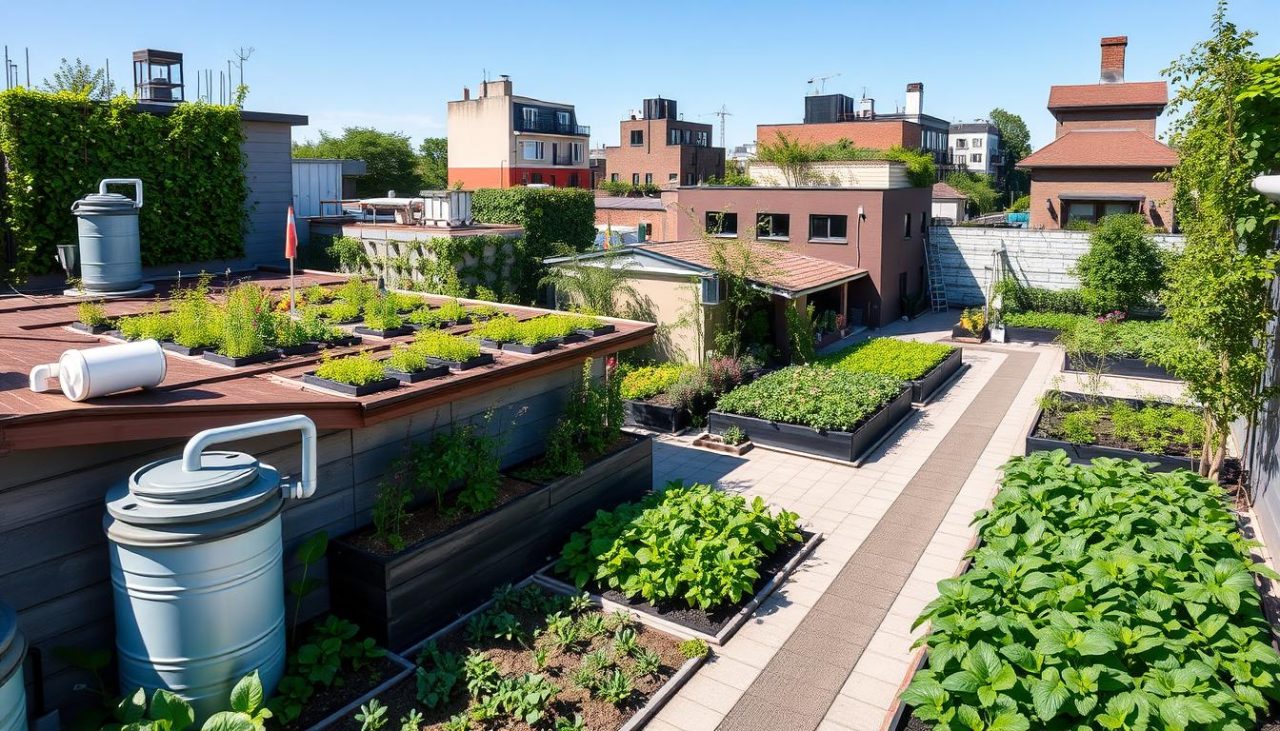
Today, cities face big challenges in growing food. Space is limited, pollution is high, and the weather is changing. To solve these problems, cities are using rooftop gardens and green roofs. These methods use space wisely and help the environment.

The Rise of Architectural Innovation in Urban Agriculture

Architecture is changing urban farming. Vertical farming is becoming popular, allowing food to be grown in tall buildings. Green roofs are also being used, turning buildings into green spaces.

Urban Farming MethodSpace EfficiencyWater UsageYield Potential
Rooftop GardensMediumHighMedium
Green Roof SystemsHighLowLow
Vertical FarmsVery HighVery LowHigh

As cities grow, these new farming methods are key to food security and sustainability. The future of urban farming is in smart, integrated designs that are both beautiful and functional.

Sustainable Architecture Techniques for Urban Farming & Green Roofs

Urban farming is getting a boost from new architectural ideas. Eco-friendly urban agriculture turns empty spaces into green areas. These spaces not only grow food but also make cities better.

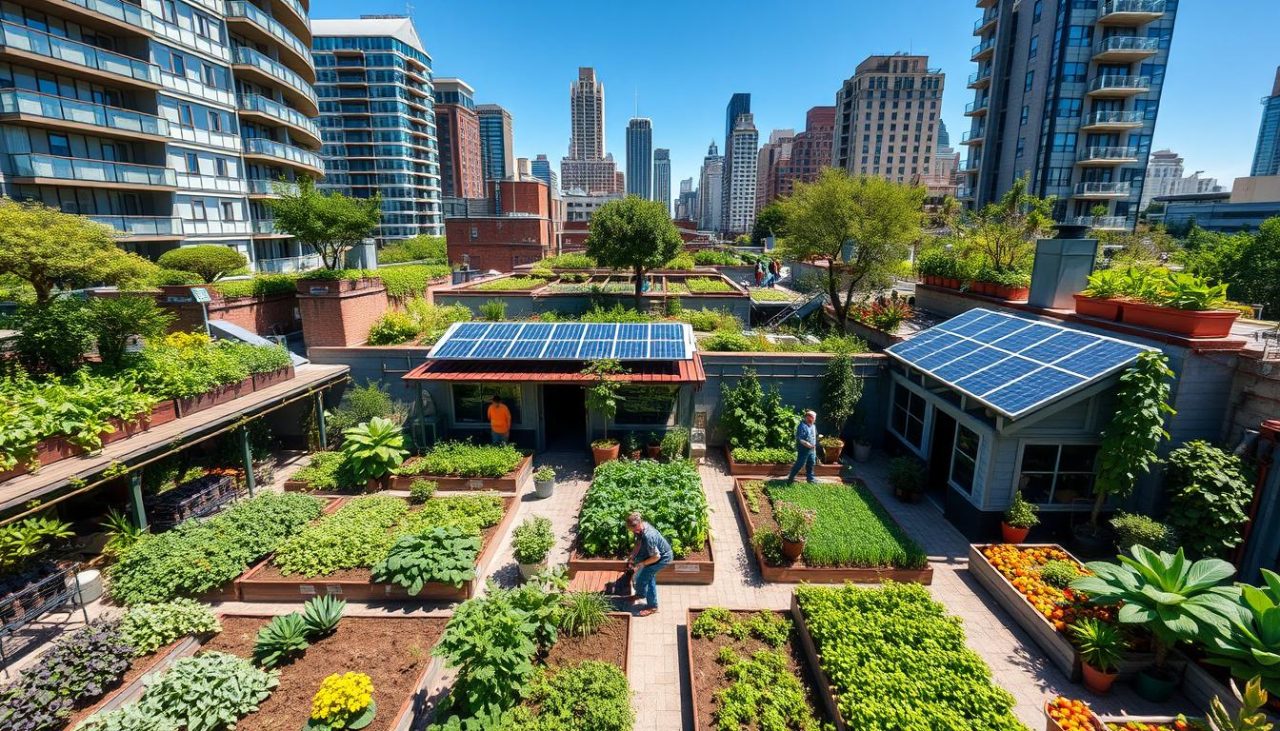
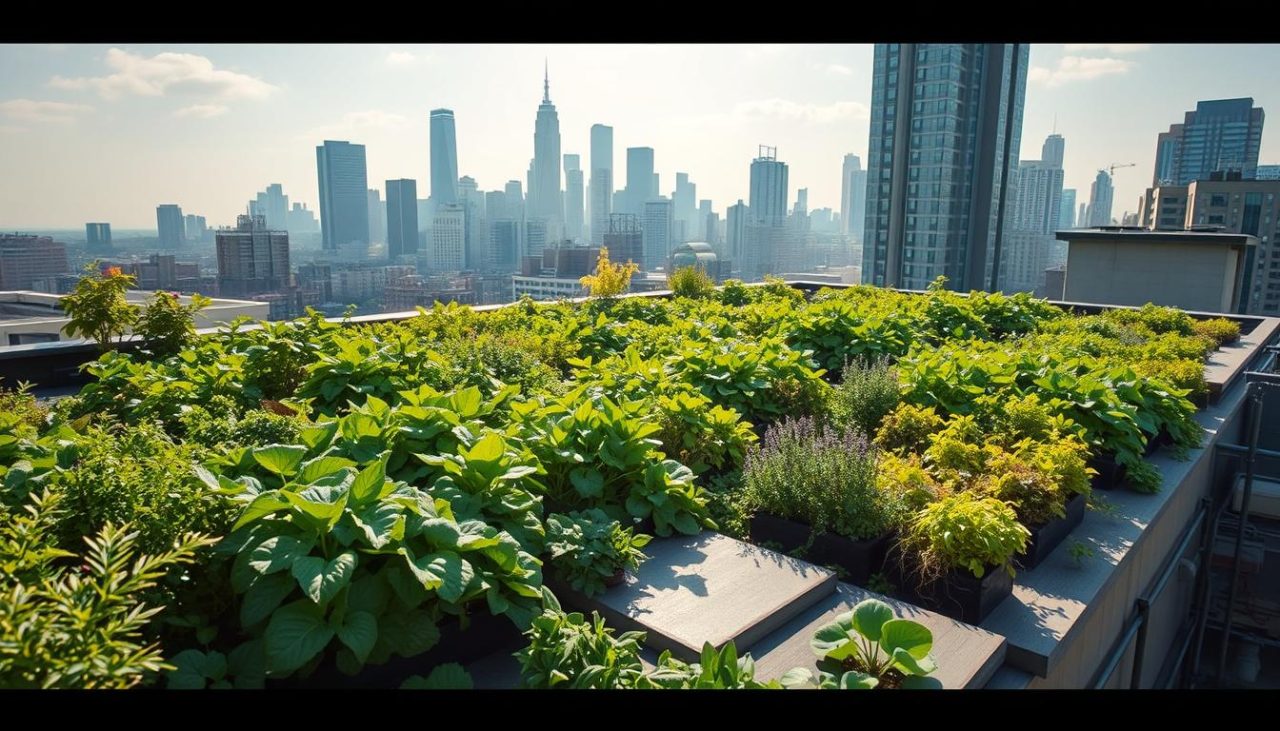
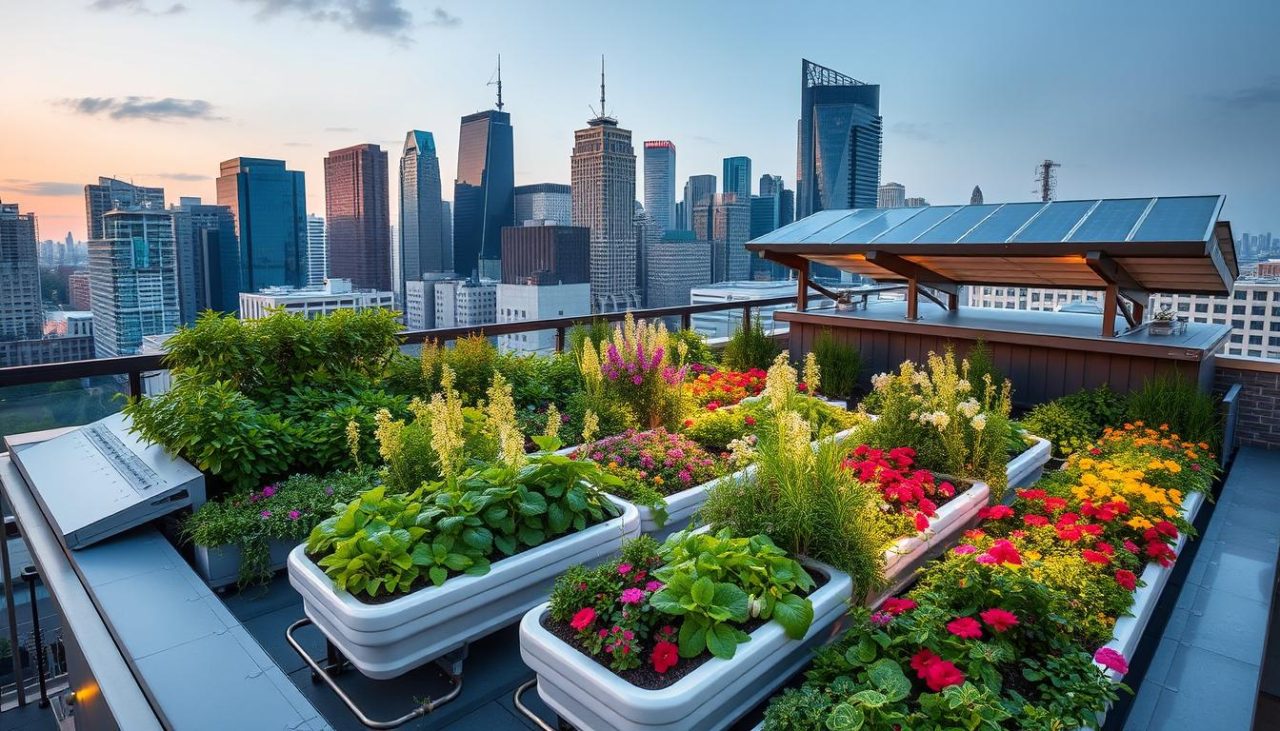
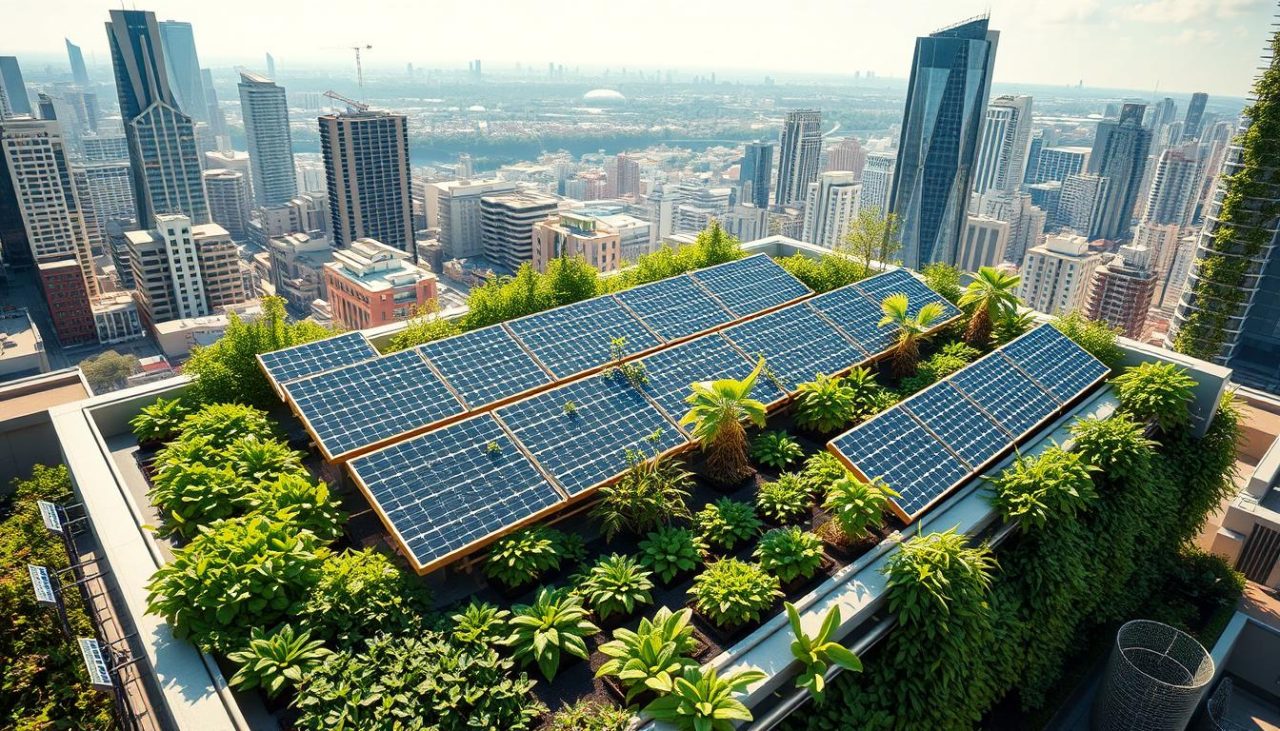
Green roof systems are a key part of sustainable city design. They use rooftops for growing plants, keeping buildings warm, and handling rainwater. This turns unused space into lively, useful areas.

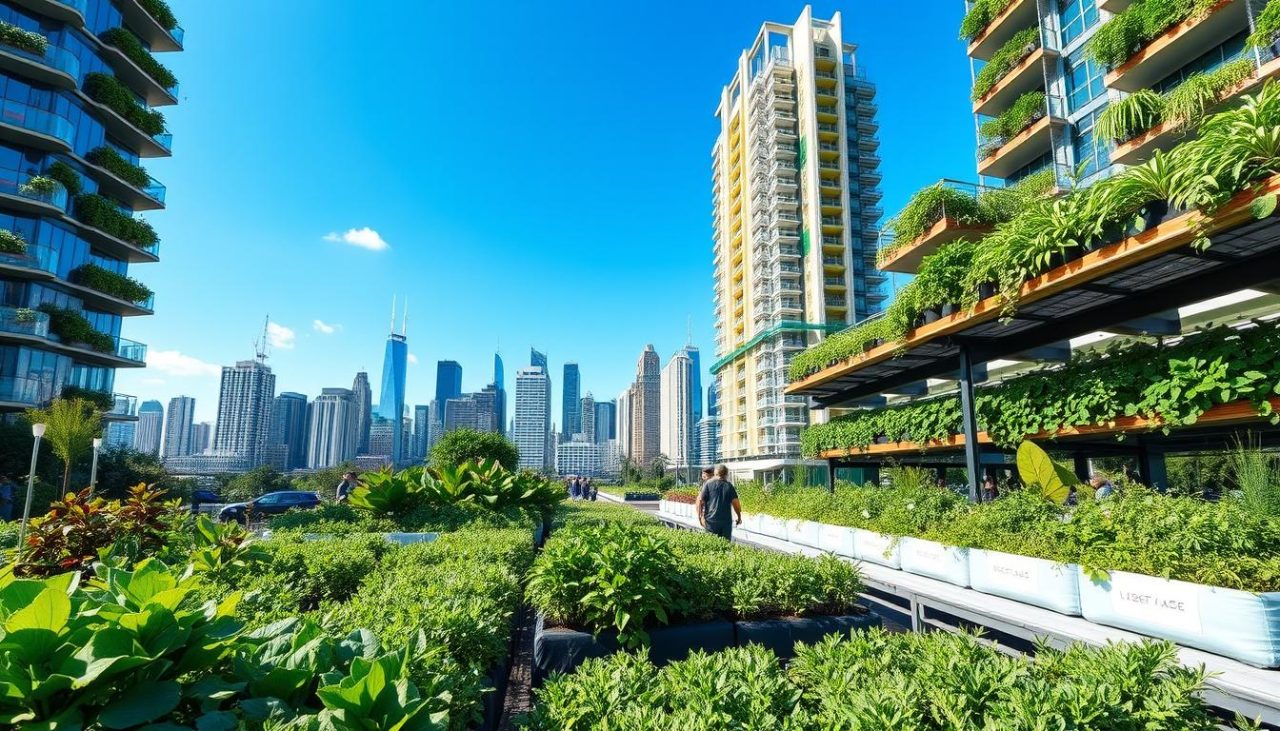
Architects are adding vertical gardens to buildings. These walls grow food, clean the air, and look good. They help cities become more diverse and green.

“Urban farming architecture is not just about food production; it’s about creating resilient, livable cities for the future.”

New materials are important in these designs. They help plants grow without harming buildings. Smart water systems also save water, making these farms very efficient.

TechniqueBenefitsChallenges
Green RoofsInsulation, Stormwater Management, Food ProductionStructural Load, Maintenance
Vertical GardensSpace Efficiency, Air Purification, AestheticsIrrigation, Plant Selection
Integrated GreenhousesYear-round Production, Energy EfficiencyInitial Cost, Climate Control

These green architecture methods are changing cities. They mix growing food with helping the environment. This makes cities greener and stronger for the future.

Vertical Farming Integration in Contemporary Building Design

Vertical farming is changing urban agriculture. It makes the most of space in busy cities, bringing food closer to people. Let’s see how modern buildings use these new growing systems.

Space-Efficient Growing Systems

Vertical farms stack layers to grow crops up. This way, they produce more food per square foot than traditional farming. Architects now design buildings with growing spaces, turning walls and unused areas into farms.

Hydroponic and Aeroponic Technologies

Hydroponics and aeroponics are big changes in farming. They use water or mist to feed plants, saving water and speeding up growth. They also let plants grow all year in controlled spaces.

SystemWater UsageGrowth RateSpace Efficiency
Traditional SoilHighNormalLow
HydroponicsLowFastHigh
AeroponicsVery LowVery FastVery High

Light Management and Natural Ventilation Strategies

Good light is key for plants. Designers use solar energy for LED grow lights, giving plants the best light. They also use cooling systems and natural air flow to keep temperatures right and save energy. These work together to make urban farms in modern buildings.

Rooftop Gardening: Advanced Design and Implementation

Rooftop gardens are changing urban farming. They turn empty rooftops into green spaces, helping cities grow food sustainably. New designs make these gardens productive and eco-friendly.

Urban permaculture is key in rooftop garden design. It creates gardens that work like nature, needing little care. Techniques like companion planting and vertical growing are used.

“Rooftop gardens are not just about growing food; they’re about creating interconnected urban ecosystems that benefit both people and the environment.”

Soil is vital for rooftop gardens. Special soils support plants without harming buildings. Composting helps keep the soil healthy and cuts down on waste.

Choosing the right plants is important. Plants that handle heat and wind well do best. Dwarf varieties and plants with shallow roots are perfect for containers.

Rooftop gardens help meet UNSDG#12 goals. They cut down on food transport, reduce packaging, and promote green living in cities.

Rooftop Gardening ElementBenefitsChallenges
Vertical Growing SystemsSpace efficiency, increased yieldIrrigation complexity, weight considerations
Rainwater HarvestingWater conservation, reduced costsStorage limitations, filtration needs
Permaculture DesignEcosystem balance, low maintenanceInitial planning complexity, specialized knowledge required

Advanced rooftop gardening is changing cities. It turns rooftops into green spaces that help make cities more sustainable.

Smart Water Management and Rainwater Harvesting Systems

Urban farming in big cities faces big water challenges. Smart water systems and rainwater harvesting are new ways to help. They save water and support growing food in cities.

Automated Irrigation Technologies

Modern urban farms use smart irrigation. Sensors check soil moisture and plant needs. This ensures plants get the right water amount.

Greywater Recycling Methods

Greywater recycling is becoming more common. It uses treated water from sinks and showers for plants. It’s a great way to save water in crowded cities.

Water Conservation Techniques

Urban farmers use many ways to conserve water. These include:

  • Vertical and horizontal Drip irrigation systems
  • Mulching to keep soil moist
  • Choosing plants that are minimal water efficient
  • Using surfaces that allow water to soak in

These methods assist urban farms to grow well while using less water.

Water Management MethodWater SavingsImplementation Cost
Rainwater HarvestingUp to 40%Medium
Automated Irrigation20-30%High
Greywater Recycling30-50%Medium-High

By leveraging these water-saving methods, urban farms and by city planner’s influence can lessen their impact on the environment. This supports growth in major cities and promotes green farming practices.

Energy-Efficient Solutions for Urban Agricultural Spaces

Urban agriculture is slowly turning cities into future green food production centers. There is more work to be done regarding both public policy, greenways, and advocacy for urban garden innovation. To be truly sustainable, resource-efficient solutions are essential. Let’s continue to explore new ways to make urban farming greener and more productive.

Solar Integration for Growing Systems

Solar energy is helping to advance urban agriculture at a rapid rate. Rooftop gardens, and vertical farms maximize sunlight for natural lighting, irrigation, and climate control. This reduces dependance on grid electricity use and lowers costs.

Passive Climate Control Methods

Passive cooling systems, like urban agriculture, are changing urban farming for the better. They use natural airflow and thermal mass for temperature control with no need of ample amount of energy. Green walls and roof gardens help keep temperatures stable, reducing the need for HVAC heating and cooling.

Reliable energy storage is an invaluable component for urban farming. Advanced batteries save renewable energy for cloudy days or nighttime. Smart grids and solar power spread this energy around, making sure it’s used well and not wasted.

Energy SolutionBenefitsApplication
Solar PanelsRenewable energy source, reduced electricity costsRooftop gardens, vertical farms
Passive CoolingLower energy consumption, natural temperature regulationGreenhouse designs, building integrated agriculture
Energy StorageContinuous power supply, energy independenceOff-grid urban farms, community gardens

These energy-saving solutions are both accessible and scalable beyond small urban farms. They’re also used in industrial size projects, such as sustainable aviation. As cities scale vertically, these technologies will help create resilient, self-sustaining food systems.

Biodiversity Enhancement Through Architectural Design

Architectural design is an essential part of boosting biodiversity in urban farming. Smart features in urban local help create ecosystems that foster many species. This not only help makes cities better but also helps with biodiversity conservation.

Creating habitats for pollinators and beneficial insects is a smart strategy. Designers can add plants that attract bees and butterflies. These green spaces are like mini-ecosystems, helping local wildlife and boosting biodiversity.

Urban and rural permaculture is another way to increase biodiversity. It uses natural systems to create self-sustaining environments. These systems often use native plants, which support local wildlife.

  • Rooftop gardens with diverse plant species
  • Vertical gardens integrated into building facades
  • Green corridors connecting urban green spaces

Even urban projects epic in scale can help with biodiversity. For example, eco-friendly airports have green spaces and exercise habitat preservation for wildlife. These areas are not just aesthetically pleasing; they also help migratory birds and support local ecosystems.

“Biodiversity-focused design is not just about creating green spaces; it’s about fostering interconnected ecosystems within our urban environments.”

By focusing on biodiversity in design, collectively we can make cities better. They become functional, beautiful, and help our planet’s ecosystems.

Environmental Impact and Carbon Capture Strategies

Urban farming is key to reducing environmental harm and supporting sustainable living. It uses carbon capture and green roofs to cut down cities’ carbon footprint. This helps improve food security too.

Carbon Footprint Reduction Techniques

Urban farming uses new and obscure ways to lower carbon emissions. Green roofs, canopies, and even hammocks act as natural carbon traps, pulling CO2 from the air. They also keep buildings warm in winter and cool in summer, saving energy.

Sustainable Material Selection

Using eco-friendly materials is vital in urban farming. Options like recycled steel, reclaimed wood, and biodegradable plastics are favored. They have a lower carbon footprint and need less energy to make and use.

  • Recycled steel for structural support
  • Reclaimed wood for planters and raised beds
  • Biodegradable plastics for temporary structures

Waste Management Solutions

Good waste management is a key practice in urban farming. Composting turns organic waste into soil, thus reducing landfill use. Harvesting rainwater and recycling greywater saves on resources overall, not just water. These processes help create sustainable, closed-loop systems.

“Urban farming isn’t just about growing food; it’s about growing sustainable cities.”

Urban farms and city based permaculture both play a major role in capturing carbon and protecting the environment. They help enforce cities to play a larger role in climate action, reduce greenhouse gas, and fight air pollution, thus becoming more resilient.

Conclusion

Sustainable architecture is evolving our cities which consequently adopt indigenous community practices such as ubuntu and sankofa. It also combines design with nature, making spaces for agriculture in unexpected places. This includes vertical farms and rooftop gardens, helping cities grow food and other plant life despite their size and resources.

Urban agriculture makes the case for positive impactful performance for many reasons. It cuts down on the logistic of food travel, boosts biodiversity, and makes the air cleaner. These green projects also help cool cities and manage water runoff. By farming in cities and the suburban area, we build stronger communities and connect with where our food grows locally.

The growth of urban farming supports global goals, like UNSDG#12 – Responsible Consumption, Production and UNSDG#11 – Sustainable Cities and Communities, and UNSDG#3 – Good Health and Well-Being. Cities and the greater Metros and county adopting these green solutions do more than feed the communities they serve; they build a sustainable future. Urban farming is essential to developing cities that are self-sufficient and care for the environment, even with climate change.

Key Takeaways

  • Urban farming integrates food production, consumption, and commerce into city landscapes
  • Sustainable architecture maximizes limited space for agriculture
  • Green roofs and vertical gardens transform unused urban space
  • Urban permaculture practices promote environmental sustainability
  • Eco-friendly urban agriculture enhances food security and community well-being
  • Innovative design solutions optimize resource use in city farming and eliminate blight

Types of Cooperatives: Leading Sustainable, Climate, & ESG Solutions

There a numerous set types of Cooperatives that, enterprises & democratic governed organizations are becoming key players in solving global environmental problems. They are owned by their members and lead in promoting green business practices and eco-friendly goods and services. These businesses are making big strides in creating a more sustainable future.

Multi-storey parking garage, Building, Modern image. https://pixabay.com/photos/multi-storey-parking-garage-building-7228120/

Cooperatives are changing how we tackle environmental justice and ecological stewardship issues, both locally and internationally. They focus on renewable and clean energy and sustainable farming. This shows that making money, community outreach, and protecting the planet can go hand in hand.

As we face climate change and use up resources, cooperatives are discovering new ways to help. They are more than just businesses and non-profits; they are communities working together for a greener world. Through their collective efforts, cooperatives are making a real difference in so many areas.

Understanding Modern Cooperative Models in Sustainability

The sustainable types of cooperatives are changing how we face environmental challenges. They bring diverse groups of people together to fight climate change and support green practices. Environmental, habitat preservation, produce, and sustainable agriculture cooperatives are leading this green movement.

Core Principles of Sustainable Cooperatives

Sustainability-focused cooperatives stand out with their key principles. They focus on stewarding the environment, fair labor practices, and community involvement. These groups aim to reduce carbon footprints and support clean energy.

By focusing on sustainability, they make a lasting positive impact on our planet.

Economic and Environmental Benefits

These types of cooperatives offer more than just environmental and social benefits. They create jobs, boost local economies, and provide affordable green goods and service. Environmental cooperatives save money through shared resources and bulk purchases.

Sustainable agriculture cooperatives help farmers and ranchers use eco-friendly methods. This leads to healthier food, minerals, and soils.

BenefitEnvironmental ImpactEconomic Impact
Renewable Energy UseReduced Carbon EmissionsLower Energy Costs
Sustainable FarmingImproved Soil HealthHigher Crop Yields
Resource SharingLess WasteIncreased Savings

Governance Structure and Member Participation

Cooperatives succeed because of owner-member involvement. Everyone has a say in decisions, ensuring objectives and actions meet community needs. This democratic structure encourages humanitarianism, innovation, and accountability.

Owner-members of environmental cooperatives often join eco-projects. Those in sustainable agriculture cooperatives share farming and ranching techniques.

“In a cooperative, every member’s voice counts. It’s not just about profit, but about creating a sustainable future for all.”

Different types of Cooperatives in Sustainability, ESG, Climate, and resiliency

Cooperatives are key in solving big sustainability, ESG, climate, carbon, and resiliency problems. They bring people together from all walks of life to work on big environmental issues. Let’s explore more about the three types of cooperatives that are making a big difference in sustainable development.

Worker-Owned Environmental Cooperatives

Worker-owned environmental cooperatives let employees take action for the eco-system of the planet. They focus on green practices, clean and renewable energy, and cutting down waste. This way, workers feel invested in the company’s success and work harder to meet environmental and social impact goals.

Consumer Green Cooperatives

Consumer green cooperatives serve those who care about the planet. They sell sustainable products like organic food and green household items. By working together, they can get better deals on these products, making green living easier for more people.

Multi-Stakeholder Climate Initiatives

Multi-stakeholder climate initiatives team up different groups to tackle big environmental issues. These cooperatives include local governments, businesses, and residents working together. They create new solutions that help the whole community.

Cooperative TypeKey FocusPrimary Stakeholders
Worker-Owned EnvironmentalSustainable practices, renewable energyEmployees
Consumer GreenEco-friendly products and servicesCustomers
Multi-Stakeholder ClimateCommunity-wide climate adaptationLocal government, businesses, residents

Renewable Energy Cooperative Solutions

Renewable, Roof, Energy image. https://pixabay.com/photos/renewable-roof-energy-solar-6811970/

Renewable Energy Cooperatives are changing the energy scene and causing a ripple effect across the monopolies and cooperative communities alike. They let locals who are owner-members control their energy future. Owner-members pool resources to fund clean and green energy projects, helping the planet and their pockets.

Solar Energy Cooperative Models

Solar cooperatives are becoming the most popular nationwide and globally. Owner-members split the cost of solar panels, making green energy affordable. Some networks even sell their surplus power, earning money for owner-members.

Wind Power Community Projects

Wind power cooperatives, like other clean energy coops, rely on community strength. They thrive in rural areas and in the flat plains with strong winds. Farmers get extra income by leasing land for turbines, helping produce renewable energy.

Energy Storage Initiatives

Energy storage is extremely key for Renewable Energy Cooperatives. Battery systems store extra energy for when it’s needed most during off-peak hours. This boosts grid reliability, durability, and cuts down fossil fuel use.

Cooperative TypeKey BenefitsChallenges
SolarLower installation costs, shared maintenanceSpace requirements, initial investment
WindHigh energy output, land lease incomeWind variability, noise concerns
Energy StorageIncreased reliability, peak shavingTechnology costs, regulatory hurdles

Renewable Energy Cooperatives pave a sustainable path. They help communities cut carbon emissions, lower energy bills, greenhouse gases, and fight climate change.

Sustainable Agriculture and Food Cooperatives

Sustainable Agriculture Cooperatives are invaluable in promoting green farming, ranching, and food making. They unite local farmers, creating a strong community effort in agriculture. This focus is on caring for the environment, preserving the local habitat, and ensuring everyone has food.

Environmental Cooperatives in farming use organic methods, cut down on chemicals, and save natural resources. By working together, members get access to new, green technologies and practices. These are often too expensive for one farmer to afford alone.

“Sustainable Agriculture Cooperatives empower farmers to produce food responsibly while protecting our planet for future generations.”

These groups often connect farms directly to tables, cutting down on transportation and emissions. They support a wide range of crops and protect natural habitats. Many also save and share seeds, keeping rare varieties alive and making crops stronger.

Benefits of Sustainable Agriculture CooperativesImpact
Reduced chemical useImproved soil and water quality
Increased biodiversityEnhanced ecosystem resilience
Shorter supply chainsLower carbon emissions
Knowledge sharingImproved farming practices

Environmental Cooperatives in farming also reach out beyond the fields. They teach people about sustainable food systems and encourage eco-friendly choices. This broad effort helps make the food chain more sustainable, from the farm to our plates.

Green Housing and Eco-Community Cooperatives

Green Housing Cooperatives are changing city living. They mix green living with cooperative ideas. People come together to build eco-friendly homes and lively areas.

Sustainable Building Practices

These cooperatives focus on green building. They use recycled stuff, solar panels, and smart designs. This lowers energy bills and helps the planet.

Community Garden Integration

Many have shared gardens or mini-gardens and hoop houses. These spots give fresh food and build community. People learn to farm sustainably and enjoy their harvest and investments.

Shared Resource Management

Cooperatives are great at sharing resources and exchanges. They have systems for preserving water, reducing waste, and managing energy. This teamwork makes the overall infrastructure more efficient and cuts down on waste.

“Our cooperative’s shared resource system has cut our utility costs by 40% while bringing neighbors closer together,” says a member of a thriving Green Housing Cooperative in Seattle.

Green Housing Cooperatives are at the forefront of green and smart city growth. They mix green living with community efforts. This creates strong, livable places for tomorrow.

Environmental Manufacturing and Production Cooperatives

Eco-friendly manufacturing cooperatives are changing the game in industrial production. They mix sustainable practices with a worker-owned model. This approach aims to cut waste, save resources, and make eco-friendly products.

Worker-owners in these cooperatives care about making money, productivity, and protecting the environment. This setup leads to new ways of production and output. For instance, many use closed-loop systems, where waste is converted into new inputs.

“Our cooperative model allows us to prioritize long-term sustainability over short-term gains. We’re not just employees; we’re stewards of our environment and our community.”

These cooperatives focus on making sustainable and/or eco-friendly versions of common products. They produce everything from biodegradable packaging to solar-powered gadgets. They’re leading the charge of green innovation and sustainable development.

Cooperative TypeKey Focus AreasEnvironmental Impact
Recycling CooperativesWaste reduction, Material recoveryLandfill diversion, Resource conservation
Green Tech CooperativesRenewable energy products, Energy-efficient devicesCarbon footprint reduction, Energy savings
Eco-textile CooperativesOrganic fabrics, Sustainable dyeing processesWater conservation, Chemical pollution reduction

The success of Eco-Friendly Manufacturing Cooperatives shows that generating capital and saving the planet can work together. As people become more eco-aware, these cooperatives are ready to lead in sustainable production and development.

Climate Action and Resilience Cooperative Networks

Climate Action Cooperatives and Community Resilience Cooperatives collaborate together for sustainability projects from human rights to conservation to fight climate change. They create robust systems for getting ready for disasters, adapting to climate change, and responding to emergencies.

Disaster Preparedness Programs

Climate Action Cooperatives make detailed plans for disaster readiness. They do risk checks, plan evacuations, and store important items. Owner-members learn first aid and emergency steps, so they can act fast during disasters.

Climate Adaptation Strategies

Community Resilience Cooperatives work on short-term and long-term climate solutions. They start habitat preservation and green projects like urban forests and rain gardens to fight flooding and heat. They also support farming and permaculture-facing agendas that’s good for the planet, to keep food safe in changing climates.

Community Emergency Response

When disasters hit, Climate Action Cooperatives act quickly. They work with local groups, manage shelters, and share resources. Their community focus means they respond fast and effectively, meeting local needs.

Cooperative TypeFocus AreaKey Activities
Climate Action CooperativesDisaster PreparednessRisk assessment, evacuation planning, emergency training
Community Resilience CooperativesClimate AdaptationGreen infrastructure, sustainable agriculture, resource management
BothEmergency ResponseShelter management, resource distribution, community coordination

“Our cooperative network turns climate challenges into opportunities for community growth and resilience,” says Emma Chen, leader of the Bay Area Climate Action Cooperative.

Together, these networks make communities stronger and more ready to face climate challenges.

ESG Integration in Cooperative Business Models

Those types of Cooperatives in general are, at the forefront of sustainability and economic development. They leverage Environmental, Social, and Governance (ESG) principles into their daily work. This approach helps them measure and enhance their positive impact.

Environmental Impact Measurement

Cooperative enterprise organization use advanced tools to measure their environmental impact. They track energy use, waste, water, and carbon emissions. Life cycle assessments and life cycle cost analysis both help them understand the full effect of their activities.

Social Responsibility Programs

Cooperatives focus on social responsibility through community efforts and engagement. They promote fair labor, diversity, international relations, and local economic growth. Some even offer education and training to empower members and encourage sustainable practices.

Governance Best Practices

Cooperatives are known for their transparent, scalable, and democratic governance. They ensure all owner-members have a say in decisions. Regular audits for checks and balances with open communication build trust and accountability.

“Cooperatives are not just businesses; they’re catalysts for positive change in sustainability and climate action.”

By embracing both CSR and ESG, cooperatives are raising the bar for sustainable business. Their structure allows them to succeed economically while protecting the environment and advancing society. This makes them key players in the battle against climate change/pollution/environmental impact and social inequality.

Conclusion

The various types of Cooperatives are a key factor in making our world more sustainable and resilient. They range from customer/producer/worker-owned groups to renewable energy projects. These efforts are crucial for a greener future for the next generations.

Cooperatives continue to tackle imposing global issues in unique ways. They focus on sustainable farming, green homes, and eco-friendly manufacturing. Their goal is to protect our planet and support communities.

In a world facing many challenges in labor, economic, politics, law, and education to name a few; cooperatives offer hope in something very attainable. They use democratic rules, share resources, foster innovation, and engage communities. By adopting these cooperative models, we can create a better world for all and for future generations to come.

Key Takeaways

  • Cooperatives play a crucial role in promoting sustainability, green production, and ESG practices
  • Member-owned structures enable democratic economics for decision-making in environmental initiatives
  • Various types of cooperatives address different aspects of labor, ecology, climate change and resiliency
  • Cooperatives combine economic success with ecological responsibility through social impact
  • Cooperative organizations as internal operations offer innovative solutions to global environmental challenges

Indigenous societies self-determination: Ubuntu and Sankofa approaches for sustainability

Indigenous communities across Africa, the Americas, the Pacific Islands, and developing nations have unique approaches to self-determination and self-actualization. These groups often draw on traditional philosophies and inspired cultural practices to achieve sustainable outcomes. Many indigenous societies use Ubuntu and Sankofa-based principles to guide their development and preserve their cultural heritage.

A gathering of traditional dwellings from various Indigenous communities in Africa, the Americas, developing 2nd world, and 3rd world, surrounded by lush vegetation and diverse wildlife

Ubuntu, a South African philosophy emphasizing collective humanity, shapes how some communities make decisions and allocate resources. Sankofa, a concept from Ghana, encourages people to learn from the past while moving forward. These ideas and concepts help indigenous groups steward their land and natural resources sustainably.

In post-colonial Africa, indigenous peoples are not necessarily the first inhabitants such as the aboriginals, but rather groups with distinct cultural practices. These communities face challenges from climate change, pollution, and modernization. Despite these obstacles, many African indigenous communities show resilience and adaptability in preserving their ways of life while engaging with the broader, changing world.

Indigenous Self-Determination in a Global Context

Indigenous peoples around the world seek self-determination to maintain self-actualization to control their own affairs and preserve their cultures. This right allows them to make decisions about their political status and economic development.

Many countries now recognize indigenous rights in their laws. But putting these rights into practice remains a challenge. Indigenous groups often face barriers when trying to exercise self-determination.

The United Nations Declaration on the Rights of Indigenous Peoples supports these goals. It affirms indigenous peoples’ right to self-determination within existing nations.

International human rights law can help promote indigenous rights. Some countries have incorporated these laws into their own legal systems. This gives indigenous groups more tools to assert their rights.

Indigenous women play an important role in self-determination efforts. They advocate for their communities while also addressing gender issues. Their involvement ensures a more complete approach to self-determination.

Self-determination takes different forms in various regions. What works for one group may not fit another. Indigenous peoples must shape their own paths forward based on their unique needs and traditions.

The Philosophy of Ubuntu: Collective Humanity

Ubuntu is a philosophy that emphasizes the interconnectedness of all people. It values community, compassion, and shared humanity over individualism.

Historical Roots and Development

The concept of Ubuntu has deep roots in African cultures. It comes from the Nguni Bantu term “ubuntu”, meaning “humanity”. The idea spread across many African societies over time.

Ubuntu is often explained by the phrase “I am because we are”. This captures its focus on collective identity. It sees a person’s humanity as tied to others.

The philosophy gained wider attention during South Africa’s anti-apartheid movement. Leaders like Desmond Tutu used Ubuntu principles to promote reconciliation.

Practical Applications in African Societies

Ubuntu shapes social norms and behaviors in many African communities. It encourages people to support each other and work for the common good.

In practice, Ubuntu can look like:

  • Sharing resources with neighbors in need
  • Making decisions as a group rather than individually
  • Welcoming strangers into the community

Some African businesses apply Ubuntu values. They may focus on collective success over competition. Ubuntu also influences conflict resolution. Communities may seek to restore harmony rather than punish wrongdoers.

Ubuntu-inspired programs address social issues. For example, some use its principles in AIDS education and support groups.

The Sankofa Concept: Learning from the Past

A diverse group of people from various indigenous communities gather around a central symbol, representing the Sankofa concept of learning from the past

The Sankofa concept teaches us to look back to move forward. It comes from West Africa and tells us to use past wisdom to build a better future.

Cultural Relevance and Modern Interpretation

Sankofa is an idea from the Akan people of West Africa. In their language, it means “it is not taboo to go back and fetch what you forgot.” This idea helps people connect with their roots.

Today, many use Sankofa to solve current problems. It pushes us to learn from history and not repeat mistakes. In schools, it means teaching kids about their culture. In politics, it guides leaders to use old wisdom for new laws.

Sankofa symbols often show up in art and fashion. A common one is a bird looking back, with an egg in its mouth. This shows the link between past and future.

Case Studies in Societal Revival

Ghana uses Sankofa to boost tourism. They invite people with African roots to visit and learn about their past. This helps the economy and builds global ties.

In the U.S., some Black communities use Sankofa to fight racism. They study past movements like civil rights to shape new strategies. This has led to better education programs and community support.

African countries often use Sankofa in development plans. They mix traditional farming with new tech. This respects old ways while moving forward. It helps create sustainable food systems that work for local needs.

Indigenous African Communities

A group of indigenous African villagers gather around a central meeting area, surrounded by traditional huts and lush vegetation

Indigenous African communities face unique challenges in their quest for self-determination. They use traditional knowledge and cultural practices to achieve sustainable outcomes. These communities strive to maintain their identities while adapting to modern realities.

Strategies for Self-Actualization

Indigenous communities in Africa employ various strategies for self-actualization. They often rely on customary governance systems to make decisions and resolve conflicts. These systems are based on centuries-old traditions and community values.

Many groups use traditional ecological knowledge to manage natural resources sustainably. This includes rotational farming, water conservation techniques, and plant-based medicines.

Indigenous African communities also focus on preserving their languages and cultural practices. They establish community schools that teach both modern subjects and traditional knowledge. This helps maintain their unique identities while preparing youth for the future.

Some groups form cooperatives to market traditional crafts and agricultural products. This allows them to generate income while preserving cultural skills.

Challenges and Triumphs

Climate change poses a significant threat to many indigenous African communities. Changing weather patterns disrupt traditional farming and herding practices. This forces communities to adapt quickly or risk losing their livelihoods.

Land rights remain a major challenge. Many groups struggle to maintain control over their ancestral territories. They face pressure from governments, corporations, and other groups seeking to exploit natural resources.

Despite these challenges, indigenous African communities have achieved notable successes. Some have gained legal recognition of their land rights. Others have established protected areas to conserve biodiversity and cultural sites.

Many communities have successfully integrated modern technology with traditional practices. They use mobile phones and the internet to share knowledge and coordinate activities. This helps them address common challenges more effectively.

Indigenous Societies in the Americas

A vibrant marketplace in an Indigenous community in the Americas, with colorful textiles, handmade crafts, and bustling activity

Indigenous communities in the Americas focus on self-governance and preserving their cultural heritage. They also work towards economic independence and sustainable practices to ensure their long-term survival and prosperity.

Self-Governance and Cultural Preservation

Many Native American ethnogroups have their own governing bodies. These structures help maintain traditional leadership roles and decision-making processes. Tribal councils often work alongside federal and state governments to protect their rights and lands.

Cultural preservation is a key priority. Indigenous groups teach their languages to younger generations. They also practice traditional ceremonies and crafts. Museums and cultural centers play a vital role in safeguarding artifacts and sharing knowledge.

Some ethnogroups use modern technology to document oral histories. This helps keep their stories alive for future generations. Many communities also run educational programs to teach youth about their heritage and customs.

Economic Independence and Sustainability

Indigenous societies in the Americas pursue various economic strategies. Some ethnogroups operate casinos and resorts on their lands. These businesses create jobs and generate income for community programs.

Many groups focus on sustainable resource management. They use traditional knowledge to protect forests, rivers, and wildlife. Some communities run eco-tourism projects, sharing their culture while protecting the environment.

Agriculture remains important for many ethnogroups. They grow traditional crops and practice sustainable farming methods. Some groups sell native foods and crafts, creating niche markets for their products.

Renewable energy projects are gaining popularity. Solar and wind farms on tribal lands provide clean energy and economic opportunities. These initiatives help communities become more self-reliant and reduce their carbon footprint.

Developing Second World Indigenous Initiatives

A group of Indigenous people from different continents gather around a symbolic fire, sharing traditional knowledge and exchanging ideas for sustainable development

Indigenous communities in developing second world nations face unique challenges. They are working to preserve traditions while adapting to modern realities. Many are finding success through regional teamwork and embracing new technologies.

Regional Cooperation for Community Empowerment

Indigenous groups across developing nations are joining forces. They share knowledge and resources to tackle common issues. In Latin America, the Indigenous Fund for Latin America and the Caribbean supports local projects. These focus on economic growth, cultural preservation, and environmental protection.

In Asia, networks of indigenous peoples collaborate on land rights. They push for legal recognition of ancestral territories. This teamwork amplifies their voices in national and global talks.

Regional groups also run training programs. These teach traditional crafts, sustainable farming, and eco-tourism skills. Such efforts create jobs and preserve cultural practices.

Education and Technology as Tools for Development

Education is key for indigenous progress in developing nations. Many communities are setting up schools that teach both modern subjects and traditional knowledge. In India, tribal schools use local languages alongside national ones. This helps students succeed while keeping their cultural identity.

Technology is opening new doors. Indigenous communities are using smartphones, computers, and the internet to market crafts globally. They also use apps to track forest health and protect their lands.

Online platforms help preserve and share indigenous languages. Young people learn to code and digital skills. This bridges the gap between tradition and the modern economy.

Global South Communities and Indigenous Resilience

A vibrant marketplace in a rural Indigenous community, with colorful textiles, handcrafted pottery, and fresh produce on display

Aboriginal peoples and Indigenous groups in the global south countries show great strength in the face of challenges. They create local solutions and work with outside groups to protect their rights and ways of life.

Grassroots Movements and Local Successes

Many indigenous communities lead grassroots efforts to defend their lands and cultures. In the Amazon, indigenous groups use mapping technology to track deforestation and protect their territories. They work together to resist illegal logging and mining.

In India, Adivasi communities set up seed banks to preserve native crop varieties. This helps them maintain food security and traditional farming practices.

Indigenous youth in Bolivia create radio programs in native languages. These shows keep their cultures alive and spread important information to remote areas.

International Aid and Its Impact

Outside aid can both help and harm indigenous resilience. Some groups offer useful support. The United Nations runs programs to protect indigenous land rights in Asia and Africa.

But aid can also create dependence. Many indigenous communities face poverty and lack basic services. Outside groups sometimes push solutions that don’t fit local needs.

The best aid works closely with indigenous leaders. It respects traditional knowledge and builds on local strengths. Some funders now focus on backing indigenous-led projects instead of outside experts.

Sustainable Outcomes from Indigenous Perspectives

A diverse group of Indigenous people from different continents gather around a communal fire, sharing traditional knowledge and sustainable practices

Aboriginal peoples and Indigenous communities view sustainability through a holistic lens that integrates environmental care with economic practices. Their approaches prioritize balance and reciprocity between humans and nature.

Environmental Stewardship

Aboriginal and indigenous peoples often act as guardians of biodiversity and natural resources. They use traditional ecological knowledge to manage forests, waterways, and wildlife sustainably.

Many aboriginal peoples and indigenous groups practice rotational agriculture and selective harvesting. These methods help preserve soil fertility and prevent overexploitation of plants and animals.

Aboriginal peoples and indigenous communities frequently engage in reforestation and habitat restoration projects. They plant native species and work to bring back endangered animals to their ancestral lands.

Marine life and water conservation is a key focus for many groups. They use ancient irrigation techniques and protect sacred water sources from pollution and overuse.

Economies in Harmony with Nature

Indigenous economic models often prioritize community well-being over individual profit, similar to the cooperative business model. They emphasize sharing and exchanging resources and maintaining long-term ecological balance.

Many groups practice subsistence economies based on hunting, gathering, and small-scale farming. These activities provide for basic needs without depleting natural resources.

Indigenous knowledge systems support sustainable industries like ecotourism, textiles, and artisanal crafts. These enterprises create income while preserving cultural traditions and ecosystems.

Fair trade partnerships help indigenous producers earn living wages for their goods. This approach supports economic stability without exploiting workers or the environment.

Some communities are developing renewable energy projects on their lands. Solar, wind, and small-scale hydropower initiatives provide clean electricity and local jobs.

Cultural Revitalization Through Arts and Traditions

A group of Indigenous people from different continents gather around a central fire, engaging in traditional arts and cultural practices

Indigenous communities use arts, craft, materials, and traditions to strengthen their cultural identity. These practices help preserve knowledge and foster a sense of belonging among community members.

Celebrating Heritage and Identity

Many Indigenous and aboriginal groups reclaim their cultural heritage through art. They create traditional crafts, music, and dance performances to express their unique identities.

Artists often blend ancient techniques with modern influences. This approach keeps traditions relevant for younger generations.

Community events showcase these artistic expressions. Festivals and exhibitions allow both insiders and outsiders to appreciate indigenous cultures.

Schools now include Indigenous art forms in their curricula more than ever. This helps children connect or reconnect with their heritage from an early age.

The Role of Elders and Oral Histories

Elders play a crucial part in cultural revitalization efforts. They pass down knowledge, stories, and customs to younger members of the community.

Oral histories preserve important information about a group’s past. These stories often contain practical wisdom and cultural values.

Many communities organize storytelling sessions. Here, elders share legends and historical accounts with attentive listeners.

Some clans and ethnogroups record these oral traditions. Audio and video archives ensure that future generations can always access this knowledge.

Language and culture preservation is often tied to oral histories. Elders help teach Aboriginal and Indigenous languages to youth, keeping these unique forms of communication alive.

Indigenous Youth: Next Generation Leadership

A group of Indigenous youth from diverse regions stand together, representing the next generation of leadership in their communities

Aboriginal and indigenous youth play a crucial role in preserving cultural traditions while driving positive change. They bring fresh perspectives and innovative approaches to addressing community and global challenges.

Educational Programs and Mentorship

Indigenous youth leadership programs are emerging globally to empower the next generation. These initiatives focus on cultural education, leadership skills, and community engagement.

The Indigenous Youth Leadership Coalition (IYLC) elevates the voices of the youth in global civic discussions. It connects youth from different regions to share experiences and ideas.

Mentorship is key in these programs. Elders and experienced leaders guide youth, passing down traditional knowledge and wisdom. This bridge between generations helps maintain cultural continuity.

Many programs incorporate both traditional teachings and modern skills. This approach prepares youth to navigate both their cultural world and the broader society.

Innovation and Modern Civic Engagement

Young Indigenous leaders are embracing technology and social media to amplify their voices. They use these tools to raise awareness about community issues and mobilize support.

Digital platforms enable Indigenous youth to connect across vast distances all over the world. This fosters a sense of global Indigenous community and shared experiences including knowledge.


Youth-led initiatives often focus on pressing issues like climate change, land rights, marine life, and language preservation. They bring fresh energy and ideas to these long-standing challenges.

Many junior leaders and youth organizers are creating innovative solutions that blend traditional knowledge with modern approaches and new technology. This includes leveraging data, sustainable development projects, and cultural revitalization efforts.

Participation in international forums is both ongoing and growing. The aboriginal and indigenous youth are increasingly representing their communities at UN events, regional and global conferences.

Global Solidarity and Indigenous Movements

Aboriginal people and indigenous communities worldwide have joined forces to amplify their voices and protect their rights. This unity has led to significant progress in self-determination efforts and sustainability-based development initiatives.

Networking and Alliances Across Borders

Indigenous groups have built strong networks that span continents. These alliances allow them to share and exchange knowledge, resources, and strategies. For example, the International Work Group for Indigenous Affairs promotes collaboration among indigenous peoples globally.

Social media and technology have made it easier for indigenous communities to connect. They use these tools to organize protests, raise awareness, and gain support for their causes.

Many indigenous organizations both precolonial and postcolonial now participate in international forums. This gives them a platform to address global issues that affect their communities.

The Influence of International Law and Policy

International laws and policy have played a crucial role in advancing indigenous rights. The United Nations Declaration on the Rights of Indigenous Peoples is a key document that many nations and ethnogroups globally have adopted.

Indigenous groups have used these laws to challenge unjust practices. They’ve won important legal battles over land and governing rights and resource management.

Global policies on climate change and biodiversity often include indigenous perspectives. This recognition has led to more sustainable approaches to environmental stewardship and habitat preservation.

Indigenous leaders now regularly attend international conferences. Their input shapes policies on issues like education, health, and economic development.

Key aspects of indigenous self-determination include:

  • Control over land, sea, and resources
  • Preservation of language and culture
  • Political and economic autonomy
  • Economic and cultural self-reliance
  • Advance intercultural commerce

Cooperatives Supporting the UN Sustainable Development Goals

Cooperatives are key to reaching the global United Nations sustainable development goals for 2030. These businesses, owned by their members, refer to as member-owners, boost economic power, ecological awareness, and social good. They work with the UN’s goals to help make the world more fair and green.

Cooperatives, like credit unions and farmer groups, help everyone grow together in unison. They mix making money with doing good by tackling big issues like poverty and climate change.

Let’s explore at how cooperatives and UN SDGs meet and intersect. These groups are changing societies from economical to cultural to even political. Their work showcase the strength of working together for a better world.

Understanding the Intersection of Cooperatives and UN Sustainable Development Goals

Cooperatives are also key in reaching the UN’s sustainable development goals around the world. These businesses, owned by their members, work with global efforts and occasionally within an international mandate to make a difference. They help communities by aligning with UN SDGs.

Defining UN SDGs and Their Global Impact

The United Nations’ sustainable development goals are a plan for a better future. These 17 goals tackle big issues like poverty, inequality, hunger, pollution, and climate change. They aim to help make the world more sustainable by 2030.

The Role of Cooperative Business Models in Sustainable Development

Cooperative businesses are well-suited to help achieve the UN SDGs. They focus on the needs of their stakeholders, who are both members and the community, which align with sustainable goals. Cooperatives also encourage and advise everyone to have a say through democratic decision-making.

Cooperative PrincipleRelation to SDGs
Voluntary MembershipPromotes Inclusion (SDG 10)
Democratic ControlSupports Equality (SDG 5)
Economic ParticipationReduces Poverty (SDG 1)
Autonomy and IndependenceFosters Resilient Communities (SDG 11)

Historical Evolution of Cooperative Support for Global Goals

Cooperatives have always supported sustainable practices, even well before the creation of the SDGs. They have dominantly assisted with financial inclusion and rural development. These efforts display their commitment to global partnerships and community empowerment.

“Cooperatives are a reminder to the international community that it is possible to pursue both economic viability and social responsibility.” – Ban Ki-moon, former UN Secretary-General

Today, cooperatives keep adapting to meet new global needs and demands. They stay true to their values of sustainability, environmental stewardship, and social responsibility.

How Different Types of Cooperatives Align with UN SDGs

Cooperatives, aggregately, are the key to helping the United Nations Sustainable Development Goals (SDGs). Through economic growth, fostering social impact, and protecting the environment are the majorly different mythologies to drive for both coop and sustainable development.

Worker cooperatives focus on good jobs, healthy labor practices, and economic growth. They give employees-owners a say in how the organizations are operated. This helps meet UN Sustainable Development Goal #8.

Consumer cooperatives focus on buying things in a responsible way. They sell products that are good for the planet promote community mobility and social impact. This supports UN Sustainable Development Goal# 12.

Producer cooperatives, especially in farming, help with United Nations Sustainable Development Goal# 2 (Zero Hunger) and UN SDG# 15 (Life on Land) while at times, UN SDG# 1(Life below Water). They help small farmers provide quality business, work practices, and protect nature. Multi-stakeholder cooperatives work with many groups to tackle enormous problems. They help with several UN SDGs at cross sectionally and complimentary.

“Cooperatives are a reminder to the international community that it is possible to pursue both economic viability and social responsibility.” – Ban Ki-moon, former UN Secretary-General

The table below shows how different cooperatives help with UN SDGs:

Cooperative TypePrimary SDGs AddressedKey Contributions
WorkerSDG 8, SDG 10, SDG 17Decent work, reduced inequalities
ConsumerSDG 12, SDG 11, SDG 17Responsible consumption, sustainable communities
ProducerSDG 2, SDG 14, SDG 15, SDG 17Food security, biodiversity protection
Multi-stakeholderSDG 17, SDG 13, SDG 9, SDG 16Partnerships, climate action

Cooperatives show they care about a better world by following the United Sustainable Development Goals. They utilize different tactics and processes to help the economy and the environment. This makes them important in reaching global goals.

Economic Impact: Cooperatives as Drivers of Sustainable Growth

All Cooperative types are crucial for sustainable growth, community uplift, and economic empowerment. They work towards the 2030 UN sustainable development goals. This is through their unique business model, promoting inclusive economic progress.

Poverty Reduction Through Cooperative Enterprise

Cooperative enterprises help fight poverty and hunger by giving opportunities to underrepresented and marginalized groups. They offer network access to resources, markets, and financial services. This helps members earn more, be more efficient, and live better.

Job Creation and Decent Work Opportunities

Cooperatives are influential job creators, offering stable jobs, safe spaces, and fair conditions. They focus on ethical business practices that are also sustainable. This ensures stable yet decent work, safe while stable labor, and supports sustainable economic growth in their communities.

Financial Inclusion and Economic Empowerment

Cooperatives help with financial inclusion by providing banking services and credit via credit unions. This empowers individuals along with micro and small businesses. It also reduces inequality.

Economic Impact AreaCooperative Contribution
Poverty ReductionIncome generation, resource access
Job CreationStable employment, fair working conditions
Financial InclusionAccessible banking, credit facilities

“Cooperatives are key drivers of sustainable economic growth, fostering inclusivity and empowerment at the grassroots level.”

Environmental Stewardship in Cooperative Organizations

Cooperatives are key to promoting sustainability through environmental sustainability, habitat preservation, ecological stewardship, and community growth. They lead efforts that support the 2030 United Nations Sustainable Development Goals. This helps create a greener future for all.

Renewable energy cooperatives are at the forefront of cutting down carbon emissions. They invest in solar, wind, hydroelectric power, battery storage. This move helps communities move away from finite fossil fuels. It also creates a labor force and makes communities energy-independent.

Sustainable agriculture cooperatives focus on green farming. They perform organic farming, crop rotation, while save water. These actions protect soil, preserve biodiversity, and ensure quality food for the future.

Resource conservation cooperatives aim to reduce waste, habitat preservation, and support the circular economy. They run recycling programs, upcycling workshops, and sharing initiatives. These efforts extend product life and reduce resource use.

“Cooperatives are at the forefront of environmental stewardship, demonstrating that business success and ecological responsibility can go hand in hand.”

Cooperatives adopt sustainable practices, helping achieve global environmental goals. They also build strong, resilient communities. This shows that economic growth and environmental care can work together, setting a great example for businesses everywhere.

Social Impact and Community Development Through Cooperatives

Cooperatives are key to making a difference in society and helping communities grow. They bring people together and help solve enormous problems. Observation is key to how cooperatives help in important areas of progress.

Gender Equality and Women’s Empowerment

Cooperatives help women and outgroup peoples by giving them opportunities to lead, guide, and earn money. They have special programs for women entrepreneurs and other underrepresented micro and small businesses. This ensures women have a say in important decisions and underrepresented group have advocacy.

Education and Skills Development Initiatives

Cooperatives invest in education and skills for their members and the community. They offer training, workshops, and scholarships. This helps people get jobs and grow personally.

Healthcare Access and Social Protection

Cooperatives help make healthcare better through equity and protect the vulnerable. Some run health clinics, healthcare entity as a shareholder/member, or offer insurance. This way, members-owners get the medical care they need.

“Cooperatives have been instrumental in transforming lives and building resilient communities across the globe.”

The good work of cooperatives doesn’t stop with their members-owners. It spreads out to whole communities. Cooperatives tackle big needs and promote growth for everyone. They show their dedication to lasting development goals.

Social Impact AreaCooperative InitiativesCommunity Benefits
Gender EqualityWomen’s leadership programsIncreased economic opportunities for women
EducationSkills training workshopsEnhanced employability and career growth
HealthcareCooperative health clinicsImproved access to medical services

Ethical Business Practices and Governance in Cooperatives

Cooperatives are ethical and are known for their commitment to doing business the right way. They focus on sustainability based development, ethical governance, and involve everyone in decision-making. This makes them sustainably stand out for their ethical practices.

Democratic Decision-Making Processes

Cooperatives operate in making decisions together. Members-owners get to help shape policies and choose leaders. This way, everyone’s voice is heard while every vote is counted, and the group’s needs come first.

They use a fair system where every member has one vote, no matter how much they contribute(. This helps keep things equal and fair, which is good for sustainable development.

Transparency and Accountability Measures

Being transparent is key for cooperatives. They share financial details, records, hold open meetings, and make sure everyone can get in touch. This keeps members in the know about what’s happening.

Cooperatives also have sound ways to make sure they’re doing the right thing. They include:

MeasurePurpose
External auditsEnsure financial integrity
Ethical committeesAddress conflicts of interest
Whistleblower policiesEncourage reporting of misconduct

Cooperatives lead the way in ethical business standards. Their way of operating standards is a model for all organizations and institutions. It shows how to develop towards sustainable goals and really listen to stakeholders.

Global Partnerships and Cooperative Networks

Cooperatives are monumental to building global partnerships for sustainable goals. They collaborate with many stakeholders to make a bigger impact worldwide. This teamwork brings new chances and resources, helping them face enormous challenges better.

International cooperative alliances are the heartbeat of these networks. They help share knowledge, exchange pool resources, and initiate joint projects across borders. For instance, the International Co-operative Alliance links over 3 million cooperatives globally, pushing for sustainable practices and growth.

Cooperatives also create partnerships with different sectors. They work with governments, NGOs, GSOs, and the private sector to use various skills and resources. These partnerships often bring new, effective solutions that tackle many sustainable goals at once.

“Global partnerships are the lifeblood of cooperative success in achieving sustainable development goals. They allow us to pool resources, share knowledge, and create a lasting impact on a global scale.”

Getting stakeholders involved while keeping them engaged is another key for cooperatives to form strong and lasting partnerships. By letting members, local communities, and international partners help curate programs and projects, not just decisions, cooperatives make sure their work meets the needs of those they help.

Partnership TypeBenefitsExamples
International AlliancesKnowledge sharing, resource poolingInternational Co-operative Alliance
Cross-sector CollaborationsDiverse expertise, innovative solutionsFairtrade International partnerships
Government PartnershipsPolicy support, funding opportunitiesUN-Habitat cooperatives program

Measuring and Reporting Cooperative Contributions to SDGs

The United Nations sustainable development goals are key in helping Cooperatives achieve and vice verse. We must have potent ways to measure and report their efforts.

Impact Assessment Methodologies

Cooperatives leverage different tools to see their social impact. They utilize surveys, focus groups, and data analysis. They aim to show both numbers and stories of change.

Many cooperatives channel in on boosting economic power in their communities.

Success Stories and Case Studies

Real-life examples show what proper cooperative development can do. In Kenya, a farming cooperative assists small farmers to grow more crops by 30%. This led to more money and better quality food for everyone.

In Canada, a credit union gave micro-loans to 500 women entrepreneurs. This helped grow the local economy in Providence .

Performance Metrics and Indicators

Important metrics help us see how cooperatives are doing. Common ones include:

MetricDescription
Job creationNumber of new jobs generated by the cooperative
Income growthIncrease in member earnings over time
Environmental impactReduction in carbon footprint or waste production
Community engagementHours of volunteer service or education programs offered

By using these tools, cooperatives can show how they help achieve 2030 UN sustainable development goals. They can make a big difference in their communities.

Future Opportunities and Challenges

Cooperatives are on the verge of exciting times, opportunities, and challenges. As global partnerships grow, they must keep up to remain important in both business and community development.

Emerging Trends in Cooperative Development

Digital platforms are changing how cooperatives organization operate. Online and social marketplaces let producers sell directly to consumers, bypass traditional intermediaries. Social media platforms helps cooperatives connect through engagement and share knowledge worldwide.

Technology Integration and Innovation

Blockchain technology and other 4th industrial tech are bringing new ways to ensure transparency and traceability. Smart contracts could make operations smoother and build trust. Data analytics help cooperatives make informed decisions and meet member needs. A.I. and, to a lessor extent, machine learning functions as a magnifier for those technologies.

Scaling Cooperative Impact

To make a bigger difference, cooperatives need to scale. They must attract more member-owners, expand services, and partner with others. Education programs and community training projects can spread the cooperative model to more areas and sectors.

ChallengeOpportunityImpact on SDGs
Limited access to capitalInnovative financing modelsBoost economic growth
Lack of digital skillsTechnology training programsEnhance education quality
Climate change risksGreen technology adoptionPromote environmental sustainability

By taking on these opportunities and challenges, cooperatives can be another expanding key in reaching the United Nations’ sustainable development goals. They can also help in inclusive community development.

Conclusion

There are numerous key performance indicators for cooperatives are in reaching the 2030 United Nations Sustainable Development Goals (UN SDGs). They match well with the UN SDGs, making a positive difference in many areas. This includes reducing poverty along with hunger and promoting reduced inequalities, which includes gender equality, leading the way to sustainable development globally.

There are many types of cooperatives, such as worker, consumer, administrative, and agricultural ones. Each type helps in different ways, like creating jobs and improving financial access. They show us how to grow in a way that’s both sustainable and fair.

Looking ahead, cooperatives need to continue to strengthening. They should adopt new technology and grow their influence to tackle ongoing massive sustainability issues. Their dedication to making a difference makes them a powerful force for good in the future.

Supporting cooperatives to become more sustainable can help us move faster towards a better, more equal world. Their work with the 2030 United Nations Sustainable Development Goals shows their power to bring about lasting, positive change. This is true on both small and big scales.

Key Takeaways

  • Cooperatives align business practices and community participation with UN Sustainable Development Goals
  • Member-owned structures balance profit and social responsibility
  • Cooperatives drive and encourage economic empowerment in diverse markets and industries
  • Collective action addresses poverty, inequality, human rights, and environmental challenges
  • Cooperative models foster inclusive growth, community development, and alternative economic models for advancement
This website is saving the energy of your screen as it is not being used. It's part of a global effort to lower the planet's electrical consumption and CO2 emission level. Resume browsing
Click anywhere to resume browsing
Verified by MonsterInsights